The shame of modern foreign policies.
On 12th May 1997 former British Foreign Minister Robin Cook made a famous speech in which he outlined his intention to give Britain’s foreign policy an “ethical dimension.”
Here is an extract:

“Our foreign policy must have an ethical dimension and must support the demands of other peoples for the democratic rights on which we insist for ourselves. The Labour Government will put human rights at the heart of our foreign policy and will publish an annual report on our work in promoting human rights abroad.”
In truth this became something of an albatross since it is easier to pledge an “ethical foreign policy” than to actually deliver it, and sadly Robin Cook never lived to see his brain-child through to maturity. [He died on the 6th August, 2005. Ed.]
However, many were inspired by this speech and felt that a new beginning was being made, one where national interests and economic greed might take second place to “ethics”. However, like many great ideas, it seems to have come to nothing when faced with the cold, hard light of day. And nowhere is the demise of this dream more clear than in the current British Prime Minster’s recent trade mission to India.
Yes, the PM these days is as much a travelling salesman as moral, spiritual and practical leader ….. unfortunately, he chose to visit India the week after this great country had been graced with a visit from the leader of Burma, General Than Shwe.
This “leader” is of course in reality a gangster dictator who seized power after an election gave victory to the democratic opposition. He now rules over a police state from the middle of the jungle, rumouredly using astrology as one of his principal policy-making guides.
Senior General Than Shwe arrived in India on Sunday (25th July) to sign economic agreements. On the first day of his visit, he travelled to Bodh Gaya and Sarnath, two important pilgrimage sites related to the life of Gautama Buddha.
He also laid a wreath at the the site where the world’s most famous non-violent protester, Mahatma Gandhi was cremated; Rajghat in New Delhi. What Gandhi would of thought of that one can only imagine – two days earlier, the Burmese military wiped out a Christian village in Karen State, eastern Myanmar.
This was no great surprise, since this is one of the nastiest, most corrupt and oppressive regimes on Earth. This from Wikipedia: (This is a long extract from Wikipedia but please read it carefully.)
Human rights in Burma are a long-standing concern for the international community and human rights organisations. There is general consensus that the military regime in Burma is one of the world’s most repressive and abusive regimes.Several human rights organisations, including Human Rights Watch and Amnesty International, and the American Association for the Advancement of Science have reported on human rights abuses by the military government.[95][96] They have claimed that there is no independent judiciary in Burma. The military government restricts Internet access through software-based censorship that limits the material citizens can access on-line.[97][98] Forced labour, human trafficking, and child labour are common.[99] The military is also notorious for rampant use of sexual violence as an instrument of control, including allegations of systematic rapes and taking of sex slaves as porters for the military. A strong women’s pro-democracy movement has formed in exile, largely along the Thai border and in Chiang Mai. There is a growing international movement to defend women’s human rights issues.[100]
The Freedom in the World 2004 report by Freedom House notes that “The junta rules by decree, controls the judiciary, suppresses all basic rights, and commits human rights abuses with impunity. Military officers hold all cabinet positions, and active or retired officers hold all top posts in all ministries. Official corruption is reportedly rampant both at the higher and local levels.”[101]
Brad Adams, director of Human Rights Watch’s Asia division, in a 2004 address described the human rights situation in the country as appalling: “Burma is the textbook example of a police state. Government informants and spies are omnipresent. Average Burmese people are afraid to speak to foreigners except in most superficial of manners for fear of being hauled in later for questioning or worse. There is no freedom of speech, assembly or association.”[102]
Evidence has been gathered suggesting that the Burmese regime has marked certain ethnic minorities such as the Karen for extermination or ‘Burmisation’.[103] This, however, has received little attention from the international community since it has been more subtle and indirect than the mass killings in places like Rwanda.[104]
In April 2007, the U.S. Government Accountability Office (GAO) identified financial and other restrictions that the military government places on international humanitarian assistance. The GAO report, entitled “Assistance Programs Constrained in Burma”, outlined the specific efforts of the government to hinder the humanitarian work of international organisations, including restrictions on the free movement of international staff within the country. The report notes that the regime has tightened its control over assistance work since former Prime Minister Khin Nyunt was purged in October 2004. The military junta passed guidelines in February 2006, which formalised these restrictive policies. According to the report, the guidelines require that programs run by humanitarian groups “enhance and safeguard the national interest” and that international organisations coordinate with state agents and select their Burmese staff from government-prepared lists of individuals. United Nations officials have declared these restrictions unacceptable.
Burma’s government spends the least percentage of its GDP on health care of any country in the world, and international donor organisations give less to Burma, per capita, than any other country except India.[105] According to the report named “Preventable Fate”, published by Doctors without Borders, 25,000 Burmese AIDS patients died in 2007, deaths that could largely have been prevented by Anti Retroviral Therapy drugs and proper treatment.[105]
Here’s something very recent:
New Delhi (AsiaNews) – Soldiers from the Burmese Army attacked Tha Dah Der, a Christian village in Karen State, eastern Myanmar, on 23 July, burning 50 homes, a school and a church. Over 600 villagers fled in the jungle as the army advanced, joining 300 more from neighbouring villages who had also abandoned their homes in fear.
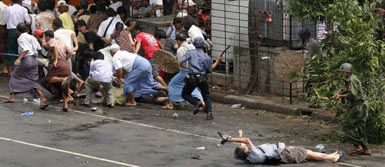
Yes, we have got used to nasty regimes, and to states sucking up to their psychopathic gangster leaders, but there are limits, surely?
Why is the British Prime Minister grovelling to India (and by the way grossly insulting Pakistan at the same time) when India is laying out the red carpet for the Burmese murderer?
I don’t think “murderer” is too strong a word. Apart from all the usual and well-documented pogroms against minorities (remind anyone of Hitler?) the Burmese mafia government refused to allow international aid agencies to help after the catastrophic 2008 cyclone, the worst in Burma’s history. This condemned hundreds of thousands of Burmese citizens to heartless, needless suffering and certainly cost many lives.
Well, above I asked “why”?
Of course, it’s for selfish national interest. India wants access to Burma’s natural resources, especially oil, while Britain wants industrial contracts with India. Cynics would say Cameron succeeded; a follow-on deal for India to buy British Hawk trainer fighters has just been announced.
But why am I reminded of Goethe’s “Faust”? Is it really worth selling our soul to the Devil (indirectly condoning India’s sickening sycophancy to the Burmese Fuehrer) for the sake of some British jobs? A confirmative answer would seem to suggest that ethics in foreign policy is well and truly dead.
Once again, a vicious dictatorship flourishes by divide and rule. Where is the united international front that might help to put an end to our fellow-humans’ suffering? We managed this unity to help end South African apartheid; have our moral standards declined so much since then?
PS South Africa? Oh weep …. In January 2007, Russia and China vetoed a draft resolution before the United Nations Security Council calling on the government of Myanmar to respect human rights and begin a democratic transition. South Africa also voted against the resolution.
Still, they put on a good World Cup, so that’s all right then ……
By Chris Snuggs
 Learning from Dogs