There’s that wonderful quote from American comedian, Woody Allen, “What if everything is an illusion and nothing exists? In that case, I definitely overpaid for my carpet.”
But that quote may not be as silly as it first appears if I made sense of a programme that we watched recently. That was a documentary broadcast by the BBC under their fabulous science series known as Horizon. As an aside, the range of programmes covered over the years under the Horizon banner is fantastic as this web page from March 2008 demonstrates. An in-depth history of this BBC series is available on WikiPedia and the ‘Home’ page of the current Horizon website is here.
Anyway, back to this particular programme, What is Reality? Rather than me natter on about a subject that I don’t understand, despite being captivated by it, let me allow you to watch the programme courtesy of YouTube! Here is the first half of the programme split into two YouTube videos; the last half will be posted tomorrow.
Do yourself a favour and settle down to watch them undisturbed – as the programme says you may never look at the world around you in quite the same way again!
It started when someone we know in Payson, Peter N, posted an item on Facebook about dogs being able to smell out cancer. The Facebook item referred to an article in Natural News. That item here went as follows:
(NaturalNews) The mainstream media is suddenly reporting on the idea that dogs can sniff out cancer in human beings. This concept is no surprise to NaturalNews readers, of course, as we’ve talked about this before, but until now the idea that cancer patients could be detected by smelling them was considered pure quackery by conventional doctors.
Of course, conventional doctors are once again wrong:Cancer patients do have a particular smelldue to the metabolic off-gassing of cancer cell tumors. But here’s the real story the mainstream media isn’t telling you: It’s not just dogs that can smell cancer — manyhealth practitionerscan also smell cancer patients.
I’ve personally spoken to numerous natural health practitioners who say they can smell cancer in patients. It’s not really a difficult thing to do, it turns out. With a bit of training, I believe most doctors could even be trained to do it, much like this dog in Japan which correctly identified cancer from stool samples 37 out of 38 times.
It doesn’t mean doctors have to sniff patients’ poo, either: You can also smell cancer on someone’s breath, so just talking to a patient can give a doctor an opportunity to do that. (Historically, by the way, physicians use to taste patients’ urine, from which they could diagnose a number of diseases, especially diabetes.)
This particular research on dogs’ ability to sniff out cancer was conducted by researchers at the Kyushu University in Japan. Dr Hideto Sonoda, who conducted the research, told the BBC, “The specific cancer scent indeed exists, but the chemical compounds are not clear. Only the dog knows the true answer.”
An important point in all this is thatthe cancer-sniffing dogs were able to detect early-stage bowel cancer— something that is extremely difficult for modern medical technology to detect. And it only takes a dog a few seconds — at virtually zero cost — to make the assessment.
Now, of course, medical scientists are busy trying to build an electronic device to replace the dog, because conventional medicine can’t stand the fact that something built by nature (the dog’s nose) might be better than some million-dollar electronic gizmo they come up with that can be billed out at $500 a test. So rather than just using dogs who can already detect cancer right now, they’re going to wait around a few years and try to create some high-tech equipment that will probably be a poor replacement for the dog.
That’s how modern medicine works: It steals good ideas from nature and replicates them, but the results are almost always a poor imitation of what Mother Nature has provided for free. Here’s how the end results would likely stack up:
CANCER-SNIFFING DOG
Accuracy: 98%
Cost: One dog biscuit and a pat on the head
CANCER-SNIFFING HIGH-TECH MACHINE
Accuracy: 60%
Cost: $500 billed to Medicare [the US medical system for those unfamiliar with the term. Ed.]
Gee, which one do you think conventional medicine will end up using?
In fact, a quick web search finds much information on the topic including these YouTube videos.
Now how to get our dogs to tell us ……… we’re OK; assuming we are!
The British Medical Journal published a ground-breaking research reporting how dogs have been trained to detect bladder cancer by its smell in urine, bringing together dogs’ exceptional sense of smell, with the theory that cancer produces chemicals with distinctive odours. (on September 24th, 2004 )
Six dogs, none of which had any prior experience in scent discrimination, were trained over seven months to distinguish between urine samples from bladder cancer patients and those from healthy people and individuals with non-cancerous diseases. For the final tests, each dog was offered a set of seven urine samples, and their task was to determine which of them was from a patient with bladder cancer. All of the samples used in the tests were completely new and unfamiliar to the dogs.
The dogs, comprising three spaniels, one papillon, one Labrador and one mongrel, correctly selected the bladder cancer urine on 22 out of 54 occasions – an average success rate of 41% compared to the 14% which would have been expected if the dogs had randomly selected a sample each time. This was statistically significant.
The research was undertaken by a unique partnership of medical scientists, including a statistician, and dog trainers. An orthopaedic surgeon from Buckinghamshire, Mr John Church, brought together colleagues from the Department of Dermatology, Buckinghamshire Hospitals NHS Trust (funded by the Erasmus Wilson Dermatological Research Fund) to develop and supervise the scientific protocol for the research, and Hearing Dogs for Deaf People (based near Princes Risborough) for the purpose of training the dogs for the trial.
“We were flattered to be asked to assist in this study on the basis of our reputation in the field of training dogs,” Claire Guest, Operations Director at Hearing Dogs said, “although we have been very careful not to let this project affect our normal work which involves training dogs for deaf people. The four of us who trained these cancer detection dogs did so using our own pet dogs, in our own homes, in our own spare time.”
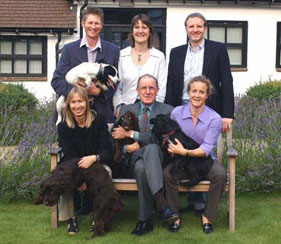
Back row: And Cook, Claire Guest, Martin Church. Front row: Carolyn Willis, John Church, Susannah Church
I rather loved the quote from John Church, “I am a passionate believer that animals have a huge amount to teach us, and I have heard many stories of people who have been alerted to the presence of cancer in their bodies by their pet dogs. I was delighted to find that the two charities were open-minded enough to participate in this study, so that we could really examine this phenomenon scientifically.”
As I keep going on about – we really can learn from dogs!
A fascinating insight and a reminder, courtesy of Alistair Cooke
Jeannie recently gave me the book Alistair Cooke’s America. The book was published in 1973 and was born out of the scripts that Cooke wrote for the television series America: A Personal History of the United States shown in both countries in 1972. I can’t recall when I first started listening to the BBC Radio programme Letter from America, broadcast by Cooke, but it was a long time ago considering that the 15-minute programme started to be broadcast on the BBC in March 1946, just 18 months after I was born!
Alistair Cooke Nov 1908 - Mar 2004
Anyway, the motivation to start into the book was born out of a desire to know a lot more about this new country of mine. But quickly there was a fascinating detour.
Early in Chapter One, The New-found Land, Cooke writes of the consequences of the Turks capturing Constantinople:
In 1453, there was a decisive turn in the centuries of warfare between the Christians of Europe and the Moslems of Asia. Their common market, bridge, and gateway was Constantinople, our Istanbul. In 1453, the Turks conquered it, and in so doing shut off the commerce between East and West, the exchange of cloth, leather wines and sword blades of Europe for the silks, jewels, chessmen, and spices of Asia. All things considered, the stoppage was much harder on the court treasuries of Europe that those of Asia and, in one vital item, harder on all Europeans. That item was spice.
Cooke then writes about historic change often being caused by the denial of a simple human need. Shortage of water, total absence of timber for the Egyptians since the time of Solomon, for example.
What I hadn’t realised that for Europeans, spices were regarded as “fundamental to human survival”. That was simply because in the 15th century spices made food edible. Cooke writes,
Even in rich houses, the meals came putrid to the table. (Dysentery, by the way, seems to have been considered through most of the last five centuries a hazard as normal as wind and rain.)
Think about that the next time you reach for the pepper!
That led me to think about the enormous benefit that electricity and therefore domestic refrigeration has had on the health and life expectancies of mankind. It is almost inconceivable to imagine the consequences of a widespread loss of electricity for, say a week, let alone a few months.
Patrice Ayme wrote a guest post for Learning from Dogs that was published on the 26th. In it he wrote,
But then, after an auspicious start, Mars lost most of most of its atmosphere (probably within a billion years or so). Why? Mars is a bit small, its gravitational attraction is weaker than Earth (it’s only 40%). But, mostly, Mars has not enough a magnetic field. During Coronal Mass Ejections, CMEs, the Sun can throw out billions of tons of material at speeds up to and above 3200 kilometers per seconds. It’s mostly electrons and protons, but helium, oxygen and even iron can be in the mix.
The worst CME known happened during the Nineteenth Century, before the rise of the electromagnetic civilization we presently enjoy. Should one such ejection reoccur now, the electromagnetic aspect of our civilization would be wiped out.It goes without saying that we are totally unprepared, and would be very surprised. Among other things, all transformers would blow up, and they take months to rebuild. we would be left with old books in paper, the old fashion way. A CME can rush to Earth in just one day. (Fortunately the Sun seems to be quieting down presently, a bit as it did during the Little Ice Age.)
So let’s just hope and pray that our continued interest in spices remains a flavouring desire and doesn’t return as a critical need for human survival.
This makes fascinating listening and thinking. I am referring to the BBC4 programme, Eureka Moment, first broadcast in March 2010.
Lovelock
Some frightening stuff to reflect on, however, he is a tremendously positive person. His level of thinking and orginality is breath taking. Painful and not pleasant, but a snapshot of a possible outcome.
Interesting from a David Hawkins point of view to measure his level of integrity on the scale of human consciousness that Hawkins developed.
I’m delighted to see that the BBC still has a huge amount available about Lovelock’s claims. A small extract from here.
The man who achieved global fame for his theory that the whole earth is a single organism now believes that we can only hope that the earth will take care of itself in the face of completely unpredictable climate change.
Interviewed by Today presenter John Humphrys, videos of which you can see below, he said that while the earth’s future was utterly uncertain, mankind was not aware it had “pulled the trigger” on global warming as it built its civilizations.
Here’s a video, taken quite recently, of the Professor explaining his approach to his science.
But whatever, don’t lose heart. Keep the faith in a better future, as Paul wrote yesterday.
Well the first thing that raised a smile was me putting in the word ‘happiness’ into a Google search and noticing the response – About 50,000,000 results (0.15 seconds)!
50 million results – wow.
Let me tell you that I don’t propose to cast myself as anything other than an ordinary Joe. The simple motivation behind this Post is that if a single person reading these words gets some insight into seeing their own lives in a richer way, then it’s worth while.
Let’s come at the subject from the perspective of good mental health. What’s that then?
Here’s an extract from MIND – the leading mental health charity in the UK.
Good mental health isn’t something you have, but something you do. To be mentally healthy you must value and accept yourself. This means that:
You care about yourself and you care for yourself. You love yourself, not hate yourself. You look after your physical health – eat well, sleep well, exercise and enjoy yourself.
You see yourself as being a valuable person in your own right. You don’t have to earn the right to exist. You exist, so you have the right to exist.
You judge yourself on reasonable standards. You don’t set yourself impossible goals, such as ‘I have to be perfect in everything I do’, and then punish yourself when you don’t reach those goals.
If you don’t value and accept yourself, you are always frightened that other people will reject you. To prevent people seeing how unacceptable you are, you keep them at a distance, and so you are always frightened and lonely. If you value yourself, you don’t expect people to reject you. You aren’t frightened of other people. You can be open, and so you enjoy good relationships.
If you value and accept yourself, you are able to relax and enjoy yourself, without feeling guilty. When you face a crisis, you know that, no matter how difficult the situation is, you will manage. How we see ourselves is central to every decision we make. People who value and accept themselves cope with life.
The BBC, often so good at important public service issues, ran a series of programmes in 2008 under the banner of The Happiness Formula. Included in that web link is a simple test to measure one’s own happiness.
Psychologists say it is possible to measure your happiness.
NB: I just tried this test myself and wasn’t sure if the analysis part of the test was working – try it yourself. But the information offered is still well worth reading.
There’s more background on Prof. Diener here. And a short video below.
Perhaps more valuable is another excellent TEDtalks video Habits of Happiness.
Your task is not to seek for love, but merely to seek and find all the barriers within yourself that you have built against it.Jala ad-Din Rumi 1207 – 1273
One would suspect that readers of this Post title would have many different responses to the word ‘love’. Perhaps in this harsh, economically challenged world, it seems a little quaint to think about love in anything other than a romantic sense.
But, trust me, there’s nothing quaint or ‘away with the fairies’ about reminding us all of both the power of love and the urgent need to bring that power further up the scale of human consciousness. Let’s even try and aim for where dogs are. Dogs intuitively demonstrate unconditional love to those around them that they trust.
Dog love!
Before we look at the effects of love, let’s remind ourselves of some of the outcomes from the stress and trauma generated by present times. A news item from the London School of Hygiene and Tropical Medicine published in July, 2009, said this:
Researchers at London School of Hygiene & Tropical Medicine and Oxford University estimated that soaring stress brought on by job losses could prompt a 2.4% rise in suicide rates in people under-64 years of age, a 2.7% rise in heart attack deaths in men between 30 and 44 years, and a 2.4% rise in homicides rates, corresponding to thousands of deaths in European Union countries, such as the UK.
Nor is the impact just economic. The sudden flipping from the wild optimism of the boom to the personal gloom and self-doubt of recession and system-wide financial crisis is bad for health and well-being.
So it appears as if there’s no shortage of reasons why engaging the power of love offers infinite possibilities for us all.
The BBC recently reported on research that shows that people in love can lower their levels of pain.
Love hurts, at least according to many a romantic songwriter, but it may also help ease pain, US scientists suggest.
Brain scans suggest many of the areas normally involved in pain response are also activated by amorous thoughts.
Stanford University researchers gave 15 students mild doses of pain, while checking if they were distracted by gazing at photos of their beloved.
He said: “One example is a footballer who has suffered quite a painful injury, but who is able to continue playing because of his emotionally charged state.”
He added that while the effect noticed by the Stanford researchers might only be short-lived in the early stages of a love affair, it may well be replaced by something similar later in a relationship, with a sense of comfort and wellbeing generating the release of endorphins.
“It’s important to recognise that people who feel alone and depressed may have very low pain thresholds, whereas the reverse can be true for people who feel secure and cared for.
Prof Gilbert states on his web page that “After years of exploring the processes underpinning shame and its role in a variety of psychopathologies,
Prof. Gilbert
my current research is exploring the neurophysiology and therapeutic effectiveness of compassion focused therapy.” (My italics.)
The old adage that you can’t love another if you don’t love yourself is based on very high levels of awareness. So the starting point to gaining the power of love is self-awareness. Here’s something from MIND:
Good mental health isn’t something you have, but something you do. To be mentally healthy you must value and accept yourself. This means that:
You care about yourself and you care for yourself. You love yourself, not hate yourself. You look after your physical health – eat well, sleep well, exercise and enjoy yourself.
You see yourself as being a valuable person in your own right. You don’t have to earn the right to exist. You exist, so you have the right to exist.
You judge yourself on reasonable standards. You don’t set yourself impossible goals, such as ‘I have to be perfect in everything I do’, and then punish yourself when you don’t reach those goals.
Finally, back to romantic love. The most glorious feeling in the world.
Again expressed so beautifully by Rumi: “The minute I heard my first love story I started looking for you, not knowing how blind that was. Lovers don’t finally meet somewhere. They’re in each other all along.”
Work to line the top of an escape shaft with metal tubing is expected to finish in the next few hours at the mine where 33 men are trapped in northern Chile.
A winch and pulley will be installed and the shaft tested before the rescue begins, it is hoped, on Wednesday.
Amid the final preparations for the rescue the Chilean health minister said some of the miners were gallantly insisting they should be last to leave.
And some wonderful pictures on the BBC website here.
I’m sure the vast majority of Learning from Dogs readers will be on top of the news that is spreading around the globe reporting that the Chilean miners have been reached. Here’s the BBC:
Rescuers have drilled through to the underground chamber where 33 Chilean miners have been trapped since August.
The breakthrough at the San Jose mine came shortly after 0800 local time (1200 GMT).
It means efforts to remove the miners through the tunnel should begin within days. Tim Willcox was at the mine when the breakthrough happened.
Rescuer workers have broken through to the 33 Chilean miners trapped half a mile underground.
Engineers and relatives of the men began celebrating on Saturday morning after the escape shaft reached the point where the miners have been stuck now for over two months.
Mining minister Laurence Golborne warned though it could take days before attempts start to remove the men from the San Jose mine.
All fabulous news.
Picture from the Daily Mail online.
Contact: Rescue workers broke through to the 33 trapped Chilean miners earlier on Saturday morning
Fascinating research on how dolphins develop ‘speech’
Once again, I am indebted to Yves Smith for posting a link in the edition of Naked Capitalism published on the 1st October that really caught my eye. This follows nicely after my piece a couple of days ago about how the stray dogs in Moscow are learning new ways to survive.
It was a piece on the BBC Earth website about how dolphins attempt to learn the language of other dolphin groups.
The BBC article starts thus:
Just magnificent
When two dolphin species come together, they attempt to find a common language, preliminary research suggests.
Bottlenose and Guyana dolphins, two distantly related species, often come together to socialise in waters off the coast of Costa Rica.
Both species make unique sounds, but when they gather, they change the way they communicate, and begin using an intermediate language.
That raises the possibility the two species are communicating in some way.
Biologist Dr Laura May-Collado of the University of Puerto Rico in San Juan made the discovery studying dolphins swimming in the Gandoca-Manzanillo Wildlife Refuge of the southern Caribbean coast of Costa Rica.
Later the article says:
As yet, Dr May-Collado cannot be sure if both species are changing the way they communicate, or whether it is one species attempting to call more like the other.
That is because her sound equipment could only record the total calls produced by mixed species groups of dolphins, and could not separate out sounds made by individuals.
“This limits how much I can say about how much they are communicating,” says Dr May-Collado.
However, dolphins are known to have an extraordinary ability to change their calls when ‘talking’ to other individuals, or to ensure they are heard over the din of background noise pollution.
So “I wouldn’t be surprised that they can modify their signals to mimic, and even possibly communicate with other species. Particularly when their home ranges force them to interact on a daily basis, which is the case of this study,” she says.


 Learning from Dogs