Tag: BBC

Rivers of ice

or should that be rivers of tears for our planet!

Our beautiful planet

A chance dip into the BBC News website a few days ago allowed me to come across an article about the vanishing glaciers in the Himalayas.  It just about broke my heart.  Here’s what it said,

Rivers of ice: Vanishing glaciers

Stunning images from high in the Himalayas – showing the extent by which many glaciers have shrunk in the past 80 years or so – have gone on display at the Royal Geographical Society in central London.

Between 2007 and 2010, David Breashears retraced the steps of early photographic pioneers such as Major E O Wheeler, George Mallory and Vittorio Sella – to try to re-take their views of breathtaking glacial vistas.

The mountaineer and photographer is the founder of GlacierWorks – a non-profit organisation that uses art, science and adventure to raise public awareness about the consequences of climate change in the Himalayas.

Rivers of Ice: Vanishing Glaciers of the Greater Himalaya can be seen at the RGS in London until 11 November 2011. Admission free.

All photos courtesy GlacierWorks and Royal Geographical Society. Map copyright Jay Hart. All images subject to copyright.

Music courtesy KPM Music. Audio slideshow production by Paul Kerley. Publication date 11 October 2011.

Then follows a 3:59 film made by David Breashears that is so beautiful as well as so upsetting.  I don’t have a way of linking to the film directly but it’s easy to watch, just click here and be very moved.

David Breashears has his own website, from where one can learn that,

David Breashears is an accomplished filmmaker, adventurer, author, mountaineer, and professional speaker. Since 1978, he has combined his skills in climbing and filmmaking to complete more than forty film projects.

In 1983, Breashears transmitted the first live television pictures from the summit of Mount Everest, and in 1985 became the first American to reach the summit of Mount Everest twice.

In the spring of 1996, Breashears co-directed and co-produced the first IMAX film shot on Mount Everest. When the now infamous blizzard of May 10, 1996 hit Mount Everest, killing eight climbers, Expedition Leader Breashears and his team were in the midst of making this historic film. In the tragedy that soon followed, Breashears and his team stopped filming to provide assistance to the stricken climbers. After returning to Base Camp, Breashears and his team then regrouped and reached the summit of the mountain on May 23, 1996, achieving their goal of becoming the first to record IMAX film images at Earth’s highest point. Breashears has said that if there is a lesson to be learned from the May 1996 tragedy, it is that for him, success that year was not to be found in reaching the summit, it was that everyone on his team returned safely. The film, titled EVEREST, premiered in March 1998.

As was written in that BBC item, David is the founder of GlacierWorks which is full of beautiful, albeit tinged with sadness, images of the glaciers featured in that BBC item.  As the GlacierWorks website explains on the home page,

The Mighty Himalayan Glaciers are Vanishing.

The rate of recession is unprecedented, accelerating and, without some remedy to the problem of climate change, unstoppable. GlacierWorks is a non-profit organization that uses art, science, and adventure to raise awareness about the consequences of climate change in the Greater Himalaya.

Read that first sentence again, “The rate of recession is unprecedented, accelerating and, without some remedy to the problem of climate change, unstoppable.” [my emphasis]

There are a number of videos on YouTube if you search for David Breashears, none up to the beauty of the slide show in the BBC item so don’t miss that at all.  However, the following is also worth watching,

OK, a change of topic but one that connects with the underlying message about the disappearing glaciers.  This was an article in the American The Nation newspaper written by Naomi Klein, following her speech to the demonstrators at Occupy Wall Street.  The article really should be read in full but I wanted to highlight just the following words from Naomi,

The point is, today everyone can see that the system is deeply unjust and careening out of control. Unfettered greed has trashed the global economy. And it is trashing the natural world as well. We are overfishing our oceans, polluting our water with fracking and deepwater drilling, turning to the dirtiest forms of energy on the planet, like the Alberta tar sands. And the atmosphere cannot absorb the amount of carbon we are putting into it, creating dangerous warming. The new normal is serial disasters: economic and ecological.

We all know, or at least sense, that the world is upside down: we act as if there is no end to what is actually finite—fossil fuels and the atmospheric space to absorb their emissions. And we act as if there are strict and immovable limits to what is actually bountiful—the financial resources to build the kind of society we need.

The task of our time is to turn this around: to challenge this false scarcity. To insist that we can afford to build a decent, inclusive society—while at the same time, respect the real limits to what the earth can take.

Thanks to Bill Mitchell of Billy Blog for linking me to the Naomi Klein speech.

We can afford to build a decent, inclusive society and we must – not tomorrow but now.  Start with your local community, think about transition.  Some of our grandchildren will be mountaineers – let them see the beautiful rivers of ice.

The soul of a dog, and a soda syphon!

Big, big thanks to Dan G. for sending this to me.

Love dogs?  Love German Shepherd dogs?  Then sit back and love this.

From the BBC programme, That’s Life, filmed in 1986.

Searching for something

Maybe less is more is really at the heart of our thirst for something more

A number of disparate recent experiences seem to have an underlying common thread.

See if these strike you in a similar fashion.

Yesterday, Joelle Jordan wrote about joy, about the wonderful relationship that dogs have with the world around them.  As Joelle wrote,

Joy is a difficult commodity to come by these days. I don’t mean entertainment, I don’t mean a good laugh, I mean pure joy, where, even just for a single moment, all worries and doubts, frustration and anger are lifted as though by Atlas.

Like so many other humans in our world, I often find myself in a constant state of stress. There always seems to be something to worry about, whether it’s money, job fulfilment, the state of my relationships, getting the house cleaned, finding time to get to the market, and more. If given the chance, I know we all could spend nearly all of our waking hours (and some of our sleeping hours, too) worrying about something. We spend so much time on the many things that inevitably work themselves out, and so little time on things that will create a memory and a crystal moment of joy.

My little dog Charlie spends his time in the completely opposite fashion; spending his waking hours seeking joy, and committing less time to things that worry him.

Charlie seems to exist normally in three states of being; content, happy and utterly joyful.

How many of us can echo Charlie’s existance in our own lives?

Then last Sunday, Father D’s sermon spoke about our tendency to develop habitual behaviours and rarely challenge the point of them.

The truth is that we get used to doing things a certain way and keep doing them without ever thinking of what we are doing.  We say things in the liturgy without even thinking of what we are saying.  I’m sure many people utter the words in the Book of Common Prayer without thinking of the theology behind the words, or the relationship between church and state that they express.

Later on,

There was a desire for “something more” but it was hard to put a finger on what it was.  I realized from these conversations that we are involved today in a time of intense searching.  Few of us are satisfied with what the church and society have served up.

The honest among us will readily admit we lead fractured lives – with a disembodied spirituality on one side, and a soulless daily existence on the other.  We are desperate for something more, for a faith with the power to transform both ourselves and our world.

“….  we are involved today in a time of intense searching“!  That smacked me right in the eye!

These are clearly challenging times with mankind facing increasing odds of an ecological disaster of Old Testament proportions, and much of the western world on the cusp of a long and difficult recession.  It is so easy to go on “doing things a certain way and keep doing them without ever thinking of what we are doing” while we wait for the leaders of our societies to fix our problems.

The truth is that we have to be the first to change, to question what we do on a daily basis and amend it if it is not truly healthy for us and for the planet.  As was said in that sermon, “It means bringing forth each day the fruits of the Spirit: Love, joy, patience, kindness, generosity, faithfulness, gentleness and self-control.”

Go back and read yesterday’s Post and reflect on how many of those ‘fruits’ are the ways of dogs.

My final connection with the theme of today’s essay is with a recent series from the BBC called ‘Status Anxiety’.  The programmes are still on YouTube and the first 10 minutes is below,

Status Anxiety discusses the desire of people in many modern societies to “climb the social ladder” and the anxieties that result from a focus on how one is perceived by others. De Botton claims that chronic anxiety about status is an inevitable side effect of any democratic, ostensibly egalitarian society. De Botton lays out the causes of and solutions to status anxiety.

Or if you prefer, all 2 hours 23 minutes may be watched on Top Documentary Films, described thus,

De Botton's book

Why doesn’t money (usually) buy happiness? Alain de Botton breaks new ground for most of us, offering reasons for something our grandparents may well have told us, as children.

It is rare, and pleasing, to see a substantial philosophical argument sustained as well as it is in this documentary. De Botton claims that we are more anxious about our own importance and achievements than our grandparents were. This is status anxiety.

Alain quotes philosophical writings, such as Democracy in America, a report by Alexis de Tocqueville on his visit to the USA in 1831. De Tocqueville noted that American equality, notable in those times, was accompanied by a climate of envy.

We jump to present-day USA, and see what, to de Botton, are some awful examples ofThe American Way. A Christian preaches get rich. A steelworker tells of his insecure life in an industry being closed down through others’ love of money.

Our protagonist points out the advantage of high status: those with high status will enjoy the care and attention of the world. Then joins this advantage with the illusion, orattempt at meritocracy in the USA, mentioning Jefferson’s notion of an aristocracy of talent.

Some of the messages towards the end of the programme are very thought-provoking indeed.  Let me draw this all together.

If you own a dog, or a cat, or any pet, stop a while today and see how their simplicity of life brings them so much more.  Naturally, we can never live life in the same way that our pet does but there are strong metaphors that carry equally strong messages for us.  Less is more.

Now watch the last part of Status Anxiety even if you didn’t watch the first segment above,  Reason?  Watch and it will become clear.


A self-affirmation

For today, I am incharge of my life.

Today, I choose my thoughts.

Today, I choose my attitudes.

Today, I choose my actions and behaviours.

With these, I create my life and my destiny.

Consequences

Acceptance of what has happened is the first step to overcoming the consequences of any misfortune. 

William James, January 11th, 1842 - August 26th, 1910

The above is a quotation attributed to the late American philosopher, William James, comprehensively written about on the Stanford Encyclopaedia of Philosophy.

When drafting this post last Wednesday, I used the quotation and reference to William James to soften, as it were, me reproducing an item on Yves Smith’s fabulous blog, Naked Capitalism.

I did have second thoughts about including the video below and the summary of what was written by Yves.  The second thoughts were around me not wanting Learning from Dogs to stray into sensationalism or hot pop topics.

The reason I did publish this post was that maybe, just maybe, young Mr. Alessio Rastani is saying it how it really is.  How we all have been lulled over the years into believing so much rubbish from so many movers and shakers in the world of power and politics.  Whereas, in truth, most people who stop and reflect on the world we are presently living in, intuitively sense, that something has broken.

The good news that may be interpreted from Mr. Rastani’s predictions is that we are now living through a period of change, the end of an era, and that the opportunity for a better, more caring world is wide open.

Introduced on the Naked Capitalism site, as follows,

This segment on BBC may not go viral, but it seems to be getting traction, based on the e-mails (hat tip readers Paul S and Marcus) and alerts in the comments section.

This is not an entertaining Rick Santelli-style rant, it’s a cool assessment of how the Euromarket crisis is likely to end, which he thinks is very badly. The flummoxed reaction of the BBC host suggests that the trader, Alessio Rastani, was a booking mistake.

But consider his second message: that Goldman and people rule the world and like him don’t care about what happens to the real economy. A depression is just a great investment opportunity if you see it coming and position yourself accordingly. Rastani is the bland, reasonable face of predatory capitalism.

But in the best interests of scepticism and balance, I also reproduce what was published in the UK’s Telegraph newspaper on the 27th September,

11:50PM BST 27 Sep 2011

The soundbites won Mr Rastani instant fame. He became a viral hit and was trending on Twitter. BBC business editor Robert Peston was among the fans. “A must watch if you want to understand the euro crisis and how markets work,” he told his army of 82,000 followers on Twitter on Tuesday.

The interview contained such gems as “Governments don’t rule the world, Goldman Sachs rules the world [and] Goldman Sachs does not care about the rescue package.”

But on Tuesday night the BBC was left facing questions about just how qualified Mr Rastani is to speak about the markets.

In the interview Mr Rastani described himself as an independent trader. Elsewhere he claims he’s an “investment speaker”. Instead of operating from a plush office in Canary Wharf Mr Rastani works and lives with his partner Anita Eader in a £200,000 semi in Bexleyheath, south London. The house, complete with a mortgage from Royal Bank of Scotland, belongs to her not him.

He is a business owner, a 99pc shareholder in public speaking venture Santoro Projects. Its most recent accounts show cash in the bank of £985. After four years trading net assets are £10,048 – in the red.

How a man who has never been authorised by the Financial Services Authority and has no discernible history working for a City institution ended up being interviewed by the BBC remains a mystery.

The incongruity led to some commentators speculating Mr Rastani was a professional hoaxer. The BBC denied the allegation: “We’ve carried out detailed investigations and can’t find any evidence to suggest that the interview with Alessio Rastani was a hoax.”

However, the BBC declined to comment on what checks, if any, it had done prior to the interview.

Mr Rastani was a little more forthcoming.

“They approached me,” he told The Telegraph. “I’m an attention seeker. That is the main reason I speak. That is the reason I agreed to go on the BBC. Trading is a like a hobby. It is not a business. I am a talker. I talk a lot. I love the whole idea of public speaking.”

So he’s more of a talker than a trader. A man who doesn’t own the house he lives in, but can sum up the financial crisis in just three minutes – a knack that escapes many financial commentators.

“I agreed to go on because I’m attention seeker,” he said on Tuesday. “But I meant every word I said.”

We shall see.


The only certainty is uncertainty.

The fascinating aspects of chaos.

I must immediately volunteer the fact that the thrust of this article is the result of a programme that we watched last Thursday night.  It was a programme originally featured on the UK BBC 4 channel in 2008.  Called High Anxieties, The Mathematics of Chaos, it is a fascinating examination into the way that mathematicians have fundamentally adjusted their views, from the certainty of Newtonian principles to the certain uncertainty offered by mathematicians such as Henri Poincare and Alexander Lyapunov.  The 60-minute documentary, directed by David Malone, is wonderfully interesting and much more relevant to the uncertainty surrounding all our lives than one might anticipate from any references to mathematicians!  It puts the collapse of Lehman Brothers, some 2 years ago, last Thursday, into an interesting perspective.

Here’s the first 9 minutes as offered on YouTube, introduced thus,

David Malone http://golemxiv-credo.blogspot.com author of The Debt Generation, directs and presents this film, It is the first part of a documentary first shown on BBC4 Television in the UK in September 2008. The film was first broadcast 2 days after the collapse of Lehman brothers at the start of the financial crisis. It looks at the discoveries in mathematics during the 20th Century which have challenged the view that the world is an essentially knowable and therefore controllable place. The film focuses on the economy and the environment and suggests that ideas about unpredictability, the butterfly effect and tipping points, stemming from mathematics, are part of what underlie some modern anxieties about the world we live in.

If this first part grabs your attention then finding the other 8 parts is easy on YouTube.  Alternatively, the complete set of videos is linked together as one film on Top Documentary Films, click  High Anxieties: The Mathematics of Chaos. where it is described as follows,

The documentary looks at the modern advances in mathematics and how they affect our understanding of physics, economics, environmental issues and human psychology.

The film looks at how developments in 20th Century mathematics have affected our view of the world, and particularly how the financial economy and earth’s environment are now seen as inherently unpredictable.

The film looks at the influence the work of Henri Poincare and Alexander Lyapunov had on later developments in mathematics. It includes interviews with David Ruelle, about chaos theory and turbulence, the economist Paul Ormerod about the unpredictability of economic systems, and James Lovelock the founder of Gaia theory about climate change and tipping points in the environment.

As we approach tipping points in both the economy and the climate, the film examines the mathematics we have been reluctant to face up to and asks if, even now, we would rather bury our heads in the sand rather than face harsh truths.

Very, very interesting and rather puts the pictures of the Petermann Glacier shown here into context.

Not good if detached.

The power of real words

Yesterday, I published a soft little item showing some reflective pictures and rather appropriate words of attachment.  Little did I know that some very powerful word forces were planning same day to really thump me around the head.  Here’s what happened.

The church that Jean and I go to on a regular basis is very inspiring.  Two reasons come to mind.  The first is the love and friendship that the congregation offer, both to regulars and visitors alike.  The second is the spiritual inspiration gifted to the priest and, boy oh boy, does that come out through his sermons.  Indeed, the rest of this article was motivated by yesterday’s sermon.

Take a look at the American railway ticket above.  Turn your head and look at the right-hand part.  What do you read?  ‘This check is not good if detached‘.  Now let me quote a little from the sermon,

It is difficult to care for people in the world when we are not a caring community.  It is totally absurd to speak of peace in a world when we do not have peace in our community.  It is impossible to be an instrument of love in the world if we are not a community of love.

What is true in the Church is of course true in the world as a whole.  We do need to learn to live together.  Railway tickets used to carry the words, “Not good if detached.”  That is true of life in general.  Our survival and progress as people on this planet are dependent on our interrelatedness.

See the beautiful spiritual inspiration that comes from those gifted to draw such powerful word pictures.  Take that last word ‘interrelatedness’.  Jean and I are studying at the local college for a Master Gardener’s Certificate.  For the simple reason that we have to find a way to tame our wild garden, comprised mainly of decomposed granite granules, so that we can grown our own vegetables, have some chickens, that sort of thing.

The last session was about botany.  To a complete non-gardener like me it was, nonetheless, fascinating.  What moved me beyond measure was the detail and complexity of all things botanical; grasses, trees, shrubs, flowering plants, you name it.  It was the interconnectedness of it all.  Here’s an example.

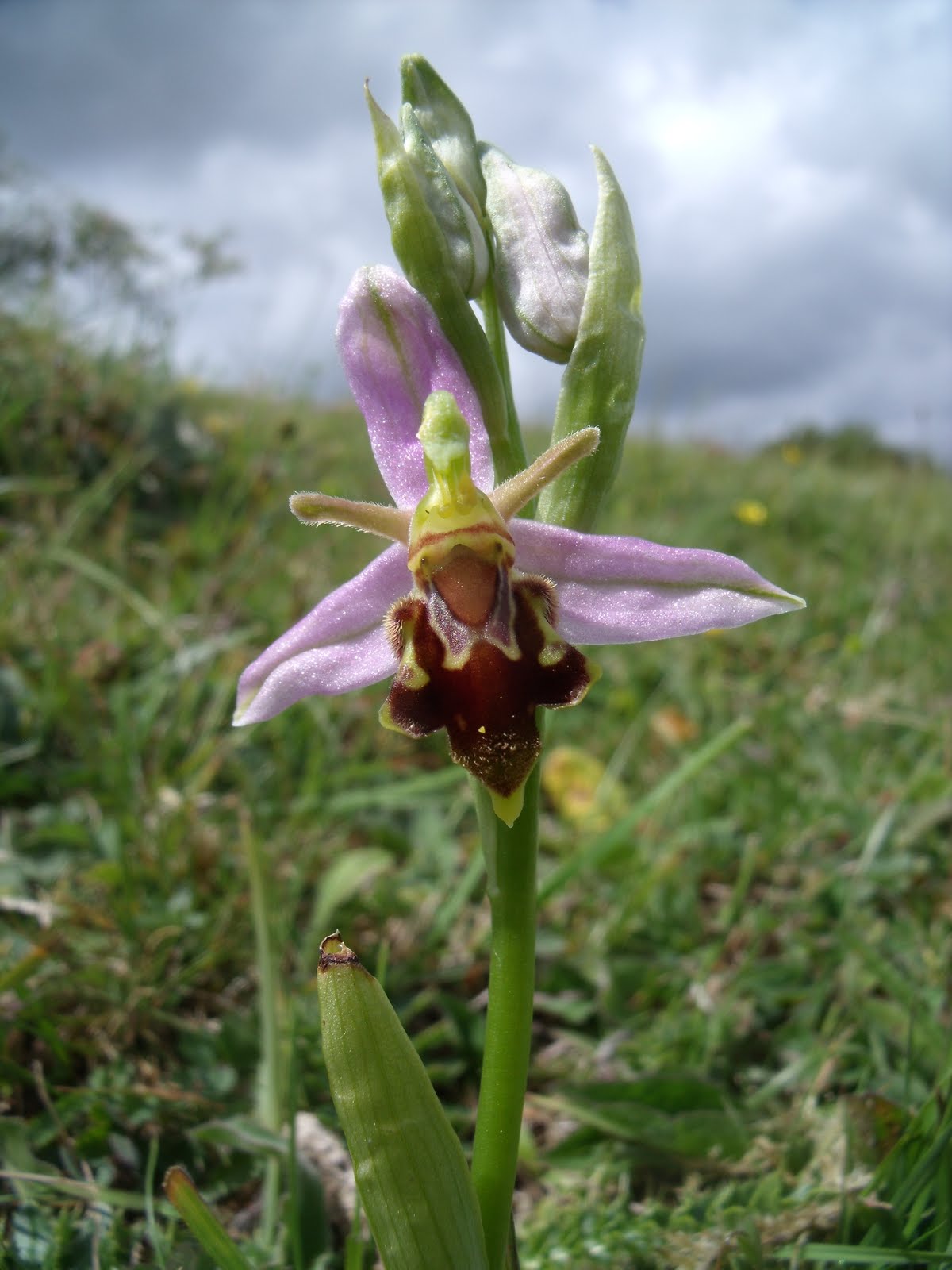
Not a female wasp, just an orchid.

Certain orchids dupe male wasps into trying to mate with them.  Here are a few extracts from a piece in the New Scientist website,

Few can resist the allure of a beautiful rose, but some wasps outdo even the most ardent flower lover. Presented with the right specimen, a male orchid dupe wasp ejaculates right on the petals.

Many insects mistake flowers for femmes, but few go as far as these wasps, says Anne Gaskett, a biologist at Macquarie University in Sydney, Australia, who led a study of the insects’ amorous intentions toward two species of Australian tongue orchids. “It’s just so hard [for the wasps] to resist,” she says.

——

Orchids are known for toying with males. Many species produce female-mimicking perfumes that lure males into spreading pollen. But most insects merely touch down on the flowers.

——

But why might an orchid provoke such misdirected affection? Gaskett thinks that her experiments show an extreme form of sexual deception that helps the flowers spread their own seed.

Think about that the next time you order flowers!

Now have a quick watch of this video extract from the BBC,

OK, let me get back to that botany class.  As our teacher pointed out, lose that particular species of wasp and the planet probably loses that species of orchid.  Think about the interconnectedness of that, and much more in the beautiful planet all around us.  It is such a marvellous, beautiful, complex and interconnected world.  We need constant reminding of that fact.  Which is where yesterday’s sermon hit the mark again.

Inspired by the pictures from a flight to the moon in 1968, American poet Archibald MacLeish spoke these beautiful words:

To see the earth as it truly is, small, blue, beautiful in the eternal silence where it floats, is to see ourselves as riders on the earth together …

That is a wonderful image, riders on the earth together.  It speaks of our togetherness as a human race, brothers and sisters on this fragile island within the vastness of the universe.  Brothers and sisters … that really need to know … that we are brothers and sisters.

We need to do all that we can to build bridges, to mend bridges, to stay together as a true community… because we are:

Not good if detached.  Amen.

What a powerful sermon.  What inspired power in those words.  Real words.

Earthrise, from Apollo 8, 1968

Forgive me for holding your attention just a tad longer.  This is the full Archibald MacLeish’s quotation, referred to in the sermon above.

To see the earth as it truly is, small and blue and beautiful in that eternal silence where it floats, is to see ourselves as riders on the earth together, brothers on that bright loveliness in the eternal cold—brothers who know now they are truly brothers.

Archibald MacLeish, American poet, ‘Riders on earth together, Brothers in eternal cold,’ front page of the New York Times, Christmas Day, 25 December 1968

This is what Frank Borman, who was on Apollo 8, had published in Newsweek, 23 December 1968,

When you’re finally up at the moon looking back on earth, all those differences and nationalistic traits are pretty well going to blend, and you’re going to get a concept that maybe this really is one world and why the hell can’t we learn to live together like decent people.

This is what Frank Borman was reported as saying in the press in early 1969,

I think the one overwhelming emotion that we had was when we saw the earth rising in the distance over the lunar landscape . . . . It makes us realize that we all do exist on one small globe. For from 230,000 miles away it really is a small planet.

and this,

The view of the Earth from the Moon fascinated me—a small disk, 240,000 miles away. It was hard to think that that little thing held so many problems, so many frustrations. Raging nationalistic interests, famines, wars, pestilence don’t show from that distance.

The power in those words. The power of the truth about our interconnectedness and the power of Not good if detached.

Let me leave you with a fragment from another Blogsite that I came across quite by chance while researching for this piece.

A blog is a voice, the inner voice, telling, in this case, what is going on, inside and out. And in me, that means it should also be about my spiritual path. My spiritual life is as important to me as breathing. Without connection with the One, what is life? What is it for?

Not good if detached.  Amen.

Amen indeed.

The beauty of service dogs

A recent item on the BBC website provides a welcome reminder of the power of the relationship between dogs and mankind.

Practically no-one is unaware of the role that dogs provide, for example, as guides for humans with sight impairment.  But there’s much more to the ‘service’ dog than that.

A service dog might be described as,

“any guide dog, signal dog, or other animal individually trained to do work or perform tasks for the benefit of an individual with a disability, including, but not limited to, guiding individuals with impaired vision, alerting individuals with impaired hearing to intruders or sounds, providing minimal protection or rescue work, pulling a wheelchair, or fetching dropped items.”

That definition is taken from the United States Code of Federal Regulations for the Americans with Disabilities Act of 1990!

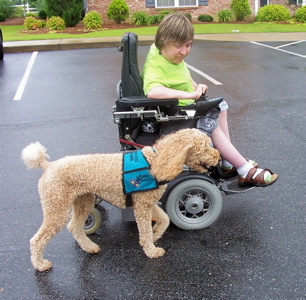
Carrie and Lilly

But then cast your eye over this, as I mentioned, from the BBC on the 26th May, 2011.

Dogs can help reduce stress in parents of children with lifelong developmental disability autism, a study suggests.

The University of Lincoln compared 20 families with dogs with 20 without.

Daniel Mills told a Royal Society of Medicine conference early results suggested any breed could improve communication and relationships.

The veterinary behavioural medicine professor hopes to use video footage to show how dogs can improve child eating, sleeping and tantrum behaviour.

At a three-day Parents’ Autism Workshops and Support course, the families listed more than a thousand ways their dog had helped – from developing language and establishing a routine to using the pet to request action in a non-confrontational way.

Full story is here in which is included Professor Mills saying: “While there is no shortage of opinion on how dogs can help, there has been little money given to scientifically look into this.”

Autism is a challenging condition and anything that can establish a scientific underpinning for the role that dogs can have is to be welcomed whole-heartedly.

Finally, there are quite a few videos online that provide more information about the special, almost magical relationship between dogs and autistic people.  Here’s one that is the first part of a series of five.

More love in many forms.

A fascinating and beautiful insight into wild turkeys!

Yesterday, I published a couple of stories that demonstrated that close, loving bonds can form between different species, including an orang-utan and a dog, and a duck and a man.

By chance, Jean and I came across another example of cross-species bonding.  This time between Joe Hutto, an American living in Florida, and a brood (is that the right description?) of newly-born wild turkeys.  The first thing these tiny birds saw when they opened their eyes after breaking clear of their egg was Joe, and they immediately imprinted him as their ‘mother’.

Joe spent a complete year and more being ‘mother’ to these birds right up to the point where they naturally flew the nest, so to speak.  Joe’s experiences led to a book, Illumination in the Flatwoods, and from that to a BBC Natural World special My Life as a Turkey, regrettably not available to viewers outside the UK.

But speaking to someone who did watch the BBC film, it was clear that it was a most beautiful and touching account of how young wild turkeys can bond to a human.  Here’s part of the programme review in the British Guardian newspaper,

By Sam Wollaston, Guardian.co.uk

Joe Hutto’s life changed when a local farmer in the Florida flatlands where he lives left a stainless steel dog bowl full of wild turkey eggs on the porch of his cabin. Joe put them in an incubator, and waited. Some weeks later, cracks began to appear. This is the crucial time: “imprinting” only occurs in the first few moments after hatching. So Joe put his face down to the level of the opening eggs and the first poult emerged, wet and confused. Joe made a chirping, clucky noise, the poult looked him square in the eye, “and something very unambiguous happened in that moment”.

The little turkey stumbled and crawled across to Joe, and huddled up against his face. It recognised Joe as its mother. In the next few hours, Joe became mother to 15 more baby turkeys and remained so for the next 18 months. My Life as a Turkey: Natural World Special (BBC2) tells that story.

Across to the programme details from the BBC2 website (may not be available 26 days after the date of this article),

Biologist Joe Hutto was mother to the strangest family in the world, thirteen endangered wild turkeys that he raised from egg to the day they left home.

For a whole year his turkey children were his only companions as he walked them deep through the Florida Everglades. Suffering all the heartache and joy of any other parent as he tried to bring up his new family, he even learnt to speak their language and began to see the world through turkey eyes. Told as a drama documentary with an actor recreating the remarkable scenes of Joe’s life as a turkey mum.

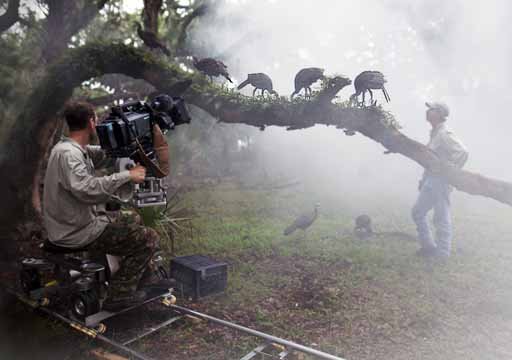
Behind the scenes image of turkeys and Jeff Palmer (actor) in misty forest in Florida. Cameraman (Mark Smith) on track & dolly shows how some of the beautiful sweeping shots were filmed.

Sam Wollaston of the Guardian continues,

It’s not hard to see how the little birds were taken in. Joe’s moustache does look a bit like feathers, he has a long scraggy neck, an understanding of the forest, and a tentative, birdlike walk. He takes them out, to catch their first grasshoppers; he teaches them how to roost. For Joe, as for any mother, parenthood is an emotional rollercoaster ride. There is the joy of seeing his babies grow, but almost constant worry. Grief too, when one is taken by a rat snake, and another by a hawk, and two more get sick (bird flu?) and die.

Adolescence arrives with all its associated problems. The males start fighting; only the toughest will get to mate. “I had no way of knowing how I was going to be part of this rite of passage,” says Joe. Steady now, Joe, let’s not take this too far, you’re not supposed to mate with any of them. For one, they’re your children. They’re also turkeys. That would be doubly wrong. Sometimes I think Joe spends too much time alone in the forest.

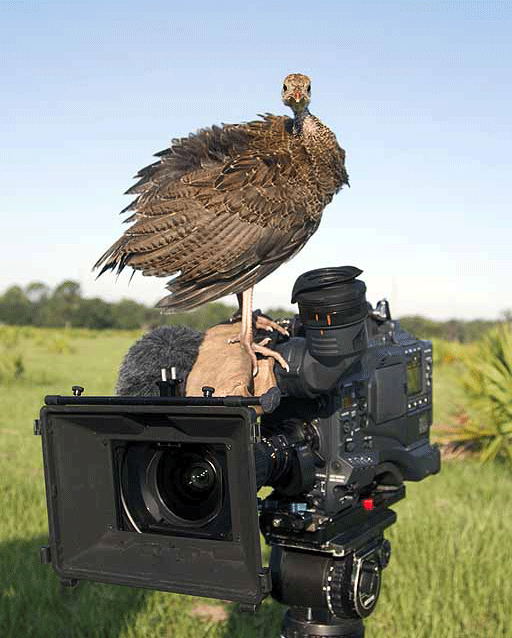
Quite so!  However, the film was so beautifully shot that it was very, very easy to forget that this was a re-enactment of Joe’s original experience.  That love is all about how you make someone, or in these cases, some other creature, feel.  Another couple of pictures from the BBC website,

Lights, camera, action!
Jeff Palmer (actor) sat on large felled tree on his cell phone with a dozen wild turkeys.

One final extract from the Sam Wollaston article in The Guardian newspaper,

My Life as a Turkey isn’t simply a wildlife film though. It’s not just about wild animals, it’s about one man’s relationship with wild animals, and that’s what makes it so fabulous. Serious animal behaviourists may not agree, but if you throw a human being in there, it all suddenly becomes a lot more interesting. I’m thinking Ring of Bright Water, Gorillas in the Mist, I’m definitely thinking Werner Herzog’s brilliant Grizzly Man about a man named Tim whose friendship with bears went wrong and he ended up inside one. My Life as a Turkey has something of Grizzly Man about it – a man obsessed, alone in a beautiful place, living with wild animals. But, although Joe was attacked, he didn’t end up inside one of his turkeys thankfully. There would have been a certain irony to that, especially if it had happened at Thanksgiving.

Anyway, it’s a lovely film – beautiful, charming, funny, sad, thought-provoking even. What thoughts did it provoke in me? That I need to go and see my mum.

Unfortunately, as mentioned above if you are outside the UK you are not able to watch the film via the BBC iPlayer system.  But you can buy the book.

Joe Hutto's book of his life with wild turkeys.

Available from Amazon, here’s just one of the reviews,

My review is not unbiased because Joe Hutto, author of “Illumination in the Flatwoods,” and I have been friends for almost 25 years.

Joe is the most humble man I’ve ever known. I am honored that he brought me the original manuscript to read. It was so beautiful I could have cried.

With the same graceful writing skills used by conservationists Aldo Leopold (“Sand County Almanac”) and Herbert Stoddard (“Memoirs of a Naturalist”), Joe gives a masterful mix of documentary-style nature reporting and heartfelt thoughts on the meaning of life. As dramatic as that sounds, I think most readers will agree that “Illumination in the Flatwoods” is a life-changing book.

You will never regret the dollars you spend to buy this book nor the time it takes you to read it. . .

Kathy McCord Cooley

“Love is just love, it can never be explained.”

What is freedom? Part Three

The Trap – 3 – We Will Force U 2 Be Free

[Note: Part Two of The Trap is available to watch in my post of the 7th where one can also link back to Part One. Ed.]

This is another brilliant Adam Curtis documentary originally produced for the BBC. It talks about the modern political realities, where the policies came from and the massive failures of those ideals and how they have ended up exactly where they did not want to be. What is discussed in this episode is the alternative idea to freedom that currently exists and traps the western societies in which we live.

And more on consciousness!

Two recent videos highlight the mystery and fascination of determining what, exactly, is consciousness.

Before I get started, it crossed my mind that some readers on Learning from Dogs might struggle finding any link between the the title of the Blog and such esoteric topics as consciousness.  Let me try and explain.  On the home page of this Blog is written,

But 10,000 years of farming the planet’s plant and mineral resources have brought mankind to the edge of extinction, literally as well as metaphorically.

Dogs know better!  Time again for man to learn from dogs!

Here’s a recent comment I made to an article on Naked Capitalism,

In a much broader sense, it feels to me as though we have been partying on the edge of a global volcano for years and years. Greece is surely a metaphor for the craziness of so many countries.

Continuing that broader sense, the period that we are in, from political, economical, societal, environmental and ethical perspectives, seems bust. Good will eventually come out of this transition, of that I have no doubt, but what a fascinating period in which to be alive!

I firmly believe that the period we are presently living through is a transition between the last, say 30 years (in a sense, many more decades than that) and a more aware, sensitive period where mankind embraces a deeper, sustainable, relationship with the planet that is home and life to all of us.  Frankly, there is no choice!

Thus the nature of consciousness, our awareness of self, is a crucial element of the future.  The greater our self-awareness, the greater our self-understanding and from that better self-understanding comes all hope of recognising our attitudes and knowing that it is our attitudes that drive our behaviours.

So here follow two videos.  Settle back and be entranced!

The first is the last episode in a brilliant BBC series broadcast in 2007, probably one of the best TV series on psychology and neuroscience ever produced.  The full series is on Top Documentary Films but the last episode called The Final Mystery is all about consciousness.  Beware you are going to never see the world in quite the same way!

Here it is, The Final Mystery presented by neuroscientist Susan Greenfield.

The second video is from Season Two of the Through the Wormhole series.  It is called Is there Life after Death? and also explores the deeper aspects of consciousness.  As the introduction to the video says,

In the premiere episode of the second season of Through the Wormhole, Morgan Freeman dives deep into this provocative question that has mystified humans since the beginning of time.

Modern physics and neuroscience are venturing into this once hallowed ground, and radically changing our ideas of life after death.

Freeman serves as host to this polarized debate, where scientists and spiritualist attempt to define what is consciousness, while cutting edge quantum mechanics could provide the answer to what happens when we die.

Here’s the film; same health warning applies!  You are going to see the world differently after watching this!

Finally, do you have a dog at home?  If you do, ponder on how their conscious world engages them.  If science can’t explain human consciousness then all we have is our own intuition with regard to animals.  Not sure about you but when one is feeling a little low and a dog comes up and lays a head across you I feel a very strong conscious connection.