“Once you eliminate the impossible, whatever remains, no matter how improbable, must be the truth.” Arthur Conan Doyle.
Ten days ago, I finished reading the book Walking Away from Empire: A Personal Journey. It had been sent to me by the author.
Let me explain how this came about.
A few weeks ago, I published an item under the title of Doggedly seeking the truth. I included the video “The Twin Sides of the Fossil-Fuel Coin: Developing Durable Living Arrangements in Light of Climate Change and Energy Decline.“ That video was a presentation by Prof. Guy McPherson.
Subsequently, during an exchange of emails with Prof. McPherson there was an offer to receive a free copy of his book, Walking Away from Empire: A Personal Journey. Naturally, I accepted.
Having finished reading the book it seemed only fair to write a review.
So far, so good!
I tried to marshal my thoughts for well over a week. Couldn’t get started. Strange, because when immersed in the book the messages were crystal clear.
Why the struggle to embrace Guy McPherson’s messages? Then in a moment of insight I realised that I was struggling to understand why I was struggling!
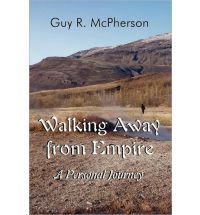
Because the blunt truth of the matter is that this book spells out the bleedin’ obvious. Humanity is between a rock and a hard place!
Look no further than the very first paragraph of the first chapter, Reason,:
At this late juncture in the era of industry, it seems safe to assume we face one of two futures. If we continue to burn fossil fuels, we face imminent environmental collapse. If we cease burning fossil fuels, the industrial economy will collapse. Industrial humans express these futures as a choice between your money or your life, and tell you that, without money, life isn’t worth living. As should be clear by now, industrial humans — or at least our “leaders” — have chosen not door number one (environmental collapse) and not door number two (economic collapse), but both of the above.
Sandy Krolick of Transition Voice wrote a review of Guy McPherson’s book in September, 2011. His last sentence was, “This is a book you will not put down; and having read it, you’ll no longer be able to ignore its conclusions.”
Again, what Sandy Krolick writes is perfectly correct. No argument. Yet …. something about that sentence from Sandy doesn’t speak to me. That struggle again.
Then I got it!
Let me go straight to page 177 of Prof. McPherson’s book and quote this:
It’s no longer just the living planet we should be concerned about. It’s us. The moral question, then: What are you going to do about it?
Then one paragraph later, come this:
There is simply no feeding the hollow spot in my gut and my psyche, as there was when I replaced my invisible, omnipotent friend in the sky with reason. Instead of abandoning the mirage of eternal life, I’m abandoning the mirage of globalization. Instead of giving up an everloving god, I’m giving up a comfortable life spent with my best friend. I’m taking yet another step in the path from make-believe to reality. And, as we all know, reality is a harsh, dispassionate mistress who doesn’t give a damn about the emptiness in my fragile little psyche. Fortunately, I still have the amusing memories of the absurdity of my former life, in which I believed I was saving the world by conducting and publishing mundane research and teaching irrelevant concepts to a largely disinterested audience.
I found the first step to be the most difficult. Simply recognizing the industrial economy as an omnicidal imperial beast forced me to cross a threshold most people find far too formidable to attempt.
Just reflect on those key words, “a threshold most people find far too formidable to attempt.”
Keep those words in mind as I quote the next paragraph from the book.
We’ve never been here as a species, much less as individuals. And every cultural message tells us we’re wrong, that the industrial age will last forever, that justice and goodness will prevail over every enemy (i.e., terrorist), that progress is a one-way street to industrial nirvana, that the harbinger of hope will keep the oil coming and the cars running and the planes flying so we can all soak up the sun on a sandy beach any time we need a break from our tumultuous lives in the cube farms of empire.
This, then, was the result of reading the book. The realisation of the reality of our existence. The immensity of the truth of where mankind is. The here and NOW!
Sorry, let me amend those last sentences. My realisation of the reality of my existence. The immensity of the truth of where I am. My here and NOW!
No wonder I struggled.
So not much of a book review, more a review of yours truly! That is the power of this book. Sandy Krolick was right; “This is a book you will not put down; and having read it, you’ll no longer be able to ignore its conclusions.”
Be warned. When you read this book brace yourself for what you see staring out of the mirror back at you. There will be no room left for delusion.
As Carl Sagan said, “It is far better to grasp the universe as it really is than to persist in delusion, however satisfying and reassuring.“
 Learning from Dogs