(A republication of a post first shown on the 8th August, 2009, still seems pretty relevant)
We live in a world where finance and money play a hugely more important role in our everyday lives than, say, 25 years ago. Well that’s how it seems. Our energy costs don’t seem to be connected to supply and demand but more in the hands of the speculators. Our house values have been greatly influenced, perhaps misaligned is a better word, by the availability of too easy money, resulting from exotic financial leveraging. Commodities are, like energy, traded for their own sake rather than to provide an efficient process of linking the grower with the consumer. And more.
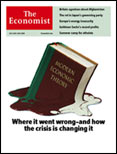
So it comes as a bit of a shock to read in a recent copy of The Economist that most of the theories and economic models are being ‘re-examined’ in the light of the current global crisis. These theories and models are not esoteric ideas kept
The Economist July 18th 2009
within the scholarly walls of universities but used by Governments, investment institutions and banks so they affect you and I in the real world, big time!
They ought to work a great deal better than they do because they have the capability to harm, as millions have found out in the last 2 years.
Anyway, The Economist, July 18th-July 24th has a lengthy briefing: The state of economics, comprised of two articles. To me it makes very sobering reading. Unless you have a subscription there is no web access to the articles so here are a few extracts to give you a flavour. The first article is about turmoil among macro-economists.
In the last of his Lionel Robbins lectures at the LSE on June 10th, Mr Krugman [Paul Krugman of Princeton and the New York Times] feared that most macroeconomics of the past 30 years was “spectacularly useless at best, and positively harmful at worst”.
These internal critics argue that economists missed the origins of the crisis; failed to appreciate its worst symptoms; and cannot now agree about the cure. In other words, economists misread the economy on the way up, misread it on the way down and now mistake the right way out.
Nor can economists now agree on the best way to resolve the crisis. They mostly overestimated the power of routine monetary policy (ie, central-bank purchases of government bills) to restore prosperity. Some now dismiss the power of fiscal policy (ie, government sales of its securities) to do the same.
Towards the end of this first article in the Briefing, there is this:
In the first months of the crisis, macroeconomists reposed great faith in the powers of the Fed and other central banks. In the summer of 2007, a few weeks after the August liquidity crisis began, Frederic Mishkin, a distinguished academic economist and then a governor of the Fed, gave a reassuring talk at the
Frederick Mishkin
Federal Reserve Bank of Kansas City’s annual symposium in Jackson Hole, Wyoming. He presented the results of simulations from the Fed’s FRB/US model. Even if house prices fell by a fifth in the next two years, the slump would knock only 0.25% off GDP, according to his benchmark model, and add only a tenth of a percentage point to the unemployment rate. The reason was that the Fed would respond “aggressively”, by which he meant a cut in the federal funds rate of just one percentage point. He concluded that the central bank had the tools to contain the damage at a “manageable level”.
Since his presentation, the Fed has cut its key rate by five percentage points to a mere 0-0.25%. Its conventional weapons have proved insufficient to the task. This has shaken economists’ faith in monetary policy. Unfortunately, they are also horribly divided about what comes next.
The second article explores the way that the efficient-markets hypothesis has underpinned many of the financial industry models.
IN 1978 Michael Jensen, an American economist, boldly declared that “there is no other proposition in economics which has more solid empirical evidence supporting it than the efficient-markets hypothesis”
Michael Jensen
(EMH).
Eugene Fama, of the University of Chicago, defined its essence: that the price of a financial asset reflects all available information that is relevant to its value.
Eugene Fama
Even as financial engineers were designing all sorts of clever products on the assumption that markets were efficient, academic economists were focusing more on how markets fall short. Even before the 1987 stockmarket crash gave them their first real-world reminder of markets’ capriciousness, some of them were examining the flaws in the theory.
However, a second branch of financial economics is far more sceptical about markets’ inherent rationality. Behavioural economics, which applies the insights of psychology to finance, has boomed in the past decade.
Behavioural economists were among the first to sound the alarm about trouble in the markets. Notably, Robert Shiller of Yale gave an early warning that America’s housing market was dangerously overvalued. This was his second prescient call. In the 1990s his concerns about the bubbliness of the stockmarket had prompted Alan Greenspan, then chairman of the Federal Reserve, to wonder if the heady share prices of the day were the result of investors’ “irrational exuberance”.
One task, also of interest to macroeconomists, is to work out what central bankers should do about bubbles—now that it is plain that they do occur and can cause great damage when they burst.
Another priority is to get a better understanding of systemic risk, which Messrs Scholes [Myron Scholes]
Myron ScholesRichard Thaler
and Thaler [Richard Thaler of the University of Chicago] agree has been seriously underestimated.
Several countries now expect to introduce a systemic-risk regulator. Financial economists may have useful advice to offer.
Financial economists also need better theories of why liquid markets suddenly become illiquid and of how to manage the risk of “moral hazard”—the danger that the existence of government regulation and safety nets encourages market participants to take bigger risks than they might otherwise have done. The sorry consequences of letting Lehman Brothers fail, which was intended to discourage moral hazard, showed that the middle of a crisis is not the time to get tough. But when is?
Mr Lo [Andrew Lo of the Massachusetts Institute of Technology] has a novel idea for future crises: creating a financial equivalent of the National Transport Safety Board, which investigates every civil-aviation crash in America. He would like similar independent, after-the-fact scrutiny of every financial
Andew Lo
failure, to see what caused it and what lessons could be learned. Not the least of the difficulties in the continuing crisis is working out exactly what went wrong and why—and who, including financial economists, should take the blame.
Mr Lo’s idea of treating financial failures in the same way as civil aviation accidents might be a brilliant idea. After all economics is a behavioural science just like the ‘science’ of air traffic controllers and air crew. Seems to me that keeping my money as safe as my body in a civil airliner isn’t a bad goal.
If you can, do get hold of a copy of the briefing, if only to arrive at the same conclusion as me. In terms of future personal financial planning, a pair of dice may be just as accurate as economists.


 Learning from Dogs