We live on a profoundly ancient and beautiful planet.
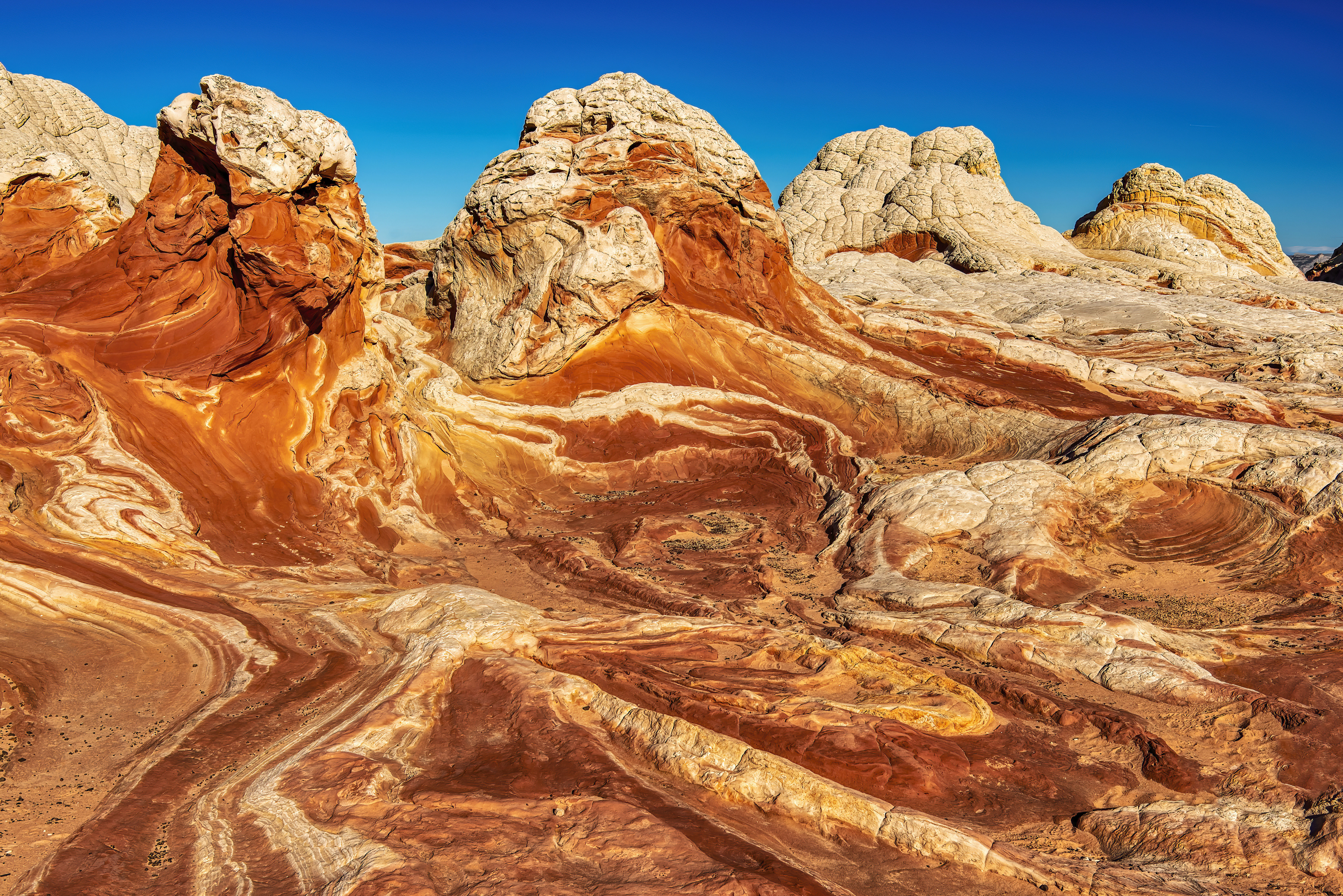
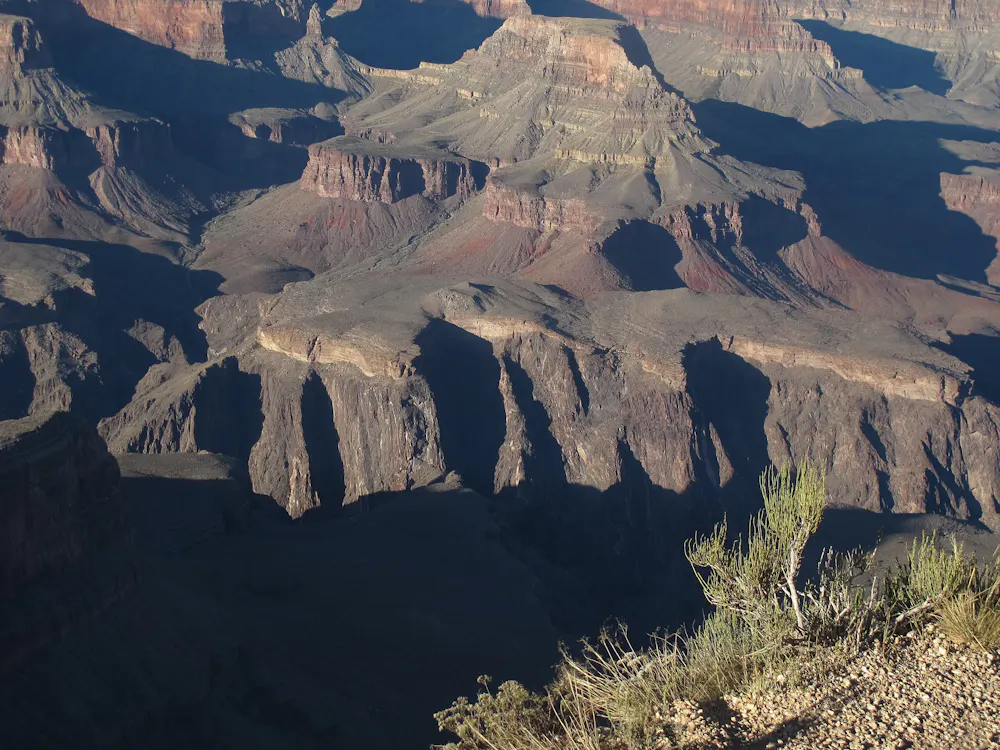
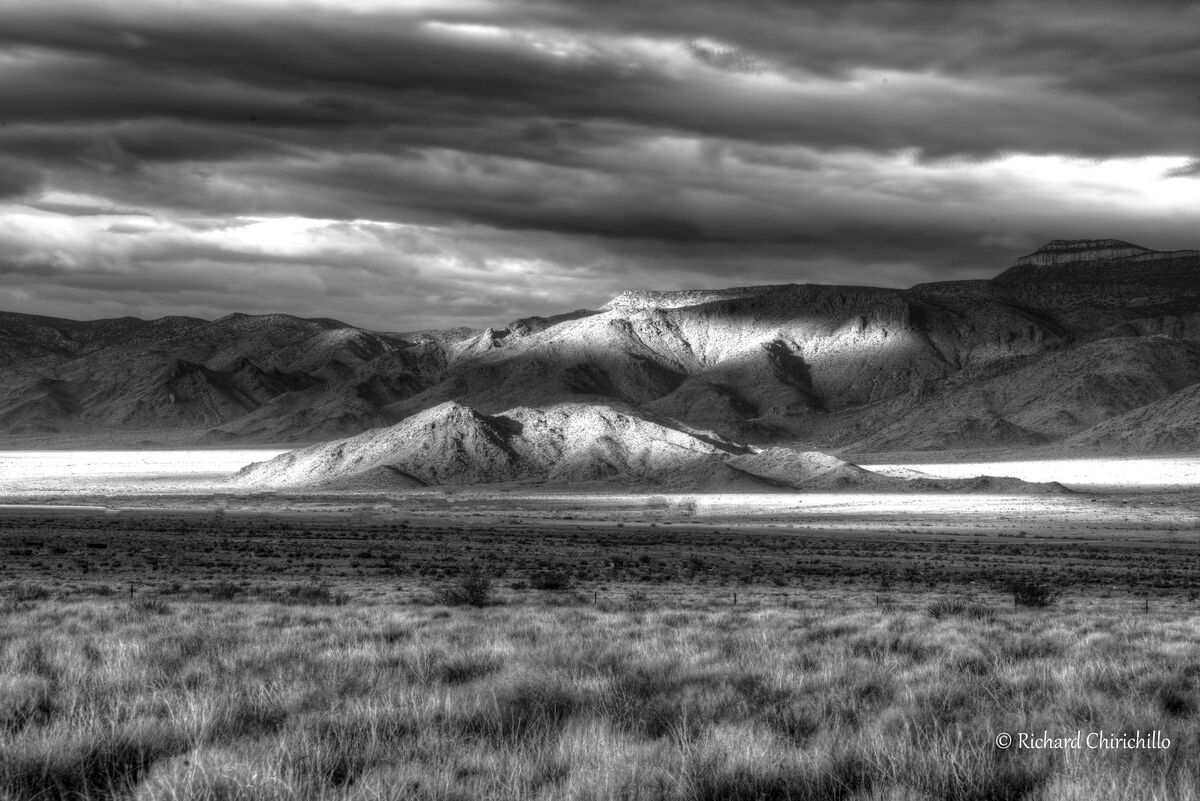
I follow the photographic website Ugly Hedgehog and have been doing for some time. There has been a post recently from the section Photo Gallery and ‘greymule’ from Colorado called his entry ‘A Couple of Desert Scenes’ and I will display just one of his images from that post.
It makes a wonderful connection to today’s post which is from The Conversation.
ooOOoo
Evidence from Snowball Earth found in ancient rocks on Colorado’s Pikes Peak – it’s a missing link
Rocks can hold clues to history dating back hundreds of millions of years. Christine S. Siddoway
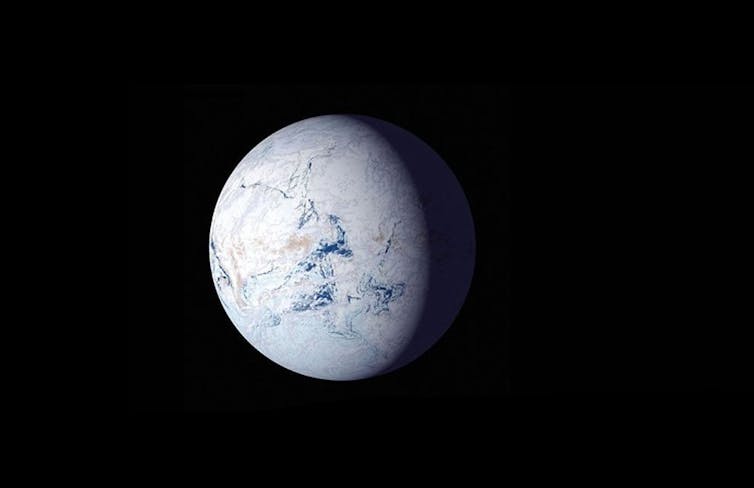
Around 700 million years ago, the Earth cooled so much that scientists believe massive ice sheets encased the entire planet like a giant snowball. This global deep freeze, known as Snowball Earth, endured for tens of millions of years.
The Snowball Earth hypothesis has been largely based on evidence from sedimentary rocks exposed in areas that once were along coastlines and shallow seas, as well as climate modeling. Physical evidence that ice sheets covered the interior of continents in warm equatorial regions had eluded scientists – until now.
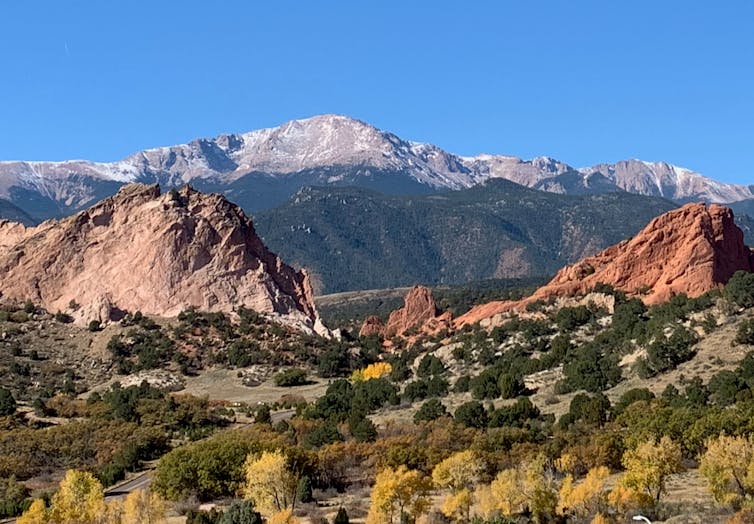
In new research published in the Proceedings of the National Academy of Sciences, our team of geologists describes the missing link, found in an unusual pebbly sandstone encapsulated within the granite that forms Colorado’s Pikes Peak.
Earth iced over during the Cryogenian Period, but life on the planet survived. NASA illustration
Solving a Snowball Earth mystery on a mountain
Pikes Peak, originally named Tavá Kaa-vi by the Ute people, lends its ancestral name, Tava, to these notable rocks. They are composed of solidified sand injectites, which formed in a similar manner to a medical injection when sand-rich fluid was forced into underlying rock.
A possible explanation for what created these enigmatic sandstones is the immense pressure of an overlying Snowball Earth ice sheet forcing sediment mixed with meltwater into weakened rock below.
Dark red to purple bands of Tava sandstone dissect pink and white granite. The Tava is also cross-cut by silvery-gray veins of iron oxide. Liam Courtney-Davies
An obstacle for testing this idea, however, has been the lack of an age for the rocks to reveal when the right geological circumstances existed for sand injection.
We found a way to solve that mystery, using veins of iron found alongside the Tava injectites, near Pikes Peak and elsewhere in Colorado.
A 5-meter-tall, almost vertical Tava dike is evident in this section of Pikes Peak granite. Liam Courtney-Davies
Iron minerals contain very low amounts of naturally occurring radioactive elements, including uranium, which slowly decays to the element lead at a known rate. Recent advancements in laser-based radiometric dating allowed us to measure the ratio of uranium to lead isotopes in the iron oxide mineral hematite to reveal how long ago the individual crystals formed.
The iron veins appear to have formed both before and after the sand was injected into the Colorado bedrock: We found veins of hematite and quartz that both cut through Tava dikes and were crosscut by Tava dikes. That allowed us to figure out an age bracket for the sand injectites, which must have formed between 690 million and 660 million years ago.
So, what happened?
The time frame means these sandstones formed during the Cryogenian Period, from 720 million to 635 million years ago. The name is derived from “cold birth” in ancient Greek and is synonymous with climate upheaval and disruption of life on our planet – including Snowball Earth.
University of Exeter professor Timothy Lenton explains why the Earth was able to freeze over.
The Tava found on Pikes Peak would have formed close to the equator within the heart of an ancient continent named Laurentia, which gradually over time and long tectonic cycles moved into its current northerly position in North America today.
The origin of Tava rocks has been debated for over 125 years, but the new technology allowed us to conclusively link them to the Cryogenian Snowball Earth period for the first time.
The scenario we envision for how the sand injection happened looks something like this:
A giant ice sheet with areas of geothermal heating at its base produced meltwater, which mixed with quartz-rich sediment below. The weight of the ice sheet created immense pressures that forced this sandy fluid into bedrock that had already been weakened over millions of years. Similar to fracking for natural gas or oil today, the pressure cracked the rocks and pushed the sandy meltwater in, eventually creating the injectites we see today.
Clues to another geologic puzzle
Not only do the new findings further cement the global Snowball Earth hypothesis, but the presence of Tava injectites within weak, fractured rocks once overridden by ice sheets provides clues about other geologic phenomena.
Time gaps in the rock record created through erosion and referred to as unconformities can be seen today across the United States, most famously at the Grand Canyon, where in places, over a billion years of time is missing. Unconformities occur when a sustained period of erosion removes and prevents newer layers of rock from forming, leaving an unconformable contact.
Unconformity in the Grand Canyon is evident here where horizontal layers of 500-million-year-old rock sit on top of a mass of 1,800-million-year-old rocks. The unconformity, or ‘time gap,’ demonstrates that years of history are missing. Mike Norton via Wikimedia, CC BY-SA
Our results support that a Great Unconformity near Pikes Peak must have been formed prior to Cryogenian Snowball Earth. That’s at odds with hypotheses that attribute the formation of the Great Unconformity to large-scale erosion by Snowball Earth ice sheets themselves.
We hope the secrets of these elusive Cryogenian rocks in Colorado will lead to the discovery of further terrestrial records of Snowball Earth. Such findings can help develop a clearer picture of our planet during climate extremes and the processes that led to the habitable planet we live on today.
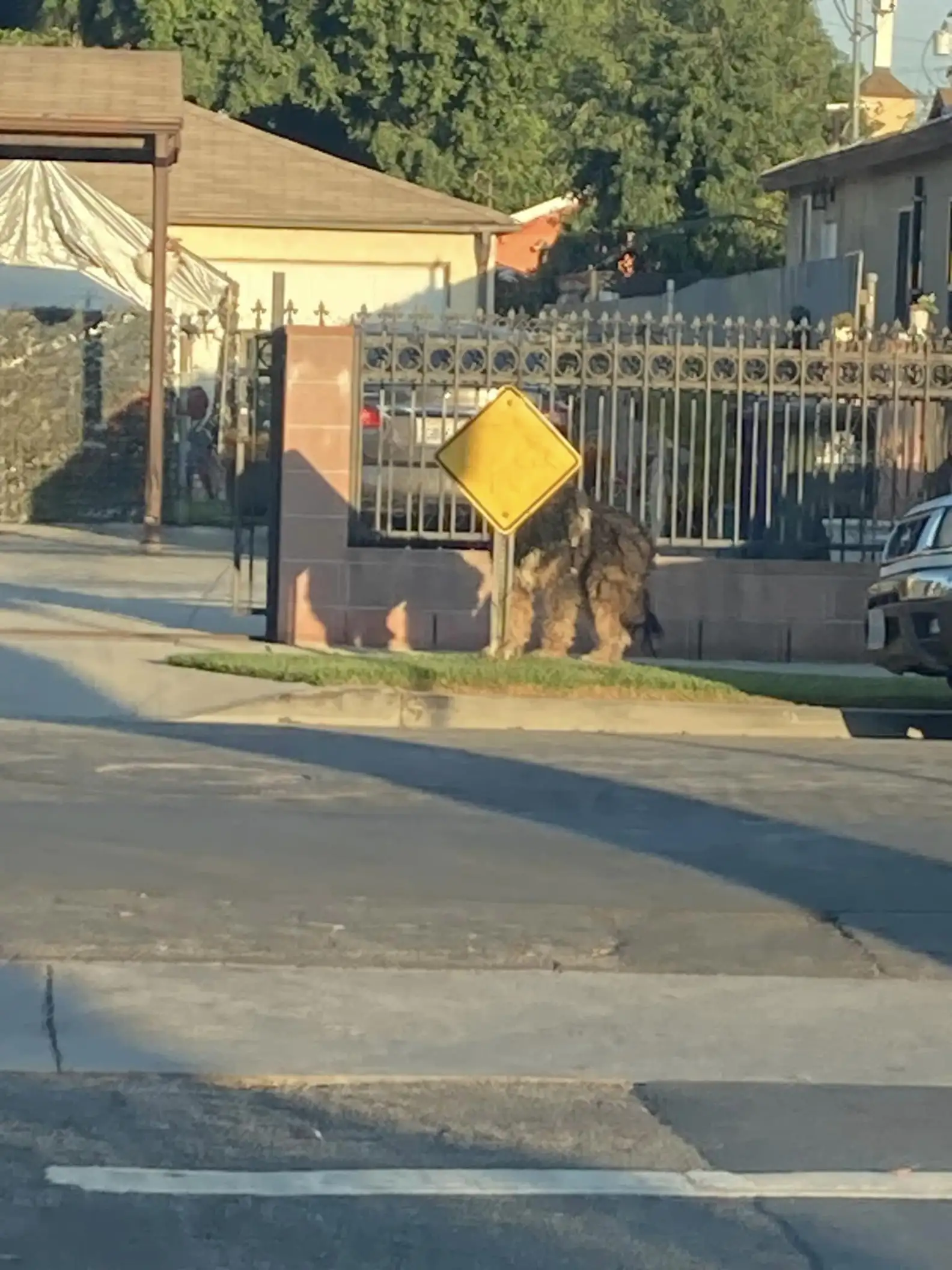
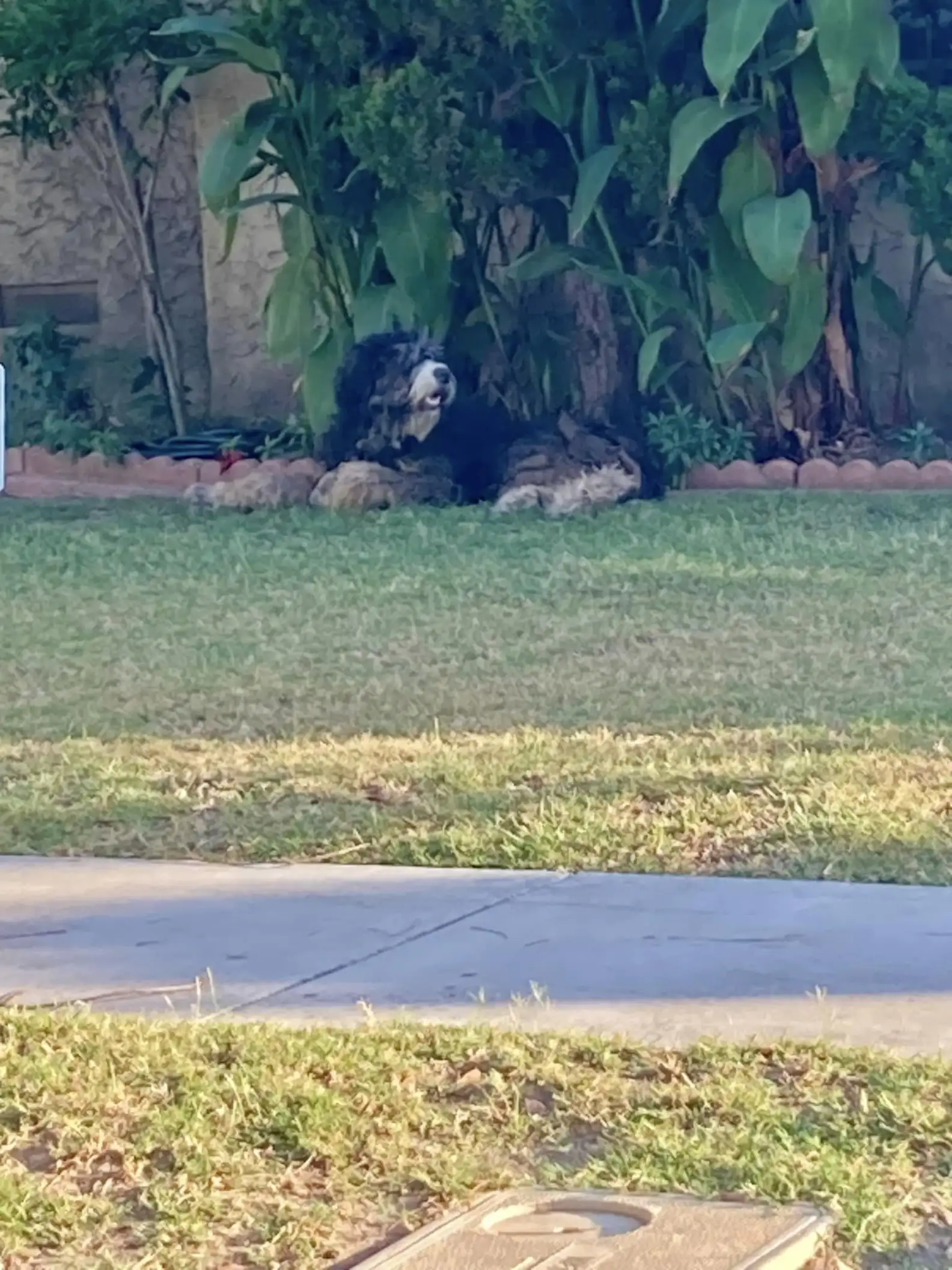
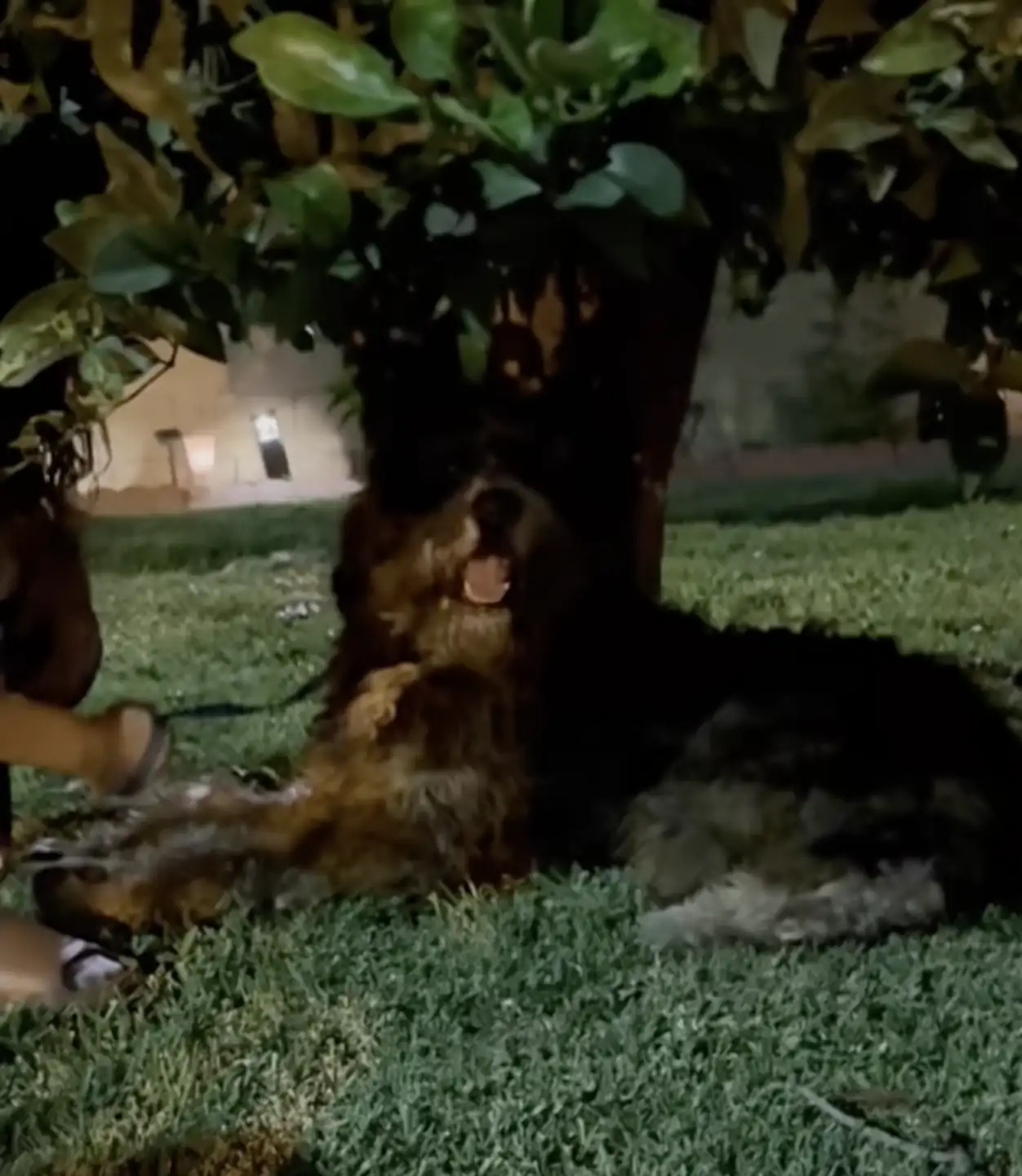
The other day, volunteer dog rescuer Mary Nakiso was driving through California’s Orange County when she passed someone cowering on the side of the street. The creature was large, hairy and alone. With a sinking feeling in her stomach, Nakiso slammed on her brakes to investigate.
As she approached the animal, Nakiso realized just how massive and afraid he was.
“He is literally 75 pounds and so big but so scared,” Suzette Hall, founder of Logan’s Legacy 29, wrote on Facebook.
Suzette Hall
The giant dog was petrified, which Nakiso soon learned was the result of being “thrown out” by his family a few minutes earlier.
“When he first got thrown out, he was so confused [and] running in circles in traffic,” Hall wrote. “A huge jeep with huge tires literally went over him …”
Suzette Hall
The pup, later named Benji, had no idea where his family had gone. He roamed the busy streets frantically, hoping to find his way home. After a while of running around in circles and dodging cars, Benji eventually disappeared.
Nakiso called Hall to notify her about Benji, and the two started monitoring local social media groups for any sightings of him. Later that day, someone posted about seeing a giant matted dog in their neighborhood.
Suzette Hall
Hall couldn’t make it back to the neighborhood fast enough due to traffic, so she messaged three more of her trusted friends who lived nearby.
The group of volunteers immediately agreed to help.
“I sent a message to Nuñez Aky, Yamileth and Karla,” Hall wrote. “When they got there, he was running back and forth so fast. So they waited for him to settle down.”
Suzette Hall
Hall stayed glued to her phone for updates while the team of volunteer rescuers hatched a plan to corner the flighty dog once and for all.
Then, she finally received the news she’d been hoping to hear all day.
“[B]ecause they are so amazing, they got him into a yard and shut the gate,” Hall wrote. “My heart was so happy. The fear and terror he had been through was over, and this big hunk of pure love was finally safe.”
Suzette Hall
The rescuers showered Benji with love and praise before carrying him to their car. They drove him straight to Camino Pet Hospital, where the shaggy pup received a long-overdue makeover.
“All the layers of his past [have] been shaved away,” Hall wrote in a Facebook update. “He literally had dreadlocks.”
Suzette Hall
Benji’s makeover was just the first of many steps to get him the home of his dreams. He’s since been neutered, and after a few more days of healing, he’ll finally be able to meet his new foster family next week.
It’s hard to know what Benji’s life was like before he was rescued, but his future is certain thanks to Hall and her team of volunteers. As Hall sees it, Benji will soon receive all the love and attention he’s always deserved.
“Benji is the sweetest, most loving dog I have ever met,” Hall told The Dodo. “[He’s] truly a miracle.”
—-
You can inquire about adopting Benji by emailing Suzette Hall at Info@loganslegacy29.com.
To help pups like Benji get the care they need, you can donate to Logan’s Legacy 29 here.
ooOOoo
That is a most beautiful story and one that should inspire many readers to look after, and care for, dogs where ever they are.
Many congratulations to Suzette for rescuing Benji.
Back in the late 1950s when my mother remarried after my father’s death, ‘Dad’, as he was called when he came to live at Toley Avenue, Preston Road, London, taught me how to construct a radio receiver made from a crystal, a crystal set. I have this memory of listening to Quincy Jones on my crystal set and loving the rhythm.
“Music is sacred to me,” Quincy Jones once said. “Melody is God’s voice.”
He certainly had the divine touch.
Jones, who had died at the age of 91, was the right-hand man to both Frank Sinatra and Michael Jackson, and helped to shape the sound of jazz and pop over more than 60 years.
His recordings revolutionised music by crossing genres, promoting unlikely collaborations and shaping modern production techniques.
Dogs are so close to humans, as has been reported many times in many places. This guest post from Lorna explores the very latest in scientific thinking.
ooOOoo
Busting Myths: Do Dogs Really Understand Human Language?
By Lorna Dikoff
Dogs are often seen as more than pets. They are companions, loyal protectors, and, for many like me, family members.
Many people think dogs understand our words like we do. This idea has been around for a long time. But is it true?
Let’s look at what science tells us about how dogs communicate. Also, let’s think about what our bonds with dogs teach us. These bonds teach us about trust and loyalty. They also reveal a deeper form of connection.
The Science of Canine Communication
Dogs have been our companions for thousands of years. During this time, they have become very good at understanding human behavior.
In 2016, researchers in Hungary made an interesting discovery. They found that dogs process words and tone similarly to humans. Dogs use different parts of their brains to recognize words and emotional sounds.
But, this doesn’t mean dogs understand language like we do. Instead, they learn to connect certain sounds (words) with specific actions or results. For example, a dog might know that the sound of a leash means a walk is coming. They recognize patterns rather than understanding language.
So while dogs are good at figuring out what we do and say, they don’t understand language the same way humans do. They’ve learned to pick up on our signs, but in their own special way.
But does this mean they understand the full meaning behind those words? The answer is no.
Dogs are great at reading people. They watch our body language, listen to our tone, and look at our faces. Dogs pay more attention to these signs than to our words.
This doesn’t mean dogs are less smart. It shows that they excel in a different type of communication.
The Myth of Full Language Comprehension
People often think dogs understand human language. We want to believe our pets understand us like other people do. It’s a nice idea, but it’s not quite true.
Dogs can learn some words and follow orders. But they don’t understand language. They remember patterns and connect words with actions. It’s not the same as how we understand each other when we talk.
This myth doesn’t make our bond with dogs any less special. It actually shows something even more extraordinary. Dogs are great at connecting with us without words. They tune into our feelings and pick up on how we act. This makes our relationship with them pretty amazing.
Dogs don’t need words to sense when we are sad, anxious, or excited. Their ability to “read” our emotions is what makes their companionship so special.
Trust and Loyalty: The Real Language of Dogs
Dogs and humans have a special bond that is far more profound than language. It’s about trust and loyalty.
These things are at the heart of what we can learn from dogs. Dogs show us how to be honest and true. They teach us about connecting with feelings, not only with words.
Dogs don’t need a large vocabulary to express their loyalty or unconditional love. Instead, they show it through actions. They sit with us when we’re sad and guard us when we’re weak. And they always get super happy to see us, even if we’ve only been gone for a bit.
This speaks to a deeper truth that dogs teach us: communication isn’t only about words. It’s about the trust we build through consistent, reliable actions.
In a world where words can sometimes mislead or fall short, dogs show us a better way. Dogs remind us of the importance of honesty and integrity in our interactions.
The Lesson from Dogs
So, do dogs understand human language? The answer is no, at least not in the way we hope. But their understanding of us is something far more profound.
Dogs teach us that we don’t always need words to talk. They teach us that our actions often speak louder than language. Their loyalty, intuition, and emotional intelligence. makes our bond with them special, more than words can explain.
We often overcomplicate communication, but dogs keep it simple. They show up and act the same way every day.
This teaches us that real connections come from trust and love. Dogs prove that understanding each other is about more than using words.
About the Author:
Lorna is the founder of Furry Friends Advisor. She is a passionate and experienced long-time dog owner with a deep love for animals. Lorna’s commitment to understanding and caring for dogs led her to spend countless hours researching and learning about canine health, behavior, and care. When not immersed in writing for her site, she is pampering her French Bulldog name Lucy. Her mission is to give advice about dog care and nutrition accessible to everyone.
ooOOoo
Thank you, Lorna.
There is no question that a dog’s actions speak so much louder than words.
Trust and loyalty; they are the supreme qualities of dogs and it is a pity that in some quarters these qualities are not seen in humans.
Global efforts to tackle climate change are wildly off track, says the UN, as new data shows that warming gases are accumulating faster than at any time in human existence.
Current national plans to limit carbon emissions would barely cut pollution by 2030, the UN analysis shows, leaving efforts to keep warming under 1.5C this century in tatters.
The update comes as a separate report shows that greenhouse gases have risen by over 11% in the last two decades, with atmospheric concentrations surging in 2023.
ooOOoo
What the jet stream and climate change had to do with the hottest summer on record − remember all those heat domes?
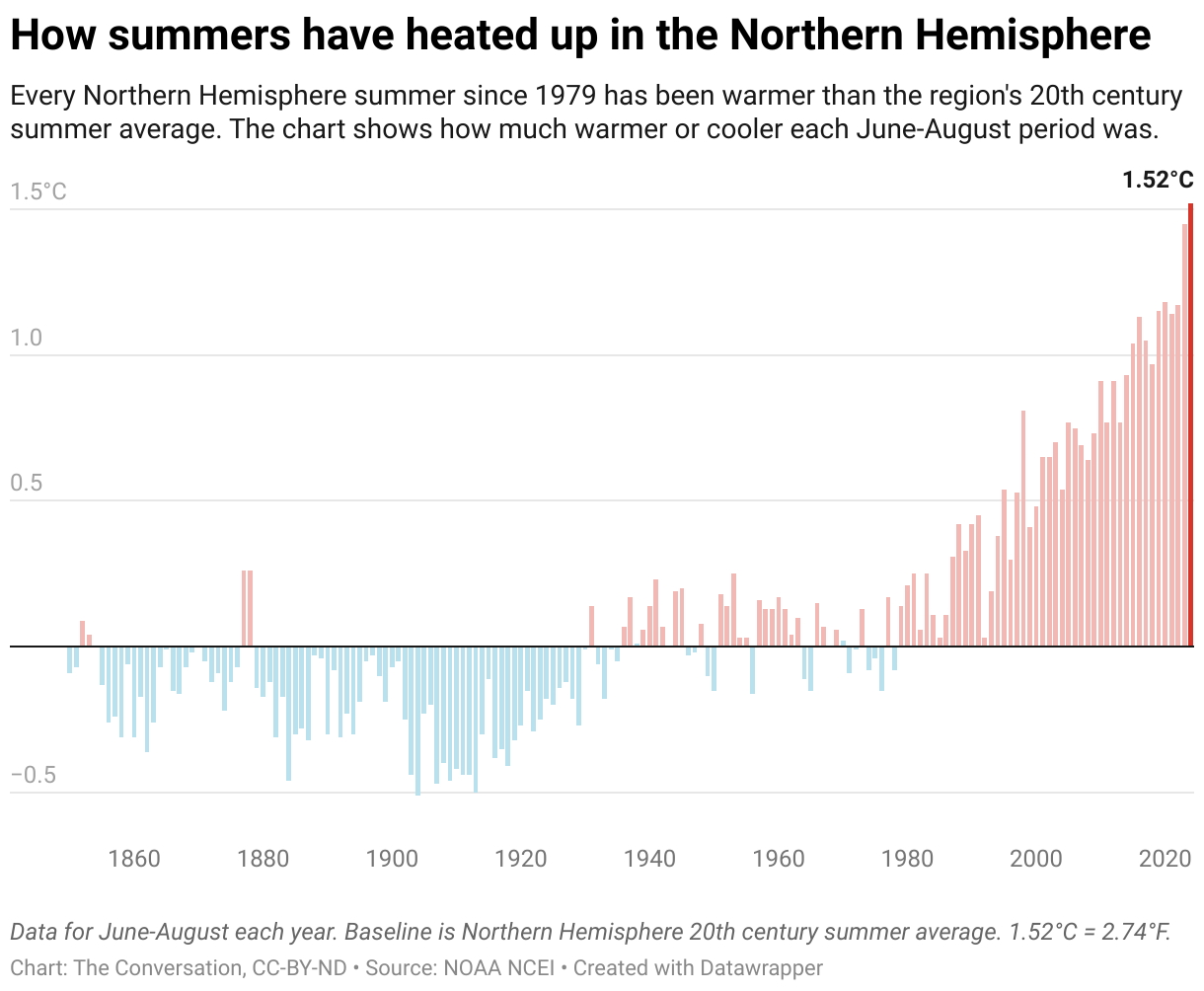
Summer 2024 was officially the Northern Hemisphere’s hottest on record. In the United States, fierce heat waves seemed to hit somewhere almost every day.
That might seem small, but temperature increases associated with human-induced climate change do not manifest as small, even increases everywhere on the planet. Rather, they result in more frequent and severe episodes of heat waves, as the world saw in 2024.
The most severe and persistent heat waves are often associated with an atmospheric pattern called a heat dome. As an atmospheric scientist, I study weather patterns and the changing climate. Here’s how heat domes, the jet stream and climate change influence summer heat waves and the record-hot summer of 2024.
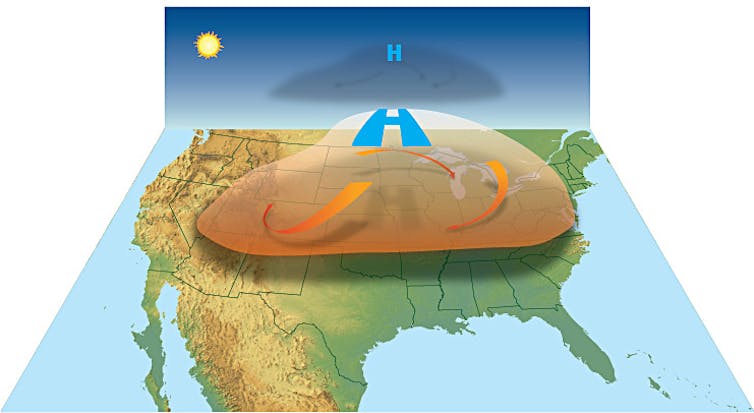
A heat dome is a persistent high-pressure system over a large area. A high-pressure system is created by sinking air. As air sinks, it warms up, decreasing relative humidity and leaving sunny weather. The high pressure also serves as a lid that keeps hot air on the surface from rising and dissipating. The resulting heat dome can persist for days or even weeks.
The longer a heat dome lingers, the more heat will build up, creating sweltering conditions for the people on the ground.
High pressure in the middle layers of the atmosphere acts as a dome or cap, allowing heat to build up at the Earth’s surface. NOAA
How long these heat domes stick around has a lot to do with the jet stream.
The jet stream is a narrow band of strong winds in the upper atmosphere, about 30,000 feet above sea level. It moves from west to east due to the Earth’s rotation. The strong winds are a result of the sharp temperature difference where the warm tropical air meets the cold polar air from the north in the mid-latitudes.
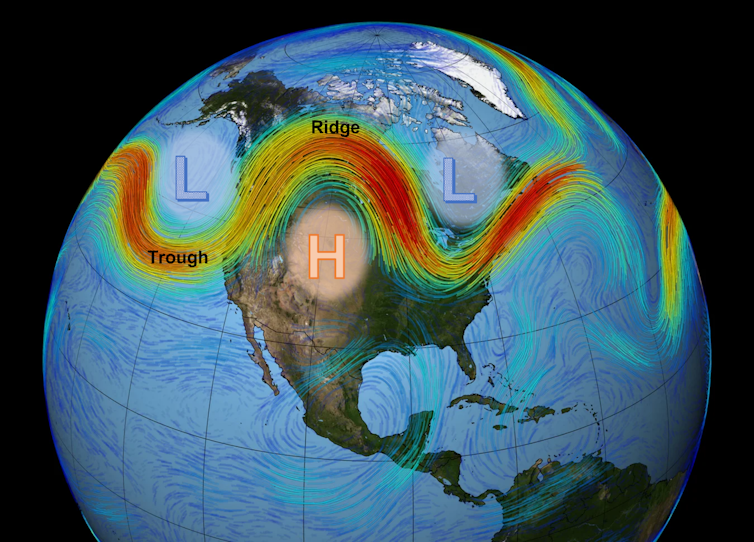
The jet stream does not flow along a straight path. Rather, it meanders to the north and south in a wavy pattern. These giant meanders are known as the Rossby waves, and they have a major influence on weather.
Where the jet stream arcs northward, forming a ridge, it creates a high-pressure system south of the wave. Where the jet stream dips southward, forming a trough, it creates a low-pressure system north of the jet stream. A low-pressure system contains rising air in the center, which cools and tends to generate precipitation and storms.
Most of our weather is modulated by the position and characteristics of the jet stream.
How climate change affects the jet stream
The jet stream, or any wind, is the result of differences in surface temperature.
In simple terms, warm air rises, creating low pressure, and cold air sinks, creating high pressure. Wind is the movement of the air from high to low pressure. Greater differences in temperature produce stronger winds.
For the Earth as a whole, warm air rises near the equator, and cold air sinks near the poles. The temperature difference between the equator and the pole determines the strength of the jet stream in each hemisphere.
However, that temperature difference has been changing, particularly in the Northern Hemisphere. The Arctic region has been warming about three times faster than the global average. This phenomenon, known as Arctic amplification, is largely caused by the melting of Arctic sea ice, which allows the exposed dark water to absorb more of the Sun’s radiation and heat up faster.
Because the Arctic is warming faster than the tropics, the temperature difference between the two regions is lessened. And that slows the jet stream.
As the jet stream slows, it tends to meander more, causing bigger waves. The bigger waves create larger high-pressure systems. These can often be blocked by the deep low-pressure systems on both sides, causing the high-pressure system to sit over a large area for a long period of time.
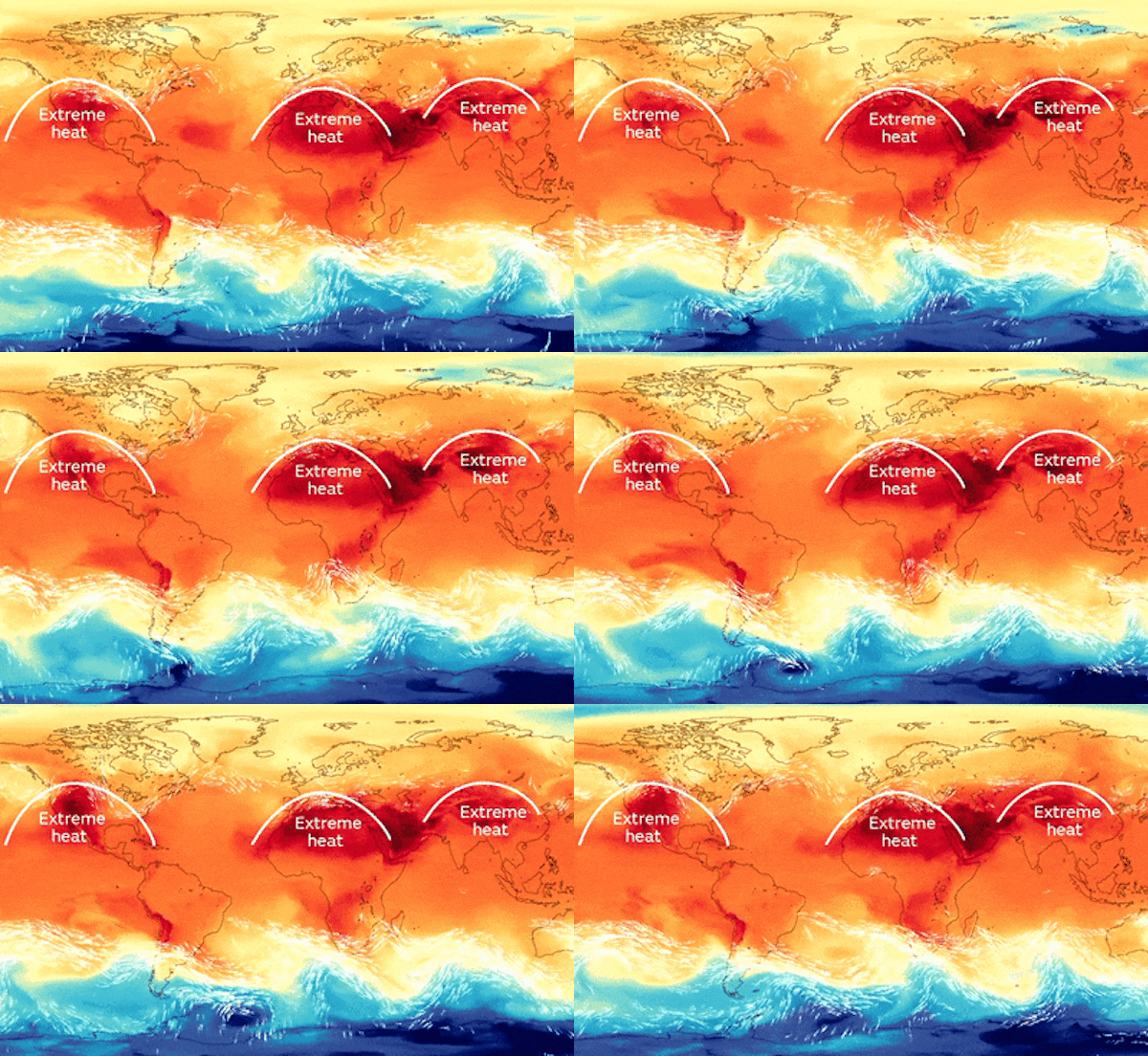
A stagnant polar jet stream can trapped heat over parts of North America, Europe and Asia at the same time. This example happened in July 2023. UK Met Office
Typically, waves in the jet stream pass through the continental United States in around three to five days. When blocking occurs, however, the high-pressure system could stagnate for days to weeks. This allows the heat to build up underneath, leading to blistering heat waves.
Since the jet stream circles around the globe, stagnating waves could occur in multiple places, leading to simultaneous heat waves at the mid-latitude around the world. That happened in 2024, with long-lasting heat waves in Europe, North America, Central Asia and China.
Jet stream behavior affects winter, too
The same meandering behavior of the jet stream also plays a role in extreme winter weather. That includes the southward intrusion of frigid polar air from the polar vortex and conditions for severe winter storms.
Many of these atmospheric changes, driven by human-caused global warming, have significant impacts on people’s health, property and ecosystems around the world.
I maybe approaching my own end of life but millions of others are younger than me. When I see a woman with a young baby in her arms I cannot stop myself from wondering what that generation is going to do.
I have been a follower of Ugly Hedgehog for some years.
Last Sunday ‘Alphadog’ posted this photograph taken on Route 66, the Antares Road, in Kingman, Arizona. It is reproduced here with Richard’s full permission.
















 Learning from Dogs
