She grew and filled our lives with joy. We loved her Boxer curl and the way that she would sit on the couch with us and just lean against our sides. Then around her 7th year, we noticed that she lost her appetite. Concerned like any parents, we took her to the vet. We received the worst news possible.
She had cancer that had metastasized in her liver. Her last few months with us were precious.
Or, more specifically, what Diego meant for Laura Bruzzese. (This will be the second in the series We Shall Not Forget Them.)
ooOOoo
Dog Love In August
August is the start of the dying season. Garden things begin their slow shrink into the earth, the days grow shorter and cooler, lazy ocean- or mint-scented summer days snap into rigid schedules of work and school.
August is also the month that I lost Diego, my first dog. You can get acquainted with Diego here, a post I wrote a few days before he died. But I would like to share a little more now, on the second anniversary of his departure.
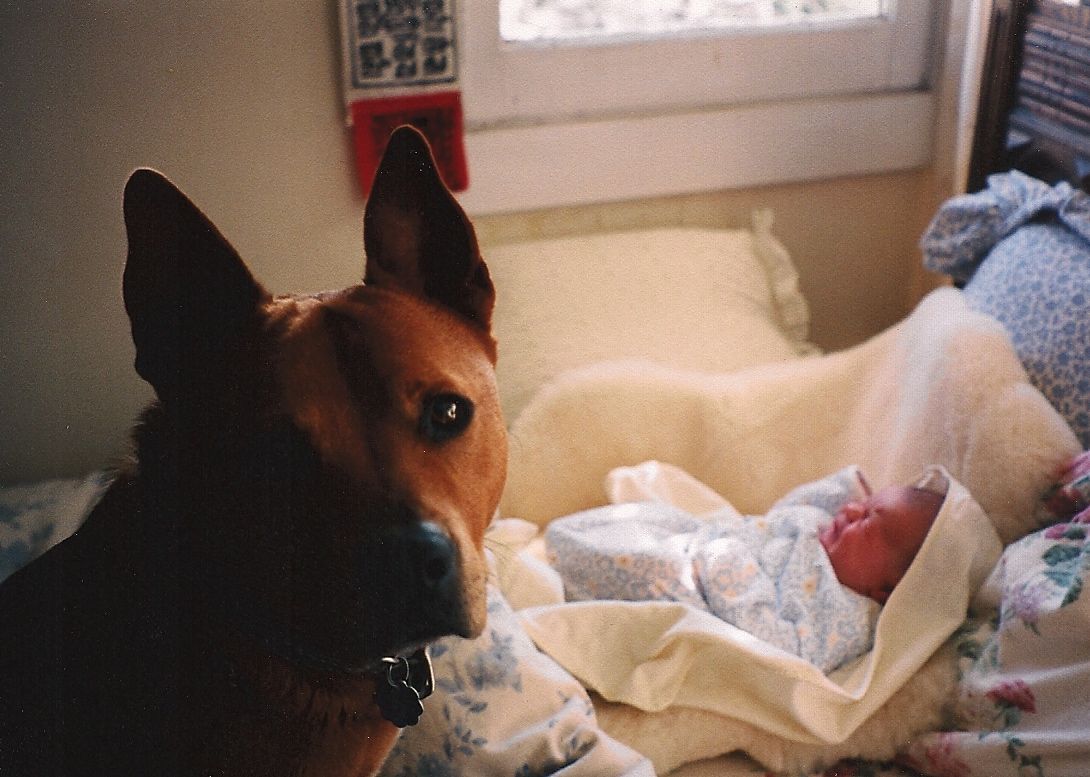
Diego was a poser, in a very literal sense of the word. He loved having his picture taken; in fact, he insisted on it whenever he saw me holding the camera. This picture, for example: it was taken the day I brought my daughter home from the hospital, the day after 21 hours of hard labor produced an eight-and-a-half-pound baby who actually stopped halfway out of my body, looked around, and scowled before resuming her reluctant journey onto the planet. (She was 12, twelve days overdue, FYI all you mothers out there who can surely feel my pain.)
There is something screaming in the bed. Please make it stop before it explodes.
I laid baby Isabella down, stepped back with the camera, looked up, and there he was: Diego, staring. Fifty-eight pounds of solid, unmoving dog. Insisting that I photograph him, too, with this creature that he wasn’t sure if he should guard against or lick. This child who personified the singular emotion of furious for the first nine weeks of her life (if she was not sleeping or eating, she was screaming).
Oh, hi Aunt Rosie. I know you’ve passed on, but I’ll bet you can still hear that screaming baby wherever you are.
When my doula told me that the colic or distemper or petite innards or whatever it was making Isabella so unhappy would resolve itself in about nine weeks, I said oh, that’s nice. But I won’t be alive for nine weeks of this. I’ll be in an asylum acquainting myself with a selection of opiates, or at the bottom of the mighty Rio Grande; so behold, an orphan.
But somehow, I survived. And Diego was part of it.
You see, from the very beginning, it was just us — the two of us, the three of us. I was abandoned by my husband before Isabella was born, a painful time that I don’t often write about.
Within a matter of weeks, the married-and-expecting life I’d known was gone, and I was left to fumble around with the pieces, a wreckage sitting on a pile of broken glass in the dark. The small hours of it were the worst, waking up alone and panicked in the middle of the night wondering how (or if) I would live through the next weeks and years. And Diego was always there, a silent and comforting presence curled at the foot of the bed or coming up to lick my tears if I was crying, which was basically all the time. He was always there.
I have a teenager now and those days seem ancient. While I rebuilt my life, Isabella grew up and Diego grew old. And finally, in his sixteenth year, he began to deteriorate to the point of pain. I knew he wouldn’t be with me much longer and I had already called the vet to ask her how it worked — when do you know it’s time? Do I take him to the office, or do you come to the house? Will he feel anything? I planned to schedule an appointment soon; I hadn’t had to make this decision before and it was a very painful.
On the morning of August 9 before I left for work, I told Diego that we would have to say good-bye soon because his body wasn’t working right anymore. I told him that I loved him and it was okay for him to go. Over and over I told him I loved him.
Less than two hours later, he drowned in the pond.
I think it was his way of avoiding the vet (he hated the clinic), and maybe sparing me that particular pain. I’m not going to say that I wasn’t devastated. But rather than remembering the urgent phone call at work from Isabella, or the vision of him when I got home, or my step-father struggling to carry the terrible weight of him away, I like to imagine Diego simply being received by the fish and toads. Delivered from his pain by warm water, wrapped in a blanket of lilies.
Anyone who has cared for pets perhaps knows that there is one, a special one, who will always occupy the largest piece of real estate in your heart, though others may follow. That was Diego for me.
But now we’re lucky enough to share our lives with another dog, the rascally, neurotic, road trip-loving Velma. I’ll end this post with a short video of her that reminds me of exactly what I love about dogs: their absolute and abundant connection with life, free of judgement, agenda, or desire to be anything other than what they are. That’s what I think of every time I see Velma in her Writhe of Exquisite Happiness. Perfect contentment of being.
ooOOoo
Laura wrote and published this back in August, 2012. But her words, emotions and feelings are those that never age. Indeed, I would add her courageous words.
Last year I instigated a new ‘page’ on Learning from Dogs. It was entitled We Shall Not Forget Them. It was introduced by me as follows:
For millions, the relationship between a person and their dog is precious beyond words. Do you still grieve the loss of your wonderful dog? Let us all know what your dog meant to you. Write whatever you want. Leave it as a thought to this page.
Then it became clear that this was not going to work properly. Because each note of remembrance was, in effect, a comment. And I discovered that under WordPress it is not possible to insert a photograph. I struggled to think of a better way of doing it. Then earlier yesterday it came to me.
I will make each message of condolence, each reflection on how special the dog was, a new and separate blog post. In other words, each dog gets their own post for a full day.
Then each time a condolence is sent in, I will update the We Shall Not Forget Them post with the name of the departed dog, the date and a link to the blog post that has the details and memories of the animal.
I hope that makes sense!
To underline how it is going to work, I am starting off with the words of loss, and photographs, of Jim and Janet’s Buddy.
That post will be published in an hour’s time and will be linked to as I described above.
ooOOoo
So I am reaching out to Susan, Asha, Katrina and Whisperofthedarkness – each of you has left a memory as a comment to here.
Please do email me some photographs and any further recollections you would like me to post, and I will do for you as I have done for Buddy.
(Laura, I shall go to that link and republish what you wrote.)
I was emailed as follows back on the 25th January:
Hi Paul,
I hope all is well with you and Jean and the furry kids. About a month ago, you had mentioned that you would welcome a post about Maggie in honor of her 9th birthday.
Maggie was very enthusiastic about this venture and managed to write a little blog with her advice on aging. I have enclosed the result for your review.
Her birthday is on 2/3. Thank you so much for giving us this opportunity. Take care!
Kind Regards,
Susan & Maggie
Ergo, this coming Friday is Maggie’s birthday.
ooOOoo
Maggie’s Advice on Aging
Hello! My name is Maggie.
I have a much longer AKC registered moniker that Mom & Dad christened me with but it’s ridiculous so I just shortened it.
Anyway, Paul was so gracious to invite me to do a post for all of you good folks at Learning from Dogs. Since I have a birthday coming up (in case you are wondering, I’ll be 9), I thought what better topic to write about than aging.
To me, age is just a number. I know that is a cliché but it’s the truth! I don’t know what other dogs my age do but I’m not ready to just lay down on the couch. Not me! I’ve got too many things to do and way too many places to see.
Here are some of my tips on how you can feel like a puppy:
Take your vitamins – I will admit. After Mom and Dad replaced my favorite brand of fish oil with another one that didn’t taste so good, I refused to take the pill. They would try and hide it in my food but I would just find it and set it to the side. I mean, who do they think they are dealing with? They finally wised up and now I am back to my brand. Some of you might be thinking, fish oil, yuck! Seriously, I swear by it. It promotes heart health and it keeps my coat silky smooth. I also have these tasty Milk Bone vitamins that help me to stay healthy and they even improve joint mobility! That way I will be keeping the ‘rents on their toes for years to come.
Get off the couch – Yes, I like couch time with my Mom and Dad but I love nothing more than to lollygag in our gigantic backyard playing ball. I will do this for hours! My bipeds on the other hand, they have their limits. I also enjoy going for walks in this cool, new park near our house. It’s in the woods and I love all the places I can explore. Just being active is not only good for you but it keeps you engaged and learning new things all the time.
Annual checkups – Going to the vet isn’t fun. I don’t know anyone that enjoys it. However, I know that everything they do for me keeps me healthy. The ‘rents see to it that I get my yearly vaccinations and physical. It keeps me in tip top shape so I will be barking at them for years to come. Mom loves it when I yell at her.
Watch your diet – Okay. I will admit this one bites. If I had my way, I would be chowing down on all kinds of good things like meat, cheese, bacon…. the list goes on and on. I need to watch my girlish figure! I eat the best food with no preservatives and it’s also chockful of vitamins. Believe it or not, I love my yummy meals, they taste good!
It’s the little things – This is what happiness is for me. I love nothing more than playing with the really cool stuffed teddies Dad got me or going for rides in the car with Mom. I really like family time when we watch movies and cuddle on the couch. Just being with my two favorite people in the world keeps me going. We spend quite a bit of time hanging out and I wouldn’t have it any other way!
I hope you found these tips helpful. It was fun spending time with all of you. Take care and give your parents a hug! They deserve it.
Bob Derham and his wife, Julie, are long-term friends back in the UK.
They recently lost their two dogs.
Bob sent me this:
Millie and Summer both had a fun life.
They were cross breed dogs, partly Springer Spaniel and part Collie. They were born in Wales, but as there are quite a lot of similar dogs there, the owner advertised in a local paper, and brought them up to Dorset one weekend 13 years ago.
Initially we had been looking for only one dog, but it seemed such a shame to separate the two puppies so we decided to take both. Most people were of the opinion that two girls from the same litter was not a good idea, but nevertheless we trained them, and the two animals were always together.
Family holidays, walking the children to the school bus, visiting friends, etc., always included Millie and Summer.
Just over two years ago, Summer became diabetic. Had this been only ten years ago, nothing could have been done for her, but we were able to inject her twice a day, and keep her healthy, apart from failing sight as a result of the insulin. It was not long after that Millie developed the same problem, so both dogs had the same routine.
Summer went to the vets on the right day for her, and was put to sleep peacefully, and two weeks later Millie needed the same choice to be made.
They enjoyed an almost identical lifespan, and we enjoyed them to the full.
Bob and Julie’s daughter Stephanie then made the following video in memory of their two beloved dogs.
Back to me.
Going to close today’s post with this poem by Rudyard Kipling.
ooOOoo
The Power of the Dog
There is sorrow enough in the natural way
From men and women to fill our day;
And when we are certain of sorrow in store,
Why do we always arrange for more?
Brothers and Sisters, I bid you beware
Of giving your heart to a dog to tear.
…
Buy a pup and your money will buy
Love unflinching that cannot lie–
Perfect passion and worship fed
By a kick in the ribs or a pat on the head.
Nevertheless it is hardly fair
To risk your heart for a dog to tear.
…
When the fourteen years which Nature permits
Are closing in asthma, or tumour, or fits,
And the vet’s unspoken prescription runs
To lethal chambers or loaded guns,
Then you will find–it’s your own affair–
But…you’ve given your heart for a dog to tear.
…
When the body that lived at your single will,
With its whimper of welcome, is stilled (how still!);
When the spirit that answered your every mood
Is gone–wherever it goes–for good,
You will discover how much you care,
And will give your heart for the dog to tear.
…
We’ve sorrow enough in the natural way,
When it comes to burying Christian clay.
Our loves are not given, but only lent,
At compound interest of cent per cent.
Though it is not always the case, I believe,
That the longer we’ve kept ’em, the more do we grieve:
For, when debts are payable, right or wrong,
A short-time loan is as bad as a long–
So why in Heaven (before we are there)
Should we give our hearts to a dog to tear?
As I have frequently mentioned, I so enjoy having guest posts being sent to me.
They give you, dear reader, a break from yours truly and so very often they offer a new and interesting perspective on dogs, on us, and on the world.
This week there are three guest posts, in various guises, lined up and, who knows, there may be a couple more heading in.
But to the first of those guest posts.
Well, technically, more of a reposting today than a pure guest post. That reposting is of a most fascinating post published by Patrice Ayme on the 25th. January. It was called WE ARE MATHEMATICS. But there were parts of Patrice’s post that I struggled with so I am offering it to you with a rather long introduction.
I hope you enjoy it.
ooOOoo
Smack!
The sound of an object falling to the floor of the shower, suddenly and without warning, nearly caused me to jump out of my skin.
I was washing my hair and had my eyelids tightly closed lest the shampoo suds got into my eyes. Inadvertently, I had felt my right elbow dislodge something from the top of the small corner shelf that held the bar of soap and the bottle of hair shampoo.
I let the flowing warm shower water rinse the suds from my face, opened my eyes and looked down. The object that had made such a sudden, loud noise was a plastic brush maybe three or four inches long. It had fallen to the wet shower floor some five feet below the corner shelf where the brush normally lived.
As I stared down at the brush, the warm water cascading comfortably down my body, I reflected that in the space of a fraction of a second my mind had computed the distance that the unknown object had fallen and offered me a sense of the speed it must have been traveling when it hit the floor.
Now don’t get me wrong! I didn’t come up with a precise answer to that question of how fast the brush was going but in that moment of thought I sensed both the distance the brush had fallen, five feet; plus or minus, and the effect of gravity in accelerating that brush even over such a small distance. (Later I calculated the brush hit the shower base going at around 10 fps.)
Now it would have never occurred to me that my brain was capable of almost instantaneous calculations, as in mathematical calculations, if I hadn’t read in the previous twenty-four hours a recent essay from Patrice Ayme. An essay that convinced me completely that, in Patrice’s words:
The world is not as astonishingly understandable, as Einstein would have it. Neuronal grid cell studies show that we are the world. Understanding the world is understanding ourselves.
The world is not just written in mathematical language, as Galileo found out. We are made mathematically. We think mathematically, because we are made of math. We are mathematics.
Patrice had opened my eyes, more accurately opened my mind, to something that was then immediately clear to me and will be to you, dear reader: Our brains have an intuitive and instinctive sense of space. Not space in some abstract sense of the term but space in the sense of spatial awareness.
Think how easily, how quickly, you understand distance. Whether it is a measure of distance in your own home or assessing how far away that bird is flying towards and setting down on a high branch of a tall pine tree.
Think how even with our eyes closed we can navigate around a familiar part of our lives. Think how the sailors of ancient times (and trust me not so ancient times) used ‘Dead Reckoning’ (DR) to navigate safely and securely across vast oceans.
Our brains could only do this if they were computing these spatial assessments mathematically.
OK, that’s enough from me. Here’s that essay from Patrice.
ooOOoo
WE ARE MATHEMATICS
Mathematically Built Brain: The Example of Grid Cells, Incarnating Algebraic Geometry.
Understanding how the cognitive functions of the brain arise from its basic physiological components has been the final frontier in logic and rational science for thousands of years. (As I tried to explain yesterday, the superstitious religious fanatics tried their best to bury all of science, and the scientific mindset, the essence of humanity; they nearly succeeded!)
The 2014 Nobel was given to John O’Keefe (a “half”!), the rest jointly to May-Britt Moser and Edvard I. Moser “for their discoveries of cells that constitute a positioning system in the brain.” I will develop here the philosophical viewpoint, which is broader (O’Keefe’s career was steered by the influence of Hebb, the famous psychologist, who got the idea of the outside patterns imprinting the neurocircuitry of the brain).
Here is Hebb: “Let us assume that the persistence or repetition of a reverberatory activity (or “trace”) tends to induce lasting cellular changes that add to its stability.[…] When an axon of cell A is near enough to excite a cell B and repeatedly or persistently takes part in firing it, some growth process or metabolic change takes place in one or both cells such that A’s efficiency, as one of the cells firing B, is increased.”
Well it turns out that evolution has had even more imagination than that. I will even propose Patrice’s Neural Theory, a vast generalization.
Galileo famously said the language of nature was written in mathematics. It turns out that it is much more than that. Our brain is mathematically organized. What Descartes consciously discovered, a coordinate frame in which to set-up calculus, is automatically generated in the brain. This is the meaning of grid cells.
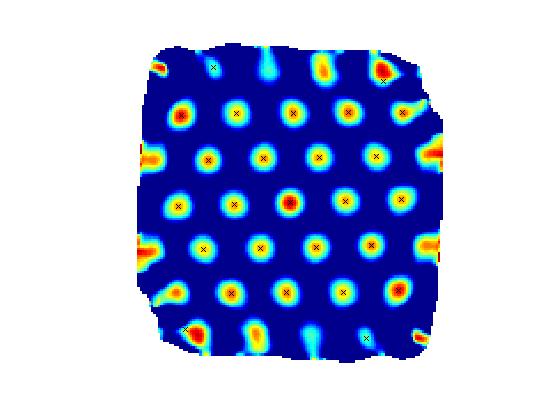
Grid cells are neurons that fire when an animal moving of its own free will traverses a set of small regions (firing fields) which are roughly equal in size and arranged in a periodic triangular array that covers all of the available environment. They were discovered in 2005 by a couple (literally) of Norwegian researchers, the Mosers, and rewarded by the Nobel Prize in 2014 (shared with O’Keefe, from London, who invented the basic experimental technique, and discovered “place cells”)
Once set, navigation can be done in the dark, blinded. Scientists’ discovery that rodents, bats and nonhuman primates have a system in the brain for so-called “dead reckoning navigation”… “Dead reckoning” refers to the ability to navigate without external cues. The term comes from ship navigation. A crew will “take a sighting” via cues such as the stars or landmarks to determine where the ship is on a map. Then, when the ship moves, ‘dead reckons’ to update location on the map paying attention to speed and direction. The Greco-Romans already had such systems, with little paddled wheels counting the distance covered over the sea. It turns out that ‘dead reckoning’ is enabled by the grid cell system, inside the brain.
Recording Of Grid Cells Activity Inside Rat Brain (Jeffery Lab and others.)
“The importance of grid cells lies in the apparently minor detail that the patches of firing (called ‘firing fields’) produced by the cells are evenly spaced. That this makes a pretty pattern is nice, but not so important in itself – what is startling is that the cell somehow ‘knows’ how far (say) 30 cm is – it must do, or it wouldn’t be able to fire in correctly spaced places. This even spacing of firing fields is something that couldn’t possibly have arisen from building up a web of stimulus associations over the life of the animal, because 30 cm (or whatever) isn’t an intrinsic property of most environments, and therefore can’t come through the senses – it must come from inside the rat, through some distance-measuring capability such as counting footsteps, or measuring the speed with which the world flows past the senses. In other words, metric information is inherent in the brain, wired into the grid cells as it were, regardless of its prior experience. This was a surprising and dramatic discovery. Studies of other animals, including humans, have revealed place, head direction and grid cells in these species too, so this seems to be a general (and thus important) phenomenon and not just a strange quirk of the lab rat.”
We should have looked for Plato’s cave. It turned out that this cave has been built, is being built inside our heads all along! This cave is built-in two ways: automatically (grid cells) and as a response to the environment, by.us, from the outside, from the environment, in.
(So it matters what our brain experienced before to mold afterwards what comes in anew from the outside! No experience is a neutral experience!)
That cave is both a topology (what’s near and what’s not, the logic of place), and a basic geometry (the grid and its grid cells). To have a grid built automatically is the equivalent of having a reference frame in mathematics. It makes sense if one wants to make mathematics!
And not just mathematics, but even Infinitesimal Calculus! It is indeed clear that animals such as dogs have a mastery of calculus: experiences have shown this, and anybody with a dog throwing a stick sideways in water will see the dog running along the shore a bit, and then jump in the water, so as to minimize the time to reach the stick, a typical calculus problem. Dogs can do calculus, because they can make algebraic geometry in their brains, having a reference frame made of these grid cells! (If they had no grid cells, they would not be able to do calculus.)
Thus Descartes rediscovered, consciously, something which had been found, evolved and calculated by evolution half a billion years ago (or more!). The reference frame, also known now as the neuronal grid cell system, is basic to all of mechanics, even Poincare’-Lorentz Relativity. (An open question: Quantum Physics uses even more general reference systems, Hilbert spaces; I will therefore predict that the brain has also that sort of organization!)
The world is not as astonishingly understandable, as Einstein would have it. Neuronal grid cell studies show that we are the world. Understanding the world is understanding ourselves.
The world is not just written in mathematical language, as Galileo found out. We are made mathematically. We think mathematically, because we are made of math. We are mathematics.
We are not just looking at shadows in a cave, as Plato would have it. And the cave was not given to us by the gods, as Socrates had it. We are the cave, we, and our personal history, built it.
Any new experience, idea or emotion, taught or experienced, is another brick in that wall of perception and analysis, we better consider it carefully, before indulging in it. Call that the Principle of Mental Precaution But that Principle extends also to what we chose NOT to experience, which can be just as bad, if not worse.
You are not just what you think. You mentally are what you were submitted to, and what you decided to submit to. Fate is written in mathematical patterns, one theorem made out of neurons, their axons, dendrites and supporting glial cells, at a time.
Such theorems are written with the physics of minds, just as sturdy as the physics of stars. Just as hopeful, just as ominous.
Plato thought mathematics were “forms”, out there, outside of the physical world. This is not what science is finding. There are not “forms” out there, and physics, nature, somewhere else. Our minds are literally made of math.
So here is my theory:
“Whatever exists in mathematics exists in the brain. And reciprocally.”
Patrice Ayme’
ooOOoo
I do so hope that this essay from Patrice fires you up as it did me. If it leaves you with questions, then offer them to me as a comment to this post and I will take it upon myself to have Patrice answer them.
Finally, did you pick up on the fact that it isn’t just our human brains that are mathematical organs, it applies to the brains of dogs as well!
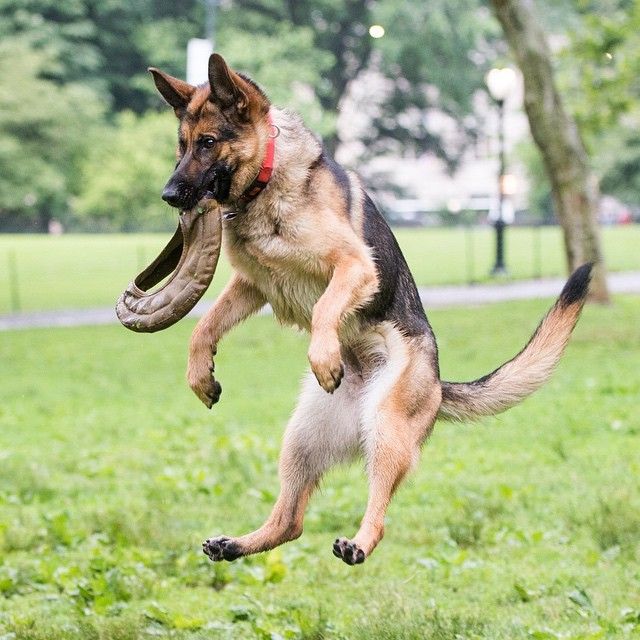
Mathematics in action. (Photo courtesy of Pinterest)
It’s not just the rescuing of people that matters.
Last Thursday, the 26th January, the BBC News website published a short video under the heading of: Italian avalanche survivors tell how they stayed alive.
A couple among the nine survivors of an Italian avalanche that devastated a mountain hotel say they survived nearly 58 hours buried beneath feet of snow by sucking on glass- and mud-filled ice, comforting each other and those nearby, and praying.
Now there’s no way I am belittling that survival; far from it. But 58 hours is a tad under 3 days.
After an avalanche buried central Italy’s luxury Hotel Rigopiano and its guests Wednesday, Jan. 18, rescue workers spent days digging in the snow in a desperate attempt to locate any survivors.
About 120,000 tons of snow, 16 feet deep, slammed into the hotel at 60 miles per hour. It took a while for emergency operators to believe the avalanche had occurred. The first man who called to report it was told that everything was fine at the hotel.
When they finally realized a disaster had in fact happened, first responders had to ski to the hotel, which took 12 hours. It took another day until the roads could be cleared with snowplows so emergency vehicles could finally get through.
Despite these circumstances, 11 survivors, including three children, were somehow able to keep themselves alive for over 40 hours by using their cellphones as flashlights to find water. The children, trapped in a game room, ate packets of Nutella and drank bottled water.
By Monday, rescuers were only pulling bodies from the snow and rubble. Discouraged and depressed, they were ready to give up hope.
The rescuers were told there were three puppies at the hotel. They had no idea where they were until they heard a noise in a boiler room inside what remained of the building. It was the three fluffy, white Abruzzo sheepdog puppies, only six weeks old, who had miraculously managed to survive both the avalanche and being stranded for five days.
“They just started barking very softly,” said Sonia Marini, one of the rescuers. “In fact, it was hard to find them right away because they were hidden. Then we heard this very tiny bark and we saw them from a little hole the firefighters had opened in the wall. We expanded the hole and we pulled them out.”
The puppies, born Dec. 4, had survived in an air pocket by eating snow, Walter Milan, the spokesman for Italy’s elite Alpine rescue squad, told the Daily Beast. They are the offspring of Nuvola (Cloud) and Lupo (Wolf), who lived at the hotel and were popular with guests.
Like their lucky litter, Nuvola and Lupo also survived the avalanche, according to a Facebook post by Martina Rossi, who was a bartender at the hotel.
Lupo e Nuvola, i pastori abruzzesi nati e cresciuti all’Hotel Rigopiano, non so come, sono riusciti a raggiungere la mia contrada, una frazione di Farindola (Villa Cupoli) sani e salvi. Questo non può di certo colmare il vuoto e la distruzione che attraversa un paese in ginocchio ancora speranzoso, nell’attesa soltanto di notizie positive, me in prima persona. Ma questi due bellissimi cagnoloni, rivedendoli, di certo sono riusciti a farmi tornare a battere il cuore, almeno per qualche secondo, riportando la speranza.
The three puppies raised the hopes and spirits of the rescuers. “If the puppies survived, humans could as well,” Milan told the Daily Beast. Firefighter Fabio Jerman agreed. “It’s an important sign of life, which gives us hope,” he said.
Sadly, no one else has been found alive. A week after the disaster, 24 bodies have been found and five people are still missing.
In addition to unusually heavy snowfall, the avalanche may have been caused by a series of earthquakes that struck the area the day before.
Last year, devastating quakes killed more than 300 people in Italy. Another fortunate four-legged survivor, a border collie pulled from the rubble two days after an earthquake struck in late October, is being trained to pay it forward as a rescue dog.
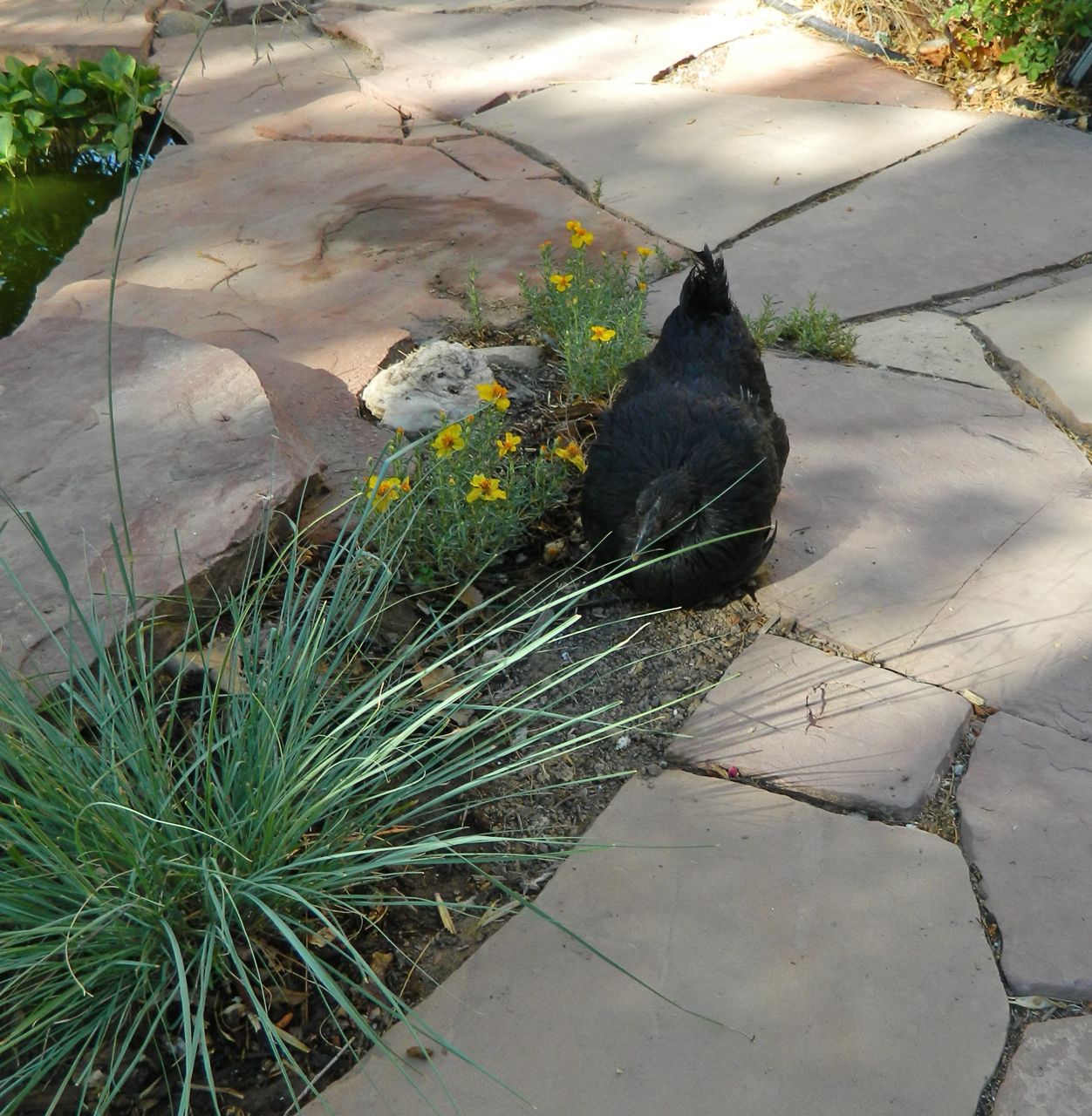
I have a marvellous blogging friend in New Mexico who has Rufina, a chicken who was shot in the head, sealed in a plastic bag, placed in a freezer for 24hrs, and lived! (albeit now blind).
I have a framed poster of Rufina up in my living room, and even one her feathers perched in one of my many, many, many St. Francis’s
Then in response to me wanting to republish that story replied: “Contact her, she’s wonderful, and her pottery is to die for.”
So I did and, with Laura’s permission here is that story of this most remarkable chicken.
ooOOoo
The Undead Chicken
by Laura Bruzzese, June 24th, 2013
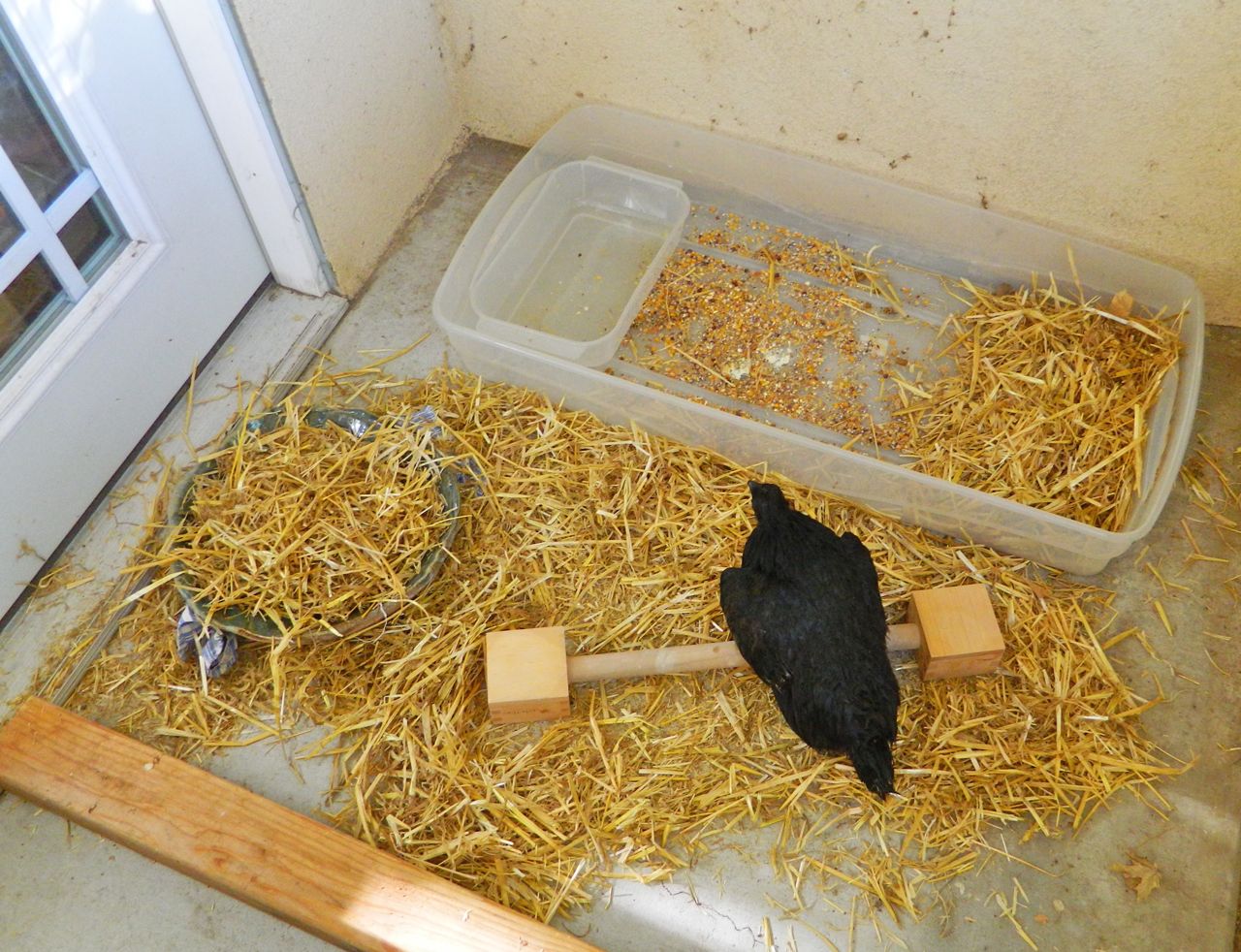
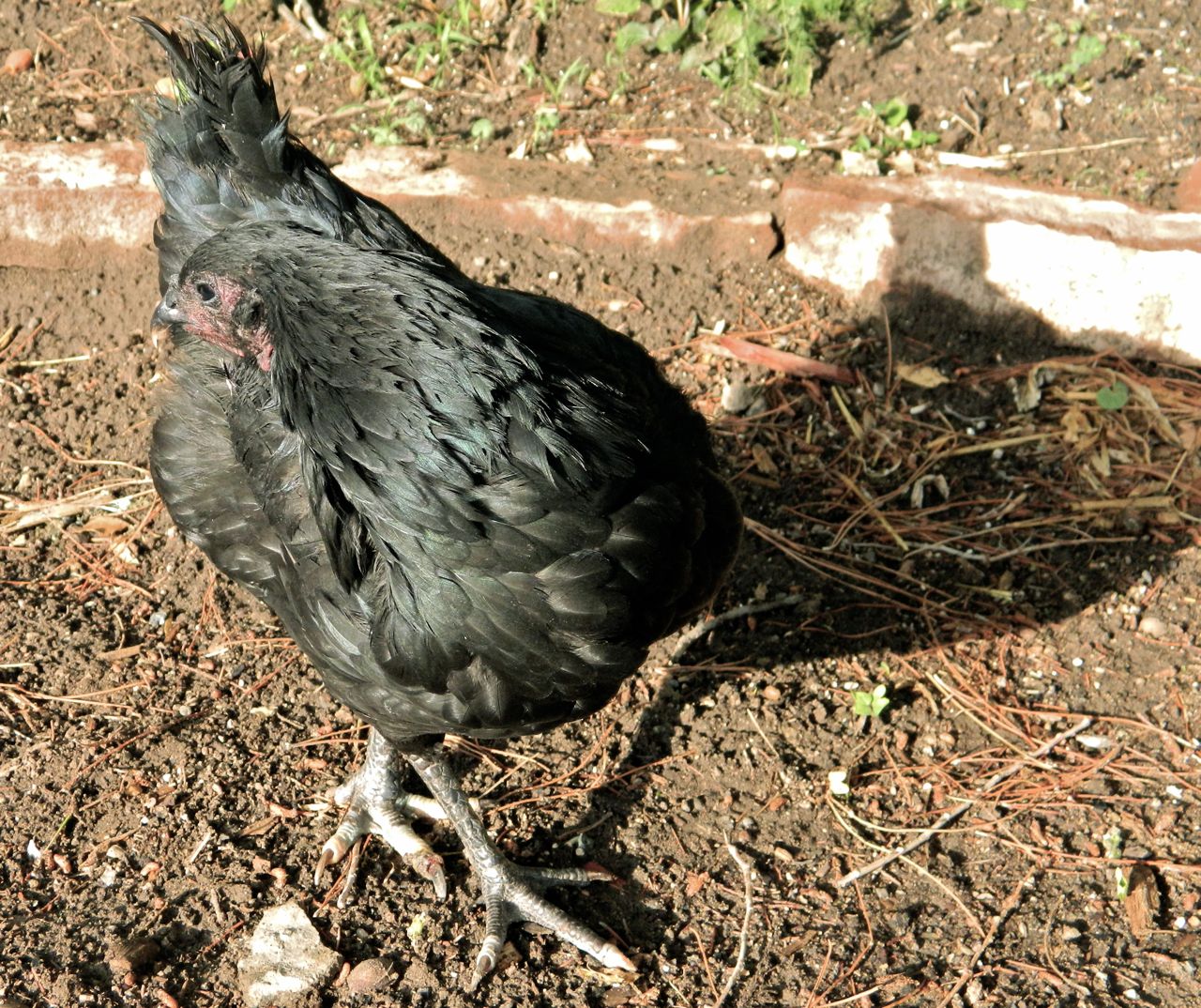
This is Rufina. She’s new to our household.
She’s quiet and doesn’t take up much space, mostly sits on her perch or in her ceramic nest all day. She moves around slowly. If you are really gentle, she lets you pick her up.
We sit by the pond together in the morning, before everyone else gets up.
Last Thursday, I answered a friend’s call on Facebook for someone to take this chicken. Isabella and I drove to my friend’s house in the South Valley, put her in a bin, and brought her home. I didn’t think she’d actually still be alive today.
My friend had posted this story Thursday morning:
The neighbor gave us fresh chickens last night for cooking up. He shot them in the head with gun and handed them over the fence. We bagged them and put in freezer for today. Evan gets home, opens freezer and one bird is perched fully alive, very cold, and pissed off.
Chase ensues… !! We now have a blind undead chicken in our yard.
Anybody want it?
I’m not sure why anyone would shoot chickens in the head.
But when I read the story, I couldn’t help but admire this chicken’s tenacity. She is courageous. She made her way out of a plastic bag inside a freezer and survived for thirty-six hours. After being shot in the head. I figured any animal that fought that hard to live deserved a little help, if only for a day or two.
The chicken hasn’t made any effort to eat like a normal chicken. Because, of course, she can’t see where to peck. (There isn’t much point in force-feeding a blind chicken.) But she does drink, so I’ve started blending up borrowed chicken food and water and giving her that. She seems content, grooming herself sometimes, showing no signs of pain or anxiety. And still, she will die.
But until then, we will enjoy each of her borrowed mornings by the pond, the sound of birds and running water, the sun on her feathers, expecting nothing.
I’m not sure why I have a blind, undead chicken in my studio. But here is one of my favorite poems, by Laura Gilpin.
The Two-Headed Calf
Tomorrow when the farm boys find this
freak of nature, they will wrap his body
in newspaper and carry him to the museum.
But tonight he is alive and in the north
field with his mother. It is a perfect
summer evening: the moon rising over
the orchard, the wind in the grass. And
as he stares into the sky, there are
twice as many stars as usual.
Now if you think that was remarkable then let me share what Laura posted a few weeks later, linked to via her Epilogue above.
ooOOoo
The Miracle of Re-Birth
by Laura Bruzzese, July 11th, 2013
Good news: it’s been three weeks since the attempted murder of Rufina, and she continues to dwell among the living!
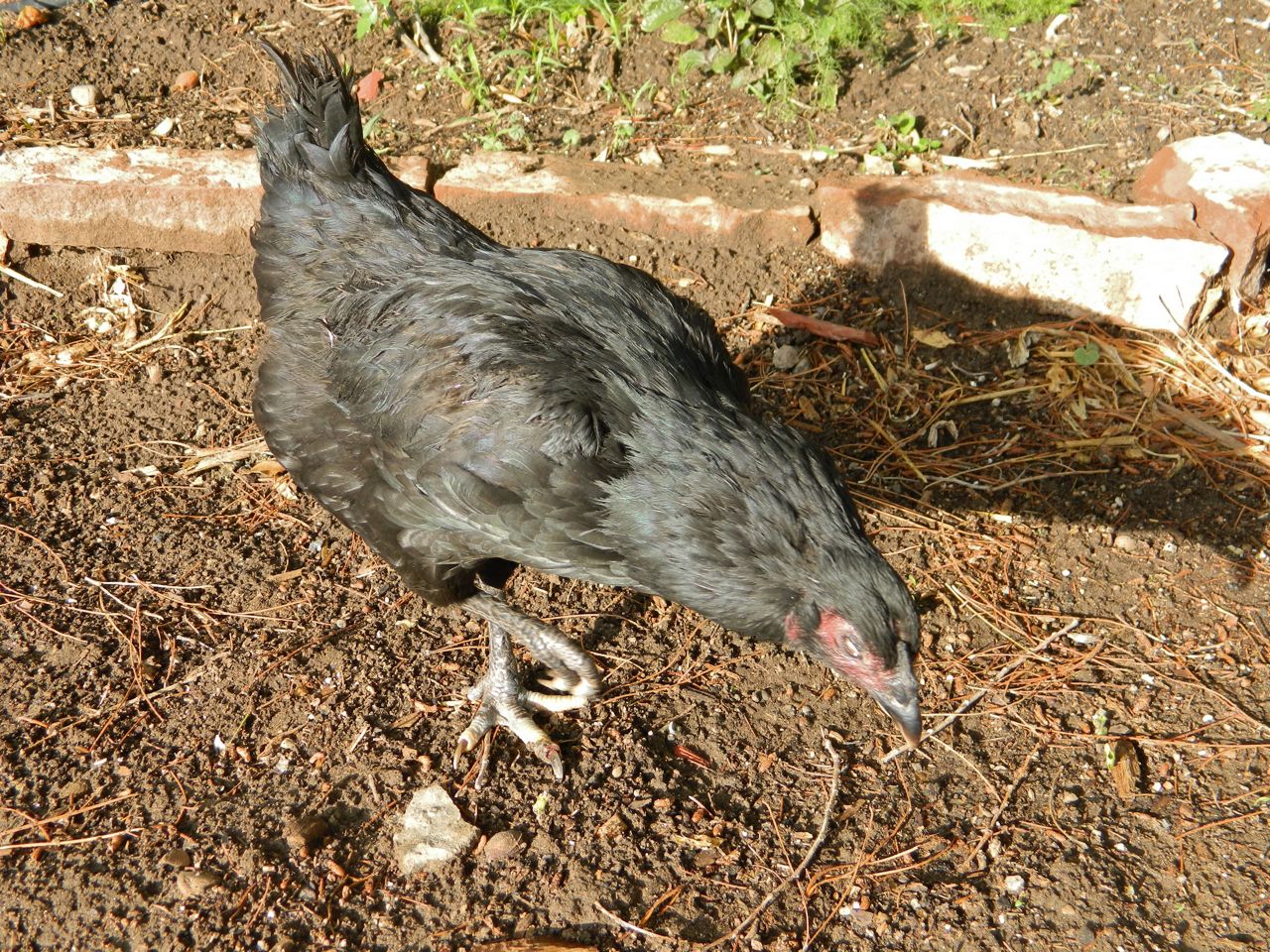
After loads of eye care, foot washing, antibiotics, food and vitamins, she has gained weight and is learning to find food and water by herself. Her remaining eye looks normal again but is still blind (I was hoping for a miracle), and the place of its former pair seems to have reached its majority in terms of healing–no eye, but no skin, either. Just a weird, green spot surrounded by red skin that looks not unlike a tiny sun-dried tomato.
But that does not prevent her daily forays into the garden where she walks around with her head craned forward to “feel” where she’s going, and from exhibiting other persisting chicken qualities that seem to evidence a contented life.
I’m still surprised, and slightly in awe of this traumatized chicken who is satisfied to reside indefinitely on my studio porch. Shiny, happy chicken.
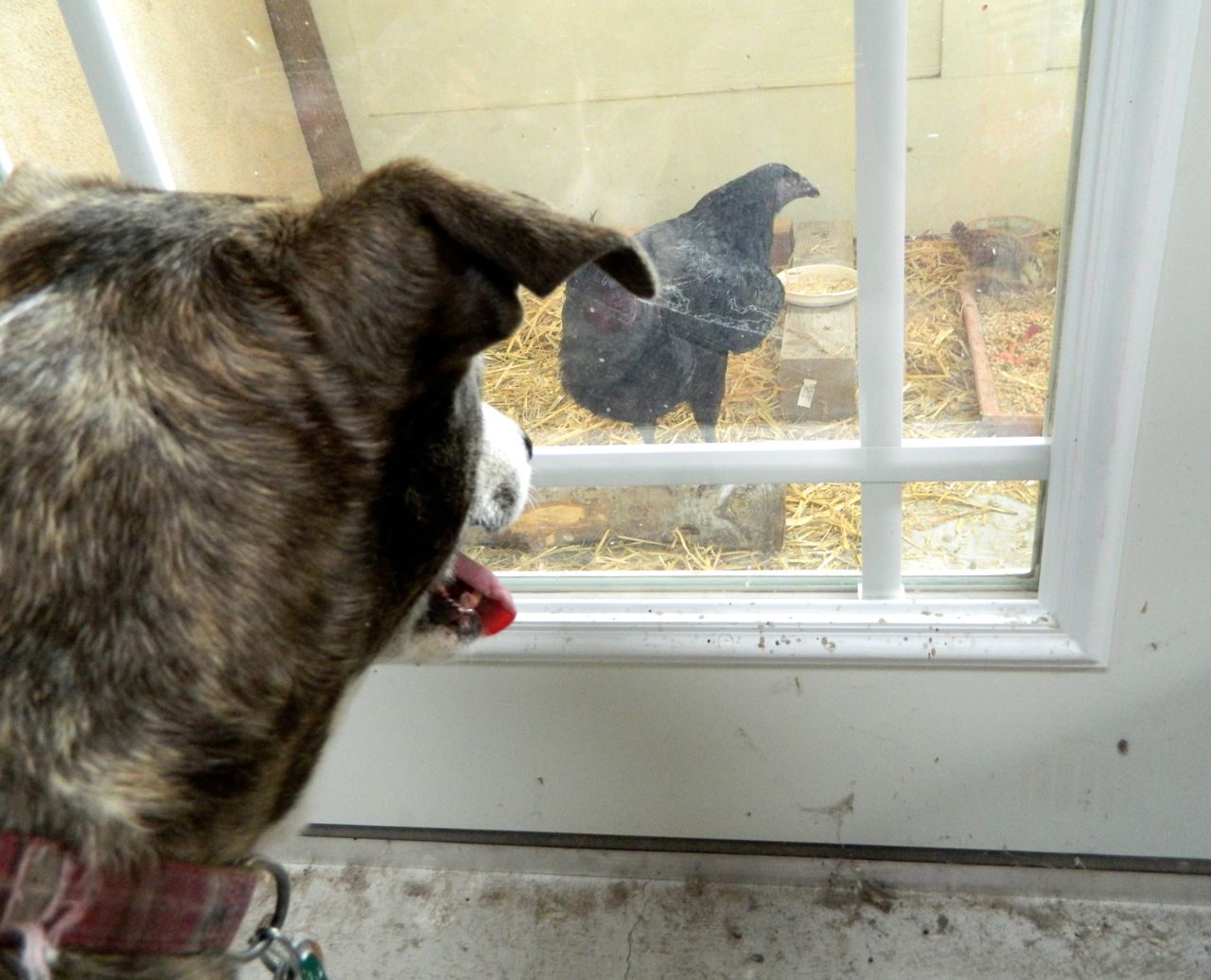
And so far, Velma the Rascally Whippet has not been the nuisance I was afraid she might be, but instead, a proud example of a bird-dog in defiance of her own natural instincts (save for one minor incident involving a tail feather. That was still attached to Rufina.). Perhaps Velma knows they are kindred spirits, she herself having survived a scary encounter with the Great Beyond earlier this year.
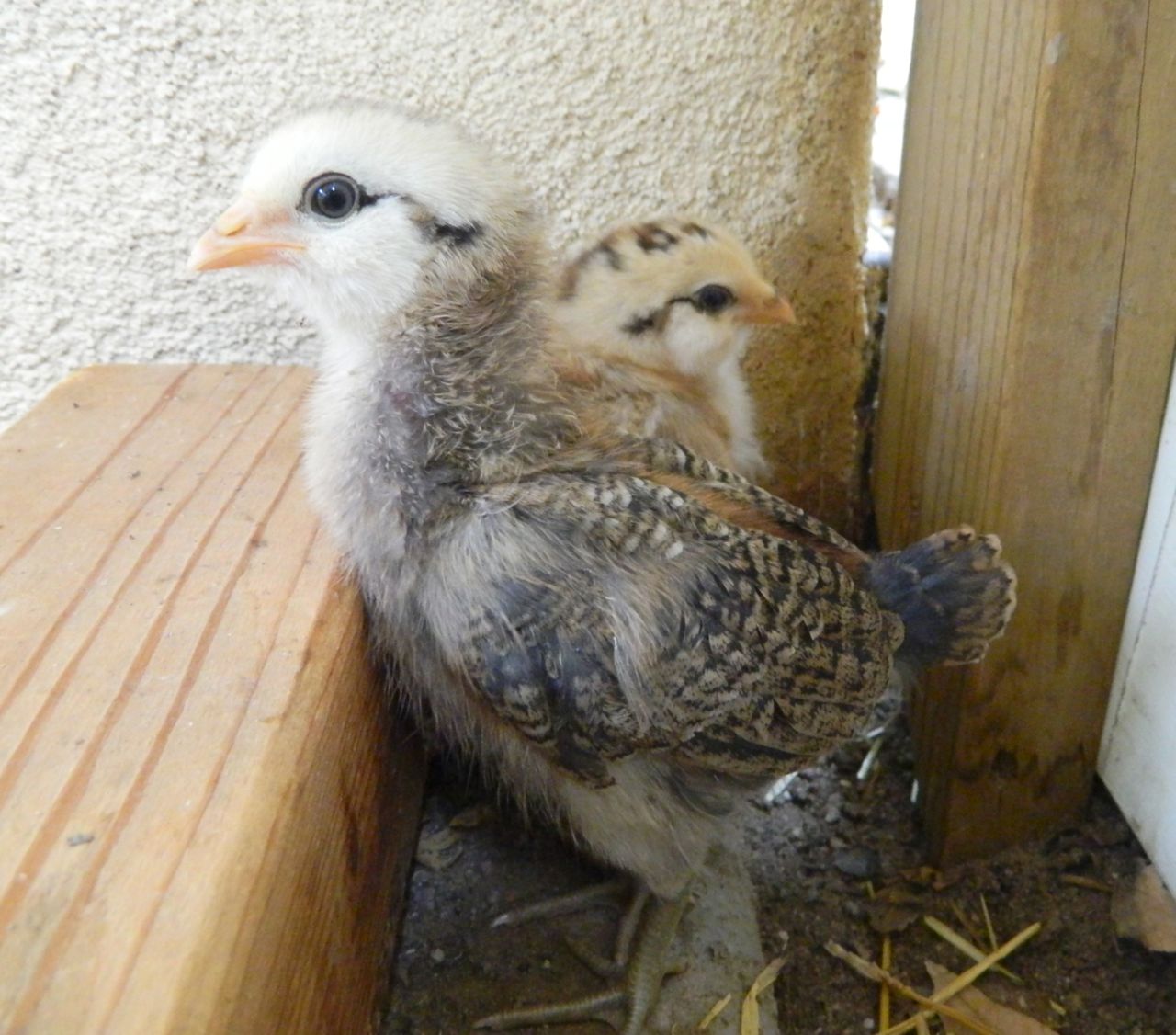
Thanks to everyone who has contributed free chicken advice, food, ER and vet consults, and even a couple of adorable, surprise chicks* (!) to keep Rufina company.
*Chicks will unfortunately be dispatched to some other venue because they are exploiting their sighted advantage: stealing food out of Rufina’s mouth, crowding the water dish, and mocking her by constantly blinking and sticking their tongues out. Also, they are filthy little creatures that walk in their own poop and then jump on me.
And finally, what’s in a name? When it became clear that chicken might live, I thought I should name her, and Rufina was the first thing that popped into my head. A few days later, I googled it to see what came up. This is what I found on Wiki:
Saints Justa and Rufina (Ruffina) (Spanish: Santa Justa y Santa Rufina) are venerated as martyrs. They are said to have been martyred at Hispalis (Seville) during the 3rd century.
Their legend states that they were sisters and natives of Seville who made fine earthenware pottery for a living, with which they supported themselves and many of the city’s poor. Justa was born in 268 AD, Rufina in 270 AD, of a poor but pious Christian family. During a pagan festival, they refused to sell their wares for use in these celebrations. In anger, locals broke all of their dishes and pots. Justina and Rufina retaliated by smashing an image of Venus.
The city’s prefect, Diogenianus, ordered them to be imprisoned. Failing to convince them to renounce their faith, he had them tortured on the rack and with iron hooks. This method also having failed, they were imprisoned, where they suffered from hunger and thirst.
They were then asked to walk barefoot to the Sierra Morena; when this did not break their resolve, they were imprisoned without water or food. Justa died first. Her body, thrown into a well, was later recovered by the bishop Sabinus. Diogenianus believed that the death of Justa would break the resolve of Rufina. However, Rufina refused to renounce her faith and was thus thrown to the lions. The lion in the amphitheatre, however, refused to attack Rufina, remaining as docile as a house cat. Infuriated, Diogenianus had Rufina strangled or beheaded and her body burned. Her body was also recovered by Sabinus and buried alongside her sister in 287 AD.
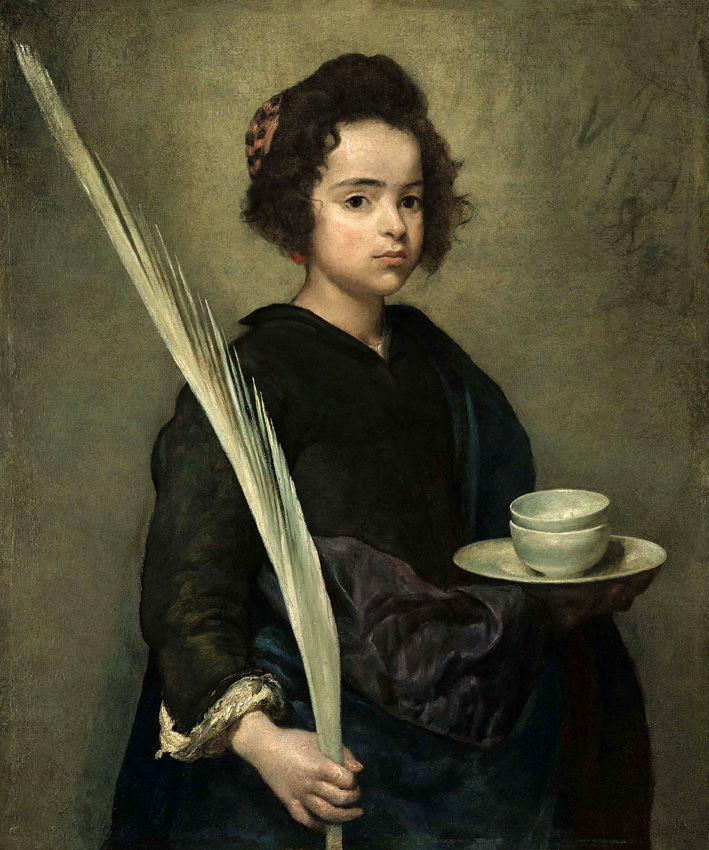
Saint Rufina, by Velázquez. See the likeness?? She’s even carrying a giant feather!
Just another name? Perhaps. Or: a dark-haired Spaniard and a Italian-New Mexican, two Christian potters separated by centuries, a saint, a chicken, and an ordinary human united in an extraordinary coincidence of the undead.
ooOOoo
Follow that!
Well I can’t but John Zande can.
For he was the first to leave a comment to Laura’s Rebirth post:
Here, i feel this song is in order. Listen carefully to the words, and who is singing them.
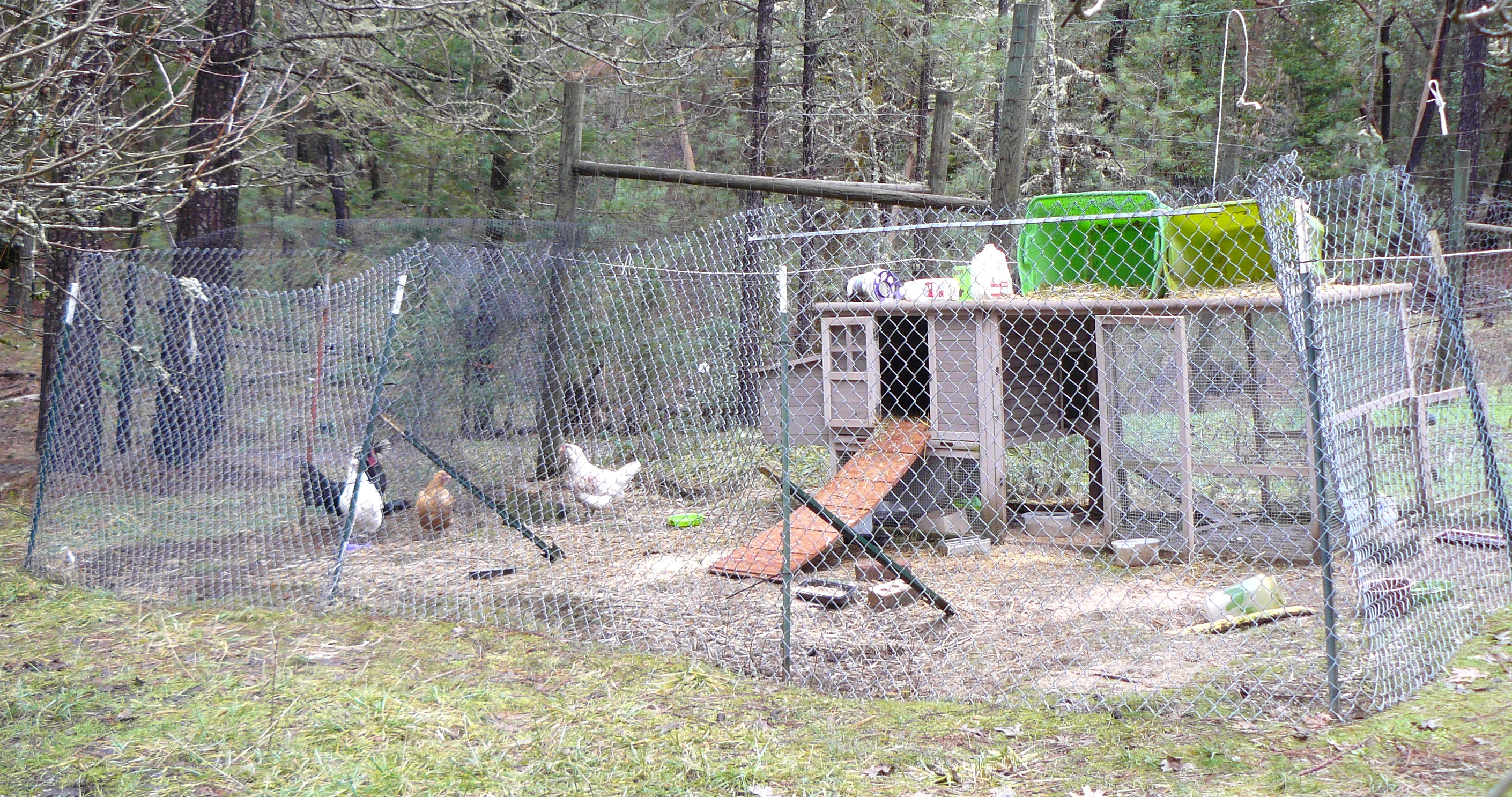
We have a rather run-down ‘home’ for our chickens close to the house. It was run-down before the snow fell and almost brought down the surrounding wire fence.
But, hopefully, this coming Thursday sees a new walk-in run being constructed for our birds so they are better protected.
It’s time we started paying attention to chickens, one of the most misunderstood and ignored species on Earth.
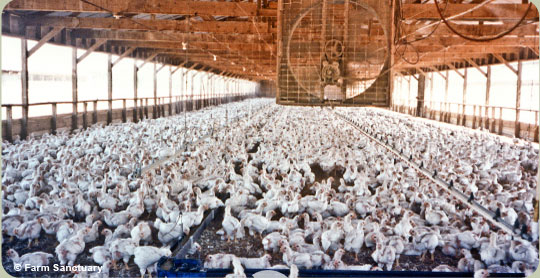
There was a time when chickens were viewed as exotic, fascinating birds. Descendants of exotic Asian jungle fowl, they were revered for their ferocity and intelligence, and domesticated around 8,000 years ago, more for cockfighting than eating. But then, we humans began eating them in ever-larger quantities, until we reached the point where we are now, with 20 billion (mostly white) chickens living in dirty, crowded barns, awaiting slaughter.
Chickens have been a part of human lives for millennia, and yet they are one of the most misunderstood, if not ignored, species on Earth. Lori Marino, an American neuroscientist and animal intelligence researcher, wants to change this. She is intrigued by the fact that chickens are so rarely recognized for their cognitive abilities and frustrated that studies about birds almost always focus on other, less-domesticated species, like crows and parrots.
“Arguably even the scientific community has been influenced by public perceptions of chickens as cognitively simple… This asymmetry in the literature is likely a reflection of, as well as a contributor to, the disconnect scientists and the public have between chickens as commodities and who they actually are as individuals.”
Chickens deserve more attention, and here are some quirky, interesting facts to get you thinking about chickens less as food and more as fascinating co-inhabitants of our world. These come via Marino’s recent paper, “Thinking Chickens,” published online in Animal Cognition in January 2017.
1. Chickens are a sub-species of the red jungle fowl that hails from southeast Asia.
The red jungle fowl (galls gallus) inhabit the edges of fields, scrubland, and groves. Domestication was well established 8,000 years ago, but some records suggest it could have started as much as 58,000 years ago.
2. Domestic chickens are similar to their wild counterparts.
Despite the intense breeding and genetic manipulation of recent years, chickens have not been cognitively or behaviorally affected by domestication. This stands in contrast to dogs and wolves, for example, which have diverged significantly due to domestication. Nor have chickens become less aggressive toward predators through domestication, which is a common outcome; in fact, some chickens are more aggressive even than red jungle fowl.
3. A chicken’s beak is highly sensitive to touch.
The beak, with numerous nerve endings, is used to explore, detect, drink, preen, and defend. This also means that when a bird is de-beaked, as often happens in industrial farming, it experiences great pain, sometimes for months, which changes its behavior. Marino writes, “At the end of the beak is a specialized cluster of highly sensitive mechanoreceptors, called the bill tip organ, which allows chickens to make fine tactile discriminations.”
4. Chickens have finely tuned senses.
They can see long distance and close-up at the same time in different parts of their vision. They can see a broader range of colors than humans. They can hear at low and high frequencies at a variety of pressure levels. They possess well-developed senses of taste and smell. They can orient to magnetic fields, like many other birds.
5. Chickens are surprisingly good at math.
Three-day-old chicks are able to perform basic arithmetic and discriminate quantities, always opting to explore a set of balls with the greater number, even when an object was visibly transferred from one set to another. Five-day-old chicks have been found to track up to five objects.
“When they were presented with two sets of objects of different quantities disappearing behind two screens, they were able to successfully track which screen hid the larger number by apparently performing simple addition and subtraction.”
6. Chickens can exercise self-control.
In an experimental setting, chickens have been given the choice between 2-second delay with 6 seconds of access to food, versus a 6-second delay with 22-seconds of access to food. The hens waited for the longer reward, “demonstrating rational discrimination between different future outcomes while employing self-control to optimize those outcomes.” Self-control usually doesn’t appear in humans until four years of age.
These are just a few of the remarkable discoveries described in Marino’s study, a highly readable, entertaining paper. It’s an important reminder that chickens, arguably the most ubiquitous animals in our world, deserve far more respect than they currently receive. Hopefully this will lead to more people questioning the horrific conditions in which most of them are kept.
It’s easy to fall into the trap of looking for a humourous way to close today’s post. But a more responsible approach would be to repeat the words from the start of the article to serve as a reminder of trying, wherever possible, to think about the food we eat, especially when animals and birds have to be slaughtered to provide us with that food.
…. we reached the point where we are now, with 20 billion (mostly white) chickens living in dirty, crowded barns, awaiting slaughter.
But please don’t leave this page until you have watched the following video.
Published on Dec 3, 2014
After 22 years of raising chickens for Perdue, one brave factory farmer Craig Watts was at his breaking point and did something no one has done before. He invited us, as farm animal welfare advocates, to his farm to film and tell his story. Ask your supermarket for Better Chicken at http://better-chicken.org.
Delighted to introduce Kevin Davies and his guest post.
Regular followers of this place will know that whenever I can I do offer space for a guest blogger. I regret that so many of the persons that ask if I accept guest posts are trying to flog something to you all!
But not Kevin. Here’s a little about him, as supplied by Kevin.
Life can be quite boring without any pets in your life. They can make your day filled with joy, make you smile when you are sad.
My name is Kevin Davies and I am pet lover. The reason why I started this website (https://petloverguy.com) is that I want to share my experience which I have. I can’t imagine my life without pets.
I have always had them since I was little. The first one me and my family had was a cat. Her name was Jenny. She was a Siamese cat with ocean blue eyes, her head was brown with a little bit of white specks, and the rest of her body was white. She was always nice to me, sat in my lap every day and when I petted her she always purred. I lost Jenny when I was 8 and it made me so sad. Actually it still makes me sad and I have never forgotten about her.
ooOOoo
Should I Shave My Dog for the Summer?
by Kevin Davies
It’s a question I hear all the time from pet parents, especially those with relatively long-haired, thick-coated dogs. Should I shave my dog for the summer? Will it make him more comfortable?
Obviously, if your dog is a Poodle, a Shih Tzu, a Lhasa Apso, or another of the “non-shedding” breeds, it’s perfectly fine to shave your dog. But what about the other breeds that aren’t typically shaved for grooming purposes? Can shaving them during the summer months make them more comfortable or will it create problems for them? We’re talking primarily here about long-haired dogs. Chows are a good example though certainly not the only breed in question. The answer is not clear cut and, likely if you ask six different people, you’ll get six different opinions.
There are two lines of thought in this situation. The first line of thought is that the haircoat acts to trap the cooler hair next to the skin and keep the dog cooler. In other words, it works as insulation. The other line of thought is that the fur simply acts like a coat would for a human, making the dog warmer than is necessary.
Frankly, science doesn’t have all the answers to these questions. What we do know is that dogs loose excess heat primarily through panting rather than through the skin. So your dog won’t “sweat” off excess heat like people do, even if shaved. Of course, that doesn’t mean that shaving your dog might not still provide some welcome relief from the heat.
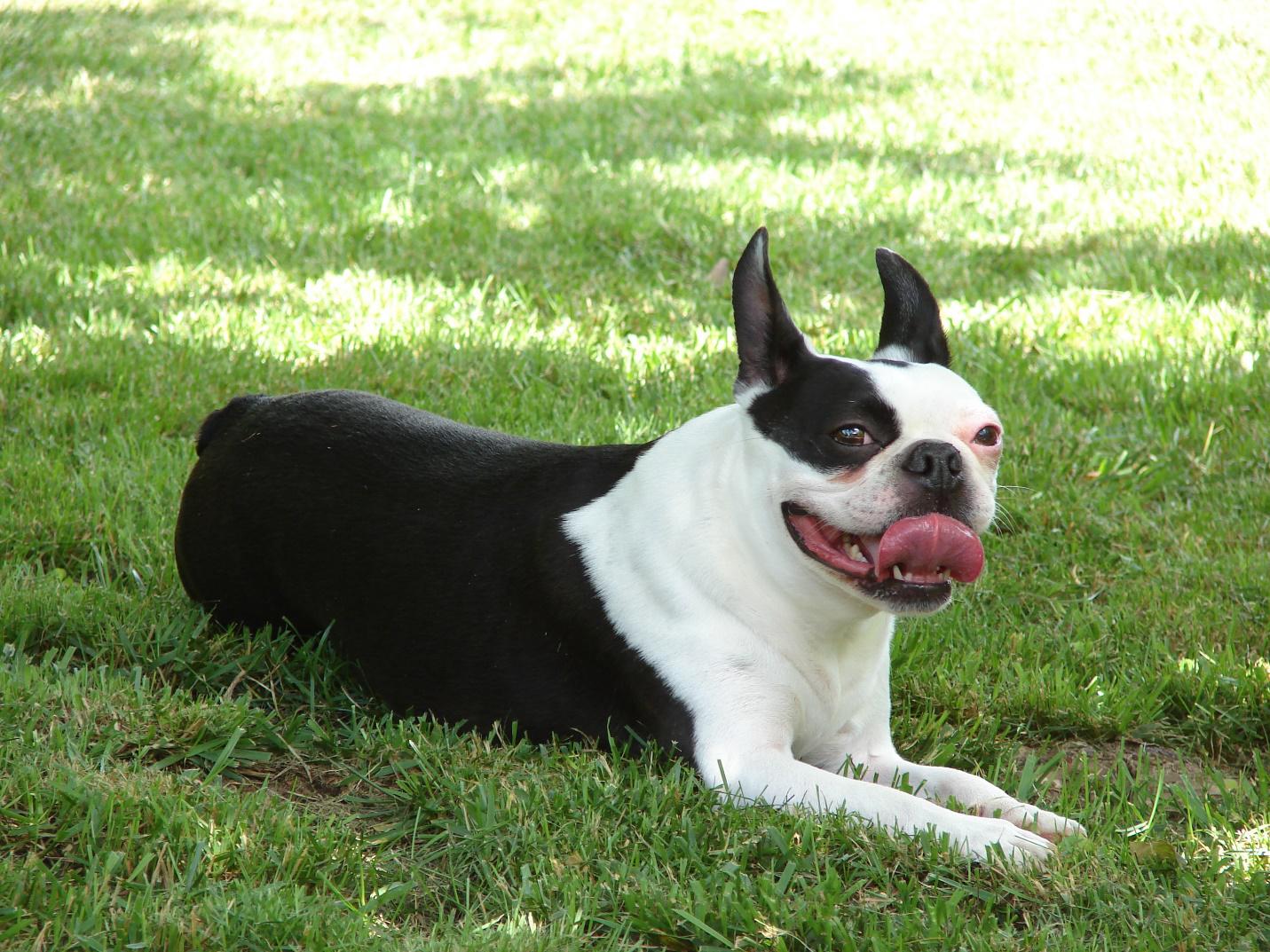
Obviously, there are differences between breeds when it comes to heat tolerance. Likely, there are differences between individual dogs as well. It’s been postulated that black absorbs heat whereas white reflects it. Therefore, dark colored dogs may be less tolerant to heat than lighter colored dogs. I’m not sure whether there’s any truth to that. There are no scientific studies that I know of to prove or disprove the theory. But, from a logical standpoint, it makes sense (to me, anyway).
What does all this mean to you, the dog owner? Should you shave your dog for summer?
I can’t give you a definitive “yes” or “no” answer. What makes sense to me is finding out what works best for your dog. Try shaving your dog and see if he seems more comfortable that way. The hair will grow back quickly for most dogs (more on that in a moment) and, if shaving doesn’t make your dog more comfortable, you don’t have to do it again.
How close should you shave your dog?
I worry about excess exposure to the sun, which may cause sunburn or even contribute to melanomas and other skin diseases. Therefore, I would leave enough fur to provide some protection rather than shaving your dog all the way down to the skin. How close should you trim? Leave perhaps 1/2 inch to an inch of hair length.
There’s one other thing that you should be aware of before you shave your dog though. In most cases, the hair will grow back perfectly normally after shaving. But, in a small number of cases, it may not. This may be remedied in some dogs with the administration of thyroid hormones and/or melatonin. However, not all dogs will respond favorably to these drugs either.
One last precaution: Even if your dog is shaved, you will still need to tailor your dog’s exercise to your individual dog’s situation. Hard exercise (i.e. marathon running, etc.) in hot temperatures is not appropriate for all dogs. Consider your dog’s physical condition and conformation and don’t overdo in the warm weather.
ooOOoo
Don’t know about you but we found that interesting.
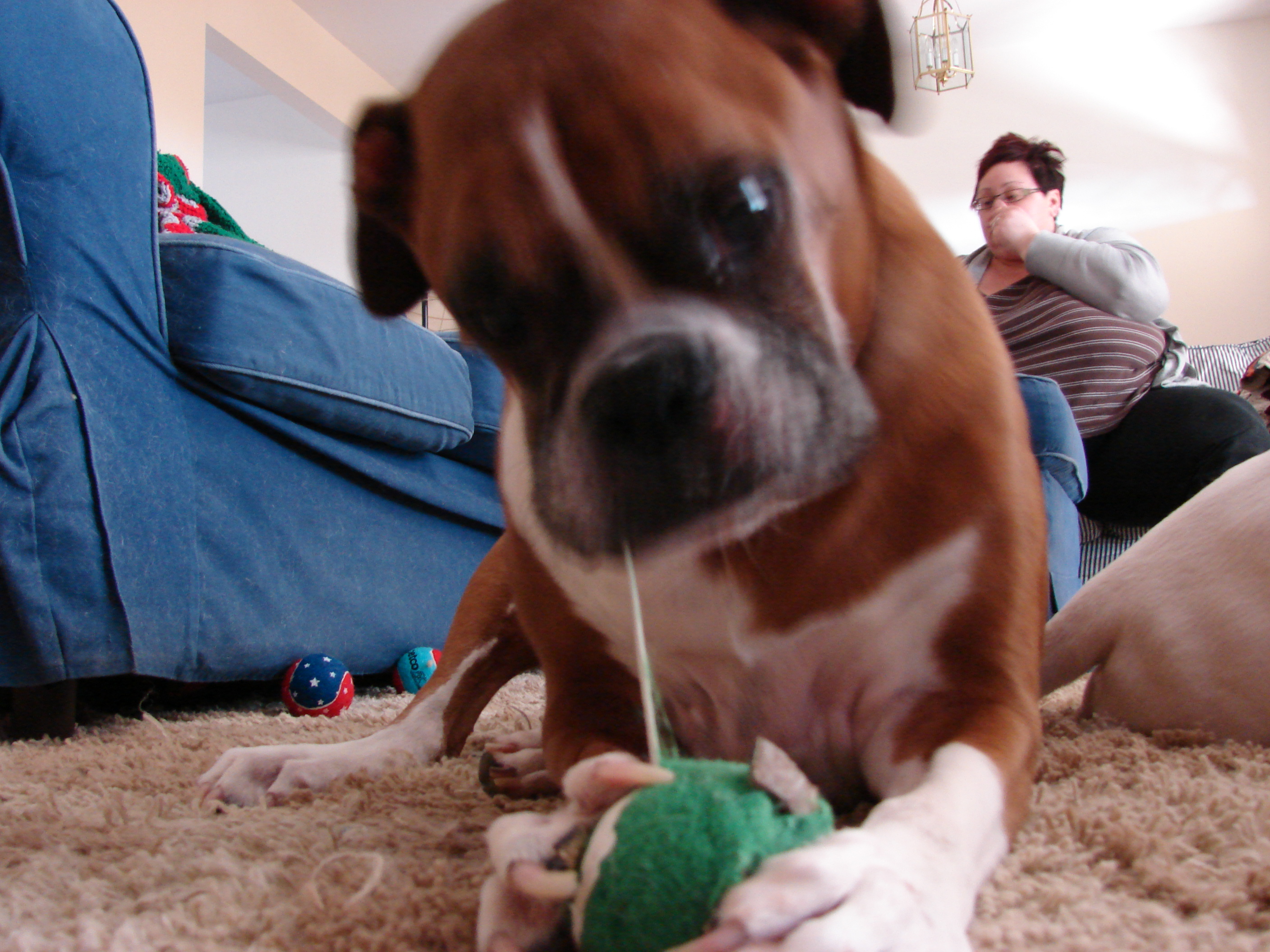 Once upon a time, there lived a beautiful Boxer named Sophie. My husband fell in love with her at first sight. He had to talk me into taking her home. It didn’t take long for me to see the light. The next thing I know I was carrying her in my arms.
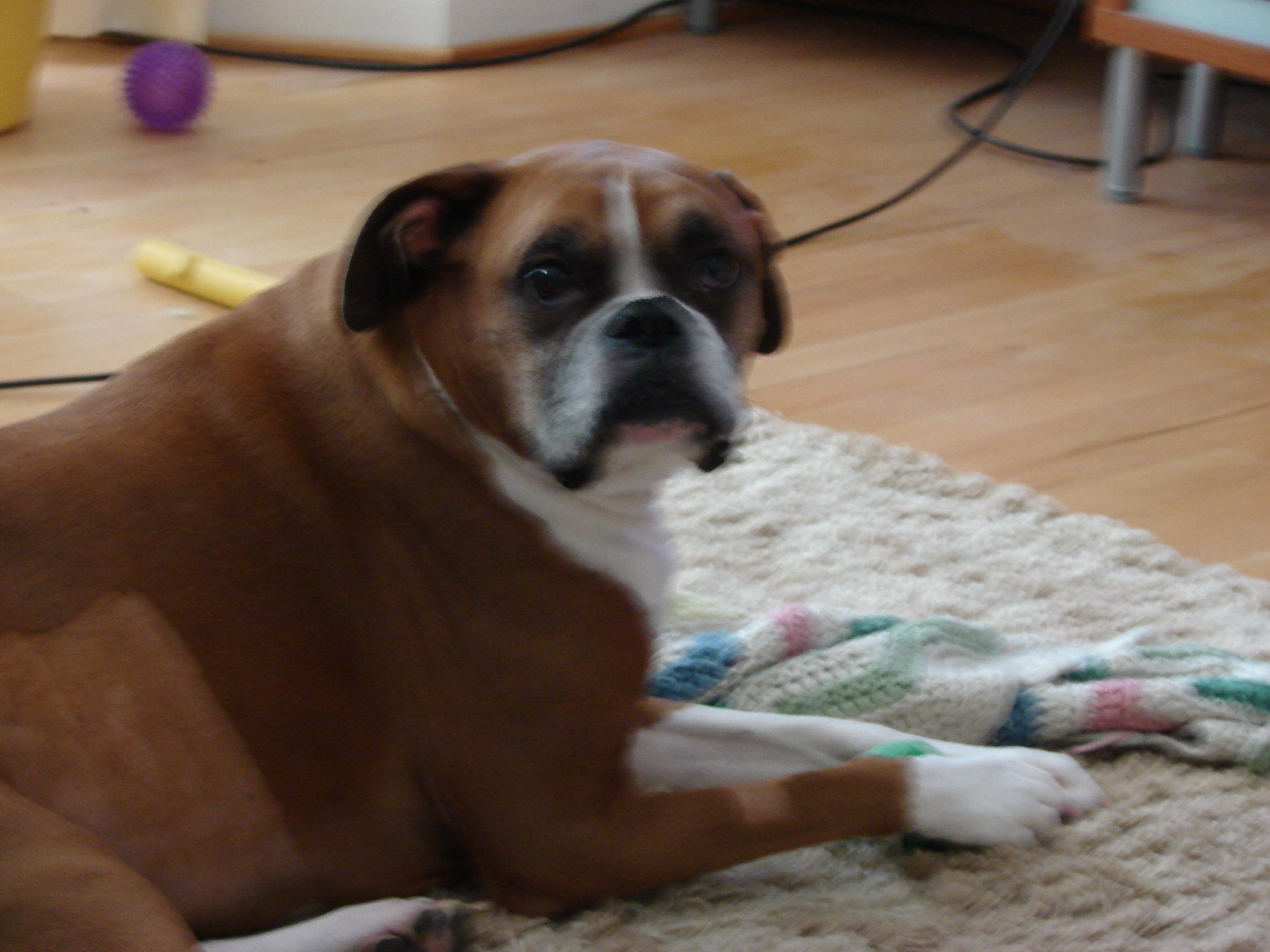 The vet had her on steroids and there for a time she returned to her happy-go-lucky Boxer self. We were fortunate to give her one last Christmas.
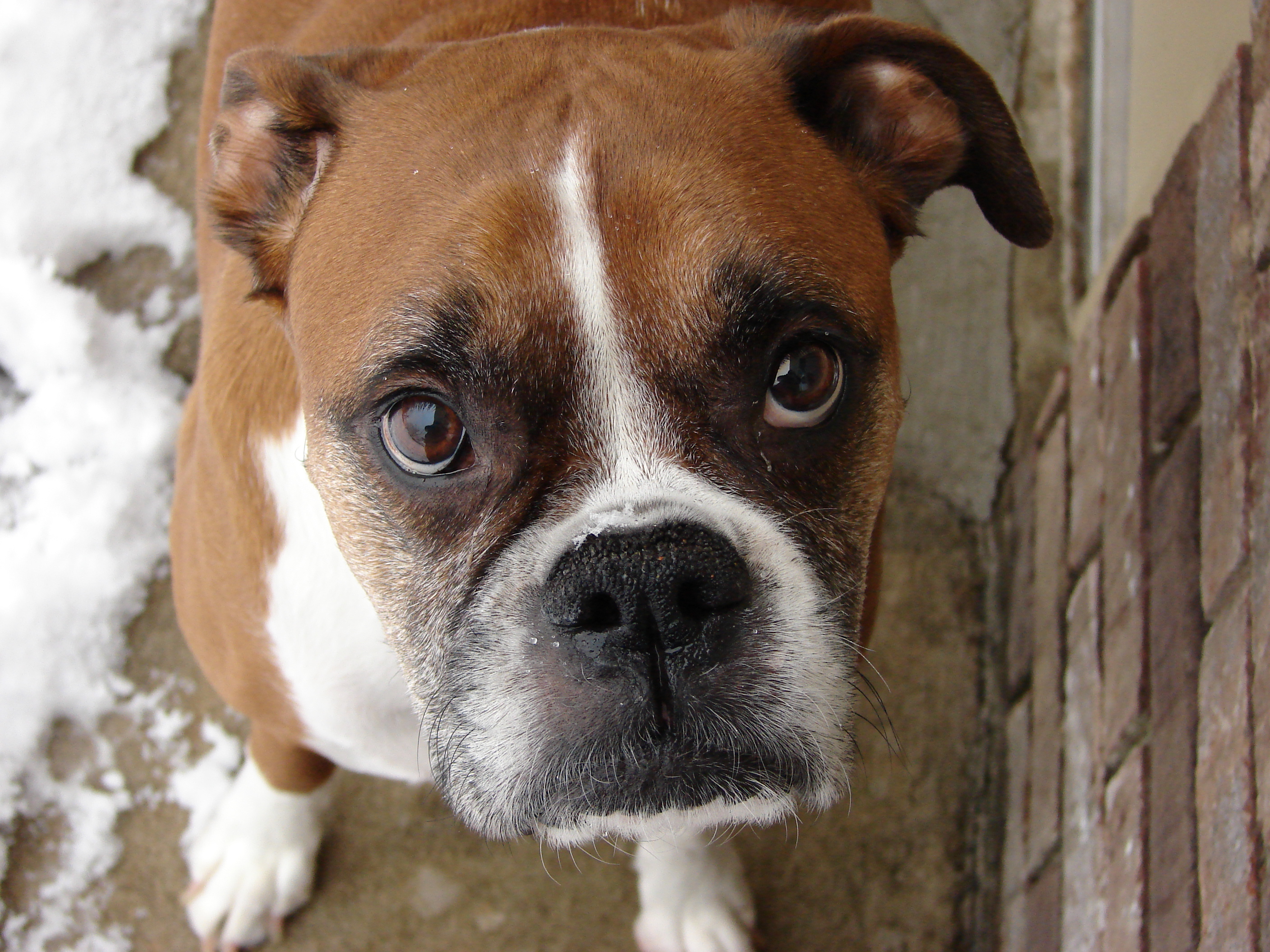 Thank you for allowing us to remember those companions that have crossed over the Rainbow Bridge. They will always be in our hearts.






 Learning from Dogs