Category: Writing

Foreboding times?

Something brooding in the air!

The smoke from the forest fires in Oregon and California has been thick in the air here in Merlin for days.

As can be seen in the photograph below. The photograph is as it was captured by the camera at 7:15 am yesterday morning. No changes by me made at all. The middle tree line is at the Eastern end of our property about a 1/4 mile away.

We are fed up with the smoke and the terrible air conditions.

But what drew me to grab the camera and take the photograph was that the image had some sort of, Oh, I don’t know, some sort of end of the world feeling about it.

It also seemed a most apt image to be an introduction to the latest essay from George Monbiot. It is republished here with Mr. Monbiot’s kind permission.

ooOOoo

Don’t Look Now

2nd September 2017

The media avoids the subject of climate breakdown – to do otherwise is to bring the entire infrastructure of thought crashing down

By George Monbiot, published in the Guardian 29 August 2017

It is not only Donald Trump’s government that censors the discussion of climate change; it is the entire body of polite opinion. This is why, though the links are clear and obvious, the majority of news reports on Hurricane Harvey have made no mention of the human contribution.

In 2016, the United States elected a president who believes that human-driven global warming is a hoax. It was the hottest year on record, in which the US was hammered by a series of climate-related disasters. Yet the total combined coverage for the entire year on the evening and Sunday news programmes on ABC, CBS, NBC and Fox News amounted to 50 minutes. Our greatest predicament, the issue that will define our lives, has been blotted from our minds.

This is not an accident. But nor (with the exception of Fox News) is it likely to be a matter of policy. It reflects a deeply ingrained and scarcely conscious self-censorship. Reporters and editors ignore the subject because they have an instinct for avoiding trouble. To talk about climate breakdown (which in my view is a better term than the curiously bland labels we attach to this crisis) is to question not only Donald Trump, not only current environmental policy, not only current economic policy, but the entire political and economic system.

It is to expose a programme that relies on robbing the future to fuel the present, that demands perpetual growth on a finite planet. It is to challenge the very basis of capitalism; to inform us that our lives are dominated by a system that cannot be sustained, a system that is destined, if it is not replaced, to destroy everything.

To claim that there is no link between climate breakdown and the severity of Hurricane Harvey is like claiming that there is no link between the warm summer we have experienced and the end of the last ice age. Every aspect of our weather is affected by the fact that global temperatures rose by around 4° between the ice age and the 19th Century. And every aspect of our weather is affected by the 1° of global warming caused by human activities. While no weather event can be blamed solely on human-driven warming, no weather event is unaffected by it.

We know that the severity and impact of hurricanes on coastal cities are exacerbated by at least two factors: higher sea levels, caused primarily by the thermal expansion of seawater, and greater storm intensity, caused by higher sea temperatures and the ability of warm air to hold more water than cold air.

Before it reached the Gulf of Mexico, Harvey had been demoted from a tropical storm to a tropical wave. But as it reached the Gulf, whose temperatures this month have been far above average, it was upgraded first to a tropical depression, then to a category 1 hurricane. It might have been expected to weaken as it approached the coast, as hurricanes churn the sea, bringing cooler waters to the surface. But the water it brought up from 100 metres and more was also unusually warm. By the time it reached land, Harvey had intensified to a category 4 hurricane.

We were warned about this. In June, for example, Robert Kopp, a professor of earth sciences, predicted that “In the absence of major efforts to reduce emissions and strengthen resilience, the Gulf Coast will take a massive hit. Its exposure to sea-level rise – made worse by potentially stronger hurricanes – poses a major risk to its communities.”

To raise this issue, I’ve been told on social media, is to politicise Hurricane Harvey. It is an insult to the victims and a distraction from their urgent need. The proper time to discuss it is when people have rebuilt their homes, and scientists have been able to conduct an analysis of just how great the contribution from climate breakdown might have been. In other words, talk about it only when it’s out of the news. When researchers determined, 9 years on, that human activity had made a significant contribution to Hurricane Katrina, the information scarcely registered.

I believe it is the silence that’s political. To report the storm as if it were a entirely natural phenomenon, like last week’s eclipse of the sun, is to take a position. By failing to make the obvious link and talk about climate breakdown, media organisations ensure that our greatest challenge goes unanswered. They help push the world towards catastrophe.

Hurricane Harvey offers a glimpse of a likely global future; a future whose average temperatures are as different from ours as ours are from those of the last ice age. It is a future in which emergency becomes the norm and no state has the capacity to respond. It is a future in which, as a paper in the journal Environmental Research Letters notes, disasters like Houston’s occur in some cities several times a year. It is a future that, for people in countries such as Bangladesh, has already arrived, almost unremarked by the rich world’s media. It is the act of not talking that makes this nightmare likely to materialise.

In Texas, the connection could scarcely be more apparent. The storm ripped through the oil fields, forcing rigs and refineries to shut down, including those owned by some of the 25 companies that have produced over half the greenhouse gas emissions humans have released since the start of the Industrial Revolution. Hurricane Harvey has devastated a place in which climate breakdown is generated, and in which the policies that prevent it from being addressed are formulated.

Like Donald Trump, who denies human-driven global warming, but who wants to build a wall around his golf resort in Ireland to protect it from the rising seas, these companies, some of which have spent millions sponsoring climate deniers, have progressively raised the height of their platforms in the Gulf of Mexico, in response to warnings about higher seas and stronger storms. They have grown from 40 feet above sea level in 1940, to 70ft in the 1990s, to 91ft today.

This is not, however, a story of mortal justice. In Houston, as everywhere else, it is generally the poorer communities, that are least responsible for the problem, who are hit first and hit worst. But the connection between cause and effect should appeal to even the slowest minds.

The problem is not confined to the United States. Across the world, the issue that hangs over every aspect of our lives is marginalised, except on the rare occasions on which world leaders gather to discuss it in sombre tones (then sombrely agree to do almost nothing), whereupon the instinct to follow the machinations of power overrides the instinct to avoid a troubling subject. When they do cover the issue, they tend to mangle it. In the UK, the BBC distinguished itself in customary fashion this month, by yet again inviting the climate change denier Lord Lawson onto the Today programme, in the mistaken belief that impartiality requires a balance between correct facts and false ones. They seldom make such a mess of other topics, because they take them more seriously.

When Trump’s enforcers instruct officials and scientists to purge any mention of climate change from their publications, we are scandalised. But when the media does it, without the need for a memo, we let it pass. This censorship is invisible even to the perpetrators, woven into the fabric of organisations that are constitutionally destined to leave the major questions of our times unasked. To acknowledge this issue is to challenge everything. To challenge everything is to become an outcast.

www.monbiot.com

ooOOoo

Dear people, I sat staring at the screen for 10 minutes and then went off when Jeannie called lunchtime. Returned to the screen a little after 2pm yesterday and still couldn’t come up with a closing thought that merited being shared with you all.

See you tomorrow!

Returning to diet!

Another fabulous guest post.

Just a few days ago I was contacted by June Frazier who offered me (and all of you!) a couple of topics for a guest post to be written by June. The two topics were 5 Common Winter Illnesses in Dogs (And How To Treat Them) and Why Now Is The Right Time To Change Your Dog’s Diet.
Of course I said ‘Yes’ and chose the second one thinking it was a tad too early for a post about Winter illnesses.

Here it is.

ooOOoo

Why Now Is The Right Time To Change Your Dog’s Diet.

3 Critical Signs That You Need To Change

by June Frazier.

Today, 96% of all dog owners in the world feed their dog’s commercial pet food. A good number of this population believes that the dried pet food is all their dog needs to stay healthy. Hence, the dogs are fed one type of food all the time.

In fact, they never consider introducing their dog to the many homemade dog food recipes available. Many dog owners are unaware of the fact that as a dog’s body changes, it requires different diets to stay healthy. If you are one of these dog owners, it is time to change your dog’s diet.

Three major reasons why now is the right time to change your dog’s diet:

1. The Age of the dog

As your dog ages, he needs extra diet considerations to stay nimble. At the age of 5, your dog is considered to be middle aged. You need to change their diet at this point as they need fewer calories and more fiber. This is because middle aged dogs are less active and their new lifestyle does not require the same diet they were on when they were younger. In addition, high calorie foods may do them more harm than good. Also, avoid giving your dog too much protein since it can damage his liver and kidneys.

Feed your dog with the right food that will benefit his joints to stay stronger, or foods that have plenty of antioxidants. Your middle aged dog may also need supplements to keep his joints and organs working optimally.

2. Obesity

Most dog parents do not realize that even in moderation, some food types contribute more to their pet’s weight than others. When your dog starts to put on a few extra pounds in their midsection, this is a clear indication that you need to change his diet.

The additional weight can easily slow down your dog. Obesity in dogs also opens them up to a variety of potential health problems. Change his diet to foods that can give them all the essential nutrients, vitamins and minerals without adding some extra kilos.

There are special diets for dogs that are specially designated for weight loss. These diets take advantage of the latest research in pet weight management, to ensure your dog leads a healthy, happier life. If your pet dog is extremely overweight, you are advised to consult with your veterinarian for a detailed and therapeutic nutritional solution.

3. Allergies and Skin conditions

On average, an itchy dog is an allergic dog. Most times, the reason behind their allergy and skin condition is their food or environment. You need to switch your dog’s diet to something a little simpler or less processed food.

In a case of an allergy, vets prescribe non-allergen diets or foods that do not trigger your dog’s allergic reaction. Homemade dog food recipes are ideal as you can mix the ingredients on your own as well as do an easy control experiment to figure out which foods cause his allergy. Also, make sure to alter one food ingredient per time until you get the culprit.

Although the transition may take a long time before you figure out what your dog is allergic to, the diet you end up with will be far healthier and nutritional to help him lead a better life. You can also take your dog to the vet to find out more about their allergy and skin condition.

Sometimes, the reason behind your dog’s skin condition may be due to a deficient diet. If your dog has a dull, matted coat, make sure you feed your dog foods rich in Omega-3 fatty acids to help improve their coat quality and gastric health.

Choosing the right food for your pet is essential for your dog’s long-term health. However, it is not a substitute for medical care.

Make sure you visit a veterinarian on a regular basis to ensure your pet is healthy and happy. Along with your new diet, make sure your dog has plenty of fresh, clean water available at all times.

It is also advisable that you change your dog’s diet gradually and systematically. Substitute a little of the new diet with the old food. Swap out a little more of the old with the new until your dog is comfortable with the new diet.

ooOOoo

No question in my mind that this was a useful and informative article. I did ask June to offer a little about herself and this is what she wrote me:

June is the founder of the blog Toby’s Bone where she shares her passion for writing and love for dogs. She wants to help you deal with your dog’s behavior issues, grooming and health needs, and proper training. Through her blog, you can find informative and reliable posts, tips and tricks, and a lot of interesting reads that will help you maintain a close bond with your furry companion.

Well this gets my vote and I sincerely hope this isn’t the last time we hear from June.

Picture Parade Two Hundred and Ten

Pictures of Casper.

(All will become clear shortly!)

Dear friend of this place, Margaret K. from Tasmania (MargfromTassie), recently sent me an email with a link to a story that had appeared on the BBC website.

I thought the photographs would make a fabulous Picture Parade.

But first sufficient of the news story for the photographs to be seen in proper context.

Meet Scotland’s ‘most well-travelled dog’

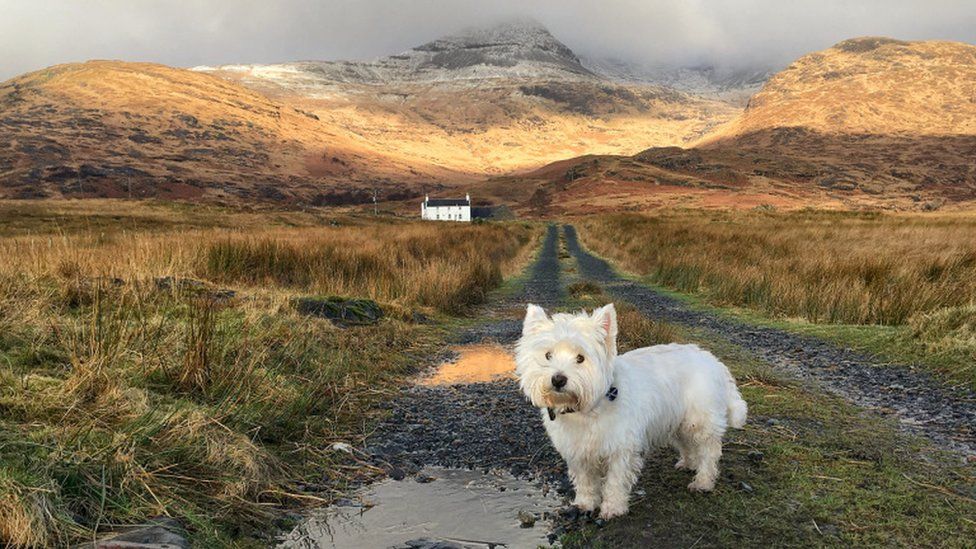
After photographs of her West Highland Terrier received more “likes” on social media than even the most stunning Glencoe landscapes she could capture, Sam Grant conceded that “the wee white dug” should star in her Scottish travel blog.

“Casper is my unique selling point,” says Sam Grant, an Edinburgh-based VisitScotland ambassador who spends her spare time travelling the country with her pet.

She adds: “There are lots of travel bloggers out there who are very good writers, but they don’t have the wee white dug.”

Here are almost all of those photographs that the BBC presented.

You will love them.

Please note that all of the photographs were taken by Sam Grant who, I am sure, retains copyright ownership of them. Sam’s blogsite is Scotland With The Wee White Dug and well worth a visit.

The village of Crianlarich is located in Glen Strathfillan to the north of the Trossachs, around eight miles north of the head of Loch Lomond

oooo

The village of Carrbridge, in the Scottish Highlands is famous for its 18th Century packhorse bridge.

oooo

Whiting Bay, Isle of Arran, offers views across to Holy Isle.

oooo

Culzean Castle is perched on the Ayrshire cliffs.

oooo

Culloden Moor in the Highlands is where the Battle of Culloden took place in 1746.

oooo

Iona, Inner Hebrides, is often described as a “tiny island paradise”.

oooo

The Tomb of the Eagles, Orkney, is thought to be more than 5,000 years old.

oooo

North Berwick, East Lothian, boasts many great beaches and coastal scenery.

oooo

“Dolphin Spirit” is a boat to take tourists onto the waters of the inner Moray Firth to see the dolphin pods.

oooo

Bow Fiddle Rock is a natural sea arch near Portknockie on the north-eastern coast of Scotland.

oooo

Kilchurn Castle is a ruined castle on a rocky peninsula at the northeastern end of Loch Awe, Argyll and Bute.

oooo

Snow capped Ben More in Glen More, Isle of Mull, Western Isles.

oooo

Balnakeil Bay is near Durness, Scottish Highlands.

I can’t resist including the rest of the text that the BBC published for the photographs are strengthened enormously by Sam’s words.

Her eccentric website details places of interest in areas including Orkney, Loch Lomond and the Scottish Borders.

It was launched in 2015 after an Instagram account written from Casper’s perspective proved popular with followers.

The social media profile has nearly 4,000 followers, who Sam says “can’t get enough” of the wee white dug’s quirky anecdotes about his travels.

Sam says travelling with Casper has given her lots of insight into Scotland’s best pet-friendly tourist attractions and holiday accommodation.

She says: “There are loads of good places that you can visit nowadays where you can bring along your four-legged friends.”

Sam hopes the blog could encourage more Scots to look around their own country, as well as attracting other visitors.

She says: “If you visit the beaches in the Outer Hebrides, you’ll see there’s really no need to go to the Caribbean – unless you’re a sun worshipper.

“Scotland’s a country with a rich history and heritage. A country full of stories just waiting to be told.”

Sam says most traffic to her website comes from the UK and US but she has had visitors from more than 100 countries – including China.

“When I see that I’ve had visitors from far-flung countries, I imagine them on the other side of the world reading about Scotland and the wee white dug,” the writer adds.

Asked if she thinks some people could say her pictures are a bit twee, Sam replied: “I did worry about that at first, so I try to make a joke of it.

“But if people like my pictures and they bring a bit of happiness to someone’s day, then why not?”

I guarantee that all of you dear people who view these photographs will have much happiness brought to you. As was brought to Jeannie and me.

Tanja Brandt

I promised you more background information.

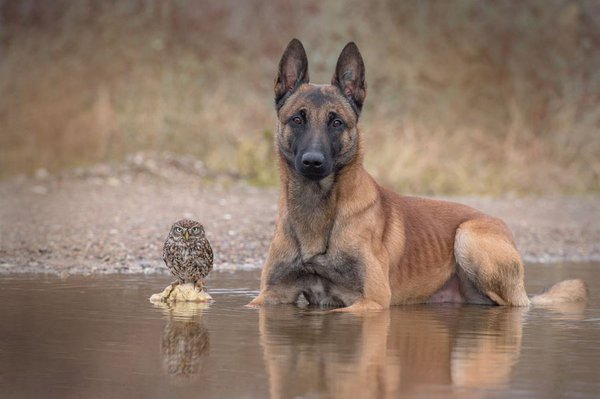
You will all recall that when we were ‘enjoying’ the chaos of having new flooring installed in three of our rooms I posted over a number of days a selection of wonderful, incredible photographs taken by Tanja Brandt.  Here is one of those photos.

We were all utterly enthralled by them and wanted to know more about Tanja.

But Tanja is German and her website and blogsite are, not surprisingly, in German. However, a good friend of mine from times past, Chris Snuggs, who is fluent in German (and French) came to the rescue when I asked for a favour of an English translation.

I sent Chris the link to Tanja’s ‘About Me’ page and here is what Chris emailed me yesterday.

Paul

At this URL: https://www.ingoundelse.de/%C3%BCber-mich/

…. she introduces herself with two short texts followed by a list of publications and/or photographic events and awards etc.

I have done a translation of the two elements of her introduction but not attempted to translate the list that follows.

I am assuming that if you want to write an introduction to her you can take her words according to my translation and reformulate them in your own words.

If you want a proper translation of her own words then I think I would need to work on it a bit more. The difficulty there is that if I translate her words directly it will not sound great in English; to get her meaning across in good English I would have to be a bit more free with the phrasing.

I hope that makes sense.

Made sense to me! Wonderful sense!
Here are those translations with the original German in blockquotes and the English translation by Chris topped and tailed with Tanja’s photographs:

Über mich …
Verlasse dich auf dein Herz – es schlug schon, bevor du denken konntest …

…. gibt es nicht so viel zu erzählen. Meine große Leidenschaft, seit ich in Windeln krabbeln kann, sind Tiere.

Tiere im Allgemeinen – vor allem auch Greifvögel und Raubkatzen – und Hunde im Speziellen.

Ich glaube, ich spreche ihre Sprache.

Ein Leben ohne Tiere ist für mich schwer vorstellbar und wenn Jemand keine Tiere mag, dann wird er sich vermutlich nicht sehr lange bei mir aufhalten.

About me
Trust your heart; it was beating before you were capable of thought.

There’s not all that much to say. My greatest passion even since I was a baby are animals – all kinds of animals, above all birds of prey and big cats – and especially dogs.

I believe I speak their language!

For me a life without animals is difficult to imagine, and if someone doesn’t like animals, then he or she would probably not be around me for long.

oooo

Fotografie ist meine Leidenschaft

Wie es begann?

Ich wollte schöne Fotos von meinen Tieren. Bzw überhaupt von Tieren. Fotos, die die Seele und den Charakter des jeweiligen Tieres widerspiegeln. Nicht einfach nur Fotos.

So kam mir der Gedanke, mit einer professionellen Kamera dürfte das kein Problem sein. Die Kamera wurde gekauft und es ging los – das Ergebnis war ernüchternd ….

Ich musste dann doch noch einige Workshops besuchen, um da zu sein, wo ich heute stehe.Kurse, Workshops, Webinare, Bücher, Austausch mit anderen Fotografen und viel üben. Und ich versuche jeden Tag, was dazu zu lernen und zu entdecken.

Aber allein das Technikverständnis macht es nicht aus, um die Seele der Tiere zu zeigen und die Arbeit mit den Tieren ist so wertvoll. Ich kann Tiere nur fotografieren, wenn sie sich wohlfühlen und mit Begeisterung mitmachen oder Wildtiere eben keine Angst vor mir haben.

Photography is my passion. How did it all begin?
I wanted to take beautiful photos of my animals, indeed, of all animals: photos which would reveal the soul and character of each animal – not just snaps …..

So I had the idea that all I needed was a professional camera. The camera was bought and off I went – the experience was chastening. I realized I needed training to get where I am now: went to workshops, on courses, internet lessons, books, exchanges with other photographers and lots more. And I still try every day to discover and learn something new.

But technique alone doesn’t suffice to lay bare the soul of a creature. Working with animals is so fulfilling, but I can only photograph them when they are at ease and enthusiastically join in the process, or if with wild animals when they are not afraid of me.

So many things make presenting this blog to you so very special for me. Then something comes along that takes it into the stratosphere of being special. That is Tanja Brandt. Tanja’s photographs and how she describes herself are stratospheric!

I am so pleased to have been granted permission by Tanja to share her photographs; something I never want to stop doing!

Visiting the Vet – Ruby’s UTI

This one is closer to home!

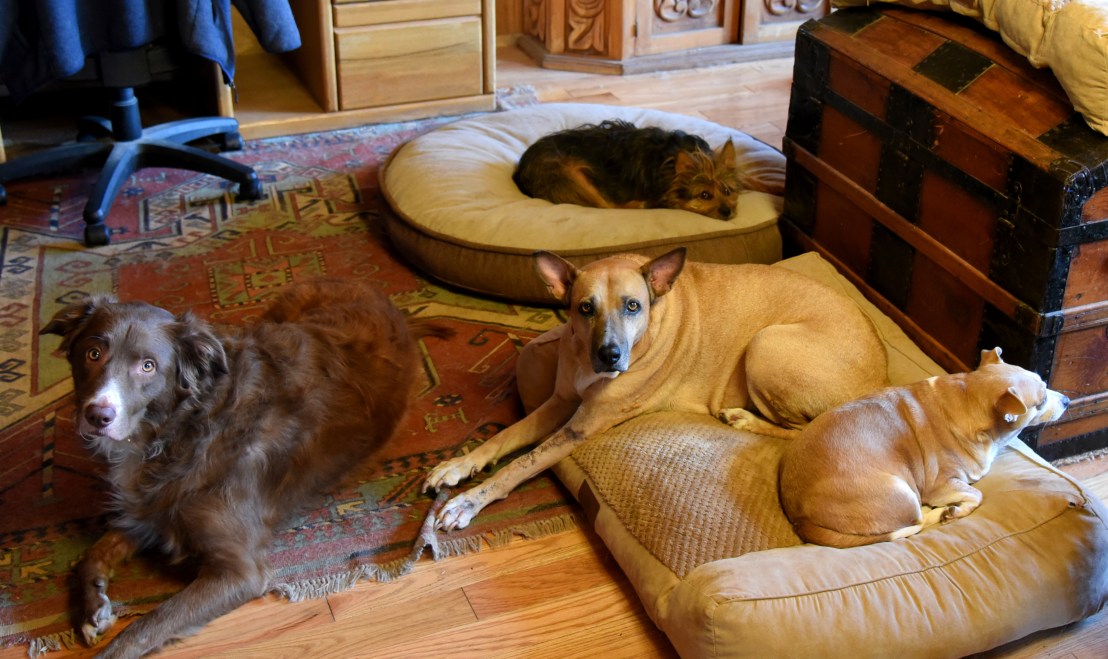
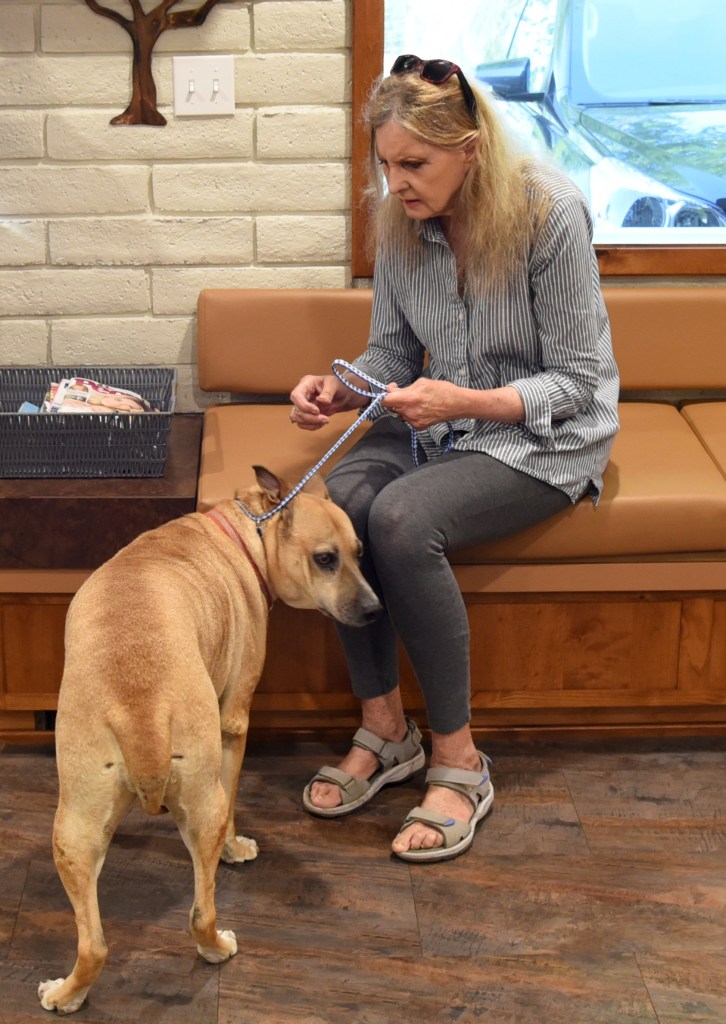
Back on the 11th August Jean and I took Ruby into Lincoln Road Vet because there was blood in her urine. Ruby is one of our six dogs that we have at home. Ruby is the last of the Mexican ex-rescue dogs and is an eleven-year old Sharpei mix.

Here she is staring up at me to the right of Oliver in the picture below .

In clockwise order: Oliver; Sweeny; Ruby; Pedy.

Because of Ruby’s age and background and the fact that there was significant blood in her urine we were bracing ourselves for some bad news.

Once checked in it wasn’t too long a wait before we were shown in to Dr. Jim’s room.

There Jim took some urine for analysis and then started examining Ruby. Jim was worried that Ruby might have kidney stones.
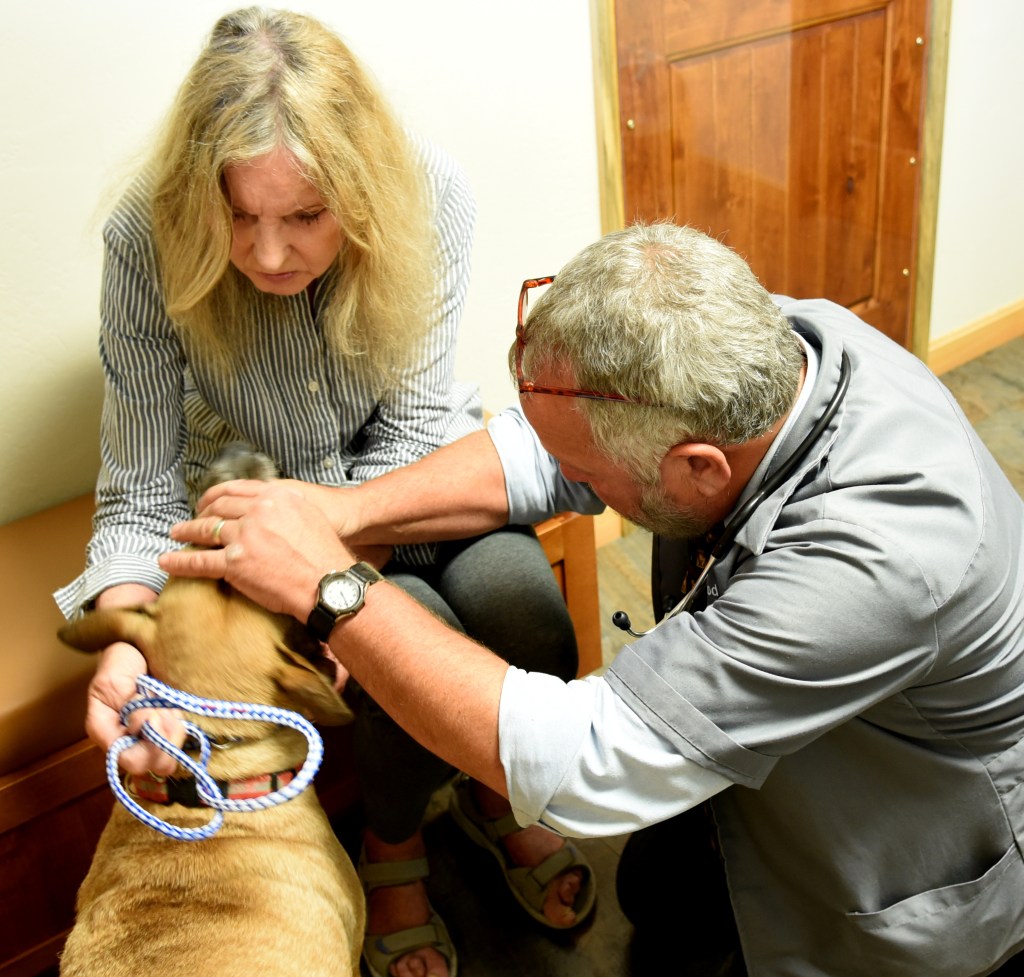
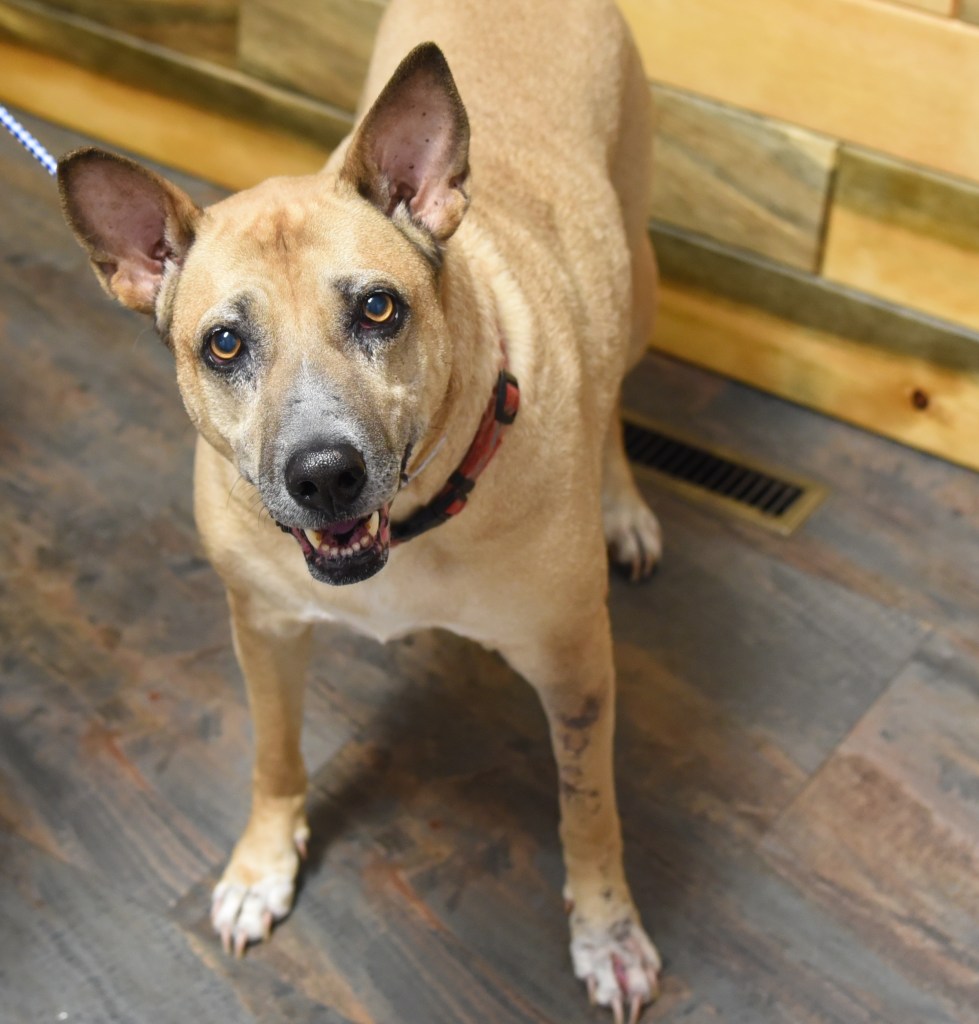
However, and thankfully, the urine test revealed an infection, nothing worse! A urinary tract infection or UTI.

Therefore, the first move would be to start Ruby on a course of Amoxillin.

Jim explained that Amoxillin was an antibiotic that he thought would be good for Ruby and would quickly determine whether or not Ruby had a simple urinary tract infection (UTI) or if it was something more challenging (my words).

Wikipedia offers a good description of Amoxicillin, from which I offer the opening paragraph.

Amoxicillin, also spelled amoxycillin, is an antibiotic useful for the treatment of a number of bacterial infections.[2] It is the first line treatment for middle ear infections. It may also be used for strep throat, pneumonia, skin infections, and urinary tract infections among others.[2] It is taken by mouth, or less commonly by injection.[2][3]

Maybe my initial reluctance to publish this Visiting the Vet post was down to me not wanting to do that before the results of the antibiotic treatment were clear.

Ergo, Jean and I are overjoyed to report that the Amoxicillin course did sort everything out and that Ruby is over her UTI and back to being her normal, healthy, happy self.

When Jim called us at home a week later he was just as pleased to hear the good news!

It’s in the language!

A comprehensive guide to the body language of our beautiful dogs.

Back in August 2016 I shared a post with you all from Vetstreet.com about interpreting the growls of a dog. It seemed to be liked by many of you.

Now fast forward to eleven days ago and an email that came in from Emma.

Dear Learning from Dogs Team,
My name’s Emma, a blogger at Hello Cute Pup.

I have been reading your blog for some time, and I absolutely love what you have been doing! Your content inspires me on a daily basis, and I’m really in love with your website.

I’ve been thinking about how I could help add value to you and your blog and I would love to contribute a guest post on your site.

I was inspired to write this article after reading your great piece “Why Dogs Are Friendly”.

I promise that I will provide HIGH-quality content that you won’t find anywhere else.

As a pet parent myself, I’ve had tons of amazing experience that I could bring to your audience.

Here are some links to other pieces that I have written to give you an idea of the quality that I am bringing to the table.

Dog Express
http://www.dogexpress.in/how-to-choose-the-best-dog-food-for-pugs
Imagine Forest
http://www.imagineforest.com/blog/baileys-best-buddy/

Safe and Healthy Life

http://www.safeandhealthylife.com/food-diet-for-dogs-the-ultimate-guide/

Let me know if you are interested. I already know your blogging style, plus I understand what your readers love as I am one.

Looking forward to hearing from you.

Cheers and have a good day!

Emma

Well you all know me sufficiently well to know that I couldn’t resist. Especially after seeing how nicely Emma had presented those pieces she linked to above.

Here is Emma’s article.

ooOOoo

A Comprehensive Guide to Basic Dog Body Language

Understanding your loved ones’ body language is always important. If you understand how your partner, sister, mother, or father acts when they feel a certain way, you can more accurately meet their emotional needs. This is the same as it is with the canine members of your family.

Understanding how your dog behaves when he or she feels certain things will help you bond, and help build trust, as well as make both you and your dog happier.

How do you decode dog behavior? There are a few ways, and a few certain body signals that your dog will give you that you should understand. Here are a few of them.

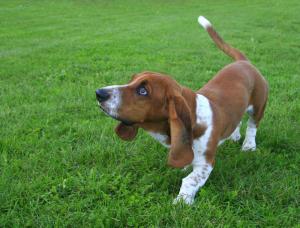
Play Bow

You may have noticed that when a dog is feeling frisky and energetic, he or she will bow their front end to the ground and push their rear end into the air. Typically, this means that the dog wants to play.
Tail Wagging

It’s a common belief that tail wagging means that a dog is happy. While this can be true, tail wagging can also mean a few other things.

  • A tail that wags low can mean your dog is scared or unsure.
  • A high and stiff tail wag can mean that your dog feels irritated, scared, or unsure. This kind of tail wagging can often lead to a dog becoming aggressive if pushed.

Freezing

Dogs often “freeze” when they are scared or guarding something like food, water, a toy, or their owner. This means that the dog will stop what he or she is doing and stand in one position without moving. When a dog is frozen, he or she is more likely to bite.

Rolling

When a dog rolls over, it usually means that he or she is submissive- but it’s important to pay attention to the dog’s whole body. If your dog’s tail and mouth are hanging loose, it can mean that he or she wants a belly rub or some attention. If the tail is tucked in or his or her mouth is stiff, it can mean that your dog is scared or nervous. Before you touch a dog who is rolled over, look for the signs of comfort.
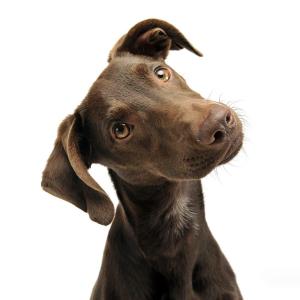
Perked Ears

Chances are, if you own a dog, you’ve seen him or her with his ears perked up. This means that your dog is alert and attentive.
Tail Between Legs

When a dog tucks his or her tail between his legs, this is a classic sign of fear. Dogs who are scared, as a general rule of thumb, are prone to becoming aggressive in an attempt to protect themselves- so be careful when getting too close to a dog who is acting fearful.
Signs of stress

Like humans, dogs can become stressed. Stress in dogs can make them act in certain ways and exhibit specific body language. Some of the signs that mean that a dog is stressed are:

  • Yawning in new situations
  • Panting when it isn’t hot
  • Licking their front paws as someone new approaches
  • Licking of the lips despite not recently having eaten or drank
  • Scratching
  • Avoiding eye contact
  • Shaking himself off after someone new touches him
  • Highly audible exhales that can be accompanied by whining or avoiding eye contact
  • Lying down and refusing to participate

Signs of fear

Dogs exhibit easy-to-read signs of fear. Some of these signs are:

  • Drooling
  • Pacing
  • Tucking his tail while moving away from something
  • Whining
  • His or her feet start to sweat
  • Growling and moving away
  • Curling his or her lips and showing teeth
  • Trying to hide
  • Running away

Signs of Happiness

Along with taking up the play bow position, dogs offer us other physical signs that they are happy. These include:

  • Energetic tail wagging
  • Tail thumping on the floor or ground
  • Lying in a relaxed, one paw tucked under, position
  • Bumping or pressing against you
  • Initiating physical contact
  • Jumping up
  • Smiling (yes, sometimes it really does look as if your dog smiles)
  • Playful barking to get your attention

Although the above behaviors are common in most dogs, it’s important to remember that dogs have individual personalities – what one dog does in a situation, isn’t necessarily what another does in that same situation. For example, if your dog reacts well with some dog shampoo, another dog might hate it. This shampoo might make him panic and he could fear baths forever.
To truly understand what your dog’s body is trying to tell you, pay attention to how he or she acts. He may react in the ways that are listed above, or he may have his own unique way of expressing to you how he feels.
Context is also a key point to focus on when you’re trying to determine how your dog feels based on his body language. For example, if your dog is being cornered by another, bigger and more intimidating dog and he wags his tail, chances are that he isn’t happy. In this situation, he more than likely is gearing up for a fight or is feeling scared.

ooOOoo

My hopes are that Emma will be writing many more guest posts for this place.

Oh, want to know a little more about Emma?

Emma is the founder of HelloCutePup. As the owner of 3 dogs, Emma has had the pleasure of learning the ins and outs to becoming a pet owner. With years of experience working on training, at-home dog health care, and aesthetic maintenance, she has the real-world experience that every pet owner is looking for. She is an avid blogger who enjoys giving realistic tips and tricks to help dog owners understand their pet’s personalities and to help pets easily become a part of the family.

Fabulous!

The wonderful love of a dog

Just enjoy!

We are chilling out for a couple of days giving our attention to Mark and Debbie who are staying with us. They came over to view the eclipse and I shall feature a few of Mark’s photographs for this coming Sunday’s Picture Parade.

(The following first seen over on the Care2 website)

Published on Aug 2, 2017

This dog’s motherly instincts are so strong that she feels the need to help raise an abandoned litter of kittens. What a hero!

And not this is not a dog that is living in a loving home but a stray dog! Incredible creatures.

Giving us better lives!

Delighted to republish this for you all.

Marc who blogs at Healthy Pawz recently decided to follow this place. I went across to Healthy Pawz to leave my thanks for the follow, as I always try to do, and read a most wonderful post. Wanted to republish it here today.

ooOOoo

Pets Can Change Our Life For The Better

Posted on August 18, 2017

Pets have an amazing ability to change our lives for the better. They find that special place in our heart and latch on with incredible amounts of unconditional love. When we regularly give our pets undivided attention, we build a bond and connection that will last a lifetime.

Every moment we spend with our pets is an opportunity to observe them and learn more about their personality, nuances or needs. Notice the simple and basic things about your pet like when they are relaxed, comfortable, happy, anxious, etc., just as you would a child. Those moments of observation will teach you so much about the little being that wants nothing more than to provide you with unconditional love and attention.

Another great benefit to having a pet is that they can sometimes see in us what we cannot see in ourselves. We know about service pets that support people in different ways for sight, comfort, seizures, autism, etc. But, our own pets are also in tune to our needs and emotions. However, we are sometimes so rushed with life that we fail to recognize the great gift our pets are offering us (me included). We have a rescue kitten with one eye and in my opinion, she’s amazing. This little cat noticed inflections in my voice that indicated stress of some sort. For me it was business as usual, but for her it was climb on my chest and rub her little face against mine. After a few hundred times of this (exaggerated of course) I finally realized that she was trying to calm me down. And I learned to better recognize when I needed to take a step back with a deep breath throughout the day.

We live in a very fast paced, get it done kind of society. That kind of daily grind can strip away some of our compassion and empathy because we are so overwhelmed with other aspects of life that we may not notice when we are stuck in that vortex spinning around aimlessly. Whether we realize it or not our pets are a great conduit to restoring that which we need to sustain us in our human relationships. Compassion and empathy are easily understood, but not always easily lived out. Our pets are a daily reminder of this because they provide both compassion and empathy daily. Because of this, we have an opportunity to reciprocate compassion and empathy back to them and to those around us.

Whether you have a dog, cat, hamster, etc., pets can enhance our lives in so many ways. Carve out some daily time to spend with your furry loved one, observe them on their terms and take some time to reflect about how they are benefiting your life. Watch over time as your emotional intelligence evolves through this process.

ooOOoo

There is so much wise advice in that post!

Hard to highlight any particular sentence but this one spoke to me early on: “When we regularly give our pets undivided attention, we build a bond and connection that will last a lifetime.”

Our Brandy!

A connection that will last a lifetime!

The day of the eclipse!

The day has arrived! Listen carefully!

Listen??  Yes, and thanks to The Smithsonian, if you are blind or visually impaired!

ooOOoo

What Does an Eclipse Sound Like?

A new app will allow blind and visually impaired users to experience the upcoming solar eclipse on August 21.

By Nathan Hurst
smithsonian.com  August 14, 2017

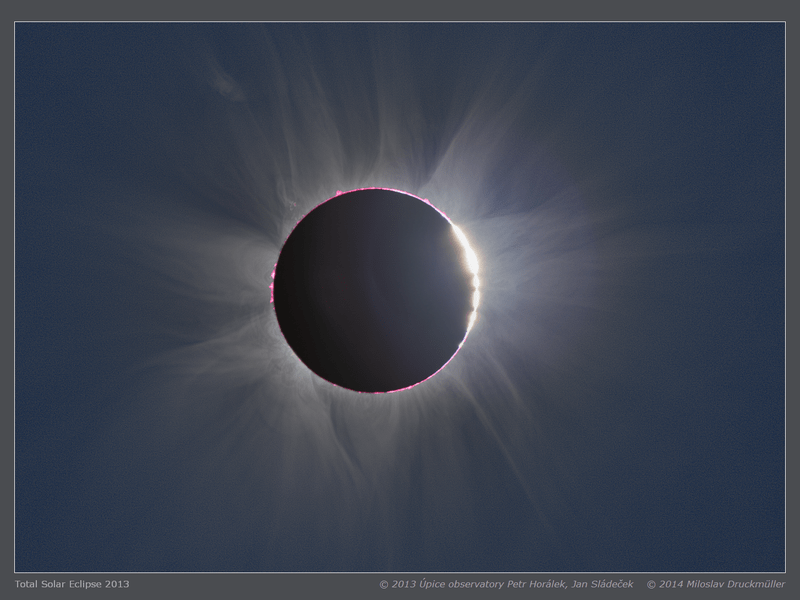
How would you describe an eclipse to a blind person? The moon moves in front of the sun, yes. But what does that look like? Someone trained in illustrative description of images might say, “The moon appears as a featureless black disk that nearly blocks out the sun. The sun’s light is still visible as a thin band around the moon’s black disk. To the upper right, at the moon’s leading edge, a small area of sunlight still shines brilliantly.”

That’s just an example of how such an event could be described. Bryan Gould, director of accessible learning and assessment technologies at the National Center for Accessible Media, a non-profit working to make media experiences accessible to people with disabilities, is hoping to offer oral descriptions of the eclipse in an app. Paired with other features, like a tactile diagram and audio from the changing natural environment as the eclipse darkens the sky, the app is designed to make the event more accessible to blind or visually impaired people who want to experience it.

Gould is working with Henry Winter, a solar astrophysicist at the Harvard-Smithsonian Center for Astrophysics, to develop the app, called Eclipse Soundscapes. As the August 21 solar eclipse darkens a path across the United States, Eclipse Soundscapes will release descriptions, timed—based on the user’s location—to match the progress of the eclipse.

Winter conceived Eclipse Soundscapes after a conversation with a friend who’s been blind since birth. She asked him to explain what an eclipse means.

Such an event might provide an interesting representation of the eclipse, thought Winter, so he partnered with the National Park Service’s Natural Sounds program, which preserves and catalogs sounds from the parks. Helpers stationed at national parks along the route will record audio during the eclipse, to hear the change in the “bioacoustical chorus” of the animals.

This can’t happen in real time, of course, so the National Center for Accessible Media is providing illustrative descriptions, based on a previous eclipse. The sounds of crickets, frogs and birds becoming active on the day of the eclipse will be added to the app later.

Last, with the help of an audio engineer named Miles Gordon, Winter is trying something completely new. Gordon developed a “rumble map” of the eclipse: The app places images of different stages of an eclipse on your smartphone’s screen, and as you trace your finger across the eclipse’s image, the vibration increases or decreases based on the brightness of the image.

“It does give you the impression that you’re actually feeling the sun, as you move your finger around,” says Winter.

“I realized I didn’t have the vocabulary to answer that question for her,” says Winter. “Every way I thought about it was visual in nature, and I didn’t know how to explain it to somebody … light, dark, bright, dim, flash. All these different words have no meaning to somebody that’s never seen.”

But the project goes well beyond audio descriptions. It includes two further elements: audio of the changing soundscape caused by the eclipse, and a tactile exploration of the eclipse’s image (which means that people who are blind or visually impaired can “feel” the eclipse using vibrations on their smartphones).

Many creatures become active as the sun sets, and many of them use darkness as an indicator of time of day. During an eclipse, crickets will chirp and frogs will chorus, thinking night has fallen. These habits were noted as far back as 1932, in a Proceedings of the American Academy of Arts and Sciences article titled “Observations on the Behavior of Animals During the Total Solar Eclipse of August 31, 1932.”

Scientists around the world will be using the eclipse as an opportunity to study solar astronomy in a way they usually can’t, measuring the ultraviolet light emitted from the sun’s corona, which Earth-based observers can’t normally see, as it is overpowered by the normal sunlight. It’s also rare for an eclipse to cover this much land — it traverses from Oregon to South Carolina — and Winter points out that it is a particularly good opportunity for education and outreach.

Though education is important, for Wanda Diaz Merced, a visiting scientist at the Harvard-Smithsonian Center for Astrophysics who is completely blind, there’s a lot more to the eclipse than that. Merced, who has consulted on the Eclipse Soundscapes project, studies human-computer interaction and astrophysics, and to do her research, she needs assistance translating data into a format she can interact with. She’s been building tools to help with that translation, and sees elements of Winter’s project that could contribute.

“It’s still not a prototype that I may use, for example, to study elements of the photosphere. It is not on that stage,” says Merced. “But hopefully one day we will be able to not only hear, but to touch.”

The eclipse will occur on August 21, starting around 10 a.m. in Oregon and finishing by 3 p.m .in South Carolina. The Eclipse Soundscapes app is available for iOS now, and the team is working on an Android app as well.

ooOOoo

I can’t imagine there’s anyone still pondering on whether or not to view the eclipse.

But that still doesn’t stop me offering you this recently presented TED Talk.

On August 21, 2017, the moon’s shadow will race from Oregon to South Carolina in what some consider to be the most awe-inspiring spectacle in all of nature: a total solar eclipse. Umbraphile David Baron chases these rare events across the globe, and in this ode to the bliss of seeing the solar corona, he explains why you owe it to yourself to witness one, too.

This talk was presented to a local audience at TEDxMileHigh, an independent event. TED editors featured it among our selections on the home page.

About the speaker: David Baron David Baron writes about science in books, magazines, newspapers and for public radio. He formerly served as science correspondent for NPR and science editor for PRI’s The World.

Enjoy it, good people. And protect your eyes!!!

Or better still allow NASA Television to show the eclipse to you.

NASA Television will air a four-hour show – Eclipse Across America – which will include live video of the event, along with coverage of activities in parks, libraries, stadiums, festivals and museums across the nation, and on social media. NASA’s show begins at 15:00 UTC (11 a.m. EDT; translate to your time zone), or later (we’ve seen this time waffle around a bit). Check the website for changes or further details.

Enhancing the life of our dogs!

We truly do want our dogs to live to a grand old age.

In recent posts I have included photographs of Cleo and Brandy. (As I will now do again!)

Cleo, the listening dog par excellence!

oooo

Brandy – as pure as it gets!

However, one of the sad aspects of our bigger dogs is that their lifespan is usually shorter than our smaller dogs.

Wouldn’t it be wonderful if they could live longer lives.

That is the reason that I didn’t hesitate for a moment in wanting to share an essay that was recently published on the Care2 site.

ooOOoo

Want Your Dog to Live to 30? Add This to Their Bowl

a Care2 favorite by Lisa Spector

About Lisa Follow Lisa at @throughadogsear

As I watched pet nutrition blogger Rodney Habib’s TedX video below, I found it simultaneously jaw-dropping and not surprising. After his dog, Sammie, was diagnosed with cancer, Habib went on a mission to find out why canine cancer is a growing epidemic. Currently, one out of every two dogs will be diagnosed with cancer at sometime in their life, mostly between age 6 and 12.

I have a 13-year-old Labrador. Admittedly, I’m obsessed with my awareness that he’s approaching the end of his life. But, what if he weren’t? What if he could live until he’s 30 like Maggie, the Kelpie, from Australia. Maggie was possibly the world’s oldest dog.

During Habib’s trek around the world, he spoke with researchers and scientists. He learned that dogs have a higher rate of cancer than any other mammal. In the ’70s, dogs lived to age 17; today the average life span is 11. Why?

Diabetes is up 900 percent in dogs in the last five years. Obesity is up 60 percent. While 10 percent of all cancer cases are genetic, 90 percent are the results of lifestyle and environmental influences, including stress, obesity, infection, sedentary lifestyle, toxins, pollution and most importantly diet.

Habib spoke with Norwegian scientist, Thomas Sandberg, who is conducting a 30-year-old study (the longest observational study to date). Sandberg is hoping to prove that poor quality food may cause cancer to develop in dogs and cats, mainly due to a compromised immune system.

Natural and dry dog's food

Here’s the part of Rodney’s TedX Talk that was jaw-dropping for me: Research shows that dogs on a diet of dry commercial pet food fed leafy green vegetables at least three times a week were 90 percent less likely to develop cancer than dogs that weren’t. And dogs fed yellow/orange vegetables at least three times a week were 70 percent less likely to develop cancer.

I feed Sanchez and Gina organic kale, spinach, green beans and carrots, along with many fruits. Personally, I wasn’t surprised by the benefits, but by the research showing that just a little bit of produce added to kibble could have such a profound effect on canine health.

Thomas Sandberg has Great Danes, who typically live only six to eight years. In a 6-year study of 80 dogs fed a completely raw diet with low amounts of carbs, only one dog developed cancer.

Another study at Purdue University showed a 90 percent decrease risk of cancer when they added green leafy vegetables to a bowl of processed food three times a week.

Remember Maggie, the world’s oldest dog? In addition to a diet that included raw fed grass milk, she also self fasted some days. She lived on a dairy farm and exercised all day long, often getting in 9 kilometers (5 1/2 miles ). Obesity is also now known to be a contributing factor to canine cancer, which is why exercising with your pet is so important.

We have dogs because we love them. We bring them into our human world and expect them to adjust. They do, because they want to please us. We expect them to follow our house rules, listen to the music we choose,  build their life around our schedules, and accept the food we choose for them. But, what if we knew more and chose differently for them? How long would they live?

Do your pets eat green leafy veggies?

ooOOoo

Now if you have read down to this point but not yet watched Rodney Habib’s talk then …. STOP!

Go back and watch that talk!

Then you can truly appreciate the value of looking at the diets of our beautiful dogs!

Love to hear your thoughts on this!

Oh, and both Brandy and little Pedy are great vegetable eaters. But we will be following the recommendations of Rodney Habib and will share our findings with you all later on.