Category: Writing

Hill’s Prescription Diet Recall

Please take note.

ooOOoo

Hill’s Prescription Diet and Science Diet Dog Food Recall Expands to Include 44 Varieties

Recall Updated 5/22/2019

March 20, 2019 — Hill’s Pet Nutrition is expanding its voluntary recall of canned dog food products due to elevated levels of vitamin D.

This recall expansion relates to the same vitamin premix that led to the January 31 voluntary recall previously announced on The Dog Food Advisor website.

Update: Additional expansion announced by the FDA May 20, 2019.

Vitamin D, when consumed at very high levels, can lead to serious health issues in dogs including kidney dysfunction.

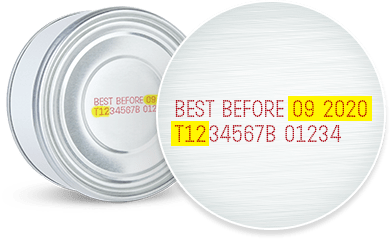
The following products and lot numbers are affected by the recall.

Items marked with * are new product SKUs that were added to the list on March 20, 2019. The item marked with ** is one additional lot code of recalled product updated on May 15, 2019.

Click here to view a text-based follow-up bulletin posted by the U.S. F.D.A. at a later date.

About Excessive Levels of Vitamin D

While vitamin D is an essential nutrient for dogs, ingestion of elevated levels can lead to potential health issues depending on the level of vitamin D and the length of exposure.

Dogs may exhibit symptoms such as vomiting, loss of appetite, increased thirst, increased urination, excessive drooling, and weight loss.

Pet parents with dogs who have consumed any of the products listed and are exhibiting any of these signs should contact their veterinarian.

In most cases, complete recovery is expected after discontinuation of feeding.

For More Complete Information

On March 21, 2019, the U.S. Food and Drug Administration published an announcement containing more complete information about this recall.

What to Do?

If your SKU, Date and Lot codes are found in the list above, you have an affected product.

You should stop feeding it and should return to the place of purchase for a full refund.

If you have questions, you may contact Hill’s Consumer Affairs at 800-445-5777.

U.S. citizens can report complaints about FDA-regulated pet food products by calling the consumer complaint coordinator in your area.

Or go to https://www.fda.gov/petfoodcomplaints.

Canadians can report any health or safety incidents related to the use of this product by filling out the Consumer Product Incident Report Form.

Get Dog Food Recall Alerts by Email

Get free dog food recall alerts sent to you by email. Subscribe to The Dog Food Advisor’s emergency recall notification system.

ooOOoo

Please, please read this and share it with your friends and colleagues who have dogs.

The Morse Code is 175 years old!

Two days of nostalgia follow! (You have been warned!)

As many of you already know, my father died fairly suddenly on December 20th, 1956. I had turned 12 some six weeks previously.

After about a year my mother remarried. His name was Richard Mills. Richard came to live at the house in Toley Avenue and had the unenviable task of taking on a new ‘son’ and ‘daughter’. (My sister, Elizabeth, some four years younger than I.)

Richard was a technical author in the newly-arrived electronics industry and one day he asked me if I would like to build a short-wave receiver. He coached me in the strange art of soldering wires and radio valves and other components and in the end I had a working receiver. That led, in turn, to me studying for an amateur radio licence. More of that tomorrow.

But the point of the introduction is to relay that The Morse Code is 175 years old on the 24th May.

Read more:

ooOOoo

Simply elegant, Morse code marks 175 years and counting

The elegantly simple code works whether flashing a spotlight or blinking your eyes—or even tapping on a smartphone touchscreen

There’s still plenty of reason to know how to use this Morse telegraph key. (Jason Salmon/Shutterstock.com)

By
Ph.D. Student in Electrical Engineering, University of South Carolina

May 21st, 2019

The first message sent by Morse code’s dots and dashes across a long distance traveled from Washington, D.C., to Baltimore on Friday, May 24, 1844 – 175 years ago. It signaled the first time in human history that complex thoughts could be communicated at long distances almost instantaneously. Until then, people had to have face-to-face conversations; send coded messages through drums, smoke signals and semaphore systems; or read printed words.

Thanks to Samuel F.B. Morse, communication changed rapidly, and has been changing ever faster since. He invented the electric telegraph in 1832. It took six more years for him to standardize a code for communicating over telegraph wires. In 1843, Congress gave him US$30,000 to string wires between the nation’s capital and nearby Baltimore. When the line was completed, he conducted a public demonstration of long-distance communication.

Morse wasn’t the only one working to develop a means of communicating over the telegraph, but his is the one that has survived. The wires, magnets and keys used in the initial demonstration have given way to smartphones’ on-screen keyboards, but Morse code has remained fundamentally the same, and is still – perhaps surprisingly – relevant in the 21st century. Although I have learned, and relearned, it many times as a Boy Scout, an amateur radio operator and a pilot, I continue to admire it and strive to master it.

Samuel F.B. Morse’s own handwritten record of the first Morse code message ever sent, on May 24, 1844. Library of Congress

Easy sending

Morse’s key insight in constructing the code was considering how frequently each letter is used in English. The most commonly used letters have shorter symbols: “E,” which appears most often, is signified by a single “dot.” By contrast, “Z,” the least used letter in English, was signified by the much longer and more complex “dot-dot-dot (pause) dot.”

In 1865, the International Telecommunications Union changed the code to account for different character frequencies in other languages. There have been other tweaks since, but “E” is still “dot,” though “Z” is now “dash-dash-dot-dot.”

The reference to letter frequency makes for extremely efficient communications: Simple words with common letters can be transmitted very quickly. Longer words can still be sent, but they take more time.

Going wireless

The communications system that Morse code was designed for – analogue connections over metal wires that carried a lot of interference and needed a clear on-off type signal to be heard – has evolved significantly.

The first big change came just a few decades after Morse’s demonstration. In the late 19th century, Guglielmo Marconi invented radio-telegraph equipment, which could send Morse code over radio waves, rather than wires.

The shipping industry loved this new way to communicate with ships at sea, either from ship to ship or to shore-based stations. By 1910, U.S. law required many passenger ships in U.S. waters to carry wireless sets for sending and receiving messages.

After the Titanic sank in 1912, an international agreement required some ships to assign a person to listen for radio distress signals at all times. That same agreement designated “SOS” – “dot-dot-dot dash-dash-dash dot-dot-dot” – as the international distress signal, not as an abbreviation for anything but because it was a simple pattern that was easy to remember and transmit. The Coast Guard discontinued monitoring in 1995. The requirement that ships monitor for distress signals was removed in 1999, though the U.S. Navy still teaches at least some sailors to read, send and receive Morse code.

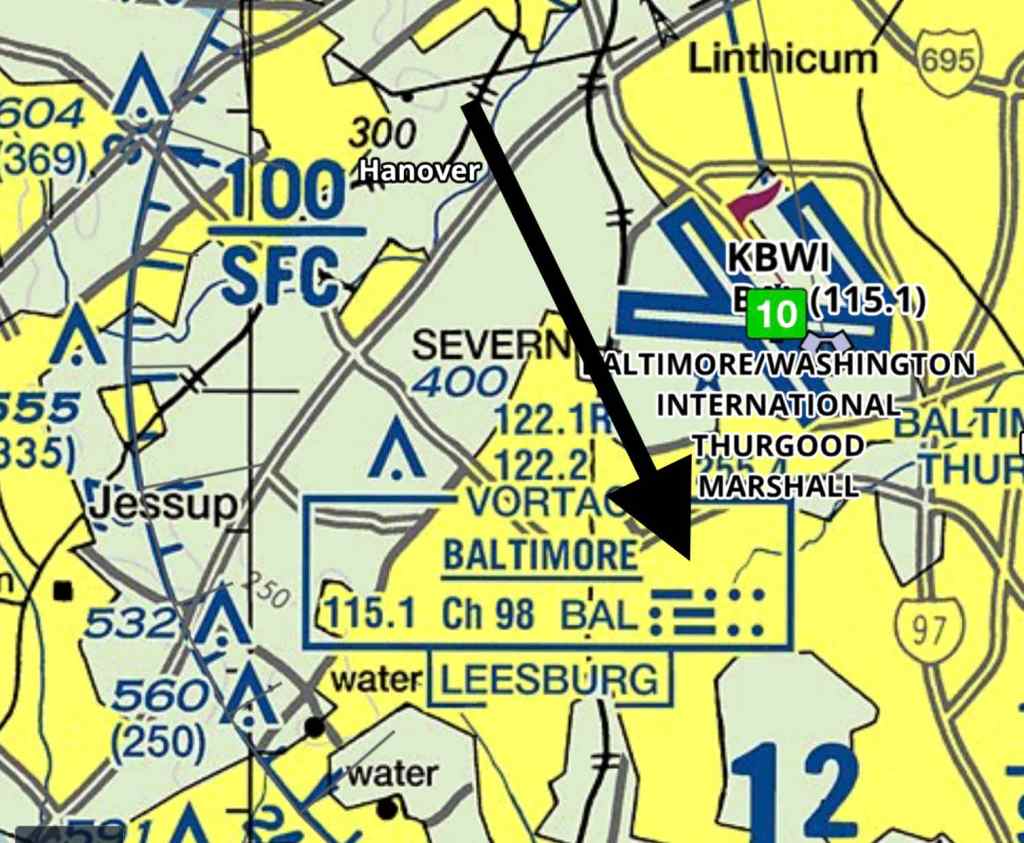
The arrow points at the chart label indicating the Morse code equivalent to the ‘BAL’ signal for a radio beacon near Baltimore. Edited screenshot of an FAA map, CC BY-ND

Aviators also use Morse code to identify automated navigational aids. These are radio beacons that help pilots follow routes, traveling from one transmitter to the next on aeronautical charts. They transmit their identifiers – such as “BAL” for Baltimore – in Morse code. Pilots often learn to recognize familiar-sounding patterns of beacons in areas they fly frequently.

There is a thriving community of amateur radio operators who treasure Morse code, too. Among amateur radio operators, Morse code is a cherished tradition tracing back to the earliest days of radio. Some of them may have begun in the Boy Scouts, which has made learning Morse variably optional or required over the years. The Federal Communications Commission used to require all licensed amateur radio operators to demonstrate proficiency in Morse code, but that ended in 2007. The FCC does still issue commercial licenses that require Morse proficiency, but no jobs require it anymore.

Blinking Morse

Because its signals are so simple – on or off, long or short – Morse code can also be used by flashing lights. Many navies around the world use blinker lights to communicate from ship to ship when they don’t want to use radios or when radio equipment breaks down. The U.S. Navy is actually testing a system that would let a user type words and convert it to blinker light. A receiver would read the flashes and convert it back to text.

Skills learned in the military helped an injured man communicate with his wife across a rocky beach using only his flashlight in 2017.

Other Morse messages

Perhaps the most notable modern use of Morse code was by Navy pilot Jeremiah Denton, while he was a prisoner of war in Vietnam. In 1966, about one year into a nearly eight-year imprisonment, Denton was forced by his North Vietnamese captors to participate in a video interview about his treatment. While the camera focused on his face, he blinked the Morse code symbols for “torture,” confirming for the first time U.S. fears about the treatment of service members held captive in North Vietnam.

Navy pilot Jeremiah Denton, a prisoner of war, blinks Morse code spelling out ‘torture’ during a forced interview with his captors.

Blinking Morse code is slow, but has also helped people with medical conditions that prevent them from speaking or communicating in other ways. A number of devices – including iPhones and Android smartphones – can be set up to accept Morse code input from people with limited motor skills.

There are still many ways people can learn Morse code, and practice using it, even online. In emergency situations, it can be the only mode of communications that will get through. Beyond that, there is an art to Morse code, a rhythmic, musical fluidity to the sound. Sending and receiving it can have a soothing or meditative feeling, too, as the person focuses on the flow of individual characters, words and sentences. Overall, sometimes the simplest tool is all that’s needed to accomplish the task.

ooOOoo

I do hope you read this article in full because it contains much interesting information. Many people will not have a clue about The Morse Code and, as you can see above, it is still relevant.

Finally, I can still remember the The Morse Code after all these years!

Mixed feelings!

The dog does a wonderful act of discovery!

There was an item on BBC News recently that shows the devotion of dogs towards humans. Yet the story also shows how cruel a young mother can be towards her own baby.

Here it is:

ooOOoo

Dog rescues baby buried alive in field in Thailand

17 May 2019
KHAOSOD -The dog helped raise the alarm after discovering the baby.

A dog in northern Thailand has rescued a newborn baby after it was buried alive, allegedly by its teenage mother.

The baby boy is said to have been abandoned by his mother, 15, to hide her pregnancy from her parents.

Ping Pong the dog was barking and digging in a field in Ban Nong Kham village. Its owner says he then noticed a baby’s leg sticking out of the earth.

Locals rushed the baby to hospital where doctors cleaned him up and declared he was healthy.

Ping Pong’s owner, Usa Nisaikha, says it lost the use of one of its legs after being hit by a car.

He told Khaosod Newspaper: “I kept him because he’s so loyal and obedient, and always helps me out when I go to the fields to tend to my cattle. He’s loved by the entire village. It’s amazing.

KHAOSOD – Ping Pong is disabled since being hit by a car.

The newborn’s mother has been charged with child abandonment and attempted murder.

Panuwat Puttakam, an officer at Chum Phuang police station, told the Bangkok Post she was now in the care of her parents and a psychologist.

He said that she regrets her actions.

The girl’s parents have decided to raise the baby.

ooOOoo

There’s no pardoning a woman who buries alive her baby. I don’t care what age she was; the mother that is. If she is old enough to become pregnant she is old enough to know better.

In stark contrast is Ping Pong, the dog, who despite having only three legs worked furiously to unearth the baby and did so without harming the infant.


Guess what! Eating one’s vegetables is very good.

This article should be shared!

I wasn’t going to post a blog for today but in going through my emails found this from April 15th.

It’s nothing to do with dogs but everything to do with staying healthy.

ooOOoo

Eating Your Veggies Is a Better Way to Get Your Vitamins Than Taking Supplements, Study Shows

Vitamins in some supplements were actually harmful at high doses, while exceeding the daily nutritional limit in food didn’t show the same risk.

(barol16/istock)

By Jason Daley
smithsonian.com, April 15, 2019,
Dietary supplements, including daily vitamins, have been a part of life in the United States for decades. In fact, people spend $30 billion per year on various pills, powders, gummies and tinctures to help improve their health, boost their brain, lose weight, build muscle and strengthen their immune system.

But a new extensive study suggests many people may be better off spending all that disposable income at the farmer’s market or grocery store produce section to buy spinach, tomatoes and other vitamin-packed veggies instead, according to a paper published this week in the journal Annals of Internal Medicine.

Researchers analyzed data from 27,725 participants in the Centers for Disease Control’s National Health and Nutrition Examination Survey (NHANES). Each volunteer, all over the age of 20, logged what they ate for 24 hours and what supplements they took in the previous 30 days. The data was collected between 1999 and 2010.

Linda Carroll at NBC News reports that during the study’s six-year follow-up period, 3,613 participants died, including 945 from cardiovascular disease and 805 from cancer. Using that data, the study team found that getting enough vitamin K—found in leafy greens—and magnesium—found in legumes, nuts, whole grains, fish and meat—were associated with a lower mortality rate. Getting the recommended dose of vitamin K, zinc and vitamin A was linked to lower mortality rates associated with cardiovascular disease.

And it turned out that taking 1,000 milligrams of calcium per day in supplement form was associated with increased cancer risk, while getting excess calcium from food did not seem to increase those risks.

“Our results support the idea that, while supplement use contributes to an increased level of total nutrient intake, there are beneficial associations with nutrients from foods that aren’t seen with supplements,” Fang Fang Zhang of Tufts University, the study’s senior author, says in a statement. “This study also confirms the importance of identifying the nutrient source when evaluating mortality outcomes.”

At first glance, the data suggested that supplement users might have better outcomes than non-vitamin takers. But Beth Mole at Ars Technica reports that supplement users tend to be wealthier and more educated than non-users, smoke less, exercise more, and have an overall healthier diet. When those factors were accounted for, the benefits of supplements disappeared. (It’s possible that supplements are helpful for portions of the population that suffer from certain nutritional deficiencies.)

The study has some limitations. Mole reports that the NHANES data relies on participants self-reporting what they eat and what supplements they take, which means the data might not be entirely accurate. The study is observational, meaning any relationship between nutrients in food and certain diseases is merely an association and does not imply causation.

Still, the study’s overall message is that supplements are not a silver bullet for health.

“I don’t think you can undo the effect of a bad diet by taking supplements,” Rekha Kumar, an endocrinologist at NewYork-Presbyterian and Weill Cornell Medicine, who was not involved in the study tells NBC’s Carroll.

This isn’t the first study to question the power of nutritional supplements. A paper last year in the Journal of the American College of Cardiology found that using multivitamins did not provide any apparent benefits but did not cause any harm either.

In a 2017 paper, data from the Nurses’ Health Study, one of the longest and most comprehensive health studies conducted, suggested that multivitamin use did not decrease incidents of stroke.

In fact, taking some supplements have negative consequences. A 2011 study found that taking vitamin E, which was hypothesized to help prevent prostate cancer, actually increased the chances of developing the disease in men instead.

Zhang and her colleagues say that much more research needs to be undertaken to confirm and understand these findings since there are so many other factors that play a role in overall health.

ooOOoo

H’mmm. It would be a braver person than I to come off the range of supplements that I take. And we are vegan as well!

But very much not in the fountain of youth!


Saturday smile!

A delightful story of one man’s bravery for another – dog!

This was published on The Daily Dodo a week ago and really does need retelling.

It shows how much we love our dogs.

ooOOoo

Man Jumps Into An NYC River To Save A Drowning Dog

Photo Credit: Erin O’Donnell

Ever since she was adopted from North Shore Animal League in March 2017, Harper has been absolutely head over heels for her mom, Erin O’Donnell, but is definitely a little nervous in new situations and can take some time to warm up to new people.

“She is a sweetheart but very anxious outside and around strangers,” O’Donnell told The Dodo.

On Saturday, O’Donnell was performing with the Brooklyn Irish Dance Company in Manhattan and left Harper in Brooklyn with friends and a trusted dog walker. Harper and her dog walker were out taking a stroll when a cab recklessly ran a stop sign and hit both the dog walker and Harper.

Both were OK and only sustained minor injuries, but poor Harper was so scared and shaken up that she ran and ran and ran — until she reached the East River, and jumped right in.

Still in a panic, Harper swam with determination and ferocity, and while at first onlookers thought she was just a dog with an owner nearby going for a swim, they soon realized that wasn’t the case at all.

“I was at the Brooklyn Barge celebrating my B’day when we saw a dog ‘going for a swim,’” Gabe Castellanos wrote in a post on Instagram. “The day grew hot and we all figured a nice swim could do us all a service. We assumed the owner was on shore keeping a watchful eye until a patron ran up to the north side of the Barge with a panicked voice saying that the dog, Harper, had run away.”

Photo Credit: Lorenzo Fonda

It was around that time that everyone began to notice Harper losing speed. The river was incredibly cold, and with the amount of energy Harper was exerting in her panicked state, it was likely that she wouldn’t be able to keep herself afloat for very much longer. This fact settled in for Castellanos, and he immediately knew he had to do something about it.

Castellanos happens to be a graduate of SUNY Maritime College and has extensive water survival skills knowledge — and so he decided he was going in.

“Since there was no sign of her making an attempt to swim back to shore, I knew something had to be done,” Castellanos told The Dodo. “I looked on the barge for any type of floating device to use if I were to jump from the end, but then I noticed there was a life vest, so I grabbed it.”

At this point, a crowd of about 300 people had gathered, invested in Harper and her well-being, and as soon as everyone realized what Castellanos was about to do, they all broke out into cheers of encouragement. Lorenzo Fonda, a Brooklyn-based filmmaker and artist, was hanging out at the Brooklyn Barge when he suddenly realized what was happening, and quickly began recording the entire ordeal.

Photo Credit: Lorenzo Fonda

Knowing the water was going to be cold and the conditions less than ideal, Castellanos strategized quickly with those around him as he prepared to jump into the water. He stripped down to his underwear, climbed over the rails, and then lowered himself as close to the water as he possibly could before letting go and diving in.

“There was a grand cheer when I entered the water,” Castellanos said. “After that, I was no longer focused on the crowds and my surroundings but focused on my breathing and swimming over to Harper. The crowds went mute during my swim. I’m sure they were still cheering, but I could not hear anything other than the water.”

Harper was still swimming at a steady pace, and Castellanos had to work hard to catch up with her. As soon as she realized someone was swimming towards her, she became even more panicked and tried as hard as she could to swim away from him.

Castellanos was persistent, though, and even though Harper struggled and lashed out a bit out of fear when he finally reached her, he stayed calm and determined and was finally able to secure her.

Cheers erupted from all over when Castellanos finally had Harper safely in his arms, and the pair quickly returned to shore. Both were exhausted and needed medical attention to make sure everything was OK, but luckily they were both completely fine, and are now recovering at their respective homes.

Photo Credit: Lorenzo Fonda

O’Donnell was in the middle of a performance when all of this occurred, and didn’t find out until later about Harper’s river adventure and the man who saved her life.

“Her paws are in rough shape, so she will need some trendy boots for a few weeks, but otherwise she’s in great spirits,” O’Donnell said. “It is definitely so refreshing to see the positive responses from people at the Brooklyn Barge and on social media expressing their sympathy for Harper and praising Gabe, who definitely saved the day.”

As an innocent onlooker that day, Castellanos didn’t have to do anything to help. He could have just sat by and watched and let someone else handle it, but instead he took a leap of faith and ended up saving Harper’s life, making him a true hero.

ooOOoo

I take my hat off to Gabe Castellanos. It’s something that 99.9% of us wouldn’t do yet Gabe didn’t think twice. OK, he had specific training but still there was a degree of risk. But he took it!

So well done, Mr. Gabe Castellanos!

Dog Food Recall Update Report

I thought it would be useful to publish this.

Here is the text of an email that was received yesterday morning.

ooOOoo

Dear Fellow Dog Lover,

Because you signed up on our website, I’m sending you this recall update report. If you no longer wish to receive these emails, please click the “unsubscribe” link at the bottom of this message.
Over the past 60 days, the FDA has announced 2 dog food recalls:

  • Thogersen Family Farm recalled its raw frozen pet food due to contamination with Listeria bacteria (4/8/2019)
  • Hill’s Pet Nutrition recalled multiple lots of Prescription Diet and Science Diet wet dog foods due toxic levels of vitamin D(3/20/2019)

For details, please visit our Dog Food Recall Alerts Center.

Feeding Tip

Got a dog that’s 7 years… or older? Here are 5 of The Advisor’s Top 15 Best Senior Dog Foods for 2019:

  • Wellness Core Grain Free Senior Formula
  • Merrick Lil’ Plates Senior Dog Food
  • Purina Pro Plan Bright Mind Adult 7+
  • Diamond Naturals Senior Dog Food
  • Victor Senior Healthy Weight

Click here to see all 15 of The Dog Food Advisor’s top senior picks for May 2019.

Please feel free to share this recall update report with other dog lovers.

Mike Sagman, Editor
The Dog Food Advisor

P.S. Not already on our dog food recall notification list? Sign up to get critical dog food recall alerts by email. There’s no cost for this service. No spam. Cancel anytime.

ooOOoo

You are welcome to receive notifications via this web site but for a more reliable, long-term service then sign up to the email service.

Best wishes!

It’s time to change our habits.

Funny how things evolve!

A week ago I was casually reading a copy of our local newspaper, the Grants Pass Daily Courier, and inside was a piece by Kathleen Parker, a syndicated columnist, entitled It’s the end of everything – or not.

I found it particularly interesting especially a quotation in her piece by Robert Watson, a British chemist who served as the chair of the panel of the Intergovernmental Science-Policy Platform on Biodiversity and Ecosystem Services (IPBES). The IPBES had recently published the results of the three-year study by 145 authors from 50 countries.

So I wrote to Kathleen Parker asking if I might have permission to quote that excerpt and, in turn, received her permission to so do.

Here it is:

Robert Watson wrote in a statement that:

“the health of ecosystems on which we and all species depend is deteriorating more rapidly than ever. We are eroding the very foundation of our economies, livelihoods, food security, health and quality of life worldwide.”

But, Watson also said, it’s not too late to repair and sustain nature – if we act now in transformative ways.

It is time to change our habits both at an individual level and the level of countries working together.

Moreover we haven’t got decades. We have got to do it now!

Back to Coyotes!

Hunting, and not for food!

We hate hunting. Period.

It’s sort of alright when the person needs to hunt to stay alive. But in the Western world the incidence of that is pretty remote.

So when author Jim wrote about coyotes and hunting I had to share it with you (and, for the record, both Jean and I are atheists).  Published with Jim’s permission.

ooOOoo

The Incredible Coyote and Western Morality

How killing for fun is not only a Christian Right, but a value

By Jim, August 5th 2018.

Christian vulgarity has reigned it’s bullets down on the North American coyote for over 100 years. The longest standing extermination order in history has killed millions of coyotes and continues its bounty program in most states. Competitive hunts sponsored throughout the nation each year with cash prizes and trophies instill to our kids the right obligation to kill for fun.

“One morning in the late 1930s, the biologist Adolph Murie stood near a game trail in Yellowstone National Park and watched a passing coyote joyously toss a sprig of sagebrush in the air with its mouth, adroitly catch it, and repeat the act every few yards. At the time, Mr. Murie was conducting a federal study intended to prove, definitively, that the coyote was “the archpredator of our time.” But Mr. Murie, whose work ultimately exonerated the animals, was more impressed by that sprig-tossing — proof, he believed, of the joy a wild coyote took in being alive in the world” (1)

The majority of politicians have failed to address this with any passion, and being the good, high moral standard western value Christians that they are, continue the killing spree. A useless torture that drives the coyote without mercy and without effect. “Under persecution, the biologists argued, evolved colonizing mechanisms kicked in for coyotes. They have larger litters. If alpha females die, beta females breed. Pressured, they engage an adaptation called fission-fusion, with packs breaking up and pairs and individuals scattering to the winds and colonizing new areas. In full colonization mode, the scientists found, coyotes could withstand as much as a 70 percent yearly kill rate without suffering any decline in their total population”.

Hunters have their ultimate victim to hunt—one that can outbreed the continued onslaught. How fun is it? While the coyote is hunted for sport, they die in earnest. Leave them to experience their joy, and populations will mitigate in their own necessary way.

Christian values and morals once again are superior delayed in common decency and way off the mark—unless your talking killing for sport.

ooOOoo

I want to add a couple of comments that were left on the post:

Not many christians are bothered by this. Why should they, when you hear them quote from their holy book, that god commanded them to subdue the earth.

It is for this very reason that many christians are nonchalant when we talk about climate change

oooo

The price paid for pointlessly killing predators is a dear one. Moreover, all needless killing of animals is wrong, says the immoral, convinced atheist.

oooo

(to which Jim replied)

Part of the doctrine is to subdue and have dominion. To hell with inferior, soulless life. The ripple effect of what was once naturally flowing is tragic and painful.

Enough said!

How close are you to your dog?

A reflection on our dogs.

I was sorting out some stuff the other day and came across the following. It is the record of a talk I gave some time ago in connection with the publication of my book Learning from Dogs.

As much as I would have expected to have previously published this on the blog I cannot find an entry. So here you are!

ooOOoo

The concept of attributing dogs with human traits is nothing new. In fact the ancient Greeks came up with a fancy word for it around two thousand years ago: anthropomorphism.

As ever, the truth of the matter is not a case of black and white but subtle shades of grey. No doubt in another two thousand years as science advances and we discover more about DNA and the mysteries of the human and canine brains the picture will develop into sharper focus. In the meantime, we must satisfy ourselves with some basic observations.

Let’s start off on common ground. One thing that we all seem to agree on is that humans are at the top of the pile in terms of evolutionary sophistication. For obvious reasons we view ourselves as the being the highest life form (although there is increasing alarm that we have totally lost touch with our basic instincts, if not totally lost the plot, by endangering the very planet that sustains life as we know it).

But I digress – back to common ground. We agree that as children our mental capacity is not fully developed. We survive by our instincts and the basic needs to be fed, watered, sheltered and bonded in a family group where we defer to a natural hierarchy. When you think about it this is precisely how dogs survive.

Like children, dogs display the most basic instincts to rough and tumble, compete for toys and establish a natural pecking order. Inherent in this is the need for a parent or pack leader to set down boundaries and create order and stability out of chaos. Without this both child and dog feel insecure and may well grow to display anti-social behaviour.

You would responsibly bring a child up with love and discipline, have consistent boundaries, teach them what is safe and what is dangerous, what is sociable and what is unsociable.

Dogs too need love and discipline, consistent boundaries, and to learn what is safe and what is dangerous, what is sociable and what is unsociable.

Communicating with a child is not so very different from communicating with a dog. Young children, like dogs, do not have the power of speech so you have to work out alternative strategies to speech in order to get through to them. You will find that if you approach a dog in much the same way as you approach a child, life will be a whole lot easier for you. And the dog! Hopefully you will have realised that praise is a far stronger motivator that punishment.

A positive approach.

Take the example of the puppy that makes a puddle on the floor and the child that wets its bed. Each one of them have not learnt control of their bladder and are simply responding to the call of nature. Neither are being naughty nor are in the wrong.

Yelling at the child will only make it more stressed and, therefore, more likely to continue wetting the bed. In exactly the same way if a puppy has an accident on the carpet being harsh will make matters worse.

How many human ‘sports’ involve chasing a moving object? How many of these games also involve people working as a team to ‘catch’ these objects? Football, rugby, basketball, tennis, badminton, etc. I could go on but you get the idea.

Why do we enjoy these games? Is it not because we too are instinctively striving for a pecking order within the pack and following our predatory instincts.

“No, no no!’ I hear you say. ‘We are a civilised, sophisticated race who have created these games for our enjoyment. They are so different to the throw and fetch games our canine friends mindlessly enjoy.’

Don’t kid yourself. Look also how football supporters revert to uninhibited childlike behaviour. At worst becoming hooligans and behaving, almost literally, like savage animals when they find themselves challenged or threatened by an opposing pack.

Or on a much more positive note how hundreds of fans, unrehearsed, suddenly find one voice and break into a prefect, heart-stopping rendition of “You’ll Never Walk Alone”. Now that’s a perfect example of the ‘pack call’.

We all enjoy the close relationship we have with our dogs. Maybe sometimes we don’t realise quite how close we are.

ooOOoo

I can’t imagine life without our dogs.

They mean everything to Jeannie and me.

A photo of Pharaoh when he was quite an old fella!

How much time do we have left?

A post from Patrice Ayme.

I have subscribed to Patrice Ayme for some time now. I don’t know who he is because he writes under a pseudonym, or a nom-de-plume. (And, indeed, I may have the gender incorrect but I’m pretty sure it’s a male.)

Patrice writes frequently and doesn’t mince his words.

But then he writes about really serious matters and often has criticism for the ‘ruling classes’.

Such as he has in the post that was published on the 6th May. I left a comment:

It’s extremely worrying and not something that can be put off. The clock is at 5 minutes to midnight. In Britain Extreme Resistance are pursuing a campaign that may just produce a political outcome. And, indeed, the English Government have come up with goals to combat climate change.

So keep banging your drum, Patrice, and hope that urgent action across the world isn’t too far away.

To which Patrice replied:

Dear Paul:
thanks! Here I am fighting with my daughter’s school, which has decided to install artificial, plastic grass. It’s horrendous for the environment, and it endangers the lives of children (in many ways, including a disease called “SUBEROSIS” caused by organic cork.) Here real ecologist take it hard, and have started to burn artificial plastic flame retardant fields: 13,000 were recently installed in the USA, a proof of mass corruption…
Feel free to use my essay on your site, BTW, of course…
And thanks again…
P

Now I hadn’t heard of Suberosis before, but no problem, a quick web search brought up Wikipedia and this:

Suberosis is a type of hypersensitivity pneumonitis usually caused by the fungus Penicillium glabrum (formerly called Penicillum frequentans) from exposure to moldy cork dust.[1][2] Chrysonilia sitophilia, Aspergillus fumigatus, uncontaminated cork dust, and Mucor macedo may also have significant roles in the pathogenesis of the disease.[1]

Cause

Cork is often harvested from the cork oak (Quercus suber) and stored in slabs in a hot and humid environment until covered in mold.[1] Cork workers may be exposed to organic dusts in this process, leading to this disease.[1]

I don’t fully understand how the laying of artificial grass leads to possible Suberosis.

But I have decided to republish even though it has nothing to do with dogs! (Well, not directly.)

ooOOoo

Nature Collapsing, Plutocracy Thriving

Both phenomena are related. The more nature collapses, the more plutocracy thrives (see the multi-centennial fall of Rome, for reference). Small people and other losers have no interest to see nature collapse. However, plutocracy does. Because Pluto-Kratia, Evil-Power, is best expressed and justified during war-like states, and civilizational collapse sure qualifies.

Plutocracy survived the collapse of the Roman and Carolingian empires with flying colors. In the Roman case, most noble families had a bishop in their midst. The collapse of the Renovated Empire of the Romans (Renovatio Imperii Romanorum) and its renewal by the Ottos and Capets brought the feudal order, another plutocratic success.

Now is no different: we have a terminal CO2 crisis bringing in extreme, sudden temperature, acidification and ocean rises: 1% of US CO2 is from state subsidized private jets. Nobody notices, because media have made sure to create entire generations just preoccupied by celebrities, not by what is going on, which is really most significant.

Nor has the media been keen to notice the likes of Biden annihilated the Banking Act of 1933, in the 1990s, bringing in the age of the financial plutocracy… itself a heavy financier of fossil fuels. So all what some schools are thinking of is installing “Apps”, and plastic grass, instead of teaching sustainable global citizenship. We are cruising towards an apocalypse, at an increasing pace: the Sixth Mass Extinction. The United Nations just came up (May 6, 2019) with an analysis made by 132 countries and 455 scientists: one million species are disappearing. For example, nearly all amphibians.

https://www.cnn.com/2019/05/06/world/one-million-species-threatened-extinction-humans-scn-intl/index.html
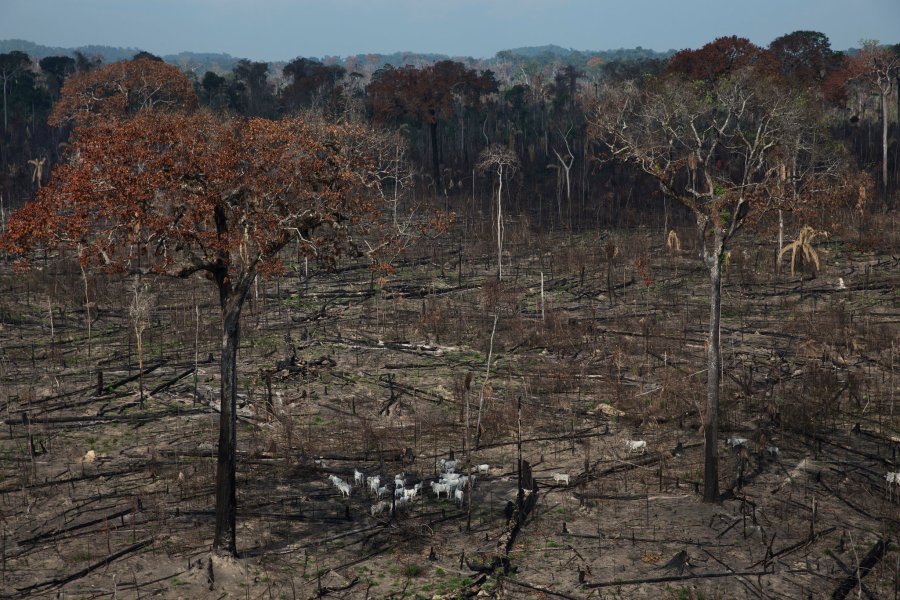
One problem with burning forests in the tropics is that what is left are often extremely poor soils (differently from northern European soils, which are very forgiving, explaining in great part why north west Europe replaced the Greco-Roman world…) Cattle grazing on a tract of illegally cleared Amazon forest in Pará State, Brazil. In most major land habitats, the average abundance of native plant and animal life has fallen by 20 percent or more, mainly over the past century,,, [Credit Lalo de Almeida for The New York Times]

In Africa, burned forest is often replaced by lateritis, a soil which is red, baked, hard… for the good reason that it is full of Aluminum.

It is the Sixth Mass Extinction, but this time the dinosaurs have thermonuclear weapons.

What to do? Get involved, get aware, protest. Protests can become unbearable to the powers that be.

This is the way the fascist government of Brunei on the island of Borneo was just dealt with. It drew powerful international condemnation when it rolled out its interpretation of sharia laws on April 3. Now, the Sultan of Brunei, Hassanal Bolkiah, reverted his decision: after all, the country won’t enforce Islamic laws that include stoning to death for rape, adultery and gay sex.

Killing all the people who got killed in World War Two was atrocious. However, what is now unfolding has the potential to be way way worse. Einstein said he didn’t know which weapons will be used to fight World War Three, but next it would be sticks and stones. That was naively optimistic. If we acidify further the ocean with acid from CO2, we may kill the Earth’s oxygen making mechanism. Not really news, as this was clear five years ago already:

https://patriceayme.wordpress.com/2014/05/30/global-hypoxia/ 

Many behave as if there will be no tomorrow, because they feel that way! It’s a self-fulfilling prophecy, it has to be resisted.

What’s needed, beyond recording what’s going on, is interpreting it, going beyond, building ideas, and moods meant to last. Only deeper thinking can do this, and ensure a planet capable of lasting. Because we are not at the regional level anymore. When climate change, plus nefarious human impact, forced the Harappan civilization to abandon its homeland, the Indus valley, it was dealing with forces it had no idea existed. Maybe there are such forces out there. But there are also plenty of forces we can see, and which are plenty lethal enough, at civilizational scale, and the scale of the entire biosphere. Stop. And think. One million species are marching towards extinction, among the plants and animals we know.

Patrice Ayme

***

***

From NYT:

WASHINGTON — Humans are transforming Earth’s natural landscapes so dramatically that as many as one million plant and animal species are now at risk of extinction, posing a dire threat to ecosystems that people all over the world depend on for their survival, a sweeping new United Nations assessment has concluded.

The 1,500-page report, compiled by hundreds of international experts and based on thousands of scientific studies, is the most exhaustive look yet at the decline in biodiversity across the globe and the dangers that creates for human civilization. A summary of its findings, which was approved by representatives from the United States and 131 other countries, was released Monday [May 6, 2019] in Paris. The full report is set to be published this year.

Its conclusions are stark. In most major land habitats, from the savannas of Africa to the rain forests of South America, the average abundance of native plant and animal life has fallen by 20 percent or more, mainly over the past century. With the human population passing 7 billion, activities like farming, logging, poaching, fishing and mining are altering the natural world at a rate “unprecedented in human history.”

At the same time, a new threat has emerged: Global warming has become a major driver of wildlife decline, the assessment found, by shifting or shrinking the local climates that many mammals, birds, insects, fish and plants evolved to survive in. When combined with the other ways humans are damaging the environment, climate change is now pushing a growing number of species, such as the Bengal tiger, closer to extinction.

As a result, biodiversity loss is projected to accelerate through 2050, particularly in the tropics, unless countries drastically step up their conservation efforts.

ooOOoo

I’m in the autumn of my life and may not live to see the consequences of what we are doing to Nature and to the Planet.

Then again, if some of the predictions bear true, I won’t have to live an awful lot longer to experience real change.

It’s time for a complete re-analysis of our relationship with the natural world.