Category: Writing

Strangely normal!

Reading the behaviours of our dogs.

Apologies, going straight into this republication of an article that appeared on the Care2 blogsite back in June. Didn’t get to sit down in front of my computer until 4pm.

ooOOoo

7 Totally Normal (But Kind of Weird) Dog Behaviors

1384665.largeBy: Katie Waldeck June 19, 2016

About Katie

It’s not surprising that our beloved canine companions’ behavior is sometimes confusing to us. After all, it’s not like they can tell us why they do certain things! But is your pooch’s behavior normal, or a sign of something more troubling?

And, for that matter, are common dog behaviors totally fine, or something we should be working to stop? Oftentimes, the answer is the former. Read on to discover some of the strangest dog behaviors that are actually totally normal.

1. Barking at Mirrors

If you show a human baby a mirror, they don’t always recognize themselves— young infants lack the self-awareness needed to do that — and dog babies are no exception. Most of the time, dogs grow out of it as they age, losing interest in their own reflections. Dogs are much less affected by visual events than humans, relying far more on their sense of smell to gather information. Since the dog in the mirror doesn’t have its own smell, most dogs tend to lose interest pretty quickly.

2. Being Scared of Thunderstorms

Dogs have far more sensitive hearing than humans, so it’s understandable that the loud noises accompanying storms don’t exactly delight our canine companions. But there may actually be more behind this fear — some scientists believe that dogs can actually detect changes in barometric pressure leading up to a storm. Thunderstorms can send even the best-behaved dogs into anxious fits, and unfortunately, it can be difficult to break even the healthiest dog of this habit. There are strategies to cope, however, such as providing a safe place for dogs to go during storms or dressing them in snug-fitting shirts that function similarly to swaddling a baby.

3. Eating Poop

Though it’s certainly not appetizing to us humans, many dogs eat poop. Eating feces is actually a fairly typical behavior for canine mothers, because it cleans the area where they are caring for their puppies. Some evidence also suggests that dogs eat feces when they’re lacking in certain nutrients. Eating poop can even be a way to get your attention and alleviate anxiety. This is not exactly a GOOD behavior for dogs, however, and solutions for it are mostly simple. Supervision and simple commands like “Leave it” and “Come” are often enough to curb most dogs’ fecal fascination, and vitamin and enzyme supplementation can work for dogs whose diets are missing nutrients.

4. Spinning Around in Circles

Plenty of dogs spin around and around for what seems like forever. Some breeds, including bull terriers in particular, are especially susceptible to this behavior. While this is often normal dog behavior, it can also be a sign of stress or anxiety. Whatever the reason your pooch spins in circles, this behavior should be nipped in the bud. The best way to do that? Well, get them moving and thinking. Take them on walks. Give them toys that stimulate their mind. If that still doesn’t work, you might need a dog behavior expert to intervene.

5. Separation Anxiety.

Many dogs experience separation anxiety — they just love you THAT much! Often, this is a result of changes in routines, moving, household membership changes or after moving in with a new family. It’s totally normal, but, unsurprisingly, it isn’t the best behavior for your pet’s mental health. The key to breaking your pooch of this behavior is to identify how big of a problem it is before you go about fixing it. Click here for detailed ways to help break this habit.

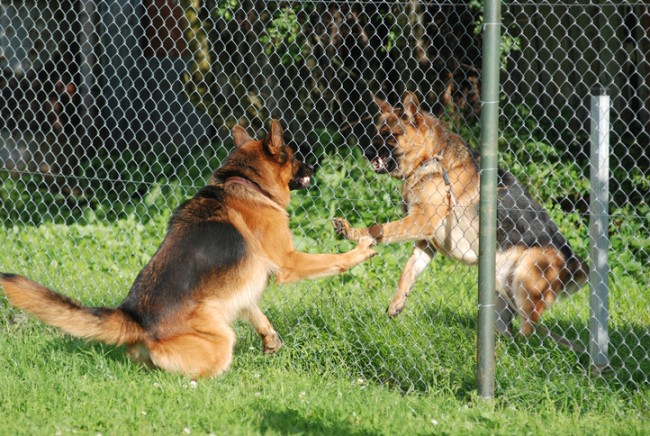
6. Hating Other Dogs.

Dogs who weren’t socialized at an early age around fellow canines will understandably have some aggression towards unknown dogs. Conversely, some dogs that have been socialized around other dogs seem to pick and choose which dogs they like. Why is that? Well, dogs aren’t all that different than humans in that regard — sometimes we just don’t like certain people. Dogs perceive a massive amount of information through scent, and two dogs may find something off-putting about each other’s smells. Dogs may also be overprotective of their owners or have something in their history that makes them especially distrustful of certain other kinds of dogs. Avoiding another dog at the park isn’t much cause for concern, but if your dog is consistently aggressive, it’s time to consult a veterinary behaviorist.

7. Having Sensitive Spots.

Some dogs have areas where they just don’t like to be touched. There can be several reasons for this — everything from a recent injury to poor socialization as a puppy — but, often, this is simply because, well, dogs just don’t like to be touched in certain spots. Think about it this way: plenty of humans don’t want to be patted on the butt by people they don’t know. In fact, most don’t! This can be perfectly innocuous — or it can be a sign of trouble. Dogs that demonstrate overly aggressive behavior regardless of where they’re touched may be in need of a behavior expert. You can read more about this here.

ooOOoo

Any thoughts dear people?

Feeding one’s inner wolves.

The wisdom of ancient minds.

The following was published by Val Boyco recently over on her blog Find Your Middle Ground.

It is republished here with Val’s very kind permission.

ooOOoo

* How to Feed your White Wolf

Life-saving dogs.

The great relationship that can exist between dogs and cheetahs.

Before you read on let me raise my hand in connection with this blog. Or to be clearer, next Monday Jean and I have the very great pleasure in welcoming my daughter, Maija (she of Sonic Journeys from SOUND UK), her husband, Marius, and my grandson Morten. They are staying with us until the 24th July.

Inevitably, and for all the right reasons, I will not be putting in anything like the normal time I usually spend on Learning from Dogs. It did cross my mind to stop blogging for those seven days but that seemed like a step too far.

However, what is certain is that the period from now right through to the last week in July is going to see me lowering the priority of this blog and being more random in nature in terms of if or how I respond to your comments and replies.  You will also read a succession of repeats of posts from previous years. I’m hoping that because so many of you will not have been reading this place during my early years that the number of times you see something that you have previously read is kept to a minimum.

So why this note to you all today? Because the rest of this week is going to be pretty busy as we get the house all tidied up and fully prepared for our visitors.

Having got that off my chest do read the following that appeared recently over on Care2.com.

ooOOoo

How Dogs Are Saving Cheetahs From Extinction

3183088.largeBy: Laura Goldman July 10, 2016

About Laura Follow Laura at @lauragoldman

Cheetahs, the fastest land animals on Earth, have been disappearing almost as fast as they can run.

But in the African country of Namibia, the cheetah population has grown from 2,500 to 4,000 since 1994. And dogs are helping to keep those numbers rising.

Instead of trapping or shooting cheetahs that wander onto their property and kill livestock, some farmers are relying on Anatolian Shepherds and their fierce barking to scare away the predators.

“You may see in history that this dog can be responsible for saving the cheetah from extinction,” Jack Hanna, director emeritus of the Columbus Zoo, told CBS News. “That is one heck of a story right there.”

The dogs are provided to farmers and ranchers by the Cheetah Conservation Fund (CCF), the world’s leading organization dedicated to saving the lives of cheetahs in the wild.

 The majority of cheetahs in the wild – over 90 percent of them, according to the CCF — live outside protected areas, surrounded by farming communities. And many of those farmers, especially poor ones, are more concerned about protecting their livelihood than an endangered species. About 10,000 cheetahs were killed during the 1980s, before CCF launched the Livestock Guarding Dog program in 1994.

Since then, the program has placed more than 500 dogs, helping to reduce the loss of livestock from 80 to almost 100 percent. The program is extremely popular — there’s a two-year wait to get in. It not only provides free Anatolian Shepherd puppies, but also training advice and free veterinary care.

“CCF research shows that the people’s attitudes towards predators are changing as a result of this and other CCF programs,” the organization said on its website.

Dogs and Cheetahs Aren’t Enemies in U.S. Zoos

As a way to promote “the life-saving role dogs play for cheetahs in the wild,” according to CBS News, some zoos in the United States are raising puppies with cheetah cubs.

“The number one question up here, this $40 million exhibit: ‘Are the dogs coming out?’” Suzi Rapp, director of the Columbus Zoo’s animal programs, told CBS News. “And I say the Columbus Zoo built the world’s most expensive Labrador retriever exhibit in the world… the biggest dog run.”

Dogs and cheetahs can also be found together at the Cincinnati Zoo. It was there, as you probably remember, where Harambe the gorilla was shot to death when a boy fell into his exhibit. His killing sparked international outrage and concern over keeping wild animals captive in zoos.

What are domesticated animals doing in these zoos? Like the Anatolian Shepherds in Africa, the zoos say, the dogs are helping to prevent cheetahs from becoming extinct. But instead of scaring cheetahs away from livestock, the zoo dogs are best buddies with the cheetahs. Their friendship, which begins when they’re about 3 months old, helps put the skittish cheetahs at ease so they can more easily be bred.

The San Diego Zoo, which has been raising dogs with cheetahs for over 30 years, gets many of its puppies from animal shelters. So in a way, the rescued dogs are paying it forward by helping save the lives of another species.

ooOOoo

That Care2 article by Laura Goldman included a short video from CBS News. However, despite me having a link to that video I couldn’t get it to play.

No problem because YouTube came up with a very good alternative.

Published on Apr 29, 2013

CCF Operations Manager Brian Badger explains how our Livestock Guarding Dog program works as part of the whole of CCF’s operations to help save the cheetah in the wild.

In fact, there was more than one interesting video and I couldn’t make up my mind which was best.

So you got two!

Published on Sep 25, 2013

In Gobabis, Namibia, these Kangal dogs guard the goats against predators, including the worlds largest population of wild cheetahs. This stops the farmers from targeting the cheetahs. Since the big dogs were introduced to Namibia, the cheetah population has reached a 30-year high ! Hurray!

Past times

Blogging for many years goes so well with poor recall!

When I was browsing through posts over the last seven years, looking for articles about cats in support of yesterday’s post, I was amazed at reading so many items that had completely slipped my mind! One in particular, going back to October, 2010, was so wonderful that it just had to be shared with you again. It was sent to me by long-term friend Chris Snuggs. It will put a smile on your face!

ooOOoo

Cats and Dogs!

As a follow-up to Paul’s post on cats, I found this on the internet, but there was no reference to the author. Whoever it was does, however, deserve the credit rather than me, who am merely a transferer on to a wider public of such gems as I stumble across during my surfing.

If anyone knows who wrote this I would be more than delighted to acknowledge his or her genius.

Peek into a dog’s diary …

8:00 am – Dog food! My favorite thing
9:30 am – A car ride! My favorite thing!
9:40 am – A walk in the park! My favorite thing!
10:30 am – Got rubbed and petted! My favorite thing!
12:00 pm- Lunch! My favorite thing!
1:00 pm – Played in the yard! My favorite thing!
3:00 pm – Wagged my tail! My favorite thing!
5:00 pm – Milkbones! My favorite thing!
7:00 pm – Got to play ball! My favorite thing!
8:00 pm – Wow! Watched TV with the people! My favorite thing!
11:00 pm – Sleeping on the bed! My favorite thing!

Peek into a cat’s diary …

Day 983 of my captivity. My captors continue to taunt me with bizarre little dangling objects. They dine lavishly on fresh meat, while the other inmates and I are fed hash or some sort of dry nuggets. All though I make my contempt for the rations perfectly clear, I nevertheless must eat something in order to keep up my strength. The only thing that keeps me going is my dream of escape. In an attempt to disgust them, I once again vomit on the carpet.

Today I decapitated a mouse and dropped its headless body at their feet. I had hoped this would strike fear into their hearts, since it clearly demonstrates what I am capable of. However, they merely made condescending comments about what a “good little hunter” I am. Bastards.

There was some sort of assembly of their accomplices tonight. I was placed in solitary confinement for the duration of the event. However, I could hear the noises and smell the food. I overheard that my confinement was due to the power of “allergies.” I must learn what this means, and how to use it to my advantage.

Today I was almost successful in an attempt to assassinate one of my tormentors by weaving around his feet as he was walking. I must try this again tomorrow — but at the top of the stairs.

I am convinced that the other prisoners here are flunkies and snitches. The dog receives special privileges. He is regularly released – and seems to be more than willing to return. He is obviously retarded. The bird has got to be an informant. I observe him communicate with the guards regularly. I am certain that he reports my every move. My captors have arranged protective custody for him in an elevated cell, so he is safe, for now……….

Just chilling out …

Cats in Physics

1 – Law of Cat Inertia: A cat at rest will tend to remain at rest, unless acted upon by some outside force – such as the opening of cat food, or a nearby scurrying mouse.

2 – Law of Cat Motion: A cat will move in a straight line, unless there is a really good reason to change direction.

3 – Law of Cat Magnetism: All blue blazers and black sweaters attract cat hair in direct proportion to the darkness of the fabric.

4 – Law of Cat Thermodynamics: Heat flows from a warmer to a cooler body, except in the case of a cat, in which case all heat flows to the cat.

5 – Law of Cat Stretching: A cat will stretch to a distance proportional to the length of the nap just taken.

6 – Law of Cat Sleeping: All cats must sleep with people whenever possible, in a position as uncomfortable for the people involved as is possible for the cat.

7 – Law of Cat Elongation: A cat can make her body long enough to reach just about any counter top that has anything remotely interesting on it.

8 – Law of Cat Acceleration: A cat will accelerate at a constant rate, until he gets good and ready to stop.

9 – Law of Dinner Table Attendance: Cats must attend all meals when anything good is served.

10 – Law of Rug Configuration: No rug may remain in its naturally flat state for very long.

11 – Law of Obedience Resistance: A cat’s resistance varies in proportion to a human’s desire for her to do something.

12 – First Law of Energy Conservation: Cats know that energy can neither be created nor destroyed and will, therefore, use as little energy as possible.

13 – Second Law of Energy Conservation: Cats also know that energy can only be stored by a lot of napping.

14 – Law of Refrigerator Observation: If a cat watches a refrigerator long enough, someone will come along and take out something good to eat.

15 – Law of Electric Blanket Attraction: Turn on an electric blanket and a cat will jump into bed at the speed of light.

16 – Law of Random Comfort Seeking: A cat will always seek, and usually take over, the most comfortable spot in any given room.

17 – Law of Bag / Box Occupancy: All bags and boxes in a given room must contain a cat within the earliest possible nanosecond.

18 – Law of Cat Embarrassment: A cat’s irritation rises in direct proportion to her embarrassment times the amount of human laughter.

19 – Law of Milk Consumption: A cat will drink his weight in milk, squared, just to show you he can.

20 – Law of Furniture Replacement: A cat’s desire to scratch furniture is directly proportional to the cost of the furniture.

21 – Law of Cat Landing: A cat will always land in the softest place possible.

22 – Law of Fluid Displacement: A cat immersed in milk will displace her own volume, minus the amount of milk consumed.

23 – Law of Cat Disinterest: A cat’s interest level will vary in inverse proportion to the amount of effort a human expends in trying to interest him.

24 – Law of Pill Rejection: Any pill given to a cat has the potential energy to reach escape velocity.

25 – Law of Cat Composition: A cat is composed of Matter + Anti-Matter + It Doesn’t Matter.

26 – Law of cat reading: Cats pretend to be really short sighted and evince the need to read a newspaper by lying on it while you are attempting to read it.

27 – Law of cat antipathy: Any cat will immediately sense a person who doesn’t like cats and go and sit on their lap.

28 – Law of cat confinement: A cat will always have its kittens in the warmest possible place, usually in your bed while you are sleeping.

29 – Law of Sleeping: A cat sleeps every day for 24 hours minus the time it takes to wheedle food out of you and eat it ..

By Chris Snuggs

ooOOoo

Isn’t that just gorgeous!

Let’s hear it for (shelter) cats.

Just to demonstrate that Learning from Dogs isn’t wall-to-wall about dogs!

Over the years that I have been writing in this place it has been mentioned before that as well as us having our dogs we also have cats. When Jeannie and I moved up from Mexico to the USA in 2010 we came with six cats, all of them cats that Jean had rescued off local streets down in San Carlos, Mexico.

Four years ago, when we moved up from Arizona to this present home here in Merlin, Southern Oregon, we built a cat run that was attached to the garage. Then about a year ago we brought what was now four cats into the house. The cats are in their own rooms during the day but mingle with the ‘living room’ group of dogs in the evening. The cats are not let outside for we fear that they would be grabbed by a passing coyote or similar before they learnt to return home in the evening.

All of which is my preamble to an article that was published a month ago over on the Care2 Causes site, and is republished here within Care2’s terms.

ooOOoo

10 Reasons to Adopt a Shelter Cat

3010560.largeBy: s.e. smith June 9, 2016

About s.e. Follow s.e. at @realsesmith

Once every eight seconds, an unwanted cat or dog is euthanized somewhere in the United States thanks to pet overpopulation and limited shelter capacity. No one likes to think about that reality, but you can do your small part to help. In addition to supporting organizations that promote an aggressive national spay and neuter policy, facilitate no-kill shelter transitions and work with communities to address specific issues like feral cat colonies, you can adopt a shelter cat (or dog!).

If you’re thinking of adding a cat to your life (and really, why stop with one?), here are ten compelling reasons to consider a shelter cat over one from a breeder or a pet store.

10. Shelter cats come in all shapes, sizes and colors.

If you want a kitten, shelters are usually overflowing with them, especially during spring kitten season. If you’re interested in an adolescent feline or even a more mature companion, shelters have those too. In fact, many are really excited by potential adopters who want to take on an older kitty, because mature cats tend to linger in shelters longer because many people prefer kittens. If you’re looking for a cat to accompany an older adult or someone who’s not as mobile, a mellow older cat might be a great fit.

9.  Shelter cats are ready to go!

They’re spayed or neutered, immunized, dewormed, microchipped and assessed for behavioral issues by the skilled staff at the shelter. They’ve also been trained to use the litterbox in most cases, so you don’t have to worry about an awkward and potentially smelly transition to living at your house. Many also come with a certificate for a free first visit to the vet, and some shelters have a take-home package with food, toys and other goodies. You’re all set up for your first year of pet ownership, and your pet will be healthy, because the shelter has a vested interest in keeping its animals happy and healthy, while pet stores and unscrupulous breeders do not.

8.  Shelter staff can help you pick the perfect companion.

Adopting an animal is a big commitment, and not all cats are the same. If you come in with your family, the shelter staff can get to know you, introduce you to some prospects, and help with the matchmaking process. They’re motivated to make sure cats find their forever homes, and they won’t lead you astray when it comes to, well, rescuing a stray. Shelter staff can also provide you with information about the adjustment period if you’ve never had a cat before.

7. Turns out you can teach an old cat new tricks.

(Note that when she’s tired of it, she’s not afraid to make her opinion known!)

6. Set an example!

There are a lot of myths about cats living in animal shelters, like claims that they’re damaged, feral or broken in some way. In fact, the vast majority of unwanted animals are happy, healthy and well-adjusted, they just need loving homes to get comfortable and let their personalities come up. By adopting a shelter cat, you can encourage other people to do the same; talking about your positive experiences and introducing people to your cat will help reduce the stigma about adopting from a rescue group.

If you want to adopt a special-needs animal, you’re certainly welcome to. Shelters are particularly choosy when it comes to homing out cats with medical problems, but they are always happy to hear people are interested, committed and ready to give a cat with some extra needs a home to share.

5. Adult cats are low maintenance.

If you want a cat in your life but you don’t have a lot of time for teaching a kitten how to use the litterbox, stay away from the toilet paper roll, and stop wreaking havoc on your shoes, an adult cat is definitely for you. Adult cats already know the lay of the land and they tend to settle into routines quickly, making them great housemates. And if you travel a lot, consider adopting cats as a pair so they can keep each other company. A shelter often has a pair of cats whom they’d love to see go out together because they’re relatives or they’ve developed a close bond.

4. You’ll feel better.

Companion animals offer a number of mental health benefits. Having a pet of any species around can make people feel happier and more balanced, and the routine of caring for and interacting with a pet like a cat can improve mood and reduce the sense of isolation. Cats are especially great companion animals for people who don’t have the energy or ability to care for a dog, but still want someone around the house to keep them company.

3. Shelter cats have varied personalities.

Cats are incredibly diverse, personality-wise. They can be shy and outgoing, playful or more reserved, fascinated by sinks or horrified by water. If you haven’t had the pleasure of having a cat in your life yet, a shelter cat might totally change the way you view these delightful animals.

Check out some of the personalities on display at the Los Alamos Animal Shelter:

2. Don’t support animal cruelty.

Pet stores source their animals from a variety of places, and those cute kittens in the window might come from an abusive kitten mill where cats endure horrible conditions to produce animals for the pet trade. The sale of companion animals in general promotes the continued existence of exploitative breeders that view cats as cash drawers, not living beings. By turning away from companion animals offered for sale and choosing to adopt, you’ll be voting with your wallet. And that adoption fee? Will be a lot lower than buying an animal from a petstore or breeder.

1. You’ll save a life.

Even if your local shelter is no-kill (which is great! consider an extra donation to help them with operational costs), adopting shelter cats to get them out of the shelter system and into living homes reduces the strain on shelters and frees up space for more homeless animals. No-kill shelters often rescue from facilities that euthanize, so by adopting from them, you’re opening up another slot for a kitty who’d otherwise be on death row. If you live in an area where there is a kill shelter or where animal care and control adopts out animals, please consider looking there first for a new cat. Some organizations maintain “kill lists” published by shelters, listing animals slated for euthanasia within the next few days, and you might find your new companion on just such a list.

ooOOoo
 Even if just one person who reads this makes a commitment to take on a shelter cat it will be one less cat on a ‘kill list’.

Affairs of the heart.

Warning: Emotional post coming up!

This is the second time I have used Affairs of the Heart as a title to a post. The previous time was January 20th, 2012 (and I’m republishing that post tomorrow). How time flies!

Indeed, in a little over two week’s time, on July 15th, all you dear, dear readers and I will be celebrating me writing this blog for seven years! Indeed, how time flies!

Yesterday, John Zande from down in Brazil, another great friend of this place, posted a comment that included a most powerful video. His comment was, “Not sure if this link will work, but this is a lovely story of an adoption that saved a life.

Sue Dreamwalker watched the video and responded:

John that was one amazing video, still wiping away tears.. Thank you.. Through our choices we CAN make Changes in our lives..:-)❤

I then followed Sue with this comment, written at 05:45 local time (PDT) yesterday:

John, Jean awoke just a few moments ago and I have just played your video in front of us both. It is so beautiful and important that I want some time to fully compose my response. Plus Jean and I need some time to stop weeping!

Just had this idea to feature your video and my reply as tomorrow’s post.

Thank you, John, for sharing this. Thank you so much.

Even if you watched this video yesterday do watch it again before continuing. Same applies to those that haven’t yet watched it. Do that now! 🙂

So now we head for my emotional response to that video.

Change is inevitable. Another word for change would be time. Time is the most fundamental principle of the Universe. Call it the Arrow of Time. It flows only in one direction. From order to disorder.
Or to put it in the words of physics (my emboldening in 2.2):
en·tro·py
ˈentrəpē/
noun
noun: entropy; plural noun: entropies; symbol: S
  1. 1.
    Physics
    a thermodynamic quantity representing the unavailability of a system’s thermal energy for conversion into mechanical work, often interpreted as the degree of disorder or randomness in the system.
  2. 2.
    lack of order or predictability; gradual decline into disorder.
    “a marketplace where entropy reigns supreme”
    synonyms: deterioration, degeneration, crumbling, decline, degradation, decomposition, breaking down, collapse; More

Entropy – “the gradual decline into disorder.

It has to be that way. For evolution is a product of the decline of one variant of life (plant, animal, insect, higher order ‘animals’, etc. ) and a new aspect of that life emerging (or not). That’s how it has to be for the beauty of life, the beauty of life in all its forms (even including politicians! 😉 ). Life is a function of a “gradual decline into disorder“.

I’m not a religious person, nor is Jean, and do not believe in any form of afterlife. When I die that’s it.

I was born in 1944. I am ageing. I have suffered some brain atrophy that means that my recall is terrible. I know that the ageing process is going to continue. It scares me. At least it motivates me to keep as physically and mentally fit as I can.

I have tried hard most of my life to stay fit, physically and mentally. I’m only now aware of the reward of such an attitude.

But I haven’t been emotionally fit. In the sense of not truly knowing who I am and what my values are. That darkness was illuminated for me in the Summer of 2007, thanks to Jon.

That very moving video of Eric and Peety speaks of Eric being saved by Peety. I so deeply understand Eric.

For in December, 2007, just a few months after Jon (as in being the best we can be) made me fully aware of my distorted view of myself I travelled out to Mexico and met Jean and all her dogs.

Jean has saved me. Directly from the love, companionship and  intimate friendship that she offers me. But Jean has also saved me indirectly. By that I mean from me living my daily life these last nearly ten years surrounded by the most beautiful dogs that one could imagine. Those dogs, each one of them in their own special way, also offering me love, companionship and intimate friendship.

Prior to December, 2007 I didn’t know how to feel my true emotions and, in consequence, didn’t know how to express them. Jean and the dogs have enabled me to feel my true emotions, and to express them.  Dozens of things pain me and it’s rare day when I don’t have the odd weep or two. However, dozens of things please me each day and now bring out a laugh, or a giggle. Even better, dozens of times each day I am loved by our dogs and the gift that goes with that love is me feeling so beautifully accepted; accepted in an utterly unconditional manner.

The love given to me from our dogs and the love from my beautiful Jean make it so easy for me to be good to myself. That love, from Jeannie and the dogs, has been a gift to me beyond my imagination.

I have hanging on my office wall a framed print of a poem by Roy Croft. I gave it to Jeannie on the first anniversary of our marriage. I want to share Roy Croft’s words with you. For they so beautifully describe the gift of love I receive from Jean. But in a way that I suspect Mr. Croft didn’t imagine when he first penned his poem, his words also so beautifully describe the gift of love I receive from our dogs.

ooOOoo

“Love” by Roy Croft

I love you,

Not only for what you are,
But for what I am
When I am with you.

oo

I love you,
Not only for what
You have made of yourself,
But for what
You are making of me.
I love you
For the part of me
That you bring out;
I love you
For putting your hand
Into my heaped-up heart
And passing over
All the foolish, weak things
That you can’t help
Dimly seeing there,
And for drawing out
Into the light
All the beautiful belongings
That no one else had looked
Quite far enough to find.

oo

I love you because you
Are helping me to make
Of the lumber of my life
Not a tavern
But a temple;
Out of the works
Of my every day
Not a reproach
But a song.

oo

I love you
Because you have done
More than any creed
Could have done
To make me good
And more than any fate
Could have done
To make me happy.
You have done it
Without a touch,
Without a word,
Without a sign.
You have done it
By being yourself.
Perhaps that is what
Being a friend means,
After all.

ooOOoo

If you have read my post through to the end, thank you!

Solace.

The stranger the times the more we need to ‘ground’ ourselves.

Without doubt these are incredibly strange and unsettling times. For the United Kingdom, for the USA, for the British Commonwealth, for Scotland, for Gibraltar; and for many other places.

When we are faced with unsettling periods then it is essential to ‘ground’ ourselves, and there are many effective ways of doing this.

One way that always works for me is to gaze into a clear, night sky. The night sky over one’s head is captivating beyond words. Perhaps I should have written that it is captivating beyond my words.

Not so for Sue Dreamwalker. Just read this most beautiful poem that Sue published a little over two weeks ago. Republished here with Sue’s kind permission.

(And to demonstrate how your’s truly is becoming a forgetful old fart when I read this out to Jeannie last night she reminded me that I had already published it! It’s worthy of another showing!)

ooOOoo

Mother Gaia ~ The Blue Dot.

11 Jun 2016

Three Sisters Glen Coe Scotland

How many times have you gazed at the stars?

To ask the question of whom we are

This Blue Dot in the vastness of space

Have you questioned the existence of the Human Race?

~~

Did we really evolve from Neanderthal Man?

From Ape to Human imagine if you can

Woolly Mammoths along with Sabre Tooth Tigers

Ice Ages and Floods, Volcanoes and Fires

~~

Mountains crashing, rising from ocean floors

Fossils created into stony forms

Petrified wood in glaciers saved

While Crystals grow beneath deep dark cave

~~

How many times have you asked ‘Who am I?’

As you gaze longingly at the starlit sky

So many treasures now upon this Blue Dot

So sad that we’ve evolved, but we also forgot

~~

That we Humans just like the Dinosaur race

Could soon disappear without a trace

As our superior brains seemed to have lost the plot

Of our coexistence within this amazing Blue Dot

~~

As we pollute our Mother who brings such life

While we rage in greed creating more strife

We poison our land modifying crops

Caring less and less until the last Bee drops

~~

Long after we’re gone as the planets realign

A new dawn will break over the memory of mankind

His legacy I’m sure one day will be discovered

As some future traveller his fossils will uncover.

~~

But it’s never too late to alter our future

When we live in harmony and learn to nurture

Holding onto LOVE and Letting go of Hate

We can all help our Blue Planet Regenerate.

Copyright Sue Dreamwalker 2016.

ooOOoo

Just meditate on those thoughts for a while without doing anything else.

Brexit – now what happens?

Here’s what is going to happen.

In the run-up to the EU referendum by the UK this Brit was tempted several times to offer an opinion on what I thought was the best decision. But I resisted. (I was qualified to vote as an overseas voter and had voted for Remain.)

My resistance was because it seemed inappropriate to pass any form of opinion before the die had been cast, so to speak. I hadn’t been living in the country for over eight years and, inevitably, was out of touch with feelings.

The Conversation blogsite yesterday had a series of articles on the aftermath of the Brexit decision but the one that seemed most useful to share with you all was an article by Gavin Barrett,  a Professor of European Constitutional and Economic Law at University College in Dublin. For many readers, including me, both within and without the UK this seemed a valuable primer.

ooOOoo

Britain votes to leave the EU, Cameron quits – here’s what happens next

June 23, 2016 11.41pm EDT

image-20160624-30267-wvhvty
Leave ahead. Anthony Devlin / PA Wire

Author

Four-legged healing marvels.

Day Two of the healing power of our wonderful dogs.

In yesterday’s post I wrote:

I was reminded of the incredible healing power of our dogs in a recent article published by author Deborah Taylor-French.

Before going on to that article let me say a little more about Deborah. Most easily done by offering what is detailed in her bio:

Deborah Taylor-French, M.A.

Deborah writes mysteries full of dogs,  positive dog leadership and animal rescue. Deborah was awarded and served as a guest artist for California’s Artists in the Schools.  As an arts educator, Deborah has led over a hundred residences and teacher workshops. 

 An active member of Redwood Writers, Deborah continues to serve as Author Support Facilitator.  Redwood Writers is the largest branch of the California Writers ClubThe true story of Sydney’s adoption, “Punk Rocker With A Poodle Brain” is published in “Vintage Voices Four Part Harmony.” Her fiction and memoir published in eight volumes of the  Redwood Writers Anthology

Deborah was also very supportive over my book and wrote an endorsement:

In “Learning From Dogs” author Paul Handover returns us to our origins where we find how early humans and dogs mutual survival and social relations. Visit the rich evidence of man and dog’s co-evolution. Dive into this man and species adventure. Reading this changes out perspective on dogs, wolves and humankind. Most importantly, “Learning From Dogs” values life on planet earth while offering ideas on peaceful co-evolution. Handover holds out a hand to readers, a hand called hope. A gem of a book.

So, all in all, it is a delight to be able to republish a recent article that Deborah published over on her place that you will all love reading.

ooOOoo

Six ways dogs help us heal

  1. Dogs show empathy.
  2. Dogs give us affection.
  3. Dogs give us their complete attention.
  4. Dogs give us physical comforting. They snuggle and lie in our laps.
  5. Dogs live in the moment, sharing enthusiasm and joy.
  6. Dogs possess sensory abilities  beyond our sensory capacity.

They hear into the distance beyond our hearing range. Dogs alert us to the approach of other people and animals. With their gift of night vision, dogs often guide us, just go camping with your dog or walk a dog at night.

Examples: Therapy dogs of every kind help the blind, the mobility challenged plus visit the sick and in-firmed. Dogs sniff out cancerous tumors, this field is now being explored by science with the goal of creating a laboratory replica of how dogs detect cancer. Many dog lovers witness their dogs seeking out members coping with illness. The world over has many truth stories of dogs comforting the sick or dying.

Dogs sensing seizeures before they happen so they can maneuver their person to a safe position, such as sitting or lying down.

img_4463Give back to dogs

Want to help homeless dogs and cats but can’t adopt?

Click here and visit The Animal Rescue Site. Through this site you can download an app, which gives money to feed needy shelterless pets. This app is called Pet to Give. Just like its title, every pet gives a selected shelterless funds to feed dogs and cats.

Check out the Greater Good. I like it because they respect my time. When I signed up for email updates, I learned that I could put in vacation holds on email updates. This is the only site informational source that I have never unsubscribed from.

Please share to spread the ways dogs heal us. In this terrible time following the mass murder in Orlando, Florida, I hope we all will spread loving kindness and healing.

Don’t have a dog right now?

No problem. Make dog friends.

If you do not have a dog, take some fresh sugar snap peas (cut or break them up for small dogs) sit in a park. As dog walkers if their dog is friendly with new people. Once the dog’s person says it’s okay to greet the dog, LET THE DOG COME TO YOU. A friendly dog will wag his or her tail and slink up to sniff your hand. After you have a relaxed connection, ask the dog’s person if you can give him or her a treat. Show them the snap peas. Hold one in the palm of your hand and let the dog eat off your hand like a dinner plate. There you go. You’ve made a good friend. Now go make another.

For eight years we lived in an apartment and could not have any pets. I missed having a dog so much. Most dog lovers know that pain and will be sympathetic. Dogs always have enough love for everyone.

ooOOoo

Hope you loved this as much as Jean and I did.

Please come back tomorrow where we continue the theme of the ways in which our dogs comfort us.

Our healing dogs!

Is it me or is the world becoming crazier each new day!

What with the ‘Remain/Leave’ EU referendum coming up in my old country and Presidential politics in my new country it seems these days as though the need for healing is growing in leaps and bounds. Thank goodness for being able to hug a dog or two (and Jean) to be reminded of what matters most of all.

I was reminded of the incredible healing power of our dogs in a recent article published by author Deborah Taylor-French. That will be republished tomorrow, with Deborah’s kind permission. However, I wanted to make this message last for more than a single post and to achieve that I’m republishing a guest post that appeared in this place towards the end of last year.

But first my introduction to that guest post.

Forget about the big world out there, be loved by our dogs.

Monday’s post about the precariousness of man’s future on this planet if we don’t prevent the melting of the Antarctic ice sheet was a bit gloomy, however true it might be. The gloom continued with yesterday’s post about the VW scandal illustrating the “unethical culture endemic in business”.

So what a nice change to think about the way that our pets keep us bright, cheerful and healthy.

All of which is my way of introducing a guest post from Vee Cecil. Now I am fairly cautious about guest posts from those who want to promote their businesses, for obvious reasons. But Vee’s essay is so lovely that it truly deserves to be shared.

Firstly, here is the email that Vee sent me back in August,

Hi!

In the U.S., 91 percent of pet owners say they consider their pet to be a member of the family. And for good reason! Our pets are constant sources of comfort and companionship.

What many pet owners may not realize is how great their furry family members are for their physical and mental health. For example, studies have shown that pet owners have lower blood pressure than people who don’t have pets and that being around pets also makes us “less anxious and less stressed.” And that’s just the beginning. There are many other wonderful health benefits that result from owning a pet.

May I write an article for learningfromdogs.com on this topic? The article will be approximately 500 words, unique to your site, and complete with resources.

Please let me know – I am always looking to spread the word about how we can be healthier and happier and having a pet is a great way to achieve both!

Best,
Vee

Here then is that article.

ooOOoo

Feeling Under the Weather? Learn More About the Amazing Healing Powers of Pets

HappyTailsAsk any dog owner and you’ll find out just how remarkable a dog can be. They can turn a terrible day into an amazing one with one lick of the face or wag of the tail. But more and more studies are showing that our four-legged friends might be even more awesome than we previously thought.

As The Washington Post explains, research is showing that being around dogs can help us feel better and less stressed, while also improving our physical health. For example, the article cites studies which found that our pets can lead to “lower blood pressure, lower resting heart rates and less risk of hypertension.”

And that’s not all. Here are four other health issues and how dogs help their human companions:

Cancer. As this CBSNews.com article explains, a recent study at Mount Sinai Beth Israel found that therapy dogs had a very positive impact on patients receiving chemo therapy. The patients showed improvements in “emotional well-being and quality of life.” The director of the program that provided the therapy dogs also noted that patients felt less stressed and anxious. The article notes that this was a ground-breaking study as the impact of therapy dogs on cancer patients hadn’t been examined before.

Alzheimer’s Disease. Therapy dogs are also proving to be extremely helpful for patients with Alzheimer’s. In this article, a man with early on-set Alzheimer’s explains how his therapy dog helps him with daily tasks. Through the help of his therapy dog, the man says his stress and anxiety levels have significantly reduced.

Surgery recovery. Chances are if you were recovering from a painful surgery you wouldn’t turn down a snuggle from a pet. But, as The Telegraph shows, researchers have found that pets can do more than just provide you with a little tender loving care. A study led by a researcher from Loyola University found that pet therapy can reduce the amount of pain patients experience after surgery. In fact, according to the article, the patients in the study, who had had joint replacement surgery, “needed 50 per cent less pain medication if they used pet therapy.”

Diabetes. And perhaps most remarkable of all is what therapy dogs can be trained to do for diabetics. In this case, dogs put their acute sense of smell to good use. As this article explains, dogs exhibiting a better-than-average sense of smell can be trained to help diabetics. Once trained these dogs use their sense of smell to detect signs of hypoglycemia and low blood sugar (based on their human companion’s breath). They’re also trained to get a sugary food for their diabetic, get help if the person goes into diabetic shock, and more.

As more research is conducted to see the benefits of not only service dogs, but pets too, it will be interesting to see how dogs are woven into more medical treatments. They are truly amazing creatures, who can help us mind, body, and soul.

***

Vee Cecil keeps busy by being a wellness coach, personal trainer and bootcamp instructor in Kentucky. She also recently launched a blog where she shares her passion for health by writing about her favorite tips, activities and recipes.

ooOOoo

If proof was needed of the quality of a relationship that can exist between a person and a dog then just look at the following photograph.

Theo11It has healing power stamped all over it; for the young boy and the Shepherd Dog!