Category: Technology

50 years; just like that!

A memorable event fifty years ago, this day!

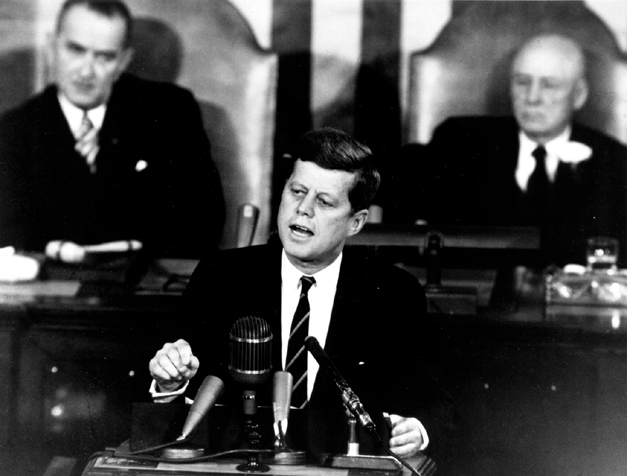
President John F. Kennedy's May 25, 1961 Speech before a Joint Session of Congress

On the 25th May, 1961, President John Kennedy summoned a joint session of Congress and asked America to commit itself to a goal – that of landing a man on the moon and returning him safely to Earth before the decade was out.

There’s a good link on the NASA site to the speech.

Plus a very good analysis of these 50 years in the Lexington column in last week’s The Economist.  As Lexington’s Notebook blog puts it,

That Kennedy speech plus 50

May 19th 2011, 15:47 by Lexington

MY print column this week notes that it is half a century next week since John Kennedy called for sending a man to the moon and returning him safely to Earth. The bottom line, I think:

If we can send a man to the moon, people ask, why can’t we [fill in the blank]? Lyndon Johnson tried to build a “great society”, but America is better at aeronautical engineering than social engineering. Mr Obama, pointing to competition from China, invokes a new “Sputnik moment” to justify bigger public investment in technology and infrastructure. It should not be a surprise that his appeals have gone unheeded. Putting a man on the moon was a brilliant achievement. But in some ways it was peculiarly un-American—almost, you might say, an aberration born out of the unique circumstances of the cold war. It is a reason to look back with pride, but not a pointer to the future.

A fascinating period!

Chernobly, Fukushima and change.

From out of darkness has to come the dawn

One side effect of the earthquake and tsunami that hit Northern Japan on the 11th March causing an explosion at the Fukushima nuclear power station is that the anniversary of the Chernobyl disaster is much more a news item than I suspect it might have been.

The nuclear accident at Chernobyl in Russia occurred on the 26th April, 1986, twenty-five years ago today.  One major difference between the two disasters was, of course, how they were reported.

Here’s a small extract from a fuller article in The Financial Times published on the 19th April written by Tony Barber who was in Russia those 25 years ago.

Twenty-five years after the explosion at the Ukrainian facility, I vividly recall every detail of those terrible days of April 1986. I was a 26-year-old foreign correspondent working in Moscow for Reuters news agency. On Friday, April 25, I flew to Kiev to spend a couple of days with Rhona, an ebullient Scottish friend who was teaching at the city’s university under a British Council programme. I was the only western journalist in Kiev that weekend.

While we caroused the night away, extraordinary events were unfolding 130km to the north. Technicians were conducting experiments that involved the disabling of automatic shutdown mechanisms at the plant’s fourth reactor. After a tremendous power surge, the reactor blew up at 1.23am on Saturday, April 26.

Except for high-ranking Communist party officials, the KGB and a number of scientists, doctors and fire-fighters, no one in the Soviet Union, let alone the wider world, knew anything about this. Soviet habits of secrecy and deception kept millions of people in the dark even as radiation spread across Ukraine, Belarus, Russia and beyond.

Certainly the disaster in Japan was widely broadcast across the world without any delays or restraints.  But the thrust of this Post today is to point out what, in the end, will have to be understood by the majority of the world’s peoples and their representatives in power.  That is that our dependence, our love affair, with cheap carbon-based energy has to come to an end, and soon.

On the 26th March, The Economist published a briefing on nuclear power entitled, When the steam clears.  As with so many of this newspaper’s essays, it was very well written [I am a subscriber to The Economist; have been for years.]  Here’s a taste of the article,

When last year a volcano closed the skies over Europe and a blown-out oil-rig turned the Gulf of Mexico black, there was no widespread enthusiasm for giving up oil or air travel. But nuclear power is much less fundamental to the workings of the world than petrol or aeroplanes. Nuclear reactors generate only 14% of the world’s electricity, and with a median age of about 27 years (see chart) and a typical design life of 40 a lot are nearing retirement. Although the world is eager to fly and thirsts for oil, it has had little appetite for new nuclear power for the past quarter of a century.

And towards the end of the article, this,

Distressing though it is, the crisis at Fukushima Dai-ichi is not in itself a reason for the world to change energy policy. The public-health effects seem likely, in the long run, to be small. Coal, with its emissions of sulphur, mercury and soot, will continue to kill far more people per kilowatt hour than nuclear does. But as an opportunity to reflect it may be welcome.  [my italics]

Power of hope

We need a continued growing awareness of the craziness of using coal and oil as primary sources of energy, and from that awareness a growing political pressure for change.  Change that recognises that mankind’s present energy strategies of continuing to pump carbon-based gases into the atmosphere are insane; pure and simple.

We need more of these examples:

Science Daily

University of Minnesota researchers are a key step closer to making renewable petroleum fuels using bacteria, sunlight and carbon dioxide.

Scientific American magazine

As the world continues to grapple with energy-related pollution and poverty, can innovation help?

The clock is ticking, as I wrote here a few days ago.

Apollo 13 – who remembers?

55:55:20 – Swigert: “Okay, Houston, we’ve had a problem here.”

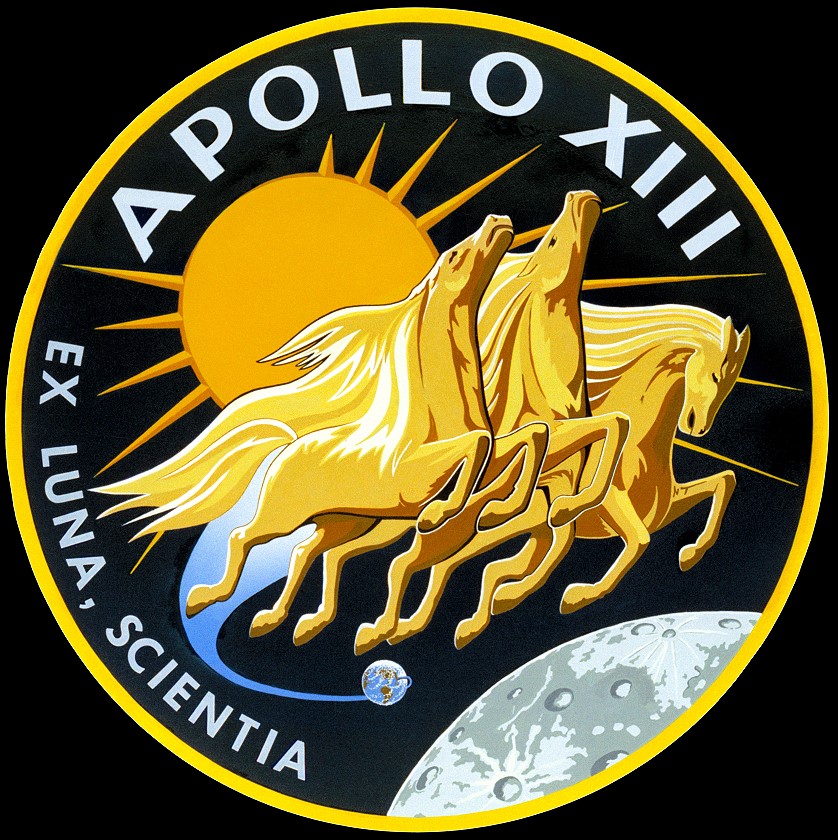
Apollo 13

Probably one of the most famous phrases from the whole Apollo program, these immortal words were uttered shortly before 10.10 PM EST on April 13th, 1970.

There is so much material around that it would be pointless covering too much ground in this Post.  So why the Post today?

Because today, too, is the 13th April.  So on this day, 41 years ago, the world came together held its collective breath and prayed for a successful outcome to this scary disaster.

There are some wonderful archives around from NASA.  Here’s one that covers the chronology of events of that famous accident.

The following includes events from 2.5 minutes before the accident to about 5 minutes after. Times given are in Ground Elapsed Time (G.E.T.), that is, the time elapsed since liftoff of Apollo 13 on April 11, 1970, at 2:13 PM Eastern Standard Time (EST). 55:52:00 G.E.T. is equal to 10:05 PM EST on April 13, 1970.

Also, those who want more information, may wish to go here, here and here

And 41 years ago, this coming Sunday, i.e. April 17th 1970, with the whole world praying for their safe return, Apollo 13 splashed down near Samoa.

Four hours before landing, the crew shed the service module; Mission Control had insisted on retaining it until then because everyone feared what the cold of space might do to the unsheltered CM heat shield. Photos of the Service Module showed one whole panel missing, and wreckage hanging out, it was a sorry mess as it drifted away. Three hours later the crew left the Lunar Module Aquarius and then splashed down gently in the Pacific Ocean near Samoa. From here.

In a very real sense, Apollo 13, like a number of the other historic Apollo flights, is a wonderful reminder of something that this Planet needs right now.  A coming together of all the peoples of this beautiful planet, a unity of mankind, to remind us in these fragile and difficult times of the saying, ‘United we stand, divided we fall.’

Finally, this Post is published, not only on the 41st anniversary of that memorable Apollo Flight but the day after the 50th anniversary of Yuri Gagarin’s first flight of a human into space, the 12th April, 1961.

Plan B for Planet Earth

Going for a sustainable future is not ‘pie in the sky’.

I have been attempting to write on Learning from Dogs about my experience reading the Lester Brown book, World on the Edge. In

Lester Brown's book

fact, there have been four articles written all with the title Total, Utter Madness (Pts 1 to 4.)  If you read the early chapters of Lester’s book you will have no issue with the notion of summarising the propositions that he presents as ‘total, utter madness’.

There was another article published on the 3rd March that I called, ‘Where are we off to?‘ that presented more information about the fragility of mankind on this Planet if we don’t change our ways, and soon. (There are links to all my articles from this 3rd March piece.)

But much of the second half of Lester Brown’s book is about the relative ease with which we can change the way we all live and offer the generations ahead of us a real alternative to the selfish, greedy way in which we treat Planet Earth at present.  That alternative is called Plan B.

Plan B offers the real hope of developing a sustainable relationship with our planet.  So this post is to reproduce in full a recent release by the Earth Policy Institute about wind power.

Wind: The Center of the Plan B Economy

Lester R. Brown

For many years, a small handful of countries dominated growth in wind power, but this is changing as the industry goes global, with more than 70 countries now developing wind resources. Between 2000 and 2010, world wind electric generating capacity increased at a frenetic pace from 17,000 megawatts to nearly 200,000 megawatts.

Measured by share of electricity supplied by wind, Denmark is the leading nation at 21 percent. Three north German states now get 40 percent or more of their electricity from wind. For Germany as a whole, the figure is 8 percent—and climbing. And in the state of Iowa, enough wind turbines came online in the last few years to produce up to 20 percent of that state’s electricity.

In terms of sheer volume, the United States leads the world with 35,000 megawatts of wind generating capacity, followed by China and Germany with 26,000 megawatts each. Texas, long the leading U.S. oil-producing state, is now also the nation’s leading generator of electricity from wind. It has 9,700 megawatts of wind generating capacity online, 370 megawatts more under construction, and a huge amount under development. If all of the wind farms projected for 2025 are completed, Texas will have 38,000 megawatts of wind generating capacity—the equivalent of 38 coal-fired power plants. This would satisfy roughly 90 percent of the current residential electricity needs of the state’s 25 million people.

In July 2010, ground was broken for the Alta Wind Energy Center (AWEC) in the Tehachapi Pass, some 75 miles north of Los Angeles, California. At 1,550 megawatts, it will be the largest U.S. wind farm. The AWEC is part of what will eventually be 4,500 megawatts of renewable power generation, enough to supply electricity to some 3 million homes.

Since wind turbines occupy only 1 percent of the land covered by a wind farm, farmers and ranchers can continue to grow grain and graze cattle on land devoted to wind farms. In effect, they double-crop their land, simultaneously harvesting electricity and wheat, corn, or cattle. With no investment on their part, farmers and ranchers typically receive $3,000–10,000 a year in royalties for each wind turbine on their land. For thousands of ranchers in the U.S. Great Plains, wind royalties will dwarf their net earnings from cattle sales.

In considering the energy productivity of land, wind turbines are in a class by themselves. For example, an acre of land in northern Iowa planted in corn can yield $1,000 worth of ethanol per year. That same acre used to site a wind turbine can produce $300,000 worth of electricity per year. This helps explain why investors find wind farms so attractive.

Impressive though U.S. wind energy growth is, the expansion now under way in China is even more so. China has enough onshore harnessable wind energy to raise its current electricity consumption 16-fold. Today, most of China’s 26,000 megawatts of wind generating capacity come from 50- to 100-megawatt wind farms. Beyond the many other wind farms of that size that are on the way, China’s new Wind Base program is creating seven wind mega-complexes of 10 to 38 gigawatts each in six provinces (1 gigawatt equals 1,000 megawatts). When completed, these complexes will have a generating capacity of more than 130 gigawatts. This is equivalent to building one new coal plant per week for two and a half years.

Of these 130 gigawatts, 7 gigawatts will be in the coastal waters of Jiangsu Province, one of China’s most highly industrialized provinces. China is planning a total of 23 gigawatts of offshore wind generating capacity. The country’s first major offshore project, the 102-megawatt Donghai Bridge Wind Farm near Shanghai, is already in operation.

In Europe, which now has 2,400 megawatts of offshore wind online, wind developers are planning 140 gigawatts of offshore wind generating capacity, mostly in the North Sea. There is enough harnessable wind energy in offshore Europe to satisfy the continent’s needs seven times over.

In September 2010, the Scottish government announced that it was replacing its goal of 50 percent renewable electricity by 2020 with a new goal of 80 percent. By 2025, Scotland expects renewables to meet all of its electricity needs. Much of the new capacity will be provided by offshore wind.

Denmark is looking to push the wind share of its electricity to 50 percent by 2025, with most of the additional power coming from offshore. In contemplating this prospect, Danish planners have turned conventional energy policy upside down. They plan to use wind as the mainstay of their electrical generating system and to use fossil-fuel-generated power to fill in when the wind dies down.

Spain, which has 19,000 megawatts of wind-generating capacity for its 45 million people, got 14 percent of its electricity from wind in 2009. On November 8th of that year, strong winds across Spain enabled wind turbines to supply 53 percent of the country’s electricity over a five-hour stretch. London Times reporter Graham Keeley wrote from Barcelona that “the towering white wind turbines which loom over Castilla-La Mancha—home of Cervantes’s hero, Don Quixote—and which dominate other parts of Spain, set a new record in wind energy production.”

In 2007, when Turkey issued a request for proposals to build wind farms, it received bids to build a staggering 78,000 megawatts of wind generating capacity, far beyond its 41,000 megawatts of total electrical generating capacity. Having selected 7,000 megawatts of the most promising proposals, the government is issuing construction permits.

In wind-rich Canada, Ontario, Quebec, and Alberta are the leaders in installed capacity. Ontario, Canada’s most populous province, has received applications for offshore wind development rights on its side of the Great Lakes that could result in some 21,000 megawatts of generating capacity. The provincial goal is to back out all coal-fired power by 2014.

On the U.S. side of Lake Ontario, New York State is also requesting proposals. Several of the seven other states that border the Great Lakes are planning to harness lake winds.

Earth Policy Institute’s Plan B to save civilization has four components: stabilizing climate, restoring earth’s natural support systems, stabilizing population, and eradicating poverty. At the heart of the plan is a crash program to develop 4,000 gigawatts (4 million megawatts) of wind generating capacity by 2020, enough to cover over half of world electricity consumptionin the Plan B economy. This will require a near doubling of capacity every two years, up from a doubling every three years over the last decade.

This climate-stabilizing initiative would mean the installation of 2 million wind turbines of 2 megawatts each. Manufacturing 2 million wind turbines over the next 10 years sounds intimidating—until it is compared with the 70 million automobiles the world produces each year.

At $3 million per installed turbine, the 2 million turbines would mean spending $600 billion per year worldwide between now and 2020. This compares with world oil and gas capital expenditures that are projected to double from $800 billion in 2010 to $1.6 trillion in 2015.

Adapted from Chapter 9, “Harnessing Wind, Solar, and Geothermal Energy” in Lester R. Brown, World on the Edge: How to Prevent Environmental and Economic Collapse (New York: W.W. Norton & Company, 2011), available online at www.earth-policy.org/books/wote.

The modern internet – a perspective.

A very thoughtful article from an interesting website.

By definition, everyone reading this article will be doing it as a result of the incredible advances in digital communications.  Thus it was that from today’s issue of Naked Capitalism there was reference to an article on a website called The Scholarly Kitchen, a site that I hadn’t come across before.  I won’t reproduce the article in full – that doesn’t seem right.  But I will present extracts to give you an idea of the thrust of the article.

The article is called The Battle for Control – What People who worry about the Internet are really worried about. Here’s how it starts:

Over the past few years, we’ve been witness to a parade of partisans in the debate over whether the Internet is making us smarter and more capable or turning us into shallow and superficial information parasites.

Nicholas Carr carries the most water for this argument, but others have joined in. Usually, their arguments that we’re going too far, becoming too fragmented, or becoming distracted are positioned to seem as if they have our best interests at heart — concern for our minds, our families, our communities, our culture.

Adam Gopnik, writing recently in theNew Yorker, breaks down the more typical partisans in the following manner:

. . . the Never-Betters, the Better-Nevers, and the Ever-Wasers. The Never-Betters believe that we’re on the brink of a new utopia, where information will be free and democratic. . . . The Better-Nevers think that we would have been better off if the whole thing had never happened, that . . . books and magazines create private space for minds in ways that twenty-second bursts of information don’t. The Ever-Wasers insist that at any moment in modernity something like this is going on, and that a new way of organizing data and connecting users is always thrilling to some and chilling to others.

A recent post by Jeff Jarvis puts what he calls “the distraction trope” into perspective. Instead of worrying about whether our brains, families, or communities are changing, Jarvis strips away that sophistry and lays bare something more primal that seems to be at stake:

And isn’t really their fear . . . that they are being replaced? Control in culture is shifting. We triumphalists — I don’t think I am one but, what the hell, I’ll don the uniform — argue that these tools unlock some potential in us, help us do what we want to do and better. The catastrophists are saying that we can be easily led astray to do stupid things and become stupid. One is an argument of enablement. One is an argument of enslavement. Which reveals more respect for humanity? That is the real dividing line. I start with faith in my fellow man and woman. The catastrophists start with little or none.

Throughout history, this fear of losing control has been consistently masked as concerns for higher, even altruistic interests. Jarvis quotes Erasmus (via Elizabeth Eisenstein’s new book, “Divine Art, Infernal Machine“), who said during the proliferation of books:

To what corner of the world do they not fly, these swarms of new books? . . . the very multitude of them is hurting scholarship, because it creates a glut, and even in good things satiety is most harmful. [The minds of men,] flighty and curious of anything new [are lured] away from the study of old authors.

Erasmus was worried about losing control over a world he’d mastered through his knowledge of old authors and stable cultural touchstones, and Carr is worried about losing control over a way of studying and thinking and processing information he’s become adept with. These are not the political leaders of the Middle East who are concerned about destabilization at an entirely different level (but for some of the same basic reasons, and from some of the same fundamental causes). Control has a softer side than anything we’d associate with authoritarianism.

Control can be channeled from competence and tradition. Change threatens both of these.

Do cut across and read the full article – it really is worth reading. It concludes thus:

It’s not that one is all good and one is all bad. There is a trade-off, an elusive balance, a mix of benefits and traits. In writing that seems prescient to both the pros and cons of humanity’s continuing exploration of its boundaries, Sigmund Freud once wrote:

Man has, as it were, become a kind of prosthetic god. When he puts on all his auxiliary organs he is truly magnificent; but those organs have not grown on to him and they still give him much trouble at times.

We may argue again and again whether the Internet is changing our brains, elevating us, lowering us, making us smarter, or making us stupid. But at the end of the day, it seems the real argument is about control — who has it, who shares it, and who wants it.

So, despite all the partisans, sophistry, and essays about our brains, our culture, our souls, it’s important to remember that what we’re really arguing about is control.

Sometimes, a cigar is just a cigar.

So near, so far!

Mixed emotions about those other worlds out there.

In recent times, Learning from Dogs has been reflecting on the magic, and fragility, of the planet we all live on.

There was the photograph of the Earthrise that attracted quite a few comments.  That was followed up by the amazing photograph of the Earth from Voyager 1 taken in 1990 from 3,762,136,324 miles away!  Then the lovely poem from Sue.

So it was interesting to note my mixed emotions to a piece on the BBC News website yesterday.  Here’s a flavour.

Worlds away

Astronomers have identified some 54 new planets where conditions may be suitable for life.

Five of the candidates are Earth-sized.

The announcement from the Kepler space telescope team brings the total number of exoplanet candidates they have identified to more than 1,200.

The data release also confirmed a unique sextet of planets around a single star and 170 further solar systems that include more than one planet circling far-flung stars.

Read the rest of the item here. (and there’s a fuller version on NetworkWorld)

So here are those mixed emotions.

  • Man has been, and still continues to be, wonderfully curious to the point of spending huge sums of money on projects that appear to do nothing more than satisfy that curiosity. (The (Kepler) mission‘s life-cycle cost is estimated at US$600 million, including funding for 3.5 years of operation, from here.)  That’s a beautiful trait, in my humble opinion.
  • Homo Sapiens is a wonderfully innovative and creative species, as so wonderfully presented by Alan Alda on a recent PBS Programme called The Human Spark.  (See the YouTube intro at the end of this Post.)
  • Look at all the inventions and incredible advances to our species that are all around us – including the PC I am using and the World Wide Web that is aiding this message!
  • For such an intelligent species as us, why is it that we are treating Planet Earth in such a suicidal manner through greed, pollution and over-consumption!
  • As was reported yesterday, we could be on the verge of total and utter chaos in terms of food.  Then also yesterday was a small item about food prices reaching a new global record.
  • It always struck me as absurd to conclude that this planet is the only habitable planet in the universe – ‘Astronomers estimate there are 1021 stars in the universe. With a conservative estimate of three planets per star (some could have many more, some would have none at all) this puts the estimated number of planets into millions of billions.‘ From here.
  • So the data coming in from Kepler is truly astounding and, personally, underlines this era as a great time to be alive.
  • But there simply is no choice in that for decades ahead, if not centuries ahead, Planet Earth is all there is for us.  So why do we do it so much harm!
  • Our civilisation is likely to go to the very limits of survivability before the message that the existing ‘model’ is broken is picked up by every major political party in the world.  That is very, very scary to contemplate.
  • So it looks as though, soon, mankind will face the ultimate decision of all time.  Give up and let the chaos overwhelm us all, or … or what?  In other words millions of us will have to live with the consequences of our greed.
  • The ‘or what?’ can only be a faith that it will be OK.
  • A faith that mankind will use the power of dreams, imagination and energy to create a new future that will, at long last, be a new dawn of democratic and just, integrous existence.
  • And maybe, just maybe, that could be the Second Coming and maybe, just maybe, the world’s Churches and religions will be our saving grace.

But of that day and hour knoweth no man, no, not the angels of heaven, but my Father only. Matthew 24:36

Fascinating times – a Chinese proverb, ‘It’s better to be a dog in a peaceful time than be a man in a chaotic period.’

Finally, here’s that video of the series preview to The Human Spark.

It’s all we have!

A bit tight on time for today’s Post so just feast your eyes on this image.


Earthrise, from the cabin of Apollo 8


This view of the rising Earth greeted the Apollo 8 astronauts as they came from behind the Moon after the lunar orbit insertion burn. The photo is displayed here in its original orientation, though it is more commonly viewed with the lunar surface at the bottom of the photo. Earth is about five degrees left of the horizon in the photo. The unnamed surface features on the left are near the eastern limb of the Moon as viewed from Earth. The lunar horizon is approximately 780 kilometers from the spacecraft. Height of the photographed area at the lunar horizon is about 175 kilometers.

The Apollo 8 mission was the first time man had left the orbit of the Earth.

The photograph was taken on the 24th December 1968 by NASA astronaut William Anders.  Within 18 months of this image being published, the environmental movement had started. Wilderness photographer Galen Rowell called it “the most influential environmental photograph ever taken.”


Phone humour!

Just a little light-heartedness for today.

From John Z. here in Payson, AZ.

I see LG have recognised that many people the wrong side of 60 now use a mobile phone and have recently launched …..


Cell phone for seniors


and from John L. from Devon, England this lovely story.

Several men are in the changing room of a golf club.  A mobile phone on a
bench rings and a man engages the hands-free speaker function and begins to
talk.  Everyone else in the room stops to listen.

MAN:  “Hello”

WOMAN:  “Hi Honey, it’s me. Are you at the club?”

MAN:  “Yes.”

WOMAN:  “I’m at the shops now and found this beautiful leather coat.  It’s
only £2,000.  Is it OK if I buy it?”

MAN:  “Sure, go ahead if you like it that much.”

WOMAN: “I also stopped by the Lexus dealership and saw the new models.
I saw one I really liked..”

MAN:  “How much?”

WOMAN:  “£60,000.”

MAN: “OK, but for that price I want it with all the options.”

WOMAN: “Great! Oh, and one more thing.  I was just talking to Janie and

found out that the house I wanted last year is back on the market.  They’re

asking £980,000 for it.”

MAN: “Well, then go ahead and make an offer of £900,000. They’ll probably
take it. If not, we can go the extra eighty-thousand if it’s what you really
want.”

WOMAN: “OK. I’ll see you later!  I love you so much!”

MAN: “Bye! I love you, too.”

The man hangs up.  The other men in the locker room are staring at him in
astonishment, mouths wide open.


He turns and asks, “Anyone know whose phone this is?”


Power of social networks in the area of finance

The nature and reach of social conversations in the investment arena.

The above sub-heading is from a recent Post on Naked Capitalism that rather spookily comes hot on the heels of one of my recent musings.  Here’s what I published on the 12th January although I wrote it on the 9th.

In the past opinion and commentary has been in the hands, more or less, of the giant media moguls.  But technology has changed that.  Now more than ever a huge people have access to the Internet.  Indeed, a quick Google search reveals that of a world population of 6.85 billion people, just under 2 billion (29%) have internet access.  In North America that percentage is 77.4% (226 million) and in Europe the percentage is 58.4% (475 million).  I.e. nearly a billion people in just North America and Europe!

My point is that, in a manner never before experienced in human history, the vast majority of us have the ability to read, learn and muse about the critically important issues facing us today, coming to conclusions that carry political weight.  We have almost infinite choice as to where and how we form opinions.

Thus having access, via the internet, to the scribblings of so many wise people may end up giving democracy the boost it really needs in the face of overwhelming powerful plutocratic forces.

Coincidentally, also on the 12th Yves Smith of Naked Capitalism published an article entitled, The 20 most influential blogs in financial media.  You can find that article here.  Here’s a flavour of what was written.

Thanks to Minyanville for publicizing this study by MindfulMoney on the nature and reach of social conversations in the investment arena. But even bigger thanks go to loyal readers and contributors for their frequent comments, leads, and critiques. The success of a blog depends on its community and I am very grateful for all the input so many of you have generously provided.

Perhaps the most interesting finding (boldface ours):

The research confirms the existence of a network of investment super-connectors with extraordinary media influence and reach. These super-connected new influentials are, for the most part, not well established voices in the media but individual bloggers who fiercely champion their independence….In the US, the network functions as the unofficial voice of Wall Street & the US federal bank with no mainstream media players at the centre of the network.

Given how many of these top blogs are critical of the status quo, this map may be hopeful sign that the blogosphere is beginning to become a important channel of discourse outside the reach of the PR machinery of major corporations and government entities.

And rather than publish all the top 20 names, you can see that list here, the top 10 are as follows:

1. Naked Capitalism
2. Infectious Greed
3. The Big Picture
4. Jesse’s Cross Roads Cafe
5. Zerohedge
6. Mish’s Global Economic Analysis
7. Calculated Risk
8. Paul Krugman’s Blog
9. FT Alphaville
10. Ludwig von Mises Institute

Anyone interested in downloading the original report as published on the MindfulMoney website can go to the article here; the link to the pdf, requiring prior registration, is towards the end of the article.  The article opens thus:

Most investors would acknowledge that social media is playing an increasing role in their investment decisions. Yet no-one has mapped the emerging network of influence likely to be playing a crucial part in those decisions.

Until now that is.  MindfulMoney’s ‘Social Finance: The New Influentials” report is aiming to better understand what this network looks like and to see if a number of super connections, so beloved of writers like Malcolm Gladwell, exist.

The research indicates that they do.

As I said, to download the article you need to register first – that link is here.

It’s a very interesting new world that we are living in and one, I pray, that is returning real power to the electorates.


In humble recognition of great writers

The technology of the Internet will prove to be of huge democratic value.

Those who know me know a disquieted man.  Someone, who despite being more at peace with himself than ever before, nonetheless senses that we, as in the mankind of Planet Earth, are already deep in the ‘no mans land’ of change between the last, say, forty years and a very different future just around the corner.

In the past opinion and commentary has been in the hands, more or less, of the giant media moguls.  But technology has changed that.  Now more than ever a huge people have access to the Internet.  Indeed, a quick Google search reveals that of a world population of 6.85 billion people, just under 2 billion (29%) have internet access.  In North America that percentage is 77.4% (226 million) and in Europe the percentage is 58.4% (475 million).  I.e. nearly a billion people in just North America and Europe!

My point is that, in a manner never before experienced in human history, the vast majority of us have the ability to read, learn and muse about the critically important issues facing us today, coming to conclusions that carry political weight.  We have almost infinite choice as to where and how we form opinions.

Thus having access, via the internet, to the scribblings of so many wise people may end up giving democracy the boost it really needs in the face of overwhelming powerful plutocratic forces.

Here are just a couple of those wise voices.

Simon Johnson

I first came across him in an article in The Atlantic Magazine back in May 2009.  That article was called The Quiet Coup.  If you haven’t read it, go here.  It is introduced thus:

The crash has laid bare many unpleasant truths about the United States. One of the most alarming, says a former chief economist of the International Monetary Fund, is that the finance industry has effectively captured our government—a state of affairs that more typically describes emerging markets, and is at the center of many emerging-market crises. If the IMF’s staff could speak freely about the U.S., it would tell us what it tells all countries in this situation: recovery will fail unless we break the financial oligarchy that is blocking essential reform. And if we are to prevent a true depression, we’re running out of time.

Simon is also one of the lead writers for the Blog Baseline Scenario.  Have a read of a recent article about the appointment of Bill Daley as President Obama’s new chief of staff.  That article concludes thus:

Top executives at big U.S. banks want to be left alone during relatively good times – allowed to take whatever excessive risks they want, to juice their return on equity through massive leverage, to thus boost their pay and enhance their status around the world.  But at a moment of severe financial crisis, they also want someone in the White House who will whisper at just the right moment: “Mr. President, if you let this bank fail, it will trigger a worldwide financial panic and another Great Depression.  This will be worse than what happened after Lehman Brothers failed.”

Let’s be honest.  With the appointment of Bill Daley, the big banks have won completely this round of boom-bust-bailout.  The risk inherent to our financial system is now higher than it was in the early/mid-2000s.  We are set up for another illusory financial expansion and another debilitating crisis.

Bill Daley will get it done.

Now let’s turn to that other writer, Patrice Ayme.

That name is a nom-de-plume but so what!  Having read Patrice for some time now and corresponded via email from time to time, I have to tell you this is one giant of an intellectual thinker.  Take this Post from example: Pluto Lie #1: Glass Beads Matter More It’s a beautifully written article but not something that you should try a skim read through; it deserves a really focussed mind on the words and the meanings expressed. Here’s a flavour:

Abstract: An American historian paid by the hyper rich, exhumed again the old fallacy that material riches matter more than anything else. He points at recent electronic gadgetry, and attributes it to Reagan. This article of faith in Reagan and American plutocracy amusingly gives, obviously without knowing, prominence to recent French and German governmental research, which allowed to make such gadgets.

I skewer this lamentable, not to say corrupt, piece of dismal propaganda which was published all over the American media, for Christmas. I use the occasion to give a new metric to evaluate riches over the last 100,000 years, explain why the USA does not use the metric system, and what European kings were really about.

Too great a disparity of riches is another name for plutocracy.  Indeed, money is power, and thus, too much money is too much power.

Here is how Patrice’s article closes (but it would be so much better if you read the article in its entirety):

Morality? Europeans Kings of old could live long, and lived strong.The best of them were working relentlessly, brandishing whatever it took to stabilize the situation ethically, politically, and civilizationally. They were incredibly brutal. They would die, and kill, just over the length of hair (kings and prospective kings wore it long, religious wore it nought). Even small children, if viewed as potential kings, would be presented with the scissors and the sword (if they did not go for the former, they would get the later).

So of course, kings of old would have made it to today’s highest class. Kings were often the richest people around, and they got there, or stayed there, by killing, in the name of new, and higher principles. This only happened because their subordinates agreed to strive towards the same new and higher principles. Hanson misses completely the spiritual dimension of the kings of old. Kings of old led an ethical revolution, which was their reason for being in power, and why people elected them (or elected to follow them).

Kings of old lived very comfortably by their metrics, with residences all around Europe, and wives, concubines, nobles under oaths to serve them (to death). Some, such as Charlemagne, were very healthy into old age. What’s more fun than to make war for decades, mostly winning, as Charlemagne did?

Dr. Victor Davis Hanson, a classicist and military historian, is a senior fellow at the Hoover Institution and a recipient of the 2007 National Humanities Medal.

That appurtenance, too, tells volumes. Hanson has tales to tell, and they sing of American plutocracy. It remains to be seen if history will sing along. Two things, though: history does not tell lies, and human beings are not reducible to gadget loving midgets.

So to repeat my point.  Whether or not one choses to agree with the likes of Simon Johnson and Patrice Ayme there is no doubt that in my mind it will be writers like these that, through the better education of millions of citizens, will not only preserve democracy in so many countries but will ensure that the age before us will be fairer and more just.

Change can be achieved by the threat of tomorrow being the same

even quicker than by the hope of tomorrow being different! C. Graham-Leigh.