Category: Technology

In the sky with diamonds!

A fascinating item recently published by Yale University.

Apologies, time pressure allows me little more than to repeat this in full.  But still no less interesting.

oooOOOooo

Nearby super-Earth likely a diamond planet

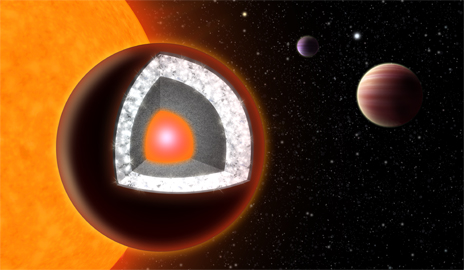
Illustration of the interior of 55 Cancri e — an extremely hot planet with a surface of mostly graphite surrounding a thick layer of diamond, below which is a layer of silicon-based minerals and a molten iron core at the center. (Image by Haven Giguere)

October 11, 2012

New research led by Yale University scientists suggests that a rocky planet twice Earth’s size orbiting a nearby star is a diamond planet.

“This is our first glimpse of a rocky world with a fundamentally different chemistry from Earth,” said lead researcher Nikku Madhusudhan, a Yale postdoctoral researcher in physics and astronomy. “The surface of this planet is likely covered in graphite and diamond rather than water and granite.”

The paper reporting the findings has been accepted for publication in the journal Astrophysical Journal Letters.

The planet — called 55 Cancri e — has a radius twice Earth’s, and a mass eight times greater, making it a “super-Earth.” It is one of five planets orbiting a sun-like star, 55 Cancri, that is located 40 light years from Earth yet visible to the naked eye in the constellation of Cancer.

The planet orbits at hyper speed — its year lasts just 18 hours, in contrast to Earth’s 365 days. It is also blazingly hot, with a temperature of about 3,900 degrees Fahrenheit, researchers said, a far cry from a habitable world.

The planet was first observed transiting its star last year, allowing astronomers to measure its radius for the first time. This new information, combined with the most recent estimate of its mass, allowed Madhusudhan and colleagues to infer its chemical composition using models of its interior and by computing all possible combinations of elements and compounds that would yield those specific characteristics.

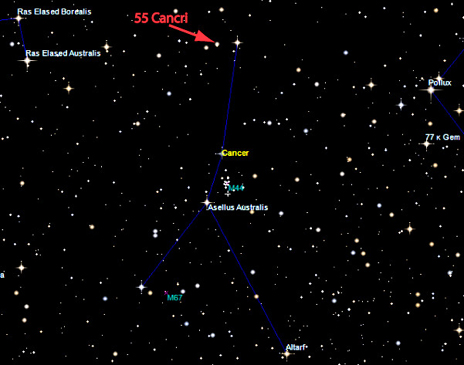
Star map showing the planet-hosting star 55 Cancri in the constellation of Cancer. The star is visible to the naked eye, though better through binoculars. (Image by Nikku Madhusudhan; created using Sky Map Online

Astronomers had previously reported that the host star has more carbon than oxygen, and Madhusudhan and colleagues confirmed that substantial amounts of carbon and silicon carbide, and a negligible amount of water ice, were available during the planet’s formation.

Astronomers also thought 55 Cancri e contained a substantial amount of super-heated water, based on the assumption that its chemical makeup was similar to Earth’s, Madhusudhan said. But the new research suggests the planet has no water at all, and appears to be composed primarily of carbon (as graphite and diamond), iron, silicon carbide, and, possibly, some silicates. The study estimates that at least a third of the planet’s mass — the equivalent of about three Earth masses — could be diamond.

“By contrast, Earth’s interior is rich in oxygen, but extremely poor in carbon — less than a part in thousand by mass,” says co-author and Yale geophysicist Kanani Lee.

The identification of a carbon-rich super-Earth means that distant rocky planets can no longer be assumed to have chemical constituents, interiors, atmospheres, or biologies similar to those of Earth, Madhusudhan said. The discovery also opens new avenues for the study of geochemistry and geophysical processes in Earth-sized alien planets. A carbon-rich composition could influence the planet’s thermal evolution and plate tectonics, for example, with implications for volcanism, seismic activity, and mountain formation.

“Stars are simple — given a star’s mass and age, you know its basic structure and history,” said David Spergel, professor of astronomy and chair of astrophysical sciences at Princeton University, who is not a co-author of the study. “Planets are much more complex. This ‘diamond-rich super-Earth’ is likely just one example of the rich sets of discoveries that await us as we begin to explore planets around nearby stars.”

In 2011, Madhusudhan led the first discovery of a carbon-rich atmosphere in a distant gas giant planet, opening the possibility of long-theorized carbon-rich rocky planets (or “diamond planets”). The new research represents the first time that astronomers have identified a likely diamond planet around a sun-like star and specified its chemical make-up. Follow-up observations of the planet’s atmosphere and additional estimates of the stellar composition would strengthen the findings about the planet’s chemical composition.

The authors of the paper are Madhusudhan, Lee, and Olivier Mousis, a planetary scientist at the Institut de Recherche en Astrophysique et Planetologie in Toulose, France.

The paper is titled “A Possible Carbon-rich Interior in Super-Earth 55 Cancri e.”

The research was supported by the Yale Center for Astronomy and Astrophysics (YCAA) in the Yale Department of Physics through Madhusudhan’s YCAA postdoctoral prize fellowship.

oooOOOooo

Dead easy to know how to finish this post off!

Lets try not to get stuck in a rut…

A fascinating look back at making tracks!

This came in from Suzann, Su to her friends, a few days ago.  Suzann is Dan Gomez’s sister and if Dan’s name is familiar it’s because he, too, sends in items for Learning from Dogs, the recent Tad too much cabin pressure being an example.  It was Su that invited me out to San Carlos, Mexico for Christmas 2007 which resulted in me meeting Jean, a long-time friend of Su, and, as they say, the rest is history!  OK, to the article from Su.

oooOOOooo

Here’s a question?

Think about railroad (railways in ‘English’!) tracks.  The US standard railroad gauge (distance between the rails) is 4 feet, 8.5 inches.  That’s an exceedingly odd number.

Why was that gauge used? Because that’s the way they built them in Scotland, and Scots expatriates designed the US railroads.

Why did the Scots build them like that? Because the first rail lines were built by the same people who built the pre-railroad tramways, and that’s the gauge they used.

Why that gauge then?  Because the people who built the tramways used the same jigs and tools that they had used for building wagons, which used that wheel spacing.

Why did the wagons have that particular odd wheel spacing?  Well, if they tried to use any other spacing, the wagon wheels would break on some of the old, long-distance roads in Scotland, because that’s the spacing of the wheel ruts.

So who built those old rutted roads?  Imperial Rome built the first long distance roads in Europe (including Scotland) for their legions.  Those roads have been used ever since. [And rarely repaired! 😉 Ed. ]

And the ruts in the roads? Roman war chariots formed the initial ruts.  Which forever more everyone else had to match for fear of destroying their wagon wheels.

Since the chariots were made for Imperial Rome, they were all alike in the matter of wheel spacing.  Therefore the United States standard railroad gauge of 4 feet, 8.5 inches is derived from the original specifications for an Imperial Roman war chariot.

Bureaucracies live forever….

So the next time you are handed a specification or a procedure or process and wonder ‘What horse’s ass came up with this?‘, you may be exactly right.  Imperial Roman army chariots were made just wide enough to accommodate the rear ends of two war horses.

Now, the twist to the story. When you see a Space Shuttle sitting on its launch pad, there are two big booster rockets attached to the sides of the main fuel tank. These are solid rocket boosters, or SRBs.  The SRBs are made by Thiokol at their factory in Utah.

The engineers who designed the SRBs would have preferred to make them a bit fatter, but the SRBs had to be shipped by train from the factory to the launch site. The railroad line from the factory happens to run through a tunnel in the mountains, and the SRBs had to fit through that tunnel.

The tunnel is slightly wider than the railroad track, and the railroad track, as you now know, is about as wide as two horses’ behinds.

oooOOOooo

Just a fabulously interesting account of something we all take for granted, or had done until now! Thank you so much, Su, for sharing that with everyone.

Change in action

There is real hope for us all!

Hopefully, you were able to watch the Amory Lovins talk in yesterday’s post?  If not, then do find time to watch how Professor Lovins sets out the powerful argument that the USA could soon, relatively speaking, be energy self-sufficient.

So on top of the Lovins presentation, I wanted to draw your attention to an item on Climate Crocks last October 5th.

One of the great stories untold in the American media is the ongoing revolution in one of the world’s most advanced economies – as Germany undertakes a bold and serious transition from powering a great engine of prosperity on fossil fuels, to plentiful and inexhaustible renewable energy.

Listening to Mitt Romney double and triple down on the bogus Fox/Fossil narrative about “clean coal” and failed renewables, it might be well to consider how one of our toughest manufacturing competitors is going all-in on the high stakes renewable energy revolution of the new century.

The article is a detailed analysis of how Germany is powering ahead, pardon the pun, in the provision of non carbon-based power, as this reference illustrates,

German use of coal to generate electricity has declined steadily from 1990 to 2011, according to readily available statistics on the German electricity system. The percentage of coal-fired electricity in German electricity generation has fallen from 56.7% in 1990 to 43.5% last year–a decrease of more than 10% despite a increase in total electricity generation during the same period of about 10%. At the same time the share of renewable energy in the electricity mix has increased from 3.6% to 19.9%, mostly due to the rapid development of wind energy and biomass.

Do go across and read the article.

Then thanks to a comment left on a recent post by Martin Lack another very positive story came to light (yet another pun – read on!),

Comment from Jules,

Here is one for you- http://www.solarroadways.com/intro.shtml – the idea is totally leftfield, but it fulfils certain issues such as distribution, decentralisation of power and offers a recharge network for electric cars and it has received a big chunk of government funding. It is so out there that I wonder if it could possibly be the answer but you never know.

Very quickly one finds that Solar Roadways are involved in something VERY interesting, namely,

Years ago, when the phrase “Global Warming” began gaining popularity, we started batting around the idea of replacing asphalt and concrete surfaces with solar panels that could be driven upon. We thought of the “black box” on airplanes: We didn’t know what material that black box was made of, but it seemed to be able to protect sensitive electronics from the worst of airline crashes.

Suppose we made a section of road out of this material and housed solar cells to collect energy, which could pay for the cost of the panel, thereby creating a road that would pay for itself over time. What if we added LEDs to “paint” the road lines from beneath, lighting up the road for safer night time driving? What if we added a heating element in the surface (like the defrosting wire in the rear window of our cars) to prevent snow/ice accumulation in northern climates? The ideas and possibilities just continued to roll in and the Solar Roadway project was born.

Now watch this!

and then watch this, as nearly 1.5 million others have!

The Solar Roadways project is working to pave roads with solar panels that you can drive on. Co-founder Scott Brusaw has made some major steps forward since our first visit back in 2007, so we visited him again for an exclusive update on the project, including the first ever video recorded of the Solar Roadways prototype! For more information visit http://www.solarroadways.com . This Solar Roadway project is highlighted as one of many planet-friendly solutions in the feature film by YERT – Your Environmental Road Trip. To learn more about YERT, visit http://yert.com .

Flattr this video here: https://flattr.com/thing/407726/YERT-video-about-Solar-Roadways-The-Prototype

And you can become a fan of YERT on Facebook here:http://www.facebook.com/home.php#!/pages/YERT-Your-Environmental-Road-Trip/12…

So nothing ever stays the same!

The death of the USA?

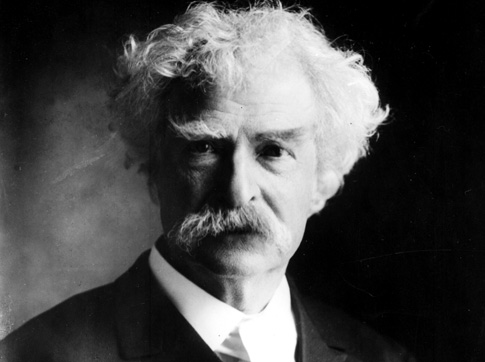
The reports of my death are greatly exaggerated! Mark Twain.

Mark Twain

Origin

Mark Twain quotation after hearing that his obituary had been published in the New York Journal.

Mistaken publications of obituaries aren’t as rare as you might expect. A recent example is of Dave Swarbrick, the British folk/rock violinist, who was killed off mistakenly by the Daily Telegraph in April 1999 when they reported that his visit to hospital in Coventry had resulted in his death. He did at least get the opportunity to read a rather favourable account of his life, not something we all get to do, and to deliver the gag “It’s not the first time I have died in Coventry”.

So why have I opened with this quote from Mark Twain?  Read on and I hope all will be clear.

Integrity is always about getting to the truth!

A little under a week ago I published a couple of posts that proposed that the United States of America is an empire in decline.  The first was What goes up? and the second Might just come down! As a Brit I well know that aspect of British history!

However a recent conversation with a friend of many years back in England, who has also been a shrewd and wise entrepreneur for longer than I care to remember, argued that the evidence for the ‘end of the USA’ could be challenged.

He cited five reasons why he thought the USA would remain, more or less, in its dominant position.  They were:

  1. Spirit of innovation
  2. Relaxed labour laws
  3. The importance of Mexico
  4. The uncertainty of China in terms of the next ’empire’
  5. The likely energy self-sufficiency for the USA in the near-term.

So let me expand on each of those points.

Spirit of innovation

Let me quote from an article in TIME Magazine of the 5th June, 2011,

Innovation is as American as apple pie. It seems to accord with so many elements of our national character — ingenuity, freedom, flexibility, the willingness to question conventional wisdom and defy authority. But politicians are pinning their hopes on innovation for more urgent reasons. America’s future growth will have to come from new industries that create new products and processes. Older industries are under tremendous pressure. Technological change is making factories and offices far more efficient. The rise of low-wage manufacturing in China and low-wage services in India is moving jobs overseas. The only durable strength we have — the only one that can withstand these gale winds — is innovation.

Now there are plenty to argue both ways in terms of the future innovation potential for the USA, as a recent article in The Atlantic does, see American Innovation: It’s the Best of Times and the Worst of Times.  But the spirit of innovation will be a powerful economic potential for the USA for many years to come.

Relaxed labour laws.

Definitely an area that I have little knowledge of except for the subjective notion that compared to many other nations, the laws in the USA are much less of a restraint on economic productivity than elsewhere.

The importance of Mexico.

Importance in the context of providing the USA with a source of cheaper manufacturing facilities.  My English friend thought that this was a significant competitive advantage for the USA.  Now, as it happens, we had a couple staying with us over the week-end of the 6th/7th October.  The husband is a senior manager of Horst Engineering, an American firm based in Guaymas, Sonora County, Mexico.  Here’s a picture from their website,

We are a contract manufacturer of precision machined components and assemblies for aerospace, medical, and other high technology industries. Our core processes include Swiss screw machining, turning, milling, thread rolling, centerless grinding, and assembly. Our extensive supply chain offers our customers a full service logistics solution for managing their precision product requirements. We are ISO9001:2008 and AS9100 registered and proud of our 66 year, three-generation legacy of quality and performance.

I was told that many American and British firms were using Mexico rather than China for a number of reasons.  Not least because Chinese suppliers require full payment before shipment.  Plus that taking into account that financial aspect together with shipping costs and other logistical issues, China wasn’t as ‘cheap’ over all.  Here’s a recent announcement from Rolls Royce,

Rolls-Royce plans new Sonora hub

The burgeoning aerospace industry in Guaymas had its efforts validated recently when the venerable Rolls-Royce chose it as the site for its newest global purchasing office.

Surrounded by several of its aerospace manufacturing suppliers, London-based Rolls-Royce will move into a Guaymas industrial park owned by Tucson-based The Offshore Group to develop a supply hub for commercial jets and military aircraft around the globe.

“Rolls-Royce has very robust booking orders for the next 10 years,” said Joel Reuter, director of communications for Rolls-Royce in North America. “We need to double our production.”

Because a number of Rolls-Royce suppliers already operate in Guaymas, the city was a logical choice, Reuter said.

The uncertainty of China in terms of the next ’empire’

The point made in terms of China taking over ’empire’ status from the USA, as Simon Johnson argues over at Baseline Scenario, is countered by the fact that politically China is an unknown quantity.  Until China endorses some form of democratic process, that unknowingness is not going to disappear.

The likely energy self-sufficiency for the USA in the near-term.

I can’t do better than to ask you to watch this video!  Just 27-minutes long, it is a very interesting review of the energy future of the USA.

As the TED website suggests in terms of why you should listen to Amory Lovins,

Amory Lovins was worried (and writing) about energy long before global warming was making the front — or even back — page of newspapers. Since studying at Harvard and Oxford in the 1960s, he’s written dozens of books, and initiated ambitious projects — cofounding the influential, environment-focused Rocky Mountain Institute; prototyping the ultra-efficient Hypercar — to focus the world’s attention on alternative approaches to energy and transportation.

His critical thinking has driven people around the globe — from world leaders to the average Joe — to think differently about energy and its role in some of our biggest problems: climate change, oil dependency, national security, economic health, and depletion of natural resources.

More on Reinventing Fire may be found here.

So, don’t know about you, but I found those five points deeply convincing.  How about you?  Are the reports of the death of the USA  greatly exaggerated? Do leave a comment.

A whole new meaning to the term ‘freefall’!

Just one small step for Felix Baumgartner, and some step!

Felix Baumgartner

I was speaking with my son, Alex, in England about an hour ago and he brought to my attention a feat that is breath-taking, in the fullest meaning of that expression.  I had to share the details with you as I’m sure that many, like me, were not aware of what is happening in a little under twelve hours time, subject to everything being in place.

A free-fall commencing from an altitude of 120,000 feet!  (Oh,that’s just about 23 miles up!)

The website to go to is the Red Bull Stratus site.  But if like me you are not really aware of who Felix is then on Wikipedia one can read this,

Felix Baumgartner (born 20 April 1969) is an Austrian skydiver and a BASE jumper. He is renowned for the particularly dangerous nature of the stunts he has performed during his career. Baumgartner spent time in the Austrian military where he practiced parachute jumping, including training to land on small target zones.

The Wikipedia entry goes on to explain,

He was born on 20 April 1969 in Salzburg, Austria.

In 1999 he claimed the world record for the highest parachute jump from a building when he jumped from the Petronas Towers in Kuala Lumpur, Malaysia. On 31 July 2003, Baumgartner became the first person to skydive across the English Channel using a specially made carbon fiber wing.

Baumgartner set the world record for the lowest BASE jump ever (95 feet), from the hand of the Christ the Redeemer statue in Rio de Janeiro.

He became the first person to BASE jump from the completed Millau Viaduct in France on 27 June 2004 and the first person to sky dive onto, then BASE jump from, the Turning Torso building in Malmö, Sweden on 18 August 2006.

On 12 December 2007 he became the first person to jump from the 91st floor observation deck, then went to the 90th floor (about 390 m (1,280 ft)) of the then tallest completed building in the world, Taipei 101, Taipei, Taiwan.

But to my mind, none of those previous jumps compare to this mission,

Red Bull Stratos, a mission to the edge of space, will attempt to transcend human limits that have existed for 50 years. Supported by a team of experts Felix Baumgartner plans to ascend to 120,000 feet in a stratospheric balloon and make a freefall jump rushing toward earth at supersonic speeds before parachuting to the ground. His attempt to dare atmospheric limits holds the potential to provide valuable medical and scientific research data for future pioneers.

The Red Bull Stratos team brings together the world’s leading minds in aerospace medicine, engineering, pressure suit development, capsule creation and balloon fabrication. It includes retired United States Air Force Colonel Joseph Kittinger, who holds three of the records Felix will strive to break.

Joe’s record jump from 102,800 ft in 1960 was during a time when no one knew if a human could survive a jump from the edge of space. Joe was a Captain in the U.S. Air Force and had already taken a balloon to 97,000 feet in Project ManHigh and survived a drogue mishap during a jump from 76,400 feet in Excelsior I. The Excelsior III mission was his 33rd parachute jump.

Although researching extremes was part of the program’s goals, setting records wasn’t the mission’s purpose. Joe ascended in helium balloon launched from the back of a truck. He wore a pressurized suit on the way up in an open, unpressurized gondola. Scientific data captured from Joe’s jump was shared with U.S. research personnel for development of the space program. Today Felix and his specialized team hope to take what was learned from Joe’s jumps more than 50 years ago and press forward to test the edge of the human envelope.

So if you are able and would like to watch the event live then this is the appropriate link.

Good luck to all involved.  What an amazing feat!

Tad too much cabin pressure!

A short pencil is better than a long memory.

The origins of this saying seem to have disappeared in the mists of time but it’s a rare person that doesn’t write a list from time to time.  But when it comes to critical processes, having a list, or better known as a ‘checklist’ is essential to completing the process correctly.

With that in mind, then let me introduce you to a story recently sent to me by old friend Dan Gomez.

oooOOOooo

I’ve always done it this way!

This is an example of what happens when we do not pay attention to detail, and do not follow instructions and checklists!

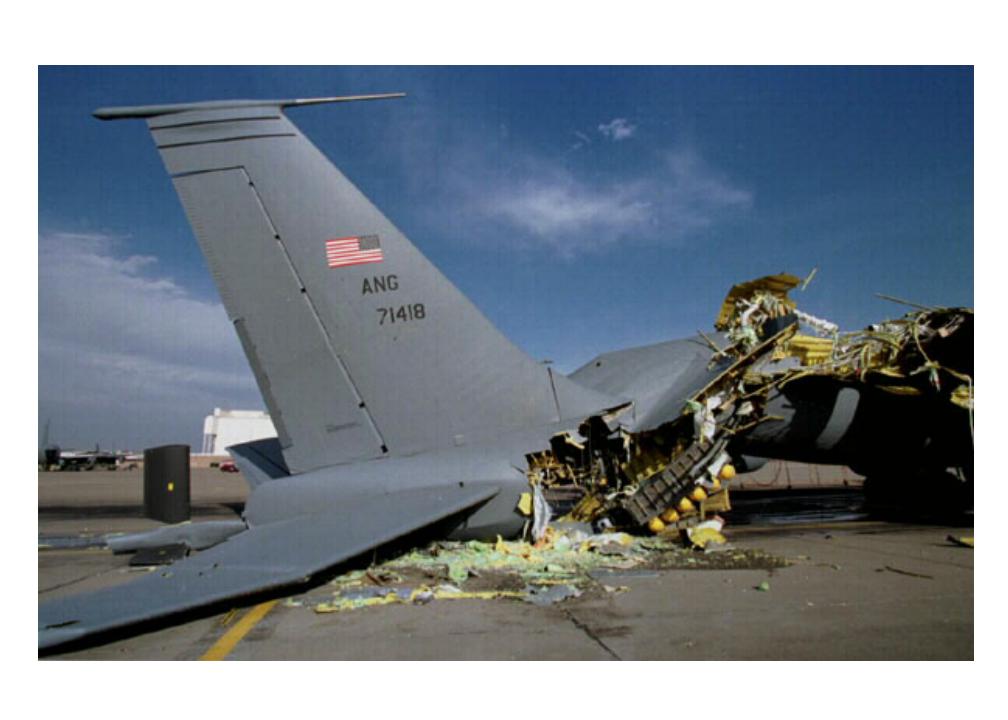
A KC-135 Aircraft was being pressurized at ground level. The outflow valves which are used to regulate the pressure of the aircraft were capped off during a 5-year overhaul and never re-opened. The post-investigation revealed that a civilian depot technician who “had always done it that way” was using a homemade gauge, and no procedure.

Apparently, the technician’s gauge didn’t even have a max “peg” for the needle, so it was no surprise he missed it when the needle went around the gauge the first time.

As the technician continued to pressurize the aircraft with the needle on its second trip around the gauge there was a “boom”.  One KC-135 went bang!  Indeed, the rear hatch was blown over 70 yards away, through a blast fence!

An incident like this is never funny and is further regrettable when we consider that this mistake is one that we taxpayers will end up paying for. Fortunately, no one was reported as being injured.

This was a good “Lessons Learned” for making sure we have trained people, with the correct tools, and who are following detailed procedures. It should serve as a reminder that just because you’ve always done it that way, it does not make it the “right” way!

oooOOOooo

Now where did I leave that pencil!

The best and the worst of mankind – the best

An extraordinary view of the Universe

I first saw this report on the BBC News website,

The Hubble Space Telescope (HST) has produced one of its most extraordinary views of the Universe to date.

Called the eXtreme Deep Field, the picture captures a mass of galaxies stretching back almost to the time when the first stars began to shine.

But this was no simple point and snap – some of the objects in this image are too distant and too faint for that.

Rather, this view required Hubble to stare at a tiny patch of sky for more than 500 hours to detect all the light.

“It’s a really spectacular image,” said Dr Michele Trenti, a science team member from the University of Cambridge, UK.

Then while the BBC News item had that stunning picture, over on the NASA website there was the following image together with more information.

Called the eXtreme Deep Field, or XDF, the photo was assembled by combining 10 years of NASA Hubble Space Telescope photographs taken of a patch of sky at the center of the original Hubble Ultra Deep Field. The XDF is a small fraction of the angular diameter of the full moon.

The Hubble Ultra Deep Field is an image of a small area of space in the constellation Fornax, created using Hubble Space Telescope data from 2003 and 2004. By collecting faint light over many hours of observation, it revealed thousands of galaxies, both nearby and very distant, making it the deepest image of the universe ever taken at that time.

The new full-color XDF image is even more sensitive, and contains about 5,500 galaxies even within its smaller field of view. The faintest galaxies are one ten-billionth the brightness of what the human eye can see.

Magnificent spiral galaxies similar in shape to our Milky Way and the neighboring Andromeda galaxy appear in this image, as do the large, fuzzy red galaxies where the formation of new stars has ceased. These red galaxies are the remnants of dramatic collisions between galaxies and are in their declining years. Peppered across the field are tiny, faint, more distant galaxies that were like the seedlings from which today’s magnificent galaxies grew. The history of galaxies — from soon after the first galaxies were born to the great galaxies of today, like our Milky Way — is laid out in this one remarkable image.

Hubble pointed at a tiny patch of southern sky in repeat visits (made over the past decade) for a total of 50 days, with a total exposure time of 2 million seconds. More than 2,000 images of the same field were taken with Hubble’s two premier cameras: the Advanced Camera for Surveys and the Wide Field Camera 3, which extends Hubble’s vision into near-infrared light.

“The XDF is the deepest image of the sky ever obtained and reveals the faintest and most distant galaxies ever seen. XDF allows us to explore further back in time than ever before”, said Garth Illingworth of the University of California at Santa Cruz, principal investigator of the Hubble Ultra Deep Field 2009 (HUDF09) program.

The universe is 13.7 billion years old, and the XDF reveals galaxies that span back 13.2 billion years in time. Most of the galaxies in the XDF are seen when they were young, small, and growing, often violently as they collided and merged together. The early universe was a time of dramatic birth for galaxies containing brilliant blue stars extraordinarily brighter than our sun. The light from those past events is just arriving at Earth now, and so the XDF is a “time tunnel into the distant past.” The youngest galaxy found in the XDF existed just 450 million years after the universe’s birth in the big bang.

Before Hubble was launched in 1990, astronomers could barely see normal galaxies to 7 billion light-years away, about halfway across the universe. Observations with telescopes on the ground were not able to establish how galaxies formed and evolved in the early universe.

Hubble gave astronomers their first view of the actual forms and shapes of galaxies when they were young. This provided compelling, direct visual evidence that the universe is truly changing as it ages. Like watching individual frames of a motion picture, the Hubble deep surveys reveal the emergence of structure in the infant universe and the subsequent dynamic stages of galaxy evolution.

The infrared vision of NASA’s planned James Webb Space Telescope will be aimed at the XDF. The Webb telescope will find even fainter galaxies that existed when the universe was just a few hundred million years old. Because of the expansion of the universe, light from the distant past is stretched into longer, infrared wavelengths. The Webb telescope’s infrared vision is ideally suited to push the XDF even deeper, into a time when the first stars and galaxies formed and filled the early “dark ages” of the universe with light.

The Hubble Space Telescope is a project of international cooperation between NASA and the European Space Agency. NASA’s Goddard Space Flight Center in Greenbelt, Md., manages the telescope. The Space Telescope Science Institute (STScI) in Baltimore, Md., conducts Hubble science operations. STScI is operated by the Association of Universities for Research in Astronomy, Inc., in Washington.

What a fabulous achievement.  Just think that “The faintest galaxies are one ten-billionth the brightness of what the human eye can see.” and “The history of galaxies — from soon after the first galaxies were born to the great galaxies of today, like our Milky Way — is laid out in this one remarkable image.”  Plus, “The youngest galaxy found in the XDF existed just 450 million years after the universe’s birth in the big bang.

Do you know what crosses my mind looking at the picture?  All those galaxies with, presumably, tens of thousands of planets and, surely, the near certainty that intelligent life must be teeming across those trillions of miles!

Let me close with this YouTube video brought to my attention thanks to Peter Sinclair of Climate Crocks.

Watch this and other space videos at http://SpaceRip.com

We’ve all seen pictures of Earth from space, but have we really taken the time to appreciate what our planet looks like against the starscapes of the Milky Way galaxy? Here, we beckon viewers to see Earth in its cosmic context, which includes the stars, interstellar gases, the moon, the sun, and the solar winds. Be sure to watch in full HD, 1080p, and imagine you’re an astronaut aboard the International Space Station with a little time on your hands.

Little boys never grow up!

Who didn’t enjoy playing with model trains!

So try this for size!

The official video about Miniatur Wunderland Hamburg, the largest model railway in the world, and one of the most successful tourist attractions in Germany. On the 1.300 m² large layout, far more than a thousand trains, aircrafts, cars and ships move about. A wonder of the world in miniature. Please, find more information here.

The wind doth blow!

Maybe even blowing trucks over!

OK, that sub-heading must seem a tad bizarre!  Let me explain.  On Tuesday, Jean had an important visit to make down in Mesa, AZ on the outskirts of Phoenix.  The first 65 miles, give or take, from Payson to Mesa are down along Highway 87.

At 11.20 we started on our return from Mesa planning on being early back home, say by 1pm at the latest.  But 31 miles up the Northbound carriageway of Highway 87, we came to a halt.  The road was closed due to an accident with a tanker.  As our local newspaper, the Payson Roundup, put it,

The driver of the truck was taken by ambulance to a Scottsdale hospital with non life-threatening injuries. DPS has not ruled out speed as the cause of the crash. Photo by Andy Towle.

Due to a hazardous spill, Highway 87 was closed most of Tuesday, but reopened Wednesday morning after overnight clean up efforts, according to the Arizona Department of Public Safety.

Officials initially thought the roadway could be closed as many as two days due to the amount of oil spewed across both sides of the highway.

The highway closed down after a semi truck carrying oil used for paving rolled Tuesday afternoon near milepost 228, at the bottom of Slate Creek.

That resulted in us having to take a 170 mile detour and not arriving back until 4.30pm!

So what’s that got to do with the post for today?  Simply that the implications of Tuesday spilled, like the tanker’s oil cargo, across into Wednesday and the long, thoughtful post I had in my mind to write got put on hold.  Thus in its place is this republication of a recent release by Stanford School of Engineering at Stanford University.  Apologies for another republished item but the article is relevant and interesting.

oooOOOooo

WIND COULD MEET WORLD’S TOTAL POWER DEMAND – AND THEN SOME – BY 2030

Wind turbines near Livermore, CA.

HIGH RESOLUTION MODELS

In their study, Jacobson and Archer adapted the three-dimensional, atmosphere-ocean-land computer model known as GATOR-GCMOM to calculate the theoretical maximum wind power potential on the planet taking into account wind reduction by turbines. Their model assumed wind turbines could be installed anywhere and everywhere, without regard to societal, environmental, climatic or economic considerations.

The new paper contradicts two earlier studies that said wind potential falls far short of the aggressive goal because each turbine steals too much wind energy from other turbines, and that turbines introduce harmful climate consequences that would negate some of the positive aspects of renewable wind energy.

The new model provides a more sophisticated look than previously possible by separating winds in the atmosphere into hypothetical boxes stacked atop and beside one another. Each box has its own wind speed and weather. In their model, Jacobson and Archer exposed individual turbines to winds from several boxes at once, a degree of resolution earlier global models did not match.

“Modeling the climate consequences of wind turbines is complex science,” said Jacobson. “This software allows that level of detail for the first time.”

With a single model, the researchers were able to calculate the exposure of each wind turbine in the model to winds that vary in space and time. Additionally, the model extracts the correct amount of energy from the wind that gets claimed by the turbines, reducing the wind speed accordingly while conserving energy. It then calculates the effect of these wind speed changes on global temperatures, moisture, clouds and climate.

POTENTIAL APLENTY

Among the most promising things the researchers learned is that there is a lot of potential in the wind—hundreds of terawatts. At some point, however, the return on building new turbines plateaus, reaching a level in which no additional energy can be extracted even with the installation of more turbines.

“Each turbine reduces the amount of energy available for others,” Archer said. The reduction, however, becomes significant only when large numbers of turbines are installed, many more than would ever be needed.

“And that’s the point that was very important for us to find,” Archer said.

The researchers have dubbed this point the saturation wind power potential. The saturation potential, they say, is more than 250 terawatts if we could place an army of 100-meter-tall wind turbines across the entire land and water of planet Earth. Alternatively, if we place them only on land (minus Antarctica) and along the coastal ocean there is still some 80 terawatts available—about seven times the total power demand of all civilization. Hypothetical turbines operating in the jet streams six miles up in the atmosphere could extract as much as an additional 380 terawatts.

“We’re not saying, ‘Put turbines everywhere,’ but we have shown that there is no fundamental barrier to obtaining half or even several times the world’s all-purpose power from wind by 2030. The potential is there, if we can build enough turbines,” said Jacobson.

Mark Z. Jacobson, professor of civil and environmental engineering. Photo: Linda Cicero / Stanford News Service

HOW MANY TURBINES?

Knowing that the potential exists, the researchers turned their attention to how many turbines would be needed to meet half the world’s power demand—about 5.75 terawatts—in a 2030 clean-energy economy. To get there, they explored various scenarios of what they call the fixed wind power potential—the maximum power that can be extracted using a specific number of wind turbines.

Archer and Jacobson showed that four million 5-megawatt turbines operating at a height of 100 meters could supply as much 7.5 terawatts of power—well more than half the world’s all-purpose power demand—without significant negative affect on the climate.

“We have a long way to go. Today, we have installed a little over one percent of the wind power needed,” said Jacobson.

In terms of surface area, Jacobson and Archer would site half the four million turbines over water. The remaining two million would require a little more than one-half of one percent of the Earth’s land surface—about half the area of the State of Alaska. However, virtually none of this area would be used solely for wind, but could serve dual purposes as open space, farmland, ranchland, or wildlife preserve.

Rather than put all the turbines in a single location, Archer and Jacobson say it is best and most efficient to spread out wind farms in high-wind sites across the globe—the Gobi Desert, the American plains and the Sahara for example.

“The careful siting of wind farms will minimize costs and the overall impacts of a global wind infrastructure on the environment,” said Jacobson. “Regardless, as these results suggest, the saturation of wind power availability will not limit a clean-energy economy.”

Funding sources include National Science Foundation, U.S. Environmental Protection Agency, and National Aeronautics and Space Administration high-end computing.

Andrew Myers is associate director of communications for the Stanford University School of Engineering.

Monday, September 10, 2012

oooOOOooo

Let me close by pointing you to Mark Jacobson’s website.

Postscript to the memory of Neil Armstrong

An afterthought about the adventurous spirit of man.

While the focus on the manned exploration of space has declined significantly since those days of the Apollo missions, the spirit to explore has not diminished.  This was underlined in spades by a recent post from the British blog Earth & Solar System that I have been subscribing to since a few weeks ago.

First some background to Earth & Solar System.

This blog reflects the research interests of the Isotope Cosmochemistry and Geochemistry Group at the University of Manchester.  In our laboratories we study samples from comets, interstellar dust, interplanetary dust, Mars, the moon and asteroids to understand how the Earth and the Solar System were formed, how they evolved and became what we see today.  We study the Earth and its chemistry to understand how it works, its mantle, crust, oceans and how we change it.  We want to share and discuss what we find with everyone.

The blog is for sharing science and what we and other research groups discover as we do science in real time.  Discussion, questioning and enquiry are good, but politics, and opinion that can’t be backed up by published scientific work are strictly off-limits and will be removed.

Yet another example of why integrity is the only way forward.

Anyway, the recent post that was published came into my ‘in-box’ on Monday and I wanted to share it with you.  Primarily because the mainstream media have moved on and there is little ‘news’ about NASA’s Curiosity rover.  That’s why this post is so fascinating and it’s reproduced on Learning from Dogs with the permission of Ashley King, the author.

oooOOOooo

A busy week

Posted on September 3, 2012 by Ashley King.

The past week has seen NASAs Curiosity rover return more amazing images of the Gale crater, fire up its DAN and SAM instruments, and take its first steps towards Mt. Sharp.

Mastcam view south-west from the Bradbury landing site. The foreground is boulder-strewn and contains the edge of an impact crater. The layered rocks in the background form the base of Mt. Sharp (NASA/JPL-Caltech/MSSS).

The new images, captured using the 100mm telephoto lens of the Mastcam, provide a glimpse of the geological treats that await scientists at the base of Mt. Sharp.  Of particular interest has been the identification of an unconformity, where two rocks in contact but of different ages indicate a break in the geological record. Satellite data suggests that the rocks lying below the unconformity contain hydrous minerals whilst those above are “dry”. It appears these rock units formed under very different environmental conditions.

Unconformity (marked by white dots) at Mt. Sharp (NASA/JPL-Caltech/MSSS).

Next, Curiosity had another driving lesson, this time positioning itself over one of the scour marks created during landing. This allowed the rover to continue testing the ChemCam and turn on the Dynamic Albedo of Neutrons (DAN) instrument, which will be used to search for water below the Martian surface. The Sample Analysis at Mars (SAM) instrument, comprising of a mass spectrometer, gas chromatograph and tunable laser spectrometer, was also gently woken up. SAM can measure the abundance of C compounds, H, N and O, elements associated with life, in atmospheric and powdered rock samples. A quick test of some Earth air trapped in the instrument since launch confirmed that it is working well and should soon be ready for Martian samples.

Curiosity has now completed four drives and is heading for Mt. Sharp. However, the first target is Glenelg, a rock outcrop 400m to the east of the Bradbury landing site, where it’s hoped Curiosity will start using its drill. Although the journey will take several weeks, Glenelg contains at least three different rock types that will help scientists piece together the geological history of Gale crater.

Leaving the Bradbury landing site. This Navcam image shows the tracks left in the Martian soil by Curiosity (NASA/JPL-Caltech).

oooOOOooo

Makes a nice change to forget about the goings-on here on Planet Earth!