Category: Spirituality

Truth is Relative

(Reposted from The Liberated Way with the generous permission of Alex Jones)

Go beyond the appearance and the behaviour to the nature that underpins everything. 

The truth of being a cat is relative only to this cat.

Recent events got me thinking about what truth is.  I find that nobody has a monopoly on truth, that truth is relative.  Take for example the colour red, I see red as red, the bee sees red as black.  Truth is the product of self, the bee brain makes red black and my brain red as red; truth in this sense is relative to the beholder of the truth.

God.

Take the example of God, some believe in God, some reject God, some like me sit on the fence as agnostics.  Those that believe in God differ on what God is: energy, gravity, a mind, with no mind, in creation, separate from creation.  God is one of those ideas that can neither be disproved or proven with any certainty.  Truth is relative to the beholder.

Nothing is certain.

Truth then to me is never one conclusion, but can be a diversity of conclusions.  Red can be red but can also be black depending on the beholder, thus truth is relative.  It is better to say I believe the truth to be, rather than say this is the truth.  With the universe composed of visible and hidden variables, always changing and in feedback loops nothing can be claimed with any certainty.

Belief.

Since truth is relative it is better to say that I act and think according to a belief rather than a truth, the same for everyone.  When the word belief is mentioned some people choke on it, they believe that the universe is deterministic, that there is only one truth, often the one they believe it to be.  It is apparent neither Bee nor I have a monopoly on the truth of what the colour red is, we hold different beliefs of the colour red relative to ourselves.

The hubristic need to monopolise belief.

I see no harm in a world holding a diversity of beliefs.  So what if a Native American believes a tree has a spirit, a belief based on animism? Yet to the Christian missionary the Native American is a lost soul to be saved, and to the Atheist the Native American is one to be converted to the progress of modern science.  The outsider has this need to force their own beliefs onto the Native American, resulting in widespread suicide, mental illness, drug abuse and alcoholism amongst the people whose belief systems they obliterated.  The need of some to westernise Islam or Islam to convert the West sets the scene for a so-called clash of civilisations: violence, hate, fear and anger.

Black swans.

Even in my own empirical and inductive approach to truth, I know I can only draw a probability of truth.  I may count 1000 white swans on a lake and conclude the world only has white swans, then one day a black swan appears.  I have to be open to the possibility of black swans, which is a position of humility.

Hubris hates diversity of belief.

The individual or group who claims their truth is the only truth is gripped in hubris.  Truth is relative, there can be many truths. Hubris follows through to control, the individual or group needs and acts to force their belief upon other people who have a different belief of a truth relative to them.  Those inflicted with hubris hate diversity, they only want one truth, that of their own.  The horrors of Nazi Germany, or the Crusades or of Vietnam were because a group of people wanted a world based on their own beliefs with all other beliefs eliminated.

Grounding belief like roots of a tree.

A belief should be grounded like a tree has roots that anchors it into the ground, otherwise it moves into fantasy.  To ground a belief it is to be tested by asking questions, by looking for observable, experiential or demonstrable evidence of its existence.  A belief untested but accepted without question is ignorance, it is opinion.

Follow the common.

When Heraclitus suggests “follow the common”, he means to deal with things based upon their nature: it is common for all ducks to love water; it is common for all energy to flow; it is common for all things to evolve or change through strife.  Heraclitus suggests people go beyond appearances and behaviour to the underlying nature of the universe, and in this one grounds belief in the common of reality rather than in the ignorance of opinion.

Plus ça change – sequel

Plus ça change, plus c’est la même chose (“the more it changes, the more it’s the same thing”).

As I wrote yesterday, “… out of curiosity I wondered what I had published a year ago, in early February 2012.  To my amazement what was published was as fresh and relevant as if it had been published today.

So here’s the second part of that trilogy of posts from February, 2012.  (It reads in its original form with the links and references unchanged.)

oooOOOooo

Climate, truth and integrity, part two

Continuing from Part One last Friday.

Last Friday I started re-publishing the wonderful comments that had appeared on Climate Sight in response to a question that I had raised, namely,

While in every way that I can think of, I support the premise of mankind affecting global climate, I would love to hear from someone who could reconcile the Post above with these recent items:” and then included the links to the WSJ and Daily Mail items.

If you are not familiar with those WSJ and Daily Mail items, then you will need to go back to Friday’s Post.

So moving on.

The third response was from chrisd3, here’s what he wrote,

Paul, here is the Met Office’s response, which begins, “[The Daily Mail] article includes numerous errors in the reporting of published peer reviewed science undertaken by the Met Office Hadley Centre and for Mr. Rose to suggest that the latest global temperatures available show no warming in the last 15 years is entirely misleading.”

Here is Deltoid taking David Rose apart on some earlier pieces:

And NASA never said anything about the Thames freezing over. Rose just made that bit up.

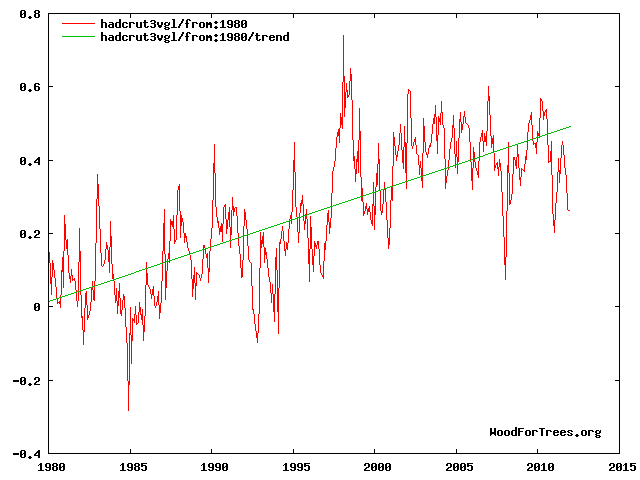
Finally, here is a chart of global temps from HadCRU:

From this, it is pretty clear why Rose chooses 15 years as his starting point: 1997-1998 was the time of the largest El Nino ever recorded, resulting in a huge temperature spike. Using that as the starting point for a temperature comparison is absolutely classic cherry-picking.

And in any event, you can’t say anything about trends in noisy data by simply comparing two arbitrary points. That is not a valid way to analyze the data (especially if you pick an obvious outlier as your starting point!). It is like trying to say whether the tide is coming in or going out by looking at the height of two waves. It just doesn’t work that way. You have to look at the long-term trend to remove the noise.

Let me take you to that Met Office response (and I’m republishing it in full).

Met Office in the Media: 29 January 2012

Today the Mail on Sunday published a story written by David Rose entitled “Forget global warming – it’s Cycle 25 we need to worry about”.

This article includes numerous errors in the reporting of published peer reviewed science undertaken by the Met Office Hadley Centre and for Mr. Rose to suggest that the latest global temperatures available show no warming in the last 15 years is entirely misleading.

Despite the Met Office having spoken to David Rose ahead of the publication of the story, he has chosen to not fully include the answers we gave him to questions around decadal projections produced by the Met Office or his belief that we have seen no warming since 1997.

For clarity I have included our full response to David Rose below:A spokesman for the Met Office said: “The ten year projection remains groundbreaking science. The complete period for the original projection is not over yet and these projections are regularly updated to take account of the most recent data.

“The projections are probabilistic in nature, and no individual forecast should be taken in isolation. Instead, several decades of data will be needed to assess the robustness of the projections.

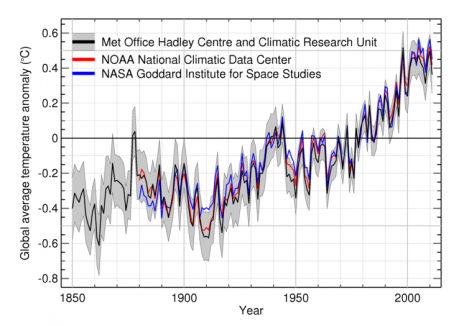
“However, what is absolutely clear is that we have continued to see a trend of warming, with the decade of 2000-2009 being clearly the warmest in the instrumental record going back to 1850. Depending on which temperature records you use, 2010 was the warmest year on record  for NOAA NCDC and NASA GISS, and the second warmest on record in HadCRUT3.”

Global average temperatures from 1850 to 2011 from the three individual global temperature datasets (Met Office/UEA HadCRUT3, NASA GISS and NOAA NCDC)

Furthermore despite criticism of a paper published by the Met Office he chose not to ask us to respond to his misconceptions. The study in question, supported by many others, provides an insight into the sensitivity of our climate to changes in the output of the sun.

It confirmed that although solar output is likely to reduce over the next 90 years this will not substantially delay expected increases in global temperatures caused by greenhouse gases. The study found that the expected decrease in solar activity would only most likely cause a reduction in global temperatures of 0.08 °C. This compares to an expected warming of about 2.5 °C over the same period due to greenhouse gases (according to the IPCC’s B2 scenario for greenhouse gas emissions that does not involve efforts to mitigate emissions).  In addition the study also showed that if solar output reduced below that seen in the Maunder Minimum – a period between 1645 and 1715 when solar activity was at its lowest observed level – the global temperature reduction would be 0.13C.

Back to that response from chrisd3.  He offered this, “Finally, here is a chart of global temps from HadCRU.”  Here is that chart, remember we are looking at Global temperatures.

Global temperature trend

OK, between this Post and my Post last Friday, you probably get the message!  There were many other contributions and I could go on and on quoting the great responses I got, all of them uniformly saying there IS global warming unprecedented in recent years.  The message is crystal clear and those who wish to deny the evidence … well, I can’t come up with a polite term, so will just leave it at that!

My final contribution is from Martin Lack, author of the Blog Lack of Environment, and a good friend of Learning from Dogs.  Here is what he wrote in a recent email,

You may have seen my latest response to How much is most?

When I eventually saw your earlier comment, I was surprised and disappointed in equal measure because I almost feel that I have failed in some way. Let me explain:  Unlike ClimateSight and SkepticalScience, which both do an excellent job of focusing on the science of climate change, my blog is deliberately focused on the politics underlying the denial of all environmental our problems; including 2 key aspects to my MA dissertation, namely the political misuse of scepticism; and the psychology of denial.  See my How to be a Climate Change ‘Sceptic’  for more detail.

Therefore, although not specifically categorised as such, just about everything I have posted is traceable back to Paul and Anne Ehrlich’sBetrayal of Science and Reason (1996) and/or Naomi Oreskes and Erik Conway’s Merchants of Doubt (2010).  For someone who does not currently go to any Church, I am remarkably fond of quoting Scripture so, if necessary, please forgive me but, as the Good Book says:  “What has been will be again, what has been done will be done again; there is nothing new under the sun” (Ecclesiastes 1:9).

Therefore, I do not think you should be surprised by the amount of misinformation and misrepresentation contained in the original WSJ Sixteen’s article; and/or the fact that denialist arguments are repeated no matter how many times they have been shown to be false.  Furthermore, I would warn against trying to summarise it all on Learning from Dogs.  This is definitely Book territory and, in addition to the two mentioned above, the market is already saturated by the likes of Climate Change Cover-up by James Hoggan and Climate Change Denial by Haydn Washington and John Cook.

With very best wishes for a fog-free future,

What to say to close these two Posts off?  Frankly, it’s difficult to know how to pitch it.  The science seems clear beyond reasonable doubt.  But if you are reading this and disagree, then PLEASE offer the science to refute the conclusions presented here.  I promise you that I will present it on Learning from Dogs.

So let me end with a simple photograph.

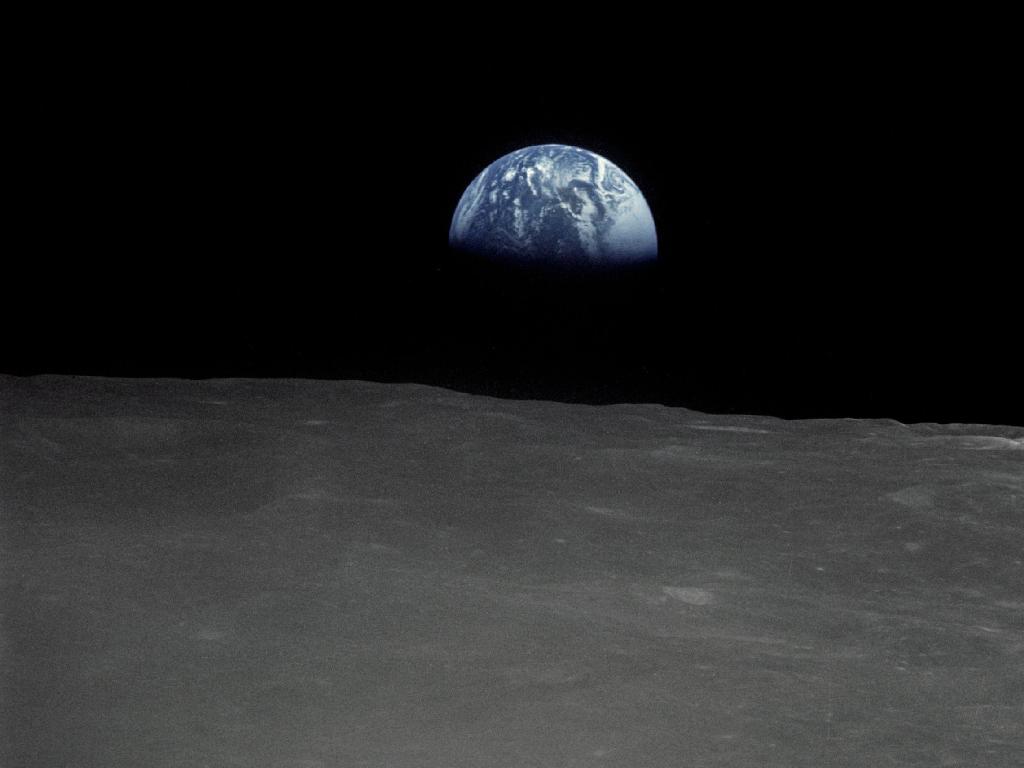
Earthrise

This is the photograph that wilderness photographer Galen Rowell called, “the most influential environmental photograph ever taken.”

The now world-famous photograph was taken by Astronaut William Anders from Apollo 8, the first manned mission to the Moon, a little over 43 years ago on December 24th, 1968.

As the Earth rose above the horizon of the moon, NASA astronaut Frank Borman uttered the words, “Oh my God! Look at that picture over there! Here’s the Earth coming up. Wow, is that pretty.”  Bill Anders then took the ‘unscheduled’ photograph.

Now project forward 43 years to the year 2055 and play with the idea of what ‘pretty‘ planet Earth will be like for mankind and so many other species, including our longest companion, the dog, if we don’t get our act together pretty soon!

Interconnectedness

All and every thing is connected on Planet Earth.

I must share the feelings of millions of others across the world when I admit to going through periods of quiet despair about where ‘modern man’ has got himself. (I don’t intend to be gender specific!)

It goes way beyond the disbelief at some of the things happening today; way beyond the anger that is generated by so many examples of greed and corruption.  It goes to a point where I just want to snuggle down with Jean, curl up with the dogs and kiss the rest of the world good-bye!

The expression that comes to mind is the one about the last person to leave the planet please switch the lights off!

(As if to demonstrate how sensitive dogs are to the feelings of us humans, Cleo just came into the room where I am writing this and laid her head across my left thigh.  I stroked her head and then she wandered back to our bed next door – I then took the following photograph)

P1120525

So what’s feeding my feelings?

Well, as many of you know yesterday and Sunday had posts about saving the Ecuadorian Jaguar and the African Lion.  In the case of the former, it’s:

The president of Ecuador claims to stand for indigenous rights and the environment, but he has just come up with a new plan to bring oil speculators in to 4 million hectares of jungle.  (That’s 9.9 million acres in old money!)

In the case of the African Lion, it’s:

In the past fifty years, the African lion population declined by as much as 90%. Many of the lion prides that do exist today are so genetically weak from being small and isolated by international borders that they can’t promise a future for African lions ….. two thirds of the African lions killed by trophy hunters end up in the U.S. That’s thousands of lions!

Last Friday I wrote about how community living for wolves and dogs had given those species “group survival and well-being“ that we humans couldn’t even dream about.

Then over at Liberated Way, Alex Jones recently wrote:

I attended a lecture at Essex University Colchester last Wednesday on the plight of indigenous indians in Canada, specifically those in Labrador. The Canadian government has embarked on a scheme to disenfranchise the indians of all their land, wipe out all their rights forever, and place them in perpetual bondage. Underlying this horror was what has happened to the indians themselves, a people tainted with mental illness, alcoholism and high suicide rates.

I asked the lecturer why it is that it appears all indigenous people across the globe share this common trait of high levels of abuse, mental illness, suicide and alcoholism. The answer given was that outsiders desired to force their alien world views upon these people destroying their sense of personal identity. For example many of these people see land as a shared resource, the capitalist ideas of land ownership is at odds with their world view. All Native American problem solving is through talking, and everyone has choice, whereas outsiders prefer to impose solutions and intellectualise with clever words.

Just read that last paragraph carefully again and note “outsiders desired to force their alien world views upon these people destroying their sense of personal identity.”

Back closer to home, the struggles of the North American Indians are well-known.

So no nice, neat solution to this place that I’m in just now other than to put down my pen and let the music from the following two videos wash over me.

If you read this far, thank you for suffering the ramblings of this silly old fart!

—-

Hands across the world.

A new but very worthwhile charity.

With grateful thanks to Neil Kelly – he of the cartoon in this post.

Don’t forget to visit the Africa for Norway website!

Deeper insights into who we are.

Two fascinating perspectives.

1. A conversation with Charles Taylor – THE 2008 KYOTO PRIZE

Video Messages from Dr. Charles MargraveTaylor, the Laureate of 2008 KYOTO PRIZE, Arts and Philosophy. “Feelings on receiving the Kyoto Prize” “What philosophers can do for society” “Future interest and theme”(2008/11/11)

Wikipedia describes Charles Taylor thus,

Charles Margrave Taylor, CC GOQ FRSC (born November 5, 1931) is a Canadian philosopher from Montreal, Quebec best known for his contributions to political philosophy, the philosophy of social science, and intellectual history. This work has earned him the prestigious Kyoto Prize and the Templeton Prize, in addition to widespread esteem among philosophers. In 2007, Taylor served with Gérard Bouchard on the Bouchard-Taylor Commission on Reasonable Accommodation with regard to cultural differences in the province of Quebec. Taylor currently teaches at McGill University in the Department of Religious Studies. He is a practicing Roman Catholic.

There is also a fuller biography presented here.

2. How we see circumstances is so much more important – Rory Sutherland on Perspectives.

The circumstances of our lives may matter less than how we see them, says Rory Sutherland. At TEDxAthens, he makes a compelling case for how reframing is the key to happiness.

The TED profile of Rory Sutherland explains that:

From unlikely beginnings as a classics teacher to his current job as Vice Chairman of Ogilvy Group, Rory Sutherland has created his own brand of the Cinderella story. He joined Ogilvy & Mather’s planning department in 1988, and became a junior copywriter, working on Microsoft’s account in its pre-Windows days. An early fan of the Internet, he was among the first in the traditional ad world to see the potential in these relatively unknown technologies.

Cities and forests; the outlook

Just a couple of items that came through my ‘in-box’ in recent times.

From the Payson Roundup newspaper of the 9th October, last.

Southwest forests are already in the early stages of a mega drought brought on by climate change.

Southwest forests are already in the early stages of a mega drought brought on by climate change that will result in massive tree die-offs and sweeping changes in Rim Country forests, according to an analysis published in the scientific journal Climate Change.

Severe drought will dominate much of this century, creating stresses on forests not seen for more than 1,000 years, according to the research that used tree ring samples from 13,000 trees, historical rainfall records and computer projections of future climate change.

The shifts will likely dramatically shrink the world’s largest ponderosa pine forest in northern Arizona, replacing pines with junipers at elevations like Payson and replacing junipers with chaparral and cactus at lower elevations.

The article concludes,

Unfortunately, the team’s climate prediction models suggest that within the next 40 years the region will fall deep into mega drought conditions. The models predict that even the wettest, coolest years in the late 21st century will exceed mega drought levels. In that case, the drought conditions of the past decade will prove the new normal rather than a bad stretch.

Williams noted that while winters in the past decade haven’t been exceptionally dry, summer temperatures have soared. As a result, the stress on the trees in the past 13 years has exceeded mega drought levels about 30 percent of the time — conditions not matched for the previous 1,000 years.

Now to a more positive message, this one from Climate Denial Crock of the Week for 10th October, 2012.

One of the clean little secrets about dealing with climate change, is that if we make our cities more efficient, and reduce their carbon footprint, we will also make them more resilient, quieter, more comfortable, more human scaled, more inviting,  and more fun.

For more on this story go to http://www.pbs.org/newshour/topic/climate-change/

As global temperatures rise, urban areas are facing challenges in keeping their infrastructure and their residents cool. Chicago is tackling that problem with a green design makeover. This report is part of our Coping with Climate Change series.

Bedtime prayers

First published on 1st November, 2009.

Time for bed

dog and boy praying

Thanks to Dan Gomez for forwarding it. Classic!

Adieu Payson

The end of a treasured time in Payson, Arizona.

Today, Jean and I together with our 11 dogs and 5 cats start the 1,200 mile journey to Merlin, Oregon.  While we have only lived in Payson since February, 2010, it has been a time of fantastic experiences.  I had to work through the long process of getting a fiancee visa from the American Embassy in London.  Until that was issued my ‘residence’ in Payson was that of a British tourist with me having to leave the USA every 90 days.

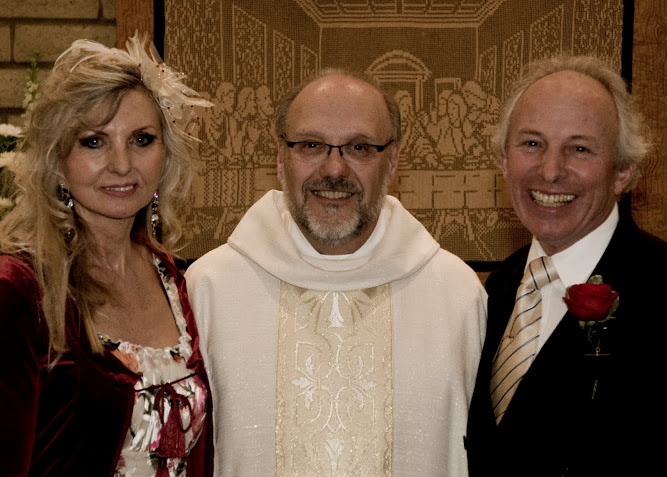
The visa was issued in October, 2010 and I flew immediately to Arizona.  On the 8th November, 2010 Jean and I were issued with a Marriage License Certificate and we were married on the 20th November at St. Paul’s Episcopal Church in Payson.

Fr. Dan Tantimonaco with the newly weds!

We have made many very dear friends here in Payson but Oregon feels like the start of our home in every sense of the word, not just because it is the first home that Jean and I have bought jointly.

One of those dear friends here in Payson has been John Hurlburt, a devoutly spiritual man.  A little over a week ago, he sent me a very thoughtful essay and I wanted to include it today as a guest post in recognition of the way that John and many, many others have embraced these couple of Brits over the last 32 months.  Thank you all.

oooOOOooo

Unity

Everything fits together

The species of animals we know as human beings is a part of everything that exists. We are a very young consciously-aware species that does not begin to know all the answers. What little we do know has a Natural pattern. It would seem that there’s a lamplighter and a navigator in all of us. The lamplighter is our fundamental awareness of being and provides nature’s guidance along life’s pathways.

Our natural navigator is designed for evolutionary competition. There’s a biological survival kit in our DNA. Extreme demand for limited resources generates deadly combat; both within and between species. As a result of competition taken to wretched excess, our global economy is leveraged 22 times beyond any earthly foundation. The unspoken intent to destroy each other over what remains of our planet is becoming increasingly evident.

The human species is engaged in a global war over money, ideals and disappearing finite resources. Ninety-seven percent of the world scientific community has confirmed that the natural effects of heat and discharges generated by human machines and related human activities are the primary cause of recent rapid climate change.

These dedicated scientists are opposed in the media by three percent of their corporate energy-financed peers. An oppressive worldwide network of often offensive politicians is similarly supported and managed accordingly. Nature couldn’t care less about politics, emotions or idealistic arguments.

Human squabbles mean very little in the totality of universal life. The drumbeat of local natural disasters increases steadily. There are no two ways about it. No amount of human ifs or buts can or will change reality. Our human species is in deep serious trouble.

It has been six million years since the first humanoids emerged and two million years since the rise of human civilization. What a sorrow it is to realize what we have done to the earth in just the past two hundred and fifty years. We’ve reached the moon and are exploring Mars. It’s well past time to clean house and re-grow our local garden.

As an old navigator, there’s a sense of urgency regarding the course life on earth has taken. For those who continue to care about facts, the prognosis is not encouraging. We have the know-how for an alternative. We can avoid the perfect storm of going over the edge of an economic cliff and the crush of an environmental crisis in the midst of a war-fuelled, profit-driven, global, corporate fight to the end. The alternative is that we have the know-how to transition rapidly to a reality-based economy and a way of living that’s gentle to the earth. The solution is global, it’s industrial, it’s natural and it’s our best hope. It may well be our only hope. It’s time to light some lamps.

Conscious human awareness emerges as we relax, contemplate, meditate, and communicate openly. These are levels of awareness beyond the limits of our daily human musings. The wisdom which flows from enlightened awareness embraces humility, experience, knowledge, understanding, and faith. Life has never been easy. We’re fragile biological beings. Our mutual growth is the result of sustained efforts over millions of years.

Yet despite attaining a higher level of conscious awareness our human culture continues to operate on a material basis rather than a moral basis. We have become confused by our own importance or the apparent lack thereof. We all too often retreat into a rut, furnish it and turn on the electronics.

By definition, natural processes support species growth in harmony with all natural life. Those natural processes are indistinguishable from the planetary support systems within which all life interacts. Human interaction is local. We spend much of our lives unaware that we are unaware; initially as infants and throughout our lives in deep sleep. When caught up in the pressures of our daily lives, it’s easy to be unaware of being unaware.

It’s time to wake up. Cosmology is an eternal spring from which the waters of the earth still flow. When we turn ourselves inside-out and achieve higher awareness, we discover who, what and where we really and truly are. In a trinity of spirituality, nature and science, we’re cosmically energized beings; spiritual beings sharing a transitory human existence.

Ninety-eight percent of the human population believes in a power beyond species and self. The simplest understanding of this belief is that we humans did not originally create ourselves. All human wisdom and understanding leads to the conclusion that human beings don’t own the earth. We’re caretakers and we’re only passing through. Given that we have a systemic crisis, what do we have to work with?

We have a species that’s squabbling over diminishing resources, an environment and an infrastructure which both desperately require attention, a sustaining objective of equitable global employment, a world economy that’s about to collapse for lack of any real foundation, a burgeoning population which further strains the system and the clear need for a unifying purpose.

Put it all together and what do we have? The navigator is our guide to growth. The navigator shares our wholeness. The lamplighter is our guide to unity. Everything fits together. Each of us is a part of the unity of life. Unity has a natural purpose. It’s time to build a life boat.

John Hurlburt is a former U.S. Navy aviator and successful corporate executive who presently serves as a senior Christian educator and a founding member of an international Transition Town in Payson, Arizona.

oooOOOooo

Don’t know about you, dear reader, but I find those incredibly powerful words.  Words that provide the truth. A truth the whole world needs.  John set out in a personal email to me the three simple fundamentals of our lives. Just a few more words to sum up the truth.

There’s an environmental crisis.  There’s an inevitable global economic abyss touching us all on a daily basis.  The need for a green economic transformation is obvious.

Thank you, John.

Sticks and stones

I make no apologies for today’s post being more emotional and sentimental.

The phrase ‘sticks and stones may break my bones but names will never hurt me‘ is well known throughout the English-speaking world and surprisingly goes back some way.  A quick web search found that in the The Christian Recorder of March 1862, there was this comment:

Remember the old adage, ‘Sticks and stones will break my bones, but words will never harm me’. True courage consists in doing what is right, despite the jeers and sneers of our companions.

So if in 1862 the saying was referred to as an ‘old adage’ then it clearly pre-dated 1862 by some degree.

A few days ago, Dusty M., here in Payson, AZ, sent me a short YouTube video called The Power of Words.  I’m as vulnerable as the next guy to needing being reminded about what’s important in this funny old world.  Then I started mulling over the tendency for all of us to be sucked into a well of doom and gloom.  Take my posts on Learning from Dogs over the last couple of days, as an example.

There is no question that the world in which we all live is going through some extremely challenging times but anger and negativity is not going to be the answer.  As that old reference spelt out so clearly, “True courage consists in doing what is right, despite the jeers and sneers of our companions.

So first watch the video,

then let me close by reminding us all that courage is yet something else we can learn from dogs.

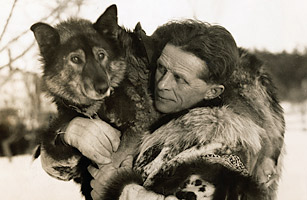
Togo the husky

In 1925, a ravaging case of diphtheria broke out in the isolated Alaskan village of Nome. No plane or ship could get the serum there, so the decision was made for multiple sled dog teams to relay the medicine across the treacherous frozen land. The dog that often gets credit for eventually saving the town is Balto, but he just happened to run the last, 55-mile leg in the race. The sled dog who did the lion’s share of the work was Togo. His journey, fraught with white-out storms, was the longest by 200 miles and included a traverse across perilous Norton Sound — where he saved his team and driver in a courageous swim through ice floes.

More about Togo another day.

What is love?

How the relationship that we have with domesticated animals taught us the meaning of love.

This exploration into the most fundamental emotion of all, love, was stimulated by me just finishing Pat Shipman’s book The Animal Connection.  Sturdy followers of Learning from Dogs (what a hardy lot you are!) will recall that about 5 weeks ago I wrote a post entitled The Woof at the Door which included an essay from Pat, republished with her permission, that set out how “Dogs may have been man’s best friend for thousands of years longer than we realized“.

The following day, I wrote a further piece introducing the book and then commenced reading it myself.  Please go there and read about the praise that the book has received.

What I want to do is to take a personal journey through love.  I should add immediately that I have no specialist or professional background with regard to ‘love’ just, like millions of others, a collection of experiences that have tapped me on the shoulder these last 67 years.

I would imagine that there are almost as many ideas about the meaning of love as there are people on this planet.  Dictionary.com produces this in answer to the search on the word ‘love’.

love

[luhv]  noun, verb, loved, lov·ing.
noun

  1. a profoundly tender, passionate affection for another person.
  2. a feeling of warm personal attachment or deep affection, as for a parent, child, or friend.
  3. sexual passion or desire.
  4. a person toward whom love is felt; beloved person;sweetheart.
  5. (used in direct address as a term of endearment, affection,or the like): Would you like to see a movie, love?

But, I don’t know about you, those definitions leave something missing for me.  Here’s my take on what love is, and it’s only by having so many dogs in my life that I have found this clarity of thought.

Love is trust, love is pure openness, love is knowing that you offer yourself without any barriers.  Think how you dream of giving yourself outwardly in the total surrender of love.  Reflect on that surrender that you experience when deeply connecting, nay loving, with your dog.

Here’s how Pat Shipman expressed it in her book:

Clearly, part of the basis of our intimacy with tame or domesticated animals involves physical contact.  People who work with animals touch them.  It doesn’t matter if you are a horse breeder, a farmer raising pigs, a pet owner, a zoo keeper, or a veterinarian, we touch them, stroke them, hug them.  Many of us kiss our animals and many allow them to sleep with us.  We touch animals because this is a crucial aspect of the nonverbal communication that we have evolved over millennia.  We touch animals because it raises our oxytocin levels – and the animal’s oxytocin levels.  We touch animals because we and they enjoy it. (p.274)

Pat soon after writes,

From the first stone tool to the origin of language and the most recent living tools, our involvement with animals has directed our course.

Thus it is not beyond reason to presume that tens of thousands of years of physical and emotional closeness between humans and their animals have developed the emotion of love in us humans, so eloquently expressed in art and life.

There’s another aspect of what we may have learned from dogs.  In Alexandra Horowitz’s book Inside of a Dog, she writes of the way that dogs look at us,

Having been folded into the world of humans, dogs no longer needed some of the skills that they would to survive on their own.  As we’ll see, what dogs lack in physical skills, they make up for in people skills.

AND THEN OUR EYES MET ….

There is one final, seemingly minor difference between the two species.  This one small behavioral variation between wolves and dogs has remarkable consequences.  The difference is this: dogs look at our eyes.

Dogs make eye contact and look to us for information – about the location of food, about our emotions, about what is happening.  Wolves avoid eye contact.  In both species, eye contact can be a threat: to stare is to assert authority.  So too is it with humans.  In one of my undergraduate psychology classes, I have my students do a simple field experiment wherein they try to make and hold eye contact with everyone they pass on campus.  Both they and those on the receiving end of their stares behave remarkably consistently: everyone can’t wait to break eye contact.  It’s stressful for the students, a great number of whom suddenly claim to be shy: they report their hearts begin to race and they start sweating when simply holding someone’s gaze for a few seconds.  They concoct elaborate stories on the spot to explain why someone looked away, or held their gaze for a half second longer.  For the most part, their staring is met with deflected gazes from those they eyeball.

Then a few sentences later, Alexandra continues to write,

Dogs look, too.  Though they have inherited some aversion to staring too long at eyes, dogs seem to be predisposed to inspect our faces for information, for reassurance, for guidance.  Not only is this pleasing to us – there is a certain satisfaction in gazing deep into a dog’s eyes gazing back at you – it is also perfectly suited to getting along with humans. (pps 45-46)

No apologies for now inserting the photograph of Pharaoh that adorns the Welcome page of Learning from Dogs.  Underlines what Alexandra wrote above in spades.

Now that is a gaze!

OK, time to start bringing this to a close.

The Toronto Star ran a great review of Pat Shipman’s book from which I will just take this snippet,

“But understanding animals and empathizing with them also triggered other changes in humanity’s evolution, Shipman said.

All those things allow people to live with people. Once people have domesticated animals, they start to live in stable groups. They have fields, crops and more permanent dwellings.”

In other words, we can see that living with animals took us from nomadic hunter-gatherers to living with other people in stable groups; the birth of farming.  It is my contention that the evolution of communities and the resulting more stable relationships elevated love leading to love becoming a higher order emotion than just associated with the ‘grunt’ of reproduction.

I started by saying that it was Pat Shipman’s book that stimulated me to wander through my own consciousness and realise that when I bury my face in the side of one of the dogs, say on the bed, it resonates with the most ancient memories in my human consciousness.  Indeed, I am of no doubt that my openness and emotional surrender to that dog enables me to be a better, as in more loving, person for Jean.

So let me close this essay by asking you to return here and read the guest post tomorrow from author Eleanore MacDonald, where Eleanore writes of the loss of their dog Djuna.  You will read the most precious and heart-rending words about love.  Thank you.