Columbia River Natural Pet Foods of Vancouver, WA, is expanding its recall to include 2 of its dog and cat food products because they have the potential to be contaminated with Salmonella and Listeria bacteria.
ooOOoo
December 24, 2018 — Columbia River Natural Pet Foods of Vancouver, WA, is expanding its recent recall to include additional dog and cat foods due to their potential to be contaminated with Salmonella and Listeria monocytogenes.
What’s Recalled?
The following products are being recalled:
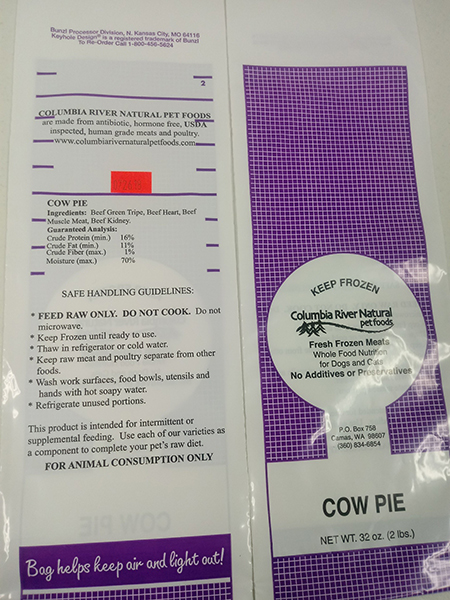
Columbia River Cow Pie Food for Dogs and Cats
Package Size: 2 pounds
Lot Number: 72618
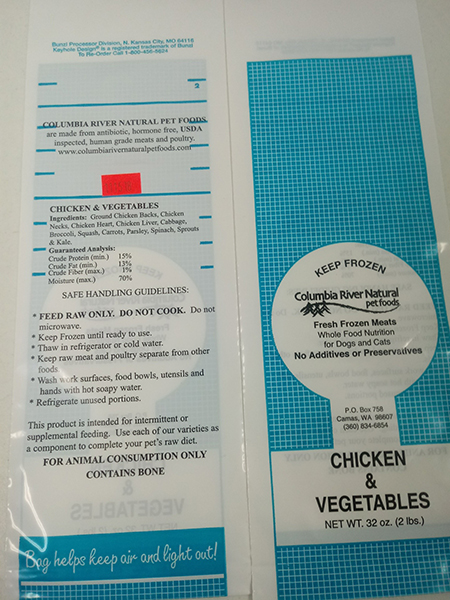
Columbia River Chicken and Vegetables Food for Dogs and Cats
Package Size: 2 pounds
Lot Number: 111518
The recall includes 261 packages of Cow Pie Lot # 72618 and 82 packages of Chicken & Vegetables Lot# 111518 fresh frozen meats for dogs and cats, produced in July 2018 and November 2018.
Cow Pie and Chicken and Vegetables are fresh frozen meat products intended to be fed raw to dogs and cats.
Both were distributed in Alaska, Oregon, and Washington through retail stores and direct delivery.
The Cow Pie product comes in frozen 2-pound purple and white plastic bags with Lot# 72618 found on an orange sticker.
The Chicken and Vegetables product comes in frozen 2-pound turquoise and white plastic bags with Lot # 111518 found on an orange sticker.
No illnesses have been reported to date.
About Salmonella and Listeria
Salmonella and Listeria monocytogenes can affect animals eating the products and there is risk to humans from handling contaminated pet products, especially if they have not thoroughly washed their hands after having contact with the products or any surfaces exposed to these products.
Healthy people infected with Salmonella and Listeria monocytogenes should monitor themselves for some or all of the following symptoms: nausea, vomiting, diarrhea or bloody diarrhea, abdominal cramping and fever.
Rarely, Salmonella and Listeria monocytogenes can result in more serious ailments, including arterial infections, endocarditis, arthritis, muscle pain, eye irritation, and urinary tract symptoms.
Consumers exhibiting these signs after having contact with this product should contact their healthcare providers.
Pets with Salmonella and Listeria monocytogenes infections may be lethargic and have diarrhea or bloody diarrhea, fever, and vomiting.
Some pets will have only decreased appetite, fever and abdominal pain.
Infected but otherwise healthy pets can be carriers and infect other animals or humans.
If your pet has consumed the recalled product and has these symptoms, please contact your veterinarian.
What Caused the Recall?
The potential for contamination was noted after testing by the Washington State Department of Agriculture revealed the presence of Listeria monocytogenes and Salmonella in one package of Cow Pie and Salmonella in one package of Chicken & Vegetables.
What to Do?
Consumers who purchased the product should discontinue use of the product and return for a full refund or exchange by returning the product in its original packaging to place of purchase.
Consumers with questions may contact the company at 360-834-6854 Monday to Friday from 8 AM to 4 PM PT.
This recall is being made with the knowledge of the U.S. Food and Drug Administration.
U.S. citizens can report complaints about FDA-regulated pet food products by calling the consumer complaint coordinator in your area.
I am speaking of the summer months and the risk of animals being burnt. Mind you, as the following article shows, summer is stretching it a bit. This article was published on December 10th!
But whenever it was published it’s a good news story.
ooOOoo
Cats, dogs and a bobcat are the latest burn victims saved with fish skin
Just this past month, California suffered its worst wildfire in the state’s history. Camp Fire in Paradise, California burned 220 acres and claimed the lives of 85 people. The vast majority of residents had little-to-no warning to evacuate, and many pets were left behind and left to fend for themselves along with the wildilfe.
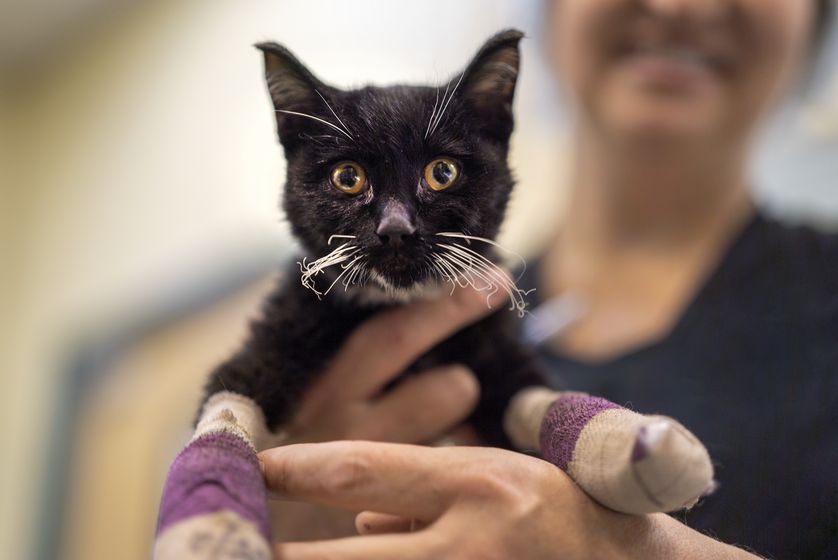
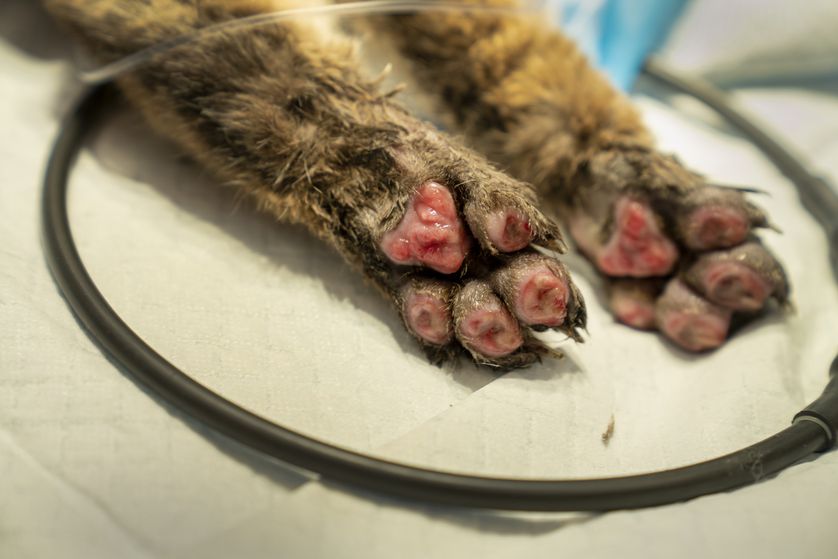
This kitten along with three other cats received care at the University of California Davis Veterinary Medical Teaching Hospital after they were found with severe burns during the Camp Fire. (Photo: Karin Higgins/UC Davis)
Several dogs and cats burned in the fire ended up at Valley Oak Veterinary Center in Chico. When Dr. Jamie Peyton, chief of the Integrative Medicine Service at the UC Davis Veterinary Medical Teaching Hospital, heard about the animals, she volunteered to treat them with the innovative method of using tilapia skin on their burns. (This is the first time dogs and cats have been treated with tilapia skin for burns.) The kitten pictured above suffered third degree burns on some of his paws and lost the pads to all his feet.
“Their paws have been badly burned,” said Dusty Spencer, a veterinary surgeon at VCA Valley Oak Veterinary Center. “Their whiskers are singed or gone. Some of them have had really bad burns on their eyelids and nose.”
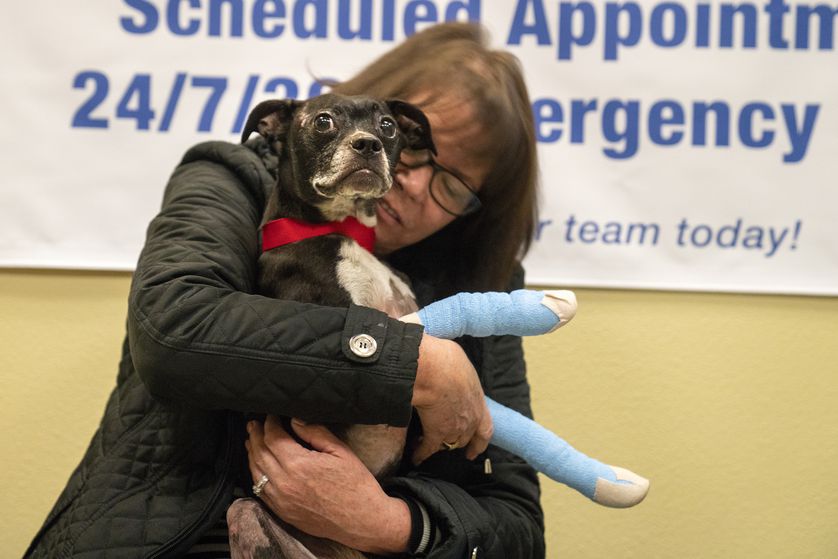
Olivia’s skin started to grow back just five days after the tilapia skin was applied. (Photo: Karin Higgins/UC Davis)
An 8-year-old Boston terrier mix named Olivia was one of the first dogs to receive treatment.
Olivia’s owners, Curtis and Mindy Stark, were out of town when the blaze began. Fortunately, Olivia has a microchip and was reunited with her owners. She suffered second-degree burns to her paws, legs and side, but it wasn’t long till she was feeling better thanks to the tilapia skin.
The Stark family was able to check Olivia out of the veterinary hospital. (Photo: Karin Higgins/UC Davis)
“It was a day and night difference,” said Curtis Stark. “She got up on the bed and did a back flip. That is the first time we saw her acting like she was before.” Treatment also works for the most severe burns
The bobcat suffered third- to fifth- degree burns on all of its pads. (Photo: Gregory Urquiaga/UC Davis)
Pets weren’t the only animals to suffer during the wildfire. Many wild animals desperately tried to flee but couldn’t.
A bobcat was also brought in for treatment. Peyton tells MNN the bobcat suffered third- to fifth-degree burns on his paws. A fifth-degree burn means the burn goes down to the bone. The animal was very thin due to his inability to hunt for food and lack of food sources after the fire. In the week since the bobcat received his first treatment, he has had three tilapia bandage changes. “Each one seems to be showing marked improvement and he is moving well and showing a lot of spunk at his rehabilitation home,” said Peyton.
It will be several months before the bobcat can be released back in the wild, but Peyton’s goal is to “help him heal as soon as possible to allow him to get back to his home.”
Previously, Peyton treated a bear cub injured in California’s Carr Fire back in August and before that two bears and a mountain lion from the Thomas Fire earlier this year.
Previous success for other injured wildlife
This summer, the Carr Fire near Redding, California burned for more than a month and scorched more than 229,000 acres — also forcing many wild animals to try and escape.
On Aug. 2, a Pacific Gas & Electric Company contractor spotted an injured black bear cub lying in the ash, unable to walk on her paws. She was the latest victim of the Carr Fire — and luckily, one the contractor knew he could help. The contractor called Lake Tahoe Wildlife Care, a certified wildlife rehabilitation facility.
A team was quickly mobilized to rescue the cub. Officers from the California Department of Fish and Wildlife (CDFW) cleared a safe path and tranquilized the cub to carry her to safety. The cub was brought to a lab to be treated by a team of veterinarians from CDFW and the University of California, Davis.
“Generally speaking, an animal that has survived a fire and is walking around on its own should be left alone, but that wasn’t the case here,” CDFW’s Environmental Program Manager Jeff Stoddard said. “In addition to her inability to stand or walk, there were active fires burning nearby, and with the burn area exceeding 125 square miles and growing, we weren’t sure there was any suitable habitat nearby to take her to.”
How does tilapia skin work for treating burns?
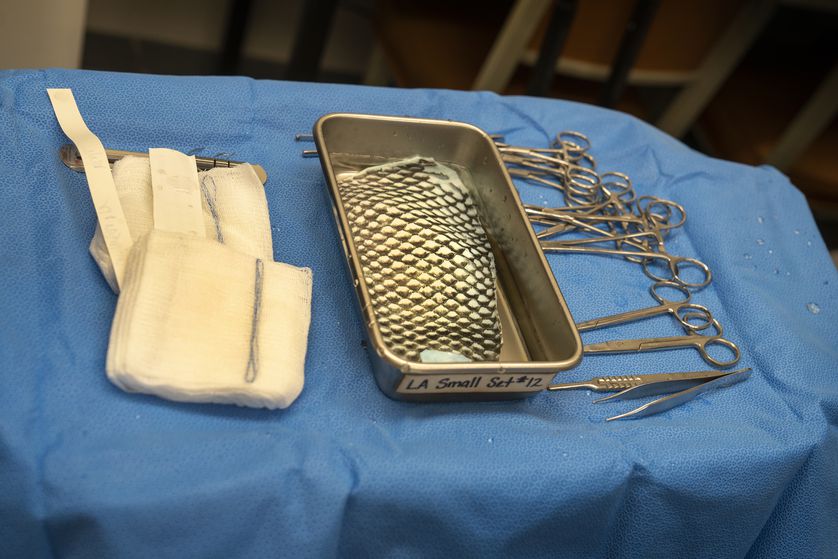
Tilapia skin is malleable enough that it can be cut into custom sizes to mold around an animal’s wounds. (Photo: Gregory Urquiaga/UC Davis)
“The tilapia skins provide direct, steady pressure to the wounds, keep bacteria out and stay on better and longer than any kind of regular, synthetic bandage would,” Peyton said. “The complete treatment also includes application of antibiotics and pain salve, laser treatments and acupuncture for pain management.”
The cub is the third bear in the state to be treated for burns with tilapia skin. Earlier this year after the Thomas fire, two bears and a mountain lion also received similar treatment. With each animal being treated, Peyton and her team grow more optimistic that tilapia skin is an effective treatment for burns that can be used in veterinary hospitals around the world.
“Just like we’ve seen in other species, we’re seeing increased pain relief. We’re seeing wound healing and an overall increased comfort,” said Peyton. “One of the most important things about being at UC Davis VMTH is that we are learning new techniques, but they don’t make much of a difference unless we can use them in the community.”
Editor’s note: This article has been updated since it was originally published in August 2018.
ooOOoo
Reading this article leaves me with the impression that there are a great number of good people out there!
There were a number of photographs of Comet 46P/Wirtanen on this site.
But the one that really leapt off the page, so to speak, was this one:
Jack Fusco Photography in California wrote: “Hi EarthSky! I’m so excited to share my 1st photo of comet 46P/Wirtanen! We took our boxer, Kona, out to the Anza Borrego Desert with us and came home with a new family photo. : ) I shared some behind-the-scenes and outtakes over on my blog as well.” Awesome photo, and thanks for the how-to-photograph info on your blog, Jack!
Dangerous Levels of Vitamin D Discovered in Several Dog Food Brands
CAUTION — ONGOING SITUATION
Last Updated December 7, 2018
December 7, 2018 — The FDA is alerting pet owners and veterinary professionals about recalls of several dry dog foods after receiving complaints that dogs eating the food experienced vitamin D toxicity.Testing found that samples of the affected foods contained as much as 70 times the intended amount of vitamin D.
Very high levels of vitamin D can cause serious health problemsin dogs, such as kidney failure or death.
Veterinarians should be aware that vitamin D toxicity may present as hypercalcemia, similar to dogs that have consumed a rodent killer.
At this time, the only pet products that are affected by this recall are foods made for dogs.
About Vitamin D Toxicity
Excess vitamin D in the diet can cause vomiting, loss of appetite, increased thirst, increased urination, excessive drooling and weight loss.
Vitamin D at toxic levels can cause kidney failure and death.
Pet owners whose dogs have been eating the recalled brands and are showing these symptoms should contact their veterinarians.
What Caused the Recalls?
The FDA has become aware of reports of vitamin D toxicity in dogs that ate dry dog food produced by the same manufacturer and marketed under several different brand names.
The FDA is working with the manufacturer to provide a comprehensive list of affected brands.
Important Warning
This is a developing situation. Additional recalls may be announced.
The Dog Food Advisor will update this page as the FDA makes further information available.
What Brands Are Recalled?
This is a developing situation and this list may not be complete.
The list of recalled dry dog food products provided to the FDA include:
Ahold Delhaize (company has not issued press release)
Ahold Delhaize (company has not issued recall bulletin)
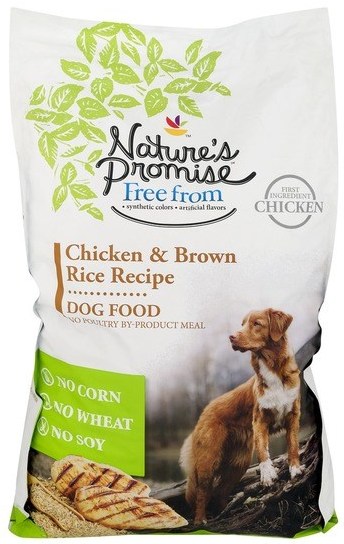
Nature’s Promise Chicken & Brown Rice Dog Food
Size: 14-lb bag
UPC: 068826718472
All lot codes
Nature’s Promise Chicken & Brown Rice Dog Food
Size: 28-lb bag
UPC: 068826718471 – 28 lb. bag
All lot codes
Nature’s Promise Chicken & Brown Rice Dog Food
Size: 4-lb bag
UPC: 068826718473
All lot codes
Nature’s Place Real Country Chicken and Brown Rice Dog Food
Size: 5-lb bag
UPC: 72543998959
All lot codes
Nature’s Place Real Country Chicken and Brown Rice Dog Food
Size: 15-lb bag
UPC: 72543998960
All lot codes
A very useful article published by The Smithsonian.
SMARTNEWS published by The Smithsonian yesterday confirmed what we were starting to suspect; there was a widespread problem with excessive Vitamin D in dog food.
ooOOoo
Excessive Vitamin D in Pet Food May Be Making Dogs Sick
A number of brands, including Nutrisca and Natural Life, have issued recalls of certain products
The Food and Drug Administration is warning dog owners to keep a close watch on their furry friends, after several brands of dry dog food were found to contain potentially toxic levels of vitamin D.
According to NPR’s Amy Held, the FDA has received reports of dogs falling ill after eating certain foods, which are made by an unnamed manufacturer and sold under at least eight different brands. Nutrisca and Natural Life issued recalls in early November, reports Shelby Lin Erdman of the Atlanta Journal-Constitution, and several other brands have followed suit. The full list, which includes products by Sunshine Mills and ELM Pet Foods, can be seen here.
The FDA says the situation is developing, and its scientists are still working to definitively link the dogs’ illnesses to their diet. But when the agency sampled some of the questionable products, it found that the foods contained as much as 70 times the amount of intended vitamin D.
As it does in humans and other mammals, vitamin D helps dogs maintain calcium and phosphorus levels in their bodies, which is essential for bone formation, along with heart, muscle and nerve function.
But if pooches ingest excessive doses of the nutrient—which happens most often when dogs accidentally eat vitamin D-containing rodenticide —their calcium and phosphorous levels can get thrown off balance, according to the veterinary company VCA. Very high amounts of vitamin D can have a number of serious health effects on dogs, including kidney disease and even death.
Symptoms of vitamin D poisoning in dogs include vomiting, loss of appetite, increased thirst, increased urination, excessive drooling and weight loss. The FDA says that pet owners who notice these symptoms in dogs that have been eating the recalled brands should contact their vets right away—there are treatments that can help.
The agency also recommends disposing of recalled products in a way that makes them inaccessible to pets, wildlife and children. And owners who suspect that their dogs have fallen sick from vitamin D poisoning can report the illness to the FDA through an online portal.
November 28, 2018 — ANF, Inc. is issuing a voluntary recall of select products of ANF Pet Food due to potentially elevated levelsof vitamin D, which can cause serious health issues in dogs.
No product images were provided with this recall.
What’s Recalled?
The following products have been recalled:
ANF Lamb and Rice Dry Dog Food
Size: 3 kg bag
UPC: 9097231622
Best by date: NOV 23 2019
ANF Lamb and Rice Dry Dog Food
Size: 7.5 kg bag
UPC: 9097203300
Best by date: NOV 20 2019
The above products were distributed in retail stores within Puerto Rico.
No other ANF Products are affected by this recall.
This voluntary recall is being conducted in cooperation with the U.S. Food and Drug Administration.
About High Levels of Vitamin D
Consumers should stop feeding the products listed above.
Dogs ingesting elevated levels of Vitamin D may exhibit symptoms such as vomiting, loss of appetite, increased thirst, increased urination, excessive drooling, and weight loss.
Vitamin D, when consumed at very high levels can lead to serious health issues in dogs including renal dysfunction.
Consumers with dogs who have consumed any of the products listed above and are exhibiting any of these symptoms, should contact their veterinarian.
What to Do?
Consumers who have purchased any of the products affected by this recall should dispose of it or return it to the retailer for a full refund.
Consumers may contact ANF, Inc. customer service at 936-560-5930 from 8 AM to 5 PM Central Time, Monday through Friday.
Or by email at mwhite@anf.com for additional information.
U.S. citizens can report complaints about FDA-regulated pet food products by calling the consumer complaint coordinator in your area.
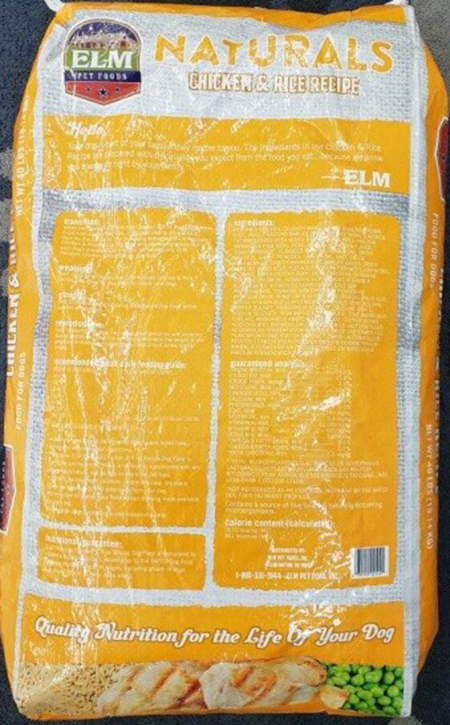
November 29, 2018 — ELM Pet Foods, Inc. is issuing a voluntary recall of certain products of Elm Dog Food because the products could contain elevated levels of vitamin D, which can cause serious health issues.
What’s Recalled?
The recall includes products manufactured between February 25, 2018 and October 31, 2018 with the following “Best By” dates:
3lb Elm Chicken and Chickpea Recipe
Size: 3-pound pkg
UPC Code: 0-70155-22507-8
TD2 26 FEB 2019
TE1 30 APR 2019
TD1 5 SEP 2019
TD2 5 SEP 2019
Elm Chicken and Chickpea Recipe
Size: 28-pound pkg
UPC Code: 0-70155-22513-9
TB3 6 APR 2019
TA1 2 JULY 2019
TI1 2 JULY 2019
Consumers, who have purchased the specific product above, during these dates, should stop feeding it to their dogs.
All Bags in the recall are yellow with the Elm Pet Foods Tag on the front of the bag and have a silhouette of a chicken at the bottom of the front side of the bag.
Consumers can check the lot codes on the back of the bag at the bottom center on the 3-lb bags and in the center of the back of the bag on the 28-lb bags.
The 40-lb bag lot numbers can be found on the bottom right of the back of the bag.
No other ELM Pet Foods products are impacted.
This is a voluntary recall and is being conducted in cooperation with the U.S. Food and Drug Administration.
Where Was the Product Sold?
Lot codes in this voluntary recall were distributed in the following states:
Delaware
Maryland
New Jersey
Pennsylvania
About Elevated Vitamin D
Dogs ingesting elevated levels of Vitamin D may exhibit symptoms such as vomiting, loss of appetite, increased thirst, increased urination, excessive drooling and weight loss.
Vitamin D when consumed at very high levels can lead to serious health issues in dogs including renal dysfunction.
Consumers with dogs who have consumed the product listed above are exhibiting these symptoms, should contact their veterinarian.
What to Do?
If consumers have questions or would like a refund they should call ELM Pet Foods at 800-705-2111 from 8 AM to 5 PM ET Monday through Friday or by email at customerservice@elmpetfoods.com.
U.S. citizens can report complaints about FDA-regulated pet food products by calling the consumer complaint coordinator in your area.
More on the elevated vitamin D issue in our dog food.
Here are the details.
ooOOoo
Evolve, Sportsman’s Pride, and Triumph Dog Food Recall
November 27, 2018 — Sunshine Mills, Inc., of Red Bay, Alabama, is voluntarily recalling select products of Evolve, Sportsman’s Pride, and Triumph dog foods due to elevated levels of vitamin D, which can cause serious health issues.
What’s Recalled?
The following products are being recalled:
Evolve Chicken & Rice Puppy Dry Dog Food
Size: 14-pound bag
UPC: 0-73657-00862-0
Evolve Chicken & Rice Puppy Dry Dog Food
Size: 28-pound bag
UPC: 0-73657-00863-7
Sportsman’s Pride Large Breed Puppy Dry Dog Food
Size: 40-pound bag
UPC: 0-70155-10566-0
Sportsman’s Pride Large Breed Puppy Dry Dog Food
Size: 40-pound bag
UPC: 0-70155-10564-0
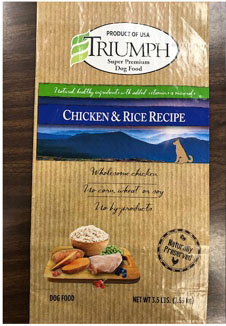
Triumph Chicken & Rice Recipe Dry Dog Food
Size: 3.5 pound bag
UPC: 0-73657-00873-6
Triumph Chicken & Rice Recipe Dry Dog Food
Size: 16-pound bag
UPC: 0-73657-00874-3
Triumph Chicken & Rice Recipe Dry Dog Food
Size: 30-pound bag
UPC 0-73657-00875-0
Bags affected have a Best Buy Date Code of November 1, 2018 through November 8, 2019.
The Best Buy Code can be located on the back of each bag.
No other Evolve, Sportsman’s Pride or Triumph products are affected by this recall.
Where Was Product Sold?
The above products were distributed in retail stores within the United States as well as some export distributors in Japan, Puerto Rico, Colombia, Israel, Canada and South Korea.
This recall is being conducted in cooperation with the U.S. Food and Drug Administration.
About High Levels of Vitamin D
Dogs ingesting elevated levels of Vitamin D may exhibit symptoms such as vomiting, loss of appetite, increased thirst, increased urination, excessive drooling, and weight loss.
Vitamin D, when consumed at very high levels can lead to serious health issues in dogs including renal dysfunction.
Consumers with dogs who have consumed any of the products listed above and are exhibiting any of these symptoms, should contact their veterinarian.
What to Do?
Consumers should stop feeding the products listed above.
Consumers who have purchased any of the affected product should dispose of it or return it to the retailer for a full refund.
Consumers may contact Sunshine Mills, Inc. customer service at (800) 705-2111 from 7AM to 4PM Central Time, Monday through Friday.
Or by email at customer.service@sunshinemills.com for additional information.
ooOOoo
Phew!
Maybe that is the last of the recalls with regard to Vitamin D.
November 19, 2018 — Harris Teeter of Matthews, NC, is recallingAbound Chicken and Rice Dog Food due to elevated levels of vitamin D, which may cause renal failure.
No graphic was supplied with the official bulletin.
The following image was retrieved from the internet and is provided in good faith by The Dog Food Advisor.
The graphic below may or may not be an accurate representation of the actual recalled product.
What’s Recalled?
The following products are being recalled by Harris Teeter.
Abound Chicken & Brown Rice Dog Food
Size: 4 lb package
UPC Code: UPC 0001111083556
Abound Chicken & Brown Rice Dog Food
Size: 14 lb package
UPC Code: 0001111083573
Batch information and Best By dates were not provided by the company in its recall bulletin.
About Elevated Levels of Vitamin D
Dogs ingesting elevated levels of Vitamin D may exhibit symptoms such as vomiting, loss of appetite, increased thirst, increased urination, excessive drooling, and weight loss.
Vitamin D, when consumed at very high levels, can lead to serious health issues in dogs including renal dysfunction.
Customers with dogs who have consumed any of the products listed above and are exhibiting any of these symptoms, should contact their veterinarian.
What to Do?
Harris Teeter has removed the recalled products from its shelves.
If you purchased these items, please do not allow your pet to consume them. Instead, return them to your Harris Teeter store for a full refund.
Customers may contact Sunshine Mills, Inc. customer service (the maker) at 800-705-2111 from 7 am to 4 pm Central Time, Monday through Friday.
Or by email at customer.service@sunshinemills.com for additional information.
U.S. citizens can report complaints about FDA-regulated pet food products by calling the consumer complaint coordinator in your area.
I don’t know what to make of these. Part of me thinks there are too many dog-food recalls and part of me thinks it is much better that we have this service. Oh well.
Giant and Martin’s Recall Nature’s Promise Dog Food
November 20, 2018 — Giant Food Stores and Martin’s Food Markets are voluntarily recalling certain lots of Nature’s Promise Dog Food because they may contain excessive amounts of Vitamin D, which may cause renal failure.
No graphic was supplied with the official news wire. The following image was retrieved from the internet and is provided in good faith by The Dog Food Advisor.
What’s Recalled?
The following products are included in this recall event:
Nature’s Promise Chicken & Brown Rice Dog Food
Size: 4 lb package
Best By Dates: November 1, 2018 to November 8, 2019
Nature’s Promise Chicken & Brown Rice Dog Food
Size: 14 lb package
Best By Dates: November 1, 2018 to November 8, 2019
Nature’s Promise Chicken & Brown Rice Dog Food
Size: 28 lb package
Best By Dates: November 1, 2018 to November 8, 2019
Giant/Martin’s has removed all affected product from its shelves and urges customers to return the product to their local store for a full refund.
The companies have received no reports of illnesses to date.
About Elevated Levels of Vitamin D
Dogs ingesting elevated levels of Vitamin D may exhibit symptoms such as vomiting, loss of appetite, increased thirst, increased urination, excessive drooling, and weight loss.
Vitamin D, when consumed at very high levels, can lead to serious health issues in dogs including renal dysfunction.
Customers with dogs who have consumed any of the products listed above and are exhibiting any of these symptoms, should contact their veterinarian.
What to Do?
Customers should stop feeding the products listed above.
Customers may contact Sunshine Mills, Inc. customer service at 800-705-2111 from 7 am to 4 pm Central Time, Monday through Friday.
Or by email at customer.service@sunshinemills.com for additional information.
In addition, customers may call Giant/Martin’s Customer Support Center at 888-814-4268.
U.S. citizens can report complaints about FDA-regulated pet food products by calling the consumer complaint coordinator in your area.
The challenge of how you think, and whether or not it is similar to how others think has long intrigued us.
Tam Hunt has written an article that now ponders on whether how we think, how we are conscious of the world around us, depends on how that ‘thing’ vibrates.
Over to Tam.
ooOOoo
Could consciousness all come down to the way things vibrate?
By Tam HuntAffiliate Guest in Psychology, University of California, Santa Barbara
Why is my awareness here, while yours is over there? Why is the universe split in two for each of us, into a subject and an infinity of objects? How is each of us our own center of experience, receiving information about the rest of the world out there? Why are some things conscious and others apparently not? Is a rat conscious? A gnat? A bacterium?
These questions are all aspects of the ancient “mind-body problem,” which asks, essentially: What is the relationship between mind and matter? It’s resisted a generally satisfying conclusion for thousands of years.
Chalmers thought the mind-body problem should be called “hard” in comparison to what, with tongue in cheek, he called the “easy” problems of neuroscience: How do neurons and the brain work at the physical level? Of course they’re not actually easy at all. But his point was that they’re relatively easy compared to the truly difficult problem of explaining how consciousness relates to matter.
Over the last decade, my colleague, University of California, Santa Barbara psychology professor Jonathan Schooler and I have developed what we call a “resonance theory of consciousness.” We suggest that resonance – another word for synchronized vibrations – is at the heart of not only human consciousness but also animal consciousness and of physical reality more generally. It sounds like something the hippies might have dreamed up – it’s all vibrations, man! – but stick with me.
How do things in nature – like flashing fireflies – spontaneously synchronize? Suzanne Tucker/Shutterstock.com
All about the vibrations
All things in our universe are constantly in motion, vibrating. Even objects that appear to be stationary are in fact vibrating, oscillating, resonating, at various frequencies. Resonance is a type of motion, characterized by oscillation between two states. And ultimately all matter is just vibrations of various underlying fields. As such, at every scale, all of nature vibrates.
Something interesting happens when different vibrating things come together: They will often start, after a little while, to vibrate together at the same frequency. They “sync up,” sometimes in ways that can seem mysterious. This is described as the phenomenon of spontaneous self-organization.
When fireflies of certain species come together in large gatherings, they start flashing in sync, in ways that can still seem a little mystifying.
Lasers are produced when photons of the same power and frequency sync up.
The moon’s rotation is exactly synced with its orbit around the Earth such that we always see the same face.
Examining resonance leads to potentially deep insights about the nature of consciousness and about the universe more generally.
External electrodes can record a brain’s activity. vasara/Shutterstock.com
Sync inside your skull
Neuroscientists have identified sync in their research, too. Large-scale neuron firing occurs in human brains at measurable frequencies, with mammalian consciousness thought to be commonly associated with various kinds of neuronal sync.
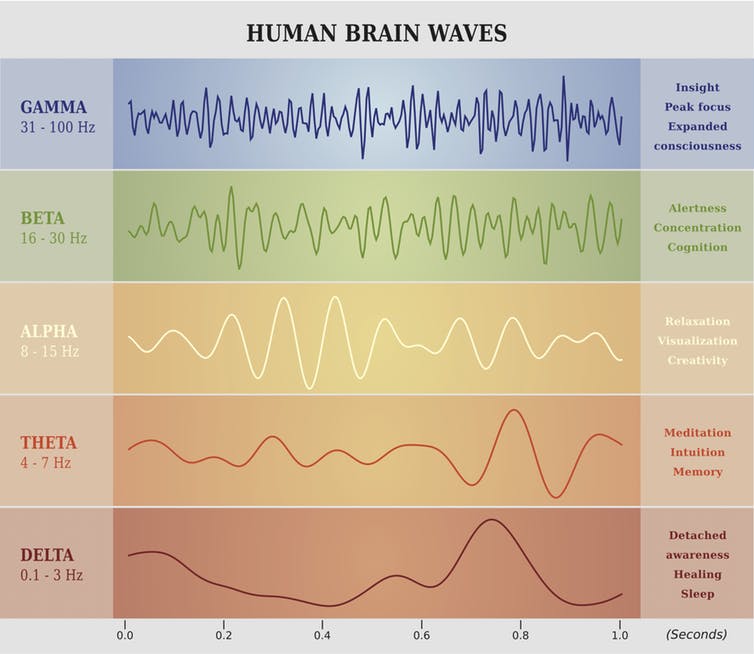
Fries focuses on gamma, beta and theta waves. These labels refer to the speed of electrical oscillations in the brain, measured by electrodes placed on the outside of the skull. Groups of neurons produce these oscillations as they use electrochemical impulses to communicate with each other. It’s the speed and voltage of these signals that, when averaged, produce EEG waves that can be measured at signature cycles per second.
Each type of synchronized activity is associated with certain types of brain function. artellia/Shutterstock.com
Gamma waves are associated with large-scale coordinated activities like perception, meditation or focused consciousness; beta with maximum brain activity or arousal; and theta with relaxation or daydreaming. These three wave types work together to produce, or at least facilitate, various types of human consciousness, according to Fries. But the exact relationship between electrical brain waves and consciousness is still very much up for debate.
Fries calls his concept “communication through coherence.” For him, it’s all about neuronal synchronization. Synchronization, in terms of shared electrical oscillation rates, allows for smooth communication between neurons and groups of neurons. Without this kind of synchronized coherence, inputs arrive at random phases of the neuron excitability cycle and are ineffective, or at least much less effective, in communication.
A resonance theory of consciousness
Our resonance theory builds upon the work of Fries and many others, with a broader approach that can help to explain not only human and mammalian consciousness, but also consciousness more broadly.
Based on the observed behavior of the entities that surround us, from electrons to atoms to molecules, to bacteria to mice, bats, rats, and on, we suggest that all things may be viewed as at least a little conscious. This sounds strange at first blush, but “panpsychism” – the view that all matter has some associated consciousness – is an increasingly accepted position with respect to the nature of consciousness.
The panpsychist argues that consciousness did not emerge at some point during evolution. Rather, it’s always associated with matter and vice versa – they’re two sides of the same coin. But the large majority of the mind associated with the various types of matter in our universe is extremely rudimentary. An electron or an atom, for example, enjoys just a tiny amount of consciousness. But as matter becomes more interconnected and rich, so does the mind, and vice versa, according to this way of thinking.
Biological organisms can quickly exchange information through various biophysical pathways, both electrical and electrochemical. Non-biological structures can only exchange information internally using heat/thermal pathways – much slower and far less rich in information in comparison. Living things leverage their speedier information flows into larger-scale consciousness than what would occur in similar-size things like boulders or piles of sand, for example. There’s much greater internal connection and thus far more “going on” in biological structures than in a boulder or a pile of sand.
Under our approach, boulders and piles of sand are “mere aggregates,” just collections of highly rudimentary conscious entities at the atomic or molecular level only. That’s in contrast to what happens in biological life forms where the combinations of these micro-conscious entities together create a higher level macro-conscious entity. For us, this combination process is the hallmark of biological life.
The central thesis of our approach is this: the particular linkages that allow for large-scale consciousness – like those humans and other mammals enjoy – result from a shared resonance among many smaller constituents. The speed of the resonant waves that are present is the limiting factor that determines the size of each conscious entity in each moment.
As a particular shared resonance expands to more and more constituents, the new conscious entity that results from this resonance and combination grows larger and more complex. So the shared resonance in a human brain that achieves gamma synchrony, for example, includes a far larger number of neurons and neuronal connections than is the case for beta or theta rhythms alone.
What about larger inter-organism resonance like the cloud of fireflies with their little lights flashing in sync? Researchers think their bioluminescent resonance arises due to internal biological oscillators that automatically result in each firefly syncing up with its neighbors.
Is this group of fireflies enjoying a higher level of group consciousness? Probably not, since we can explain the phenomenon without recourse to any intelligence or consciousness. But in biological structures with the right kind of information pathways and processing power, these tendencies toward self-organization can and often do produce larger-scale conscious entities.
Our resonance theory of consciousness attempts to provide a unified framework that includes neuroscience, as well as more fundamental questions of neurobiology and biophysics, and also the philosophy of mind. It gets to the heart of the differences that matter when it comes to consciousness and the evolution of physical systems.
It is all about vibrations, but it’s also about the type of vibrations and, most importantly, about shared vibrations.
ooOOoo
Well, I’m not sure of the relevance but I’m bound to say that I am going to the doctor once a week for Alpha-Sim resetting. The reason I mention it is the Alpha frequency in the above brain wave chart. I sit very quietly for about 90 minutes and it does seem to provide some benefit.









 Learning from Dogs