Category: Politics

Just about water.

Having no drinking water puts every other aspect of living in the shade!

Yesterday afternoon, around 4pm, local thunderstorm activity produced some rain.  Not much but sufficient to wet the ground.  It brought to an end several weeks of intense drought complicated by what is now more than 55,000 acres of fires burning in southwest Oregon: more details here.
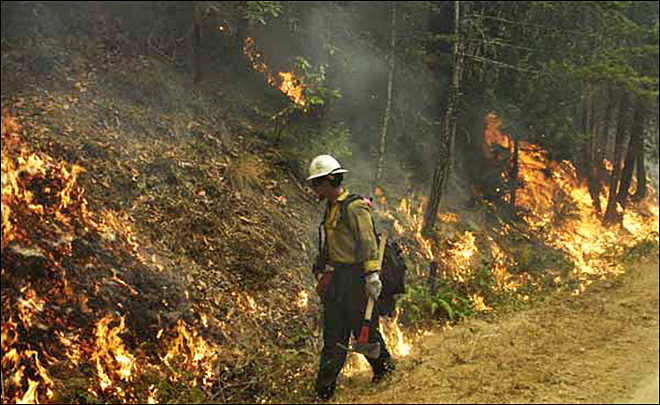
Oregon Wildfires
A Redmond Hotshots crew on the Douglas Complex conducts a burnout operation to create a barrier to the wildfire’s advance by removing fuel in its path.

Anyway, this is not about fire, irrespective of how potentially dangerous it can be in this part of the world, it is about water. So with that in mind, here’s a recent ‘Tomgram‘ from William deBuys, with introduction by Tom Engelhardt; republished with Tom’s generous permission.

oooOOOooo

Tomgram: William deBuys, Goodbye to All That (Water)

Martha and the Vandellas would have loved it.  Metaphorically speaking, the New York Times practically swooned over it.  (“An unforgiving heat wave held much of the West in a sweltering embrace over the weekend, tying or breaking temperature records in several cities, grounding flights, sparking forest fires, and contributing to deaths.”) It was a “deadly” heat wave, a “record” one that, in headlines everywhere, left the West and later the rest of the country “sweltering,” and that was, again in multiple headlines, “scary.”  The fire season that accompanied the “blasting,” “blazing” heat had its own set of “record” headlines — and all of this was increasingly seen, in another set of headlines, as the “new normal” in the West. Given that 2012 had already set a heat record for the continental U.S., that the 10 hottest years on record in this country have all occurred since 1997, and that the East had its own sweltering version of heat that wouldn’t leave town, this should have been beyond arresting.

In response, the nightly primetime news came up with its own convenient set of new terms to describe all this: “extreme” or “severe” heat.  Like “extreme” or “severe” weather, these captured the eyeball-gluing sensationalism of our weather moment without having to mention climate change or global warming.  Weather, after all, shouldn’t be “politicized.”  But if you’re out in the middle of the parching West like TomDispatch regular William deBuys, who recently headed down the Colorado River, certain grim realities about the planet we’re planning to hand over to our children and grandchildren can’t help but come to mind — along with a feeling, increasingly shared by those in the sweltering cities, that our particular way of life is in the long run unsustainable. Tom

Never Again Enough

Field Notes from a Drying West 

By William deBuys

Several miles from Phantom Ranch, Grand Canyon, Arizona, April 2013 — Down here, at the bottom of the continent’s most spectacular canyon, the Colorado River growls past our sandy beach in a wet monotone. Our group of 24 is one week into a 225-mile, 18-day voyage on inflatable rafts from Lees Ferry to Diamond Creek. We settle in for the night. Above us, the canyon walls part like a pair of maloccluded jaws, and moonlight streams between them, bright enough to read by.

One remarkable feature of the modern Colorado, the great whitewater rollercoaster that carved the Grand Canyon, is that it is a tidal river. Before heading for our sleeping bags, we need to retie our six boats to allow for the ebb.

These days, the tides of the Colorado are not lunar but Phoenician. Yes, I’m talking about Phoenix, Arizona.  On this April night, when the air conditioners in America’s least sustainable city merely hum, Glen Canyon Dam, immediately upstream from the canyon, will run about 6,500 cubic feet of water through its turbines every second.

Tomorrow, as the sun begins its daily broiling of Phoenix, Scottsdale, Mesa, Tempe, and the rest of central Arizona, the engineers at Glen Canyon will crank the dam’s maw wider until it sucks down 11,000 cubic feet per second (cfs). That boost in flow will enable its hydroelectric generators to deliver “peaking power” to several million air conditioners and cooling plants in Phoenix’s Valley of the Sun. And the flow of the river will therefore nearly double.

It takes time for these dam-controlled tidal pulses to travel downstream. Where we are now, just above Zoroaster Rapid, the river is roughly in phase with the dam: low at night, high in the daytime. Head a few days down the river and it will be the reverse.

By mid-summer, temperatures in Phoenix will routinely soar above 110°F, and power demands will rise to monstrous heights, day and night. The dam will respond: 10,000 cfs will gush through the generators by the light of the moon, 18,000 while an implacable sun rules the sky.

Such are the cycles — driven by heat, comfort, and human necessity — of the river at the bottom of the continent’s grandest canyon.

The crucial question for Phoenix, for the Colorado, and for the greater part of the American West is this: How long will the water hold out?

Major Powell’s Main Point

Every trip down the river — and there are more than 1,000 like ours yearly — partly reenacts the legendary descent of the Colorado by the one-armed explorer and Civil War veteran John Wesley Powell. The Major, as he preferred to be known, plunged into the Great Unknown with 10 companions in 1869. They started out in four boats from Green River, Wyoming, but one of the men walked out early after nearly drowning in the stretch of whitewater that Powell named Disaster Falls, and three died in the desert after the expedition fractured in its final miles. That left Powell and six others to reach the Mormon settlements on the Virgin River in the vicinity of present-day Las Vegas, Nevada.

Powell’s exploits on the Colorado brought him fame and celebrity, which he parlayed into a career that turned out to be controversial and illustrious in equal measure. As geologist, geographer, and ethnologist, Powell became one of the nation’s most influential scientists. He also excelled as an institution-builder, bureaucrat, political in-fighter, and national scold.

Most famously, and in bold opposition to the boomers and boosters then cheerleading America’s westward migration, he warned that the defining characteristic of western lands was their aridity. Settlement of the West, he wrote, would have to respect the limits aridity imposed.

He was half right.

The subsequent story of the West can indeed be read as an unending duel between society’s thirst and the dryness of the land, but in downtown Phoenix, Las Vegas, or Los Angeles you’d hardly know it.

By the middle years of the twentieth century, western Americans had created a kind of miracle in the desert, successfully conjuring abundance from Powell’s aridity. Thanks to reservoirs large and small, and scores of dams including colossi like Hoover and Glen Canyon, as well as more than 1,000 miles of aqueducts and countless pumps, siphons, tunnels, and diversions, the West has by now been thoroughly re-rivered and re-engineered. It has been given the plumbing system of a giant water-delivery machine, and in the process, its liquid resources have been stretched far beyond anything the Major might have imagined.

Today the Colorado River, the most fully harnessed of the West’s great waterways, provides water to some 40 million people and irrigates nearly 5.5 million acres of farmland. It also touches 22 Indian reservations, seven National Wildlife Reservations, and at least 15 units of the National Park System, including the Grand Canyon.

These achievements come at a cost. The Colorado River no longer flows to the sea, and down here in the bowels of the canyon, its diminishment is everywhere in evidence. In many places, the riverbanks wear a tutu of tamarisk trees along their edge. They have been able to dress up, now that the river, constrained from major flooding, no longer rips their clothes off.

The daily hydroelectric tides gradually wash away the sandbars and beaches that natural floods used to build with the river’s silt and bed load (the sands and gravels that roll along its bottom). Nowadays, nearly all that cargo is trapped in Lake Powell, the enormous reservoir behind Glen Canyon Dam. The water the dam releases is clear and cold (drawn from the depths of the lake), which is just the thing for nonnative trout, but bad news for homegrown chubs and suckers, which evolved, quite literally, in the murk of ages past. Some of the canyon’s native fish species have been extirpated from the canyon; others cling to life by a thread, helped by the protection of the Endangered Species Act. In the last few days, we’ve seen more fisheries biologists along the river and its side-streams than we have tourists.

The Shrinking Cornucopia

In the arid lands of the American West, abundance has a troublesome way of leading back again to scarcity. If you have a lot of something, you find a way to use it up — at least, that’s the history of the “development” of the Colorado Basin.

Until now, the ever-more-complex water delivery systems of that basin have managed to meet the escalating needs of their users. This is true in part because the states of the Upper Basin (Colorado, Wyoming, Utah, and New Mexico) were slower to develop than their downstream cousins. Under theColorado River Compact of 1922, the Upper and Lower Basins divided the river with the Upper Basin assuring the Lower of an average of 7.5 million acre-feet (maf) of water per year delivered to Lees Ferry Arizona, the dividing point between the two. The Upper Basin would use the rest. Until recently, however, it left a large share of its water in the river, which California, and secondarily Arizona and Nevada, happily put to use.

Those days are gone.  The Lower Basin states now get only their annual entitlement and no more. Unfortunately for them, it’s not enough, and never will be.

Currently, the Lower Basin lives beyond its means — to the tune of about 1.3 maf per year, essentially consuming 117% of its allocation.

That 1.3 maf overage consists of evaporation, system losses, and the Lower Basin’s share of the annual U.S. obligation to Mexico of 1.5 maf. As it happens, the region budgets for none of these “costs” of doing business, and if pressed, some of its leaders will argue that the Mexican treaty is actually a federal responsibility, toward which the Lower Basin need not contribute water.

The Lower Basin funds its deficit by drawing on the accumulated water surplus held in the nation’s largest reservoir, Lake Mead, which backs up behind Hoover Dam. Unfortunately, with the Lower Basin using more water than it receives, the surplus there can’t last forever, and maybe not for long. In November 2010, the water level of the lake fell to its lowest elevation ever — 1,082 feet above sea level, a foot lower than its previous nadir during the fierce drought of the 1950s.

Had the dry weather held — and increasing doses of such weather are predicted for the region in the future — the reservoir would have soon fallen another seven feet and triggered the threshold for mandatory (but inadequate) cutbacks in water delivery to the Lower Basin states. Instead, heavy snowfall in the northern Rockies bailed out the system by producing a mighty runoff, lifting the reservoir a whopping 52 feet.

Since then, however, weather throughout the Colorado Basin has been relentlessly dry, and the lake has resumed its precipitous fall. It now stands at 1,106 feet, which translates to roughly 47% of capacity.  Lake Powell, Mead’s alter ego, is in about the same condition.

Another dry year or two, and the Colorado system will be back where it was in 2010, staring down a crisis.  There is, however, a consolation — of sorts.  The Colorado is nowhere near as badly off as New Mexico and the Rio Grande.

How Dry I Am This Side of the Pecos

In May, New Mexico marked the close of the driest two-year period in the 120 years since records began to be kept. Its largest reservoir, Elephant Butte, which stores water from the Rio Grande, is effectively dry.

Meanwhile, parched Texas has filed suit against New Mexico in multiple jurisdictions, including the Supreme Court, to force the state to send more water downstream — water it doesn’t have. Texas has already appropriated $5 million to litigate the matter.  If it wins, the hit taken by agriculture in south-central New Mexico could be disastrous.

In eastern New Mexico, the woes of the Pecos River mirror those of the Rio Grande and pit the Pecos basin’s two largest cities, Carlsbad and Roswell, directly against each other. These days, the only thing moving in the irrigation canals of the Carlsbad Irrigation District is dust. The canals are bone dry because upstream groundwater pumping in the Roswell area has deprived the Pecos River of its flow. By pumping heavily from wells that tap the aquifer under the Pecos River, Roswell’s farmers have drawn off water that might otherwise find its way to the surface and flow downstream.

Carlsbad’s water rights are senior to (that is, older than) Roswell’s, so in theory — under the doctrine of Prior Appropriation — Carlsbad is entitled to the water Roswell is using. The dispute pits Carlsbad’s substantial agricultural economy against Roswell’s, which is twice as big. The bottom line, as with Texas’s lawsuit over the Rio Grande, is that there simply isn’t enough water to go around.

If you want to put your money on one surefire bet in the Southwest, it’s this: one way or another, however these or any other onrushing disputes turn out, large numbers of farmers are going to go out of business.

Put on Your Rain-Dancing Shoes

New Mexico’s present struggles, difficult as they may be, will look small-scale indeed when compared to what will eventually befall the Colorado. The U.S. Bureau of Reclamation expects the river’s 40 million water-users to grow to between 49.3 and 76.5 million by 2060. This translates into a thirst for Colorado River water of 18.1 to 20.4 maf — oceans more than its historical yield of 16.4 maf.

And that’s not even the bad news, which is that, compared to the long-term paleo-record, the historical average, compiled since the late nineteenth century, is aberrantly high. Moreover, climate change will undoubtedly take its toll, and perhaps has already begun to do so. One recent study forecasts that the yield of the Colorado will decline 10% by about 2030, and it will keep falling after that.

None of the available remedies inspires much confidence. “Augmentation” — diverting water from another basin into the Colorado system — is politically, if not economically, infeasible. Desalination, which can be effective in specific, local situations, is too expensive and energy-consuming to slake much of the Southwest’s thirst. Weather modification, aka rain-making, isn’t much more effective today than it was in 1956 when Burt Lancaster starred as a water-witching con man in The Rainmaker, and vegetation management (so that trees and brush will consume less water) is a non-starter when climate change and epidemic fires are already reworking the landscape.

Undoubtedly, there will be small successes squeezing water from unlikely sources here and there, but the surest prospect for the West?  That a bumper harvest of lawsuits is approaching. Water lawyers in the region can look forward to full employment for decades to come. Their clients will include irrigation farmers, thirsty cities, and power companies that need water to cool their thermal generators and to drive their hydroelectric generators.

Count on it: the recreation industry, which demands water for boating and other sports, will be filing its briefs, too, as will environmental groups struggling to prevent endangered species and whole ecosystems from blinking out. The people of the West will not only watch them; they — or rather, we — will all in one way or another be among them as they gather before various courts in the legal equivalent of circular firing squads.

Hey, Mister, What’s that Sound?

Here at the bottom of Grand Canyon, with the river rushing by, we listen for the boom of the downstream rapids toward which we are headed. Sometimes they sound like a far-off naval bombardment, sometimes more like the roar of an oncoming freight train, which is entirely appropriate. After all, the river, like a railroad, is a delivery system with a valuable cargo. Think of it as a stream of liquid property, every pint within it already spoken for, every drop owned by someone and obligated somewhere, according to a labyrinth of potentially conflicting contracts.

The owners of those contracts know now that the river can’t supply enough gallons, pints, and drops to satisfy everybody, and so they are bound to live the truth of the old western saying: “Whiskey’s for drinkin’, and water’s for fightin’.”

In the end, Powell was right about at least one thing: aridity bats last.

William deBuys, a TomDispatch regular, irrigates a small farm in northern New Mexico and is the author of seven books including, most recently, A Great Aridness: Climate Change and the Future of the American Southwest.

Copyright 2013 William deBuys

oooOOOooo

The stuff of life: literally.

If readers will forgive me, I will continue the theme tomorrow with a rather more personal perspective.

In Defence of Politics.

A guest post from Chris Snuggs.

Regular readers of Learning from Dogs will know that Chris often pops up on these pages. Most recently with Now this is a dog! and before that with Reflections on pain and peace.

I first met Chris many years ago when he was working for a French educational college with the name of ISUGA, based in Quimper, France. As a result of being introduced to Chris, I had the very good fortune of becoming a guest teacher at ISUGA.

Classroom picture taken at ISUGA.

Anyway, Chris has his own blog Nemo Insular Est. If the title doesn’t immediately say very much to you, try Chris’ sub-title: Truth, Justice, Sanity & Brotherhood.

Thus it is with great pleasure I offer this guest post from Chris.

oooOOOooo

In Defence of “Politics”

by Chris Snuggs.

The most depressing thing I ever heard at school was: “I’m not interested in politics.” Even at the age of 10, this seemed to me bizarre, for politics is at the heart of everything. It decides what we can eat, how much money we have, what sort of shelter we have, health, education, defence, what it takes to get locked up, EVERYTHING – including in the USA of course gun control …….

“Politics” completely arranges the environment of our existence, within which we can be individuals and lead some kind of “private life”, but nothing can function in a civilised manner without politics.

There is only one circumstance I can imagine when the statement: “I’m not interested in politics.” might possibly be justified, and that is if you lived in a society where everything was perfect: no injustice, hunger, or discomfort; excellent health, education, shelter and sustenance in a peaceful environment with nothing to worry about ….

There remains a niggling doubt about whether such a society would be just a teensy bit boring. However, the point is, has there ever been one? Does anyone KNOW one? Are they accepting immigrants?

If we accept that politics decides everything, then there are certain conclusions to be drawn. If it is so fundamentally important, is it not then legitimate to oblige everyone to vote, as they do in Australia for example? Then again, is it acceptable that we so easily tolerate as “democracy” elections where only 30% of eligible voters actually vote? And is it acceptable that the teaching of “politics” and all it involves holds such little place in our schools?

I would say “NO!!” And in fact, the study of politics involves so many branches of knowledge. You can’t (or shouldn’t) be taught “politics” without teaching psychology. Why is X saying that? What are his motivations? What is the psychology of voting groups. Or without studying logic, so as to recognize false arguments, of which there is no lack. You need to study what evidence is, since a political policy should be based on evidence, not fantasy or demagoguery.

In fact, just as politics decides everything then a study of politics involves just about every branch of knowledge, too. You cannot vote sensibly for party X which wants to build zillions of windfarms or go full-steam ahead on shale-fracking if you don’t have a reasonable understanding of the science, and of course environmental consequences. You can’t sensibly vote for or against grammar schools without a sound knowledge of the social and psychological rationale behind them or indeed of their history. The same applies to religion of course, and almost any other area you care to mention.

No, politics as a subject of study, discussion and involvement is vastly undervalued in our society. And the fact that politicians are often venal and incompetent liars is not a reason to be LESS interested in politics but a compelling reason to be MORE involved!! If you don’t get informed and involved, the politicians will do it THEIR way, and you have to ask yourself one final question: Do you REALLY trust them to do it in YOUR interests?

oooOOOooo

(Sorry about the late delivery!)

True Independence.

Can’t believe a year has gone so quickly!

Last year, on this day, I published the transcript of the Declaration of Independence before Congress on July 4, 1776.  Part of one of the comments, left by Patrice Ayme, was this:

That the trust is gone is actually a good thing. We cannot trust a system where a few lead hundreds of millions, if not billions. Even if they come from the People, and especially if they come from the People. Because the less power where they come from, the greedier they are, and thus, the more eager to be bought.

Two thousand years ago, any grouping of a few thousands Germans got enraged when someone would proclaim himself a king. Now people venerate those who think they can do all the thinking in place of billions.

Hence we are facing the reality of a vastly incomplete revolution: Athens, at her apex, had direct democracy (OK, no women, no slaves…). We don’t.

Perhaps, what has changed most in the last year is the realisation, the growing realisation, as to where real power lies.

This highly subjective conclusion comes to me as a result of reading, very recently, two essays.

The first was an essay by ‘Gaius Publius’ seen on Naked Capitalism.  It was called: A Primer – What’s in a “Tar Sands” Pipeline?

In the wake of renewed interest in the Keystone Pipeline project and the likelihood that Obama will eagerly approve it unless we stop him, there’s a lot of interest in what actually flows through those pipes.

Van Jones has called it “planet-cooking goo.” I’ve called it “sludge.” But what is it really?

To answer that question, we need to look at:

▪ What is “tar sand“?
▪ What is extracted from it (answer, bitumen or “tar”)?
▪ What is done to the bitumen to make it “flow”?

All of which produces a great bottom line. Click any of those links to jump to that section.

The primary source, though not the only source, of this information is a great article and slideshow at the Scientific American website. Feel free to click and read as we walk through this material.

It is a thorough and very disturbing explanation of what Keystone XL is truly about; please don’t hesitate to read it in full.

It includes this video:

However, I will republish the closing paragraphs:

SO WHAT FLOWS THROUGH THE PIPES?

If you thought that diluted bitumen, as produced by the upgrading plants, is now capable of flowing through a pipeline to the cash registers in Texas (or wherever), you’d be wrong. Even in diluted form, bitumen doesn’t flow. To make it flow, it has to be heated — often to 150°–160°F — and then forced through the pipelines under high pressure.

So what flows through the pipeline? Keeping those cash registers in mind, you now have all the pieces. Tar sand pipelines contain:

A carbon-rich colloidal suspension …

Made up of lighter-than-water, easily-evaporated toxic liquids (like diesel) …

And heavier-than-water solids (the tar or bitumen itself) that sink to the bottom of rivers and below the mud in fields …

Which has been heated hot enough to burn your hand — or accelerate the external corrosion of the pipeline itself, including pinhole breaks …

Which has been forced to move under high pressure …

And which contains poisons and toxins like sulphur, arsenic, nickel, lead and mercury …

All so megalomaniacal carbon billionaires can make even more money.

That’s what flows through the pipelines. Or to put it more simply:

What flows through the pipes is the unmonetized assets of the try-and-stop-me CEO class, which if it spills, will poison everything it touches for decades or centuries, and if it gets into the air, will turn most of our grandchildren — the ones that survive — into hunter-gatherers.

Bill McKibben counts those unmonetized assets (proven reserves) at $27 trillion dollars. Add in reserves that are likely but not proven, plus the ones in the melting Arctic that are yet to be found, and you’re talking real money. The billionaire class won’t walk away from that in a hurry.

And that, kids, is Science Talk for today. We learned a little about a lot, didn’t we — everything from colloidal suspensions and bitumen “froth,” to billionaire psychopathology and cash registers in Texas. To those of you who got to this end of the post, my thanks!

So hold in mind the reference to the billionaire class as I cross the ‘pond’ to the old country for the second essay.

Recently, George Monbiot published an essay under the title of Robber Barons.

It opened, thus:

Why do we ignore the most blatant transfer of money from the poor to the rich?

It’s the silence that puzzles me. Last week, the Chancellor stood up in parliament to announce that benefits for the very poor would be cut yet again. On the same day, in Luxembourg, our government battled to maintain benefits for the very rich. It won. As a result, some of the richest people in Britain will each continue to receive millions of pounds in income support from taxpayers.

There has been not a whimper of protest. The Guardian hasn’t mentioned it. UK Uncut is silent. So – at the other end of the spectrum – is the UK Independence Party.

I’m talking about the most blatant transfer of money from the poor to the rich that has occurred in the era of universal suffrage. Farm subsidies. The main subsidy – the single farm payment – is doled out by the hectare. The more you own or rent, the more money you receive.

Later on mentioning:

The minister responsible for cutting income support for the poor, Iain Duncan Smith, lives on an estate owned by his wife’s family. Over the past ten years, it has received €1.5m in income support from taxpayers.

How much more obvious do these double standards have to be before we begin to notice?

Then Mr. Monbiot examines some of the cultural aspects such as how “A high proportion of the books aimed at very young children are about farm animals.” then closes with this thought.

Whatever the reason may be, it’s time we overcame these inhibitions and confronted this unembarrassed robbery of the poor by the rich. The current structure of farm subsidies epitomises the British government’s defining project: capitalism for the poor, socialism for the rich.

So examples from both sides of The Atlantic that reveal deeply disturbing issues.  However …….

I celebrate America this day.  I celebrate the power of the common man to achieve justice and fairness for the peoples of all nations. I celebrate the Constitution of the United States of America.

oooOOOooo

Preamble

We the people of the United States, in order to form a more perfect union, establish justice, insure domestic tranquility, provide for the common defense, promote the general welfare, and secure the blessings of liberty to ourselves and our posterity, do ordain and establish this Constitution for the United States of America.

oooOOOooo

Down here, from up there!

The power of mankind’s footprint on Planet Earth.

Last Friday, I published a post under the title of People, people, everywhere! Coincidentally, that same day over on Transition Town Payson‘s blog a post was published Urban Sprawl, a Vision from Space! It seemed like a fitting follow-on to that post on Learning from Dogs and is reproduced with the kind permission of the TTP team (thanks Rob).

oooOOOooo

Urban Sprawl, a Vision From Space!

Posted on by

Urban Sprawl has a major impact on all our Resources!

Urban Sprawl can be tracked

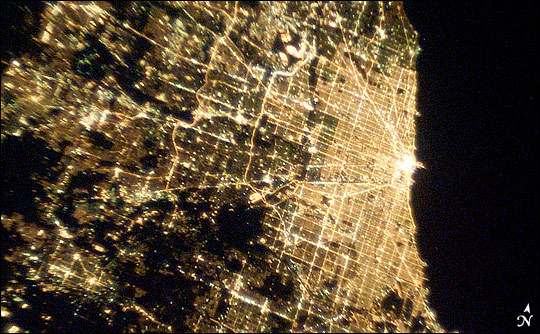
In the Sun Belt Areas of our country, phenomenal growth has occurred over the past 30 years.  Satellite images from 1984 through 2012 show the impacts on the Landscape in a time lapse image that is a scary picture of what the next 30 years may bring.

A blog article from the Atlantic Cities website forwarded to me by my friend Dave H. It is a geographic time lapse of satellite images provided by Google.  Their article titled  “The Devastating Impact of 30 Years of Sprawl, as Seen From Space.” gives startling images of how our cities have grown.

“These GIFs were recorded from Google’s “Landsat Annual Time Lapse” tool by Samuel Aston Williams, a young Texas architect. Williams wanted to contribute something new to a startling series of showing three decades of human-landscape intervention recently produced by a collaboration of Google, NASA, TIME and others.”

Read the full article.

The Atlantic Cities also published a blog titled “A Terrifying, Fascinating Time lapse of 30 Years Impact on Earth.”  The images in this blog shows development in other places on the earth in a scary 30 year blink of an eye.

“Since the 1970s, NASA and the U.S. Geological Survey have been amassing satellite images of every inch of our planet as part of the Landsat program. Over time, the images reveal a record of change: of cities expanding, lakes and forests disappearing, new islands emerging from the sea off the coast of rising Middle East metropolises like Dubai.

If you could thumb through these historic pictures as if in a flip book, they would show stunning change across the earth’s surface, in both our natural environments and our man-made ones. Now, the digital equivalent of that experience is possible – three decades of global change as GIF – in a project unveiled today between NASA, the USGS, TIME, Google, and the CREATE Lab at Carnegie Mellon University.

Landsat images taken between 1984 and 2012 have been converted into a seamless, navigable animation built from millions of satellite photos. As Google wrote this morning on its blog: “We believe this is the most comprehensive picture of our changing planet ever made available to the public.”

See the time lapse images here.

Here’s the Problem!

World Population Growth.

Our Population is only going to Grow Larger!

World population details here.

NASA has also been Following Urban Sprawl

This is how Baltimore has grown in 200 Years!

“October 11, 2002:  While space technology was undergoing its spectacular birth during the 1950s and ’60s, and visionaries were predicting the spread of human colonies into space, another kind of human colony was spreading rapidly–right here on Earth!

It was the dawn of the modern suburb, a time of post-war prosperity when housing developments popped up across the landscape like mushrooms after a rain.

A half-century later, we now understand that many environmental problems accompany the outward spread of cities: fragmenting and destroying wildlife habitat, for example, and discharging polluted runoff water into streams and lakes.”

More information here.

Urban Sprawl in the United States is covered in Photos by Christoph Gielen

The photo below was taken by Christoph Gielen.  There is a symmetrical beauty to his aerial photos of Urban Areas.  Please go to his Twisted Sifter website for phenomenal aerial photos of our Urban Centers.

A Great Aerial photo by Christoph Gielen of an Arizona Neighborhood

Urban Sprawl is defined in detail at the Wiki website;

An interesting phenomena is that Sprawl is a term only used in America for Urban Growth,  “The term “sprawl” is most often associated with US land use; outside the US (and especially outside the Anglosphere), the term “peri-urbanisation” is often used to denote similar dynamics and phenomena.”

More on Urban Sprawl.

Urban Sprawl and Public Health?

Smart Growth is the alternative to Urban Sprawl,  unfortunately many people argue against high density living and it is still a contentious point.  Do we continue to grow outward or upward.  Will we feel more like rats trapped in a cage or free range rats. Read the following National Institute of Health article for their take on the impacts of Urban Sprawl vs. Smart Growth.

Urban Sprawl

“Urban sprawl in the United States has its origins in the flight to the suburbs that began in the 1950s. People wanted to live outside of city centers to avoid traffic, noise, crime, and other problems, and to have homes with more square footage and yard space. As suburban areas developed, cities expanded in geographic size faster than they grew in population. This trend has produced large metropolitan areas with low population densities, interconnected by roads. Residents of sprawling cities tend to live in single-family homes and commute to work, school, or other activities by automobile.”

“Although there is considerable evidence that urban sprawl has adverse environmental impacts and contributes to a variety of health problems—including obesity, diabetes, cardiovascular disease, and respiratory disease implementation of policies designed to combat sprawl, such as smart growth, has proven to be difficult.”

Smart Growth

“Smart growth can be defined as a policy framework that promotes an urban development pattern characterized by high population density, walkable and bikeable neighborhoods, preserved green spaces, mixed-use development (i.e., development projects that include both residential and commercial uses), available mass transit, and limited road construction.”

Urban Sprawl, Smart Growth, and Deliberative Democracy

From Wiki these are the Advantages and Disadvantages of Urban Sprawl

Advantages

– More single family residences on larger lots.
– Lower land prices.
– Less experience of noise and pollution.
– Suburban areas generally associated with “sprawl” tend to have lower crime and higher-quality schools.
– Perceived overwhelming consumer preference for sprawl-type developments.

Disadvantages

– High car dependence.
– Inadequate facilities e.g.: cultural, emergency, health, etc.
– Higher per-person infrastructure costs.
– Inefficient street layouts.
– Low diversity of housing and business types.
– Higher per-capita use of energy, land, and water.
– Perceived low aesthetic value

Source: Wikipedia

Our Human Colonies seem to be spreading about as fast as our ice caps are melting.  I wonder if there is any correlation?

Is it time for mankind to adapt to a new future?  No, it’s past time.  We have a lot of catching up to do in implementing new technologies to provide sustainable growth options in all areas; industry, transportation, energy production, carbon footprints, food supply, to taking care of our precious fresh water supplies.

How do we make our cities more sustainable and resilient?  Start with telling your national, state and local politicians that you want a sustainable future.  Let’s work together and make this happen.

Urban Sprawl or Smart Growth, your choice!

Make your world Sustainable!

oooOOOooo

AGW certainty, Part Two

Continuing the examination of two views on AGW.

Readers will recall that this post opened yesterday.  That Part One closed with Martin writing this:

Martin Lack

Much of what Oakwood writes is an attack upon the Hockey Stick graph of palaeoclimatic temperature reconstructions first produced in 1998 (MBH98).

However, the fatal flaws in Oakwood’s scepticism regarding MBH98 are as follows:

  1. MBH98 has been validated by at least 14 other reconstructions (as cited in IPCC AR4 in 2007) using a wide variety of other proxy data(see Wikipedia for relevant links)
  2. Hockey Stick-shaped graphs turn up in reconstructions of CO2 levels and temperature – now going back over thousands of years – because they are not ‘statistical noise’ –
  3. Arguments about splicing instrumental data onto proxy data only serve to challenge the extent to which the speed of late 20th Century warming is unprecedented.
  4. Such arguments do not invalidate the conclusion that it is now almost certainly warmer than it has been at any time since the last Ice Age (i.e. a period of relative climate and sea level stability that has made agriculture, urbanisation and civilisation possible).

However, this is no reason for us to be complacent because, as Oakwood must know, the 50 to 100 metres of sea level rise that will be caused by the melting of terrestrial ice sheets will necessitate the mass migration of millions of people. This makes his concerns about current poverty and starvation (i.e. the main reason he eventually cites for not believing action is yet necessary) look very trivial indeed.

So continuing ….

Oakwood

The argument that the ‘divergence problem’ does not bring into question proxy studies is just one example of supposed ‘settled’ evidence in the case for AGW. There are others which collectively bring down the case to one of opinion.

Martin Lack

After a lengthy attempt to assert that the “hide the decline” controversy was or is significant, Oakwood eventually moves onto attack the significance of MBH98; and to claim that ACD is no more than a matter of opinion. It is only possible to reach this conclusion by dismissing the majority of climate scientists as being stupid, sloppy, or sinister.

Oakwood

Here are a few others:

  • Mann et al’s original hockey stick (1998) (as well as a number of other studies) shows an unprecedented temperature rise in the first half of the 20th century, a temperature change that most climate scientists believe can be explained by natural phenomena, such as the Sun (while failing to reproduce the man-made rise in the 2nd half of the century, due to the divergence problem explained above).

Martin Lack

However, Climategate and, more especially Climategate 2.0 merely served to demonstrate how deliberate and organised are the attempts to discredit climate science and derail international attempts to tackle the ACD problem.

Oakwood

Thus, we are expected to believe there was both an unprecedented NATURAL temperature rise and unprecedented MAN-MADE rise in the same century. Not impossible, but statistically highly unlikely.

Martin Lack

Oakwood suggests that assertions about early 20th Century warming are statistically highly unlikely (i.e. that climate scientists are stupid to make them). However, the real statistically highly unlikely suggestion is that 30 years of monthly average temperatures exceeding their long-term average values could be a consequence of natural variation. Unlike early 20th Century warming, this is definitely not capable of being explained by natural causes (such as cyclical solar activity or random volcanic eruptions).

Oakwood

  • The ‘record’ (in just 35 years) of minimum summer ice in the Arctic is repeatedly presented as evidence for impending doom. However, the record MAXIMUM ice cover in the ANTarctic, at the same time, is dismissed with ‘we have another explanation for that’.

Martin Lack

Trying to shift the focus away from the accelerating rate of ice loss in the Arctic is very lame indeed. The Arctic is surrounded by land and (now) increasing amounts of warming water. The reasons for the ice loss are well understood and it is happening faster than was predicted even 5 years ago. The Antarctic is surrounded by a huge expanse of cold ocean and is also being kept cold by the human caused hole in the ozone layer. The reasons why its ice is not melting so fast are therefore also well understood. In addition, it should be noted that the Antarctic Peninsula is the fastest warming place in the southern hemisphere.

Oakwood

  • Whatever the weather, blame global warming. A few years ago, milder winters and earlier springs in the UK were hailed as evidence of AGW. But now we get lots of snow, and appalling spring, cooler summers, etc, and guess what, its due to global warming.
  • Hot/dry weather and floods around the world are routinely highlighted as ‘more evidence’ whereas as cold weather extremes and records are dismissed as ‘just natural variation’ – again, and again and again.

Martin Lack

Oakwood‘s remarks about extreme events are also very misleading. The number of records being broken for hot and/or dry events is many times greater than the number of records being broken for cold and/or wet events. As Hansen et al explained last year, in their review of historical data for the last five decades, natural variability does not explain the steady shift in average temperatures and the broadening of the range of conditions experienced in any one place.

I really can’t believe that Oakwood is so parochial in his outlook that he dares to mention the cold weather the UK has experienced recently. We may have had the coldest Spring for 50 years, but, that does not change the fact that global average temperatures are still the highest ever in recorded history. Furthermore, it does not change the fact that the analysis of Hansen et al (2012) continues to be validated by events such as those in Central Europe at the moment – where 1 in 100 year flood events have recurred after only 10 years. Not impossible – just statistically highly unlikely.

Oakwood

Those who highlight the lack of rising temperature for the past 10-15 years are routinely dismissed as deniers and liars. We’re told, ‘but the last decade is the warmest in a 100 years’. No-one disputes that. Given the world warmed by 0.8 degC in 100 years, that’s perfectly reasonable, and is not a defence against the fact that warming has at least paused.

  • We’re told: ‘but the heat is going into the ice caps and the deep oceans and atmospheric heat is just a small percentage of the total’, How convenient. In the 1980s and 1990s, atmospheric temperature was enough for ‘proof’ of serious AGW. We didn’t hear anything about ocean heat then. No-one suggested that perhaps the warming was due to a release of previously ‘hidden’ ocean heat. Or that we shouldn’t read too much into a small atmospheric temperature rise.
  • We see again and again, whatever happens, whatever the data show, the theory is revised to ‘show’ that nothing has changed. This is simply not plausible science.
  • We’re told, the physics of CO2-induced global warming is just that, ‘physics’, and we can’t change that however much we dispute it. No-one disputes the physics. But, the atmosphere (believe it or not) is very complicated. We have the physics that says aerosols reflect the Sun’s heat, that clouds may increase and also reflect more heat. We now hear the relationships with the oceans is very important (which we didn’t hear before). Thus the debate is not about the reality of the CO2-global warming physics. Its about the sensitivity of the system and which physical phenomena will dominate.

Martin Lack

Given the massive inertia in the climate system (which guarantees decades of future temperature rise even if CO2 emissions were completely halted today), there is no reason for us to be complacent about the fact that we have only seen a rise of 0.8C since the Industrial Revolution. The scientific consensus remains that equilibrium climate sensitivity is somewhere in excess of 2C and that such a rise in temperature will not be good for the vast majority of life on Earth. On the evidence of the ACD that we are already experiencing, I think there is very good reason to agree with that conclusion.

Again, I am astonished that Oakwood even dares to mention the ‘global warming has stopped’ canard. This misconception has been debunked so many times; there are even debates about who has written written the best rebuttals.  Here is a summary: Whilst surface warming may have paused, the warming of the ocean (which is driving the increased frequency of extreme weather events of all kinds) has continued. Given that oceans cover two thirds of the Earth’s surface, is this something really worth arguing about?

Climate scientists are therefore not changing their story to accommodate inconvenient new data. Only climate change sceptics do that. The only implausible science on offer today is that which seeks to explain all the data without acknowledging that CO2 is the main driver. Sure, CO2 does not explain everything but, you cannot explain all the data unless the primacy of CO2 is accepted.

Oakwood

Some will respond: ‘but all of these arguments have been debunked many times’. All they really mean is another opinion or speculation has been given by an AGW believer. Nothing wrong with these, but don’t claim they represent settled science.

Martin Lack

However, I should like to re-iterate the importance of the recently-published results of investigations at a lake in the NE of Arctic Russia. What this new 3.6 million year continuous palaeoclimatic record tells us is that current warmth is not unprecedented (if you go back to an era in which humans did not exist – 400 or 1,100 thousand years ago). This demonstrates that good scientists do not change their story when they get unexpected results.

Oakwood

I have no problem with scientists believing in AGW and believing it a serious threat. But when so much of their case is based on weak arguments, I do have a problem with claiming the case is ‘settled’ and that anyone who questions or challenges it is a liar, denier, conspiracy theorist, etc.

Both sides of the debate have their extremists and nutters. My interest is in the rational middle ground. To suggest an ‘eccentric’ like Christopher Monckton is ‘typical’ of all AGW-sceptics is just like claiming all Conservative voters are fascist and all Labour voters communist. It has no place in informed and educated debate.

Martin Lack

Oakwood claims arguments for concern over ACD are “weak” but, in making this assertion, the only information he has referred to is very much out-of-date (such as IPCC AR4 in 2007). Oakwood moves on to discuss unhelpful labels such as “liar” and “denier”.

I do not think I have ever suggested that anyone who professes to be ‘sceptical’ is lying. However, I do think that, just like the tobacco executives whose ‘modus operandi’ they are copying, the executives of fossil fuel companies know more than they care to admit. There is also a great deal of evidence to indicate that climate change ‘scepticism’ is in fact being driven by unscientific economists aided in their anti-science cause by a handful of friendly scientists who tell them what they want to hear. This is not scepticism, it is ideological prejudice.

Oakwood

The term “denier” was introduced with the intention of associating AGW-sceptics with Holocaust Deniers. That is to say, AGW-sceptics are putting millions of lives at risk through their lies and ignorance. Given the weakness of the AGW case, the use of the labels ‘denier’, ‘deny’, denial’ seems to represent an insult to every victim of the Holocaust.

Martin Lack

I agree that use of the term ‘denier’ is generally not helpful, but, given all the evidence that conflicts with their position, I do think that those who remain ‘sceptical’ about the primary cause of ongoing climate change are being irrational. If your beliefs require you to dismiss any and all evidence that conflicts with them, that is not scepticism, it is wilful blindness; it is what Young Earth Creationists have to do in order to protect themselves from wicked and ungodly scientific ideas.

Therefore, even if Oakwood does not do it, many who are ‘sceptical’ do rely upon conspiracy theories to dismiss all the evidence that conflicts with their beliefs. This includes dismissing most scientists as stupid, sloppy or sinister.

Oakwood

And why is it not time to act now? I am an environmentalist and see many environmental and social problems that need addressing. In particular, the need for ‘sustainability’ in all we do. There remain millions dying each year from such things as malnutrition, lack of safe drinking water, malaria, etc.

These are hard facts with zero room for any doubt. Given the weakness in the AGW-case, it is not a priority. I see some benefits in acting. For example, in many cases a reduction in CO2 emissions leads to much improved energy-efficiency, and less pollution. However, the case is not made for diverting money and effort from the more immediate priorities, covering pristine countryside in wind farms to satisfy urban energy demands, or using more biofuels at the expense of more hunger.

Martin Lack

Having wasted so much time trying to falsify MBH98, Oakwood finally gets round to the important bit of my question: Why does he think the time to act has not yet arrived?

Failing to address the point that a wide range of industrial, political and economic organisations now agree that it is time to act, Oakwood opts instead to simply re-state his belief that attempts to mitigate the ACD problem will do more harm than good. All the evidence I have seen suggests that he is mistaken. To-date, I think the most compelling evidence is that contained in the IIED’s 2009 report , ‘Assessing the costs of Adaptation to Climate Change: A review of UNFCCC and other recent estimates’ (PDF available here), which begins with the following very sobering executive summary:

Several recent studies have reported adaptation costs for climate change, including for developing countries. They have similar-sized estimates and have been influential in discussions on this issue.

However, the studies have a number of deficiencies which need to be transparent and addressed more systematically in the future. A re-assessment of the UNFCCC estimates for 2030 suggests that they are likely to be substantial under-estimates. The purpose of this report is to illustrate the uncertainties in these estimates rather than to develop new cost estimates, which is a much larger task than can be accomplished here.

The main reasons for under-estimation are that: (i) some sectors have not been included in an assessment of cost (e.g. ecosystems, energy, manufacturing, retailing, and tourism); (ii) some of those sectors which have been included have been only partially covered; and (iii) the additional costs of adaptation have sometimes been calculated as ‘climate mark-ups’ against low levels of assumed investment. In some parts of the world low levels of investment have led to a current adaptation deficit, and this deficit will need to be made good by full funding of development, without which the funding for adaptation will be insufficient. Residual damages also need to be evaluated and reported because not all damages can be avoided due to technical and economic constraints.

There is an urgent need for more detailed assessments of these costs, including case studies of costs of adaptation in specific places and sectors.

Oakwood

Thus, belief in AGW is not a simple moral argument which some would want to believe – good vs evil, or capitalist vs environmentalist, etc.

Martin Lack

Oakwood says he does not think this is a good-vs- evil or a capitalist-vs- environmentalist issue. I would agree. However:

  • I am not the one who is allowing my political beliefs to prejudice my approach to the science;
  • I am not the one who is accusing most scientists of being stupid, sloppy or sinister in order to dismiss what they are telling me; and
  • I am not the one changing my story or my preferred argument whenever something I have formerly relied upon is shown to be unreasonable.

Although it is a shame that he is part of a minority within the UK’s current Coalition Government, I will conclude by quoting from a recent speech by the Secretary of State for Energy and Climate Change, Edward Davey:

Of course there will always be uncertainties within climate science and the need for research to continue… We make progress by building on what we know, and questioning what we don’t. But some sections of the press are giving an uncritical campaigning platform to individuals and lobby groups who reject outright the fact that climate change is a result of human activity. Some who even deny the reality of climate change itself… By selectively misreading the evidence, they seek to suggest that climate change has stopped so we can all relax and burn all the dirty fuel we want without a care…

Oakwood says he opposes action to curb ACD because there are bigger problems we need to solve. If this were likely to be true, it would be an admirable position to take. Unfortunately, the bulk of the evidence suggests that ACD is a problem unlike any other and, unless we make serious attempts to minimise it, its consequences will dwarf all other problems we face.

This is because basic physics tells us that allowing the Earth to warm up will cause terrestrial ice to melt and sea levels to rise. It was predicted and it is now happening. The time to act to stop it is now. Millions of people cannot and will not adapt to having their land and their cities submerged under water.

oooOOOooo

Well I think that the agreement of Oakwood and Martin to set out their positions is fabulous and very worthy.

If readers will forgive me, tomorrow I will offer my own personal reflections on what has been offered by Martin and Oakwood today and yesterday.

Please don’t forget the wolves!

Time is not on the side of the wolves and for all those who care for them.

It’s unusual for me to publish a post at this time of the day. However, following my recent post I cry for the wolves I wanted to circulate two recent emails received from the Center for Biological Diversity.  Here they are in their original format.

Feel free to forward this post as far and wide as you would like to.

Thank you,

Paul and Jean.

oooOOOOoo

Center for Biological Diversity

Dear Paul,

Gray wolf

Last week the Obama administration issued a sweeping delisting plan to remove protections for wolves across the lower 48 states. The plan only maintains protections for the small population of Mexican gray wolves in Arizona and New Mexico.

If finalized this proposal will mean the premature end of decades of work to restore wolves to the American landscape — even though wolves currently occupy a mere 5 percent of their historic range.

The proposal also means that states will hold the reins of wolf management across most of the country. We’ve already seen what state management entails for wolves in the northern Rocky Mountains and Great Lakes, where protections were removed in the past two years — in short, aggressive trapping and hunting seasons designed to drastically reduce populations, resulting in at least 1,600 wolves killed.

Please take action now to halt this delisting plan before it’s too late: Tell the U.S. Fish and Wildlife Service not to turn its back on America’s wolves.

Click here to take action and get more information.

If you can’t open the link, go to http://action.biologicaldiversity.org/p/dia/action3/common/public/?action_KEY=13725.

oooOOOooo

Center for Biological Diversity

Dear Paul,


Donate Now

Help Save America's Wolves.

Wolves Stripped of Protection —
Don’t Let it Happen.

The future of America’s wolves is at stake right now: The Obama administration just announced its plans to strip Endangered Species Act protections from nearly all wolves in the lower 48 states.

We need your help. A generous member is matching all emergency gifts to our Wolf Defense Fund until tomorrow. Please give right now.

This announcement means the U.S. Fish and Wildlife Service is gutting 40 years of wolf conservation and recovery.

And when wolves lose federal protections, they die. Too often they’re hunted, trapped and ruthlessly persecuted with the same vicious attitude that nearly drove them extinct a century ago.

It also means that wolves — absent today from 95 percent of their historic habitat in the continental United States — are virtually guaranteed never to fully recover in places like the Northeast, California, and most of the Rocky Mountains and Pacific Northwest.

The Center for Biological Diversity’s expert legal team is already working to get into court right away to stop this terrible plan.

The Center has an amazing track record of saving wolves. We’ve overturned illegal wolf-killing decisions in Idaho, Montana, Wyoming, Minnesota and Wisconsin. Wolves in Oregon today are protected by a court injunction won by the Center. But this will be the biggest wolf case yet, and we need your help to win it.

The entire U.S. wolf recovery program hangs in the balance.

If this decision stands, wolves will never be reintroduced to California, the Northeast or the southern Rocky Mountains. Killing of the small population in Oregon and Washington will ramp up, preventing it from ever recovering. Make no mistake: Despite the government’s warm and fuzzy PR spin, this decision is about ending wolf recovery in the United States once and for all.

Our team of scientists, lawyers and activists has been preparing for this terrible decision, and now — with your help — they’ll begin the biggest legal battle of the decade.

If you’re as sickened as I am by the killing, please help us stop it. Donate to the Wolf Defense Fund today.

For the wolves,

Kierán Suckling
Kierán Suckling
Executive Director
Center for Biological Diversity

P.S. Because this is an emergency, one of our members will match every gift made by tomorrow, Sunday, June 16. Help us take advantage of this extraordinary offer by donating as much as you can to the Center’s Wolf Defense Fund and passing this appeal on to your friends and social media networks.

P.P.S. If you have problems with the links above, please cut and paste this into your browser: https://org.salsalabs.com/o/2167/p/salsa/donation/common/public/?donate_page_KEY=9994&track=E1305G2

oooOOOooo

G8 madness!

If it wasn’t so serious, it would be so funny!

I read a recent article posted by Rob Hopkins on the Transition Culture blogsite, a blog that I subscribe to.  Those who are unfamiliar with Rob, the Transition Culture site has his background, from which I quote this snippet:

Rob Hopkins, with a familiar Totnes building in the background.

“Rob Hopkins brings humour, imagination and vision to the great challenges of our time, and argues that what is needed, above all else, at this time in history, is “engaged optimism”.  The rapidly-spreading Transition movement which he was pivotal in establishing, is an embodiment of that.  Nicholas Crane, presenter of BBC2’s recent ‘Town’ series, recently referred to Transition as “the biggest urban brainwave of the century”.

He is the co-founder of Transition Town Totnes and of the Transition Network. This grew out of many years experience in education, teaching permaculture and natural building, and setting up the first 2 year full-time permaculture course in the world, at Kinsale Further Education College in Ireland, as well as co-ordinating the first eco-village development in Ireland to be granted planning permission.

Anyway, back to the article.  It struck me as so absurd that I tried my hand at asking Rob for permission to republish.  Back, almost immediately, came his positive reply. Thank you, Rob.

Oh, and before going to Rob’s article, for those that, like me, are a bit rusty on the composition of the G8, here’s a Wikipedia extract:

The Group of Eight (G8) is a forum for the governments of the world’s eight wealthiest countries. The forum originated with a 1975 summit hosted by France that brought together representatives of six governments: France, West Germany, Italy, Japan, the United Kingdom, and the United States, thus leading to the name Group of Six or G6. The summit became known as the Group of Seven or G7 the following year with the addition of Canada. The G7, that is active even after the creation of the G8, is composed by 7 of 8 of the wealthiest countries on Earth (as net wealth and not GDP). In 1997, Russia was added to the group which then became known as the G8. The European Union is represented within the G8 but cannot host or chair summits.

Now without any further ado, here is that article.

oooOOOooo

12 Jun 2013

Why even the G8 prefer vibrant, diverse local economies really …

shop

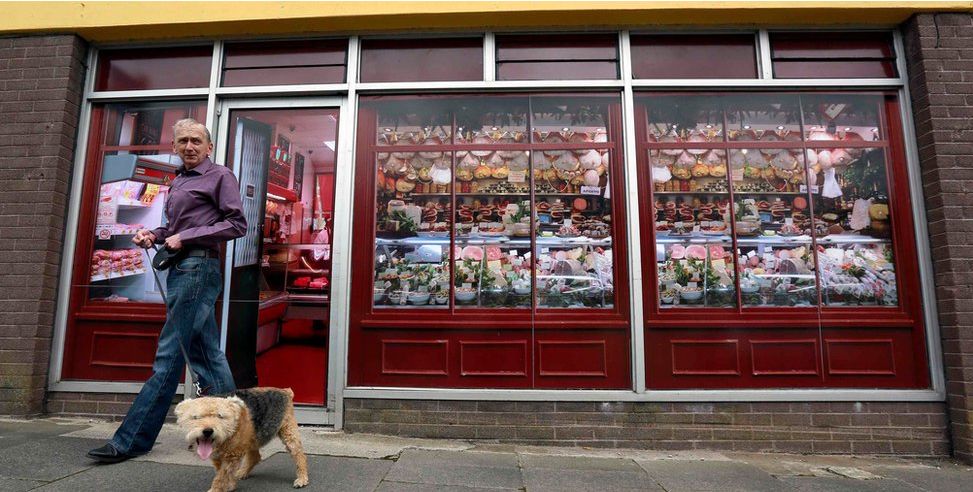
If there was one picture that captured the times we are living through it is this.  It appeared on the BBC website recently with the following caption:

Kevin McGuire walks his dog past a vacant shop in Belcoo, Northern Ireland.  The empty shop is one of a number that have had graphics placed on the windows to make them look like working shops ahead of the G8 summit which takes place nearby later this month.  

Let’s take that a bit more slowly.  Here is a shop, one of many that has gone out of business due, among other things, to the growth-fixated policies of the G8, situated in a place G8 ministers will be driven past en route to their summit.  Rather than their being able to see how things are actually unfolding in the real world, the division and misery being caused by their approach to the economy, the windows have been plastered with stickers that present it as a fully-stocked, thriving shop.  As singer/comic Mitch Benn put it on BBC Radio 4′s The Now Show on Friday,  ”the last thing you’d want would be for a bunch of people meeting to fix the economy to see how bad the economy’s got”.

The BBC reported the story, giving a bit more information about it:

County Fermanagh’s district council sanctioned the fake retail units as part of a £1m makeover before it hosts the G8 summit. The event takes place on 17 and 18 June at the Lough Erne golf resort near Enniskillen.  The chief executive of Fermanagh District Council has defended the optical illusion.

“It was aimed at undeveloped sites at the entrance to the town and then right throughout the county in terms of the other towns and villages, looking at those vacant properties and really just trying to make them look better and more aesthetically pleasing,” says Brendan Hegarty

Here’s the thing that fascinated me most though.  It’s the kind of shop they chose to portray it as.  They didn’t print up large stickers that would present the shop as being a Tesco Metro, a Sainsbury’s Local, an Aldi perhaps, or even branch of one of the banks that contributed significantly to our getting into this mess in the first place.  They didn’t make one huge sticker, one false façade, that showed a new shopping precinct, glittering with all the usual chain stores that dominate every such precinct.  Or a Travelodge perhaps.  Rather they set out deliberately and in considerable detail to portray the kind of vibrant, local, independent business that has either become extinct, or which survives in spite of, rather than because of, the policies of the G8.  Here’s another one…

_68047523_oldladies

The windows are hung with delicious-looking hams, the display features meats and a whole range of delicious local produce, beautifully arranged.  Although the cut-and-paste nature of the graphic design rather gives the game away (the same arrangements of hams appear two or three times), what they are trying to portray here is that most endangered of species, the local, independent butcher.

In the mid-1990s there were 22,000 butchers in the UK, by 2010 there were just 6,553.  The independent butcher is making something of a spirited fightback though, although certainly not aided, in any sense, by the G8.  The butcher that would have occupied that shop no longer exists, most likely because a supermarket opened nearby and completely shifted the balance of the Belcoo economy (any readers from Belcoo who might like to write in and tell us what led to this shop’s demise would be most welcome).

The other day I spoke to Nick Sherwood of REconomy Herefordshire, who has co-ordinated the Herefordshire Economic Evaluation (the second such piece of work, the Totnes one already being published, and Brixton’s coming soon).  Our conversation will be published here soon, but one of the things that really struck me was the following:

We estimate that the top five major supermarkets in Herefordshire account for between 71% – 83% of all household expenditure on ‘brought home’ food and drink, or up to £180m annually. In addition, around £30m per year is spent in the smaller ‘chain’ supermarkets.

Herefordshire-EB-cover-198x300Their conclusion is that the true ‘local spend’ figure, i.e through local, independent businesses in Herefordshire, could be around 16% of the total.  In terms of a national version of that figure, the best I can find is the figure from the Portas Review that states that 8,000 supermarkets now account for over 97% of all UK grocery sales.  Although clearly other smaller supermarkets account for some of the remaining sales, let’s assume, for argument’s sake, that nationally, 3% of what we spend on groceries goes out through local and independent businesses.

I would imagine that everyone seeks an economy that is able to provide jobs, economic activity, stronger and happier communities and community resilience, while also skilfully reducing its carbon emissions on the scale required.  The question of our times though, as far as I’m concerned, is whether that is best achieved by expanding the 97% of our economy currently dominated by huge supermarkets, the kinds of enterprise that the UK government and the G8 see as leading the push for growth, or protecting and enhancing the 3%?

It’s a vital question, because at the moment the push to eradicate the 3% altogether, or at least squeeze it a lot harder, continues apace.  Yet that 3% is better suited to meeting those core needs of ours.  As the recent report by Localise West Midlands on ‘community economic development’ states:

Our research has found strong evidence that local economies with higher levels of SMEs and local ownership perform better in terms of employment growth (especially disadvantaged and peripheral areas), the local multiplier effect, social and economic inclusion, income redistribution, health, civic engagement and well-being than places heavily reliant on inward investment where there are fewer, larger, remotely owned employers.

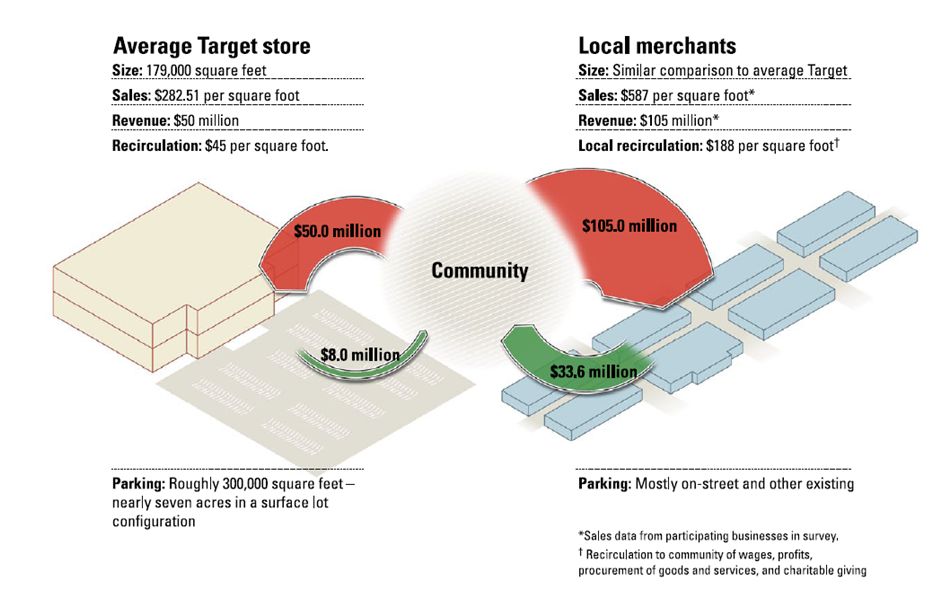
A study focusing on New Orleans compared 179,000 square feet of retail space that is home to 100 independent businesses to the same-sized space that is home to a single supermarket. The former generated $105 million in sales with $34 million staying in the local economy, while the latter generated $50 million in sales with just $8 million staying locally, and necessitated 300,000 square feet of parking space (see graphic below).

shops

Santander’s ‘Market of Hope’ which I wrote about here last year is a great example of how a city can be fed by looking at large retail spaces in such a way that they boost and support the local independent economy rather than undermine it. When Sir Terry Leahy, CEO of Tesco, was asked whether there was any alternative to supermarkets, replied:

“… queueing at one store than trudging down Watford High Street in the rain to another shop … is this what people actually want to go back to?”

But no, it’s not about “going back”, rather about going forward in a way that meets our needs rather than those of the City of London.  What we now know is that even G8 ministers would rather pass through High Streets populated with small, independent butchers, bakers, grocers, would rather see shop windows overflowing with delicious food,  trusting that the relationship they have built up with the shopkeeper over many years will mean that he/she stocks the best produce they can find.  It feels right.  It’s human scale.  It makes sense.  It’s an economy that is ours, it belongs to local people, to the local economy.  Even G8 ministers would now appear to prefer a shopping experience that actually involves interacting with other human beings rather than wandering anonymously around a superstore and then cashing yourself out at the end.

The core argument of The Power of Just Doing Stuff, published on Friday, is that if we really want to achieve our goals of jobs, economic activity, stronger and happier communities and community resilience, while also skilfully reducing our carbon emissions on the scale required, we’d be better off focusing on growing the 3% rather than the 97%.  It’s a pretty simple idea, and, to me at least, a blindingly obvious one, but that doesn’t mean it’s easy.

However, the experience is that this fightback has already begun.  The explosion of new bakeries, pop-up shops, community renewable energy projects, craft breweries, independent record shops, complementary currencies and communities acquiring their own assets is already happening around us, but it needs us to get behind it, to put our shoulders, our spending power, our sheer bloody will, to making it 10%, 30% 70%.  If we want a stable climate, reduced energy vulnerability, economic stability, and a healthy human culture, we really have no choice.  As Maria van der Hoeven of the IEA said recently at the launch of a World Energy Outlook Special Report, Redrawing the Energy-Climate Map, ”the path we are currently on is more likely to result in a temperature increase of between 3.6 °C and 5.3 °C”.

Fortunately, it’s a push that is life-enhancing, thrill-generating and in which we discover a resourcefulness, a kindness and a passion in ourselves that we may have forgotten was there.  I’ll leave you with a quote from the book, from Helen Cunningham of DE4 Food, a social enterprise food hub in Derbyshire that grew out of Transition Matlock.  The project grew from helping a local farmer with lambing and has grown into an innovative new business:

“Never in my life did I imagine that I’d be able to bring lambs into the world! It wasn’t a skill I ever expected to have. It was such a different thing from what we were doing in the rest of our lives, and I think from then we’ve all thought “OK, we can learn these new skills, we can learn how to lamb, we can learn how to grow vegetables and learn how to do Excel Profit and Loss sheets and whatever.” I think we all just really wanted to change the way we live, and change our own personal lives and to change things and live different lives ourselves as well as a different life in our community”.

You can pre-order your copy of The Power of Just Doing Stuff here.

oooOOOooo

As has been said before, and undoubtedly will be said many times more, it really is a very strange world we live in!

Looking into self.

Rounding off the week.

Starting with Monday’s video of Carl Sagan reminding us all that Planet Earth is just a grain of sand in the vast cosmos right through to yesterday’s Dealing with madness post, much of the week has been reminding us all of one very fundamental truth.  No better expressed than in a comment from Patrice Ayme [my emphasis]:

… there is no healthy man without a healthy world.

Regulars will have noted the high levels of debate this week.  Thank you all for those comments.

I have also received a couple of emails with feedback and comments, sent to me on a personal basis.  One of those emails had such a powerful message that I begged for permission to publish it on Learning from Dogs.  I was asked to keep the author’s identity private but, trust me, it is from someone I know well who subscribes to ideas of integrity and honesty in spades.

The author also strongly recommended publishing in association with his personal essay an extract from Chris Hedges’ book “Death of the Liberal Class”.  That extract follows straight on from the essay.

oooOOOooo

Reflections from a Vietnam Combat Veteran

War is an unnatural dichotomy.  Both sides are morally and materially diminished.  A future World War would most probably finish us as the self-appointed predominant intelligent species on planet earth.  It seems worth noting that German industrialists coordinated fundamentalist propaganda to foster the bigotry, hatred and fear which fueled their profitable war engines prior to World War II.

United States commercial media today reflects a financially dominated military-industrial culture with liberty and justice for sale.  The results are divisive and lead to both a declared international war against nebulous assailants we have been taught to dislike and an internal political war that has polarized our once fair nation.

We’ve stopped investing in the future in response to radicals who want to destroy government, human rights and what remains of the earth’s surface resources.  There is an emerging police state mentality on display with a variety of candidates for local dictator.

It’s well past time for moderate republicans to ignore their uber-conservative brethren.  It’s well past time for moderate democrats to renounce their corporate ties.  This will only happen when our financial and political leaders awaken to the reality of what is in the best long-term interests for all life on this planet rather than our present unsustainable global economy.

To complicate the problem, our planet is under attack by a swarm of vociferous human locusts seeking profit without regard to the consequences.  Meanwhile, despite human denial, the universe continues to emerge.  Species which do not adapt to change do not survive.

It’s important to remember that we’re in the midst of a battle that’s as old as the conscious awareness of the human species.  We generally have very little idea of the inclusive nature of our being; let alone the nature of our collective being as a species. We have as yet to learn how to surrender to reality.  The battle is with our own species.

Committing collective suicide for quarterly profit is not a sane way of life.  What we’ve created is a neo-feudal global economy without any foundation that feeds on an empire of consumption.  When we combine a neo-feudal economy with neo-fascist politics we arrive at a moral and biological dead end.

The coup d’état of the current Corporate State is the Citizen’s United ruling that makes money a form of free speech.  Money has no DNA.  In case anyone missed how the “occupy” movement was crushed, there’s no question that we’re rapidly criminalizing all forms of dissent.  These actions are being taking under the 1917 Espionage Act and related state secrets acts.  No discernment of moral value is considered and no public hearings are conducted.  People who speak up are locked up.  We’ve become a fearful and secretive population.

Our self-appointed elite power structure is completely irrational in its belief that human reason is our ultimate power and money is its servant.  We are made of the stuff of the stars.  At best, we’re in our adolescence as a species.  We think we know the answers rather than admitting our ignorance.  What little we know is vastly less than what we have as yet to learn.  We are often unaware of being unaware.

The lives we presently lead can not be sustained in ways that we have become accustomed to; ways we take for granted.  What’s going to need to change?  The simple answer is everything.  Our species has systemically corrupted the small part of the cosmos which sustains our being.  Nature has no sense of humor, no patience for human squabbles and no financial interest.

Fortunately, we already know what we need to do to adapt.  We know how nature works through the wisdom of our earth sciences.  The answer is simple.  Love the earth.  Love life.  Share compassion.  Educate, naturally energize, and transform.  The resulting process of change will help re-establish a realistic world economic foundation.

oooOOOooo

‘Death of the Liberal Class’

By Chris Hedges

From the book “Death of the Liberal Class,” by Chris Hedges.  Excerpted by arrangement with Nation Books, a member of the Perseus Books Group.  Copyright © 2010.

The following selection is taken from the first chapter of the book, published in October 201 by Nation Books.

In a traditional democracy, the liberal class functions as a safety valve. It makes piecemeal and incremental reform possible. It offers hope for change and proposes gradual steps toward greater equality. It endows the state and the mechanisms of power with virtue. It also serves as an attack dog that discredits radical social movements, making the liberal class a useful component within the power elite.

But the assault by the corporate state on the democratic state has claimed the liberal class as one of its victims. Corporate power forgot that the liberal class, when it functions, gives legitimacy to the power elite. And reducing the liberal class to courtiers or mandarins, who have nothing to offer but empty rhetoric, shuts off this safety valve and forces discontent to find other outlets that often end in violence. The inability of the liberal class to acknowledge that corporations have wrested power from the hands of citizens, that the Constitution and its guarantees of personal liberty have become irrelevant, and that the phrase consent of the governed is meaningless, has left it speaking and acting in ways that no longer correspond to reality. It has lent its voice to hollow acts of political theater, and the pretense that democratic debate and choice continue to exist.

The liberal class refuses to recognize the obvious because it does not want to lose its comfortable and often well-paid perch. Churches and universities—in elite schools such as Princeton, professors can earn $180,000 a year—enjoy tax-exempt status as long as they refrain from overt political critiques. Labor leaders make lavish salaries and are considered junior partners within corporate capitalism as long as they do not speak in the language of class struggle. Politicians, like generals, are loyal to the demands of the corporate state in power and retire to become millionaires as lobbyists or corporate managers. Artists who use their talents to foster the myths and illusions that bombard our society live comfortably in the Hollywood Hills.

The media, the church, the university, the Democratic Party, the arts, and labor unions—the pillars of the liberal class—have been bought off with corporate money and promises of scraps tossed to them by the narrow circles of power. Journalists, who prize access to the powerful more than they prize truth, report lies and propaganda to propel us into a war in Iraq. Many of these same journalists assured us it was prudent to entrust our life savings to a financial system run by speculators and thieves. Those life savings were gutted. The media, catering to corporate advertisers and sponsors, at the same time renders invisible whole sections of the population whose misery, poverty, and grievances should be the principal focus of journalism.

In the name of tolerance—a word the Rev. Dr. Martin Luther King Jr., never used—the liberal church and the synagogue refuse to denounce Christian heretics who acculturate the Christian religion with the worst aspects of consumerism, nationalism, greed, imperial hubris, violence, and bigotry. These institutions accept globalization and unfettered capitalism as natural law. Liberal religious institutions, which should concern themselves with justice, embrace a cloying personal piety expressed in a how-is-it-with-me kind of spirituality and small, self-righteous acts of publicly conspicuous charity. Years spent in seminary or rabbinical schools, years devoted to the study of ethics, justice, and morality, prove useless when it comes time to stand up to corporate forces that usurp religious and moral language for financial and political gain.

Universities no longer train students to think critically, to examine and critique systems of power and cultural and political assumptions, to ask the broad questions of meaning and morality once sustained by the humanities. These institutions have transformed themselves into vocational schools. They have become breeding grounds for systems managers trained to serve the corporate state. In a Faustian bargain with corporate power, many of these universities have swelled their endowments and the budgets of many of their departments with billions in corporate and government dollars. College presidents, paid enormous salaries as if they were the heads of corporations, are judged almost solely on their ability to raise money. In return, these universities, like the media and religious institutions, not only remain silent about corporate power but also condemn as “political” all within their walls who question corporate malfeasance and the excesses of unfettered capitalism.

Unions, organizations formerly steeped in the doctrine of class struggle and filled with members who sought broad social and political rights for the working class, have been transformed into domesticated negotiators with the capitalist class. Cars rolling off the Ford plants in Michigan were said to be made by UAW Ford. But where unions still exist, they have been reduced to simple bartering tools, if that. The social demands of unions in the early twentieth century that gave the working class weekends off, the right to strike, the eight-hour workday, and Social Security, have been abandoned. Universities, especially in political science and economics departments, parrot the discredited ideology of unregulated capitalism and have no new ideas. The arts, just as hungry as the media or the academy for corporate money and sponsorship, refuse to address the social and economic disparities that create suffering for tens of millions of citizens. Commercial artists peddle the mythical narrative, one propagated by corporations, self-help gurus, Oprah and the Christian Right, that if we dig deep enough within ourselves, focus on happiness, find our inner strength, or believe in miracles, we can have everything we desire.

Such magical thinking, a staple of the entertainment industry, blinds citizens to corporate structures that have made it impossible for families to lift themselves out of poverty or live with dignity. But perhaps the worst offender within the liberal class is the Democratic Party.

The party consciously sold out the working class for corporate money. Bill Clinton, who argued that labor had nowhere else to go, in 1994 passed the North American Free Trade Agreement (NAFTA), which betrayed the working class. He went on to destroy welfare and in 1999 ripped down the firewalls between commercial and investment banks to turn the banking system over to speculators. Barack Obama, who raised more than $600 million to run for president, most of it from corporations, has served corporate interests as assiduously as his party. He has continued the looting of the U.S. Treasury by corporations, refused to help the millions of Americans who have lost their homes because of bank repossessions or foreclosures, and has failed to address the misery of our permanent class of unemployed.

Populations will endure the repression of tyrants, as long as these rulers continue to manage and wield power effectively. But human history has demonstrated that once those in positions of power become redundant and impotent, yet insist on retaining the trappings and privileges of power, their subject populations will brutally discard them. Such a fate awaits the liberal class, which insists on clinging to its positions of privilege while at the same time refusing to play its traditional role within the democratic state. The liberal class has become a useless and despised appendage of corporate power. And as corporate power pollutes and poisons the ecosystem and propels us into a world where there will be only masters and serfs, the liberal class, which serves no purpose in the new configuration, is being abandoned and discarded. The death of the liberal class means there is no check to a corporate apparatus designed to enrich a tiny elite and plunder the nation. An ineffectual liberal class means there is no hope, however remote, of a correction or a reversal. It ensures that the frustration and anger among the working and middle classes will find expression outside the confines of democratic institutions and the civilities of a liberal democracy.

Dealing with madness!

“No excellent soul is exempt from a mixture of madness.”

So wrote Aristotle .

But it offers little comfort in response to some recent essays that I have been reading.  I closed yesterday’s essay from ‘Our unsustainable way of life‘ with the comment, “If it strikes you as utter, complete madness trust me, you are not alone.”  The madness is still coming!  Stay with me!

I have referred to George Monbiot before; most recently in a republication of his essay The Great Unmentionable.

Feral

George has a new book being published by Allen Lane today under the title of Feral: searching for enchantment on the frontiers of rewilding. I would offer you the link to the book on the Allen Lane website but at the time of writing this post that link is not functioning.  It’s certainly a book I want to read.  You may learn more here.

Anyway, some recent Monbiot essays in the UK Guardian newspaper have been setting the scene for his new book.

On the 22nd May, there was an essay published under the heading of What’s Missing from this Picture? (the link is to George Monbiot’s website).  The essay starts, thus:

Somehow almost all of us have missed the real story behind the disappearance of our wildlife.

By George Monbiot, published on the Guardian’s website, 22nd May 2013

Even before you start reading the devastating State of Nature report, you get an inkling of where the problem lies. It’s illustrated in the opening pages with two dramatic photographs of upland Britain. They are supposed to represent the natural glories we’re losing. In neither of them (with the exception of some distant specks of scrub and leylandii in the second) is there a tree to be seen. The many square miles they cover contain nothing but grass and dead bracken. They could scarcely provide a better illustration of our uncanny ability to miss the big picture:

State of Nature - pic 1

State of Nature - pic 2

The majority of wildlife requires cover: places in which it can shelter from predators or ambush prey, places in which it can take refuge from extremes of heat and cold, or find the constant humidity that fragile roots and sensitive invertebrates require. Yet, in the very regions in which you might expect to find such cover (trees, scrub, other dense foliage) there is almost none. I’m talking about the infertile parts of Britain, in which farming is so unproductive that it survives only as a result of public money. Here, in the places commonly described as Britain’s “wildernesses”, almost nothing remains. And the “almost” has become radically smaller over the past 20 years.

Then a few paragraphs later, comes this:

The uplands of Britain are astonishingly unproductive. For example, 76% of the land in Wales is devoted to livestock farming, mostly to produce meat. But, astonishingly, by value Wales imports seven times as much meat as it exports. Six thousand years of nutrient stripping and erosion have left our hills so infertile that their productivity is miniscule. Even relatively small numbers of livestock can now keep the hills denuded.

Without subsidies, almost all hill-farming would cease. That’s not something I’m calling for, but I do believe it’s time we began to challenge the system and its outcomes. Among them is a policy that’s almost comically irrational and destructive.

So what was it that came at me as utter madness?

It was this:

The major funding that farmers receive is called the single farm payment, which is money given by European taxpayers to people who own land. These people receive a certain amount (usually around £200 or £300), for every hectare they own. To receive it, they must keep the land in what is called “Good Agricultural and Environmental Condition” (GAEC). It’s a term straight out of 1984.

Among the compulsory standards in the GAEC rules is “avoiding the encroachment of unwanted vegetation on agricultural land”. What this means is that if farmers want their money they must stop wild plants from returning. They don’t have to produce anything: to keep animals or to grow crops there. They merely have to prevent more than a handful of trees or shrubs from surviving, which they can do by towing cutting gear over the land.

Oh, and then we learn:

The government of Northern Ireland has been fined £64 million for (among other such offences) giving subsidy money to farms whose traditional hedgerows are too wide. The effect of these rules has been to promote the frenzied clearance of habitats. The system ensures that farmers seek out the remaining corners of land where wildlife still resides, and destroy them.

Leading to the bizarre (and that’s putting it kindly) situation where:

A farmer can graze his land to the roots, run his sheep in the woods, grub up the last lone trees, poison the rivers with sheep dip and still get his money. Some of the farms close to where I lived in mid-Wales do all of those things and never have their grants stopped. But one thing he is not allowed to do is what these rules call “land abandonment”, and what I call rewilding. For no good reason, public money is used both to engineer the mass destruction of habitats through grazing and clearing, and to prevent any significant recovery.

There’s nothing I can add.  Except this.  I am collecting ideas and essays that are going to focus on the positive aspects of this ‘new world order’. I’m going to offer some examples of the power of positive change because as Rebecca Solnit wrote recently there is a case for hope!

Our unsustainable way of life

The second of two essays reflecting the ‘New World Order’.

Yesterday, I introduced the first essay from Patrice Ayme.  Today, the second essay is a complete ‘copy and paste‘ as it appeared on TomDispatch.  The importance of such writers as Patrice Ayme, the authors that are published on TomDispatch, and many more besides, is beyond measure.  As the old saying goes, “The only thing required for evil to triumph is for good men to do nothing“.

So without further ado, here is that TomDispatch essay.

oooOOOooo

Tomgram: Mattea Kramer and Jo Comerford, Congress Tweeted While America Burned

Posted by Mattea Kramer and Jo Comerford at 10:11am, May 21, 2013.
Follow TomDispatch on Twitter @TomDispatch.

[Note for TomDispatch Readers: Those of you who were struck by the recent TD piece “You Are a Guinea Pig: How Americans Became Exposed to Biohazards in the Greatest Uncontrolled Experiment Ever Launched” shouldn’t miss last Sunday’s fascinating Bill Moyers interview with its authors, David Rosner and Gerald Markowitz, who have written the new book Lead Wars: The Politics of Science and the Fate of America’s Children. Tom]

Three days after the terrorist attacks of September 11, 2001, Congress passed a joint resolution called an Authorization for Use of Military Force (AUMF). You might remember it. In layman’s terms, it was a carte blanche for the Bush administration to go to war wherever it wanted, whenever it wanted, however it wanted, under the guise of fighting anyone who “planned, authorized, committed, or aided” the September 11th attackers, or “harbored” any terrorists or terror organizations connected to the attacks. That document, more than any other, launched the Global War on Terror or GWOT. President Obama long ago ditched the name and acronym, but he kept the global war.

And don’t expect that to change. On Thursday, Assistant Secretary of Defense Michael Sheehan went before Congress and insisted that the Defense Department couldn’t be more “comfortable” with AUMF, as it was written, and that not a word should be altered or amended for changed circumstances. The Pentagon was so comfortable, in fact, that its officials foresee using that resolution to continue its drone-powered “dirty wars” in the Greater Middle East and Africa for years to come. “In my judgment,” Sheehan said, “this is going to go on for quite a while, yes, beyond the second term of the president… I think it’s at least 10 to 20 years.”

So there you have it. The military got its blank check for overseas wars, for sending out the drones and the special operations forces, and has no plans to change that before 2023, if not 2033. In other words, for at least the next decade, the GWOT, whatever label it’s given, will continue to be the central fixture of American foreign policy.  It’s not going anywhere. Today, TomDispatch regulars Mattea Kramer and Jo Comerford of the invaluable National Priorities Project look at the “homeland” a decade into the future, as the effects of Congress’s austerity policies sink in. Put the two together and what a grim scene you have: a country investing in war in distant lands as it crumbles here at home. Andy Kroll

How America Became a Third World Country 
2013-2023 
By Mattea Kramer and Jo Comerford

The streets are so much darker now, since money for streetlights is rarely available to municipal governments. The national parks began closing down years ago. Some are already being subdivided and sold to the highest bidder. Reports on bridges crumbling or even collapsing are commonplace. The air in city after city hangs brown and heavy (and rates of childhood asthma and other lung diseases have shot up), because funding that would allow the enforcement of clean air standards by the Environmental Protection Agency is a distant memory. Public education has been cut to the bone, making good schools a luxury and, according to the Department of Education, two of every five students won’t graduate from high school.

It’s 2023 — and this is America 10 years after the first across-the-board federal budget cuts known as sequestration went into effect.  They went on for a decade, making no exception for effective programs vital to America’s economic health that were already underfunded, like job training and infrastructure repairs. It wasn’t supposed to be this way.

Traveling back in time to 2013 — at the moment the sequester cuts began — no one knew what their impact would be, although nearly everyone across the political spectrum agreed that it would be bad. As it happened, the first signs of the unraveling which would, a decade later, leave the United States a third-world country, could be detected surprisingly quickly, only three months after the cuts began. In that brief time, a few government agencies, like the Federal Aviation Administration (FAA), after an uproar over flight delays, requested — and won — special relief.  Naturally, the Department of Defense, with a mere $568 billion to burn in its 2013 budget, also joined this elite list. On the other hand, critical spending for education, environmental protection, and scientific research was not spared, and in many communities the effect was felt remarkably soon.

Robust public investment had been a key to U.S. prosperity in the previous century. It was then considered a basic part of the social contract as well as of Economics 101. As just about everyone knew in those days, citizens paid taxes to fund worthy initiatives that the private sector wouldn’t adequately or efficiently supply. Roadways and scientific research were examples. In the post-World War II years, the country invested great sums of money in its interstate highways and what were widely considered the best education systems in the world, while research in well-funded government labs led to inventions like the Internet. The resulting world-class infrastructure, educated workforce, and technological revolution fed a robust private sector.

Austerity Fever

In the early years of the twenty-first century, however, a set of manufactured arguments for “austerity,” which had been gaining traction for decades, captured the national imagination. In 2011-2012, a Congress that seemed capable of doing little else passed trillions of dollars of what was then called “deficit reduction.” Sequestration was a strange and special case of this particular disease.  These across-the-board cuts, instituted in August 2011 and set to kick in on January 2, 2013, were meant to be a storm cloud hanging over Congress. Sequestration was never intended to take effect, but only to force lawmakers to listen to reason — to craft a less terrible plan to reduce deficits by a wholly arbitrary $1.2 trillion over 10 years. As is now common knowledge, they didn’t come to their senses and sequestration did go into effect. Then, although Congress could have cancelled the cuts at any moment, the country never turned back.

It wasn’t that cutting federal spending at those levels would necessarily have been devastating in 2013, though in an already weakened economy any cutbacks would have hurt. Rather, sequestration proved particularly corrosive from the start because all types of public spending — from grants for renewable energy research and disadvantaged public schools to HIV testing — were to be gutted equally, as if all of it were just fat to be trimmed. Even monitoring systems for possible natural disasters like river flooding or an imminent volcanic eruption began to be shut down.  Over time the cuts would be vast: $85 billion in the first year and $110 billion in each year after that, for more than $1 trillion in cuts over a decade on top of other reductions already in place.

Once lawmakers wrote sequestration into law they had more than a year to wise up. Yet they did nothing to draft an alternate plan and didn’t even start pointing out the havoc-to-come until just weeks before the deadline. Then they gave themselves a couple more months — until March 1, 2013 — to work out a deal, which they didn’t.  All this is, of course, ancient history, but even a decade later, the record of folly is worth reviewing.

If you remember, they tweeted while Rome burned. Speaker of the House John Boehner, for instance, sent out dozens of tweets to say Democrats were responsible: “The president proposed sequester, had 18 mo. to prioritize cuts, and did nothing,” he typically wrote, while he no less typically did nothing. For his part, Senate Majority Leader Harry Reid tweeted back: “It’s not too late to avert the damaging #sequester cuts, for which an overwhelming majority of Republicans voted.” And that became the pattern for a decade of American political gridlock, still not broken today.

Destruction Begins

March 1st came and went, so the budgetary axe began to fall.

At first, it didn’t seem so bad. Yes, the cuts weren’t quite as across the board as expected. The meat industry, for example, protested because health inspector furloughs would slow its production lines, so Congress patched the problem and spared those inspectors. But meat production aside, there was a sense that the cuts might not be so bad after all.

They were to be doled out based on a formula for meeting the arbitrary target of $85 billion in reductions in 2013, and no one knew precisely what would happen to any given program. In April, more than a month after the cuts had begun, the White House issued the president’s budget proposal for the following year, an annual milestone that typically included detailed information about federal spending in the current year. But across thousands of pages of documents and tables, the new budget ignored sequestration, and so reported meaningless 2013 numbers, because even the White House couldn’t say exactly what impact these cuts would have on programs and public investment across the country.

As it happened, they didn’t have to wait long to find out. The first ripples of impact began to spread quickly indeed. Losing some government funding, cancer clinics in New Mexico and Connecticut turned away patients. In Kentucky, Oregon, and Montana, shelters for victims of domestic violence cut services. In New York, Maryland, and Alabama, public defenders were furloughed, limiting access to justice for low-income people. In Illinois and Minnesota, public school teachers were laid off. In Florida, Michigan, and Mississippi, Head Start shortened the school year, while in Kansas and Indiana, some low-income children simply lost access to the program entirely. In Alaska, a substance abuse clinic shut down. Across the country, Meals on Wheels cut four million meals for seniors in need.

Only when the FAA imposed furloughs on its air traffic controllers did public irritation threaten to boil over. Long lines and airport delays ensued, and people were angry. And not just any people — people who had access to members of Congress.  In a Washington that has gridlocked the most routine business, lawmakers moved at a breakneck pace, taking just five days to pass special legislation to solve the problem. To avoid furloughs and shorten waits for airline passengers, they allowed the FAA to spend funds that had been intended for long-term airport repairs and improvements.

Flights would leave on time — at least until runways cracked and crumbled.  (You undoubtedly remember the scandal of 2019 at Cincinnati International Airport, when a bright young candidate for Senate met her demise in a tragic landing mishap.)

And then, of course, the Pentagon asked for an exemption, too. We’re talking about the military behemoth of planet Earth, which in 2013 accounted for 40% of military spending globally, its outlays exceeding the next 10 largest militaries combined.  It, too wanted a special exemption for some of its share of the cutbacks.

Meat inspectors, the FAA, and the Department of Defense enjoyed special treatment, but the rest of the nation was, as the history books recount, not so lucky. Children from middle-class and low-income families saw ever fewer resources at school, closing doors of opportunity. The young, old, and infirm found themselves with dwindling access to basic resources such as health care or even a hot dinner. Federal grants to the states dried up, and there was less money in state budgets for local priorities, from police officers to lowly streetlights.

And remember that, just as the sequestration cuts began, carbon concentration in the atmosphere breached 400 parts per million.  (Climate scientists had long been warning that the level should be kept below 350 for human security.) Unfortunately, as with the groundbreaking research that led to the Internet, it takes money to do big things, and the long-term effects of cutting environmental protection, general research, and basic infrastructure meant that the U.S. government would do little to stem the extreme weather that has, in 2023, become such a part of our world and our lives.

Looking back from a country now eternally in crisis, it’s clear that a Rubicon was crossed back in 2013. There was then still a chance to reject across-the-board budget cuts that would undermine a nation built on sound public investment and shared prosperity. At that crossroads, some fought against austerity. Losing that battle, others argued for a smarter approach: close tax loopholes to raise new revenue, or reduce waste in health care, or place a tax on carbon, or cut excessive spending at the Pentagon. But too few Americans — with too little influence — spoke up, and Washington didn’t listen.  The rest of the story, as you well know, is history.

Mattea Kramer is Research Director at National Priorities Project, where Jo Comerford is Executive Director. Both are TomDispatch regulars.  They wrote A People’s Guide to the Federal Budget.

Follow TomDispatch on Twitter and join us on Facebook or Tumblr. Check out the newest Dispatch book, Nick Turse’s The Changing Face of Empire: Special Ops, Drones, Proxy Fighters, Secret Bases, and Cyberwarfare.

Copyright 2013 Mattea Kramer and Jo Comerford

oooOOOooo

If it strikes you as utter, complete madness trust me, you are not alone.