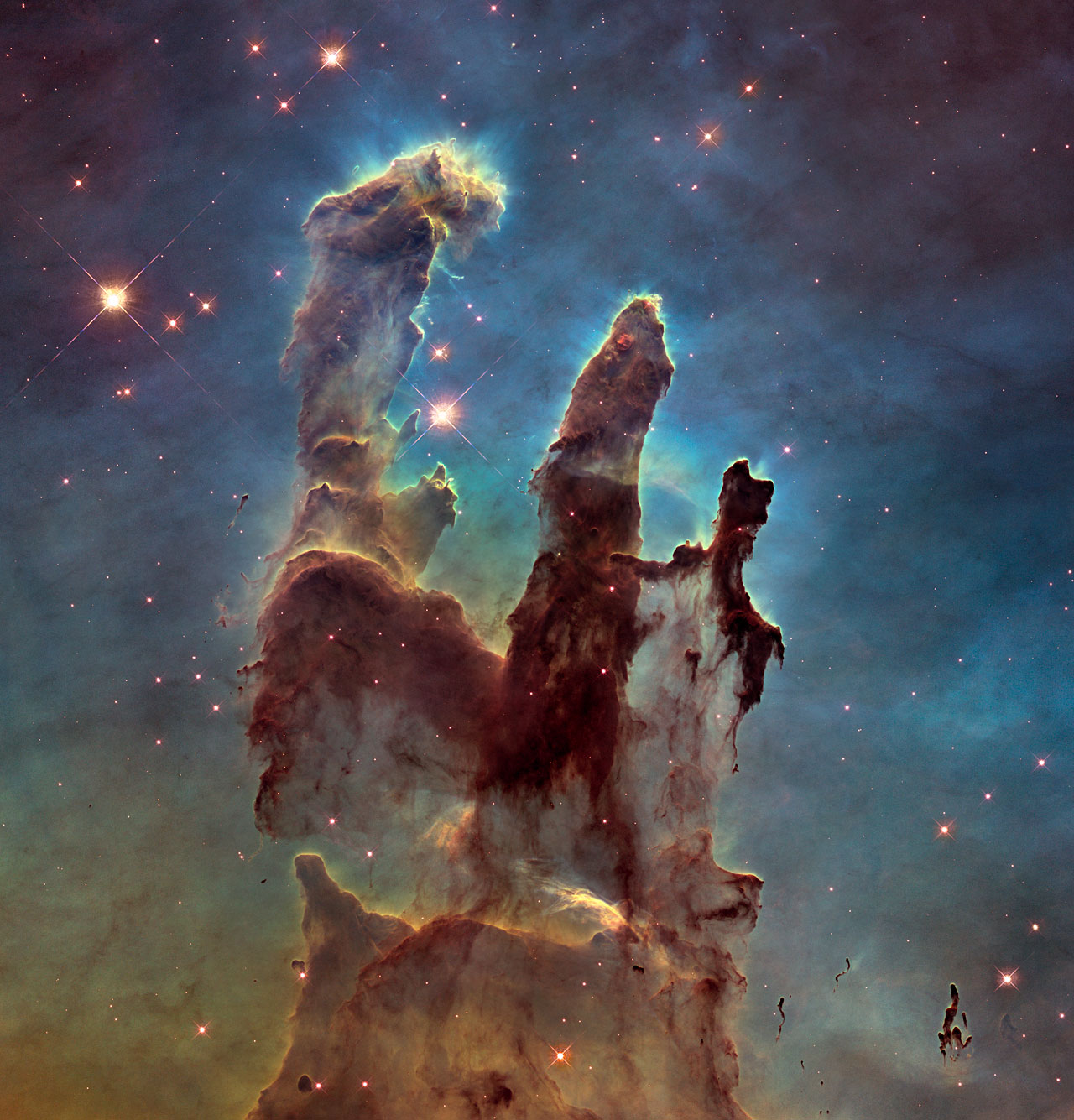
The NASA/ESA Hubble Space Telescope has revisited one of its most iconic and popular images: the Eagle Nebula’s Pillars of Creation. This image shows the pillars as seen in visible light, capturing the multi-coloured glow of gas clouds, wispy tendrils of dark cosmic dust, and the rust-coloured elephants’ trunks of the nebula’s famous pillars. The dust and gas in the pillars is seared by the intense radiation from young stars and eroded by strong winds from massive nearby stars. With these new images comes better contrast and a clearer view for astronomers to study how the structure of the pillars is changing over time.
I subscribe to EarthSky and the link to this image and background information was in yesterday’s daily summary. The mind-blowing facts are that the Eagle Nebula is found in the constellation Serpens and is 6,500 light-years away from our dear planet. To put that into context, that is 38,210 trillion miles from us. The star cluster associated with the nebula is about 5.5 million years old.
EarthSky has the very interesting text of the NASA Press Release regarding this new, high-resolution image.
For me, I just want to let that image wash over me. Not least because it reminds me that I am a very lucky person to be living at a time when one can lose oneself in such sights.
Here’s the image again, this time without the explanation.
Following yesterday’s post about Ellesmere Island and the white wolves, I had plans to write more about the history of the wolf and the dog. (Oh, and thank you so much for the great way you all reacted to yesterday’s post.)
But events transpired to get in the way.
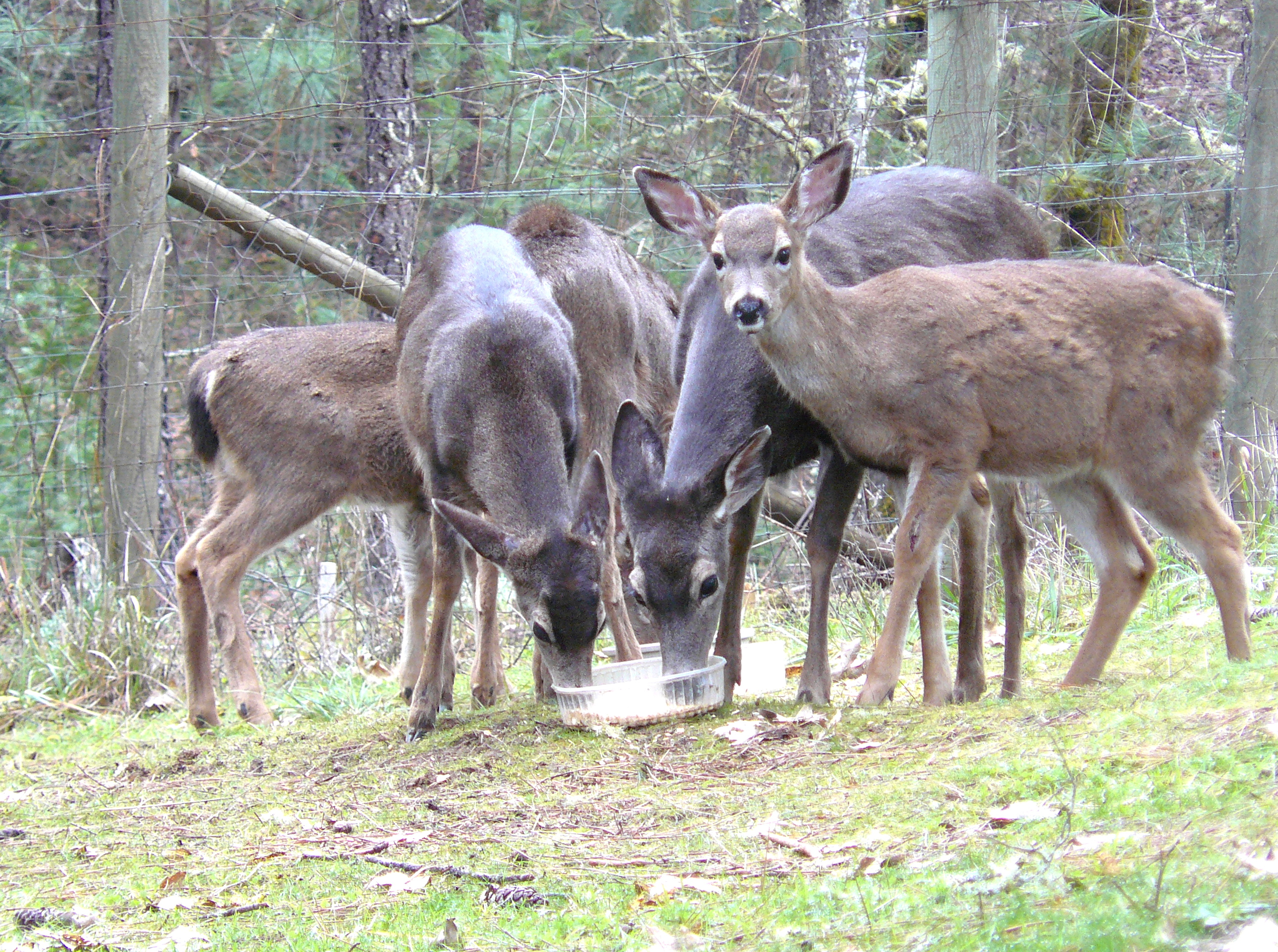
We were longer in Grants Pass in the morning than anticipated, then it was time for a quick lunch, get the fire going again, go through a rather bulging inbox, and then I was in the mood to start the post. I stood up to stretch and noticed that the deer that we feed most days were waiting impatiently.
So outside to put down some feed for the deer, then hover around, just captivated by them, decide to grab the camera from indoors and take a picture,
then, while I was outside realised that I ought to bring some logs in for the fire, and …… you get the scene, I’m sure.
I sat down at my PC to start the post and knew that I was stressing about there not being enough time to do it justice.
Gave myself a talking to about writing a blog was not something to stress about and looked for a ‘fill-in’ for today.
Opened an email recently sent to me from long-time UK friend, Neil Kelly, and discovered Neil had included in the email the most wonderful, evocative, serenely beautiful photograph of a rambler from calmer, more peaceful times. It really had to be shared with you.
The reason I am choosing to write about Ellesmere Island is because of a recent BBC film: Snow Wolf Family and Me.
This video offers a great insight into the film:
Published on Dec 29, 2014
A new BBC film, Snow Wolf Family and Me, explores the lives and habits of arctic wolves, revealing the family secrets of one of our most feared predators. Ellesmere Island is one of the most remote and beautiful places on Earth. This is the only place in the world where wolves are naive to man and have no fear. It allowed wildlife cameraman Gordon Buchanan and scientists an unparalleled opportunity to form bonds with a wild wolf family, revealing the remarkable story of their relationships and behaviour.
Here series producer Ted Oakes talks about some of the highlights and challenges of being accepted by a wild wolf pack.
Snow Wolf Family and Me will be broadcast on 29th and 30th December 2014 at 21:00 on BBC Two.
Music by Jean-Marc Petsas. Photofilm produced by Dualtagh Herr.
Family members back in England who did watch both episodes of the film said it was breath-taking, especially the scenes in the second episode where the wolves were filmed coming right up close to Gordon.
Gordon Buchanan and White wolf.
What captivated me, seeing how quickly the wolves acclimatised to Gordon and his two colleagues, was imagining that this must have been what it was like when, thousands of years ago, wild wolves bonded with early man providing the start of the glorious and beautiful relationship between canines and humans. A wonderful relationship experienced by millions of us around the world today.
The next short video illustrates that the ancient lineage, from wolf to dog, still resonates between both species.
Ellesmere Island Expedition 2008 – Howling Good Time
Not only to the aircraft but to all the many individuals who made it happen!
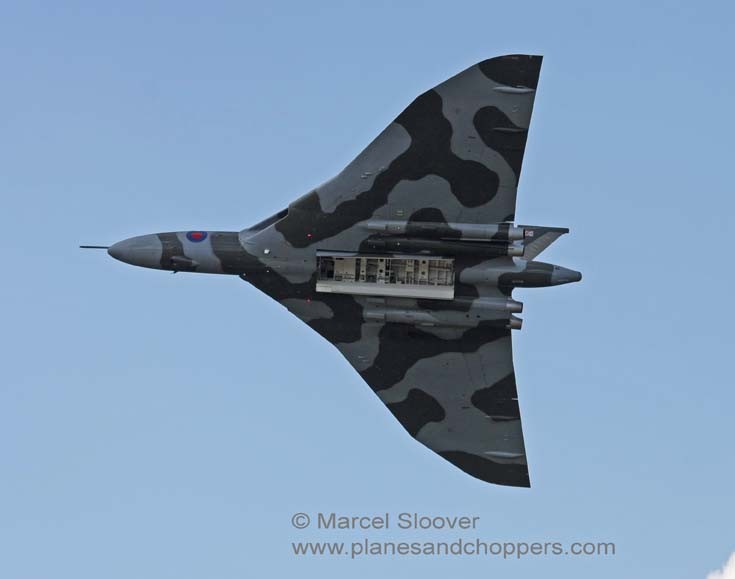
As I mentioned in yesterday’s post Nostalgia with wings, today I was going to write about a particular aircraft: The Avro Vulcan.
I chose the image above because it resonated so strongly with the comment left by Hariod Brawn that I included in yesterday’s post. Namely:
I took my father [who test-piloted the Vulcan and Victor. PH] to see Vulcan XH558 fly what was then thought to be its final flight (it subsequently was overhauled and took to the skies again). It flew along the length of the runway at a 45 degree angle with its bomb bay doors open. On the inside of the doors in huge letters was the single word ‘farewell’. It was really quite an emotional experience both for my father and myself.
There’s a lengthy item on WikiPedia about this aircraft. I will repost a couple of parts of that article.
Avro Vulcan XH558 (civil aircraft registration G-VLCN) The Spirit Of Great Britain is the only airworthy example of the 134 Avro Vulcan V bombers that were operated by the Royal Air Force from 1953 until 1985. Vulcan XH558 served with the RAF between 1960 and 1985 in the bomber, maritime reconnaissance and air-to-air refuelling roles. The RAF operated XH558 as a display aircraft from 1986 until 1992, when budget cuts forced its retirement.
It is operated by the Vulcan to the Sky Trust as a display aircraft, funded entirely by charitable donations and the UK Heritage Lottery Fund. It is registered with the United Kingdom Civil Aviation Authority as G-VLCN but has an exemption to fly in Royal Air Force markings as XH558.
Restoration to flight
The engineering staff of the Vulcan Operating Company (the engineering arm of Vulcan to the Sky Trust, owners of XH558) worked to return Vulcan XH558 to flight, with the first test flight taking place on 18 October 2007. They were supported by the “Vulcan to the Sky” club, a supporters and fundraising organisation. Though the website carried an announcement on 1 August 2006 that the project was in danger of being abandoned due to lack of finance, the target of raising the remaining £1.2m was achieved on 31 August 2006, thanks to a high-profile publicity campaign orchestrated by the supporters club, Vulcan to the Sky Club (formerly Vulcan 558 Club).
Time had almost run out for XH558 when Sir Jack Hayward, a British philanthropist, donated £500,000, which topped off the £860,000 already raised by Vulcan to the Sky Club and Friends. Although the aircraft restoration was nearly complete, the aircraft was not ready for the flypast down The Mall in London for the 25th Anniversary of the Falklands conflict on 17 June 2007 or the RAF Waddington Airshow and the Royal International Air Tattoo (RIAT).
It was intended that the Vulcan would fly during at least one UK airshow during the 2007 season, but due to delays in returning the aircraft to flight, mainly down to delays in the return of refurbished flight-critical components, the aircraft was not ready for the display season.
On 16 August 2007, the aircraft started engine testing on the airfield at Bruntingthorpe. On the next day, XH558’s No.3 Rolls-Royce Olympus 202 jet engine was run for the first time in over 20 years. This is a different engine from that used by XH558 during its final season with the RAF’s Vulcan Display Flight in 1992, with all four of the Vulcan’s original Olympus 202 engines having been replaced by zero-hour units which had been stored since 1982. The VTS Team also has another four fully inhibited engines in stock. The removed engines were either scrapped, sectioned for display or passed on to VRT’s XL426 at Southend. Another milestone in the restoration project was achieved on 22 August 2007, when all four of XH558’s Olympus engines were run at nearly full power settings, for short intervals.
The first post-restoration flight, which lasted 34 minutes, took place on 18 October 2007.
What a great project!
Now to a couple of videos. (There are many to chose from on YouTube, by the way.)
The first is a 45-minute documentary that I have only watched for the first few minutes, but it looks a good one.
and the second is much shorter but reveals to great effect the wonderful sound of the Vulcan’s engines.
Published on Oct 28, 2012
When the engines exceed 92% power, the Vulcan makes this cool howl sound.
He [my father] was an RAF pilot during the war and through to the early 1960’s. He test-piloted the Vulcan and Victor, though started on what he called ‘string bags’, by which he meant Tiger Moths. In between he flew the Spitfire, Lancaster, Meteor and specialised in flying in electrical storms, about which he wrote a manual for the RAF.
……
I took my father to see Vulcan XH558 fly what was then thought to be its final flight (it subsequently was overhauled and took to the skies again). It flew along the length of the runway at a 45 degree angle with its bomb bay doors open. On the inside of the doors in huge letters was the single word ‘farewell’. It was really quite an emotional experience both for my father and myself.
I thought it would be nice to include some video of XH558; that will be tomorrow’s post. For today, I wanted to reminisce from my own private flying days.
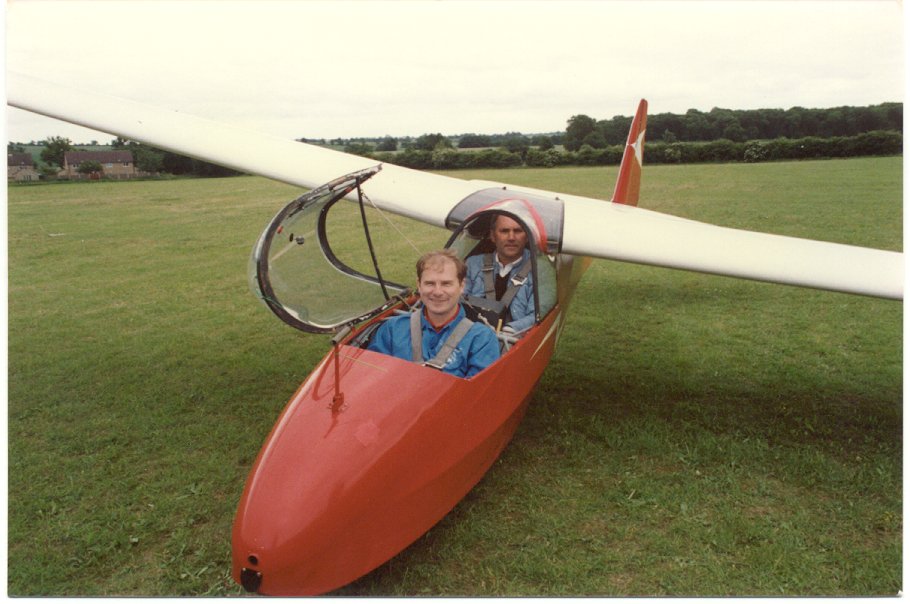
A K-7 two-seat glider.
My first exposure to private flying was on the 7th June, 1981 when, at Rattlesden Gliding Club in Suffolk, I was taken up for two air-experience circuits in a two-seater glider known as a ‘K7’. I was immediately hooked! Those experience flights leading to a 4-minute flight (flight number 46) on the 6th September, 1981 that has the remark in my pilot’s log book: Solo! Now fast forward to October, 1984 and my log book shows me attending a gliding instructor’s course at Lasham, resulting in me being issued with a British Gliding Association (BGA) Assistant Instructor Rating on the 14th October. (105/84).
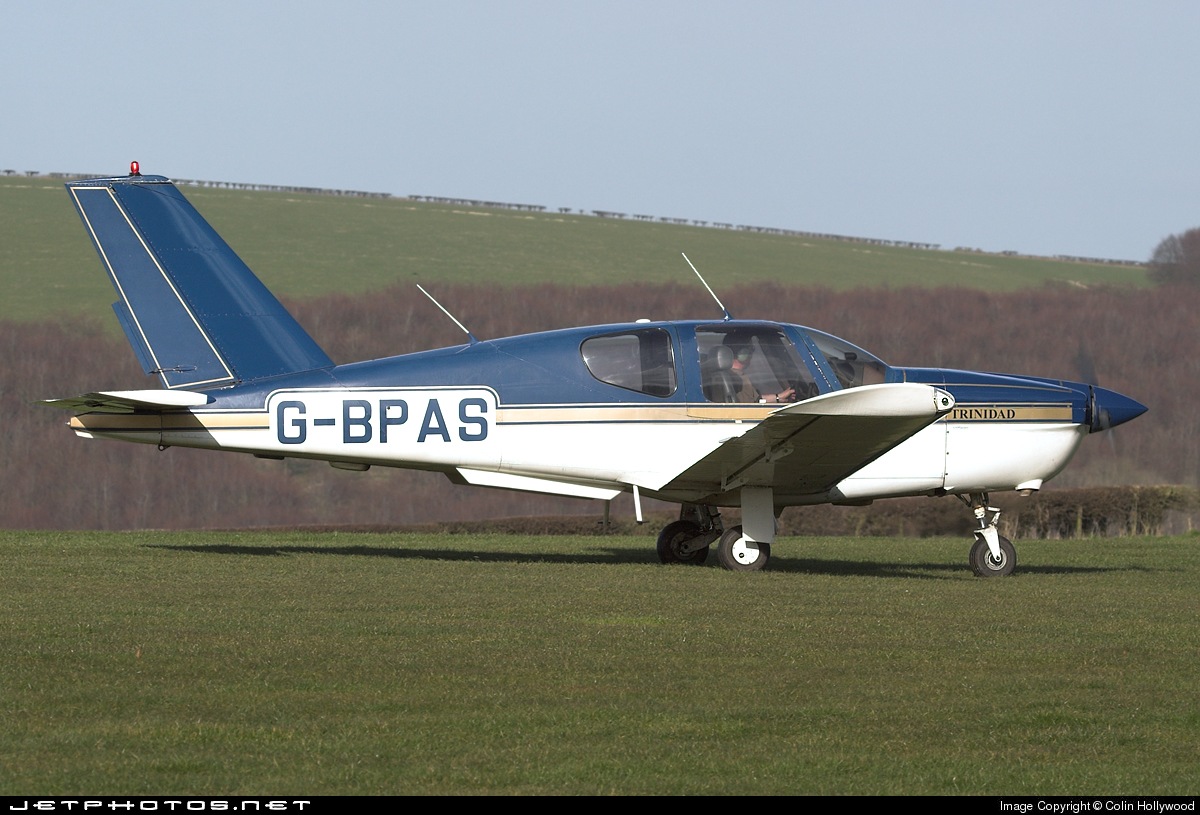
Over on the power side of things, in March, 1984, I started Private Pilot training at the Suffolk Aero Club at Ipswich Airport and gained my PPL on the 9th November, 1984. Subsequently, gaining my Instrument Rating in July, 1999 when I was then operating from Exeter Airport and flying frequently for business purposes. For that ‘serious’ flying I used a Socata TB20, a French retractable, single-engined aircraft, based at Exeter. A very fine, long-distance aircraft.
TB20, G-BPAS, photographed at Compton Abbas airfield (EGHA).
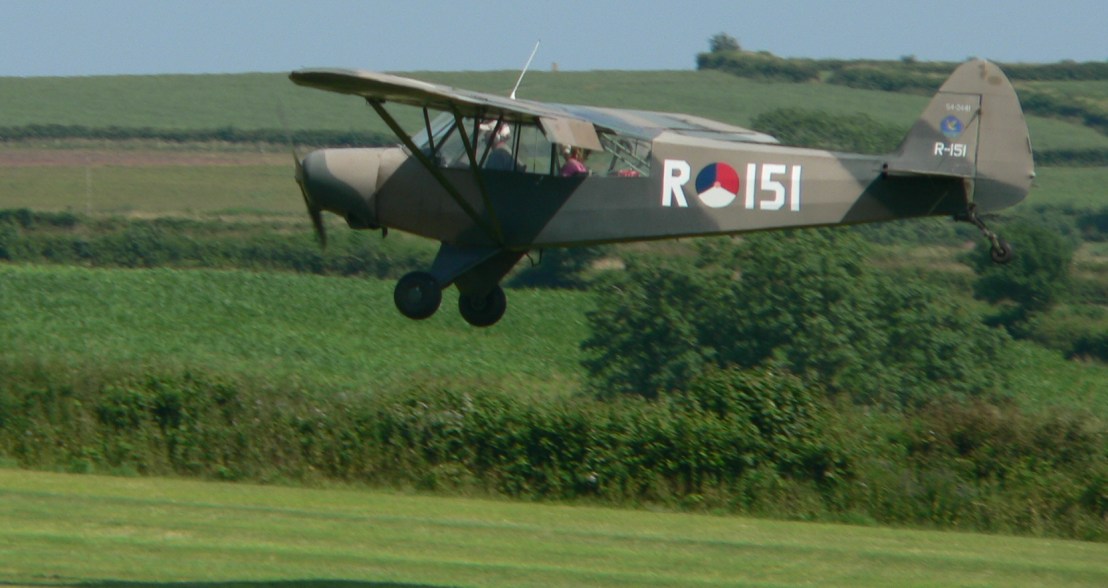
But the aircraft that I had the most fun flying was a dear old Piper Super Cub. Here’s the background to the aircraft.
Piper Super Cub, L-21B, R-151
A/C Construction No. 18-3841, Frame No. 18-3843
Original Engine, Lycoming 135 Type 0-290-D2, 54/2441
Romeo 151 was one of a batch of 298 L-21’s delivered in 1954. There were 584 L-21B’s produced by Piper for military use, the ‘L’ standing for Liaison. The L-21B’s were PA-18-135’s with civil Lycoming 0-290-D2 engines, glasswork as most L-21A’s and L-18’s and a gross weight of 1760 lbs.
This aircraft was delivered to Koninklijke Luchtmacht, Dutch Air Force, on the 1st July, 1954 and registered R-151. After various homes R-151 transferred to the Dutch civil register as PH-GER, 1st April 1976 with 4,458 hours and shortly thereafter was registered to Vlieclub Hoogeveen, Certificate Number 2380.
On the 27th March, 1981 the aircraft was delivered to the UK with a total time of 5,043 hours and in September, 1981 became G-BIYR; ‘YR’. In April, 1983 YR was the first of type to be given a Public Transport CofA (Certificate of Airworthiness) and was used for training at Tollaton. YR reverted to a Private CofA in January, 1984 when purchased by Mike and Barbara Fairclough. The aircraft had by then accumulated 5,120 hours.
In 1992, YR was re-engined with a Lycoming 150HP, 0320-A2B No. L49809-27A (zero hours). Finally on the 2nd June, 1995 the aircraft was repainted in her original Dutch insignia and given CAA (UK Civil Aviation Authority) permission to use the original call-sign: Romeo 151.
The aircraft was based at and flown from Watchford Farm airstrip in South Devon, England.
Now forgive the nostalgic photographic memories!
Yours truly approaching Watchford Farm airstrip in South Devon, EnglandFlying in the French Alps with Mont Blanc in sight9,300 ft up in the French Alps!
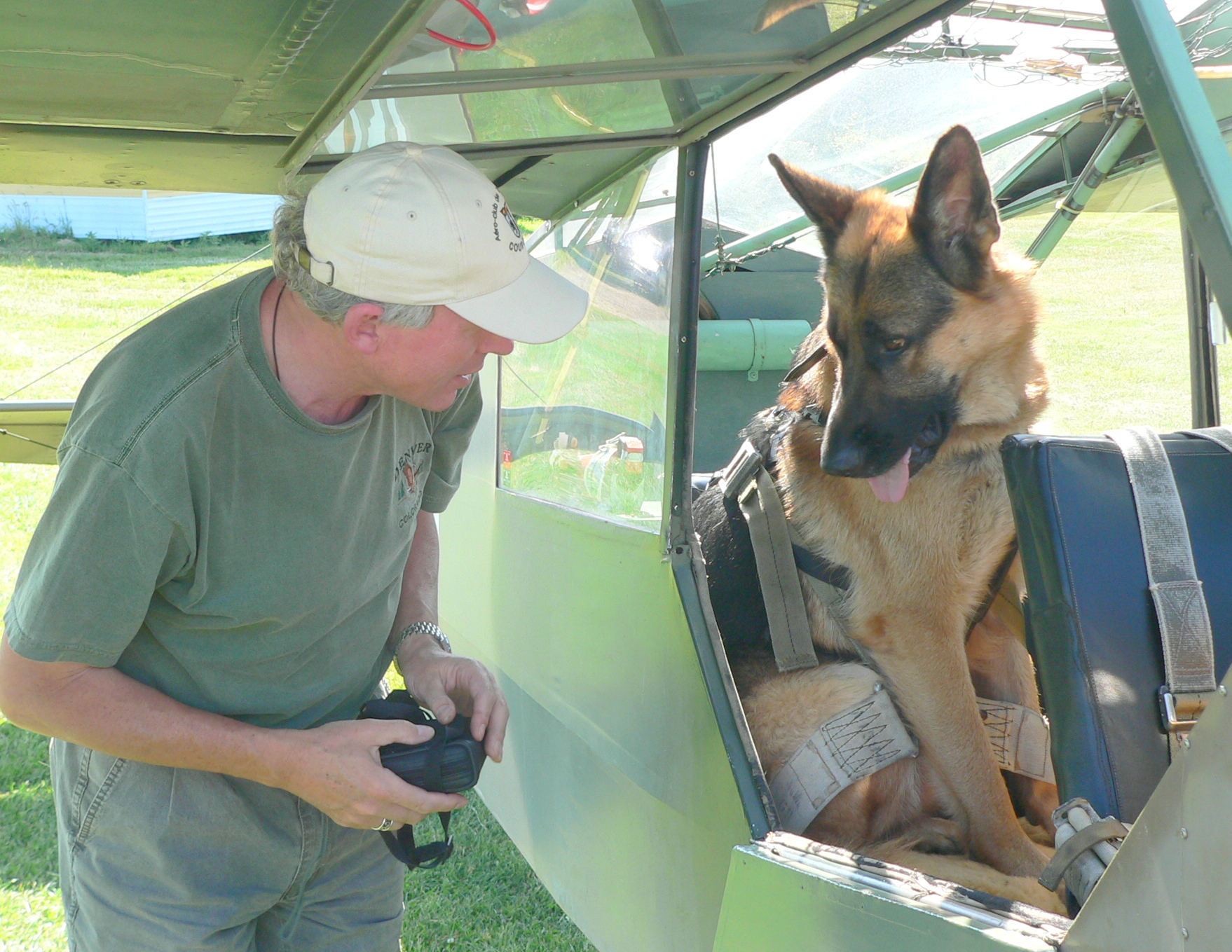
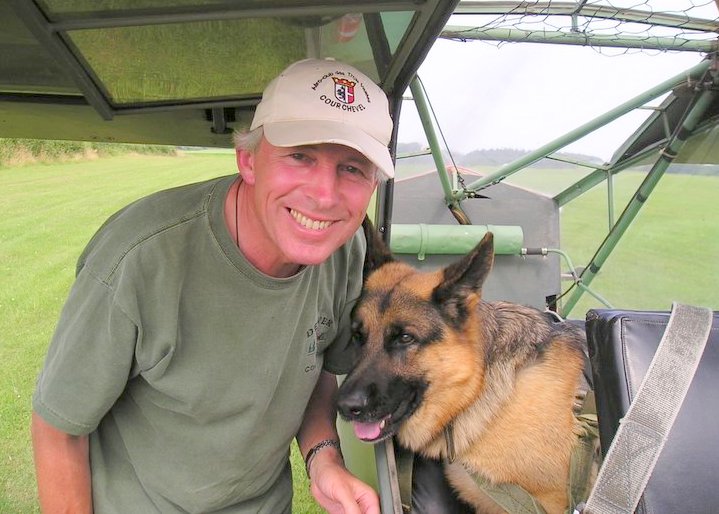
Every time I went to the airfield with Pharaoh he always tried to climb into the cockpit. So one day, I decided to see if he would sit in the rear seat and be strapped in. As the next picture shows, there was absolutely no problem with that!
Come on Dad, let’s get this thing off the ground!
My idea had been to fly a gentle circuit in the aircraft. First, I did some taxying around Watchford’s large grass airfield to see how Pharaoh reacted. He was perfectly behaved.
But then I thought long and hard about taking Pharaoh for a flight. In the Piper Cub there is no autopilot so if Pharaoh struggled or became agitated it would have been almost impossible to fly the aircraft and cope with Pharaoh sitting in the seat behind me. So, in the end, I abandoned the idea. The chances are that it would have been fine. But if something had gone wrong, the outcome just didn’t bear thinking about.
Thus we elected for taxying all around the airfield which, as the next picture shows, met with full doggie approval. The date was July 2006.
That was fun!
So enough of my recollections for today – tomorrow the Vulcan XH558.
(Apologies if these are not widely appreciated but with all our families living thousands of miles away, this seemed like a convenient way of sharing a few pictures from our Christmas day.)
There was no point in getting all dressed up before we had completed our ‘house’ duties, that included mucking out the stables.
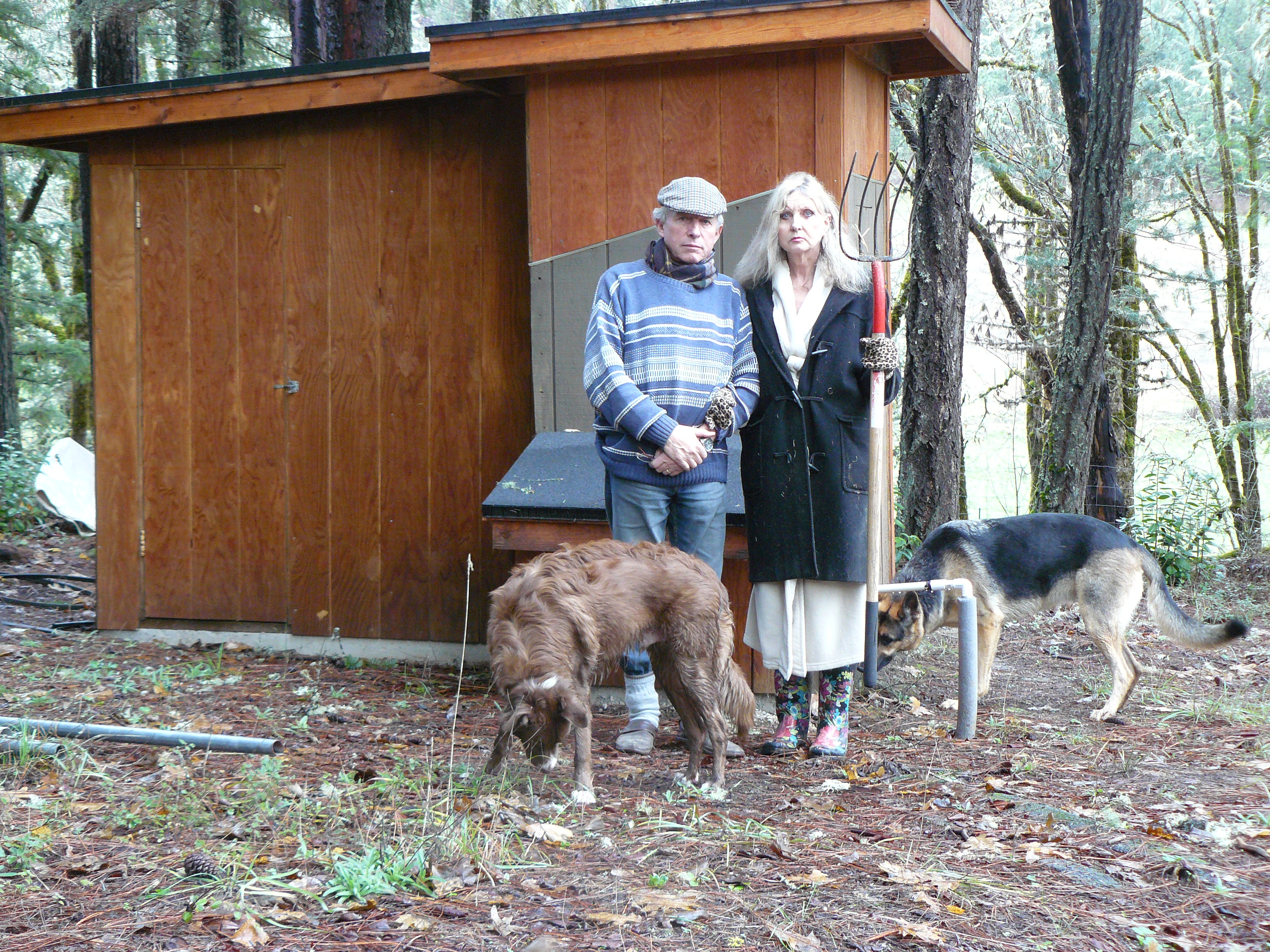
Our ‘country’ look seemed to warrant a photograph! Taken in front of the well-house.
The morning forecast had rain and declining temperatures with the snow-line expected to be around 2,500 feet. This picture was taken on Highway I5 as it heads South for the Siskiyou Mountain pass; where we pulled over being about 3,000 feet.
Together with our neighbours, Dordie and Bill, we had all decided to have a Christmas Lunch at Callahan’s Mountain Lodge on Old Highway 99 just off I5 Exit 6.
Callahan’s Mountain Lodge
oooo
Looking out from the deck of Callahan’s Lodge showing clearly that we were above the snow-line.
From L-R: Jean, yours truly, Dordie & Bill.
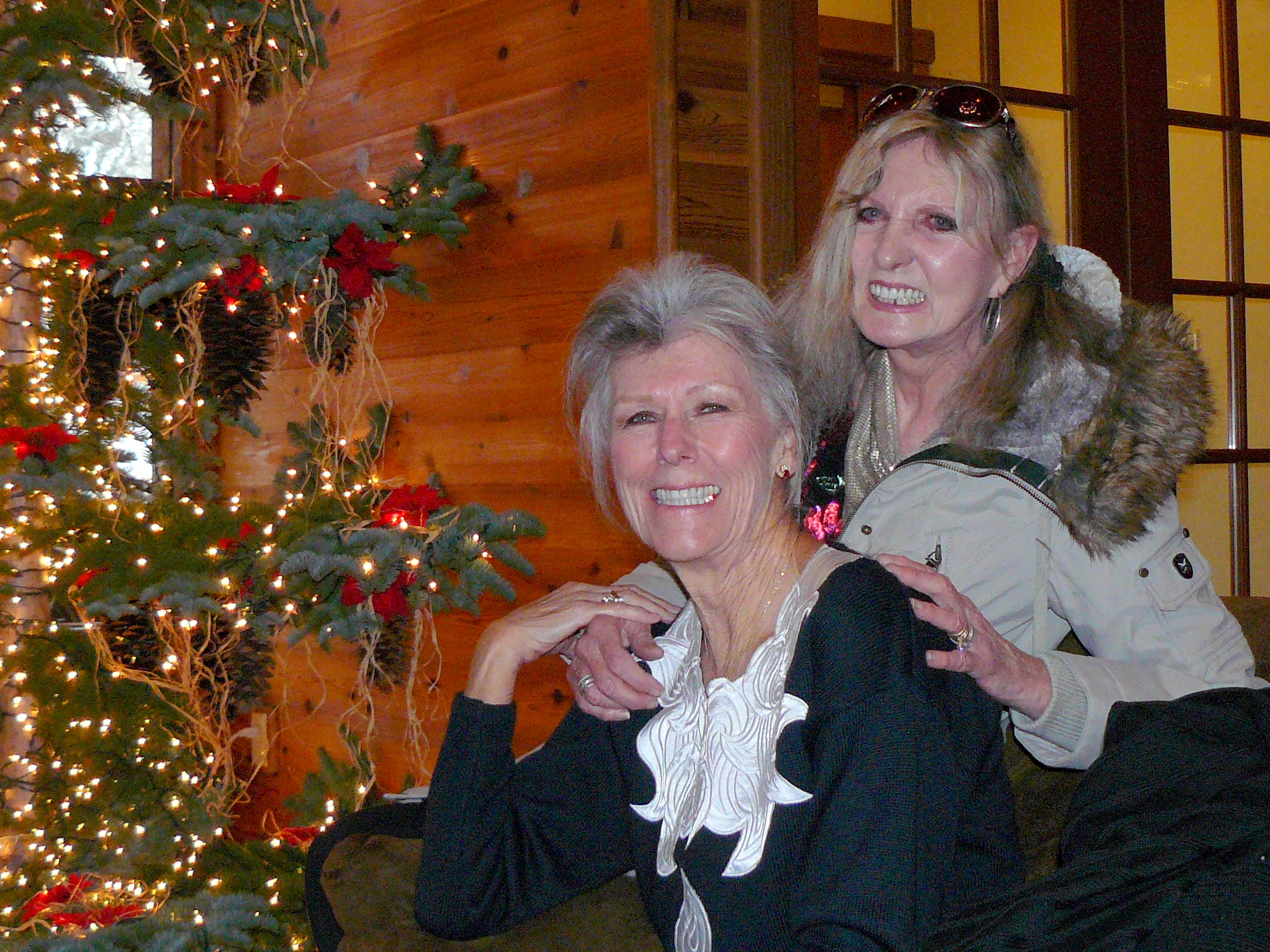
Two lovely ladies!
The Lodge’s dog, Blue, that happily wandered all about the place including among the diners!
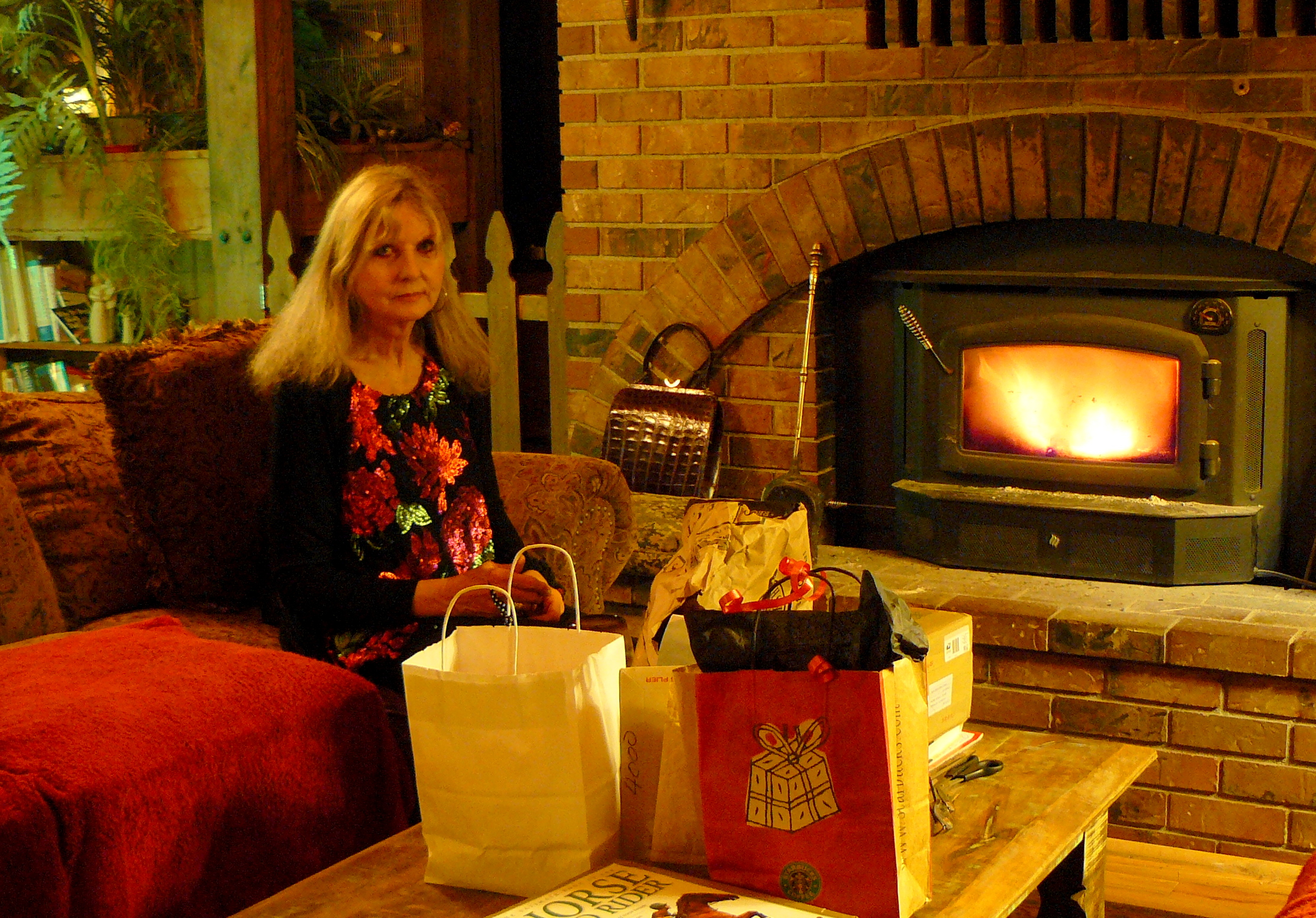
Later on in the afternoon, when Jean and I had returned home, it was time to open a few Christmas presents.
I trust that every one of you dear readers had as happy and pleasant a day as did Jean and me. Because, for us, it was wall-to-wall smiles from the moment we awoke …..
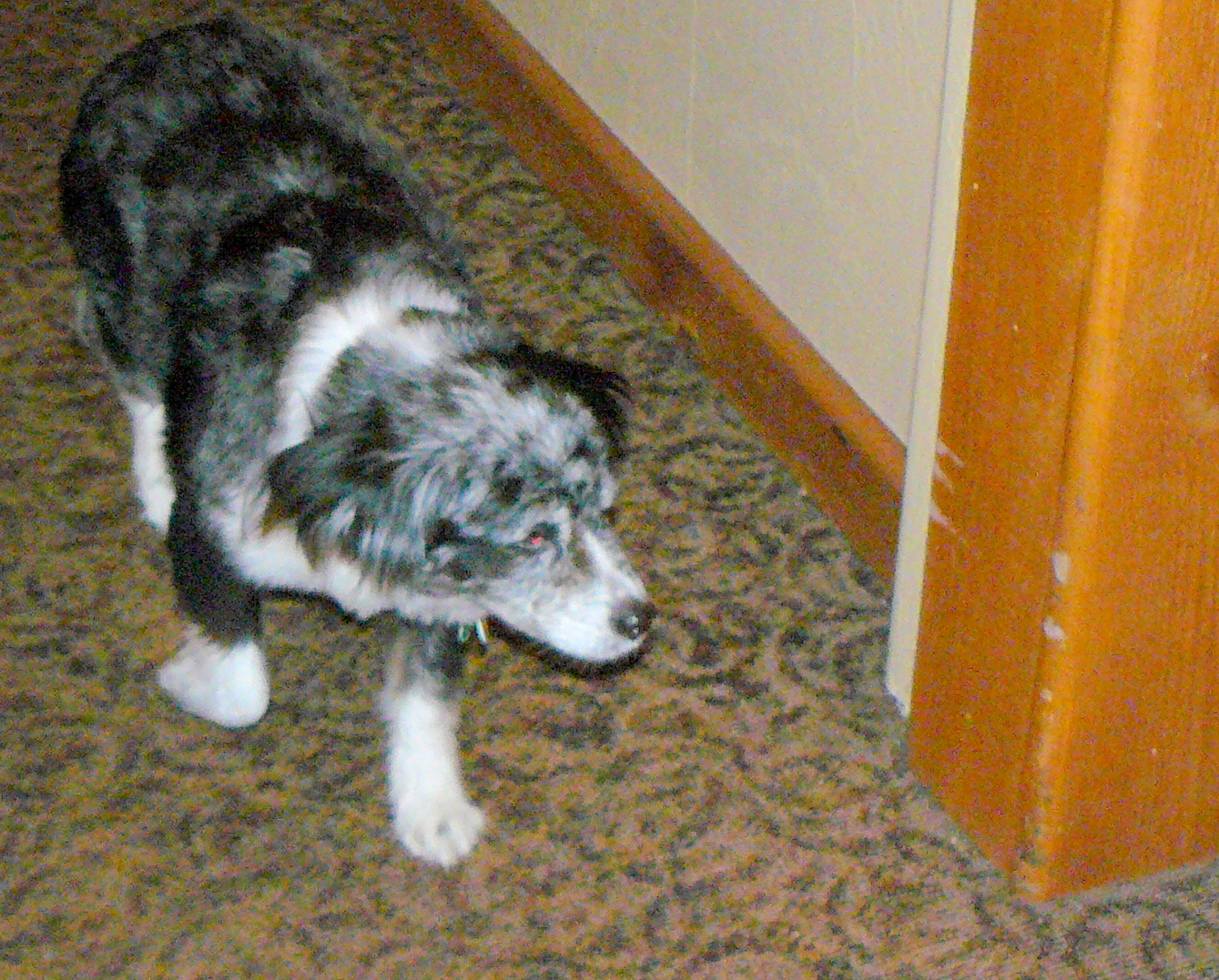
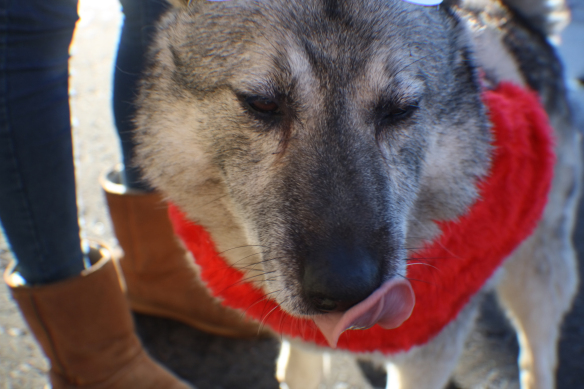
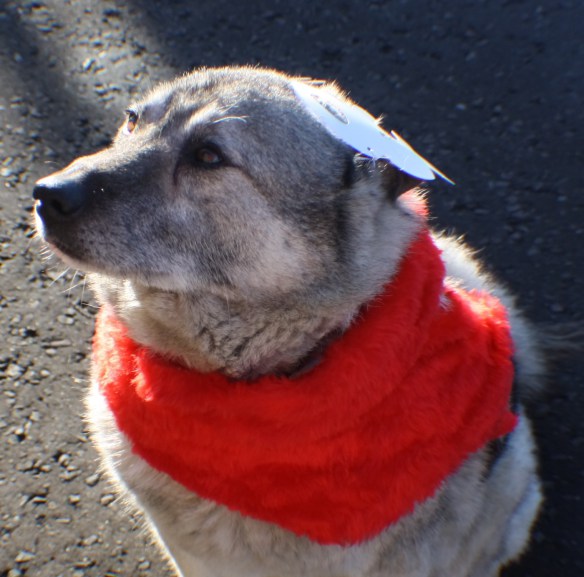
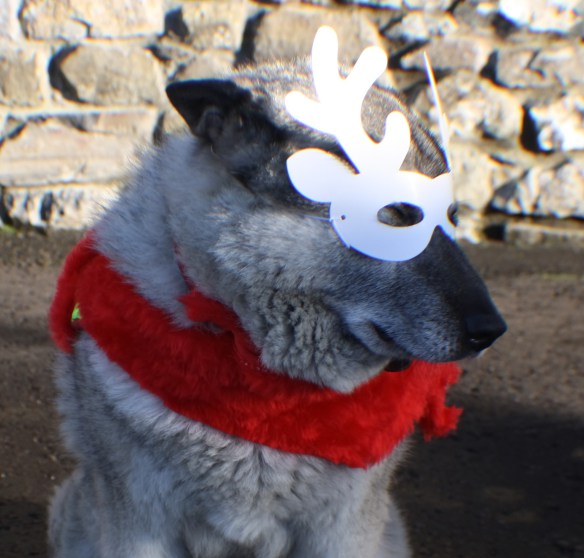
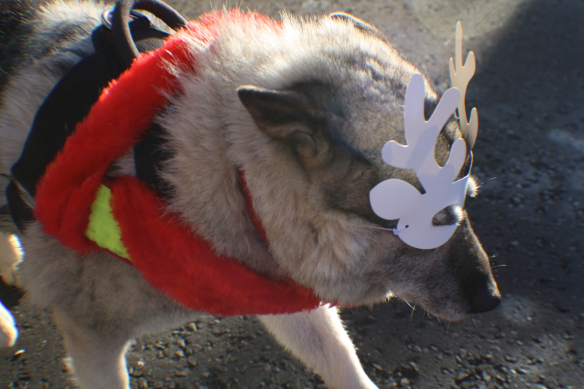
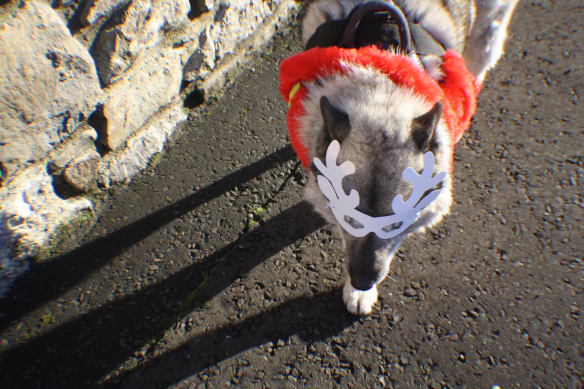
I saw the following images published over on the blogsite Decidingly Bob, that has the sub-heading of Life as I see it! What was so perfect was that the ‘I’ is a dog! The post from which these images are taken, with Bob’s permission, was published on December 12th under the post title of “Bob’s Diary. ..I am not a Reindeer!”
They seemed perfect for the last Picture parade before Christmas Day!
ooOOoo
Bob’s Diary. ..I am not a Reindeer!
“After the Christmas Reindeer story, I thought I was safe for a few weeks. Life can be cruel can’t it?
I knew there was trouble brewing when Maria and Sara offered me jelly babies.”
oooo
But I didn’t expect this …
oooo
No sir, I got to talk to Sir Bob about this…
oooo
I am not a reindeer….
oooo
I have the answer..
oooo
I am a Superhero.
ooOOoo
Listen everyone, have a wonderful week and please be safe out there.
Over the years, I have collected well over a hundred ‘draft’ posts. In the main, these are simply things that have caught my eye that could perhaps be a blog post sometime in the future.
Recently, I have been wandering through these drafts, throwing away those topics that were clearly dated, and endeavouring to find the gems that really do need to be shared with you.
This post most definitely falls into the ‘must share’ category.
It is just a photograph. A photograph that I regret I can no longer recall it’s source.
But trust me, this is one of those photographs that …….
Among my subscription feeds is one to EarthSky News. Thus it was courtesy of yesterday’s update that I saw the link to the following video. It was promoted as follows: “High plains storms. The opening is brilliant … the end is awesome. (You’ll like the rest too.) By Nicolaus Wegner.” Nicolaus Wegner’s own website was easily found here; on which the following photograph was seen. (This actual image was taken from a web search – the full size, breathtaking version, may be seen here.)
So back to the video. (Just note that when I watched it, it seemed unable to spool past the 8-second mark. If this happens to you, just manually drag the progress bar along to 10 seconds, or just past that. It’s worth it!)
High plains storms are some of the most beautiful and wild in the world. I spent May – September 2014 photographing all types of severe weather in Wyoming, Montana, South Dakota, Nebraska, and Colorado. This time lapse project is a result of that effort. From rainbows to tornadoes, there is a little bit of everything in here.











 Learning from Dogs