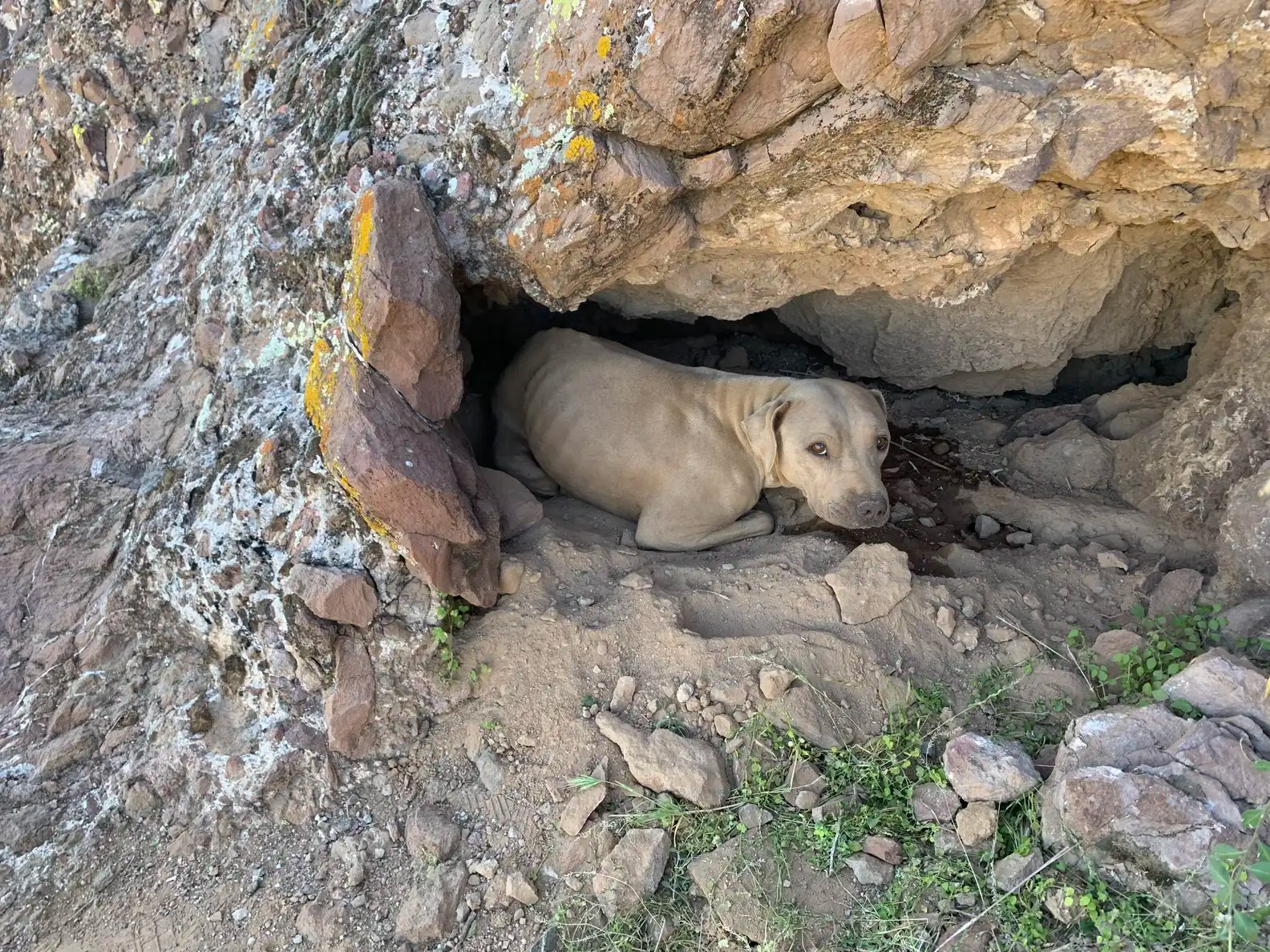
A Good Samaritan was hiking a narrow, slippery trail on Lookout Mountain in Phoenix, Arizona, and was very focused on his hike until something caught his eye. He was about half a mile up the mountain and a little off the beaten path when he caught a glimpse of light reflecting off of something — and was shocked to realize it was a pair of amber eyes.
The eyes belonged to a very scared dog huddled up in a tiny hole in the side of the mountain. She was completely blending in with her surroundings, and if she hadn’t had such piercing eyes, the hiker may not have noticed her. He had no idea how she’d managed to get up there, but it was clear that she’d been stuck for a while and might not be able to last much longer.
The Good Samaritan quickly contacted the Arizona Humane Society (AHS), who sent two emergency animal medical technicians, Tracey Miiller and Ruthie Jesus, out to help while he waited with the pup until they arrived. The dog was definitely scared but seemed open to getting help.
“This Good Samaritan waited probably almost two hours, and then we found this incredible dog, who incidentally is literally the same color as the dirt,” Jesus said in a press release. “She blends in so much, the complainant told us that he wanted to call her Bright Eyes because when he hiked past her, that was literally the only thing he saw was her amber bright eyes staring back at him.”
After a quick and careful assessment on the side of the mountain, the technicians determined that Bright Eyes was dangerously dehydrated with cut-up paws and a wound on her rear end.
“She was really sweet and letting me pet her head, but she absolutely did not want to come out of that den, so I kind of had to just sort of pull her out,” Jesus said.
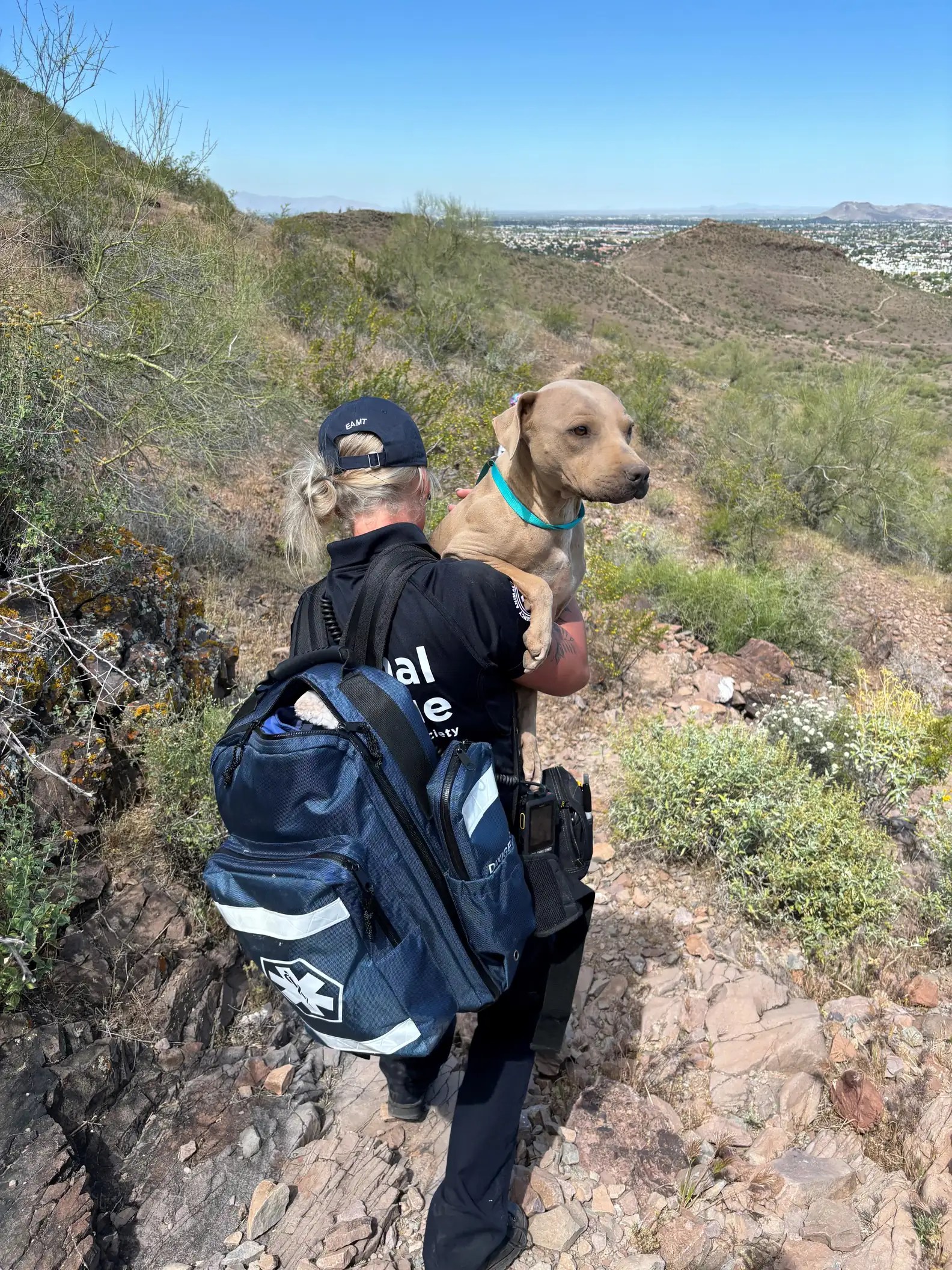
She was definitely too weak to walk with her rescuers down the mountain, so the technicians took turns carrying her until they reached the ambulance. Bright Eyes was calm the whole time, so grateful to finally be safe.
“She actually really just relaxed and seemed to enjoy being carried down the mountain,” Jesus said. “But it was a very teeny-tiny rocky trail that was pretty slick, and so Tracey and I took turns carrying her down the mountain, and she was just an absolute angel. She knew we were getting her to safety.”
It’s still a mystery as to how or why Bright Eyes ended up on the mountain in the first place, but the important thing is someone found her and now she’s getting the care she needs.
“We were so elated to be able to get her,” Jesus said. “She was just so dehydrated. I think she’d probably been up there several days and that was probably her last day, and this Good Samaritan really just saved her life.”
ooOOoo
Frankly, there’s nothing more to add to this account. For it captured all that so many people do for dogs.
Although I was born in London in 1944, as a result of an affair between my father and mother, my father had two daughters with his wife, Maud, and Rhona and Corinne, for they were their names, took me under their wing. In the 50s Maud, Rhona and Corinne all moved to Devon and I started going regularly to Totnes. When I started driving I usually stopped for a break close by Stonehenge so the site has a special interest to me.
So when I saw this article in The Conversation it had to be shared.
ooOOoo
Stonehenge may have aligned with the Moon as well as the Sun
When it comes to its connection to the sky, Stonehenge is best known for its solar alignments. Every midsummer’s night tens of thousands of people gather at Stonehenge to celebrate and witness the rising Sun in alignment with the Heel stone standing outside of the circle. Six months later a smaller crowd congregates around the Heel stone to witness the midwinter Sun setting within the stone circle.
But a hypothesis has been around for 60 years that part of Stonehenge also aligns with moonrise and moonset at what is called a major lunar standstill. Although a correlation between the layout of certain stones and the major lunar standstill has been known about for several decades, no one has systematically observed and recorded the phenomenon at Stonehenge.
This is what we are aiming to do in a project bringing together archaeologists, astronomers and photographers from English Heritage, Oxford, Leicester and Bournemouth universities as well as the Royal Astronomical Society.
There is now an abundance of archaeological evidence that indicates the solar alignment was part of the architectural design of Stonehenge. Around 2500 BC, the people who put up the large stones and dug an avenue into the chalk seemed to want to cement the solstice axis into the architecture of Stonehenge.
Archaeological evidence from nearby Durrington Walls, the place where scientists believe the ancient people who visited Stonehenge stayed, indicates that of the two solstices it was the midwinter one that drew the largest crowd.
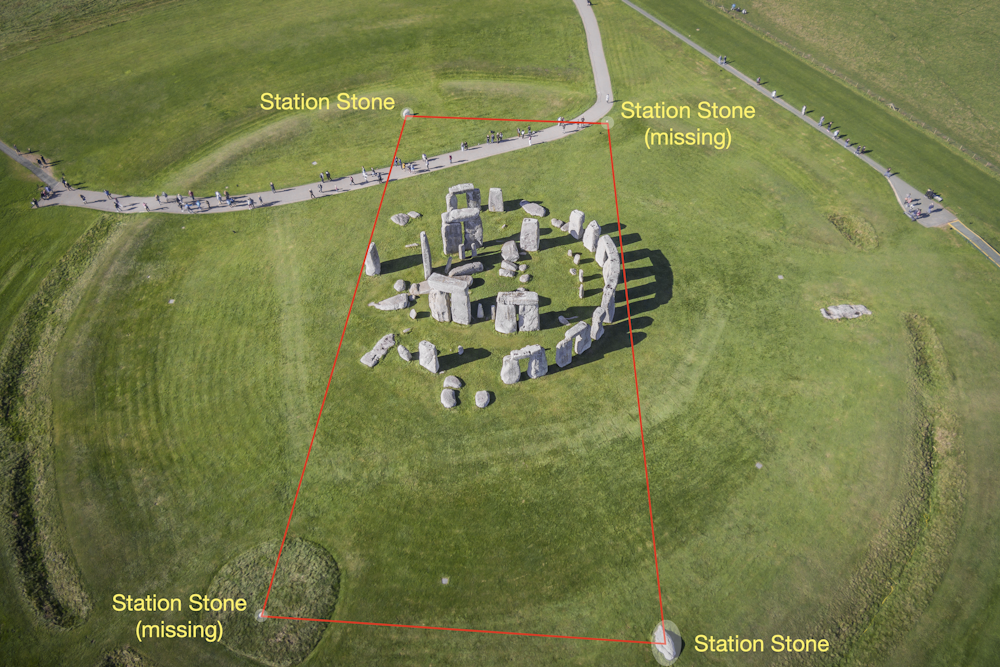
But Stonehenge includes other elements, such as 56 pits arranged in a circle, an earthwork bank and ditch, and other smaller features such as the four station stones. These are four sarsen stones, a form of silicified sandstone common in Wiltshire, that were carefully placed to form an almost exact rectangle encompassing the stone circle.
Only two of these stones are still there, and they pale in comparison to their larger counterparts as they are only a few feet high. So what could their purpose be?
Only two of the station stones are still there. Drone Explorer/Shutterstock
Lunar standstill
The rectangle that they form is not just any rectangle. The shorter sides are parallel to the main axis of the stone circle and this may be a clue as to their purpose. The longer sides of the rectangle skirt the outside of the stone circle.
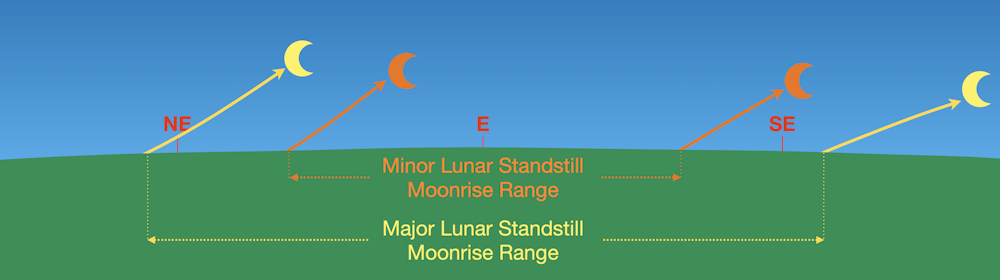
It is these longer sides that are thought to align with the major lunar standstill. If you marked the position of moonrise (or set) over the course of a month you would see that it moves between two points on the horizon. These southern and northern limits of moonrise (or set) change on a cycle of 18.6 years between a minimum and a maximum range – the so-called minor and major lunar standstills, respectively.
The major lunar standstill is a period of about one and a half to two years when the northernmost and southernmost moonrises (or sets) are furthest apart. When this happens the Moon rises (and sets) outside the range of sunrises and sets, which may have imbued this celestial phenomenon with meaning and significance.
The range of Moonrise positions on the horizon during minor and major lunar standstills. Fabio Silva, CC BY-NC
The strongest evidence we have for people marking the major lunar standstill comes from the US southwest. The Great House of Chimney Rock, a multi-level complex built by the ancestral Pueblo people in the San Juan National Forest, Colorado, more than 1,000 years ago.
It lies on a ridge that ends at a natural formation of twin rock pillars – an area that has cultural significance to more than 26 native American tribal nations. From the vantage point of the Great House, the Sun will never rise in the gap between the pillars.
However, during a major standstill the Moon does rise between them in awe-inspiring fashion. Excavations unearthed preserved wood that meant researchers could date to the year episodes of construction of the Great House.
Of six cutting dates, four correspond to major lunar standstill years between the years AD1018 and AD1093, indicating that the site was renewed, maintained or expanded on consecutive major standstills.
Returning to southern England, archaeologists think there is a connection between the major lunar standstill and the earliest construction phase of Stonehenge (3000-2500 BC), before the sarsen stones were brought in.
Several sets of cremated human remains from this phase of construction were found in the southeastern part of the monument in the general direction of the southernmost major standstill moonrise, where three timber posts were also set into the bank. It is possible that there was an early connection between the site of Stonehenge and the Moon, which was later emphasised when the station stone rectangle was built.
The major lunar standstill hypothesis, however, raises more questions than it answers. We don’t know if the lunar alignments of the station stones were symbolic or whether people were meant to observe the Moon through them. Neither do we know which phases of the Moon would be more dramatic to witness.
A search for answers
In our upcoming work, we will be trying to answer the questions the major lunar standstill hypothesis raises. It’s unclear whether the Moon would have been strong enough to cast shadows and how they would have interacted with the other stones. We will also need to check whether the alignments can still be seen today or if they are blocked by woods, traffic and other features.
The Moon will align with the station stone rectangle twice a month from about February 2024 to November 2025, giving us plenty of opportunities to observe this phenomenon in different seasons and phases of the Moon.
To bring our research to life, English Heritage will livestream the southernmost Moonrise in June 2024, and host a series of events throughout the year, including talks, a pop-up planetarium, stargazing and storytelling sessions.
Across the Atlantic, our partners at the US Forest Service are developing educational materials about the major lunar standstill at Chimney Rock National Monument. This collaboration will result in events showcasing and debating the lunar alignments at both Stonehenge and at Chimney Rock.
Bob Derham is someone I met many years ago, when I was living on my yacht in Larnaca, Cyprus, and I can do no better than to repeat what I wrote in my autobiography.
ooOOoo
I negotiated what I thought was a good deal and sold the company. Inevitably I resigned from what was now not my company; it was the end of November in the year of 1988.
In Tollesbury, I had my annual tax returns done by Peter Michael, also living in the village. Peter was an accountant who also taught accountancy at the nearby Essex University. I saw Peter and we discussed the recent agreement for the sale of the business.
“Paul, there is not a lot you can do, to be honest. You will be liable in broad terms for the tax in the difference between the opening price and the closing price. In your case the opening price was near enough zero and the closing price…” Peter did not need to finish the sentence. I got the picture and stood up to leave. Just has I was going out of the room, Peter added: “Unless you can leave the country before April 15th next year, and stay away for a minimum of four tax years. In other words, leave before April 15th, 1989.”
I walked home from Peter Michael’s house that November, 1988 with the advice I had been given ringing in my ears. I would worry about the tax implications in a day or two. But once again fate intervened.
I was a subscriber to the boating magazine Practical Boat Owner (PBO). In a late 1988 issue I read in the classifieds:
Songbird of Kent – Tradewind 33
Great opportunity to purchase a long-distance ocean yacht designed by John Rock for sea-kindly short-handed sailing.
Well kitted out, continually updated and maintained Songbird of Kent is the yacht for you if you dream of blue waters and serious long distance cruising.
Lying Larnaca, Cyprus.
I knew about Tradewind yachts, was familiar with John Rock. (As the designer of Tradewind yachts he had been featured several times in Practical Boat Owner magazine), and knew how many of his yachts had made world circumnavigations, and, finally, I deserved a holiday. I arranged to go out to Larnaca as soon as I could.
About a week later I caught a flight to Larnaca International Airport; upon arriving I rented a car and drove the few miles to the Marina.
The yacht was easy to find as it was out of the water. I met the owners, Michael and Betty Hughes, who were still living onboard Songbird of Kent. They explained why they were selling. Simply because, as Michael put it, they had been living on the boat for many years and it was time to return to their native Wales. Songbird had been extensively cruised the length of the Mediterranean Sea using Larnaca Marina as the base.
I quietly inspected the boat. Because it was lifted out viewing the boat in detail was much easier than had it still been floating. It was in good condition; very good condition in fact. Then I climbed up the ladder and entered the boat. Again I found everything that I expected, and more. It was clear to me that Michael and Betty had had the boat as their home and, consequently, everything was in order. Or to use the phrase; shipshape and Bristol fashion!
I excused myself, left the yacht and went and sat on a nearby seawall. I wanted to think. To be honest, it was pretty easy thinking. I loved the boat; it was a purchase I could afford, and if everything went to plan and I left the UK before April 15th, 1989, and stayed away for four tax years, there would be no UK tax to pay on the sale of my company Dataview. Nothing: Nada!
So that is exactly what I did!
I went back to Songbird, where Michael and Betty were still sitting in the cockpit, and told them I would buy it. They drew up a contract there and then and I signed it!
My autobiography
ooOOoo
Here is Bob’s story:
Paul and I first met in 1992, when I was working as a contract pilot on the BAC 1-11 for Cyprus Airways.
My last flying post was down in New Zealand, a wonderful place to be, with it’s natural beauty, and lack of aggression and oppression. The joy of life is set around being outdoors, so road trips, camping, sailing, and skiing all feature, but less on big houses, and possessions.
Although I have travelled widely in my career, I now want a simple life, and that amounts to being free of ties to a property, such that all I really need is a warm, dry place to sleep, a suitable place to prepare food, and a place to relax, it is no longer about the big house, which brings it’s own issues, and expenses.
Following on from my time living on Paul’s boat, I was then drawn to living on a boat. I owned a smaller Westerley Centaur, for a few years, and even though small, I had a very happy time when I lived on that. It was down in Lymington, a small market town on the south coast of England opposite Yarmouth, on the Isle of Wight, that I kept my first boat.
The reason for this was simple 🙂
One of the interesting people I met in Cyprus was a man called Les Powles. Paul and I would regularly go out and have a mezze in a side street of Larnaca. Les would be very easy company, and found fun in the most silly situations. I was invited to call by on his boat any time, and have a “ cuppa” What I was intrigued with onboard was a picture of the globe, but cut in half, and opened up. There were a series of lines around the world. I asked Les what this was. His reply was “It’s where I have been when sailing round the world.“
So why I asked are their three lines ?
“Because I have done it three times!“
Les was a most unusual character in that he had started building his boat in 1970. It took him 5 years to complete, and apart from a few short sea trials, Les actually had no other sailing experience, but in 1975, with barely enough rice and water onboard, he headed west. Actually he had intended to go to the Caribbean, but he had applied the variation to his navigation the wrong way, and made land fall 1500 miles from his intended destination. Les only died last year, 96, and his home had been his boat for all those years.
It’s that bit that has been the big thing for me.
Having a home has been ongoing hassle, the fun and enjoyment has been removed, because you are in a trap.
It is important to have a home, but I started to question the point of having a physical building. That brings all the ongoing costs and expenses, where the authorities can milk you for a lot of money!
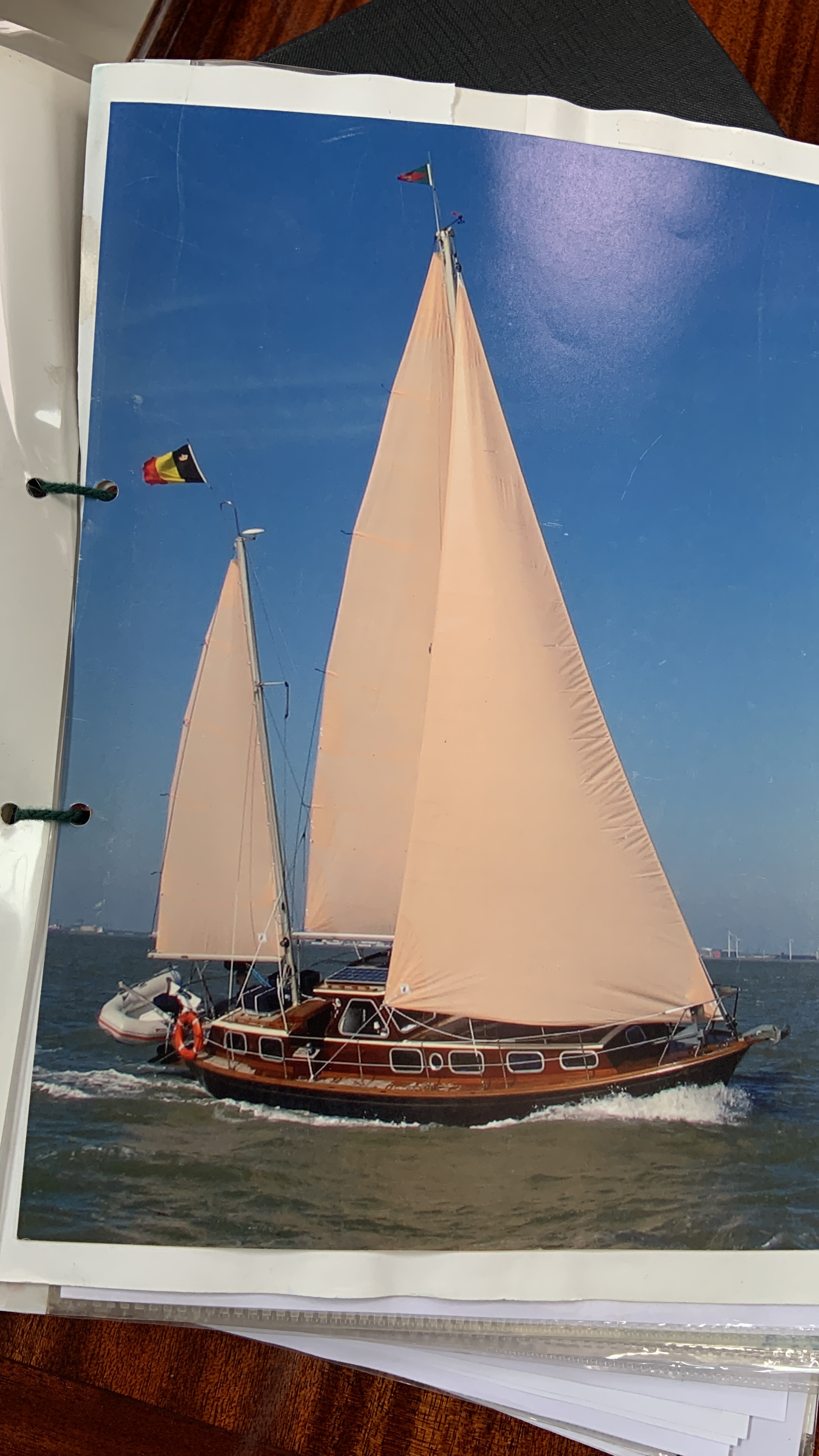
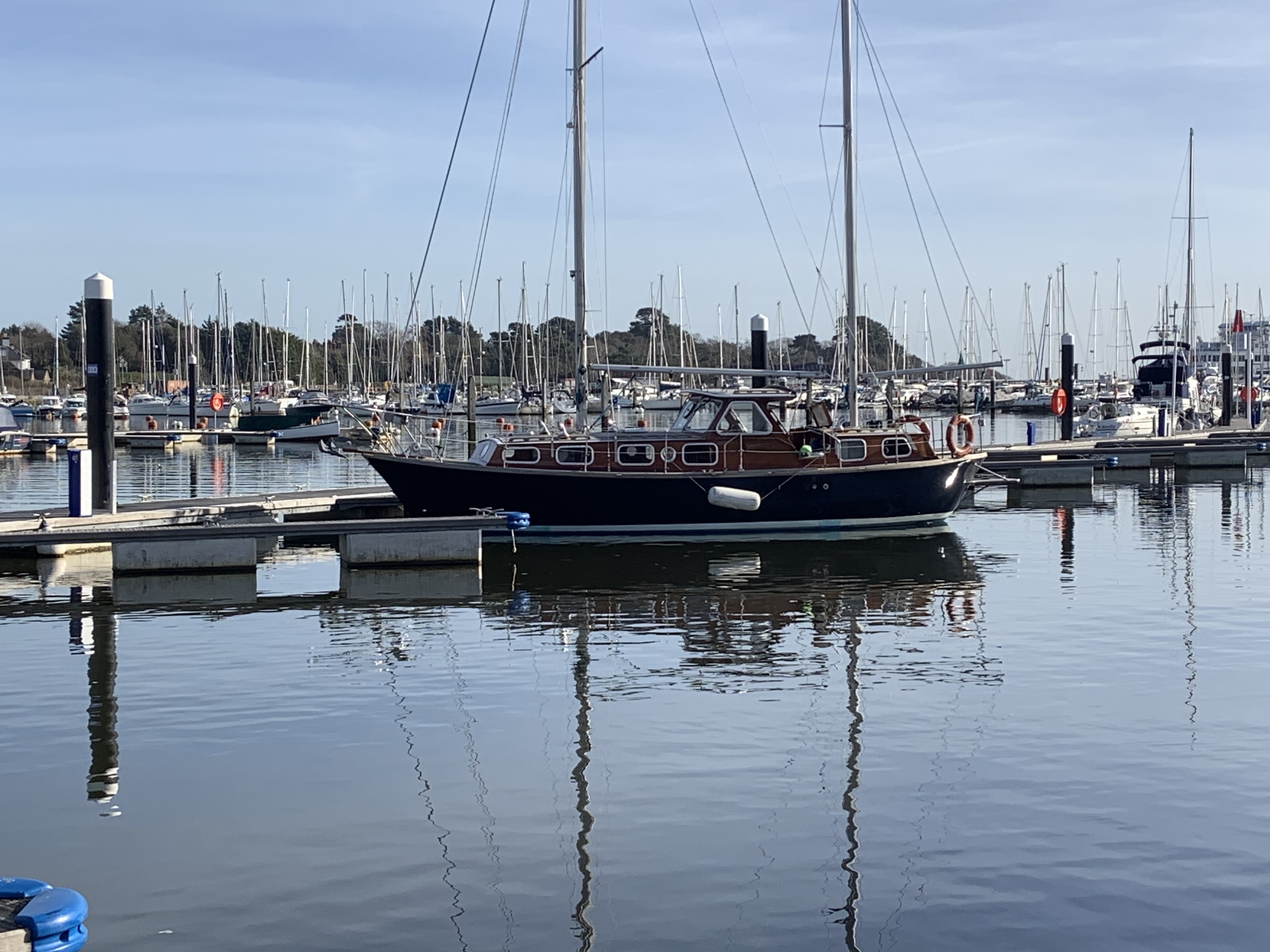
I first saw Antoinette, in Lymington, and from the first moment I saw the boat, I knew I could make the boat my “home.”
She went to Southwold in Suffolk, England for a major refit, and so there is a new engine, gearbox, and propeller, replaced decking, and repairs have been carried out to the hull.
Inside, I can stand up, and although only 37 foot long, being beamy, there is a lot of room.
There are double cabins both fore and after, with “heads” (bathrooms). The main cabin and galley is very comfortable. It has a lot of mahogany wood, so looks homely, and the “dog house” (bit in the middle), is a very open useable space, either enclosed when cold and wet, or if the weather permits, opened up to enjoy the sun.
The key is that this is “my home”.
I can now travel, and go where I like, but I have my home with me. It has heating, but normally when you arrive somewhere, part of the mooring fees offer a shower unit and facilities. I have space to entertain, but above all, I am free of all the ties that we adopt by following the life society offers us as “the norm“.
It is only now that I see the traps that others face, because I can up anchor and head off, and can see where Les Powles got his freedom, and lived his dream.
In the cabin of Antoinette with Finn the dog belonging to Natalie (on the left).
The collie is “Finn”, Natalie’s dog. I think Paul was one of the first to see her when she was born, so 31 years later, Natalie wants to enjoy the alternative life.
As for Finn, he loves it. Fresh air, plenty going on, and a lot to see.
“Tiny living”, but the release from the way most people live is amazing.
No speeding tickets for me. 🤪
ooOOoo
Thank you, Bob for the story of you and me. That last thirty years have flown by and those years on Songbird of Kent were really special albeit the end of my cruising days were pretty scary.



































 Learning from Dogs