Category: Philosophy

A few reflections on a new world order

Maybe the power of open communications is our only way forward.

A number of disparate ideas have flown into my ‘in-box’ and left me with these thoughts.

The first was the last essay on TomDispatch.  This one from the hands of Mr. Engelhardt himself.  I’m referring to Tomgram: Engelhardt, The Washington Straitjacket.  As many of you know, Tom has been generous in granting me blanket permission to republish his posts and I frequently so do;  as yesterday’s post written by Professor Michael Klare demonstrated.

Let me give you a idea of where Tom was coming from with this personal essay,

The Barack Obama Story (Updated) 
How a Community Organizer and Constitutional Law Professor Became a Robot President
By Tom Engelhardt

President Barack Obama
The White House
1600 Pennsylvania Avenue, NW
Washington, D.C. 20500

Dear President Obama,

Nothing you don’t know, but let me just say it: the world’s a weird place. In my younger years, I might have said “crazy,” but that was back when I thought being crazy was a cool thing and only regretted I wasn’t.

I mean, do you ever think about how you ended up where you are? And I’m not actually talking about the Oval Office, though that’s undoubtedly a weird enough story in its own right.

The next paragraph opens, thus:

After all, you were a community organizer and a constitutional law professor and now, if you stop to think about it, here’s where you’ve ended up: you’re using robots to assassinate people you personally pick as targets.

Then there’s a comprehensive description of all the outcomes that have taken place in the last few years as in this paragraph,

Still, who woulda thunk it?  Don’t these “accomplishments” of yours sometimes amaze you? Don’t you ever wake up in the middle of the night wondering just who you are? Don’t you, like me, open your eyes some mornings in a state of amazement about just how you ended up on this particular fast-morphing planet? Are you as stunned as I am by the fact that a tanker carrying liquid natural gas is now making a trip from Norway to Japan across the winter waters of the Arctic? Twenty days at sea lopped off an otherwise endless voyage via the Mediterranean Sea, and the Indian and Pacific Oceans. Did you ever think you’d live to see the opening of the Northeast Passage in winter? Don’t you find it ironic that fossil fuels, which helped burn that oceanic hole in the Arctic ice, were the first commercial products shipped through those open waters? Don’t you find it just a tad odd that you can kill someone in distant Yemen without the slightest obstacle and yet you’ve been able to do next to nothing when it comes to global warming? I mean, isn’t that world-championship weird, believe-it-or-not bizarre, and increasingly our everyday reality?

Tom’s essay comes to this conclusion,

And don’t you ever wonder whether a labyrinth of 17 (yes, 17!) major agencies and outfits in the U.S. “Intelligence Community” (and even more minor ones), spending at least $75 billion annually, really makes us either safe or smart? Mightn’t we be more “intelligent” and less paranoid about the world if we spent so much less and relied instead on readily available open-source material?

I mean, there are so many things to dream about. So many ghostly possibilities to conjure up. So many experimental acts that offer at least a chance at another planet of possibility. It would be such a waste if you only reverted to your community-organizer or constitutional-law self after you left office, once “retirement syndrome” kicked in, once those drones were taking off at the command of another president and it was too late to do a thing. You could still dream then, but what good would those dreams do us or anyone else?

It’s a very powerful analysis that I really encourage you to read.

Then thanks to a mailing from the WordPress team, I was drawn to a recent account of life by Ruth Rutherford.  In an essay from the 13th November, Ruth writes about living in the dark, as this sample evocatively describes,

Dating in the dark

Just got back from visiting my ol’ stomping grounds in New Jersey where I spent the weekend with my parents and grandparents, just talking, eating and enjoying good company. And all this was done in the dark. Yep, that’s right. Even nearly two weeks after Hurricane Sandy unleashed her fury, the Garden State is still struggling to recover. And let me tell you: Living without power for that long will quickly make you appreciate the little things.

Like walking into a dark room and then transforming it with just the flip of a switch. Or turning on a faucet and seeing water actually pour out. Or pulling into a gas station on any day you choose, not just the days you’re allowed to based on the numbers on your license plate. Or just using the bathroom without strategically planning your “number twos” based on how much water is in the tank. Or not having to wake up at two o’clock in the morning to wander outside in your pajamas to fill the generator with gas. (Okay, fine. My dad did that part. But still…)

When you’re without electricity for a while, your mind tends to do a lot of thinking. There are no reality shows to turn your brain into mush, no hair dryers to block out the noise of everyday life, and no steaming hot baths to drown your worries in. Basically, it’s you, alone, with a candle, a flashlight and your thoughts. So I spent the time brain blogging.

At the heart of this essay is the concept that ‘dating’ as in finding one’s life partner has become too complex.  This is how Ruth concludes her ideas.

Yep, I’m telling you to be shallow.

Forget the deep end, folks. Jump, cannonball style, into the shallow end and let the fun begin!

Shared interests. Favorite movies. Local hot spots. Interesting hobbies. Recent vacations. Current music playlists. Boring work stories. Embarrassing childhood memories. Stupid jokes. Mutual attraction. Sparks. Chemistry.

Because if you can’t relate on these basic levels, then who the heck cares if you both want two boys, one girl and a yellow Labrador named Minnie?

Start small. Start simple. Grab a lantern and meet during a power outage. It’s amazing what you’ll find out about your date in the dark. (With your clotheson, people! Get your minds out of the gutter.)

~Ruth

Finally, closer to home. Patrice Ayme and Martin Lack have been exchanging views in comments to my recent post Unintended Consequences.  Patrice ended a comment with this: ” If goodness is to win, it has to be smarter than the enemy.

So what’s this all coming to?  According to WordPress there are over 500,000 people blogging about the world as they see it.  The number of others who read all those words must be well into many, many millions.  Even humble old Learning from Dogs received over 45,000 viewings in November alone bringing the total viewings to over 785,000!

As the saying goes, “the only thing required for evil to win, is for good people to do nothing.”

Go and read the latest from Bill McKibben on 350.org.

The_New_York_Times

The article in The New York Times tells the story of students, faculty and alumni around the country who are demanding divestment from fossil fuels. On a few campuses, like Swarthmore, they’ve been at it for semesters — but all of a sudden, as the article says, they find themselves “at the vanguard of a national movement. In recent weeks, college students on dozens of campuses have demanded that university endowment funds rid themselves of coal, oil and gas stocks. The students see it as a tactic that could force climate change, barely discussed in the presidential campaign, back onto the national political agenda.”

The picture that accompanies the article comes from our Minneapolis roadshow last Friday night, and the article concisely lays out the demands and the strategy of the campaign. It’s precisely the boost we need. So please, go read it here: www.nyti.ms/SESrfr

We’re quickly getting traction, but we can get more if we have your help.

So, first things first: please email the article by clicking the “E-Mail” button on the New York Times website — if we can get it on the newspaper’s “most emailed list”, we can help make sure it goes as far as possible, as fast as possible.

For full instructions on how to email the article, click here: www.350.org/nyt

I sense that we, as in the peoples on this planet, are well into a period of such change that even by the end of 2013, a little over 50 weeks away, the precipice for humanity will be within sight.  I hold out zero hope that any time soon our leaders and politicians will stop ‘playing games’ and focus on doing what’s right.  The time for truth, for integrity, for sound debate is NOW!

The sharing of ideas, thoughts and emotions that this ‘virtual’ world of blogging offers (despite me regarding the word ‘blogging’ as ugly) is going to be the only tool, the only channel to carry sufficient weight and power for the wishes and desires of the ‘common man’ to live peacefully and safely to the end of this century and beyond!
Animals in love

The beautiful hidden depths of the consciousness of animals

Back in the Summer of 2011, I published a couple of posts on the subject of consciousness.  The first one was called Consciousness, science or God? and the second one about a month later continued the theme under the heading of And more on consciousness.

In that second article, I concluded with these words:

Finally, do you have a dog at home?  If you do, ponder on how their conscious world engages them.  If science can’t explain human consciousness then all we have is our own intuition with regard to animals.  Not sure about you but when one is feeling a little low and a dog comes up and lays a head across you I feel a very strong conscious connection.

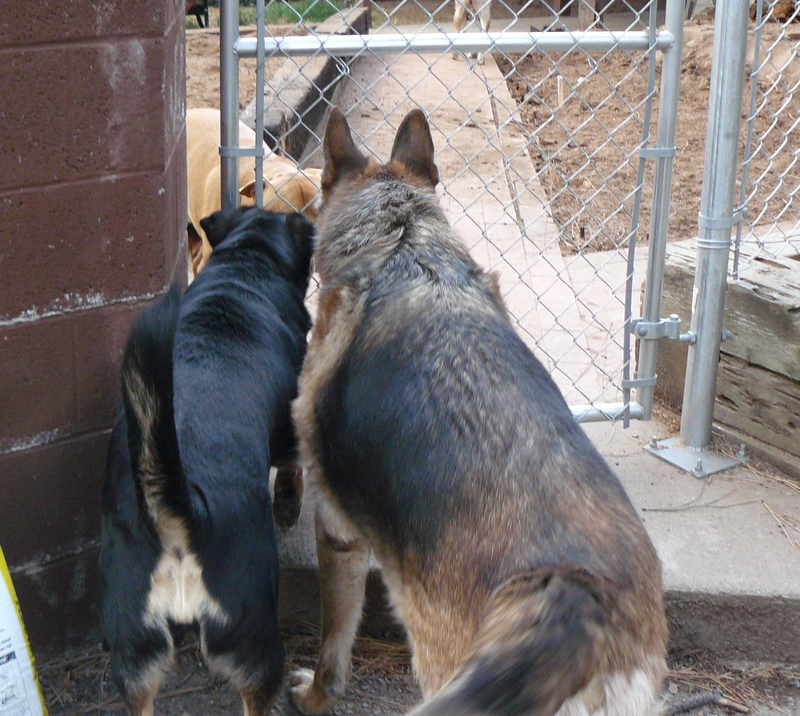
Hazel and Pharaoh

The dog to the left of Pharaoh in the above picture is Hazel.  Shortly before we left San Carlos, Mexico to move up to Arizona in February, 2010, this dog was dumped outside Jean’s house.  She was still in milk and Jean explained that it was common practice for female dogs to be cast out shortly after they had had pups.  The pups would have been sold for a few pesos and the mother dog was no longer of any use or value and was ‘disposed’.

We took her in, of course, and she joined the other dozen dogs on our journey to our new Arizonan home.  Hazel has the sweetest of dispositions and frequently sleeps snuggled up against me at night.  As I write these words, Hazel is sleeping just to the left of my feet.  There are times when Hazel looks into my eyes with what I can’t lable as anything other than the look of a dog in love.

So with that in mind, let me introduce you to Kate and Pippin.  As their website proposes  Kate & Pippin is “An unlikely love story“.

THE STORY

Pippin, a helpless baby fawn was abandoned by her mother on the property of Isobel Springett. Isobel’s Great Dane, Kate, adopted Pippin immediately and they have been best friends ever since.

The story of Kate’s and Pippin’s loving relationship is charmingly chronicled in a handsome book featuring the beautiful photography of Isobel Springett.

Here’s Martin Springett, author of the book.

While there’s a small degree of overlap with the first video, you’ll still love to watch this.

A collection of photos from pips’s early days. She was just a few days old when she found us. Music is by my brother Martin Springett.

To close, here’s Pip at about two and a half months old. She’s just lost her spots and is looking like a teenager, all legs! She loves grapes and bananas after her bottle. (And the music is fabulous – Artist: Jelengue “Amar Mi Verdad”)

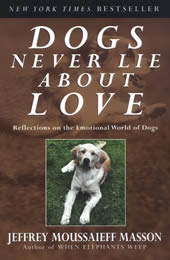
Reminds me of that great book from Jeffrey Masson, Dogs never lie about love!

Deeper insights into who we are.

Two fascinating perspectives.

1. A conversation with Charles Taylor – THE 2008 KYOTO PRIZE

Video Messages from Dr. Charles MargraveTaylor, the Laureate of 2008 KYOTO PRIZE, Arts and Philosophy. “Feelings on receiving the Kyoto Prize” “What philosophers can do for society” “Future interest and theme”(2008/11/11)

Wikipedia describes Charles Taylor thus,

Charles Margrave Taylor, CC GOQ FRSC (born November 5, 1931) is a Canadian philosopher from Montreal, Quebec best known for his contributions to political philosophy, the philosophy of social science, and intellectual history. This work has earned him the prestigious Kyoto Prize and the Templeton Prize, in addition to widespread esteem among philosophers. In 2007, Taylor served with Gérard Bouchard on the Bouchard-Taylor Commission on Reasonable Accommodation with regard to cultural differences in the province of Quebec. Taylor currently teaches at McGill University in the Department of Religious Studies. He is a practicing Roman Catholic.

There is also a fuller biography presented here.

2. How we see circumstances is so much more important – Rory Sutherland on Perspectives.

The circumstances of our lives may matter less than how we see them, says Rory Sutherland. At TEDxAthens, he makes a compelling case for how reframing is the key to happiness.

The TED profile of Rory Sutherland explains that:

From unlikely beginnings as a classics teacher to his current job as Vice Chairman of Ogilvy Group, Rory Sutherland has created his own brand of the Cinderella story. He joined Ogilvy & Mather’s planning department in 1988, and became a junior copywriter, working on Microsoft’s account in its pre-Windows days. An early fan of the Internet, he was among the first in the traditional ad world to see the potential in these relatively unknown technologies.

Adieu Payson

The end of a treasured time in Payson, Arizona.

Today, Jean and I together with our 11 dogs and 5 cats start the 1,200 mile journey to Merlin, Oregon.  While we have only lived in Payson since February, 2010, it has been a time of fantastic experiences.  I had to work through the long process of getting a fiancee visa from the American Embassy in London.  Until that was issued my ‘residence’ in Payson was that of a British tourist with me having to leave the USA every 90 days.

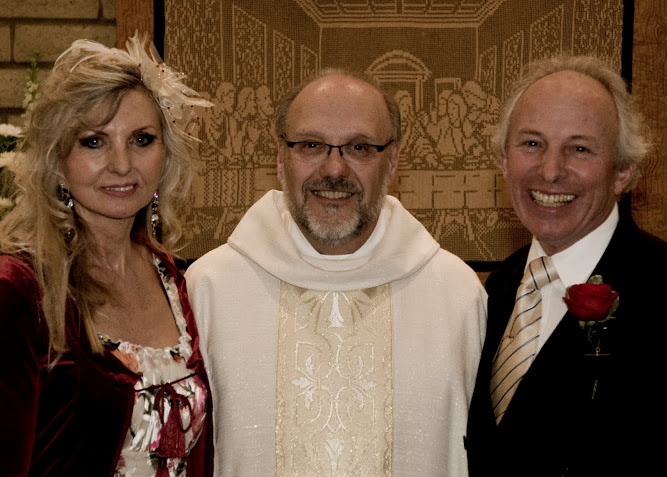
The visa was issued in October, 2010 and I flew immediately to Arizona.  On the 8th November, 2010 Jean and I were issued with a Marriage License Certificate and we were married on the 20th November at St. Paul’s Episcopal Church in Payson.

Fr. Dan Tantimonaco with the newly weds!

We have made many very dear friends here in Payson but Oregon feels like the start of our home in every sense of the word, not just because it is the first home that Jean and I have bought jointly.

One of those dear friends here in Payson has been John Hurlburt, a devoutly spiritual man.  A little over a week ago, he sent me a very thoughtful essay and I wanted to include it today as a guest post in recognition of the way that John and many, many others have embraced these couple of Brits over the last 32 months.  Thank you all.

oooOOOooo

Unity

Everything fits together

The species of animals we know as human beings is a part of everything that exists. We are a very young consciously-aware species that does not begin to know all the answers. What little we do know has a Natural pattern. It would seem that there’s a lamplighter and a navigator in all of us. The lamplighter is our fundamental awareness of being and provides nature’s guidance along life’s pathways.

Our natural navigator is designed for evolutionary competition. There’s a biological survival kit in our DNA. Extreme demand for limited resources generates deadly combat; both within and between species. As a result of competition taken to wretched excess, our global economy is leveraged 22 times beyond any earthly foundation. The unspoken intent to destroy each other over what remains of our planet is becoming increasingly evident.

The human species is engaged in a global war over money, ideals and disappearing finite resources. Ninety-seven percent of the world scientific community has confirmed that the natural effects of heat and discharges generated by human machines and related human activities are the primary cause of recent rapid climate change.

These dedicated scientists are opposed in the media by three percent of their corporate energy-financed peers. An oppressive worldwide network of often offensive politicians is similarly supported and managed accordingly. Nature couldn’t care less about politics, emotions or idealistic arguments.

Human squabbles mean very little in the totality of universal life. The drumbeat of local natural disasters increases steadily. There are no two ways about it. No amount of human ifs or buts can or will change reality. Our human species is in deep serious trouble.

It has been six million years since the first humanoids emerged and two million years since the rise of human civilization. What a sorrow it is to realize what we have done to the earth in just the past two hundred and fifty years. We’ve reached the moon and are exploring Mars. It’s well past time to clean house and re-grow our local garden.

As an old navigator, there’s a sense of urgency regarding the course life on earth has taken. For those who continue to care about facts, the prognosis is not encouraging. We have the know-how for an alternative. We can avoid the perfect storm of going over the edge of an economic cliff and the crush of an environmental crisis in the midst of a war-fuelled, profit-driven, global, corporate fight to the end. The alternative is that we have the know-how to transition rapidly to a reality-based economy and a way of living that’s gentle to the earth. The solution is global, it’s industrial, it’s natural and it’s our best hope. It may well be our only hope. It’s time to light some lamps.

Conscious human awareness emerges as we relax, contemplate, meditate, and communicate openly. These are levels of awareness beyond the limits of our daily human musings. The wisdom which flows from enlightened awareness embraces humility, experience, knowledge, understanding, and faith. Life has never been easy. We’re fragile biological beings. Our mutual growth is the result of sustained efforts over millions of years.

Yet despite attaining a higher level of conscious awareness our human culture continues to operate on a material basis rather than a moral basis. We have become confused by our own importance or the apparent lack thereof. We all too often retreat into a rut, furnish it and turn on the electronics.

By definition, natural processes support species growth in harmony with all natural life. Those natural processes are indistinguishable from the planetary support systems within which all life interacts. Human interaction is local. We spend much of our lives unaware that we are unaware; initially as infants and throughout our lives in deep sleep. When caught up in the pressures of our daily lives, it’s easy to be unaware of being unaware.

It’s time to wake up. Cosmology is an eternal spring from which the waters of the earth still flow. When we turn ourselves inside-out and achieve higher awareness, we discover who, what and where we really and truly are. In a trinity of spirituality, nature and science, we’re cosmically energized beings; spiritual beings sharing a transitory human existence.

Ninety-eight percent of the human population believes in a power beyond species and self. The simplest understanding of this belief is that we humans did not originally create ourselves. All human wisdom and understanding leads to the conclusion that human beings don’t own the earth. We’re caretakers and we’re only passing through. Given that we have a systemic crisis, what do we have to work with?

We have a species that’s squabbling over diminishing resources, an environment and an infrastructure which both desperately require attention, a sustaining objective of equitable global employment, a world economy that’s about to collapse for lack of any real foundation, a burgeoning population which further strains the system and the clear need for a unifying purpose.

Put it all together and what do we have? The navigator is our guide to growth. The navigator shares our wholeness. The lamplighter is our guide to unity. Everything fits together. Each of us is a part of the unity of life. Unity has a natural purpose. It’s time to build a life boat.

John Hurlburt is a former U.S. Navy aviator and successful corporate executive who presently serves as a senior Christian educator and a founding member of an international Transition Town in Payson, Arizona.

oooOOOooo

Don’t know about you, dear reader, but I find those incredibly powerful words.  Words that provide the truth. A truth the whole world needs.  John set out in a personal email to me the three simple fundamentals of our lives. Just a few more words to sum up the truth.

There’s an environmental crisis.  There’s an inevitable global economic abyss touching us all on a daily basis.  The need for a green economic transformation is obvious.

Thank you, John.

Creativity, John Cleese style

The art and magic of being creative.

I can’t recall who it was that mentioned this TED video which is a great shame as I really should pay credit to a wonderful examination of the business of being creative.

“Telling people how to be creative is easy – being creative is difficult.” John Marwood Cleese (born 27 October 1939) is an English actor, comedian, writer and film producer. He achieved success at the Edinburgh Festival Fringe and as a scriptwriter and performer on The Frost Report.

In the late 1960s he became a member of Monty Python, the comedy troupe responsible for the sketch show Monty Python’s Flying Circus and the four Monty Python films: And Now for Something Completely Different, The Holy Grail, Life of Brian and The Meaning of Life. In the mid 1970s, Cleese and his first wife, Connie Booth, co-wrote and starred in the British sitcom Fawlty Towers. Later, he co-starred with Kevin Kline, Jamie Lee Curtis and former Python colleague Michael Palin in A Fish Called Wanda and Fierce Creatures.

He also starred in Clockwise, and has appeared in many other films, including two James Bond films as Q, two Harry Potter films, and three Shrek films. With Yes Minister writer Antony Jay he co-founded Video Arts, a production company making entertaining training films. It was founded in 1972 by John Cleese, Sir Antony Jay, and a group of other television professionals. The videos feature well known British actors, and humorously explain business concepts. Productions include Meetings, Bloody Meetings and More Bloody Meetings, and have featured Cleese, Dawn French, Prunella Scales, Hugh Laurie, and Robert Hardy.

In December 1977, Cleese appeared as a guest star on The Muppet Show. Cleese was a fan of the show, and co-wrote much of the episode. He appears in a “Pigs in Space” segment as a pirate trying to hijack the spaceship Swinetrek, and also helps Gonzo restore his arms to “normal” size after Gonzo’s cannonball catching act goes wrong. During the show’s closing number, Cleese refuses to sing the famous show tune from Man of La Mancha, “The Impossible Dream”. Kermit the Frog apologises and the curtain re-opens with Cleese now costumed as a Viking trying some Wagnerian opera as part of a duet with Sweetums. Once again, Cleese protests to Kermit, and gives the frog one more chance. This time, he is costumed as a Mexican maraca soloist. He has finally had enough and protests that he is leaving the show, saying “You were supposed to be my host. How can you do this to me? Kermit — I am your guest!”. The cast joins in with their parody of “The Impossible Dream”, singing “This is your guest, to follow that star…”. During the crowd’s applause that follows the song, he pretends to strangle Kermit until he realises the crowd loves him and accepts the accolades. During the show’s finale, as Kermit thanks him, he shows up with a fictional album, his own new vocal record John Cleese: A Man & His Music, and encourages everyone to buy a copy. This would not be Cleese’s final appearance with the Muppets. In their 1981 film The Great Muppet Caper, Cleese does a cameo appearance as Neville, a local homeowner. As part of the appearance, Miss Piggy borrows his house as a way to impress Kermit the Frog. Cleese won the TV Times award for Funniest Man On TV — 1978-79.

Many people think you are either born with creativity or you aren’t. But John Cleese explains how to become creative and in the video, he talks about such thing as the unconscious mind.

John Cleese has his own website here.

The thinking dog

Science embraces what many intuitively know: Animals have consciousness.

This was published on the Big Think website at the end of August.

Scientists Give Animals Consciousness

Nick Clairmont on August 29, 2012, 2:34 PM

What’s The Big Idea?

Scientists have given animals consciousness. Not through complex manipulation of the brain or through genetic manipulation, but by publicly acknowledging the consensus, for the first time in such a straightforward way, that non-human animals, including some of our evolutionarily distant cousins, have awareness and experience like we do.

The declaration, called The Cambridge Declaration On Consciousness, was signed at the Francis Crick Memorial Conference of Consciousness in Human and Non-Human Animals in the presence of Stephen Hawking in July in Cambridge, U.K. by an international group of scientists including cognitive neuroscientists, neuropharmacologists, neurophysiologists, neuroanatomists and computational neuroscientists.

What do they mean by consciousness? The Declaration treats it as the same as the phrase, “subjective experience.” Philosophers who share this view of consciousness with the scientists often say that something is conscious if there is “something that it is like” to be that thing. So, according to this, a rock is not conscious, because there is nothing “that it is like to be a rock.”

The signing marked the first formalization of the scientific consensus about the consciousness of several non-mammals, including birds, octopuses and even bees.

So if we now turn to that Conference held in Cambridge, England under the subject of Consciousness in Human and and Non Human Animals, we see how that declaration reads,

We declare the following: “The absence of a neocortex does not appear to preclude an organism from experiencing affective states. Convergent evidence indicates that non-human animals have the neuroanatomical, neurochemical, and neurophysiological substrates of conscious states along with the capacity to exhibit intentional behaviors. Consequently, the weight of evidence indicates that humans are not unique in possessing the neurological substrates that generate consciousness. Nonhuman animals, including all mammals and birds, and many other creatures, including octopuses, also possess these neurological substrates.”

The full document is really worth reading, by the way.

There is much more about the conference including some remarkable videos here, from which I will select two.  The first one, in particular, is very moving, and upsetting!  Be warned!

OK, forgive me but I’m going to state the obvious!  Just read the entry on Wikipedia about Orangutans.

Orangutans are among the most intelligent primates and use a variety of sophisticated tools, also constructing elaborate sleeping nests each night from branches and foliage. The apes have been extensively studied for their learning abilities. There may even be distinctive cultures within populations. Field studies of the apes were pioneered by primatologist Birutė Galdikas. Both orangutan species are considered to be Endangered with the Sumatran orangutan being Critically Endangered. Human activities have decimated the populations and ranges of both species. Threats to wild orangutan populations include poaching, habitat destruction and the illegal pet trade. There are several conservation and rehabilitation organisations dedicated to the survival of orangutans in the wild.

Among the most intelligent primates‘! Yet again, an example of mankind treating the planet as a disposable item!  A quick web search came across the Orangutan Foundation so as well as being saddened and angry, there is something we can do; support them.

The second video from that Conference website is about the intelligence of dolphins – enjoy!

Back to the Big Think article, which concludes,

What’s The Significance?

The signatories have indicated that we cannot, at least certainly not for the reasons we have been giving, ignore the fact that animals have the same type of experiences that gives us a reason to treat other humans humanely.

Beyond the ethical ramifications, this declaration is another step in a long line of conclusions that the animal brain displays remarkable plasticity and is able to accomplish highly complex tasks in multiple ways.

While anyone who has gone to a zoo or owned a pet has at least temporarily thought of animals as conscious, there is still a large contingent that strongly believes that humans are exceptional in some morally and scientifically significant way. But, as Christof Koch, who co-presented the declaration notes, “The belief in human exceptionalism, so strongly rooted in the Judeo-Christian view of the world, flies in the face of all evidence for the structural and behavioral continuity between animals and people.”

Well done those scientists!

Brain-to-brain communication

Communication seems to be a bit of a theme just at present!

About 18 months ago, I wrote a piece on Learning from Dogs about Rupert Sheldrake’s fascinating book Dogs That Know When Their Owners Are Coming Home. The reason that this has come up again (and, as it happens, I’m rereading Sheldrake’s book just now) is a recent item on the Big Think website called Can We Have Brain-to-Brain Communication?  Here’s what was written.

Dr. Michio Kaku addresses the question of Collective Intelligence. Some people think that the next big innovation in the coming decades is not going to involve the Internet because we can already connect computers to the human mind. Therefore, Dr. Kaku says this brain-to-brain communication would involve not just the exchange of information, but also the transmission of emotions and feelings, “because these are also part of the fabric of our thoughts.”

There’s also an interesting 4-minute video by Dr. Kaku that may be accessed here.

But then again, many pet owners would probably take it for granted that our cats and dogs can read our mind, as Dr. Sheldrake rather entertainingly explains below.

Before closing today’s post, the research that Dr. Sheldrake has undertaken is very impressive.  His website is here, from which one learns that,

Dr. Sheldrake

Rupert Sheldrake, one of the world’s most innovative biologists and writers, is best known for his theory of morphic fields and morphic resonance, which leads to a vision of a living, developing universe with its own inherent memory.

He worked in developmental biology at Cambridge University, where he was a Fellow of Clare College. He was then Principal Plant Physiologist at the International Crops Research Institute for the Semi-Arid Tropics (ICRISAT), in Hyderabad, India. From 2005 to 2010 he was Director of the Perrott-Warrick project. , funded from Trinity College, Cambridge.

Rupert Sheldrake … Biography 
A Guide to the Website Rupert’s Science and Philosophy

The website is a very useful resource, as this section underlines,

Unexplained Powers of Animals

by Rupert Sheldrake

In the late 1980s and early 1990s I explored a variety of experimental approaches for the investigation of unexplained phenomena that might help to enlarge our scientific view of the world, summarised in my book Seven Experiments That Could Change the World: A Do-It-Yourself Guide to Revolutionary Science (1994).

One of the seven experiments concerned unexplained abilities of animals, and I published a series of papers on the unexplained powers of animals, see Papers on animals .

I summarised much of this research in my book Dogs That Know When Their Owners Are Coming Home, And Other Unexplained Powers of Animals (1999).

My research with Aimée Morgana into the telepathic powers of her African Grey Parrot, Nkisi, led to the celebrated debate at the London RSA with Prof Lewis Wolpert, which is featured on this website The Telepathy Debate 

More information is available on Nkisi, including a tape of one of his conversations with Aimée in The Nkisi project

So if your pet is looking at you as though they know what you are thinking – they probably are!

Sticks and stones

I make no apologies for today’s post being more emotional and sentimental.

The phrase ‘sticks and stones may break my bones but names will never hurt me‘ is well known throughout the English-speaking world and surprisingly goes back some way.  A quick web search found that in the The Christian Recorder of March 1862, there was this comment:

Remember the old adage, ‘Sticks and stones will break my bones, but words will never harm me’. True courage consists in doing what is right, despite the jeers and sneers of our companions.

So if in 1862 the saying was referred to as an ‘old adage’ then it clearly pre-dated 1862 by some degree.

A few days ago, Dusty M., here in Payson, AZ, sent me a short YouTube video called The Power of Words.  I’m as vulnerable as the next guy to needing being reminded about what’s important in this funny old world.  Then I started mulling over the tendency for all of us to be sucked into a well of doom and gloom.  Take my posts on Learning from Dogs over the last couple of days, as an example.

There is no question that the world in which we all live is going through some extremely challenging times but anger and negativity is not going to be the answer.  As that old reference spelt out so clearly, “True courage consists in doing what is right, despite the jeers and sneers of our companions.

So first watch the video,

then let me close by reminding us all that courage is yet something else we can learn from dogs.

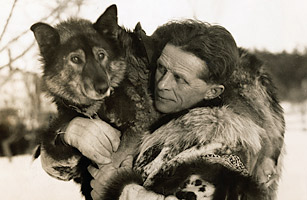
Togo the husky

In 1925, a ravaging case of diphtheria broke out in the isolated Alaskan village of Nome. No plane or ship could get the serum there, so the decision was made for multiple sled dog teams to relay the medicine across the treacherous frozen land. The dog that often gets credit for eventually saving the town is Balto, but he just happened to run the last, 55-mile leg in the race. The sled dog who did the lion’s share of the work was Togo. His journey, fraught with white-out storms, was the longest by 200 miles and included a traverse across perilous Norton Sound — where he saved his team and driver in a courageous swim through ice floes.

More about Togo another day.

The changing ways in which humans communicate

How Virtual Reality Has Changed the English Language and the Way Humans Communicate

Introduction

Is it noise or content?

One of the wonderful consequences of spending far too much time ‘blogging’ is the connections that I have made over the last 27 months.  I have come across a wonderful range of interesting writers and learnt so much more from those links.  However, that’s not all, by a long chalk.  A number of you have offered to contribute an essay to Learning from Dogs. (And if you are reading this and would like to offer a guest post then ‘fill your boots!‘ )

So it was that a few weeks ago I received an email from Alexa Russell.  She offered me a guest post that I found very interesting, leading to it being published today.

I asked Alexa to write a little about herself, to which she replied, “I am a freelance writer who likes to write about technology, education and the changing nature of society. I am currently considering graduate school but fear being scared off by mounting costs and diminishing returns.”

So onto the post, which Alexa explains is about the ways in which virtual reality and digital devices change how we humans communicate and use the English language.  Alexa is the author of several resources on studying English and the value in earning anEnglish PhD.  Here she asks what Learning from Dogs has previously wondered — do we need to understand language in order to get the message?

oooOOOooo

How Virtual Reality Has Changed the English Language and the Way Humans Communicate

Technology has changed the way we communicate in some obvious (and occasionally obnoxious) ways. Grammar, punctuation, and even a more general respect for lexical rules have diminished in favor of speed and facility in text messages, which are now the most common communicative tool. Probably more periods have been omitted in the last two days than in the hundreds of years since the Gutenberg Bible. None will be omitted here, but maybe they should be.

As social networks expand, making an acquaintance at a coffee shop can easily translate to a lifetime connection – thanks to Facebook. And finally, there is a way to sever contact without engaging in direct conflict – defriending. The funniest thing about defriending is that it is usually considered as an unimpeachable revocation, as starkly offensive as a breakup – when in fact the message has not even crossed the digital threshold to the real world.

As virtual reality and networks progress, so too do our attempts to understand exactly what has happened and may happen to our grip on physical reality. There are a myriad of movies that attempt to explore the subject: The Matrix, Inception, and Avatar, to name a few of the most popular. In The Matrix, Neo discovers that he can will himself to do anything, move with almost infinite speed, gain superman strength, as long as he can carry that belief to his avatar in The Matrix. In Avatar, the protagonist cannot walk in real life but is then given a taller, stronger, more agile host to control. Inception tests the boundaries of the physical, as well as the emotional, as the virtual realities of the “hacked” mind have real impact on his or her emotional truth.

The conclusions that all of these movies come to is the same, albeit shocking fact: virtual reality has real-world effects. Neo can die if he believes he has died. Love can transfer from the blue, tall, strong, avatar to the avatar’s handicapped controller. Inception controls the outlook and actions of an individual well beyond the confines of the dreamworld. It can even come to define the rest of the dreamer’s life.

Virtual reality allows us to shed our physical shells and our weak points. There is nothing holding us back from becoming what or who we want to be. The zits and potbellies of real life give way to what is being communicated. Equally, as in the Matrix, World of Warcraft and even in NASA’s new medical diagnosis virtual reality for astronauts, skills can be learned more quickly than ever will be possible in real life. The NASA device gives astronauts an instant how-to guide, which will enable them to collect data and provide diagnoses as if they had years of medical school under their belts.

So, it really shouldn’t be all that surprising that grammar, punctuation, and spelling have lost a lot of their importance. When people communicate through a virtual medium, they can forget things like academic training and rules of grammar. The value of training and rules is diminishing. It is the essence of the message, not its style, that matters. The biggest question, however  is, can you understand the essence?

oooOOOooo

You can understand why it was such a pleasure to receive Alexa’s essay!  And the question left in the air, so to speak, in her closing sentence, is one of huge import.  As we add to, or is it replace, our tradition of the ‘spoken’ word with this new-world of staccato speak, what’s happening to the essence of the message!

I do hope that Alexa will grace these pages again.

Integrity, part two.

A lifting of the importance of integrity is the key to our survival.

Let me start by reflecting on the difference between ‘truth’ and ‘integrity’.

Here’s one of the definitions of Truthconformity with fact or reality; verity: the truth of a statement.

Here’s one of the definitions of Integrityadherence to moral and ethical principles; soundness of moral character; honesty.

So while in yesterday’s article, I frequently referred to the word ‘truth‘, determining the ‘fact or reality‘ of a wide range of issues associated with anthropogenic climate change is not always straightforward.  Many of us probably have a strong intuition of the ’cause and effect’ of man’s footprint on this planet but a strong intuition is not the same as truth.

Then let’s turn to the notion of integrity. This is a much bigger issue, to my mind, the appalling lack of integrity!  Illustrated by one simple example.  How many leading politicians from any number of countries have demonstrated soundness of moral character; honesty with regard to the changing climate, even offering something as simple as “I don’t know!

There’s a saying that pilots use, “If there’s any doubt, there’s no doubt!”  Come on, politicians and leaders, at the very least there is doubt!

OK, let me move on!

If integrity is partly defined as honesty, then while it’s easy to take a pot-shot at the world’s politicians maybe we need to look closer at home; ourselves.  Are we as honest with our own self as we now need to be?

Here’s an example that supports that question.

A few days ago there was a report on the website The Daily Impact about the crash of US fisheries.  Let me show you how that report opens,

Report: US Fisheries Crashing

We live in a country in which every household has two TV sets, most of them receiving hundreds of channels, and two cell phones, many of them “smart.” One of every two households has a computer connected to the Internet. This country is currently in the middle of a hotly contested presidential election. And yet among the things that have almost completely escaped public attention is this: last week the US government declared fisheries disasters on four coasts.

Reflect on that paragraph.  Surely it’s a reflection about the lack of integrity, of honesty, about our society?

The report ends thus,

The disaster declaration covering all these dire situations makes them eligible for Congressional aid, along with drought-stricken farmers in the Midwest and Southwest, flooded-out homeowners in New Orleans and along the Gulf, the fire-ravaged states of the far West, and the derecho-pounded Northeast. Congress will no doubt be delighted by the opportunity to help.

We eat nearly five billion pounds of seafood every year — about 16 pounds for each of us — and 85 per cent of it is imported (according to NOAA). Yet in the wake of this grim assessment of a large proportion of the domestic industry, and the questions it raises about the future sources of seafood, there is no discussion of “fisheries independence” or “peak fish” in politics or the media. Only in such outposts as this website and Mother Jones will the dire warning from the Commerce Department be reported as what it is — a dire warning.

Then there was a recent article on the Australian Permaculture news website about the US food and dairy industry.  Here’s how that opened,

Americans’ right to access fresh, healthy foods of their choice is under attack. Farmageddon tells the story of small, family farms that were providing safe, healthy foods to their communities and were forced to stop, sometimes through violent action, by agents of misguided government bureaucracies, and seeks to figure out why.

Filmmaker Kristin Canty’s quest to find healthy food for her four children turned into an educational journey to discover why access to these foods was being threatened. What she found were policies that favor agribusiness and factory farms over small family-operated farms selling fresh foods to their communities. Instead of focusing on the source of food safety problems — most often the industrial food chain — policymakers and regulators implement and enforce solutions that target and often drive out of business small farms that have proven themselves more than capable of producing safe, healthy food, but buckle under the crushing weight of government regulations and excessive enforcement actions.

I’m not going to insert that YouTube video into this post but you can link to both the full article and the film here.  For anyone interested in the fate of the family farm in the USA, the film is a ‘must see’!  Once again, the theme of integrity, of adherence to moral and ethical principles; honesty, comes to mind!

How I do want to close this rather personal reflection on present times (some may call it an indulgent reflection!) is by including a video from this seasons TED Talks.  It was brought to my attention by Christine over at her excellent blog 350 or bust.  The video is about resolving conflict,

William Ury, author of “Getting to Yes,” offers an elegant, simple (but not easy) way to create agreement in even the most difficult situations — from family conflict to, perhaps, the Middle East.

The reason why this seems like a very appropriate way to close this is because the way things are going at the moment, avoiding conflict could become rather important, rather soon!