As I said in my email to her after Jeannie and I had listened to it:
OK. Have listened to it just now.
I don’t know what to say.
Frankly, I’m overwhelmed. I need some time to let it settle down but it’s going to be featured on the blog very soon.
Thank you
Paul
I’m still ‘processing’ it but that doesn’t stop me from sharing it with you.
ooOOoo
Ralph spends the whole hour with independent journalist, Dahr Jamail, author of “The End of Ice,” his first person report on the front lines of the climate crisis.
In late 2003, award-winning journalist, Dahr Jamail, went to the Middle East to report on the Iraq War, where he spent more than a year as one of only a few independent US journalists in the country. Mr. Jamail has also written extensively on veterans’ resistance against US foreign policy. He is now focusing on climate disruption and the environment. His book on that topic is entitled, The End of Ice.
“So much of what we talk about is so dire and so extreme and so scary and also disheartening that I quote Vaclav Havel, the Czech dissident writer and statesman. And he reminds us that as he said, ‘Hope is not the conviction that something will turn out well but the certainty that something is worth doing no matter how it turns out.” And that’s where I get into this moral obligation that no matter how dire things look, that we are absolutely morally obliged to do everything we can in our power to try to make this better.” Dahr Jamail, author of “The End of Ice”
Mera seemed to have little trouble in the snow and ice. (Photo: Don Wargowsky)
When Seattle-based mountain guide Don Wargowsky was leading an expedition to Mera Peak and Baruntse in Nepal’s Himalayas last November, he picked up an extra member on his team. A stray dog noticed the climbers somewhere around 17,500 feet and decided to stick around with the group.
The climbers had just summited Mera Peak, and when they were coming down around Mera La pass, they saw the pup going up.
“What struck me was to get to that pass, there were a few hundred feet of fixed rope which means the terrain was so difficult that most climbers need rope to help themselves up,” Wargowsky tells MNN. “To see a dog up there just running by all these climbers in their $2,000 down suits and crampons was very unusual. When she came up to me, I gave her a bit of beef jerky and she didn’t leave for 3 1/2 weeks.”
The team dubbed their newest four-legged member “Mera” and she tagged along on the way back down the mountain. Wargowsky realized he had seen her in the town of Kare a few days earlier, but she had made no effort then to get close. He thinks that’s because street dogs aren’t treated very well in Nepal due to the fear of rabies.
“Dogs are shooed away pretty aggressively,” he says. “So, she was naturally pretty shy.”
A new climbing partner
Climbing is hard work. (Photo: Don Wargowsky)
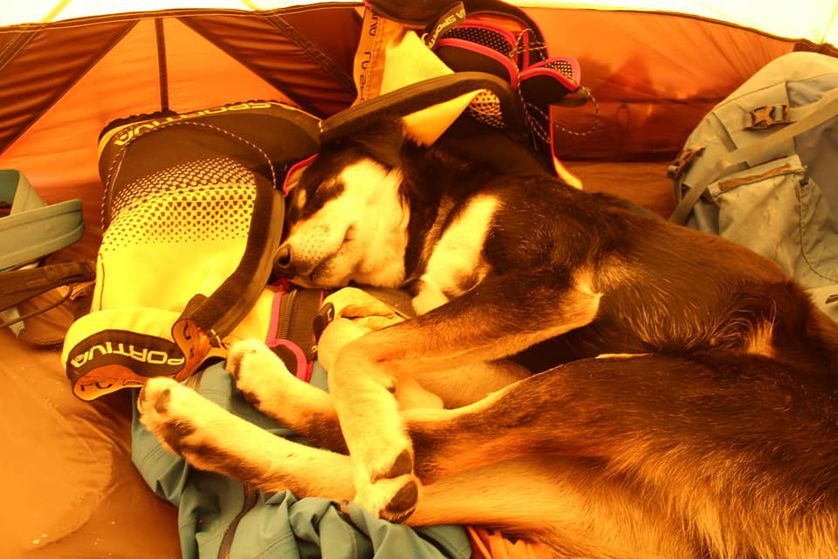
But once Mera decided to join the expedition, she gradually lowered her guard. The first night, Wargowsky tried to encourage her to sleep in his tent, but she wouldn’t come inside. The next morning, he found her curled up outside the flaps covered in a layer of snow. After that, he was able to coax her inside. He gave her one of his sleeping pads and a coat to keep her warm.
Wargowsky was in a difficult position with his uninvited guest. The elements were unforgiving, and he was worried about the dog who had no protection for her paws or her body in conditions that likely reached minus 20 or minus 30 degrees Fahrenheit at times. But he had no luck getting her to leave … and where would she go?
“Obviously my responsibility was to the group, but I was super happy to have her with us. I didn’t encourage her to come along, but I wasn’t going to have her starve, so I would feed her,” he says. “I really tried to persuade her to stay at camp as we got into steeper and more dangerous terrain. Where we were was a more remote part of Nepal. If we didn’t feed her, she was going to starve.”
Mera stuck with the expedition the entire time, never venturing far from Wargowsky’s side. Or technically, his knee.
“She would walk with her nose almost in the back of my knee when we would walk,” he says. “But she wanted to be up front. If I would drop back to hang out with a slower client, she would go up and walk with whoever was up front. She didn’t get out of sight pretty much the entire time we were there.”
‘No clue what her motivation was’
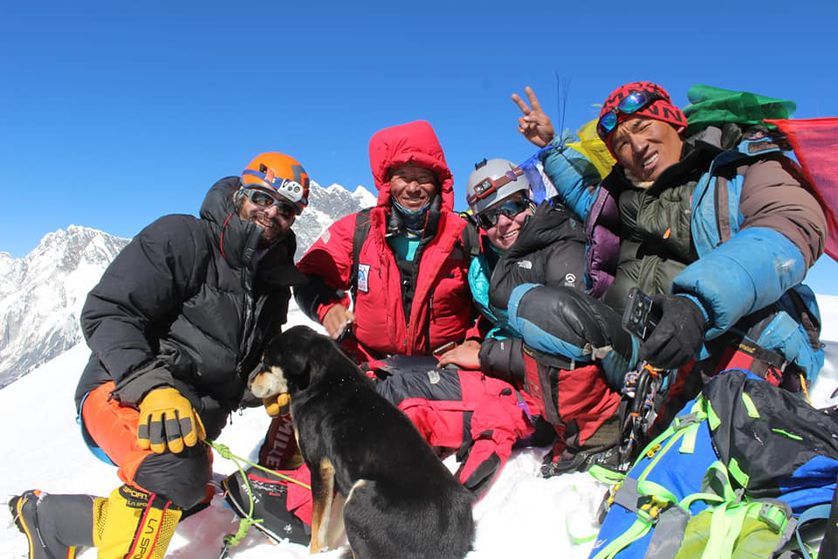
Mera celebrates with her fellow climbers. (Photo: Don Wargowsky)
There was only one time when Mera was gone for several days.
While Wargowsky was working on training with some members of the expedition, showing them how to climb the ice with rope, Mera followed the team’s sherpas instead. They were working to set up ropes to “camp one” at around 20,000 feet. She scrambled up the steep terrain but seemed afraid to go back down and wouldn’t return with them to base camp.
“She ended up spending two nights alone on a glacier at 20,000 feet. I really thought she was going to freeze to death,” Wargowsky says. The sherpas went up to continue working and she was there. But instead of going back down right away, she followed them to 22,000 feet as they continued working before going back to base camp.
The next day when the entire team went to make the climb, Wargowsky tried to keep her at base camp because he didn’t want her to make the steep climb again. He tied her up but she got out of her rope and quickly caught up with them. Wargowsky couldn’t leave his human clients to take her back, so Mera was allowed to stay with the group.
“I have no clue what her motivation was,” he says. “We were feeding her at base camp, so it wasn’t the food. It’s not like there was anything up there for her, but it was amazing to see.”
Tackling the ice and snow
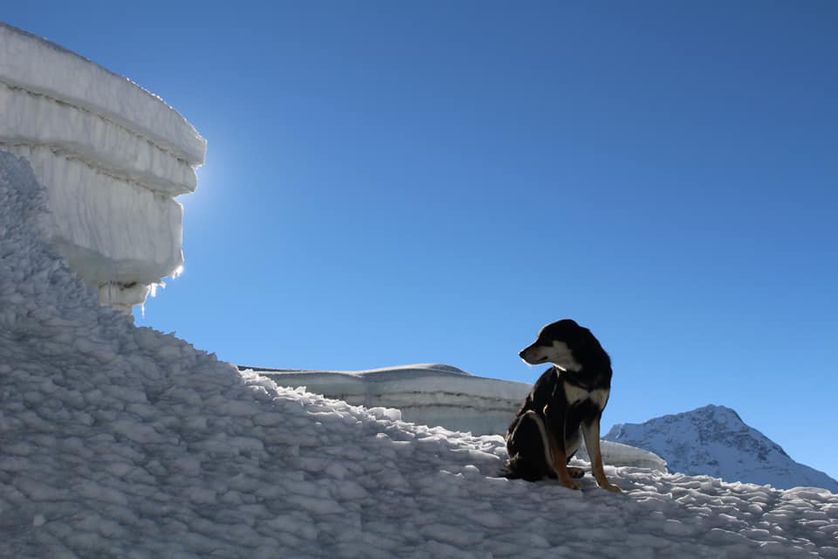
Mera often trotted ahead of the climbers, waiting for them to catch up. The temperatures didn’t seem to faze her. (Photo: Don Wargowsky)
Early on, Mera started to slide and Wargowsky was able to catch her and save her from what could’ve been a dangerous fall. When the team moved to camp two at around 21,000 feet, they were sidelined there for four days because of bad weather. Mera stayed with Wargowsky, who shared his tent and his food with the pup.
“I split all my meals with her 50/50 so we both lost weight,” he says. He guesses the scruffy brown-and-tan stray weighed probably 45 pounds to start with but lost maybe five or 10 pounds during the trip. Wargowsky says Mera looked like a combination of a Tibetan mastiff and a Nepali sheepdog.
Wargowsky was impressed with how well Mera navigated the snow and ice and handled the cold.
“She did very very well like 98 percent of the time. There were certain slopes very early in the morning or late at night when the snow was very crusty and icy when it was very slippery and you could see her kind of struggle with it,” he says. “Her paws got beat up and it was hard to see her paws bleeding a little. But everything healed up that evening and it was all superficial.”
He says it was also hard to believe she didn’t go snow-blind. The humans were all wearing expensive glacier goggles while she trotted along with no protection.
The highest a dog has ever climbed
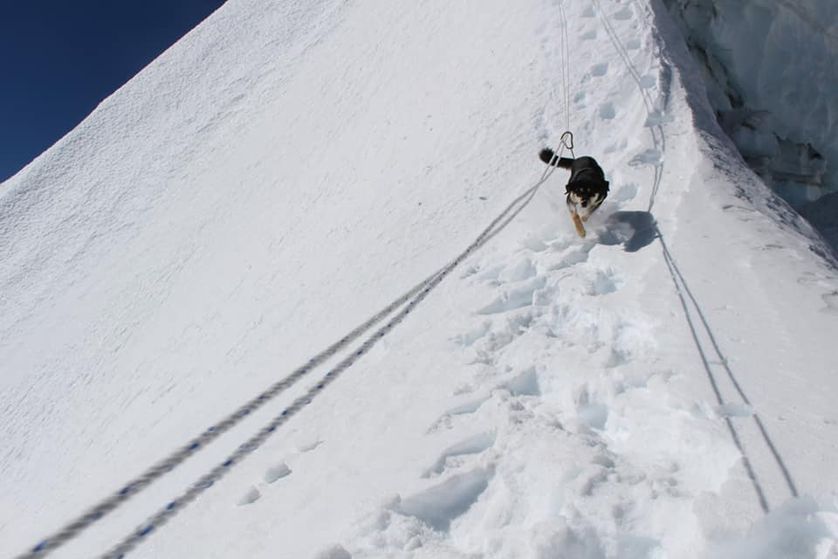
In one particularly harrowing descent, Mera was clipped to a rope to keep her safe. (Photo: Don Wargowsky)
There was only one part of the descent where she was assisted by a rope. Somehow, she had climbed the vertical 15-foot-tall section without incident but when it was time to go back down, she didn’t want to do it. The humans were rappelling, so to coax the dog down safely, they tied a rope harness to her so she could half-run, half tumble. You can see it in the photo above, but Wargowsky points out that the truly harrowing part of the mountain isn’t even visible in the shot.
In the end, when the team — along with their canine mascot — had come down from their completed 23,389-foot climb of Baruntse, Mera was hailed as a bit of a hero. Word had spread about her alleged feat and Wargowsky had to show off photos from his phone to prove she had been with them.
“She was the first dog to ever have climbed that mountain,” he says. “We can’t find anything that says a dog has ever been that high. I believe that is the highest that a dog has ever climbed ever at any point in the world.”
“I am not aware of a dog actually summiting an expedition peak in Nepal,” Billi Bierling of the Himalayan Database, an organization that documents climbing expeditions in Nepal, told Outside. “I just hope that she won’t get into trouble for having climbed Baruntse without a permit.” Bierling told Outside that there have been a few reported cases of dogs at Everest Base Camp (17,600 feet) and some who’ve trailed teams through the Khumbu Icefall up to Camp II (21,300 feet) on Mount Everest, but Mera’s adventure is perhaps the highest-recorded elevation by a dog anywhere in the world.
‘This dog wants to climb mountains’
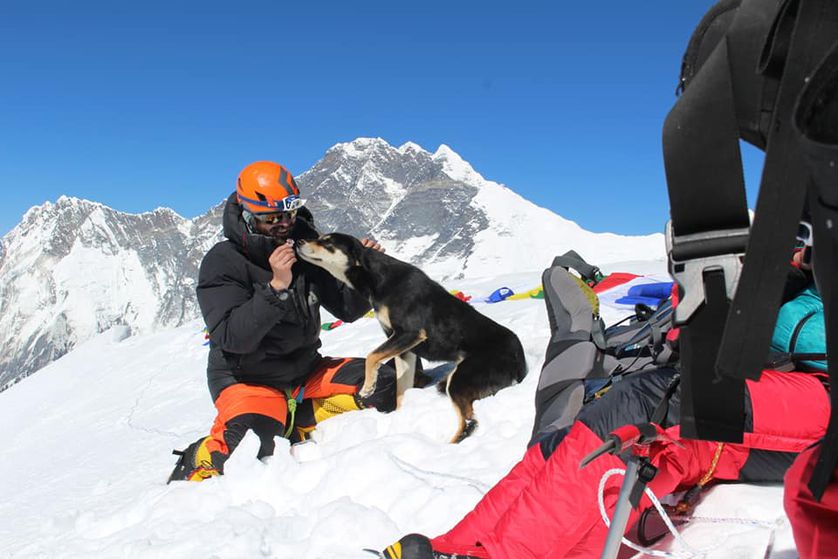
Wargowsky shares his food with his climbing buddy. (Photo: Don Wargowsky)
After all that climbing and bonding, Wargowsky was tempted to bring his new friend home with him to the U.S.
“I really would’ve loved to adopt her. But I live in a 700-square-foot unit in Seattle and this dog wants to climb mountains. I gave it a lot of consideration. I didn’t care what it cost. Despite how much I loved this dog, I thought it would’ve been a very selfish thing to do to bring her to such a small space.”
But he didn’t want to leave what he calls “this hero of a dog” out on the streets. Fortunately, the expedition’s base camp manager was also smitten with the adventurous dog. Because dogs can’t fly, NirKaji Tamang paid someone $100 to walk three days to pick her up until they could get her on a bus and get her to his home in Kathmandu.
After what she had accomplished on Baruntse, Tamang changed the athletic dog’s name to Baru. He took her to the vet to make sure she was healthy. Her injuries quickly healed, and she gained weight.
Wargowsky, who told his remarkable Mera story online, was thrilled recently to receive photos of her. He will be back in Nepal several times this year for expeditions, and he plans on visiting his canine climbing partner.
“With what we had available, I don’t know what more I could’ve done to prevent her from climbing. She was definitely there of her own free will,” he says. “I truly loved that dog.”
ooOOoo
This is such a wonderful account of a stray dog coming into contact with a group of such loving people. Plus, the photographs are wonderful especially the fourth one; just following the Tackling the Ice and Snow sub-heading. I could look at that photograph for ever!
Hi Paul,
I thought that you and Jeannie might like to see this, if you haven’t already done so.
It brought a tear to my eye. Very inspiring – the way the world should be. The best of humanity.
Warm regards
– Margaret K
I read this a few moments ago (10am PST Monday, 18th.) and, without question, knew that I had to republish it. It is done with George Monbiot’s kind permission.
ooOOoo
Re: generation
Why older people must stand in solidarity with the youth climate strikes.
By George Monbiot, published in the Guardian 15th February 2019
The Youth Strike 4 Climate gives me more hope than I have felt in 30 years of campaigning. Before this week, I believed it was all over. I thought, given the indifference and hostility of those who govern us, and the passivity of most of my generation, that climate breakdown and ecological collapse were inevitable. Now, for the first time in years, I think we can turn them around.
My generation and the generations that went before have failed you. We failed to grasp the basic premise of intergenerational justice: that you cannot apply discount rates to human life. In other words, the life of someone who has not been born will be of no less value than the life of someone who already exists. We have lived as if your lives had no importance, as if any resource we encountered was ours and ours alone to use as we wished, regardless of the impact on future generations. In doing so, we created a cannibal economy: we ate your future to satisfy our greed.
It is true that the people of my generation are not equally to blame. Broadly speaking, ours is a society of altruists governed by psychopaths. We have allowed a tiny number of phenomenally rich people, and the destructive politicians they fund, to trash our life support systems. While some carry more blame than others, our failure to challenge the oligarchs who are sacking the Earth and to overthrow their illegitimate power, is a collective failure. Together, we have bequeathed you a world that – without drastic and decisive action – may soon become uninhabitable.
Every day at home, we tell you that if you make a mess you should clear it up. We tell you that you should take responsibility for your own lives. But we have failed to apply these principles to ourselves. We walk away from the mess we have made, in the hope that you might clear it up.
Some of us did try. We sought to inspire our own generations to do what you are doing. But on the whole we were met with frowns and shrugs. For years, many people of my age denied there was a problem. They denied that climate breakdown was happening. They denied that extinction was happening. They denied that the world’s living systems were collapsing.
They denied all this because accepting it meant questioning everything they believed to be good. If the science was right, their car could not be right. If the science was right, their foreign holiday could not be right. Economic growth, rising consumption, the entire system they had been brought up to believe was right had to be wrong. It was easier to pretend that the science was wrong and their lives were right than to accept that the science was right and their lives were wrong.
A few years ago, something shifted. Instead of denying the science, I heard the same people say “OK, it’s real. But now it’s too late to do anything about it.” Between their denial and their despair, there was not one moment at which they said “It is real, so we must act.” Their despair was another form of denial; another way of persuading themselves that they could carry on as before. If there was no point in acting, they had no need to challenge their deepest beliefs. Because of the denial, the selfishness, the short-termism of my generation, this is now the last chance we have.
The disasters I feared my grandchildren would see in their old age are happening already: insect populations collapsing, mass extinction, wildfires, droughts, heat waves, floods. This is the world we have bequeathed to you. Yours is among the first of the unborn generations we failed to consider as our consumption rocketed.
But those of us who have long been engaged in this struggle will not abandon you. You have issued a challenge to which we must rise, and we will stand in solidarity with you. Though we are old and you are young, we will be led by you. We owe you that, at least.
By combining your determination and our experience, we can build a movement big enough to overthrow the life-denying system that has brought us to the brink of disaster – and beyond. Together, we must demand a different way, a life-giving system that defends the natural world on which we all depend. A system that honours you, our children, and values equally the lives of those who are not born. Together, we will build a movement that must – and will – become irresistible.
I confess to not having heard of this endangered species before.
But my son, Alex, sent me an email earlier in the week hoping I would post something on the blog.
ooOOoo
Dear Alex
Creating widespread awareness of the four African pangolin species is an important part of our mission, because if people don’t know what a pangolin is, why would they care enough to help save it?
It’s World Pangolin Day this Saturday and here are two easy ways you can get involved right now:
Share this newsletter
Forward this email to all your friends to encourage them to sign up and receive our updates too. Tag10ForPangolins
Share our latest Facebook campaign tagging at least 10 friends in your post, and help us reach our target of telling 100,000 people about pangolins by Saturday. We’ve just passed the 51,000 mark and with your help we can reach our goal!
With thanks,
Catherine and Team Pangolin
ooOOoo
Every little helps!
And guess what I found:
PANGOLIN – The Most Poached Animal in The World
Pangolins are the most heavily poached animal in the world, despite the fact that most people don’t even know that they exist.
The Pangolin is a small mammal, covered in large overlapping scales. It’s mainly a nocturnal animal with a diet consisting of insects such as ants and termites.
They may look like weird-scaly anteaters, but they are actually not part of the anteater family at all. The 2 most unique features of this animal are, that it is covered in plate armor scales from head to toe, and even though it has four legs, it walks predominantly on it’s hind legs, and uses it’s front legs for griping & digging.
So why are these creatures being so heavily poached? Well It’s all to do with their scales. The Pangolin’s scales & meat are used in traditional medicine, fashion and even eaten in high-end cuisine.
Thanks for watching
And then on Wednesday the BBC News had an extensive item about Pangolins. It’s a long article with a video. Please read it.
You may have already seen this because it was very widely shown.
In the tail end of Deep Adaptation there is reference to Greta’s video because it was so powerful. Young Greta Thunberg is a 16-year-old person who passionately wants this world to change and to change soon.
Here’s the piece that accompanied that video:
In this passionate call to action, 16-year-old climate activist Greta Thunberg explains why, in August 2018, she walked out of school and organized a strike to raise awareness of global warming, protesting outside the Swedish parliament and grabbing the world’s attention. “The climate crisis has already been solved. We already have all the facts and solutions,” Thunberg says. “All we have to do is to wake up and change.”
 Ralph spends the whole hour with independent journalist, Dahr Jamail, author of “The End of Ice,” his first person report on the front lines of the climate crisis.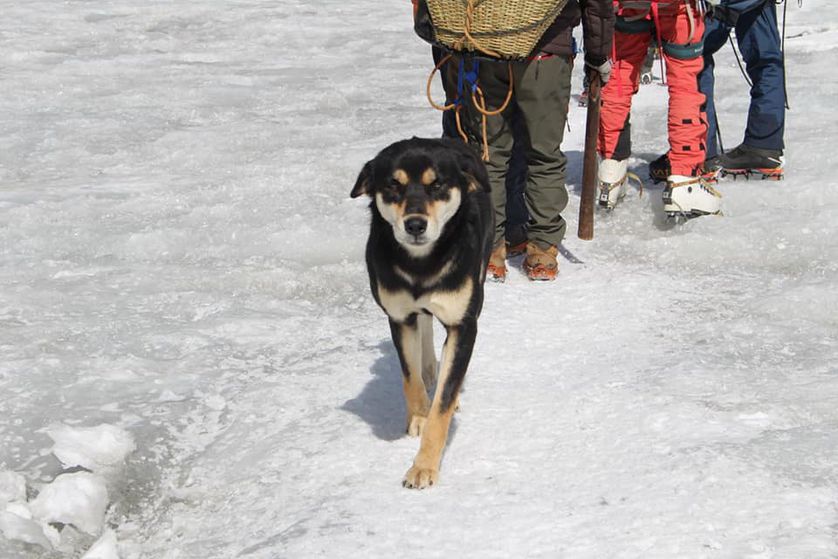



 Dear Alex
 Learning from Dogs