Category: People

And what about mathematics?

Yet another revelation!

Fairly soon after publishing my post about music and the dog world I came across another article on dogs, and other animals, having a sense of numbers.

Now this post which was originally published by The Conversation is intricate in it’s deliberations but it is still clear. Try the article yourself.

ooOOoo

Animals that can do math understand more language than we think

May 28, 2020

By Erik Nelson, Phd Student, Philosophy, Dalhousie University

It is often thought that humans are different from other animals in some fundamental way that makes us unique, or even more advanced than other species. These claims of human superiority are sometimes used to justify the ways we treat other animals, in the home, the lab or the factory farm.

So, what is it that makes us so different from other animals? Many philosophers, both past and present, have pointed to our linguistic abilities. These philosophers argue that language not only allows us to communicate with each other, but also makes our mental lives more sophisticated than those that lack language. Some philosophers have gone so far as to argue that creatures that lack a language are not capable of being rational, making inferences, grasping concepts or even having beliefs or thoughts.
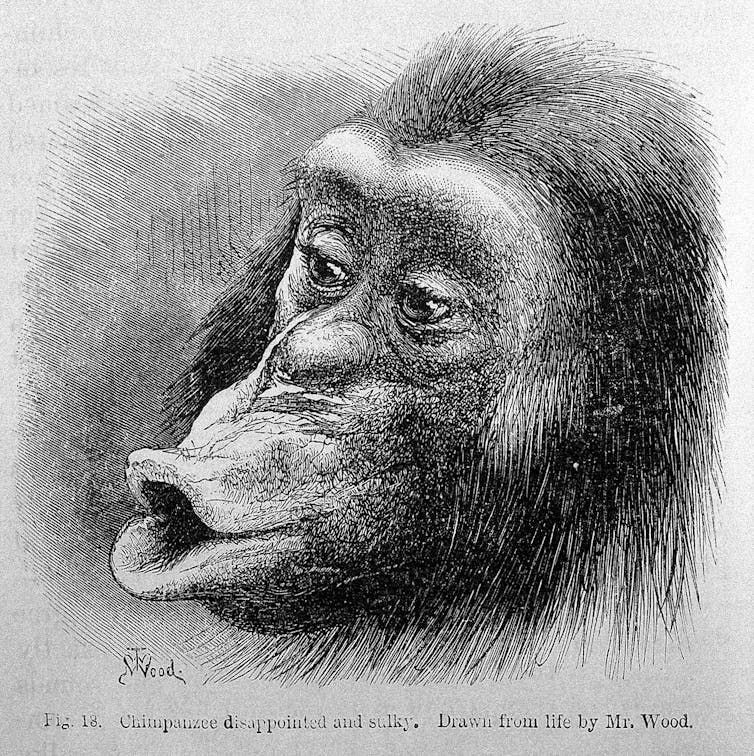
An illustration of a sulky chimpanzee from Charles Darwin’s 1872 book, ‘The Expression of the Emotions in Man and Animals.’ (Wellcome Collection)

Even if we are willing to accept these claims, what should we think of animals who are capable of speech? Many types of birds, most famously parrots, are able to make noises that at least sound linguistic, and gorillas and chimpanzees have been taught to communicate using sign language. Do these vocalizations or communications indicate that, like humans, these animals are also capable of sophisticated mental processes?

The philosophy of animal language

Philosophers have generally answered this question by denying that talking parrots and signing gorillas are demonstrating anything more than clever mimicry. Robert Brandom, a philosopher at the University of Pittsburgh, has argued that if a parrot says “red” when shown red objects and “blue” when presented with blue ones, it has not actually demonstrated that it understands the meaning of those words. According to Brandom — and many other philosophers — understanding the meaning of a word requires understanding both the meaning of many other words and the connections that exist between those words.

Imagine that you bring your toddler niece to a petting zoo for the first time, and ask her if she is able to point to the rabbits. If she successfully does, this might seem like a good indication that she understands what a rabbit is. However, you now ask her to point to the animals. If she points to some rocks on the ground instead of pointing to the rabbits or the goats, does she actually understand what the word “rabbit” means? Understanding “rabbit” involves understanding “animal,” as well as the connection between these two things.

So if a parrot is able to tell us the colour of different objects, that does not necessarily show that the parrot understands the meanings of those words. To do that, a parrot would need to demonstrate that it also understands that red and blue fall underneath the category of colour, or that if something is red all over, it cannot, at the same time, be blue all over.

What sort of behaviour would demonstrate that a parrot or a chimpanzee did understand the words it was using? As a philosopher who focuses on the study of animal cognition, I examine both empirical and theoretical work to answer these types of questions.

In recent research, I argue that testing an animal’s arithmetical capabilities can provide insight into just how much they are capable of understanding. In order to see why, we need to take a brief detour through the philosophy of mathematics.

Counting animals

In the late 1800s, the German mathematician and philosopher Gottlob Frege tried to demonstrate that arithmetic is an objective science. Many philosophers and mathematicians at the time thought that arithmetic was merely an artifact of human psychology. Frege worried that such an understanding would make arithmetic entirely subjective, placing it on no firmer ground than the latest fashion trends.

In The Foundations of Arithmetic, Frege begins by logically analyzing what sorts of things numbers are. He thinks that the key to this investigation is figuring out what it takes to answer the question “how many?”

If I hand you a deck of cards and ask, “How many?” without specifying what I want counted, it would be difficult to even figure out what sort of answer I am looking for. Am I asking you how many decks of cards, how many cards all together, how many suits or any of the other number of ways of dividing up the deck? If I ask, “How many suits?” and you respond “four,” you are demonstrating not just that you can count, but that you understand what suits are.

Frege thought that the application of number labels depends on being able to grasp the connection between what is being counted and how many of them there are. Replying “four” to the question “How many?” might seem like a disconnected act, like parrots merely calling red objects “red.” However, it is more like your niece pointing to the rabbits while also understanding that rabbits are animals. So, if animals are able to reliably respond correctly to the question “How many?” this demonstrates that they understand the connection between the numerical amount and the objects they are being asked about.

Animal mathematical literacy

One example of non-human animals demonstrating a wide range of arithmetical capabilities is the work that Irene Pepperberg did with African grey parrots, most famously her subjects Alex and Griffin.

In order to test Alex’s arithmetic capabilities, Pepperberg would show him a set of objects on a tray, and would ask, “How many?” for each of the objects. For example, she would show him a tray with differently shaped objects on it and ask, “How many four-corner?” (Alex’s word for squares.) Alex was able to reliably provide the answer for amounts up to six.

Alex was also able to provide the name for the object if asked to look for a number of those objects. For example, if a tray had different quantities of coloured objects on it including five red objects, and Alex was asked, “What colour is five?” Alex was able to correctly respond by saying “red.”

Pepperberg’s investigations into the ability to learn and understand basic arithmetic provide examples that show that Alex was able to do more than simply mimic human sounds. Providing the right word when asked, “How many?” required him to understand the connections between the numerical amount and the objects being asked about.

Animal mathematical skills

While Pepperberg’s results are impressive, they are far from unique. Numerical abilities have been identified in many different species, most prominently chimpanzees. Some of these capabilities demonstrate that the animals understand the underlying connections between different words and labels. They are therefore doing something more than just mimicking the sounds and actions of the humans around them.

Animals that can do basic arithmetic show us that some really are capable of understanding the terms they use and the connections between them. However, it is still an open question whether their understanding of these connections is a result of learning linguistic expressions, or if their linguistic expressions simply help demonstrate underlying capabilities.

Either way, claims that humans are uniquely able to understand the meanings of words are a bit worse for wear.

ooOOoo

There’s little that I can add to the excellent summary in that penultimate paragraph;

Animals that can do basic arithmetic show us that some really are capable of understanding the terms they use and the connections between them. However, it is still an open question whether their understanding of these connections is a result of learning linguistic expressions, or if their linguistic expressions simply help demonstrate underlying capabilities.

but one thing is becoming clearer and clearer: dogs and other animals are a whole lot smarter than many (most?) of us think. Primarily on the back of research into the nature of our creatures and especially those creatures that are very close to us.
A sailing memory, part two.

Again, this is for Pendantry.

I left yesterday’s post with the statement: “However, getting to Gibraltar was not without its challenge for we suffered a knockdown and this scared us both to the core.

This is the account of that knockdown.

ooOOoo

The knockdown

So this was it, the end of life. This is what that end felt like. A lifetime of experiences reduced to this stilled moment; all my hopes, dreams, pleasures, memories, everything shrunk to this tiny moment of now.

I knew, in some trance-like way, that if just one of those foaming, giant waves swept across us, so utterly over-whelmed as we were on our side, it would flood the cabin, and down Dave and I and the yacht would go.

Other sensations came to me. Feelings of quiet, of calm, even of peace. My world now reduced to close, intimate dimensions. To the yacht’s wheel, to which I so grimly hung. To the front edge of the port cockpit seat, now underneath me, against which I braced my feet. To the starboard guardrail, bizarrely above my head, and to those raging seas so very close that seemed to beckon, ‘Give up, give up now and slip away.’

Me and Dave, alone in this Mediterranean storm 10 days West of Cyprus, are going to drown, founder without trace in these vast waves and probably end up not being missed for many days. Our dream of sailing across the Atlantic snuffed out as easily as Songbird of Kent would sink the 5,000 feet down to the seabed. The futility of it all.

It was a strange, detached perspective that hardly registered the gusts coming at us like great padded hammers. This unimaginable gale that had Songbird of Kent, my floating home for the last 5 years, totally pressed down on her port side, even though the yacht offered nothing more to the winds than her bare mast and rigging.

From within the cabin, Dave could do no more than simply watch. Hunkered down outside, I could do no more than simply hang-on. Both of us transfixed in this stillness of life’s imminent ending. Dave would later say no words would ever properly describe what his eyes had seen.

My past life, rather ominously, started running before me. How one year, in the early 1950s, when I was 7 or 8 years old, my parents had rented a holiday villa in the French Atlantic coastal town of Arcachon. What a glorious summer holiday that had been.

Arcachon’s beautifully sheltered bay had enabled me to learn to swim. The buoyant sea-water helping me increase the number of strokes each day, until one afternoon I had swum out to a yacht anchored well off the beach. As I hung on to the anchor chain, panting hard, the owner looked over the guardrail. Next, me being rowed back to the beach in a dinghy and then everyone getting to know Englishman John Calvert, a solo sailor living aboard his yacht, Garrawog.

Next year we had holidayed again in Arcachon and found Garrawog moored in the small yacht harbour. I recalled fond memories of sitting in the cabin with my father and John Calvert, drinking lemonade, eating cream crackers and loving the cosiness of it all.

Then the amazing coincidence when the following year we had holidayed at the French Mediterranean town of Menton and Garrawog had sailed into the harbour. That had led to John taking us sailing along the coast, memories so vivid, all these years later, of helping to haul sails, steer Garrawog, even remembering the gentle nudge of the yacht into the waves.

I was clear how those memories had fuelled my romantic obsession with sailing. How as a young teenager growing up in London I had joined the Welsh Harp sailing club, based at a large lake, well a reservoir, just three miles from home, and learnt to sail a dinghy. All fuelling this fascination with the sea. Yet that romantic obsession didn’t revolve around idyllic meanderings along the Mediterranean coastline. No, my dreams involved ocean sailing. Not even as part of a crew, but sailing, single-handed, across the oceans.

I had devoured every book written by those sailors who, totally alone, had journeyed the vast oceans in a small yacht. Joshua Slocum, who wrote of his solo trip around the world in his yacht, Spray, way back in 1895. Master English navigator, Francis Chichester, who conceived the idea of a single-handed yacht race across the Atlantic ocean, later completing a round-the-world solo circumnavigation in his yacht, Gipsy Moth IV. Eric Tabarly, Chay Blyth, Robin Knox-Johnston and many more.

I reflected how that dream had remained with me for years. All through nearly 20 years as a salesman and entrepreneur to the point when, quite suddenly, on a Monday in the Spring of 1986, uncharacteristically I had nothing in my diary for that day, or for many days ahead. I had just sold my thriving company in Colchester and there was no longer a job to go to!

Then not so long after I had taken a holiday in Larnaca and in wandering around the marina I had seen Songbird of Kent for sale, and had bought it! I had previously read about Tradewind yachts and knew how many had made world circumnavigations. Thus by the end of 1986, my new address had become: Yacht ‘Songbird of Kent’, Larnaca Marina, Cyprus.

A shout from Dave jerked me back to the real world.

Hey, is it my imagination or is that wind easing?

I lifted my head and turned my face into the weather coming full at us. The seas were just as terrible but, yes, something was different, some subtle lowering of the tone of the wind.

Dave, you’re right, it has eased back a bit. We’re not so pressed down, are we?

Don’t think so. What do you reckon?

Not sure what to do, frankly these conditions scare the shit out of me!

In the subtlest way imaginable, Songbird provided the answer. The yacht now showed some response to the waves rather than previously being so overwhelmed. A tiny thought entered my mind, something I hardly dared acknowledge: Songbird is not going to founder.

Those 3 tons of lead at the bottom of Songbird’s keel were, at last, overcoming the wind pressure on her topsides and with seawater cascading down from the mast and rigging, the yacht slowly righted and bestowed on me and Dave the continuation of our lives. A miracle of miracles!

I quickly helmed the bow round to point us downwind, putting the full force of the gale directly aft. Within moments, a wave slowly started to overtake us but I couldn’t do anything other than keep my eyes on the mast-head wind-vane that, against all odds, had stayed intact during the knock-down. Watching the arrow head that absolutely had to keep pointing directly into the wind. We may be upright but one slip of steering, one moment’s loss of concentration and I knew we would slew broadsides to the seas and go over again.

I couldn’t believe the size of this wave that lifted us up and up, as if we were in giant, invisible hands. Up to the foaming crest from which was revealed, all around us, wild, angry, jagged waves, huge crests covered in white foam, an Alpine-like scene of raging hell as far as the eye can see. A vista of utter desolation.

Then the foaming crest moved ahead of us and Songbird slid down that vast lee of the wave, down towards the trough that lay behind us. Our bowsprit pointed directly into the dark green water ahead, water streaked with spume, as down and down we went until the inevitable arrival of the next wave started us up to another foaming crest.

We had survived what we could never have imagined. Hardly believing it, we intuitively knew that surviving that first wave increased the odds of us surviving the next few. Then the next few, and the next few until, against all expectations, we knew we stood a chance of living through it all.

I spotted something in the water and shouted, “Dave, look, look there in the water, just to our left. That bit of sail, surely not from our mainsail?

As we ran before the weather, a scrap of white sail had surged past our side, a piece of sail bearing the number 33 and two palm trees, the symbol of a Tradewind 33 yacht.

Dave laughed, “I can’t believe that, Paul. It’s from the mainsail that blew out when the gale first struck. How amazing! It must be from us, can’t be too many other Tradewind 33s out here!“.

Imagine that, Dave, after all that we have been through these past few hours, we’ve just sailed by a bit of our mainsail, close enough to have grabbed it.

That triggered my mind as to when this terrible experience started. How long ago was that? I didn’t have a clue, though surely it couldn’t have been much more than an hour or so ago. Indeed, I struggled to think what day it was, then realised it was Thursday, October 8th, 1992. Just 24 hours since we had left the dirty, commercial port of Algiers for the last leg of our trip from Larnaca in Cyprus to Gibraltar.

Dave, hand me the log, it’s at the back of the chart table.

I read,

Thursday, 8th October, 1992.

08:20 Sea state terrible.

I recalled how the dawn had revealed banks of low angry clouds, skidding across the tops of a nasty swell, made even worse by a vicious cross-swell. The next entry after that read,

09:00 Sky extremely threatening. Wind NE F4. Just 16 miles east of Greenwich meridian.

Then we had approximately 3 hours of sailing to go before we crossed Greenwich. On to the last entry,

12:00 Sea extremely ugly, Wind NNE F5. Longitude 2 minutes East of Greenwich.

Just 15 minutes from crossing that historical navigational line. I recalled how we had chatted about sharing a glass of something to celebrate ‘crossing the line’! Then how my words had been torn away when, in a seeming instant of time, this huge squall had come out of the North, heralding this vast, cauldron of a storm. The mainsail, even tripled-reefed, was way too much sail. But it was far too dangerous to leave the cockpit to drop the sail, too much to do anything other than hang on.

The mainsail failed, ripped into shreds as it tore away from the mast-track and disappeared into the storm. The sounds of the event obliterated by the screaming noise of a wind that I had guessed was now more than 50 knots. The rain and spray had stung my face so hard that I needed to turn my head away just to breathe. Clearly something had to give; I expected the mast to fail.

But it didn’t! Instead, as the wind force grew and grew, it steadily pressed us further and further over until Songbird ended up fully horizontal to the sea. It seemed a lifetime ago.

I looked at my watch: 5.30pm. To hell and back in so few hours!

Dave, what’s our position?

Dave ducked out of sight to read the GPS, came back out with a slip of paper on which he had written our position: Eight minutes of longitude west of the Greenwich meridian. We were now in the Western hemisphere!

Come on, Dave, you take the wheel. I’m going to fetch a couple of beers.

I reckon a double celebration, Paul, crossing the Meridian and living to tell the tale!

We drank our beers, chit-chatted about nothing much, both aware that we had literally stared into the abyss of a dark watery grave, and sailed on.

Just before 13:00 on Saturday, October 10th, Songbird rounded Gibraltar’s breakwater, briefly rolled in the cross-swell, and slipped into the calm waters of the inner harbour.

Soon we were safe and secure in a marina berth, a few minutes walk from good food and friendly bars. Our experiences rapidly migrated into the private worlds of our minds, as if discussing it openly might replay it all with a different, more tragic, outcome.

I struggled through those first nights of sleep. Again and again I awoke, panic across my chest, clinging to the sides of my bunk, trying to lay all the nightmares to rest. Slowly, those October days resting up in Gibraltar shone a light on this sailing obsession. How, with the sudden death of my father in 1956, those memories of idyllic times in and around Garrawog had buried themselves deep into my hidden emotional world. How dreams of sailing had more to do with keeping the memory of my father alive than with anything else.

That gale expunged the obsession. I never sailed on Songbird again or, for that matter, on any other sailing vessel. Paid crew eventually returned Songbird to England, where she was subsequently sold.

I would never forget the stillness I had experienced in the midst of all that chaos, but one knock-down in a lifetime was more than enough.

ooOOoo

This is absolutely a true account of what happened. Yes, an intimate, personal account of what happened but accurate down to the last detail.

I am so pleased I kept a written account of the knockdown all those years ago for if I was to recall it today then much of the detail would have been lost. Maybe lost as a result of old age or lost as a consequence of not wanting it in one’s mind. Who knows.

Finally, there are no photographs because we just had more important things to look after – keeping ourselves alive!

A sailing memory, part one.

This is for Pendantry!

There was a remark left on my post on Tuesday by Pendantry. This is what he said, “Still waiting to hear the story of that dangerous trip you took (once?) that you dropped a teaser about years ago….

Well not only am I including the excerpt from the book Letter to a Grandson, as yet unpublished, but I am extending it to two posts, simply because I think it’s too long for one.

So this is part one.

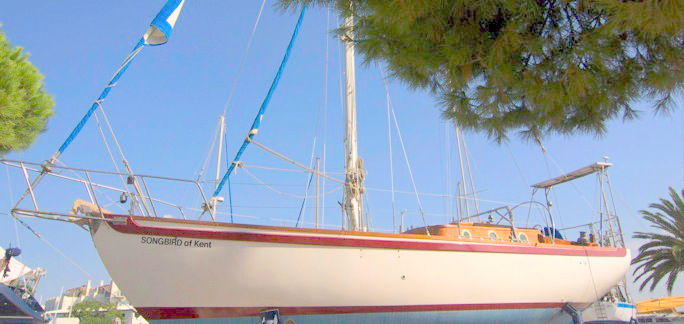
Tradewind 33 – Songbird of Kent. My home for five years.


ooOOoo

Songbird Of Kent

I decided to sell Dataview and worry about the taxation later. Now it is easy to write that all these years later knowing how it turned out; I never paid the tax!
For that same year, 1986, I went to Cyprus on holiday. Or rather I should say I went to the Greek half of Cyprus, to Larnaca, for a well-deserved holiday.

In wandering around the marina one day I saw a boat for sale. It was a Tradewind 33, a heavy-displacement cutter, called Songbird of Kent. The owners, Michael and Betty Hughes, were selling after many years of living on board and they returning to their native Wales. It had been extensively cruised in the Mediterranean with the base being Larnaca Marina.


It was a lovely boat and I could afford it. Plus, it offered an answer to my prayers. If I bought Songbird of Kent and left the UK before April 15th 1987 and stayed away for four tax years there would be no tax to pay. Nothing; Nada!
So that’s exactly what I did!


I bought Songbird, flew back to Devon and made preparations for leaving the United Kingdom for good. It was a busy period. One that had me saying cheerio to my son and daughter, but insisting that, so long as they came out to see me, it would not be four or five years before I saw them again. Plus loads of packing up, disposing of my house and eventually boarding that aircraft with a one-way ticket: London Stansted to Larnaca, Cyprus.


I settled in to living on board Songbird of Kent. I bought myself a small motorbike and in time, believe it or not, discovered there was a gliding club on the Island, at Kingsfield just to the East of Larnaca. The airfield was built for the Army Air Corps, possibly around 1960, but I can’t remember whether or not it was still in military hands. I don’t think it was!

But, I am able to look up my flying log and see that I flew a T21 from Kingsfield on the 28th October, 1990. It became a regular habit; quite quickly, as on the 17th November, 1990, I completed my instructor flight test and was signed off to instruct.
I also took an Advanced Open Water Diver course run by instructor Ian Murray. Ian was a PADI diving instructor. PADI stood for Professional Association of Diving Instructors.

My life was pretty good.


Each summer I would sail solo to Turkey, usually West along the South coast, the Greek side of Cyprus, then turn North and make it to Alanya or Antalya. There I would wait for guests to come from England including, most importantly, for Maija and Alex to visit.
Then we would gently cruise from harbour to harbour westwards, sometimes entering Greece much further West.

One day in Larnaca Marina a boat came quietly in and moored in the vacant berth next to me. I hopped off Songbird and went to help the sailor on board. It looked as though he was sailing solo.
After he had been securely moored, I asked him where he had come from. He was English; his name was Les Powells. He unassumingly said he was on his way home after a solo circumnavigation. Indeed, I later learned that it was his third solo circumnavigation!

The mind absolutely boggles! I mean I have just an idea, from reading books written by Francis Chichester and others, what a single solo circumnavigation would be like. But three!!
Over the coming days, we chatted about a whole range of stuff. When the subject of glider flying came up, Les said that was something he had always wanted to do.

I immediately offered to teach him to fly gliders. For a few weeks thereafter, we drove across to Kingsfield, when the Club was operating, and I taught Les up to the point where he went solo.
In the time we spent together, Les inspired me to undertake more longer sailing trips than just going across at the start of the season from Cyprus to Turkey and, of course, returning at the end of the season. Maybe, even try a transatlantic.

The idea of crossing the Atlantic kept nudging away at me. Especially since Dave Lisson, a Canadian friend from Larnaca Marina, was very much in favour of coming with me. Dave and I chatted about it and we agreed; we would give it a go! It was 1992 and a little late in the year to be starting off but we reckoned on it being alright. We left Larnaca Marina on the 10th September, 1992.


The idea was to head for Malta bypassing Crete. The weather soon became less than idyllic and by late on 13th September I made an entry in the sailing log: Conditions deteriorating. Then a further entry in the log at 11:00 on the 14th: Giant seas 3-4 metres.

Eventually on the 20th September we entered Valletta Harbour. We set off again on the 24th September. Our next port of call was Sidi Bou Said marina in Tunisia, which we entered on the 26th September.

The plan was to sail directly from Sidi Bou Said to Gibraltar but, once again, the weather got in the way. Thus on the 3rd October we entered Algiers harbour to take on fuel and to have a rest from the inclement conditions. We left Algiers on the 7th October heading for Gibraltar.


I must say that sailing in a smallish yacht had an almost unreal quality to it. The routine of sailing soon enveloped us. We slept frequently but lightly. At night, every twenty minutes or so, the one on watch would come on deck to take a look round. There was a simplicity in sailing, using a self-steering gear to helm the boat, and I remember one night coming on deck, there wasn’t a moon, and all around me, literally 360 degrees of vision, the stars came right down to the horizon. I was transfixed. We were far enough from land not to have any light pollution. It was magical. Indeed, it was a memory that has never left me.


However, getting to Gibraltar was not without its challenge for we suffered a knockdown and this scared us both to the core.

ooOOoo

Part Two tomorrow.

Our modern connected world!

A delightful conversation with Amit Roy.

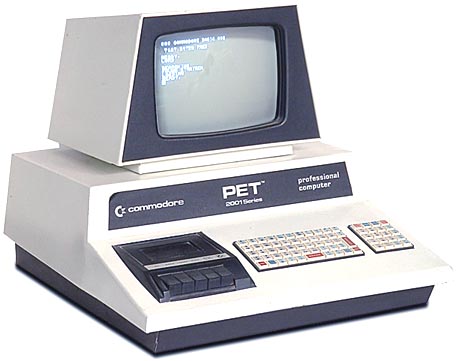
Way back in 1978 I started a company called Dataview. It was based in Colchester, Essex and I sold Commodore Computers; the ‘PET”, standing for Personal Electronic Transactor.

A photograph of a very early PET.

Now I was a word-processing salesman for IBM previously and didn’t know a thing about computers. I operated out of a small shop at first in Church Street and people came into the shop and played around with my demonstration models. Unbelievably I sold some!

Later I got involved with a software program known as Wordcraft. The first comprehensive word processing program for the PET. Indeed, I had the exclusive world distribution rights to Wordcraft. One thing lead to another and soon I was operating from much larger premises down at Portreeves House at East Bay, still in Colchester.

I appointed a Head of Marketing, Amit Roy, and the company grew and grew. I focused on appointing distributors across the world, and that included Dan Gomez in southern California, and he became a close friend being my best man when Jeannie and I were married in 2010.

Anyway, back to the story of Dataview. Eventually I sold out and escaped the country (and taxes) by moving to a yacht in the Greek side of Cyprus before April 15th. I went to Larnaca Marina. That was in 1986.

On Sunday, through a link from a mutual friend, I called Amit, the first time we had spoken since 1986. We had the most delightful of telephone conversations.

Amit was born in Burma, he is now 79, and lost his wife some 13 years ago. The counsellor who saw Amit after the death of his very dear wife said that he had to be strong and to take up something he could become passionate about. Amit joined the Colchester Photographic Society and took up studying again, in photography, and became a very good photographer.

With Amit’s permission I share some of his photographs with you.

The Red Arrows Flying After Dark

oooo

Firstsite At Dusk

oooo

Mischievous Boys of Bengal – India

oooo

Orchid Isabelia Pulchella

oooo

Felixstowe Docks at Dusk

oooo

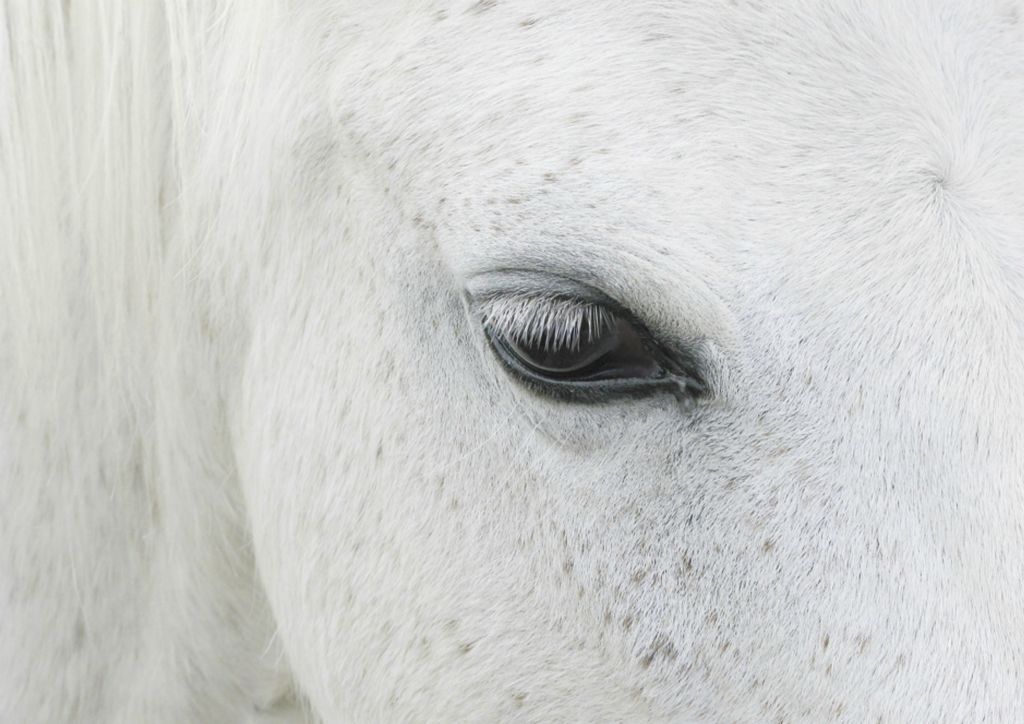
Horse Study

These are just a few but they are superb; absolutely marvellous.

That is the most welcome of connections – thanks to Roger Davis for suggesting it!

The smell of COVID-19!

That is to a dog!

It was only a matter of time before the dog’s supreme sense of smell came to the aid of COVID-19 hunters!

A dog has a sense of smell that is 10,000 to 100,000 times more acute than that of a human.

Picture taken from NOVA.

But back to COVID-19.

Here’s an article from the Smithsonian.

ooOOoo

Dogs Are Being Trained to Sniff Out COVID-19

Researchers are attempting to teach eight dogs to detect the pandemic, which could help quickly screen large numbers of people in public places

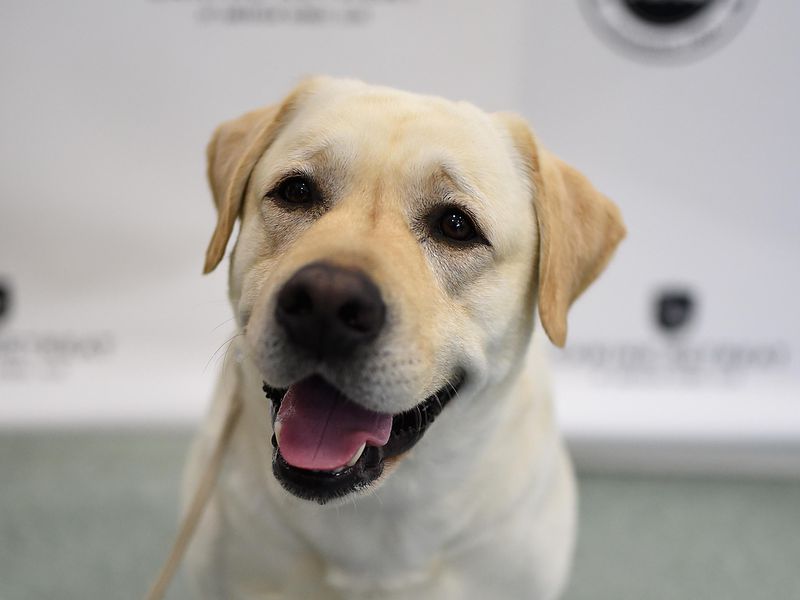
This yellow lab is not involved in the research, but it still a very good doggo. (Photo by Jamie McCarthy/Getty Images)

By Alex Fox     smithsonianmag.com
May 1, 2020

Dogs are being enlisted in the fight against the novel coronavirus. Researchers at the University of Pennsylvania are testing a pack of eight Labrador retrievers to find out if their sensitive snouts can detect the pandemic virus by scent, Karin Brulliard reports for the Washington Post.
Humans have trained our canine friends’ finely tuned noses to sniff out other deadly diseases, including malaria, diabetes, some cancers and Parkinson’s disease, reported Ian Tucker for the Guardian in 2018. Other research has shown that viruses give off a particular smell, Cynthia Otto, director of the Working Dog Center at UPenn’s School of Veterinary Medicine, tells the Post.

If the dogs’ 300 million scent receptors can be trained to smell the novel coronavirus they could eventually be used in public places such as airports, businesses or hospitals to quickly and easily screen large numbers of people. Because this diagnosis by dog would depend on the smell given off by people infected with COVID-19 it should have no problem picking out asymptomatic carriers.

The yellow, black and chocolate labs will be trained for three weeks using a process called odor imprinting. Miss M., Poncho and six other dogs will be exposed to COVID-19 positive saliva or urine collected from hospitals and then rewarded with food when they pick out the correct samples, according to a statement from UPenn. When the dogs have the scent, they’ll be tested to see if they can pick out COVID-19 positive people.

“We don’t know that this will be the odor of the virus, per se, or the response to the virus, or a combination,” Otto, who is leading the project, tells the Post. “But the dogs don’t care what the odor is. … What they learn is that there’s something different about this sample than there is about that sample.”

Dogs are also being trained for this purpose in the United Kingdom by the charity Medical Detection Dogs in collaboration with Durham University and the London School of Hygiene and Tropical Medicine, reports the BBC.

“This would help prevent the re-emergence of the disease after we have brought the present epidemic under control,” Steve Lindsay, public health entomologist at Durham University, tells the BBC.

The U.K. trial expects to start collecting COVID-19 positive samples in the coming weeks and will train its dogs shortly thereafter, per the Post. If the trial is successful the group aims to distribute six dogs to be used for screening in U.K. airports.

“Each individual dog can screen up to 250 people per hour,” James Logan, epidemiologist at Durham University and collaborator on the project, tells the Post. “We are simultaneously working on a model to scale it up so it can be deployed in other countries at ports of entry, including airports.”

Otto tells the Post that the trial could inspire an electronic sensor that could detect COVID-19 which might be able to rapidly test thousands of people. But if the dogs’ olfactory prowess can’t be replicated, then the ability to scale up could be limited by another issue: the U.S.’s shortage of detection dogs.

ooOOoo

The list of fabulous skills that dogs have and their ability to help us humans out is practically endless.

To be more to the point, if dogs really can make a difference in determining who has got COVID-19, especially at airports, then this is a step to eventually returning to a more open and normal lifestyle.

May it happen!

I would like to close by returning to that NOVA article and republishing the following:

Put another way, dogs can detect some odors in parts per trillion. What does that mean in terms we might understand? Well, in her book Inside of a Dog, Alexandra Horowitz, a dog-cognition researcher at Barnard College, writes that while we might notice if our coffee has had a teaspoon of sugar added to it, a dog could detect a teaspoon of sugar in a million gallons of water, or two Olympic-sized pools worth. Another dog scientist likened their ability to catching a whiff of one rotten apple in two million barrels.

Incredible!

Hubble into music.

Back to the space telescope!

I cannot stop engaging in Hubble stories and republishing them in this place.

The latest is an account, published here, of how scientists turned an image of a galaxy into music! Or rather added music to the video.

Here it is!

ooOOoo

Cool! A Hubble photo translated to music

Posted by in | May 10, 2020

There’s no sound in space. But – working with NASA – musicians and scientists turned a Hubble Space Telescope image of a galaxy cluster into music.

We stumbled on this video via a May 3, 2020, re-post at ScienceAlert. Matt Russo and Andrew Santaguida of System Sounds in Toronto – which calls itself “a sci-art outreach project” – created the video. It’s part of NASA’s Astrophysics Visualizations series. NASA explained the video this way:

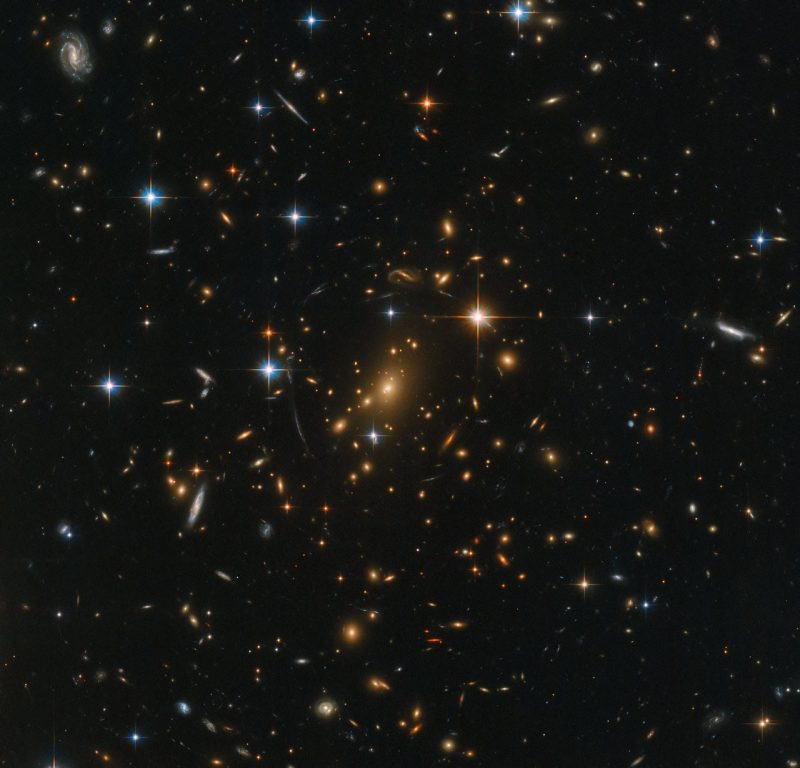
Space becomes sonified in this visualization of a cluster of galaxies imaged by NASA’s Hubble Space Telescope. Time flows left to right, and the frequency of sound changes from bottom to top, ranging from 30 to 1,000 hertz. Objects near the bottom of the image produce lower notes, while those near the top produce higher ones. Most of the visible specks are galaxies housing countless stars. A few individual stars shine brightly in the foreground. Stars and compact galaxies create short, clear tones, while sprawling spiral galaxies emit longer notes that change pitch. The higher density of galaxies near the center of the image – the heart of this galaxy cluster, known as RXC J0142.9+4438 – results in a swell of mid-range tones halfway through the video. Hubble’s Advanced Camera for Surveys and Wide Field Camera 3 acquired this image on August 13, 2018.

Cool!

Here’s the original Hubble image of galaxy cluster RXC J0142.9+4438, later “sonified” by Russo and Santaguida. NASA wrote: “Galaxies abound in this spectacular Hubble image; spiral arms swirl in all colors and orientations, and fuzzy ellipticals can be seen speckled across the frame as softly glowing smudges on the sky. Each visible speck of a galaxy is home to countless stars. A few stars closer to home shine brightly in the foreground, while a massive galaxy cluster nestles at the very center of the image; an immense collection of maybe thousands of galaxies, all held together by the relentless force of gravity.” Read more about this image, which is via ESA/ Hubble & NASA, RELICS.

Here’s the original Hubble image of galaxy cluster RXC J0142.9+4438, later “sonified” by Russo and Santaguida. NASA wrote: “Galaxies abound in this spectacular Hubble image; spiral arms swirl in all colors and orientations, and fuzzy ellipticals can be seen speckled across the frame as softly glowing smudges on the sky. Each visible speck of a galaxy is home to countless stars. A few stars closer to home shine brightly in the foreground, while a massive galaxy cluster nestles at the very center of the image; an immense collection of maybe thousands of galaxies, all held together by the relentless force of gravity.” Read more about this image, which is via ESA/ Hubble & NASA, RELICS.

Bottom line: Musicians and scientists turned a Hubble Space Telescope image – of galaxy cluster RXC J0142.9+4438 – into music.

ooOOoo

That is so lovely.

It’s only just over half a minute long but is still precious!

And I learnt a new word: sonification!

Golden Brown

A musical classic!

We were listening to the radio early on Tuesday morning and the BBC News played a tribute to the recent death of Dave Greenfield. Here’s a little bit of that BBC News piece:

The Stranglers keyboard player Dave Greenfield has died at the age of 71 after testing positive for Covid-19.

Greenfield died on Sunday having contracted the virus after a prolonged stay in hospital for heart problems.

He penned the band’s biggest hit, Golden Brown, a song about heroin, which went to number two on the UK singles chart in 1982.

The Stranglers bass player Jean-Jacques “JJ” Burnel paid tribute to Greenfield as a “musical genius”.

He said: “On the evening of Sunday May 3rd, my great friend and longstanding colleague of 45 years, the musical genius that was Dave Greenfield, passed away as one of the victims of the Great Pandemic of 2020.

“All of us in the worldwide Stranglers’ family grieve and send our sincerest condolences to [Greenfield’s wife] Pam.”

Drummer Jet Black added: “We have just lost a dear friend and music genius, and so has the whole world.

“Dave was a complete natural in music. Together, we toured the globe endlessly and it was clear he was adored by millions. A huge talent, a great loss, he is dearly missed.”

There’s more to read but I wanted to republish one of the photographs taken:

(Left to right) Dave Greenfield, Jean-Jacques Burnel, Jet Black and Hugh Cornwell of The Stranglers in 1980

Then to close my tribute to Dave here’s a beautiful rendition of that most famous song – Golden Brown.

https://youtu.be/AWAsI3U2EaE

A classic, a real classic.

The loss of Dave Greenfield. A loss to us all!

Brandy goes walkabout!

A couple of nerve-twisting hours!

Yesterday morning, well before 7am, we let all the dogs out for their morning walks, smells and ablutions! They are let out on our property.

Ten minutes later all of them were back home save one: Brandy!

Then followed a good couple of hours while I, and then later Jeannie and I, walked the entire property, all 13 acres, looking for Brandy. To no avail. He appeared to have disappeared. It’s not helped by the fact that Brandy has poor hearing and can’t really hear calls more than thirty feet away.

At one point I went out with Cleo, our GSD, who has a supreme sense of smell and excellent hearing, to look for Brandy. No luck!

I was getting very stressed and while Brandy at times does go for a walk on his own he had never been gone for this long.

Brandy!

Well eventually, with the help of our new neighbours, we located Brandy and, in time, got him back in the house. The only way off the property is via Bummer Creek, which flows across our property, under a bridge built on our driveway, that is not fenced. Only Brandy sometimes takes a stroll down the creek. Brandy had done so this morning and ended up past our neighbours property, a good quarter mile or more downstream.

It was then time to go across and thank our neighbours for their help. I was invited in for a coffee and also spent time with the eight-year-old, soon to be nine, chatting about this and that, and, towards the end of the coffee, about writing!

This was lovely and I said that if aforesaid young man was to write a story about one of their two dogs I would love to feature it as a guest post in this place!

Then when I came home I was thinking more about encouraging the young man to write some more and came across the following. I trust it is OK to republish.

ooOOoo

Creative writing techniques for kids: a step-by-step guide to writing a story

Encouraging children to write a story of their very own can give them an enormous confidence boost, as well as help them consolidate their literacy learning by putting their phonics, grammar and reading skills into practice. Primary teacher Phoebe Doyle offers parents tips on how to get their children’s creative thoughts flowing.

The way literacy is taught in primary schools has changed radically in the last couple of decades; when I was at school in the 80s we copied from blackboards, had whole hours of handwriting practice and sweated over spellings without any formal teaching of phonics whatsoever. While I think the more structured approach to literacy teaching we see in classrooms today makes learning more fun and accessible, my one worry is that there’s little time left for writing creatively.

When I was at school I adored writing stories – even stories with chapters and illustrations. I know my author brother did too – we found some of his old stories a few years back, and I felt so pleased he’d had the time to write these endless pages of action, adventure, characterisation and twisting plotlines.

As a primary teacher I ensured I would have a week each term when, during literacy sessions, we would focus solely on creating stories. I wasn’t deviating from the curriculum – far from it. During this week children would be consolidating their learning of phonics and  be ‘writing for purpose’, considering carefully the aspects of story and who their audience might be.

It may very well be that your children write stories at home regardless of whether they’re required to for school, because most children have a seemingly natural urge to want to do so from time to time. This is just a little guidance on how you can support them and encourage a more structured approach to their story writing.

Plot planning

Firstly, ask your child where the story is going to take place. It could be somewhere fictional or real, it could be a planet, a country, a town or a house – anywhere!

Then, ask when the story is taking place – now? In the future? In the past?

Finally ask what they think is going to happen. Remember that this doesn’t have to be accurate and they don’t have to stick to what they say; many of the best writers say that their plots develop organically as they write. If they do have a firm idea of where they want to go with the plot, though, they can create an outline by completing a story planner, which could look something like this:

  • First….
  • Then…
  • Next…
  • And finally….

Characterisation

Ask your child who is going to be in the story. How do they want their readers to feel about each character? Again, they may want to jot some ideas down. You could make a table for them to help them organise their thoughts, with these headings:

  • Name of character
  • Relationship to other characters
  • What he/she looks like
  • Behaviour

Story language

Ask your child to think of some fabulous words to use in their story writing. They might be long words or simple ones, or they might be great descriptive words or words that help create pace and tension. Encourage them to jot these down and refer to the list as they write their story.

Story starters

All writers know that you’ve got to capture the attention of your readers right from the start; you want to make them desperate to read on. Ask your child to think of some good story openers that’ll entice people to find out more. Here are a few examples:

First sentences that are mysterious…
Molly had no sense of the day that lay ahead.

Story starters that use language tricks like alliteration…
It was damp, dark and dreadfully dusty when Molly entered the house.

Story openers that create tension…
Molly could hear her heart beating faster than ever before. Could this really be happening?

Stories that go straight into dialogue…
“But I don’t want to go to school, Mummy,” groaned Molly.

Encourage your child to look at some of the books they like to read and see how they begin in order to offer inspiration.

Get writing

Once they’ve got all of these ideas in place, they can start writing. They could do a draft in the first instance and then a neat, polished version later. They may wish to write in short chapters, use illustrations, or make their own book to write in – let them use their imagination and creativity when it comes to presentation, and make sure you show how much you value the end product by keeping it to read again with the other books in your house.

If your child finds writing a story a little daunting, start with something small from our list of 9 fun writing projects to do with your children.

We also recommend the free art and creative writing challenges on the Night Zookeeper website; your child will be contributing to a co-created animated television show.

You could also try a great story-making app and get your child writing fiction on their tablet!

Plus, find out how to support storytelling skills for children in EYFS, KS1, KS2 and KS3 to get them thinking about story elements, plot and character development.

ooOOoo

It’s a great video by the way. Plus, it is a good article and I hope that I can bring it to the attention of my neighbour and thence onto his son.

And I really hope that in a while I can feature him and his guest post in this place!

Out of the mouths of young people!

A young man aged eight asks a very deep question.

Now the answer, that I am about to republish, is written to Tristan, aged 8. But frankly I have no doubt that the answer will be keenly read by persons of all ages. Certainly, this 75-year-old found the answer of great interest.

But to the question:

How can a Big Bang have been the start of the universe, since intense explosions destroy everything? – Tristan S., age 8, Newark, Delaware

And the answer:

ooOOoo

How could an explosive Big Bang be the birth of our universe?

April 30, 2020
By Michael Lam, Assistant Professor of Physics and Astronomy, Rochester Institute of Technology

Pretend you’re a perfectly flat chess piece in a game of chess on a perfectly flat and humongous chessboard. One day you look around and ask: How did I get here? How did the chessboard get here? How did it all start? You pull out your telescope and begin to explore your universe, the chessboard….

What do you find? Your universe, the chessboard, is getting bigger. And over more time, even bigger! The board is expanding in all directions that you can see. There’s nothing that seems to be causing this expansion as far as you can tell – it just seems to be the nature of the chessboard.

But wait a minute. If it’s getting bigger, and has been getting bigger and bigger, then that means in the past, it must have been smaller and smaller and smaller. At some time, long, long ago, at the very beginning, it must have been so small that it was infinitely small.

Let’s work forward from what happened then. At the beginning of your universe, the chessboard was infinitely tiny and then expanded, growing bigger and bigger until the day that you decided to make some observations about the nature of your chess universe. All the stuff in the universe – the little particles that make up you and everything else – started very close together and then spread farther apart as time went on.

Our universe works exactly the same way. When astronomers like me make observations of distant galaxies, we see that they are all moving apart. It seems our universe started very small and has been expanding ever since. In fact, scientists now know that not only is the universe expanding, but the speed at which it’s expanding is increasing. This mysterious effect is caused by something physicists call dark energy, though we know very little else about it.

A visualization of tiny energy fluctuations in the early universe. ESA, Planck Collaboration, CC BY

Astronomers also observe something called the Cosmic Microwave Background Radiation. It’s a very low level of energy that exists all throughout space. We know from those measurements that our universe is 13.8 billion years old – way, way older than people, and about three times older than the Earth.

If astronomers look back all the way to the event that started our universe, we call that the Big Bang.

Many people hear the name “Big Bang” and think about a giant explosion of stuff, like a bomb going off. But the Big Bang wasn’t an explosion that destroyed things. It was the beginning of our universe, the start of both space and time. Rather than an explosion, it was a very rapid expansion, the event that started the universe growing bigger and bigger.

This expansion is different than an explosion, which can be caused by things like chemical reactions or large impacts. Explosions result in energy going from one place to another, and usually a lot of it. Instead, during the Big Bang, energy moved along with space as it expanded, moving around wildly but becoming more spread out over time since space was growing over time.

Back in the chessboard universe, the “Big Bang” would be like the beginning of everything. It’s the start of the board getting bigger.

It’s important to realize that “before” the Big Bang, there was no space and there was no time. Coming back to the chessboard analogy, you can count the amount of time on the game clock after the start but there is no game time before the start – the clock wasn’t running. And, before the game had started, the chessboard universe hadn’t existed and there was no chessboard space either. You have to be careful when you say “before” in this context because time didn’t even exist until the Big Bang.

You also have wrap your mind around the idea that the universe isn’t expanding “into” anything, since as far as we know the Big Bang was the start of both space and time. Confusing, I know!

Astronomers aren’t sure what caused the Big Bang. We just look at observations and see that’s how the universe did start. We know it was extremely small and got bigger, and we know that kicked off 13.8 billion years ago.

What started our own game of chess? That’s one of the deepest questions anyone can ask.

ooOOoo

Before the Big Bang then there was “no space and there was no time.” Michael Lam says that is confusing. I think that’s a gigantic understatement.

There there’s Dark Energy!

I wonder if we humans will ever come to the point where it is all understood!

More on the magnificent Hubble!

More on the magnificent Hubble!

The BBC have published an excellent article.

There was such a good response to the article on the Hubble that I published on April 27th that it was an easy decision to republish the article that was presented on the BBC website on the 24th, and this time the photographs can be downloaded.

ooOOoo

Hubble telescope delivers stunning 30th birthday picture

By Jonathan Amos, Science correspondent, 24 April 2020

It’s 30 years ago to the day that the Hubble telescope was launched – and to celebrate its birthday, the veteran observatory has produced another astonishing image of the cosmos.

This one is of a star-forming region close to our Milky Way Galaxy, about 163,000 light-years from Earth.

The larger object is the nebula NGC 2014; its companion is called NGC 2020.

But astronomers have nicknamed the scene the “Cosmic Reef” because it resembles an undersea world.

[There is an audio by Antonella Nota that is a little under 10 minutes long. I cannot embed it into this post for some unclear reason. Go here if you want to listen to it! It’s well worth listening to.]

Antonella Nota: “It’s called the people’s telescope because it brought the Universe to the people”

Famously blighted by blurred vision at the outset of its mission in 1990, Hubble was eventually repaired and upgraded.

The remarkable pictures it has taken of planets, stars, and galaxies have transformed our view of the cosmos.

Indeed, there are those who think Hubble is the most important scientific tool ever built.

It’s still far from retirement.

The US space agency (Nasa), which runs the observatory in partnership with the European Space Agency (Esa), says operations will be funded for as long as they remain productive.

Last year, its data resulted in almost 1,000 scientific papers being published – so it continues to stand at the forefront of discovery.

For its 25th birthday, Hubble imaged a giant cluster of stars called Westerlund 2

Engineers obviously keep a watching brief on the health of Hubble’s various systems. Pleasingly, all four instruments onboard – the two imagers and two spectrographs – work at full tilt.

In the past, the telescope’s Achilles heel has been the six gyroscopes that help turn and point the facility, maintaining a rock-steady gaze at targets on the sky.

These devices have periodically failed down the years, and during their final servicing mission in 2009 space shuttle astronauts were tasked with replacing all six.

Three have subsequently shut down again, but Nasa project scientist Dr Jennifer Wiseman says this is not yet an issue for serious concern.

“Nominally, we need three gyroscopes, but we can operate on just one due to the ingenuity of the engineers,” she asserted.

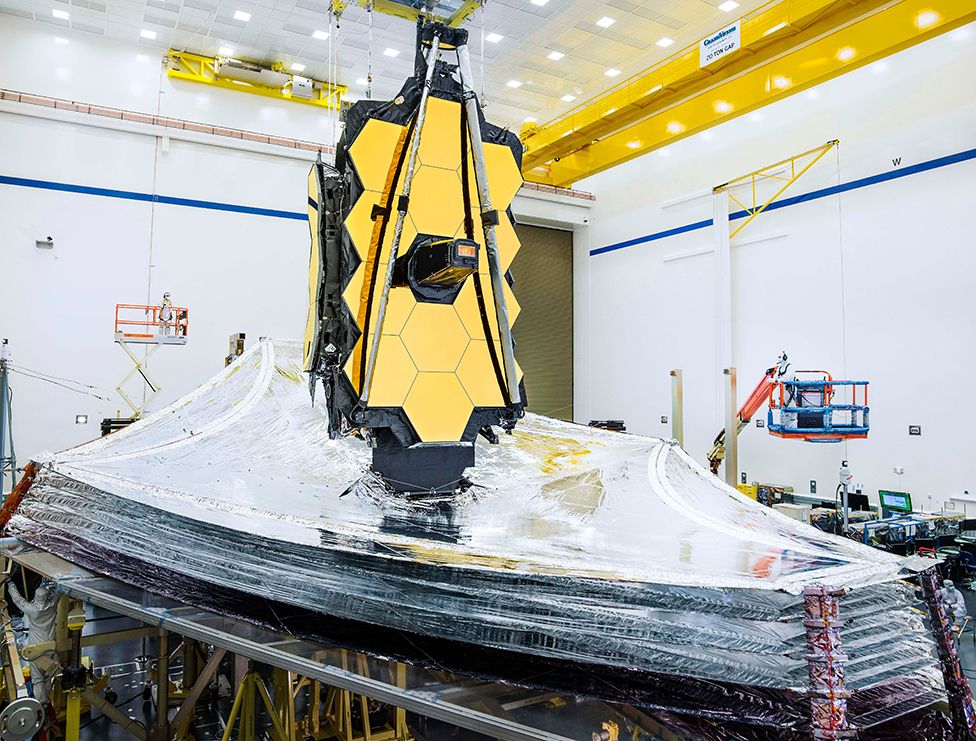
There’s a quiet confidence that Hubble can keep working well into the 2020s. Its supposed “successor” – the James Webb Space Telescope (JWST) – is due for launch next year, but the presence in orbit of this more modern observatory will in truth merely just extend capability; it won’t make Hubble redundant.

That’s because the new facility has been designed to see the cosmos at longer wavelengths of light than Hubble. The duo will be complementary and will on occasion actually pursue targets together to get a fuller perspective.

This is an exciting prospect for astronomers everywhere – but especially for those in Europe where Hubble has been such a rewarding endeavour, says Esa project scientist Dr Antonella Nota.

“From the memorandum of understanding there was a guarantee that European astronomers would get 15% of observing time for the duration of the mission. If I look back at how much time European astronomers got – on average it’s 22%. And it is a peer-reviewed process so we never needed to put a finger on the scales. European astronomers are creative; they’re smart; they’re doing leading-edge science,” she told BBC News.

What has Hubble contributed to science?

It’s a bit of a cliche, but Hubble has truly been a “discovery machine”.

Before the telescope launched in 1990, astronomers didn’t know whether the Universe was 10 billion years old or 20 billion years old.

Hubble’s survey of pulsating stars narrowed the uncertainty, and we now know the age extremely well, at 13.8 billion.

The observatory played a central role in revealing the accelerating expansion of the cosmos – a Nobel Prize-winning breakthrough – and it provided the definitive evidence for the existence of super-massive black holes at the centre of galaxies.

The Deep Field images require Hubble to stare at the same patch of sky for days on end

It’s amazing to think that when Hubble launched, scientists had yet to detect the first exoplanet, the name given to a planet orbiting a star other than our Sun. Today, Hubble is pioneering the study of these far-off worlds, examining their atmospheres to try to gauge their nature.

And although the sparkling eight-metre-class ground-based telescopes can now match – and even exceed – Hubble’s skill in certain fields of study, the space telescope remains peerless in going super-deep.

Its so-called Deep Field observations in which it stared at a small patch of sky for days on end to identify the existence of very distant, extremely faint galaxies is one of the towering achievements in astronomy.

These studies have shown us what the Universe was like just a few hundred million years after the Big Bang. Only JWST, with its finely-tuned infrared detectors, will go deeper still.

A Hubble classic: The Veil Nebula is the expanding debris of an exploded star

Kathryn Sullivan was one of the astronauts onboard Space Shuttle Discovery when it released Hubble into its 612km-high orbit on 25 April, 1990 – a day she recounts in a recent book, Handprints On Hubble.

“Hubble’s scientific impact has just been immense. But what I had not really appreciated until I started writing my book was the extent to which Hubble – because of its gorgeous images and their mind-bending implications – has really permeated popular culture,” she told BBC News.

“I see Hubble on the side of U-Haul (rental) trailers, on tattoos, on lunchboxes, on shirts, in advertisements, almost ubiquitously.

“And I think part of that is down to Hubble coming into service just as the internet was becoming the thing we now know it to be.

“That’s put the pictures right in front of people.”

JWST will study the Universe at longer wavelengths of light

ooOOoo

This is the most amazing invention and regular missions to service the telescope including regular updates to the technology have kept it current.

It has produced the most distant and beautiful photographs. It has also refined our knowledge of when the universe came into existence – 13.8 billion years ago.

Staggering!