By Bill Weaver
Chief Test Pilot, Lockheed
Among professional aviators, there’s a well-worn saying: Flying is simply hours of boredom punctuated by moments of stark terror. But I don’t recall too many periods of boredom during my 30-year career with Lockheed, most of which was spent as a test pilot. By far, the most memorable flight occurred on Jan. 25, 1966.
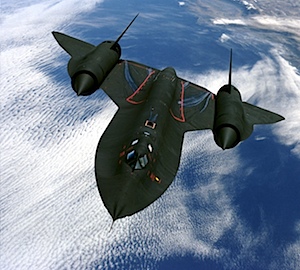
Jim Zwayer, a Lockheed flight-test specialist, and I were evaluating systems on an SR-71 Blackbird test from Edwards. We also were investigating procedures designed to reduce trim drag and improve high-Mach cruise performance The latter involved flying with the center-of-gravity (CG) located further aft than normal, reducing the Blackbird’s longitudinal stability.
We took off from Edwards at 11:20 a.m. and completed the mission’s first leg without incident. After refueling from a KC-135 tanker, we turned eastbound, accelerated to a Mach 3.2 cruise speed and climbed to 78,000 ft., our initial cruise-climb altitude.
Several minutes into cruise, the right engine inlet’s automatic control system malfunctioned, requiring a switch to manual control. The SR-71’s inlet configuration was automatically adjusted during supersonic flight to decelerate airflow in the duct, slowing it to subsonic speed before reaching the engine’s face. This was accomplished by the inlet’s center-body spike translating aft, and by modulating the inlet’s forward bypass doors.
Normally, these actions were scheduled automatically as a function of Mach number, positioning the normal shock wave (where air flow becomes subsonic) inside the inlet to ensure optimum engine performance. Without proper scheduling, disturbances inside the inlet could result in the shock wave being expelled forward- a phenomenon known as an “inlet unstart.”
That causes an instantaneous loss of engine thrust, explosive banging noises and violent yawing of the aircraft, like being in a train wreck. Unstarts were not uncommon at that time in the SR-71’s development, but a properly functioning system would recapture the shock wave and restore normal operation.
On the planned test profile, we entered a programmed 35-deg. bank turn to the righ t. An immediate unstart occurred on the right engine, forcing the aircraft to roll further right and start to pitch up. I jammed the control stick as far left and forward as it would go. No response. I instantly knew we were in for a wild ride. I attempted to tell Jim what was happening and to stay with the airplane until we reached a lower speed and altitude. I didn’t think the chances of surviving an ejection at Mach 3.18 and 78,800 ft. were very good. However, g-forces built up so rapidly that my words came out garbled and unintelligible, as confirmed later by the cockpit voice recorder.
The cumulative effects of system malfunctions, reduced longitudinal stability, increased angle-of-attack in the turn, supersonic speed, high altitude and other factors imposed forces on the airframe that exceeded flight control authority and the stability augmentation system’s ability to restore control.
Everything seemed to unfold in slow motion. I learned later the time from event onset to catastrophic departure from controlled flight was only 2-3 seconds. Still trying to communicate with Jim, I blacked out, succumbing to extremely high g-forces.
Then the SR-71 literally disintegrated around us. From that point, I was just along for the ride. And my next recollection was a hazy thought that I was having a bad dream. Maybe I’ll wake up and get out of this mess, I mused. Gradually regaining consciousness, I realized this was no dream; it had really happened. That also was disturbing, because I COULD NOT HAVE SURVIVED what had just happened.
I must be dead. Since I didn’t feel bad- just a detached sense of euphoria- I decided being dead wasn’t so bad after all. As full awareness took hold, I realized I was not dead. But somehow I had separated from the airplane.
I had no idea how this could have happened; I hadn’t initiated an ejection. The sound of rushing air and what sounded like straps flapping in the wind confirmed I was falling, but I couldn’t see anything. My pressure suit’s face plate had frozen over and I was staring at a layer of ice.
The pressure suit was inflated, so I knew an emergency oxygen cylinder in the seat kit attached to my parachute harness was functioning. It not only supplied breathing oxygen, but also pressurized the suit, preventing my blood from boiling at extremely high altitudes. I didn’t appreciate it at the time, but the suit’s pressurization had also provided physical protection from intense buffeting and g-forces. That inflated suit had become my own escape capsule
My next concern was about stability and tumbling. Air density at hi gh altitude is insufficient to resist a body’s tumbling motions, and centrifugal forces high enough to cause physical injury could develop quickly. For that reason, the SR-71’s parachute system was designed to automatically deploy a small-diameter stabilizing chute shortly after ejection and seat separation. Since I had not intentionally activated the ejection system–and assuming all automatic functions depended on a proper ejection sequence–it occurred to me the stabilizing chute may not have deployed.
However, I quickly determined I was falling vertically and not tumbling. The little chute must h ave deployed and was doing its job. Next concern: the main parachute, which was designed to open automatically at 15,000 ft. Again I had no assurance the automatic-opening function would work.
I couldn’t ascertain my altitude because I still couldn’t see through the iced-up faceplate. There was no way to know how long I had been blacked-out or how far I had fallen. I felt for the manual-activation D-ring on my chute harness, but with the suit inflated and my hands numbed by cold, I couldn’t locate it. I decide d I’d better open the faceplate, try to estimate my height above the ground, then locate that “D” ring. Just as I reached for the faceplate, I felt the reassuring sudden deceleration of main-chute deployment.
I raised the frozen faceplate and discovered its uplatch was broken. Using one hand to hold that plate up, I saw I was descending through a clear, winter sky with unlimited visibility. I was greatly relieved to see Jim’s parachute coming down about a quarter of a mile away. I didn’t think either of us could have survived the aircraft’s breakup, so se eing Jim had also escaped lifted my spirits incredible.I could also see burning wreckage on the ground a few miles from where we would land. The terrain didn’t look at all inviting–a desolate, high plateau dotted with patches of snow and no signs of habitation.
I tried to rotate the parachute and look in other directions. But with one hand devoted to keeping the face plate up and both hands numb from high-altitude, subfreezing temperatures, I couldn’t manipulate the risers enough to turn Before the bre akup, we’d started a turn in the New Mexico-Colorado-Oklahoma-Texas border region. The SR-71 had a turning radius of about 100 miles at that speed and altitude, so I wasn’t even sure what state we were going to land in. But, because it was about 3:00 p.m., I was certain we would be spending the night out here.
At about 300 ft. above the ground, I yanked the seat kit’s release handle and made sure it was still tied to me by a long lanyard. Releasing the heavy kit ensured I wouldn’t land with it attached to my derriere, which could break a leg or cause other injuries. I then tried to recall what survival items were in that kit, as well as techniques I had been taught in survival training.
Looking down, I was startled to see a fairly large animal- perhaps an antelope- directly under me. Evidently, it was just as startled as I was because it literally took off in a cloud of dust.
My first-ever parachute landing was pretty smooth. I landed on fairly soft ground, managing to avoid rocks, cacti and antelopes. My chute was still billowing in the wind, though. I struggled to collapse it with one hand, holding the still-frozen faceplate up with the other.“Can I help you? ” a voice said. Was I hearing things? I must be hallucinating. Then I looked up and saw a guy walking toward me, wearing a cowboy hat. A helicopter was idling a short distance behind him. If I had been at Edwards and told the search-and-rescue unit that I was going to bail out over the Rogers Dry Lake at a particular time of day, a crew couldn’t have gotten to me as fast as that cowboy-pilot had.
The gentleman was Albert Mitchell, Jr., owner of a huge cattle ranch in northeastern New Mexico. I had landed about 1.5 mi. from his ranch house–and from a hangar for his two-place Hughes helicopter. Amazed to see him, I replied I was having a little trouble with my chute. He walked over and collapsed the canopy, anchoring it with several rocks. He had seen Jim and me floating down and had radioed the New Mexico Highway Patrol, the Air Force and the nearest hospital.
Extracting myself from the parachute harness, I discovered the source of those flapping-strap noises heard on the way down. My seat belt and shoulder harness were still draped around me, attached and latched.
The lap belt had been shredded on each side of my hips, where the straps had fed through knurled adjustment rollers. The shoulder harness had shredded in a similar manner across my back. The ejection seat had never left the airplane. I had been ripped out of it by the extreme forces, with the seat belt and shoulder harness still fastened.
I also noted that one of the two lines that supplied oxygen to my pressure suit had come loose, and the other was barely hanging on. If that second line had become detach ed at high altitude, the deflated pressure suit wouldn’t have provided any protection. I knew an oxygen supply was critical for breathing and suit-pressurization, but didn’t appreciate how much physical protection an inflated pressure suit could provide.
That the suit could withstan d forces sufficient to disintegrate an airplane and shred heavy nylon seat belts, yet leave me with only a few bruises and minor whiplash was impressive. I truly appreciated having my own little escape capsule.
After helping me with the chute, Mitchell said he’d check on Jim. He climbed into his helicopter, flew a short distance away and returned about 10 minutes later with devastating news: Jim was dead. Apparently, he had suffered a broken neck during the aircraft’s disintegration and was killed instantly. Mitchell said his ranch foreman would soon arrive to watch over Jim’s body until the authorities arrived. I asked to see Jim and, after verifying there was nothing more that could be done, agreed to let Mitchell fly me to the Tucumcari hospital, about 60 mi. to the south.
I have vivid memories of that helicopter flight, as well. I didn’t know much about rotorcraft, but I knew a lot about “red lines,” and Mitchell kept the airspeed at or above red line all the way. The little helicopter vibrated and shook a lot more than I thought it should have. I tried to reassure the cowboy-pilot I was feeling OK; there was no need to rush. But since he’d notified the hospital staff that we were inbound, he insisted we get there as soon as possible. I couldn’t help but think how ironic it would be to have survived one disaster only to be done in by the helicopter that had come to my rescue.
However, we made it to the hospital safely–and quickly. Soon, I was able to contact Lockheed’s flight test office at Edwards. The test team there had been notified initially about the loss of radio and radar contact, then told the aircraft had been lost They also knew what our flight conditions had been at the time, and assumed no one could have survived. I explained what had happened, describing in fairly accurate detail the flight conditions prior to breakup.
The next day, our flight profile was duplicated on the SR-71 flight simulator at Beale AFB, Calif. The outcome was identical. Steps were immediately taken to prevent a recurrence of our accident. Testing at a CG aft of normal limits was discontinued, and trim-drag issues were subsequently resolved via aerodynamic means. The inlet control system was continuously improved and, with subsequent development of the Digital Automatic Flight and Inlet Control System, inlet unstarts became rare.
 Investigation of our accident revealed that the nose section of the aircraft had broken off aft of the rear cockpit and crashed about 10 mi from the main wreckage. Parts were scattered over an area approximately 15 miles long and 10 miles wide. Extremely high air loads and g-forces, both positive and negative, had literally ripped Jim and me from the airplane. Unbelievably good luck is the only explanation for my escaping relatively unscathed from that disintegrating aircraft.
Two weeks after the accident, I was back in an SR-71, flying the first sortie on a brand-new bird at Lockheed’s Palmdale, Calif., assembly and test facility It was my first flight since the accident, so a flight test engineer in the back seat was probably a little apprehensive about my state of mind and confidence.
As we roared do wn the runway and lifted off, I heard an anxious voice over the intercom.
“Bill! Bill! Are you there?”
“Yeah, George. What’s the matter?”
“Thank God! I thought you might have left.”
The rear cockpit of the SR-71 has no forward visibility–only a small window on each side–and George couldn’t see me. A big red light on the master-warning panel in the rear cockpit had illuminated just as we rotated, stating: “Pilot Ejected.” Fortunately, the cause was a misadjusted micro switch, not my departure.

– – – – – – – – – – – – – – – – – – – –
Bill Weaver flight-tested all models of the Mach-2 F-104 Starfighter and the entire family of Mach 3+ Blackbirds–the A-12, YF-12 and SR-71. He subsequently was assigned to Lockheed’s L-1011 project as an engineering test pilot, and became the company’s chief pilot. He later retired as Division Manager of Commercial Flying Operations.
He still flies Orbital Sciences Corp.’s L-1011, which has been modified to carry the Pegasus satellite-launch vehicle. And as an FAA Designated Engineering Representative Flight Test Pilot, he’s also involved in various aircraft-modification projects, conducting certification flight tests.









 Learning from Dogs