A route to be free of hate and ill-will and a guarantee of happiness – read on:
The Brahma Viharas are also known as the Four Divine Emotions or The Four Divine Abodes. They are the meditative states, thoughts, and actions to be cultivated in Buddhist meditation. They are the positive emotions and states that are productive and helpful to anyone of any religion or even to the one with no religion.
The result will be a good person, free from hate and ill-will. Those who cultivate the brahma viharas are guaranteed to happiness. Those who further cultivate equanimity, may reach insightful states and wisdom of enlightenment experiences.
The Four Divine Emotions
1. Loving-kindness (Pali: Metta)
2. Compassion (Pali:Karuna)
3. Joy with others (Pali: Mudita)
4. Equanimity (Pali: Upekkha)
The Four Divine Emotions are known in Pali (Pali is a literary and liturgical language only) as the Brahma-viharas and are also known as the divine abidings or the divine abodes. They are emotional states to be strived for. By practising and developing the divine emotions, we will have a peaceful and patient daily life practice.
Joy
Loving-kindness is a soft, affection and care for others and yourself.It is not a hard, romantic type of love and not a love that includes extreme attachment or controlling feelings.
Compassion is like an open heart that cares for everyone. It includes empathy, being able to see the other person’s position and caring for and about them.
Joy with others, sometimes is called sympathetic joy or appreciative joy. It is the ability to be happy when you see others happy. Their joy becomes your joy as you welcome less suffering and happiness of others.
Equanimity is the balanced state of mind. It is the middle way state of mind that is neither clinging nor pushing away.
The above was an excerpt from the best selling book The Complete Book of Buddha’s Lists — Explained, by David N. Snyder, Ph.D., with a Foreword by the Venerable Madewela Punnaji. The full version can be downloaded for free from here.
On July 15th, 2009 a post called Parenting lessons from Dogs started what has now become a bit of a ‘habit’. But more reflections tomorrow.
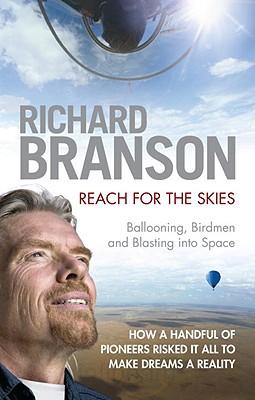
Reach for the Skies
Today I want to voice something that has been running around my mind for some time. It is whether we give in to the mounting doom and gloom at so many levels in our societies (and it can be a very compelling draw) or whether we see this as a painful but necessary period where slowly but surely the desires of ordinary people; for a fairer, more truthful, more integrous world are gaining power.
And I’m going to use Richard Branson to voice it for me!
(Now this is an unusually long Post so I’ve inserted the Read More divider to prevent the Post visually swamping your browser.)
It is probably a bit non-PC [PC = politically correct, Ed] to say anything negative about the World Cup, but I sense that the importance of being PC is beginning to wane; not that it ever bothered me anyway.
Let’s look at the positives, since almost everything has some positives somewhere; Stalin, Hitler, Pol Pot and the North Korean regime being obvious exceptions.
They built world-class stadia on time.
The foreign visitors who were there generally got to venues on time and the matches all started on time.
Inside the stadia (despite the obvious occasional sillinesses for which we can blame FIFA), everything went tickety-boo. According to some pundits, the atmosphere was “the best ever”, despite (or because of?) the hideous vuvuzela.
There was no major crime wave, no terrorism, no significant disasters of any kind.
The South Africans were reportedly very hospitable.
Opposing fans celebrated together; the England fans totally restored their reputations; reports of drunken English mobs were distinguishable by their absence. (they probably couldn’t afford to get there.)
South Africa took pride in its ability to put on the World Cup, which many had suspected it incapable of.
For a month the nation forgot all its problems; most people had a big party, even if the South African team (and Africa in general) was made to realize the enduring gulf between its standard of football and that of the other continents.
So, all’s well that ends well, then? Unfortunately not ….
The country paid around 10 billion rand to put the event on, three times more than original estimates. Where did all the money go?
The country is left with giant stadia that may never again be filled, the so-called “white-elephants” typical of almost all these major events. Apparently even the wondrous “Birds-nest” stadium in Beijing used for the opening ceremony of the Olympics has only been used once since 2008.
Only half the number of expected foreign tourists came, as the organisers over-priced everything. Organisers claim the extra income generated will pay for the costs, but nobody believes them …..
Preparations for the World Cup provided jobs, but those workers are now back on the street. The ordinary people of South Africa benefited little from the event, except in terms of “national pride”.
And there of course is an interesting animal; “national pride”. In a grown-up world, you’d have hoped that national pride would be best achieved through one of the following:
the building of suitable housing for the population
the setting-up of an affordable and accessible national health system (fat chance, even the USA hasn’t got that!!)
the diminution and ending of corruption
the creation of a fair society
the development of the economy to provide jobs and create wealth to allow ordinary people to live decently and comfortably
Any of these and other things could be seen as deserving of “national pride”, but the ability to put on at vast expense a four-week jamboree that mostly benefited the political elite, other nations, FIFA and the international television networks is a dubious contender for “pride”.
But of course it depends which side of the coin you are looking at. For some, all the expense justifies the “putting of South Africa on the map.” The politicians as usual will have been the most happy; four weeks in the spotlight strutting about on the world stage, loads of media coverage, hundreds of journalists hanging on their every word …
As for the real ethos behind the World Cup, the bits that don’t hit the glitzy headlines, two in particular struck me as symbolic of Man’s capacity for self-delusion; Africa’s attitude to its poor and the obscene power of international non-governmental monopolies such as FIFA.
These have been variously described in excellent articles written by proper journalists. The first example is from Globalpost. I find it pretty depressing.
Green Point Stadium, Cape Town: In Cape Town, Green Point Stadium is covered in a sheath of woven fiberglass so that it glows at night like a floating bowl. But its location on six city blocks in a prime real estate area has also created controversy. In 2006, the city’s government published a study that found the stadium’s location offered the least amount of economic gain to Cape Town’s resident. In fact, repairs to several older stadiums in the surrounding area could have led to savings that could have paid for 250,000 new homes for the city’s poor, according to researchers.
But FIFA wanted a stadium that would sit between South Africa’s iconic Table Mountain and Robben Island, according to reports, causing the football federation’s president, Sepp Blatter, to come under fire.
“I really think that we’re going into Green Point because Sepp Blatter says: ‘I like Green Point,’ not because it is the best thing for South Africans,” Cape Town’s then-mayor, Helen Zille, said in 2006.
Sepp Blatter will take his $2 BILLION profit away with him to some lush office somewhere, while the ordinary residents of Cape Town pick up their lives as before. How long “national pride” will sustain them is a moot point.
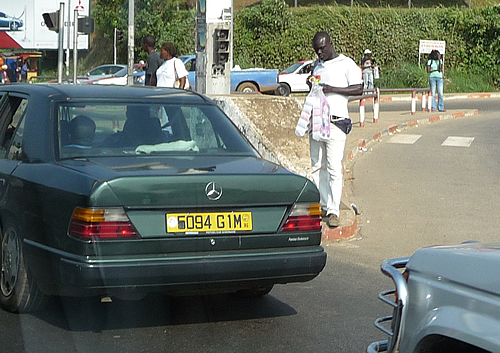
Roadside waterseller in Gabon, West Africa
The Marketing Bonanza:If you’ve been to Africa and driven around a bit, you’ll know that there are street traders everywhere. These are desperately poor people who will try to flog you anything and everything. They wander up and down lines of cars carrying their pathetic wares. In the ferocious midday heat women often carry large heavy buckets full of water bottles on their heads. Many do this all day every day to earn a pittance.
But of course, like beggars in the big city, they don’t really create the right “image” and “ambiance” for a major international event with its glitz and invasion of well-off foreigners. So, as reported in “The Guardian” they were simply banned whenever the authorities considered it appropriate. So much for the World Cup “improving the lives of ordinary Africans”.
But not just anyone will be allowed to participate in what President Jacob Zuma calls “the greatest marketing opportunity of our time“. Informal traders – a significant part of the working poor – are subject to a verbatim “exclusion zone” from the bonanza in the fan parks, fan walks and stadiums. For them, the World Cup may as well be happening on another continent.
I have personal experience of something similar in Gabon. When the wife of President Bongo died, the whole country was ordered to do a week’s mourning. Street trading was banned. This of course did not affect the elite, but for many of the rest it meant the difference between eating and going hungry. When a few daring and desperate people dared to try to sell their pitiful produce in some locations the police confiscated it and trashed their stands.
And FIFA? It is reported to have made $2 BILLION in tax-free profits. Who controls this money? Why is it tax-free? How will it be spent? To whom is FIFA really accountable? Ah, to national Football Associations? You mean like the British one, which pays £6 million per annum to a failed manager, which is three times more than the German Coach gets?
These vast sums swilling about leave a nasty taste in the mouth. Of course, any organisation’s primary concern is usually to its own self-aggrandizement, so nothing new there. Even the European Union refuses to get its accounts signed off properly, so what faith the common man can have in the honesty of these vast international organisations is questionable.
Well, the World Cup has come and gone and it provided much entertainment for those watching the games. The long-term legacy for the ordinary people of South Africa (43% of whom live on less than $2 per day) is another matter, so forgive me if my rejoicing is muted.
PS The Vuvuzuela …. nothing to me more clearly illustrates Man’s stupidity. The sound output of this instrument is 113db, which can apparently become harmful to the hearing after only 90 seconds. Those in the stadia (including the players, by the way – did anyone ask THEM what they felt?) were subject to nearly TWO HOURS of continuous multiple vuvuzuelae. Many of those people will have had their hearing IRREPARABLY DAMAGED. This will only become clearer to them in LATER YEARS.
For me it is a symbol of our stupidity. All the above health risks are clear and known. Did FIFA ban the damned thing? OF COURSE NOT!! That would have diminished the “local colour” so vital for the international media, which gives Blatter his $2 billion profit. Who gives a damn about ordinary people’s hearing? I doubt whether Sepp Blatter exposed himself overmuch to the bloody things, though he seems pretty deaf already.Once again, for a transient thrill or benefit we do ourselves lasting damage, no different from the way we often treat the planet of course.
Using a cat carrier from a local animal hospital, outdoorsman Zak Anderegg was able to save a dog left for dead in a remote cavern in the canyons along the Arizona-Utah border.
Although I have only seen a trailer for this film, I watched the interviews and excerpts Paul has linked in this article and found them very moving.
In these days of uncertainty and fear it is heartening to see and read about a relationship founded on unconditional love.
It signifies to me that it is the quality of our relationships that makes the difference in life, not material possessions – and then how we go about finding more examples of these in our everyday lives.
Jon Lavin
This is all about Trust
The prompt for writing this particular Post was the other evening Jean and I watched the film The Soloist. I’ll come on to that later.
Before I do, I want to look at another aspect of learning from dogs; that is the question of trust. We have so much to learn from dogs with regard to trust.
Because dogs spend so much of their time living in the present, just being a dog in the ‘now’ moment as it were, they seem to be able to read another dog very quickly. Dogs don’t have ‘hidden agendas’.
You see we humans can be (and should be) as happy in the present as dogs are. But so often our fears, worries and concerns for the future hinder our ability to experience the present, to enjoy the NOW.
Look at the faces of others around you when you have a moment. (Or, indeed look at your own right now in the mirror.) Do you see a face serenely happy unencumbered with the past or the future? Rarely is my guess.
That’s why a dog can read another dog in micro-seconds and know everything about that other animal. There are no secrets – what you see is what you get.
Look at this picture.
Pharaoh and Poppy
This is Poppy (8 lbs/3.5 kg) picking up food droppings from Pharaoh (90 lbs/40 kg). In fact, within seconds of taking this picture, Poppy had pushed between Pharaoh’s front legs and put her face in the dish and started eating Pharaoh’s food, at which point Pharaoh went over the Poppy’s dish and started eating from there. (NB. Anyone that has dogs in their home will know how possessive they can be at feeding time.)
Immediately when Pharaoh met Poppy, when he and I ended up in Mexico in 2008, they instantly trusted each other. This is a beta level (second in status to the alpha, i.e. dominant) pure bred German Shepherd bonding with a Yorkie mix female dog that was found, hairless and starving, on a Mexican construction site – rescued by Jean after almost certainly being thrown out after she had made some Mexican a few pesos from selling her puppies.
Here’s another picture of these two:
Total trust!Jamie Foxx and Robert Downey Jr in The Soloist
Now to the film. It wasn’t a blockbuster and didn’t get rave reviews but if viewed from the simple perspective of trust and friendship it delivers a powerful message that is beautifully compelling.
There’s an official trailer on YouTube here but the better review is this extract from the 60 Minutes programme below.
You need to watch this film to see how trust is built up, and out of that trust comes a wonderful friendship. But you will get a taste of the sheer beauty of this true story by this 12 minute YouTube video. Try and put aside these few minutes so you can watch this without interruption.
And here’s a link to another extract from the 60 Minutes programme concentrating on Mr Ayers playing his heart out.
If you want to read the column in the LA Times that Steve Lopez wrote in December 2004 about Mr Ayer’s Christmas present, just click here.
Finally, the film closes with these words from the actor who portrays Mr Lopez. Please read them to yourself, aloud if you can.
Points West by Steve Lopez
A year ago I met a man who was down on his luck and thought that I might be able to help him. I don’t know that I have. Yes, my friend Mr. Ayers now sleeps inside. He has a key, he has a bed, but his mental state and his well-being are as precarious now as they were the day we met.
There are people who tell me that I helped him, mental health experts who say that the simple act of being someone’s friend can change the brain chemistry, improve his functioning in the world.
I can’t speak for Mr Ayers in that regard, maybe our friendship has helped him, but maybe not.
I can however speak for myself. I can tell you that by witnessing Mr Ayers’ courage, his finality, his faith in the power of his art, I’ve earned the dignity of being loyal to something you believe in, holding on to him. Above all else, I believe him, without question that it will carry you home.
And now recall that when you were reading those words, you were totally and completely living in the present. Keep that feeling of grace close to you forever.
By living in the present, you offer yourself as a friend to the world.
Conscientiousness isn’t all it’s cracked out to be!
(Foreword from Paul.)
Jon is one of those rare individuals who not only has been committed to a path of self-awareness for more than 30 years but who has also studied incredibly hard so as to be able to help others and do so from a base of real competence, as his own Blog describes. I can speak as a current ‘client’ of Jon who is assisting me in my own journey.
But then I realised the great strength in what Jon has written. It is this.
There are many notable teachers out there who thousands upon thousands have turned to for a deeper understanding of what life is all about. As far back as time itself teachers have surfaced and given spiritual guidance to those that come in need. But it’s very difficult to read or listen to these great teachers and connect with the fact that they were born, as we are all born, with nothing. And all of them, like many of us, went through Hell on wheels to come out the other side with a greater self-awareness and a deeper understanding of the real truths in nature. Like all of us who wish to rise above our present place they first acknowledged their own frailties. It is the starting point.
So, let me get to the point. Jon has the awareness and understanding to offer real help to those that seek answers that are currently beyond reach. Jon’s article is an wonderful illustration that he experiences the same fears and feelings of helplessness that you and I feel. You and I and Jon and all of humanity are much more closely connected than we realise.
Paul H.
—————————————–
To see in is to see out!
I’ve been running my own business for about 12 years now. In the beginning it started because I had a thirst for wanting to make a difference in small business in our local area and a passion for wanting to do it through working with people directly, on their behaviours. Still have, really.
I think this came as a form of acknowledgement to the few exceptional people managers I experienced while I was employed, and the all too common, terrible ones.
I was also mentored by a group of people to whom no developmental tool was barred. My eyes were well and truly opened to how a change of view could change outcomes.
The final boot up the backside was redundancy in the late 90s. I was all ready to go and just needed a kick.
My work ethic, trained at home and then through an engineering apprenticeship, was to conscientiously work hard and try hard and to treat people the way you want to be treated. Nothing wrong with that. I assumed automatic reward would follow as long as I did those things.
Over time I wised up and became a bit less idealistic and a little more politically aware but carried on in much the same way.
Much later I found myself embarking on a whole new adventure, with a lovely wife and family, all dependent on me, with a few contacts to start getting work from!
It took a year before the first jobs came in that didn’t necessitate robbing the almost non-existent savings and redundancy payment just to keep food on the table. Then, work slowly picked up and it started to get quite good for a one-man band. We were able to go on holiday once a year, camping, but still great, and then abroad.
All the time, I beavered away, trying hard, being very conscientious, as I’d been brought up to be, but slowly getting very stressed.
Time was when it took Friday night to de-stress, then 3 days, then 10 days and recently, not at all.
So faced with this present downturn, which is likely to go on for much longer than any of the others I’ve seen and survived, I’m wondering just what new strategy to adopt. Money is already getting very tight and everything is feeling very ‘hand to mouth’. Can’t really see one month in front of the other.
I notice our local farmer who I went to school with but didn’t really know.
I’ve got degrees, lived abroad, can speak Finnish fluently, (what use is that, I hear you say!), and can turn my hand to most things, but I still feel quite dis-empowered and at a bit of a loss.
My farmer friend is always smiling, he’s got a flock of geese he’s fattening up, the same with his beef cattle, does livery for half a dozen horses or so, has fields planted with various cereal crops, and has his finger in lots of different pies – and definitely does not look stressed. He is also renting his land plus another farm.
I honestly don’t know what to make of this all except for a few really important things – the importance of diversification, relationships and appreciating what you’ve got, especially people things, here, in the now.
I have also come to the realisation that I still haven’t cracked the main thing with being self-employed, and that is replacing fear with trust.
It’s been said by various enlightened people that we see a reflection of the world we hold in mind. Going forward into this brave new world I would like to see opportunities rather than fear, I will diversify into things which make more use of my wide range of talents, and I will swap fear for trust.
“An ethic of kindness, benevolence and sympathy extended universally and impartially to all human beings.”WikiPedia
Introduction
Friedrich Nietzsche
I do not in any of this mean to say that humanitarianism is a negative thing, I am merely attempting to describe why humanitarianism exists in the world today in much larger proportion than it has in the past.
I hope also in some of this to disagree, hopefully intelligently, with Nietzsche’s claim that humanitarianism decreases the overall strength of the human race, or at least its higher echelons.
Self-interest
Human beings are either entirely or nearly entirely driven by self-interest, this much has been made clear by both ancient and modern philosophy.
Different philosophers have realized this point in different ways.
Mises said that all people are rational maximizers.
Nietzsche said that the natural human being attempts to exert his force upon the world surrounding him.
Plato said that all men desire good things, but each man has his own subjective opinion of the “good” which he came to via his own experiences (both during and before “life”.)
I highly doubt that human nature has changed a great deal in 100 years.
However, 100 years ago it was very common for European nations to do just about whatever they wanted to the rest of the world. In fact, human nature is in all likelihood not very different now than it was in the days of the early church, when Christians were wrapped in lambskin, covered in oil, and burned alive in order to serve as torches.
The answer to whom we turn to when the times are tough.
Light your own fire!
Regular readers of Learning from Dogs will know that a few days ago, Sherry wrote a piece entitled Light My Fire? It expressed her view that lately she was finding it a problem to be inspired, finding the passion as Sherry put it.
I have been thinking about Sherry’s article for the last few days and a couple of peripheral things come to mind.
We tend to get more of what we notice and orient towards. By allowing ourselves to become absorbed in the negative, that is what we tend to notice. The fact is that the media thrive and make vast sums of money focusing on the negative. Just compare the amount of negative with the positive in any news cast.
That is not to say that we should not be aware of the negative or hide our heads in the sand. We can however change the way we view things and that has to come from within.
In fact, the answer rarely lies “out there”.
Change in how we view things, i.e. our attitude, needs to start coming from “within” ourselves.
The one thing that characterises these times is uncertainty.
A lot of us don’t even know where the next bit of money to pay the bills is coming from. In spite of the tendency to look ‘out there’ for strong direction, I still feel that the inner resolve has got to come for inside.
Another thing, I don’t believe it’s possible to think ourselves out of this one.
Although it’s a subject I go on a lot about, the sense of direction and well being has to come from us, or rather the feeling of interconnectedness that we share with everything. At a level, we are all connected.
We are all connected.
The one thing that gets us all through is a faith in some higher consciousness, that we can all tap into when we remember and ask for that miracle of clarity.
This is not thinking. The opposite in fact. This is a process of trust and ‘allowing’.
Allowing requires a power that few can sustain for long as we’re all geared to doing. ‘Allowing’ requires us to turn off the noise machine that is in our head and creating a quietness and space for awareness to surface.
Paul recently wrote an article on Living in the Present that describes this way of letting go rather well. I know for a fact that Paul is new to these ideas but already he is finding a peace and clarity emerging that shows that there’s always a good time to start – NOW!
Back to my thoughts. I am not advocating lying down and letting the world roll over us – the opposite in fact. By bringing awareness into this whole mess, we are more likely to take the right action.
I have honestly noticed that the more effort and circular thinking I have put into my present financial difficulties, and I’m a real expert in worry and circular thinking, the worse things have got.
I notice that by returning to silence and simply observing, a background is created that allows solutions and options to rise.
By asking to be shown the way forward and then letting go of the need for an instant solution, subtle options and ways forward present themselves.
Then right action follows.
An acceptance that in any moment we are all operating at our maximum level of consciousness. We are all doing the best we can. If we knew better, we would do better.
Therefore, what is going on in the world is a reflection of ourselves and is absolutely perfect for where the sum total of all of us are. (“Perfect”, does not mean we have to like it but it is, never the less, inevitable)
It follows, therefore, that the best way to help the world is to work on ourselves by striving to be the best we can, in every way. And the only way to do that is with awareness.
I think it was Abraham Maslow who coined the phrase, “Self Actualising”, meaning, being the best we can in every way, mentally and physically.
During these undoubtedly troubled times in the earth’s history, we all tend to turn to someone or something to provide a sense of direction. That someone you need to turn to is yourself.
Safe, as in psychologically as well as physically, has its rewards.
Jon Lavin
I had a very interesting session recently. I did some coaching work with a client company who managed a small team. The day was split into two – the morning with the client and the afternoon with the whole team.
What struck me about the day was the power of good leadership and the importance of leaders who are aware of how they come across and are capable of forming a relationship with their teams.
My client was struggling with her team because she was unaware how she was communicating, not only with her team but with other people in the organisation.
Unfortunately, becoming aware of how we are in a relationship with others brings us face to face with ourselves and requires a willingness to accept ourselves, warts and all, before trying to change anything.
After we all had lunch together and broke the ice a bit we focused on what was working (not what was not working), what was missing, what inspired and what was possible. By examining these areas and so creating a safe environment, everybody was able to reveal more of themselves and what they needed to have a satisfactory, safe working relationship with each other.





 Learning from Dogs