The wonderful news that US Gray Wolves are now back under protection reminded me of the beautiful story of Tim and his ‘pet’ wolf Luna that was published on Learning from Dogs September, 2009.
The first article opened up as follows:
An amazing true story of a relationship between a wild wolf and a man.
This is a story of a particular event in the life of Tim Woods told to me by his brother, DR. It revolves around the coming together of a man sleeping rough, with his dog, on Mingus Mountain, and a fully grown female Gray or Grey Wolf. Mingus is in the Black Hills mountain range between Cottonwood and Prescott in Arizona, USA
But then I added a postscript which I am going to reproduce in full again.
The story of Luna has some interesting connections.
The person taking the picture in the Post about Tim Woods was Willie Prescott. He just happens to be the grandson of William H. Prescott from whom the town of Prescott is named. Here’s that picture again.
Just a couple of items from disparate sources came together last Friday to demonstrate just how possibly corrupt it has been over the last so many years! But there is a golden lining to this stuff.
That is the ever increasing spread and reach of all forms of digital communications, from the humble email through to Wikileaks, is making it increasingly difficult for those that wish to cheat and lie their way through their lives, at the expense of others, to do so without detection.
Anyway, back to the theme of the Post.
The first item is from here (thanks to Naked Capitalism for the link):
A news story today provides further confirmation of the rule by the banking classes in the US, with only token gestures to the rule of law.
(and after an in-depth review closes with:)
The message seems pretty clear. Sarbox [Sarbanes-Oxley Act. Ed]was intended to curtail phony corporate accounting in the wake of Enron. But why resort to complicated transactions like the energy company’s famed Raptors when Citi shows that mere lying will produce the same results with much less fuss?
All three years of the revision period were revised down. Again, if a mistake or inaccuracy (as opposed to intentional falsehood) is responsible for errors, one would expect them to be normally distributed – that is, some would be positive, some negative. This is obviously not the case.
Is there any good news in the report? Well, yes – there was a material uptick in non-residential fixed investment, centered around equipment and software. How much of this is a normal replacement cycle (deferred last year) and how much signifies real expansion is an open question and one not easily answered. However, I wouldn’t call this particularly “robust”, despite the pump monkey characterization this morning in the media.
The drops in some of the previously-published numbers were, however, simply stunning. For example, PCE (personal consumption) was previously reported for Q1/2010 as 2.13. The revision is 1.33, a thirty percent downward revision. That’s not an error, it was a falsehood.
Worse was the services false report. The previous reported number for Q1/2010 was 0.69. Revised was 0.03, a downward revision of ninety-five percent.
The services revision backward was truly sickening – the entirety of 2009 was negative with the exception of the fourth quarter, where all but the first was previously reported positive, and the changes were ridiculous. First quarter was revised down from -0.13% to -0.75%, second from +0.09% to -0.79%, and so on. Again,that’s not an error, it’s a lie.
Needless to say when I get all my graph source data updated, it’s going to look worse than it did – including my “government ponzi support” graph, one of my favorites.
The futures are diving on the report, as well they should. Not because it’s bad – but because the entirety of the 2009 data set was a bald-faced lie.
Frankly, I’m much less interested in what is happening to Western economies – my views have been regularly reported on Learning from Dogs.
What appals me is how far we seem from those famous words in the Gettysburg Address given by President Abraham Lincoln on the afternoon of Thursday, November 19, 1863 (my emphasis):
It is rather for us to be here dedicated to the great task remaining before us—that from these honored dead we take increased devotion to that cause for which they gave the last full measure of devotion—that we here highly resolve that these dead shall not have died in vain—that this nation, under God, shall have a new birth of freedom—and that government of the people, by the people, for the people, shall not perish from the earth.
Pres. Lincoln's words
P.S. As it happens, after finishing this article last Friday, Jean and I watched the film The Verdict in the evening. The words used by the lawyer Frank Galvin (Paul Newman) in his summation struck me so powerfully that I have made them a separate Post for tomorrow. By Paul Handover
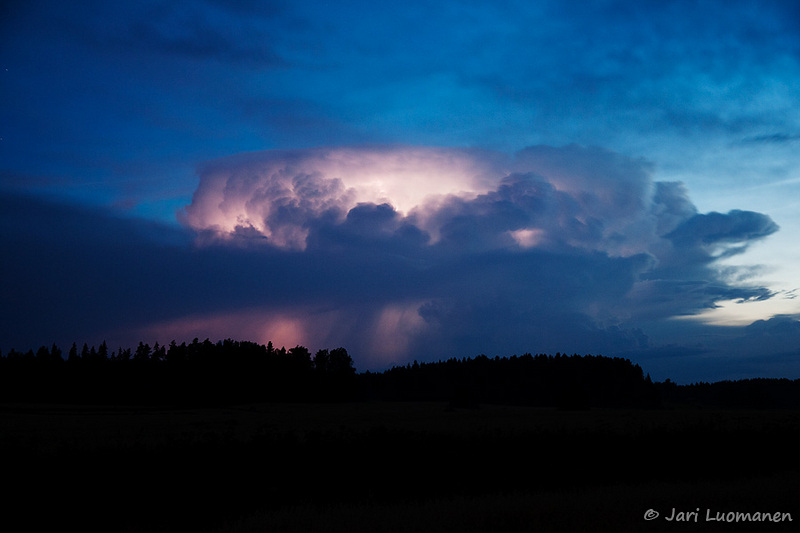
This is just an update to show you an example of photographs taken by Finn Jari Luomanen over the night of the 29th-30th July. All the pictures may be seen here – they are of this quality:
2010_07_29-30 Mesoscale convective system
Here’s what Jari said about this night:
This mesoscale convective system sweeped over Finland with ferocious energy. The day before was historical as a record breaking temperature of 37,2 degs Celsius was recorded. The MCS proved to be a good match.
Thunderstrikes happened every two seconds at the peak and it was difficult to expose correctly due to the multiple strikes in each exposure.
Noctilucent clouds shone above the swiftly moving cell creating an eerie electric blue backdrop for the spectacle.
Never before have I seen anything close to this. I was jumping behind the tripod firing away in the hot, humid night. Since when has Finland turned into tropics?
The Economist, for me, is one of the great newspapers of our time. I have often referred to it on Learning from Dogs.
Last Saturday’s edition (July 24th – 30th 2010) carried a most beautiful obituary about Mau Piailug who in 1976 demonstrated that ancient seafarers could indeed have voyaged from Hawaii to Tahiti, a distance of some 2,500 miles, before the age of compasses, sextants or charts. Here is an extract from that obituary (you may need to register to view it):
As a Micronesian he did not know the waters or the winds round Tahiti, far south-east. But he had an image of Tahiti in his head. He knew that if he aimed for that image, he would not get lost. And he never did. More than 2,000 miles out, a flock of small white terns skimmed past the Hokule’a heading for the still invisible Mataiva Atoll, next to Tahiti. Mau knew then that the voyage was almost over.
On that month-long trip he carried no compass, sextant or charts. He was not against modern instruments on principle. A compass could occasionally be useful in daylight; and, at least in old age, he wore a chunky watch. But Mau did not operate on latitude, longitude, angles, or mathematical calculations of any kind. He walked, and sailed, under an arching web of stars moving slowly east to west from their rising to their setting points, and knew them so well—more than 100 of them by name, and their associated stars by colour, light and habit—that he seemed to hold a whole cosmos in his head, with himself, determined, stocky and unassuming, at the nub of the celestial action.
Mau Piailug creating model of his canoe - Steve Thomas Photo
Mau Piailug was born in 1932 on Satawal, a tiny Pacific island no wider than a mile in Micronesia. When he was still a little baby, his grandfather put him in a tide pool as though he were putting him in a cradle. There the sea gently rocked him back and forth with the rhythm of the tides.
When Mau was six, his grandfather began to teach him about navigation. He started by telling him about the stars; the grandfather made a star compass out of a circle of coral rocks, and in the center he put a little canoe he had made of palm fronds. Then he explained how the stars rose in the sky and traveled from east to west.
As he grew older, Mau spent his evenings in the canoe house. There he asked the elders to teach him about navigation. In this way, and with his grandfather’s help, he learned the paths of more than a hundred stars. He also learned that when clouds covered the sky, he could use the direction of the ocean waves to guide the canoe. He could also follow the birds toward land when they headed home in the evening, and he studied the creatures of the sea, for in times of trouble they, too, could help him find land.
A film was made about Mau called The Last Navigator. Do click on the link and read more about what Steve ‘learnt’ from Mau – here’s a closing taste:
It has been nearly fifteen years since I first met Piailug. In that time I have been blessed with relative fame and prosperity – an eventuality, by the way, that Piailug foretold to me. As I look back, I am impressed now by the twin qualities in the man that impressed me then: his generosity and his courage. Piailug took me into his family, assumed responsibility for my material and political well-being, and taught me his navigation without reserve. The knowledge he gave me about navigation is considered priceless in his culture. The knowledge he gave me about myself, I have come to see, is priceless as well. I often think of Piailug, and the fierceness and determination with which he defends a way of life he knows will die as the wise elders died. He has the courage to live and teach and voyage in spite of the certain knowledge that his struggle can never stem the tide of Westernization, which will change the character of his archipelago and may well eliminate the very role of the navigator as steward of his island’s sustenance and keeper of the flame of cultural knowledge.
Those that know me or have followed Learning from Dogs for the last year (and thank you!) know that I am pretty pessimistic about the economic future for North America and Europe (at least!). I speak not as an economist, far from it, but as someone sufficiently old to think that many millions of individuals and their countries have been living on borrowed time for decades.
David Kauders
Twenty years ago I didn’t really do anything than feel uncomfortable when friends announced another new house with mortgages far in excess of the old ‘rule’ of 1.5 to 2.0 times one’s annual income.
Then I came across David Kauders of Kauders Portfolio Management who explained in fundamental ways why this was all going to end in tears, so to speak. Wasn’t he right!
Thanks to David, I am moderately more well-off than I would have been – without a doubt. Not only did David manage my private pension, he greatly influenced my modest personal investments outside his portfolio.
Where’s this heading? This Blog is an attempt to show that integrity in all that we all do is not only the best personal strategy, it is the only viable course for mankind in bringing us back from the brink of global disaster. So a couple of recent items about economic matters from people of great integrity underlined the value of mentioning them in this Blog.
The first is a talk given by Elizabeth Warren two years ago, in January 2008, entitled The Coming Collapse of the Middle Class. It’s nearly an hour long but very well worth watching especially in the way that Ms. Warren shows how counter-intuitive is our understanding of how family costs have risen over the last 30 years. Although it applies to the US, it certainly has relevance for British viewers. Do watch it.
Here’s how the video is described:
Distinguished law scholar Elizabeth Warren teaches contract law, bankruptcy, and commercial law at Harvard Law School. She is an outspoken critic of America’s credit economy, which she has linked to the continuing rise in bankruptcy among the middle-class.
Next is that stalwart Karl Denninger. How he finds the energy and enthusiasm for publishing his Market Ticker is beyond me. He’s not subtle but his personal integrity is beyond reproach in my opinion.
Karl was recently interviewed by Bill Still (Bill produced the highly acclaimed film The Money Masters) and despite the videos being heavily edited Karl says “and for the most part accurately captures my views on the topics covered.”
Again these interviews are not short but, again, if you want to understand how dangerous the fundamentals still are – then watch them.
Karl Denninger, author of Market Ticker and winner of the 2008 Reed Irvine Accuracy in Media Award explains the roots of the current crisis and why real economic growth is impossible. He explains why the stock market rebounded in 2009 and why that can’t continue. He explains what needs to be done with the banks and predicts that all the big banks will fail.
Part One:
Part Two:
Finally back to David Kauders. He also publishes an opinion website Contrary View. Here’s what David wrote in February 2010.
No. 73 22nd February 2010 Predicting lost decades
There is plenty of evidence from Japan about lost decades for investments. Japan has now lost two decades in equity and property investment, during which time only Government Bonds provided any sanctuary. All policy options failed, because none tackled the real problem, which is that there is already too much debt. What lessons can be drawn for Britain?
Shares here have certainly had a lost decade. On the Japanese evidence, they may well suffer another lost decade. Property has only hit minor bumps, so the Japanese experience suggests that property may suffer a long decline for two decades. In the UK, the Bank of England’s support for mortgages will be withdrawn over the next two years, which itself threatens prices. Why, though, the hysteria about Government debt?
It is questionable whether pundits appreciate the extent of the private sector debt problem, which explains why two groups of economists can offer totally contradictory remedies. In a world with no Gold standard and therefore no anchor to the monetary system, Government debt is relatively safe. The global economy is perched on a knife edge, with a permanent loss of output that must cause income loss and therefore restrict the capacity of households to service their debts. Seeing the commercial risks, banks are still restricting lending, which means there can be no sustained recovery.
There is a misconceived demographic argument being touted at present, which completely ignores the real driver of the post-1945 expansion, namely increased credit. That credit growth has simply gone too far and now brings its own problems. For those people who neither saw the credit crunch nor the long fall in interest rates and inflation coming, to now be credible in predicting a lost decade for bonds, is itself unbelievable.
You see how it all makes sense – the fundamentals are in charge, and always will be!
This is how an excellent film by Rick Ray on the Dalai Lama is introduced. We watched the DVD a few evenings ago and it was heart-stirring and full of the extraordinary wisdom from one of the leading spiritual leaders alive today.
Do watch it if you can. Here’s the official trailer from YouTube:
As so often seems to be the case these days, there is a website for the movie here. And the Dalai Lama’s website is here.
Finally, I see that part of the film, where Rick Ray is having an audience with His Holiness, is available on YouTube. I’ll post links to the four videos over the next two days.
“Fear paralyzes; curiosity empowers. Be more interested than afraid.” — Patricia Alexander, American educational psychologist.
This dropped into my email in-box the other day so I grabbed it to set this Post off on the right theme.
There is much around that can generate fear, touched on in my Post a couple of days ago where I quoted Richard Branson.
Prof. Lovelock
For an example of fear, many will have listened to the recent interview of Professor James Lovelock on the BBC Today programme and wondered just where we are all heading. ( The interview may be listened to here. – it’s 7 minutes long but listen to it!)
Here’s a YouTube video of Lovelock being interviewed in 2009. (Also worthy of watching for the full 13 minutes and note the connection between Lovelock and Branson.)
So if you listened and watched these two interviews then one could argue that there is more than enough to be fearful of our future.
Now go back to the opening quotation: “Fear paralyzes; curiosity empowers. Be more interested than afraid.”
Being fearful is not the answer – even if no alternative appears to be a rational way of mentally processing something.
Here’s a piece from Wayne Dyer’s book, There’s a Spiritual Solution to every Problem.
We are subjected to many illusions in our daily life. The greatest one is the one that keeps us trapped in giving our energy to what always has been.
The past is behind us. Predicting the future accurately, even by eminent scientists such as James Lovelock, is very, very unreliable. Thus all we have is today. So do not be afraid, be curious.








 Learning from Dogs