Brits will be well aware that the Irish have been the source of many funny stories and ‘Irish’ humour is still a favourite with the English.
But this piece from Baseline Scenario is very troubling, and that’s putting it mildly.
The excellent article, as they all are from Baseline, is here.
I stole a small extract to underline the import of what BS are writing about.
However, let’s be clear: Europe’s headache remains large, and this should concern all of us – just look at Ireland to see how misunderstood and immediate the remaining dangers are. Ireland’s difficulties arose because of a massive property boom financed by cheap credit from Irish banks. Ireland’s three main banks built up loans and investments by 2008 that were three times the size of the national economy; these big banks (relative to the economy) pushed the frontier in terms of reckless lending. The banks got the upside, and then came the global crash in fall 2008: property prices fell more than 50 percent, construction and development stopped, and people stopped repaying loans. Today roughly one-third of the loans on the balance sheets of major banks are nonperforming or “under surveillance”; that’s an astonishing 100 percent of gross national product, in terms of potentially bad debts.
(That’s my italics, by the way.)
Anyway, do read it in full – it’s got important implications.
And then give yourself a proper laugh at the wonderful sense of humour that comes across from the Irish Sea ….
Lifeboat crews have made an unusual rescue off the coast of Anglesey – an 81-year-old man and a wheelie bin.
The man had gone out in a small inflatable dinghy to recover his neighbour’s bin which had swept out to sea in strong winds, in a high tide.
He was blown about a mile off Red Wharf Bay until Moelfre inshore lifeboat was launched to rescue him.
He was picked up suffering from mild hypothermia and taken to hospital in Bangor by ambulance. The crew said the man was not wearing a life jacket or waterproof clothing. His dinghy was also half full of water because of the sea conditions.
The Moelfre crew then went back out to tow in the dingy and wheelie bin, which was still half full of rubbish.
Moelfre lifeboat station spokesman Dave Massey said: “Everyone at the Moelfre lifeboat station wishes the gentleman a speedy recovery.
“The volunteer lifeboat crews at Moelfre have dealt with a wide variety of emergency calls over the years but I am sure that this is the first time we have been involved in towing in a wheelie bin.”
The Welsh coastline was hit by some of the highest tides of the year on [last] Friday.
Focus warning! This is a longer piece that usual but also a more important piece than usual. Please find the time to read it and explore the links. Thank you.
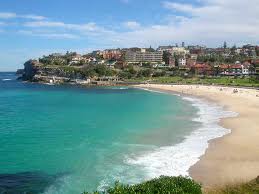
Many, many years ago I lived in Tamarama Bay, just East of Sydney,
Bronte Beach, Australia
Australia. It was a very short walk to Bronte Beach which was much better experience than the famous Bondi Beach about half a mile North of where we lived.
Thus when I saw the name Bronte Capital it caught my eye because of old resonances from the word “Bronte”.
OK, to the point!
John Hempton is a principle at Bronte Capital, an Australian fund manager. John is no slouch having been in his past a Chief Analyst for the New Zealand Treasury and Executive Assistant to the CEO of ANZ Bank in New Zealand. John’s CV is here.
Bronte Capital have a Blog – well who doesn’t – and it was a link to that Blog from Naked Capitalism that caused me to read a recent article from John about deregulation.
Despite me not understanding many of the technical aspects, it struck me with some force, so much so that I wanted to reproduce chunks of it on Learning from Dogs. John was gracious enough to give me written permission to so do! Thanks John.
I have just read Daniel Amman’s excellent biography of Marc Rich – the oil trader notoriously pardoned by Bill Clinton. I don’t want to get into the politics and ethics of the pardon other than to note that few things in it are black-and-white when you finished reading the book.
and a couple of paragraphs later explains that Marc Rich has a rather appropriate surname – well this is how John writes:
Marc Rich exploited price fixing/import/export controls to make simply unbelievable profits trading oil. Marc Rich & Co (the Swiss vehicle) was started with just over $1 million in capital and a couple of years later was making in excess of $200 million in profit. This level of profitability exceeds – by far – any other trading operation I have ever seen – and was probably the most profitable trading operation in history. Marc Rich & Co (since renamed Glencore) is possibly the most valuable business in Switzerland within the lifetime of its founder.
Just stop here for a moment.
This man, Rich, goes from one million dollars in capital to two hundred million dollars in profits in 2 years, give or take! Read on:
A typical Marc Rich & Co trade involved Iran (under the Shah), Israel, Communist Albania and Fascist Spain. The Shah needed a path to export oil probably produced in excess of OPEC quotas and one which was unaudited and hence could be skimmed to support the Shah’s personal fortune. Israel – a pariah state in the Middle East – wanted oil. Spain had rising oil demand and limited foreign currency but was happy to buy oil (slightly) on the cheap. Spain however did not recognise Israel and hence would not buy oil from Israel – so it needed to be washed through a third country. Albania openly traded with both Israel and Spain. Oh, and there is an old oil pipeline which goes from Iran through Israel to the sea.
So what is the deal? The Shah sells his non-quota oil down the pipeline through Israel and skims his take of the proceeds. Israel skim their take of the oil. Someone doing lading and unlading in Albania gets their take and hence make it – from the Spanish perspective – Albanian, not Israeli oil. The Spanish ask few questions. The margins are mouth-watering – and they all come from giving people what they really want rather than what they say they want. We know what the Shah wanted (folding stuff). We know what Israel wanted (oil). We know what Spain wanted (cheap oil). Who cares that Spain was publicly spouting anti-Israel rhetoric. [Similar trades allowed South Africa to break the anti-Apartheid trade embargoes.]
John explains:
It also helped that Marc Rich & Co was a (highly) multilingual firm. Rich is fluent in Spanish (it is the language he talks to his children in). He speaks English, German, Yiddish and presumably Hebrew. His business partner (Pincus Green – pardoned the same day as Rich) speaks Farsi amongst many other languages. They could do this deal because they could negotiate it and – deep in their heart they hold the Ayn Rand view that trade is a moral virtue and hence they do not need to be concerned with other morality. [The only line that matters is the law – and then it might not be the law of his adopted country – Switzerland – rather than the United States where he was resident.]
My italics, by the way. Just stay with me for a short while longer to ‘get’ John’s important message. Here’s John again:
The regulatory regime for domestic American oil was also perverse. Old oil (meaning wells drilled before the first oil crisis) received one price. New oil (wells drilled after the crisis) received a higher price. Squeeze oil (oil that was extracted from wells that ran less than 10 barrels per day) received a higher price still. The oil could be chemically identical and the price difference over $20 per barrel. Obviously a trader with a method (any method) of changing the oil source could make a fortune. Again I am not commenting on legality or morality. That was just plain fact. Ayn Rand applies – you give a value and you receive a value.
What all this regulation did was that it allowed people to make simply grotesque profits by thwarting regulation. The regulation thus worked less well and it was socially unfair. Pincus Green was good at negotiating in Farsi. He was astoundingly brave going to Iran immediately after the Shah fell. He was good at organising shipping. He worked really hard – but he did not invent something that changed the world and he wound up a billionaire. Traders make money by intermediating real business solutions – but these were real business solutions to problems made by legislation. Bad regulation, moral indignation about “trading with the enemy” or “trading with Israel” or with racists in South Africa made people with Ayn Rand morals exceedingly wealthy because you could arbitrage your way around any of these regulations.
OK, you are probably getting the drift of this important article from John. If any of this ruffles your hair, then read it all – it’s a very important message. This is what John is saying:
As a plea then I want a debate about the right form of regulation – a regulation that controls agency problems but does not allow arbitrage opportunities to people with “Ayn Rand morals”.
We are not going to get that from the current Tea Party Republicans. They simply argue that regulation (they say but do not mean all regulation) impinges on “freedom” (something that is clearly a good but hard to define). However many of the same people want planning regulations to ban a mosque in downtown New York because it is an insult to the victims of 9/11 (and banning mosques is not a restriction on “freedom”).
If that is the level of debate we are not going to get good re-regulation – we are just going to get pandering to whichever lobby group manages to garner most support. And that is a real risk because we will leave agency problems in place (they benefit the rich and powerful) and we will introduce the same sort of (dumb) regulation that made Marc Rich and Pincus Green astoundingly wealthy. That sort of regulation also benefits the rich and powerful – especially those with “Ayn Rand morals”. [The rich and powerful – if you have not noticed – are good lobbyists. Unless we are careful many amongst them will get their way.]
You didn’t rush those last three paragraphs, did you?
John concludes thus:
I don’t know how to do this well – but I thought I would state the obvious. The most obvious things that need regulation are things with a government guarantee (implicit or explicit). If you have an implicit guarantee (as we now know almost all large financial institutions have) then regulation really matters. If there are large agency problems (small shareholders, large management) then regulation should be deliberately biased to put power in the hands of shareholders not managers (eg banning staggered board elections).
Likewise other agency problems should be strongly policed and the regulation should be of the form that allows that policing. When Elliot Spitzer found that Marsh – a large insurance broker – was participating in bid rigging against schools buying insurance that was shocking – and is precisely the sort of thing in financial markets that should be policed strongly. But it took Elliot considerable effort to find and prove his case. The rules should be established so that sort of behaviour is really difficult to hide.
And I do not think that I need to explain to anyone how much mortgage brokers contributed to the crisis by (a) deliberately misleading borrowers about conditions on their mortgage and (b) participating in the faking of borrowers income/assets/education level when they on-sold the loans to Wall Street. Agency problems were at the core of the crisis.
On the other side if there is no agency problem then deregulation should remain the order of the day. Trade restrictions create arbitrageurs – and the arbitrageurs ensure the trade restrictions don’t work anyway.
There are obviously going to be extensions to this rough rule – and this post is really to garner discussion. But for a start I expect agents who benefit from their agency (and the abuse of their agency) to join the Tea Party.
It is difficult to get policy right. And when and if the policy is got right we are in for a very long fight to implement it.
I take my hat off to Mr John Hempton. He’s in the ‘finance’ industry, probably doing well, and yet he has the courage to hold a mirror up to the desperately immoral happenings going on around him.
It’s a real pleasure and honour to publish this Post.
Let me close with a short piece from the Sydney Morning Herald of the 2nd January, 2010.
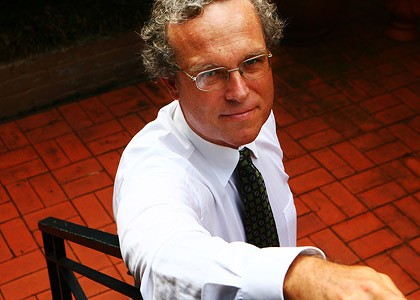
John Hempton ... blog locally, act globally. Photo: Domino Postiglione
WHEN John Hempton started a blog as he recovered from pneumonia, he did not expect to send shockwaves through the finance industry.
But that is exactly what the 42-year-old fund manager did through his Bronte Capital blog. His exposé of an unrelated US hedge fund would eventually lead to $426 million in investments being frozen and authorities seizing control of the Albury fund manager Trio Capital shortly before Christmas.
Apologies for the repeat but unable to write a fresh post for the next few days. This post about Kevin has been one of the most popular on Learning from Dogs.
Trust is both taught and learnt!
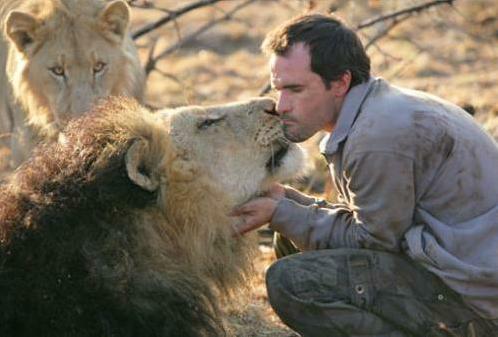
Thanks to Naked Capitalism, we posted an item on the 19th December about an unknown wild-life ranger working in the wildlife refuge area of Lanseria, South Africa. Here was one of the pictures included in that Post:
The Post finished with an appeal to anyone that knew the name of this Ranger. Many of you did and responded; thank you!
His name is Kevin Richardson and there is an interesting account of how he works and some of his ‘experiences’ in Revolution Magazine, luckily with online content. That article is here. It starts thus:
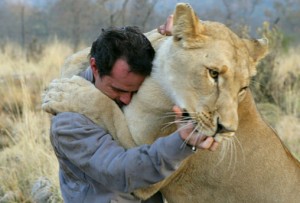
To do this he does not use the common methods of breaking the animal’s spirit with sticks and chains, instead he uses love, understanding and trust. With this unusual method of training he has developed some exceptionally personal bonds with his students. He sleeps with lions, cuddles newborn hyenas, swims with lionesses. Kevin can confidently look into their eyes, crouch to the their level and even lie down with them – all taboos in the normal world of wild animal handling – yet he doesn’t get mauled or attacked.
The article goes on to say that Kevin often works with the animals when they are very young. Thus he is demonstrating very powerfully that how we behave, especially with our children when they are young, creates the environment for building trust out of consistency of deed and thought. (By the way, do read some of the comments posted at the end of that Magazine article – some of them make for powerful reading.)
Kevin Richardson at 'work'.
Luckily, thanks to this wired world we now live in, there is also video of Kevin available on YouTube. A quick search under Kevin Richardson on YouTube will quickly find a number of videos but here are two that I wanted to share with you.
The first will leave you speechless and possibly wet-eyed!
The second is a promotional video by Kevin encouraging us to buy his recent book – and why not!
This is a very remarkable person and it’s an honour to share this with you. We have so much to learn from all animals.
Demonstrating the joy of being really good at what you do!
Before I get to the subject matter, just another word from me about the Posts being published on Learning from Dogs just now. As I mentioned earlier, I’m presently away from home and back in England for as long as it takes to complete all the necessary procedures at the US Embassy in London. All part of me being allowed to become a resident of Payson, Arizona and the husband to my lovely Jeannie.
Anyway, I’m posting items that catch my eye and don’t require the normal amount of time to prepare and write, simply because to have a new Post every day means keeping the pipeline going to cover the times when I shall be in darkest Devon and away from internet coverage! Trust I have your support during this period – I just love seeing so many readers of the Blog!
OK, to the article.
Bob Hoover
Bob Hoover is well known to many besides pilots because for years he has demonstrated the huge skill in managing the energy of a flying aircraft – with both engines stopped.
Thanks to Peter Kelsey, a Facebook contact, who recently posted a YouTube video of Bob flying his famous display. But more about the man. Here’s an extract from Wikipedia:
Robert A. “Bob” Hoover (born January 24, 1922) is a former air show pilot andUnited States Air Forcetest pilot, known for his wide-brimmed straw hat and wide smile. In aviation circles, he is often referred to as “The pilots’ pilot.”
Bob Hoover learned to fly at Nashville‘s Berry Field while working at a local grocery store to pay for the flight training.[1] He enlisted in the Tennessee National Guard and was sent for pilot training with the Army.[2] He was sent to Casablanca where his first major assignment of the war was test flying the assembled aircraft ready for service.[3] He was later assigned to the Spitfire-equipped 52nd Fighter Group in Sicily.[4] In 1944, on his 59th mission, his malfunctioning Mark V Spitfire was shot down by a Focke-Wulf Fw 190 off the coast of Southern France and he was taken prisoner.[5] He spent 16 months at the German prison campStalag Luft 1 in Barth,Germany.[6]
He managed to escape from the prison camp, stole an Fw 190, and flew to safety in the Netherlands.[7] After the war, he was assigned to flight-test duty at Wright Field. There he impressed and befriended Chuck Yeager.[8] Later when Yeager was asked who he wanted for flight crew for the supersonicBell X-1 flight, he named Bob Hoover. Hoover was Yeager’s backup pilot in the Bell X-1 program and flew chase for Yeager in a LockheedP-80 Shooting Star during the Mach 1 flight.[9] He also flew chase for the 50th anniversary in an F-16 Fighting Falcon.[10]
What Bob shows is that true professionalism, in whatever one does, work or play, always comes over as an underplayed, understated skill. Just look at this video for proof of that:
Well over 1,700,000 viewings at the time of writing this Post!
Remember Gordo Cooper in the film “The Right Stuff” poses the question, “Who’s the greatest pilot you ever saw?” Most pilots of all sorts would elect Bob Hoover for that honorable position.
The Smithsonian seem to agree as well. If you can, settle back and watch Bob Hoover’s talk at the 2010 Smithsonian Charles A Lindberg lecture. The video at that link is a long one and Bob doesn’t come on stage until minute 20.
But the flying scenes in the introduction include some historic footage and the talk by Bob Hoover, now nearly 90, is just wonderful. That link also includes the following summary of Bob Hoover:
Robert A. “Bob” Hoover is a fighter, military, and civilian test and air show pilot of legendary proportions. Using his superb piloting skills to fly aircraft to the edge of their performance capabilities, Hoover has left an indelible mark in aviation history. During his Air Force and North American Aviation careers, he flew 58 combat missions (and as a WWII POW flew himself to freedom), served as back-up pilot on the Bell X-1 and tested a wide array of fighter aircraft. As an ambassador of aviation, Hoover flew aerobatic routines in a North American P-51 Mustang, the T-39, and the Aero Commander fleet, culminating in the Shrike Commander 500S, at more than 2,500 civilian and military air shows. Bob Hoover will discuss his career in aviation and some of the pilots he has known including Orville Wright, Eddie Rickenbacker, Charles Lindbergh, Jacqueline Cochran, Neil Armstrong, and Yuri Gagarin.
The lesson from dogs is so obvious but, in a sense, so out of reach to us.
The story published yesterday about the Japanese Akita dog, Hachikō, reverberated around my mind for some days afterwards. (It was written on the 27th.)
It wasn’t only about the incredible loyalty shown by the dog towards its master – refusing to accept that its master was never coming home, year after year. To be honest, humans also show great loyalty to their families and dear friends.
No, there was something else that I couldn’t put my finger on until this morning. It was a dog’s ability to make the best of every moment, to fully experience what is happening now. It’s not the first time I have reflected on this aspect of the dog.
We humans have a similar capability but our intellect, our capacity to reflect on the past and ponder (worry?) about the future frequently means that the value of the moment, the preciousness of now, is lost. I could go on about this – perhaps in another Post.
But I was reminded of when I published a short piece over a year ago, from an unknown author, that was a wonderful attempt to let us humans see into the mind of a dog. Here it is again.
A love song
Pharaoh
I am your dog and have something I would love to whisper in your ear. I know that you humans lead very busy lives. Some have to work, some have children to raise, some have to do this alone. It always seems like you are running here and there, often too fast, never noticing the truly grand things in life.
Look down at me now. While you sit at your computer. See the way my dark, brown eyes look at yours.
You smile at me. I see love in your eyes. What do you see in mine? Do you see a spirit? A soul inside who loves you as no other could in the world? A spirit that would forgive all trespasses of prior wrong doing for just a single moment of your time? That is all I ask. To slow down, if even for a few minutes, to be with me.
So many times you are saddened by others of my kind passing on. Sometimes we die young and oh so quickly, so suddenly that it wrenches your heart out of your throat. Sometimes, we age slowly before your eyes that you may not even seem to know until the very end, when we look at you with grizzled muzzles and cataract-clouded eyes. Still the love is always there even when we must take that last, long sleep dreaming of running free in a distant, open land.
I may not be here tomorrow. I may not be here next week. Someday you will shed the water from your eyes, that humans have when grief fills their souls, and you will mourn the loss of just ‘one more day’ with me. Because I love you so, this future sorrow even now touches my spirit and grieves me. I read you in so many ways that you cannot even start to contemplate.
We have now together. So come and sit next to me here on the floor and look deep into my eyes. What do you see? Do you see how if you look deeply at me we can talk, you and I, heart to heart. Come not to me as my owner but as a living soul. Stroke my fur and let us look deep into the other’s eyes and talk with our hearts.
I may tell you something about the fun of working the scents in the woods where you and I go. Or I may tell you something profound about myself or how we dogs see life in general. I know you decided to have me in your life because you wanted a soul to share things with. I know how much you have cared for me and always stood up for me even when others have been against me. I know how hard you have worked to help me be the teacher dog that I was born to be. That gift from you has been very precious to me. I know too that you have been through troubled times and I have been there to guard you, to protect you and to be there always for you. I am very different to you but here I am. I am a dog but just as alive as you.
I feel emotion. I feel physical senses. I can revel in the differences of our spirits and souls. I do not think of you as a dog on two feet; I know what you are. You are human, in all your quirkiness, and I love you still.
So, come and sit with me. Enter my world and let time slow down if only for a few minutes. Look deep into my eyes and whisper in my ears. Speak with your heart and I will know your true self. We may not have tomorrow but we do have now.
We may not have tomorrow, but we do have now! Cherish the moment.
Let’s all pray to keep the flame of hope burning brightly for these guys.
On the 24th August, Learning from Dogs published a piece about 33 Chilean miners trapped underground. I’m sure many read that.
Well the BBC are still covering the event and their news web site has an informative update on what is happening.
The plan to rescue the 33 men trapped 700m (2,300ft) underground in the San Jose copper mine in Chile is a complex undertaking that could take engineers until the end of the year to achieve.
In a similar operation in 2002, American rescuers spent two days drilling a hole just wide enough to fit a man to rescue nine miners trapped underground.
The Americans had to drill down just 74m. By comparison, the plan to rescue the 33 men in Chile nearly three quarters of a kilometre underground is a much greater challenge. But, says John Urosek, who took part in the 2002 Quecreek mine rescue in Pennsylvania, it is not “mission impossible.”
“I would put this at the tough end of things. It’s not mission impossible but it’s a difficult mission,” says Mr Urosek who is now chief of mine emergency operations for the US Mine Safety and Health Administration.
The key to the operation is the use of a specialist drilling machine, designed to bore deep narrow holes through any rock to a depth of just over a kilometre.
So if you are having a bad day, stop and think about these 33 souls buried some 4.5 miles (7km) inside a Chilean mine some 2,300 feet (700m) down .
The announcement that they were still alive was made on Sunday by Chilean President Sebastian Pinera.
Surrounded by relatives of the miners who have gathered outside the mine, he held up a note from the miners saying: “All 33 of us are fine in the shelter.”
“It will take months to get them out,” Mr Pinera said. “They’ll come out thin and dirty, but whole and strong.”
Todd Russell, an Australian miner who was trapped 3,000ft underground in Tasmania after an earthquake in 2006, said he and a second miner who survived the collapse relied on each other for support.
“It’s amazing what your body can do,” he told the BBC World Service. “We survived on hope and courage, and each other, [and] we were lucky enough to have a bit of underground mine water.”
“They’re lucky that they’ve got 33 guys there with them that they can rely on each other,” Mr Russell said.
Here’s some footage of their rescue:
Let’s all pray that these 33 Chilean miners end up arm-in-arm back on the surface as Todd and Brant did.
It’s almost unimaginable that Planet Earth could go the same way. Then again, anyone over the age of, say 60, would find where we are today, in terms of mankind’s long-term survival, equally unimaginable from how the world looked 40 years ago.
Jon Lavin wrote a Post on the 13th June, 2010 entitled, “Dealing with the fear of the known.” I’ve been thinking about that in recent weeks including the comment to Jon’s article from Per. Here’s how Jon closed that article:
If more of us got used to coming out of the mind before making an important decision, and simply sat with the question for a while, the answer would probably present itself.
This will probably raise more questions than it answers but that’s not a bad thing.<!–
And here’s the recent comment from Per:Great advice… but how do we remove the fear of what is known?
Presumably Per was implying that we shouldn’t fear the known. However, I beg to differ here; it is actually fear of the UNKNOWN that is rather pointless (I am not afraid of aliens), while fear of the KNOWN is CRUCIAL to our survival.
But like anything else, you can have too little or too much. Too little, and you survive a very short time. Too much, and you sit cowering in your cellar afraid to go out. As with EVERYTHING in life it is a question of BALANCE.
How do we know how much fear to deploy? Instinct, intelligence, knowledge and experience. If any of these are deficient, we may apply an inappropriate fear quotient.
Let’s take “Global Warming”! How afraid of it should I be? What are my marks out of 10 for the four fear-factors above?
Instinct = 8 – I instinctively fear a situation when my environment is getting hotter, as I don’t know what that will imply. Intelligence = 8 – I am (just) intelligent enough to appreciate the dangers of a rise in temperature. Knowledge = 4 – I have no real idea exactly what is going on or how far it will go; the messages are mixed and I see no real panic among governments. Experience = 0
So, a score of just 20 out of 40, which means IGNORANCE and DOUBT and these add up to FEAR ….. so I am quite afraid.
Home grown vegetables
More apparently, than my leaders seem to be, who can’t even ban flying across the Atlantic at a cost of 60,000 tons of CO2 per day. The question is, will this considerable amount of fear push me into actually DOING something about GW? What is my inertia level and what is my tipping point? What would it take to get me to dig up my garden and plant potatoes? To sell my car and buy a horse? Sadly, humans are in general pretty inert …… it is much easier to do nothing or too little until it is (almost) too late.
So, “fear” is absolutely essential to our survival. If you’re a driver who doesn’t fear accidents then please keep out my my way until you very soon die in one.
Fear is also what pushes me to drive very carefully. People who greedily lent money to Madoff had no fear they would lose it, having lost all control of whatever ration of commonsense and/or logic they might once have had. Perhaps now people will fear rather more about losing their money and therefore invest it more wisely.
To take another topical example, any company in the future (is there one?) drilling for oil in the Gulf of Mexico will fear the lash of Obama’s tongue and stick and this fear will push them to be a bloody sight more careful and to have an effective contingency plan. Actually, why more people don’t have a lot more fear is a mystery to me.
Right, having dealt with fear, we come to our response to it, which is of course the interesting bit. The world is changing so fast that almost all of us have limited control. Even the US President has limited control. This is not comfortable.
How then can we gain more control and become more comfortable? Jon has pointed the way; we must become more self-reliant. Jon will presumably now have much less fear of starving to death, since he is producing a proportion of his own grub. Anyone installing solar-panelled heating will be much less fearful about their electricity being cut off.
I would go further. Anyone owning a horse will or would have much less fear about running out of fuel and being immobile – or more to the point, of being unable to plough and sow his fields, without which we really are stuck. (Incidentally, I am predicting a big comeback for work horses. They are slower, yes, but you can’t breed a tractor (or indeed talk to it) or produce your own fuel, which is where the horse wins out. We’ll have to move more slowly, but then speed is vastly overrated.)
Now Jon with his chickens is a special case. Is there, I wonder, a small element of “fear” in his decision to keep chickens? Humans are complex …. Another major factor pushing Jon down this road could be (and in his case probably is) social responsibility.
It seems pretty clear that if EVERYONE became more self-reliant then vast, expensive, high-consuming centres of production would be scaled down. Unfortunately, social responsibility is not exactly fasionable in today’s consumer world (or we wouldn’t use plastic bags for a start, just to take one small example). Like the vegetarians of 30 years ago, Jon might be seen as an exception if not crank; until of course the fear factor becomes higher and then everyone will try to grow their own potatoes.
So, fear of powerlessness drives us to take initiatives that will help to remove at least some of this fear; a circular but inevitable process. Nothing new about it; the only sad thing is that humans seem to need to travel quite a long way down the path of doom before they really start to react.
This of course is why we did nothing when Hitler invaded the Rheinland in 1936; wait and see seemed easier at the time. It’s also why America totally ignored Jimmy Carter’s ideas of some decades ago about reducing America’s dependence on Arab oil. It was much easier to deride him and do the easy (but totally wrong) thing, especially of course as the oil companies have loads of money and can buy off people who otherwise might see the light.
Well, we’re well past “Wait-and-see” now …… we are now entering the “Do-it-or-else ….” period. And where Jon is of course achieving a double-whammy is that his increasing self-reliance is also GOOD FOR SOCIETY. If everyone were more self-reliant in every way a vast saving in energy and everything else could be achieved. Flying exotic fruits into Britain from South Africa is insane, yet so normal that it seems … errrmmmm … normal.
All this was obvious years if not millennia ago, but the current state of the world has increased the fear factor and is pushing people like Jon down this road. But it is an interesting road. Being self-reliant has multiple advantages, though it will be pretty hard on the rich, who may have to learn how to do things they usually pay underlings to do.
But Jon is in the vanguard of this movement; there is VAST scope for increasing self-reliance. It could and should be an adventure, though it will involve enormous change. The latter of course can also be stressful, but less so when it is clearly a change for the better, as I believe it will be.





 Learning from Dogs