My apologies but events yesterday conspired to get in the way of me offering a more thoughtful article for today. So I hope you will be happy with another video of Joseph Campbell.
Many, many years ago I was a salesman with IBM UK; their office products division. I found it a wonderful job in a great company and was very happy. The annual reward for meeting one’s sales targets was the 100% Club. I seem to recall that at one of these lavish events, one of the guest entertainers was Peter Ustinov. Indeed, somewhere deep in my belongings is an autograph of the great man.
Anyway, as a nice alternative to the posts on Learning from Dogs this past week, here’s a wonderful compilation of interviews of Sir Peter taken by ‘Parky’ otherwise known as Sir Michael Parkinson – ah sweet memories!
Life is without meaning. You bring the meaning to it.
The meaning of life is whatever you ascribe it to be.
Being alive is the meaning.
Going back to yesterday’s Post, if you either watched in full or dipped into each segment of the film, Prophets of Doom – The American Collapse, it would have been impossible for you not to end up pretty despondent about where civilisation in general, and American civilisation, in particular, has got itself.
The film is probably factually well-based, despite the awful style of the presenter, so it would be a perfectly human response to worry about how close to the precipice we are getting.
Anyway, the following evening we watched a wonderful DVD lent to us by John H, Mythic Journeys. Here’s the official trailer. Watch it, but more importantly listen to the words of the soundtrack, they are inspiring.
If you go to the website, as highlighted, then you will read this about the movie.
Own the award-winning spiritual film that has captivated audiences across the country and has been hailed as a “Masterpiece”, “Profoundly Transformative”, and “Life-Changing”!
Mythic Journeys is not your typical documentary. Like a mythological story it is a multi-layered experience, rich and stimulating interviews with philosophers and spiritual leaders are interwoven with a gorgeous animated tale of a king, a sorcerer, and a mischievous corpse. The film takes the audience on a powerful spiritual journey.
But there’s more to it, as the next video clip underscores. It’s this. As Duncan Campbell explains in the video, change is deeply unsettling for humans.
There is no doubt that millions of people across the world sense that we are in an era of very great change. It deeply undermines our security in the future, whether having any real form of emotional reliance on the future makes any sense anyway. But if we let go of the future, as Terry Hershey so competently voiced when he was here in Payson, then we can pray and love each moment of each day.
Life is without meaning. You bring the meaning to it.
The meaning of life is whatever you ascribe it to be.
Being alive is the meaning.
This is a quote from Joseph Campbell and, as with so much of his writings, these few words have an import way beyond the face reading of the four sentences. Why am I called to this introduction? Let me explain.
The last few days have been unusually hectic, almost as though my senses have been deliberately targeted by a whole variety of messages. Not planned, you have to understand, just the way it’s been. However, when reflecting on the way these messages have moulded my emotions, it has been very clear that conflicting messages have produced conflicting emotions and that getting to the heart, as in the meaning of it all, requires quiet, contemplative time.
So what I am going to do over the next few days, not over the week-end, is to present each of these elements in the order that they were presented and then, at the end, offer what I hope is a more balanced perspective, i.e. the core meaning.
The first ‘message’ came from watching a 90 minute video highlighted on the web site, Top Documentary Films. The film explored the ways that six prominent Americans thought the ‘American Way’ was heading. Deeply gloomy except for the last 10 minutes or so.
Today’s world has troubles unique to its time in history, from the global financial crisis to technological meltdowns to full scale, computerized global war.
Observing the convergence of such events, contemporary prophets have begun to emerge from obscurity to suggest that these conditions might be signs of the demise of the modern world.
These men are historians as well, using all manner of information and patterns from the past to provide context for where we are going.
Their predictions interpret the current state of affairs in our world as evidence that the America we know may come to an end.
The men proposing these ideas are not crackpots living on the streets of New York; they are intelligent, learned men who come armed with the evidence to back up their claims.
I am now going to include the film, in all its parts, as found on YouTube. Don’t suggest you watch it all, unless you feel so inclined, but try and get a feel for the various aspects of American life that are portrayed as unsustainable.
Just as important, make a note of your emotions as you watch these excerpts (and commenting on this Blog even better!)
When we’re in love with God, the cosmos, our living garden planet and the steadily growing conscious interconnection between those who understand and serve, we live in awe and wonder and realize a peaceful natural serenity in the midst of our daily concerns and responsibilities.
As our world, our environment and our culture appear to be unraveling, it becomes increasingly necessary for human beings to slow down to re-energize. It’s clear that our species has recently lost spectacularly to natural forces in the Gulf of Mexico and Japan. It’s no coincidence that it’s our technology which continues to reveal the fundamental weakness of human ego. It’s more than a metaphor that our individual and species arrogance is our Achilles heel.
There are many people who fail to perceive, understand and appreciate parallel realities from a rational, sensory and unified perspective by learning to see through a mystical third eye. Mysticism may be misunderstood as simply thinking outside of the box. Forget about the box. Let go of self-centered fears. Become aware of being unaware. Nurture capabilities to perceive non-locally and act locally. What’s happening worldwide comes with the territory. We are each responsible for our collective destiny
Meditation reflects that imagination and creativity are necessary to invent and utilize tools. Creativity did not begin with humans and is not exclusive to humans. God’s nature precedes emerging technology. Morality derives from our common need for species unity.
The message is that God doesn’t care about money and the sky is no longer a human limit. The fact remains that except for occasional astronauts we all continue to live on the same planet. Those who understand need no explanation.
There is a need for productive use of intelligence and technology at our natural frontiers. We need to refuel world economies with clean energy visions that provide solutions for our present local planetary emergency.
We may choose to implement the changes necessary to avoid impending local ecosphere, cultural and technological meltdowns while preparing for a migration to the stars.
Unification is a common goal. Leaving the nest of our garden planet is a partial unifying solution for the problems of our exponentially expanding species. An alternative is that our obsession with the symbol of money will have the same dire consequences for those who are obsessed as for those whom are oppressed.
Please love God, maintain an even strain, follow your bliss, continue to learn, share and serve our common purpose under God, proceed as the way opens, cross the next bridge as we come to it, enjoy the journey and stay in touch.
There’s always much more to people than meets the eye!
I can’t recall at what point in the life of Learning from Dogs that Per Kurowski popped up over the parapet but it was pretty early on. Per has been a great supporter of my varied efforts to promote the way that dogs are a wonderful example of integrity, trust and openness.
Anyway, Per comes from a background that one might not associate with the rest of this article. Per used to be a director at the World Bank. One of his Blogs includes this:
I warned many about the coming crisis, long before it happened, on many occasions and in many places, even at the World Bank. They did not want to listen and that´s ok, it usually happens, but what is not ok, is that they still do not seem to want to hear it. “We can easily forgive a child who is afraid of the dark; the real tragedy of life is when men are afraid of the light.” (Plato: 427 BC – 347 BC)
Just a couple of days ago, I posted about the moon that passed closer to the Earth on the 19th than for the last 20 years. Per added a comment to that Post, “And this is a homemade version of the beautiful Harvest Moon song by Neil Young” With this link. At that link you can watch and listen to Per singing ‘Harvest Moon’ recorded by Neil Young. Enjoy.
Here was that moon, as seen from Payson in Arizona with some cloud in the sky!
That moon!
Finally, for those interested in the lyrics, here they are.
Come a little bit closer
Hear what I have to say
Just like children sleepin’
We could dream this night away.
But there’s a full moon risin’
Let’s go dancin’ in the light
We know where the music’s playin’
Let’s go out and feel the night.
Because I’m still in love with you
I want to see you dance again
Because I’m still in love with you
On this harvest moon.
When we were strangers
I watched you from afar
When we were lovers
I loved you with all my heart.
But now it’s gettin’ late
And the moon is climbin’ high
I want to celebrate
See it shinin’ in your eye.
Because I’m still in love with you
I want to see you dance again
Because I’m still in love with you
On this harvest moon.
Come a little bit closer
Hear what I have to say
Just like children sleepin’
We could dream this night away
But there’s a full moon risin’
Let’s go dancin’ in the light
We know where the music’s playin’
Let’s go out and feel the night
Because I’m still in love with you
I want to see you dance again
Because I’m still in love with you
On this harvest moon
When we were strangers
I watched you from afar
When we were lovers
I loved you with all my heart
But now it’s gettin’ late
And the moon is climbin’ high
I want to celebrate
See it shinin’ in your eye
Because I’m still in love with you
I want to see you dance again
Because I’m still in love with you
On this harvest moon
Yet another reflection of the precious planet upon which all life depends.
Watch this!
It comes towards the end of the fascinating documentary about the life of John Trudell. If you would like to watch the complete documentary, then that is available on-line also. It is described by the site Top Documentary Films thus:
At its most basic level, Trudell is an eye-opening documentary that challenges belief systems. At its loftiest, Trudell will inspire you to reawaken your spirit.
In the telling of Trudell, Rae invested more than 12 years chronicling John Trudell’s travels, spoken word, and politics. (The making of the movie, a journey in itself, is as much a story as the finished product).
The film combines archival, convert, and interview footage in a lyrical and naturally stylized manner, with abstract imagery mirroring the coyote nature of Trudell.
Pockmarked with adversity, counterbalanced by preservance, Trudell begins in the late sixties when John Trudell and a community group, Indians of All Tribes, occupy Alcatraz Island for 21 months. This creates international recognition of the American Indian cause and gives birth to the contemporary Indian people’s movement.
Rae revisits Alcatraz, returning to what John refers to as his birth. From Alcatraz, we follow John’s political journey as the national spokesman of the American Indian Movement (AIM).
During this tumultuous period, his work makes him one of the most highly politicalsubversives of the 1970′s, earning him one of the longest FBI files in history (more than 17,000 pages).
“It is better to travel well than to arrive.” Buddhist quote.
Those of you who are regular readers of Learning from Dogs, and I am flattered at how many there are now, will recall that on March 8th I posted an announcement of the Rev. Terry Hershey coming to Payson to give a couple of seminars based around his best-selling book, Soul Gardening. Jean and I had the honour of having Terry stay with us for a couple of nights.
Anyway, on Monday morning, the day Terry was to give his talks, four of us took a couple of hours off in the morning to take a walk around the majestic granite boulders, a couple of miles on from our house. These great boulders give rise to the name of the road that we live on; Granite Dells Rd. Most afternoons, Jean and I take Pharaoh and his little pack of dogs for this three-mile walk so today was no different other than the walk being in the morning.
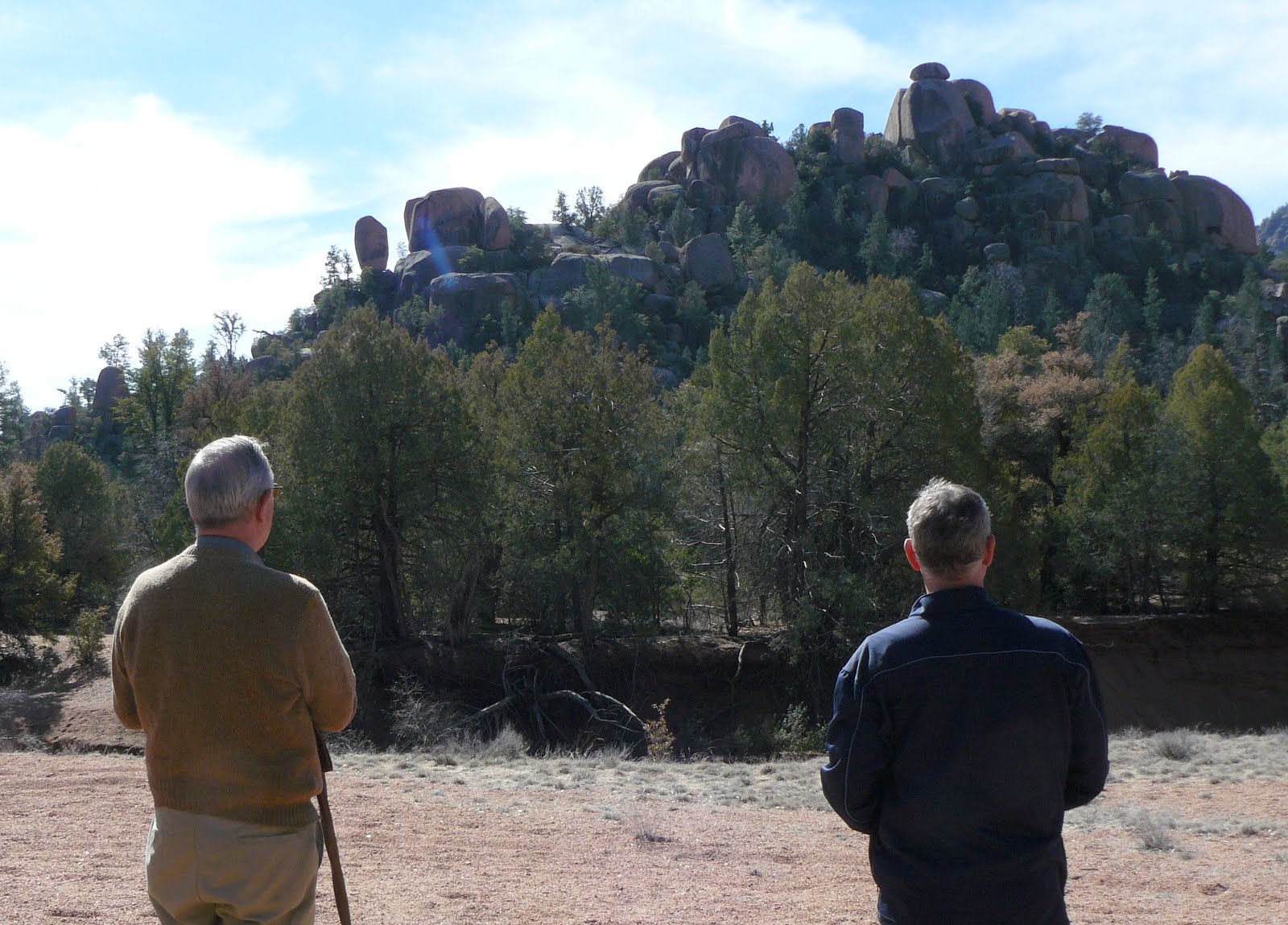
John H and Terry admiring the granite dells.
However, one of the benefits of having Terry with us on the walk was that he pointed out something really obvious that, so far, Jean and I had just taken for granted, i.e. missed!
It’s this. That dogs, when out for a walk off-leash, never travel the same journey, however many times they go on the same walk. All dog-owners will be aware of this.
Dogs are all over the place, scurrying here and there, following sweet scents, totally absorbed in the intimacy of their relationship with their immediate experience. There’s no ‘purpose’ to their behaviour, there’s no ‘clock’ running in their head as to what time it is and when they have to be somewhere else. It is the epitome of travelling well, as from the quote at the start of this article.
The metaphor of how dogs journey as a comparison to how so many of us humans travel with eyes closed, never stopping to smell the roses, was mentioned by Terry when we stopped for group photo towards the end of the walk. Terry also touched on the importance of living in the present, as dogs do so very, very well, many times during his later talks.
As soon as we make our happiness conditional on ‘getting’ somewhere in the future, our journey rather becomes pointless.
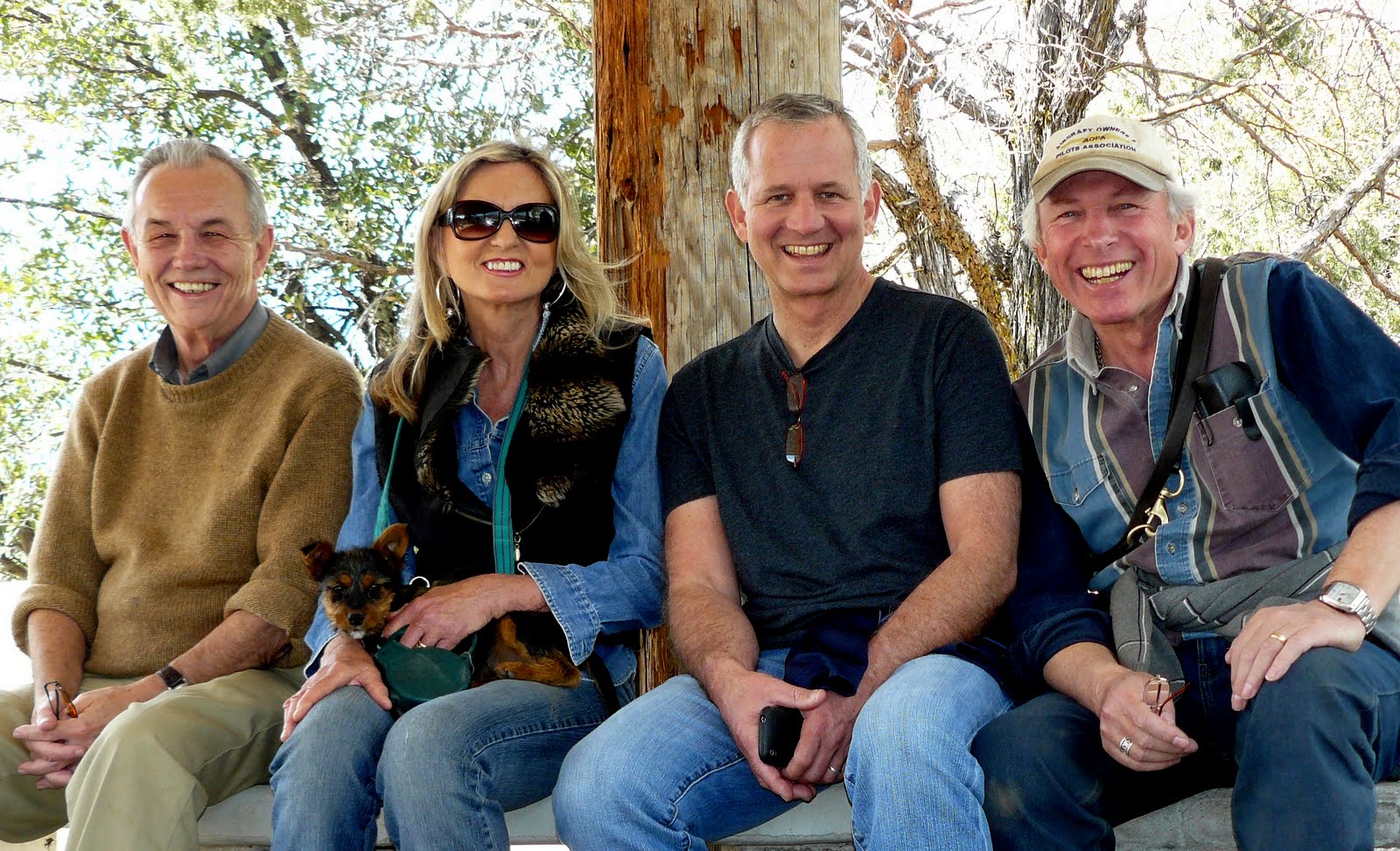
John, Jean, Terry, Paul - being happy in the moment.
I am indebted to James Kwak, the author of this article on Baseline Scenario, for giving me permission to reproduce in full what was published on the 12th March, 2011.
By James Kwak
A friend passed on this article in The Motley Fool by Morgan Housel. It begins this way:
“Enough.
“That’s the title of Vanguard founder John Bogle’s fantastic book about measuring what counts in life.
“The title, as Bogle explains, comes from a conversation between Kurt Vonnegut and novelist Joseph Heller, who are enjoying a party hosted by a billionaire hedge fund manager. Vonnegut points out that their wealthy host had made more money in one day than Heller ever made from his novelCatch-22. Heller responds: ‘Yes, but I have something he will never have: enough.’”
The rest of the article discusses the cases of Rajat Gupta and Bernie Madoff, the former accused (but not criminally) and the latter convicted of illegal activity done after they had already been enormously successful, professionally and financially.
Housel asks, why do people push on — legally or illegally — when they have more of everything than anyone could possibly need? He summarizes the happiness research as follows:
“Money isn’t the key to happiness. What really gives people meaning and happiness is a combination of four things: Control over what they’re doing, progress in what they’re pursuing, being connected with others, and being part of something they enjoy that’s bigger than themselves.”
Of course, even if that’s true (and I think it is, except for the first sentence, on which more below), that doesn’t mean that people realize it. And if people don’t understand the relationship between their actions and their personal outcomes, we have no reason to believe that they will behave in a utility-maximizing way.
That said, renowned economist Justin Wolfers was recently on Planet Money saying that money does, indeed, buy happiness. He was discussing a paper he did with Betsey Stevenson looking at datasets covering many countries over many years. They find a positive relationship between income and subjective well-being, whether in the form of life satisfaction or happiness (although the relationship appears somewhat weaker for happiness).* In particular, they find that there is no satiation point, at least when making cross-country comparison (that is, the positive relationship persists even when you look only at countries that are at least moderately wealth).
At one point in the Planet Money interview, I believe Wolfers did say that when it comes to happiness, someone (Kahneman, I think) had estimated that there is a satiation point at around $75,000 per year. But, he went on, the issue is that we may want subjective states other than simple happiness. So, for example, we may want the subjective feeling of power, whether or not it actually makes us happy in the moment. And those other subjective states may not have satiation points, or they may have little to do with income.
But ultimately I agree with Heller. It is a great thing to have “enough,” and to know you have enough. And that is a feeling that for some people, apparently, no amount of money can buy.
* The difference, put simply, is between whether you feel happy at this moment and whether you feel satisfied with your life as a whole. For more, see this fantastic TED Talk by Daniel Kahneman (which I have recommended before).
Brought forward as a result of the Japanese earthquake.
I had this item scheduled for publication on Friday 18th March, the day before this month’s full moon. But recent events in Japan made me decide to bring it forward to today for reasons that will be clear when this Post is read further.
The world is set to experience the biggest full moon for almost two decades when the satellite reaches its closest point to Earth next weekend.
On 19 March, the full moon will appear unusually large in the night sky as it reaches a point in its cycle known as ‘lunar perigee’.
Stargazers will be treated to a spectacular view when the moon approaches Earth at a distance of 221,567 miles (356,577 km) in its elliptical orbit – the closest it will have passed to our planet since 1992.
The full moon could appear up to 14% bigger and 30% brighter in the sky, especially when it rises on the eastern horizon at sunset or is provided with the right atmospheric conditions.
Moon apogee and perigee
This phenomenon has reportedly heightened concerns about ‘supermoons’ being linked to extreme weather events – such as earthquakes, volcanoes and tsunamis. The last time the moon passed close to the Earth was on 10 January 2005, around the time of the Indonesian earthquake that measured 9.0 on the Richter scale.
Hurricane Katrina in 2005 was also associated with an unusually large full moon.
Previous supermoons occurred in 1955, 1974 and 1992 – each of these years experienced extreme weather events, killing thousands of people.
However, an expert speaking to Yahoo! News today believes that a larger moon causing weather chaos is a popular misconception.
Dr Tim O’Brien, a researcher at the Jodrell Bank Centre for Astrophysics at the University of Manchester, said: “The dangers are really overplayed. You do get a bit higher than average tides than usual along coastlines as a result of the moon’s gravitational pull, but nothing so significant that will cause a serious climatic disaster or anything for people to worry about.”
But according to Dr Victor Gostin, a Planetary and Environmental Geoscientist at Adelaide University, there may be a link between large-scale earthquakes in places around the equator and new and full moon situations.
He said: “This is because the Earth-tides (analogous to ocean tides) may be the final trigger that sets off the earthquake.”
Volcanoes have reportedly erupted in Japan, Indonesia, and Kamchatka Russia today, presumably due to the massive Japanese earthquake. There have been no reports of damage from the eruptions.



 Learning from Dogs