The last two weeks predominantly have been posts under the umbrella of WordPress’ Writing 101 event. I’m bowing out at the half-way point.
Simply because the arrival of Pedy and the huge pleasure that Jean and I have had from rescuing him meant I wanted to return to writing most of the time about dogs and what we humans can learn from them.
So with that in mind it has been widely reported in recent days about the news that we humans bond with dogs as we do with babies. Let me quote a little from a recent article from the BBC.
Gazing into a dog’s eyes can stimulate the same bonding process that occurs between mother and child.
Presented by Zoe Gough
Eye contact between a mother and her baby strengthens their attachment by activating the so-called ‘love hormone’ – oxytocin – in the mother’s brain.
This drives emotional bonding between parent and offspring by encouraging both nurturing and interactive behaviours.
Studies have shown that stroking or making eye contact with a dog can trigger a similar release of oxytocin in a human’s brain.
Now a team of Japanese scientists have found that the “mutual gaze” between dogs and their owners can lead to a bond that is similar to that between a mother and child, with humans experiencing the same feelings of affection for their dogs as they might do for their family, therefore helping to bring the species closer.
The findings are reported in the journal Science and also note that wolves do not show the same response. Authors suggest this means that the bonding process probably co-evolved in both species as dogs became domesticated.
“It can be said that dogs successfully cohabit with humans because they have been successful in adapting the bonding mechanism to relations with humans,” said lead author Dr Miho Nagasawa, from the School of Veterinary Medicine, Azabu University, Japan.
All of which serves as a wonderful foreword to how the stray dogs manage so successfully to exist on the Moscow subway. I reported on this back in 2011 under the title of The Tenacity of Dogs but immediate neighbours Larry and Janell sent me a link to a much more detailed account of these subway dogs. Here is the remarkable story.
ooOOoo
The Life of Subway Dogs
To those of you who own dogs or like them, this should be interesting.
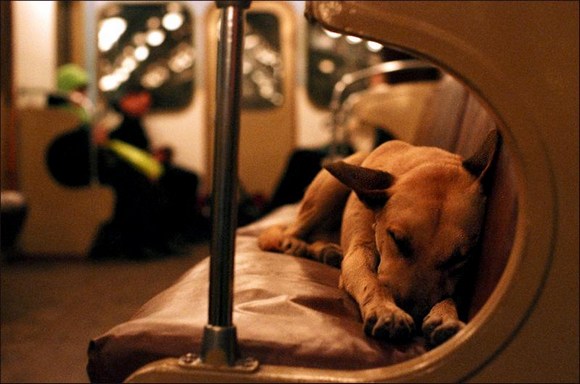
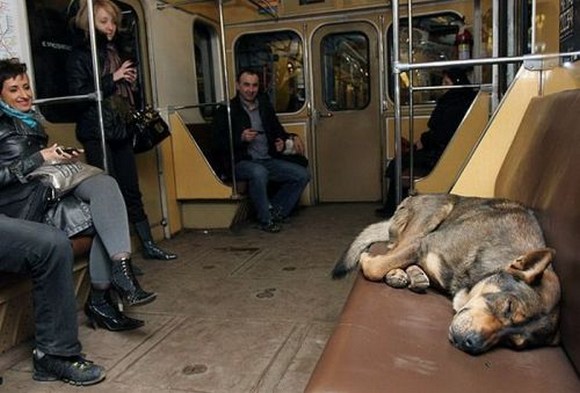
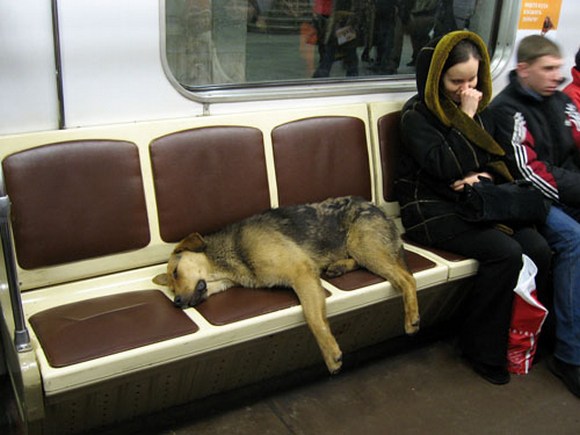
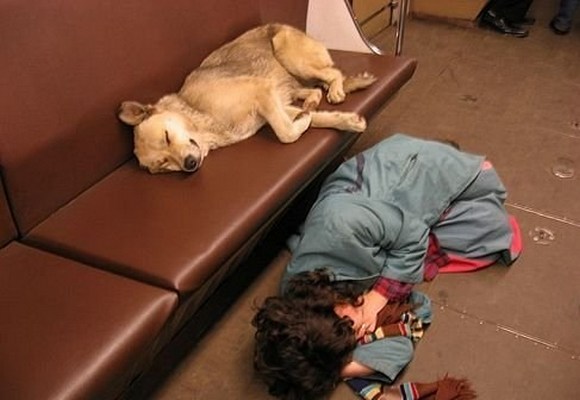
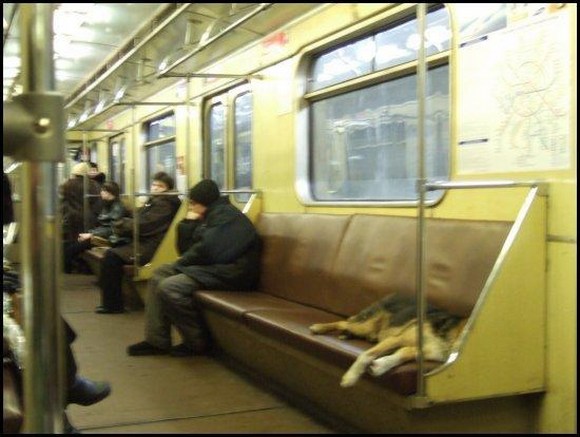
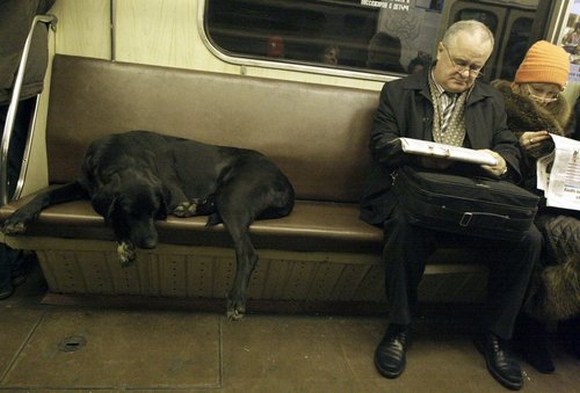
The elite of Moscow’s 35,000 stray dogs are about 500 Russian dogs constantly living in the Moscow subway (Metro). About 50 of subway dogs have learned to ride the trains, commuting from quiet suburbs stations where they spend the night to downtown where it’s easier to get some food.
Each morning, like clockwork, they board the subway, off to begin their daily routine amidst the hustle and bustle of the city. But these aren’t just any daily commuters. These are stray dogs who live in the outskirts of Moscow Russia and commute on the underground trains to and from the city centre in search of food scraps.
Then after a hard day scavenging and begging on the streets, they hop back on the train and return to the suburbs where they spend the night.
Living in the subway is just a survival tactic the Moscow stray dogs have come up with. The subway dogs have figured out how to use the city’s huge and complicated subway system, getting on and off at the stops they need. They recognize the desired station by smell, by recorded announcer’s voice, and by time intervals basing on their biological clocks. Usually they ride first or last car to keep away from crushes.
Experts studying the dogs, who usually choose the quietest carriages at the front and back of the train, say they even work together to make sure they get off at the right stop – after learning to judge the length of time they need to spend on the train.
In Soviet times stray dogs were barred from subway. Moscow Metro’s passengers are so accustomed to dogs on subway – sleeping on empty seats and hanging around stations – that they do not pay any attention.
For these strays the Moscow Metro is their home. The subway dogs get outside to do all their deeds and behave friendly to the passengers. They have very good instincts about people, greeting happily kind passengers and avoiding contacts with intolerant persons. And they always find somebody who will share food with them.
With children the dogs “play cute” by putting their heads on youngsters’ knees and staring pleadingly into their eyes to win sympathy – and scraps.
Dogs are opportunistic and intelligent, and when they figured out they were no longer chased away from the subway stations, they began hopping trains for a lift into the city. The Moscow subway system is a maze that can be confusing for people, but the dogs appear to have learned the system.
Once in the city, the dogs have their own special ways of getting food. Some position themselves outside butcher shops and wait for dog lovers coming out of the shop to toss them a bone. Others have refined a technique of sneaking up behind people who are eating food and surprising them with a loud bark which hopefully scares the person into dropping whatever they’re eating. If the dog is successful in getting the person to drop their food, he grabs his prize and runs.
Packs of stray dogs are led not by the strongest or most dominant member, but by the most intelligent dog in the pack. The dogs understand living among people in a large city requires brains and not muscle to survive. Researchers have observed dog packs selecting pack members that are smaller and cuter than the other ones who are then sent out to beg for food.
The dogs also don’t leave messes laying around where someone can step in them, and they relieve themselves in out of the way spots away from the main traffic areas. The subway riding stray dogs of Moscow have essentially learned how to interact with people and move among them in order to survive.
ooOOoo
Aren’t dogs the most remarkable species of animal!
Today’s Prompt: A man and a woman walk through the park together, holding hands. They pass an old woman sitting on a bench. The old woman is knitting a small, red sweater. The man begins to cry. Write this scene.
We encourage you to give fiction a try, even if that is not what you normally do — it can be a fun way to stretch. If fiction feels like a bridge too far, take some element from the scene that speaks to you, and write a non-fiction piece about that. Perhaps you are drawn to the old woman, and will write a piece about your grandmother, or the crying man will inspire a story about the last time you cried joyful tears.
Today’s twist: write the scene from three different points of view: from the perspective of the man, then the woman, and finally the old woman.
If point of view was an object, it would be William Carlos Williams’ infamous red wheelbarrow; everything depends on it.
Consider a car/pedestrian accident: the story differs depending on whether you’re the driver, the pedestrian, or the woman across the street who witnessed the horror. Everyone will tell a different story if asked to recount the event.
Shifting point of view can be your best friend if you’ve got writers’ block. If you’re stuck or you feel your writing is boring and lifeless, Craig Nova, author of All the Dead Yale Men, suggests shifting the point of view from which your story is told:
Take point of view, for example. Let’s say you are writing a scene in which a man and a woman are breaking up. They are doing this while they are having breakfast in their apartment. But the scene doesn’t work. It is dull and flat.
Applying the [notion] mentioned above, the solution would be to change point of view. That is, if it is told from the man’s point of view, change it to the woman’s, and if that doesn’t work, tell it from the point of view of the neighborhood, who is listening through the wall in the apartment next door, and if that doesn’t work have this neighbor tell the story of the break up, as he hears it, to his girlfriend. And if that doesn’t work tell it from the point of view of a burglar who is in the apartment, and who hid in a closet in the kitchen when the man and woman who are breaking up came in and started arguing.
Now my reaction upon first reading today’s theme was that this was both fun and inspiring. Then I realised that before I could commit words to the post I would need to let the fictional circumstances brew for a while amongst the aged brain cells and, if possible, it would be wonderful to include a dog in the story. 🙂
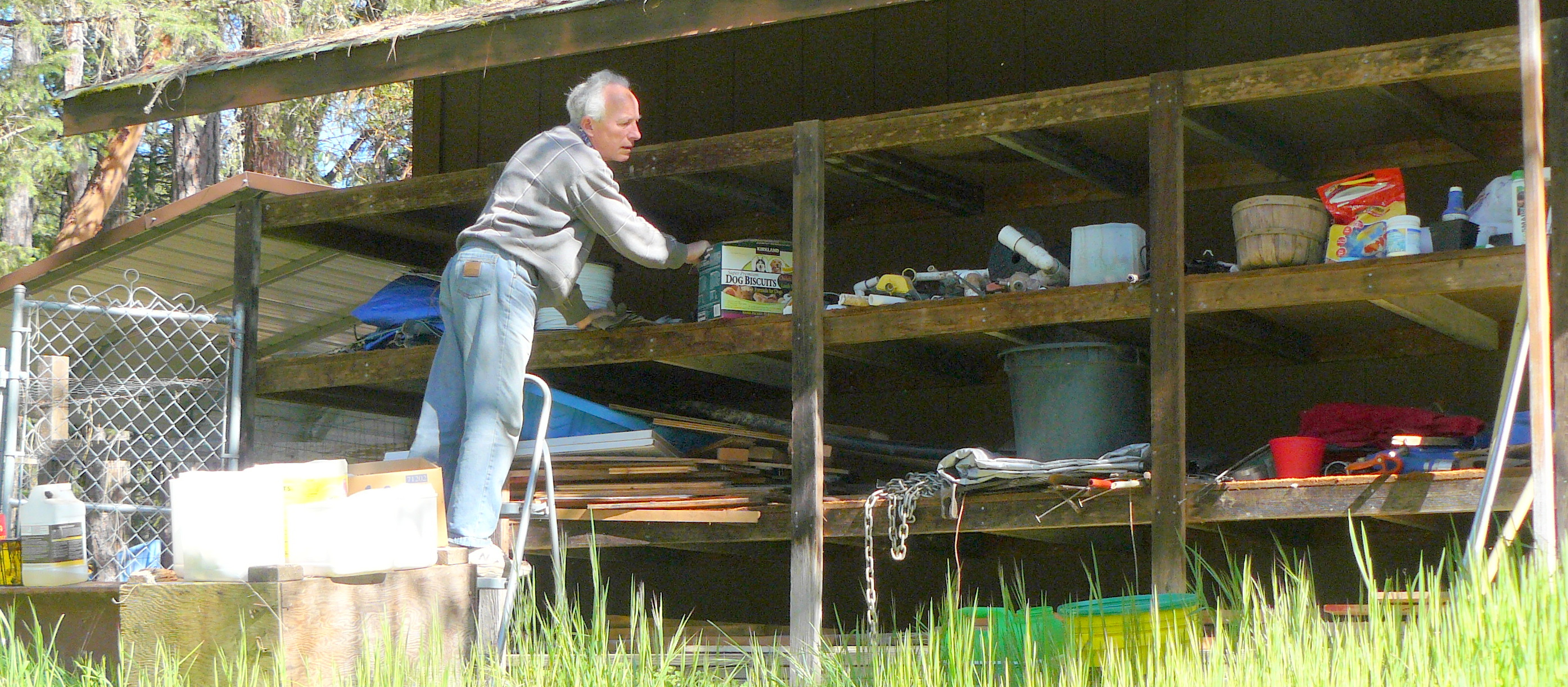
So for the next hour (I’m writing this at 10:30am) I shall use the wonderful weather we have today to continue my project of sorting out the grand mess around the back of the garage and see what creative thoughts come to mind!
Yet another point of view!
oooo
Echoes
“Jim, what’s the matter? You’ve seen this dear old lady sitting on the bench almost every time we’ve come walking. What’s brought on the tears today?”
Sandra thought that she knew her husband inside out, possibly better than he knew himself. Yet this quiet, sudden release of deep inner feelings from Jim had her perplexed.
Jim let go of Sandra’s fingers and fished around in his trouser pocket for a tissue. He blew his nose and wiped his eyes on his sleeve.
“Oh, it’s OK sweetheart, just some stirring of a place from too many years ago.”
Sandra re-engaged her fingers with Jim’s and they carried on walking through the park. Cleo bounded across the soft, green parkland grass, as ever looking so happy. She reflected that Cleo had always shown such happiness for being alive. Ever since they had cradled the young German Shepherd puppy in their arms. Gracious, Sandra reflected, nearly five years ago now.
What was it that had been stirred in Jim’s memories?
OK, it was the first time they had seen the old woman knitting but, otherwise, the woman was a familiar sight always sitting quietly on the park bench. Sandra struggled to recall exactly what the woman had been knitting; seemed like a tiny sweater, possibly for a very young grandchild. Why had that reduced Jim to tears? He was such an open man. That was what had attracted her to Jim all those many years ago when they had first met by chance. Jim’s previous wife, Diana, had been killed a few years before in a tragic car accident, her own husband had died of a coronary a couple of years before she met Jim.
Jim sensed that his sudden weeping would have raised some deep questions for Sandra. He struggled to rise above the pain of his recollection and decide what to do about that memory. That memory of his and Diana’s first child, a son, born with such hope yet with such tragedy written into his potentially short future. How the hospital staff had broken the news. Little Philip had been born with a massive brain aneurism and, at best, had a life expectancy of a few months. Philip never came out of hospital and died sixty days after he was born. Jim quietly ran the numbers through his mind; nearly eighteen years ago now.
He had never mentioned it to Sandra. A connection to the past that really should have died that same day as Philip died. First Philip and then Diana. After Diana died in that terrible road accident he thought that was the end of everything. Thought there was nothing that could ever happen in his future that would return a smile to his face, return the feelings of love to his heart. That’s when he started volunteering at the local dog shelter. There was something about helping those unfortunate dogs, dogs of all ages and circumstances, that, over time, spoke to him and made him discover reasons for living again. If these dogs, many of whom had had such terrible experiences, could so easily put their past behind them and enjoy living for each new moment then so could he.
That’s how he and Sandra had met. She had come in to the dog shelter carrying a small, lively little mongrel mix that she had found in the forest when out on a walk.
Their walk today, as usual, had brought them almost full circle and they were approaching the black, wooden park bench; the old lady still knitting away.
Doris had seen this couple on many previous occasions when the weather made it pleasant for her to sit on the bench here in the park. They seemed such a happy couple, unusually so in these complicated times. Every time she saw them it reminded her of the many happy years that she and Larry had had together. Still couldn’t accept that it was over five years ago now since he had died. That’s why, whenever the weather made it possible, she would come and sit on this park bench and remember the times when she and Larry would sit quietly here and just watch the world go by.
Today, for reasons only known to Cleo, as Jim and Sandra approached the park bench, Cleo went bouncing over to the old woman and next thing was sitting next to her on the seat.
Doris put out an arm to Cleo and ruffled the soft warm hair between Cleo’s gorgeous Shepherd ears. She watched as the man came over to her. “I’m so sorry but Cleo, for whatever reason, has taken a shine to sitting next to you today. Funny why today Cleo sensed the need to be with you on the bench. For we have seen you sitting out here in the park dozens of times before”
The man’s wife joined him and they both stood in front of the wooden bench. “My name’s Jim and this is my wife Sandra. I know we have seen each other frequently over the months.”
“Hi Jim and Sandra, my name is Doris and, yes, I have also seen you both out walking frequently. It looks as though your dog, Cleo is that her name, has instinctively sensed my good news.”
Jim and Sandra looked quizzically at Doris.
“Yes, I heard last weekend that my daughter and her husband successfully had the birth of their first child; a son. My grandson that is. I’m knitting him a sweater, as you can see.”
“Oh, that’s wonderful, Doris”, said Jim. “Wish we could stay a little longer and chat but we need to be home within the hour. When we next see you can we come across and here the good news in detail?”
“Of course you can! Go on, off you both go and take your gorgeous dog with you otherwise I will steal her away from you!” There was a soft laugh in the back of her throat.
“Come on, Cleo”, called Sandra and off they went.
Later when Jim and Sandra were back home and enjoying a hot tea after their walk, Jim apologised for his tears and quietly explained what had brought them on.
Sandra put down her cup of tea, came up to Jim and kissed him very slowly and tenderly on the lips.
“That was nice, sweetheart, what did I do to deserve that?”
“Jim, I didn’t want to mention it until I was certain. I have not had my period this month. I’m pretty sure that I’m pregnant. I’m going to town tomorrow to take a pregnancy test.”
For the second time that day Jim uncontrollably burst into tears.
oooo
I’m not sure how well I really captured each person’s point of view but it was fun writing it nonetheless!
Today’s Prompt: Write about the three most important songs in your life — what do they mean to you?
Nailing Brahms’ Hungarian Dance Number 5 on your alto sax. Making perfect pulled pork tacos. Drawing what you see. Or, writing a novel. Each requires that you make practice a habit.
Today, try free writing. To begin, empty your mind onto the page. Don’t censor yourself; don’t think. Just let go. Let the emotions or memories connected to your three songs carry you.
Today’s twist: You’ll commit to a writing practice. The frequency and the amount of time you choose to spend today — and moving forward — are up to you, but we recommend a minimum of fifteen uninterrupted minutes per day.
The basic unit of writing practice is the timed exercise. – Natalie Goldberg
Author Natalie Goldberg says to “burn through to first thoughts, to that place where energy is unobstructed by social politeness or the internal censor.” Here are some of her rules of free writing practice from Writing Down the Bones, which we recommend you keep in mind:
Keep your hand moving. (Don’t pause to reread the line you’ve just written. That’s stalling and trying to get control of what you’re saying.)
Don’t cross out. (That is editing as you write. Even if you write something you didn’t mean to write, leave it.)
Don’t worry about spelling, punctuation, grammar. (Don’t even care about staying within the margins and lines on the page.)
Lose control.
Don’t think. Don’t get logical.
Go for the jugular. (If something comes up in your writing that is scary or naked, dive right into it. It probably has lots of energy.)
Jorge Luis Borges said: “Writing is nothing more than a guided dream.” So, what are you waiting for? Get writing. Fifteen minutes. Go. And then, do it again tomorrow, and the day after, and the day after.
Now having written a daily post for well over five years, I’m comfortable with the concept of committing to a writing practice.
Thus I’m going to republish something that gets to the heart of more worldly matters – keeping a smile on your face in these ‘interesting’ times. It comes from a blog that I recently started following: One Regular Guy Writing about Food, Exercise and Living Longer.
Regular readers know that I have embraced the theory of positive psychology. I have written a number of posts on the benefits of a positive point of view. You can find an index of them at the end of this post.
In a study of a large number of adults in their mid to late 50’s researchers found that “when people displayed higher levels of agency, communion and redemption and lower levels of contamination, their mental health improved. They consider good mental health to be low levels of depression and high levels of life satisfaction and psychological and social well-being.”
They explained the four keys to good mental health as follows:
• Agency—Did the subjects feel able to influence and respond to events in life, or did they feel battered around by the whims of external forces?
• Communion—Are the people connected to others or disconnected?
• Redemption—Did the subjects take a negative experience and find some positive outcome?
• Contamination—Did they tell narratives of good things turning bad?
In it I quoted Maggie Crowley, Psy.D., a Health Psychologist at the center for Integrative Medicine and Wellness at Northwestern Memorial Physicians Group.
Dr. Crowley listed the following as maladaptive coping strategies:
*Demand our circumstances be different *Devalue ourselves and others *Demean/blame ourselves and others *When the above fail to work, do we choose another strategy? *Or, do we double our ill-conceived efforts and feed our downward spiral.
She said that we needed something to shift our mental gears out of the stressful/fearful response that triggers that damaging cascade of negative emotion. She suggested the following activities that set off the parasympathetic approach:
*Practicing appreciation *Making choices that are positive *Using constructive language *Employing our strengths and personal power.
I think that there is a great similarity between the four keys to good mental health mentioned in the Journal and the points made by Dr. Crowley in dealing with stressors.
Regarding positive psychology, I have found it answered a lot of questions for me. If you are interested you can explore it in the following posts:
This is such incredibly powerful and useful advice with lots of further reading to boot!
For we are bombarded with negative news from all quarters and having a healthy relationship with oneself and, thence, with the world around us is, in the end, what life is all about.
Today’s Prompt: If you could zoom through space in the speed of light, what place would you go to right now?
The spaces we inhabit have an influence on our mood, our behavior, and even the way we move and interact with others. Enter a busy train station, and you immediately quicken your step. Step into a majestic cathedral, and you lower your voice and automatically look up. Return to your own room, and your body relaxes.
A place belongs forever to whoever claims it hardest, remembers it most obsessively, wrenches it from itself, shapes it, renders it, loves it so radically that he remakes it in his own image. – Joan Didion
Today, choose a place to which you’d like to be transported if you could — and tell us the backstory. How does this specific location affect you? Is it somewhere you’ve been, luring you with the power of nostalgia, or a place you’re aching to explore for the first time?
Today’s twist: organize your post around the description of a setting.
Giving your readers a clear sense of the space where your story unfolds will help them plunge deeper into your writing. Whether it’s a room, a house, a town, or something entirely different (a cave? a spaceship?), provide concrete details to set this place apart — and to create a more immersive reading experience.
The title of my story is taken from that famous poem Sea Fever by John Masefield. Here’s that first stanza of Masefield’s poem:
I must go down to the seas again, to the lonely sea and the sky,
And all I ask is a tall ship and a star to steer her by;
And the wheel’s kick and the wind’s song and the white sail’s shaking,
And a grey mist on the sea’s face, and a grey dawn breaking.
There is a place in my mind to which I can so easily travel that resonates perfectly with my chosen title. A memory of a dark night out in the Atlantic ocean one time in the Autumn of 1969.
First let me set the scene of this place in my mind, a scene almost fifty years ago, written from that time.
The call of the open ocean
Those first few hours were utterly absorbing as I went through the whole business of clearing the yacht harbour at Gibraltar and heading out to the South-West hugging this unfamiliar coastline of Southern Spain. It was tempting to move out to deeper waters but the almost constant flow of large ships through the Straights of Gibraltar soon quashed that idea. Thankfully, the coastal winds were favourable for me and my single-masted sailing yacht.
After such a long time sailing in the relatively confined waters of the Mediterranean, it was difficult for me to imagine that in a few hours time the southern-most point of Spain would pass me by and the vastness of the Atlantic ocean would be my home for the next few weeks.
Soon the city of Tarifa was past my starboard beam and the Spanish coastline was rapidly disappearing away to the North-West. The horizon ahead of me was already approaching 180 degrees of raw, open ocean. There was just a flicker of a thought that whispered across my mind: Oh Paul, what have you gone and done!
Where this crazy adventure had been born.
In 1986 I had the opportunity to take a few years off. Off from a working life, that is. I had started my own company in 1978 after eight years of being a salesman for the Office Products Division of IBM UK. In 1986, the successful sale of my company meant that for a while I could go and play. By chance, that summer I went on a vacation to Larnaca on the Island of Cyprus; Larnaca being on the Greek side of what was a divided island (and still is!) between Greece and Turkey.
Larnaca struck me as a lovely place on a lovely island in the Eastern part of the Mediterranean Sea. Again, quite by chance, one day during my vacation, when strolling around Larnaca Marina, I noticed a yacht with a For Sale notice on the yacht’s pulpit. The yacht, named Songbird of Kent, was a Tradewind 33, a type that I had heard about previously from reading yachting magazines. I vaguely recalled that the type had been designed in the UK by John Rock, himself an experienced deep-water yachtsman, for the purpose of serious ocean sailing and that many Tradewinds had completed vast ocean crossings.
I was still looking at the yacht, lost in some dream about sailing the seas, when a call brought me back to ground, so to speak. It was a call from a man who had just come on deck from the cabin and had spotted me looking at Songbird.
“Hi, my name is Ken and I’m the owner of Songbird. Did you want to come onboard and have a look around?” I couldn’t resist!
It transpired that Ken, and Betty his wife, an English couple, had been living on Songbird for some years, cruising the Mediterranean each Summer, and now wanted to return to England.
It was obvious that the yacht, a single-masted vessel with double head-sails known in the trade as a cutter rig, had been cared for in every possible way and that the yacht was offered for sale in a manner that meant she could become my permanent new home with little or no effort on my behalf. Thus so it was that three hours later Ken and Betty and yours truly had agreed terms for the sale of Songbird of Kent. One of those spur of the moment things that we do in our lives that, so often, make being alive such a reward.
I should explain that as a younger man (I was 42 when I agreed to buy Songbird) I had devoured the books written by such round-the-world solo sailors as Francis Chichester and Joshua Slocum and many others and harboured this silly, naive dream of one day doing a solo transatlantic crossing. Later on in life, when living in Wivenhoe in Essex, I bought my first yacht but never achieved anything more than local coastal sailing and a couple of overnight sailings to Holland; all with others I should hasten to add, never solo! However, I knew for sure that if there was one yacht that was perfect for open ocean sailing it was the Tradewind.
So it wasn’t long before my home in Great Horkesley, near Colchester, had been sold and I was adjusting to a new life as a ‘live aboard yachtie’ out in Cyprus.
I loved living in Larnaca for a whole bundle of reasons that I won’t go into here. Except one! That was that in my years of living and working near Colchester, which was where my business had been based, I had been introduced to gliding and eventually had ended up becoming a gliding instructor. So imagine my delight at finding that there was an active gliding club on a British ex-military airfield thirty minutes away from Larnaca. It was not long before I was fully back to gliding.
One day, I was doing gliding experience flights for some visitors. Early in the afternoon, up came a quietly spoken Englishman who wanted to get an idea of what it was like to fly in a glider. Les, for that was his name, settled himself in. I checked his straps were secure, pointed out the canopy release and jumped into the seat behind him, and within moments we were airborne.
Later on, when back on the ground and sitting to one side of the old runway, Les and I started chatting about our backgrounds and what had brought each of us to Larnaca. I learned that Les was not only Les Powles, the famous solo sailor, but that he was living on board his yacht, Solitaire, right here in Larnaca Marina.
Over the following days, often with a beer or two in hand, I heard Les’ tales about him having been in his 50s when he built Solitaire, with little prior knowledge of boatbuilding. That he had just eight hours of sailing experience when he decided to sail solo around the world. That remarkably, he had made it across the Atlantic, albeit discovering that his navigation skills didn’t quite match up to his boatbuilding abilities. This translating to his first landfall being the coast of Brazil, a 100 miles south of, and a different hemisphere, to the Barbados he had been aiming for!
I listened for hours, in utter rapture of what Les had achieved. This quiet, unpretentious man that had achieved so much. Including how after solo circumnavigation number one, Les ended up completing a further three solo circumnavigations, all of them full of incidents. Particularly, the last one, with Les being given up for dead when he hadn’t been heard of for over four months. When eventually he sailed up the Lymington River in Hampshire, in a skeletal state, his arrival caused a media frenzy. Lymington Marina subsequently gave him a free berth for life. Les’ boat had been damaged in a storm, he had lost all communications and had virtually run out of food by the time he made it back to England. Oh, and Les was 70 at the time!
At one point in me listening to Les he asked me about my own sailing ambitions. I remarked that I had this tired old idea of a solo sailing across the Atlantic.
“Have you done any solo sailing before?”, Les asked me.
I replied, “At the start of most Summers, I sail alone from Larnaca across to the Turkish coast to meet up with family and friends who want to cruise along with me.”
Continuing, “Generally I head for Alanya or a little further along the Turkish coast; to Antalya. It takes me two or three days to get there non-stop, most often with me going west-about Cyprus, and then straight up to Turkey. But I am embarrassed to admit that I hate both that trip, and the return solo trip at the end of the Summer. Detest would be a better word than hate.”
Pausing before adding a moment later, “If I can’t stomach solo sailing for three days then there’s no chance, no chance at all, that I could sail solo across the Atlantic ocean.”
It was then that Les said something both profound and deeply inspiring.
“Paul, guess what! The first three days of being alone at sea are just as terrible for me, too. Indeed, I have never met a solo sailor who doesn’t say the same. Those early days of adjusting to your new world, your new world of being alone out on the ocean, are the worst. But never lose hope that from some point around the third or fourth day, you will have worked through that transition and found an unbelievable state of mind; a freedom of mind that has no equal.”
Back to reality.
So here I was, Les’ words still ringing in my ears, as slowly but persistently the coastlines of Spain to the North and of Africa to the South became more and more distant and fuzzy. It was at 15:30 that I made an entry in my yacht’s log: “No land in sight in any direction!”
Now was the time to make sure that my bunk was made up, flashlights to hand, and my alarm clock ready and set. Alarm clock? Set to go off every twenty minutes; day and night! For this was the only way to protect me and my yacht from being hit by one of those gigantic container ships that seemed to be everywhere. It took at least twenty minutes from the moment a ship’s steaming lights appearing above the horizon to crossing one’s path!
It was in the early hours of my first morning alone at sea, when once again the alarm clock had woken me and I was looking around an ocean without a single ship’s light to be seen that more of Les’ words came to me. I remembered asking Les: “What’s the appeal of sailing?” Les replied without a moment’s hesitation: “It’s the solitude. When you’re out at sea on your own, there’s no government or bankers to worry about. You’re not responsible to anyone but yourself.”
Yes, I could sense the solitude that was all around me but it was an intellectual sense not an emotional one. That would come later. Inside I was still afraid of what I had let myself in for.
Remarkably quickly however, the pattern of solo life aboard a thirty-three-foot yacht became my world. Frankly, it staggered me as to how busy were my days. Feeding myself, navigating, trying to forecast the winds, staying in touch with other yachties via the short-wave radio, keeping the boat tidy and a zillion other tasks meant the first few days and nights just slipped by.
But it was a sight on my fourth night at sea that created the memory that would turn out to remain with me for all my life. The memory that I can go to anytime in my mind.
That fourth night I was already well into the routine of waking to the alarm clock, clipping on my harness as I climbed up the three steps that took me from my cabin into the cockpit, scanning the horizon with my eyes, checking that the self-steering had the boat at the correct angle to the wind and then, if no ships’ lights had been seen slipping back down into my bunk and sleeping for another twenty minutes. Remarkably, I was not suffering from any long-term tiredness during the day.
It was a little after 3am that fourth night when the alarm clock had me back up in the cockpit once again. Then it struck me.
Songbird was sailing beautifully. There was a steady wind of around ten knots from the south-east, almost a swell-free ocean, and everything set perfectly. Not a sign of any ship in any direction.
Then I lifted my eyes upwards. There was not a cloud in the night sky, not a single wisp of mist to dim a single one of the million or more stars that were above my head. For on this dark, moonless night, so far removed from any shore-based light pollution, the vastness, yet closeness of the heavens above was simply breath-taking. I was transfixed. Utterly unable to make any rational sense of this night splendour that glittered in every direction in which I gazed. This dome that represented a vastness beyond any meaning other than a reminder of the magic of the universe.
This magic of the heavens above me that came down to touch the horizon in all directions. Such a rare sight to see the twinkling of stars almost touching the starkness of the ocean’s horizon at night. A total marriage of this one planet with the vastness of outer space.
I heard the alarm clock go off again and again next to my bunk down below. But I remained transfixed until there was a very soft lightening of the skyline to the east that announced that another dawn was on its way.
I would never again look up at the stars in a night sky without being transported back to that wonderful night and the memory of a lonely sea and sky.
ooOOoo
As dear Les said, “… a freedom of mind that has no equal.”
That place in my mind, that dark, stupendous night out in the Atlantic, still has the power to remind me of that freedom!
I know it will be one of my last thoughts when my time is up.
As I’m sure you know Learning from Dogs is written under WordPress. Right from the start, I took the decision to offer a daily post and am so glad I did. (This post is number 2,435!)
However, many bloggers do not subscribe to a daily publication of a post and WordPress, in an effort to encourage more bloggers to so do, have launched Writing 101. Here’s what they sent out to those bloggers that signed up to Writing 101, as indeed did I.
ooOOoo
Day One: Unlock the Mind
You write because you have an idea in your mind that feels so genuine, so important, so true. And yet, by the time this idea passes through the different filters of your mind, and into your hand, and onto the page or computer screen — it becomes distorted, and it’s been diminished. The writing you end up with is an approximation, if you’re lucky, of whatever it was you really wanted to say.
– Author Khaled Hosseini, “How to Write,” the Atlantic
On The Daily Post, we try to instill a daily blogging habit in each of our readers. We’ve gotten to know many of you — your avatars, your blogs — and are reminded each day that our community is full of many different stories and voices.
Some of you want to take your craft of writing to the next level — you might be a seasoned daily prompter ready for something more, or want to experiment with different aspects of storytelling, from considering your setting and point of view, to developing your characters and dialogue.
So welcome to Writing 101: Building a Blogging Habit. In these twenty days, we’ll dive into the elements of storytelling, help you cut through writer’s block and — as Natalie Goldberg teaches — access the pure thoughts and ideas of your wild mind.
To get started, let’s loosen up. Let’s unlock the mind. Today, take twenty minutes to free write. And don’t think about what you’ll write. Just write.
Keep typing (or scribbling, if you prefer to handwrite for this exercise) until your twenty minutes are up. It doesn’t matter if what you write is incomplete, or nonsense, or not worthy of the “Publish” button.
And for your first twist? Publish this stream-of-consciousness post on your blog.
Need a helping hand? Head to The Commons. Happy writing!
ooOOoo
So apart from Sundays I shall be posting in accordance with the daily theme for the next twenty days. On Sundays I shall revert to my usual Picture Parade.
So that’s enough of a preamble (or delaying tactic!) to today’s theme – here we go.
ooOOoo
Just twenty minutes of free writing.
(Time: 15:10 PDT)
Writing without thinking!
On the face of it that is an absurd notion … and yet? And yet, there is something fascinating in being totally free to let the words spill out without regard to the potential reader – I guess how one might approach writing a daily diary or journal.
Or try exploring the concept of consciousness!
It strikes me that it’s a little like those odd times when one is sitting in a passenger seat on a commercial airliner flight and one starts to ponder about what makes you and all your fellow passengers remain aloft! There is a difference however in that physics does understand the nature of lift that occurs when air flows across the upper and lower surfaces of a wing.
But consciousness!
I’m pretty sure in my guess that while the human brain is well-understood the precise process, for want of a better term, that explains consciousness is not perfectly understood. If I am wrong on that count then so be it. I hope I am not, for there is something incredibly wonderful, even ephemeral, about a conscious human wondering what it is that makes him or her that conscious human wondering just what it is that causes him or her to be that conscious person! (I sense the closeness of a circular argument appearing out of the mists of my own consciousness!)
The way the brain works in terms of thoughts and inner thoughts and even deeper subconscious thoughts is wonderful. Anyone who has had cause to use the services of a counsellor or therapist to delve into the inner workings of the mind could not fail to be in awe of the power of our brains, the way our brains are so deeply ‘wired-up’ during our formative childhood years, and the way that they conduct our behaviours during our years of adult life.
Which leads me nicely to a closing thought (my wrist-watch is telling me that my twenty minutes are up in six minutes time).
Here it is.
Writing is such a wonderful gift. Put no better than in the words of Khaled Hosseini as quoted in that opening of the Writing 101 item above. It strikes me that it is impossible to write on a regular basis without revealing a great deal about one’s own thoughts, inner thoughts and deeper subconscious thoughts.
That is why blogging is such an incredible way of making connections. Connections across countries, cultures, genders and creeds. In my years of writing this blog I feel an incredible family of friends out there. Those that follow my humble scribblings and, in turn, those that attract my own following.
It would be wonderful to think that this new world of digital writing and the consequential sharing of the thoughts and ideas that drive our writing may one day make this world a very much better place.
For Christians the world over the Easter weekend is the religious moment of the year.
For all of humanity, believers and non-believers alike, the following simple but powerful words ought to be a reminder of eternal values for every day of the year.
ooOOoo
Today’s Quote from Theresa
Beautiful words and image from Theresa at Soul Gatherings. Let it settle in.💛
It seems to me that it is so incredibly easy to be influenced, even engulfed, by bad news.
Back on the 20th I posted an item that had been sent to me by John Hurlburt, who is the old lamplighter, called Interstellar News.
Here’s another essay from John that is a great reminder of that old adage: We are what we think.
ooOOoo
Misery Is Optional
There’s always been a delicate balance in the struggle between growth and stagnation. The emerging universe invariably prevails. The good news is that absolutely insisting upon the denial of reality naturally backfires in the long run. Common sense has repeatedly saved our collective bacon from the fire as our species has faced former crises. The stakes have never been higher.
There’s a natural balance that runs through our relatively brief species history. Extreme cultural alternatives include plutocracy and anarchy. There’s no question that if we’re not an active supporter of an inclusive solution we contribute to our collective dissolution.
Nero fiddled while Rome burned. There’s a current global analogy. Global media communications reflect hate, divisiveness and violence. The obvious truth is essentially ignored. A result is our present state of angst, paranoia and associated stress disorders. We compensate with bread and circuses.
Indifference doesn’t have to be a local reality. We’re all naturally connected in whatever we conceive of as God. We share a common soul. If we are wise we’ll act accordingly. We’ll accept our inherent responsibilities as stewards of Creation. The fulfilment of positive actions in according with the nature of our being is a blessing that keeps on giving.
an old lamplighter
ooOOoo
These are beautiful words and whatever one’s religious or spiritual convictions if we don’t recognise that we are all “naturally connected” then it won’t be long before we run out of bread and circuses – and deservedly so.
Going to close this post by using the following picture and quotation taken from the latest Terry Hershey newsletter.
“Beyond living and dreaming there is something more important: waking up.“
Returning to a favourite story about one of our dogs.
Yesterday’s post, the second this week about the long history of humans and dogs ended with me sharing a photograph of Hazel looking up at me as I was writing the post. Here it is again.
Dogs are such wonderful animals.
Later in the evening, thinking about how much we can learn from dogs (and, thank you so much, Deborah of Dog Leader Mysteries) my mind turned to the wonderful motivation dogs are for creative writing whether that is non-fiction, creative non-fiction or fiction.
In turn that reminded me of when, in the Summer of 2011, Jean and I attended a creative writing course at our nearby college in Payson, Arizona where we were then living. Here’s a story from that time that is fictional, in the sense that the event did not take place, but the names of all concerned, photographs and location are real!
ooOOoo
Messages from the Night
by Paul Handover
Dhalia heads for the hills!
“Jean, where’s Dhalia?”
“Don’t know. She was here moments ago.”
“Jeannie, You take the other dogs back to the car and I’ll go and scout around for her. Oh, and you better put Pharaoh on the leash otherwise you know he’ll follow me.”
“Paul, don’t worry, Dhalia’s always chasing scents; bet she beats us back to the car. Especially as it’s going to be dark soon.”
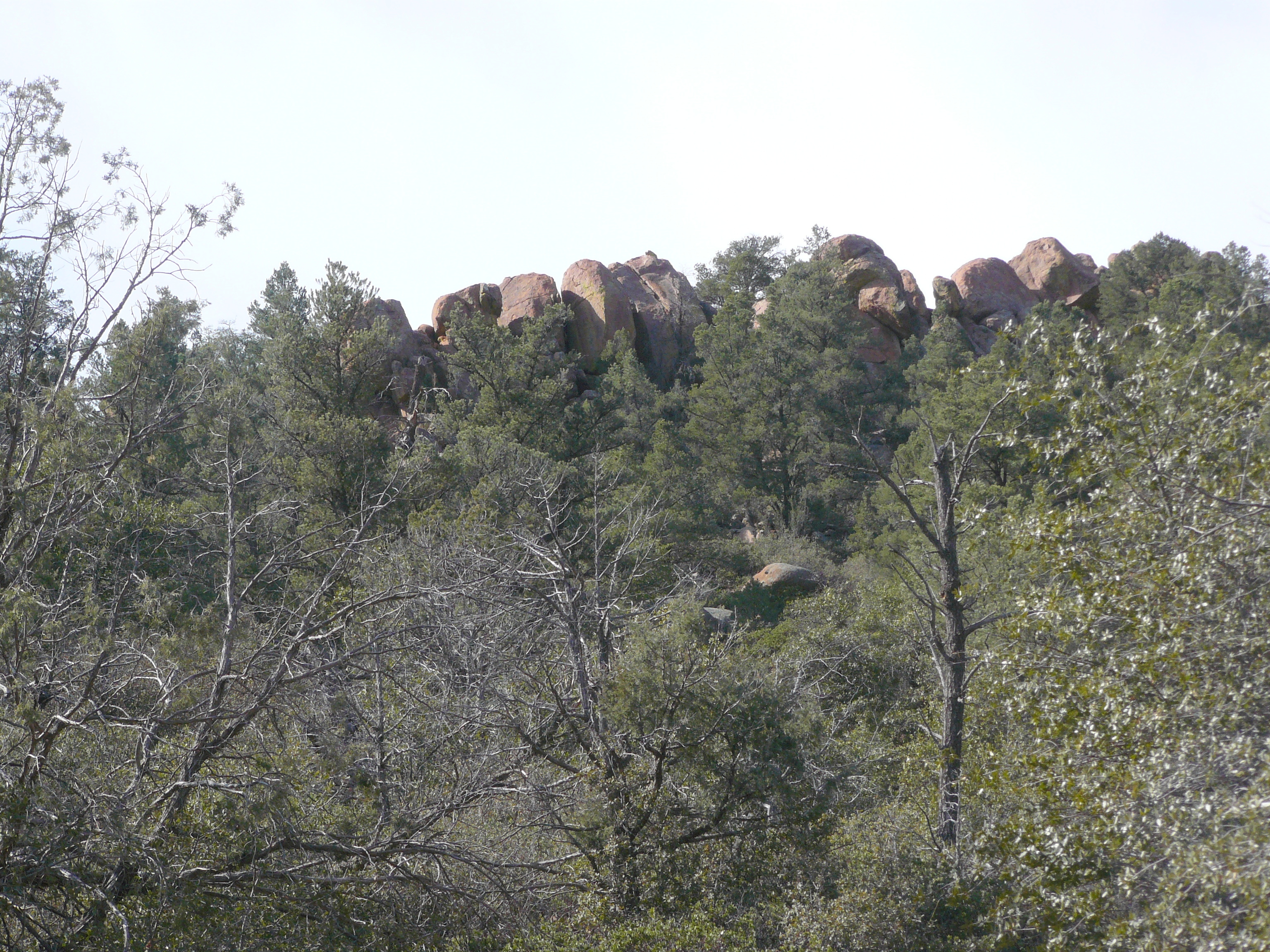
Nonetheless, Paul started back down the dusty, dirt road, the last rays of the sun pink on the high, tumbled cliffs of granite. This high rocky, forest plateau, known as the Granite Dells, just 3 miles from their home on the outskirts of Payson, made perfect dog-walking country and rarely did they miss an afternoon out here. However this afternoon, for reasons Paul was unclear about, they had left home much later than usual.
No sign of Dhalia ahead on the road so he struck off left, hoping she was somewhere up amongst the trees and the high boulders. Soon he reached the first crest, panting hard in the thin air. Behind him, across the breath-taking landscape, the setting sun had dipped beneath faraway mountain ridges; a magnificent sight. Suddenly, in the midst of that brief pause of admiring the perfect evening, a sound echoed around the cliffs. The sound of a dog barking. Paul bet his life on that being Dhalia. Just as quickly the barking stopped.
Challenging walking country.
The barking started up again, barking that suggested Dhalia was hunting something. The sound came from an area of boulders way up above the pine trees on the other side of the small valley ahead of him.
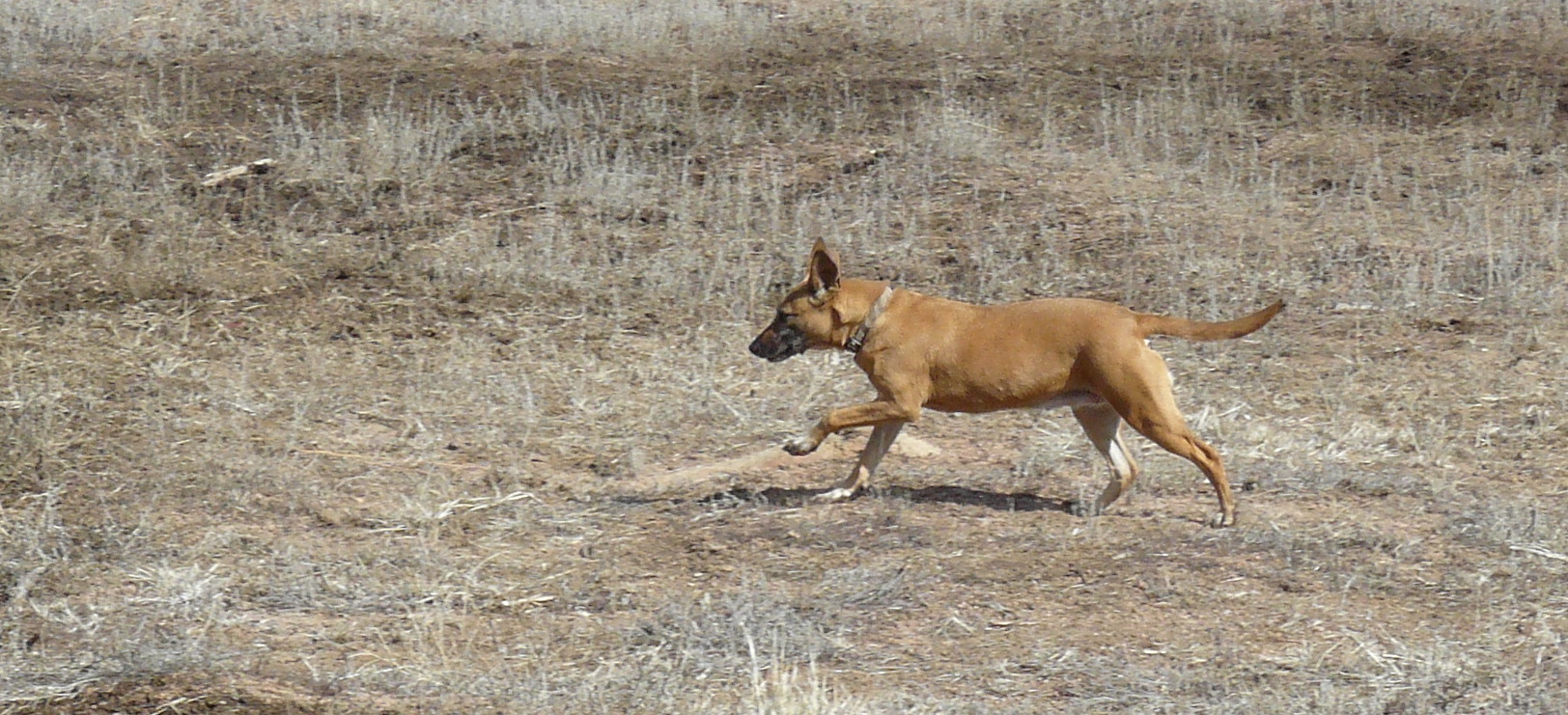
Perhaps, Dhalia had trapped herself. More likely, he reflected, swept up in the evening scents of the wilderness, Dhalia had temporarily reverted back to the wild, hunting dog she had been all those years ago. That feral Mexican street dog who in 2005 had tentatively turned away from scavenging in a pile of rubbish in a dirty Mexican town and shyly approached Jean. Jean had named her Dhalia.
He set off down to the valley floor and after fifteen minutes of hard climbing had reached the high boulders the other side. Paul whistled, then called “Dhalia! Dhalia! Come, there’s a good girl.”
Thank goodness for such a sweet, obedient dog.
He anticipated the sound of dog feet scampering through rough undergrowth. But no sound came.
He listened; no sounds, no more barking. Now where had she gone? Perhaps past these boulders down into the steep ravine beyond him, the one so densely forested with pine trees. With daylight practically gone he needed to find Dhalia very soon. He plunged down the slope, pushing through tree branches that whipped across his face, then fell heavily as his foot found empty space instead of the anticipated firm ground.
Paul cursed, picked himself up and paused. That fall had a message: the madness of continuing his search in the near dark. This terrain made very rough going even in daylight. At night, the boulders and plunging ravines would guarantee a busted body, at best! Plus, he ruefully admitted, he didn’t have a clue about finding his way back to the road from wherever he was!
The unavoidable truth smacked him full in the face. He would be spending this night alone in the high, open forest!
It had one hell of a very scary dimension. He forced himself not to dwell on just how scary it all felt. He needed to stay busy, find some way of keeping warm; last night at home it had dropped to within a few degrees of freezing. Paul looked around, seeing a possible solution. He broke a small branch off a nearby mesquite tree and made a crude brush with which he swept up the fallen pine needles he saw everywhere about him. Soon he had a stack sufficient to cover him, or so he hoped.
Thank goodness that when he and Jeannie had decided to give four dogs of their dogs this late afternoon walk, he had jeans and a long-sleeved shirt on, a pullover thrown over his shoulders. Didn’t make Dhalia’s antics any less frustrating but he probably wasn’t going to freeze to death!
The air temperature sank as if connected with the last rays of the sun. Paul’s confidence sank in harmony with the temperature. He lay down, shuffled about, swept the pine needles across his body, tried to find a position that carried some illusion of comfort. No matter the position, he couldn’t silence his mind. No way to silence the screaming in his head, his deep, primeval fear of this dark forest about him, imagination already running away with visions of hostile night creatures, large and small, watching him, smelling him, biding their time.
Perhaps he might sleep for a while? A moment later the absurdity of that last thought hit him. Caused him to utter aloud, “You stupid sod. There’s no way you’re going to sleep through this!”
His words echoed off unseen cliffs in the darkness, reinforcing his sense of isolation. He was very frightened. Why? Where in his psyche did that come from? He had spent many nights alone at sea without a problem, a thousand miles from shore. Then, of course, he knew his location, always had a radio link to the outside world. But being lost in this dark, lonely forest touched something very deep in him.
Suddenly, he started shivering. The slightest movement caused the needles to slip from him and the cold night air began to penetrate his body. He mused about how cold it might get and, by extension, thanked his lucky stars that the night was early October not, say, mid-December. So far, not too cold, but soon the fear rather than the temperature started to devour him. What stupid fool said, ‘Nothing to fear but fear itself!’ His plan to sleep under pine needles, fear or no fear, had failed! He couldn’t get warm. He had to move.
He looked around, saw an enormous boulder a few yards away, like some giant, black shadow. No details, just this huge outline etched against the night. Paul carefully raised himself, felt the remaining needles fall away, and gingerly shuffled across to the dark rock. He half-expected something to bite his extended hand as he explored the surface, as he ran his hand down towards the unseen ground. Miracle of miracles, the granite gently emitted the warmth absorbed from the day’s sun. He slowly settled himself to the ground, eased his back against the rock-face and pulled his knees up to his chest. He felt so much less vulnerable than when he had been flat out on the forest floor. Paul let out a long sigh, then burst into tears, huge heart-rending sobs coming from somewhere deep within him.
Gradually the tears washed away his fear, restored a calmer part of his brain. That calmer brain brought the realisation that he hadn’t considered, well not up until now, what Jeannie must be going through. At least he knew he was alive. Jeannie, not knowing, would be in despair. He bet she would remember that time when out walking here in the Dells they had lost little Poppy, an adorable ten-pound poodle mix, never to be found again despite ages spent combing the area, calling out her name. A year later and Jeannie still said from time to time, “I so miss Poppy!“. First Poppy and now him! No question, he had to get through this in one piece, mentally as much as physically.
Presumably, Jeannie would have called 911 and been connected to the local search and rescue unit. Would they search for him in the dark? He thought unlikely.
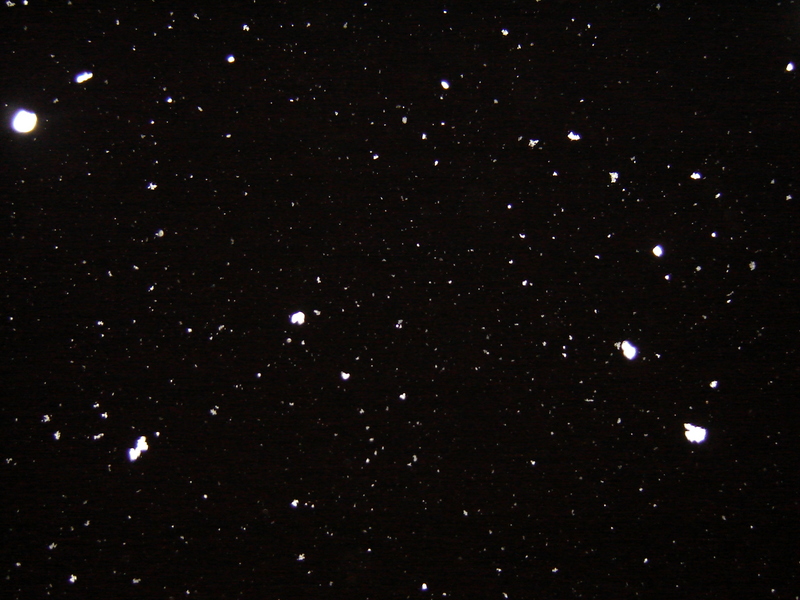
A vast stellar clock.
Thinking about her further eased his state of mind and his shivering stopped. Thank goodness for that! Paul fought to retain this new perspective. He would make it through, even treasure this night under the sky, this wonderful, awesome, night sky. Even the many pine tree crowns that soared way up above him couldn’t mask a sky that just glittered with starlight. Payson, at five-thousand feet, had many beautifully clear skies and tonight offered a magical example.
Frequently during his life, the night skies had spoken to him, presented a reminder of the continuum of the universe. On this night, however, he felt more humbled by the hundred, million stars surrounding him than ever before.
Time slipped by, his watch in darkness. However, above his head that vast stellar clock. He scanned the heavens, seeking out familiar pinpoints of light, companions over so much of his lifetime. Ah, there! The Big Dipper, Ursa Major, and, yes, there the North Pole star, Polaris. Great! Now the rotation of the planet became his watch, The Big Dipper sliding around Polaris, fifteen degrees for each hour.
What a situation he had got himself into. As with other challenging times in his life, lost in the Australian bush, at sea hunkering down through a severe storm, never a choice other than to work it out. Paul felt a gush of emotion from the release this changed perspective gave him.
Far away, a group of coyotes started up a howl. What a timeless sound, how long had coyotes been on the planet? He sank into those inner places of his mind noting how the intense darkness raised deep thoughts. What if this night heralded the end of his life, the last few hours of the life of Paul Handover? What parting message would he give to those that he loved?
Jeannie would know beyond any doubt how much he had adored her, how her love had created an emotional paradise for him beyond measure. But his son and daughter, dear Alex and Maija? Oh, the complexities he had created in their lives by leaving their mother so many years ago. He knew that they still harboured raw edges, and quite reasonably so. He still possessed raw edges from his father’s death, way back in 1956. That sudden death, five days before Christmas, so soon after he had turned twelve, that had fed a life-long feeling of emotional rejection. That feeling that lasted for fifty-one years until, coincidentally also five days before Christmas, he had met Jean in 2007.
His thoughts returned to Alex and Maija. Did they know, without a scintilla of doubt, that he loved them. Maybe his thoughts would find them. Romantic nonsense? Who knows? Dogs had the ability to read the minds of humans, often from far out of visual range. He knew Pharaoh, his devoted German Shepherd, skilfully read his mind.
Paul struggled to remember that saying from James Thurber. What was it now? Something about men striving to understand themselves before they die. Would that be his parting message for Alex and Maija? Blast, he wished he could remember stuff more clearly these days and let go of worrying about the quote. Perhaps his subconscious might carry the memory back to him.
He looked back up into the heavens. The Big Dipper indicated at least an hour had slipped by. Gracious, what a sky in which to lose one’s mind. Lost in that great cathedral of stars. Then, as if through some passing of consciousness, the Thurber saying did come back to him: All men should strive to learn before they die, what they are running from, and to, and why. As last words they would most certainly do for Alex and Maija!
Paul reflected on those who, incarcerated in solitary confinement, had their minds play many tricks, especially when it came to gauging time. What a bizarre oddment of information; where had that come from? Possibly because he hadn’t a clue about his present time. It felt later than 11pm and earlier than 4am, but any closer guess seemed impossible. Nevertheless, from out of those terrible, heart-wrenching hours of being alone he had found calm, had found something within him. He slept.
Suddenly, a sound slammed him awake. Something out there in the dark had made a sound, caused his whole body to become totally alert, every nerve straining to recognise what it might be. It sounded like animal feet moving through the autumn fall of dead leaves. He prayed it wasn’t a mountain lion. Surely such a wild cat preparing to attack him would be silent. Now the unknown creature had definitely paused, no sound, just him knowing that out there something waited. Now what, the creature had started sniffing. He hoped not a wild pig. Javelinas, those pig-like creatures that always moved in groups, could make trouble – they had no qualms at attacking a decent-sized dog.
Poised to run, he considered rising but chose to stay still and closed his right-hand around a small rock. The sniffing stopped. Nothing now, save the sound of Paul’s rapid, beating heart. He sensed, sensed strongly, the creature looking at him. It seemed very close, ten or twenty feet away. The adrenalin hammered through his veins.
He tried to focus on the spot where he sensed the animal waited; waited for what? He pushed that idea out of his head. His ears then picked up a weird, bizarre sound. Surely not! Had he lost his senses? It sounded like a dog wagging its tail; flap, flap, flapping against a tree-trunk.
A dog? If a dog, it had to be Dhalia!
Then came that small, shy bark! A bark he knew so well. Oh wow, it is Dhalia. He softly called, “Dhalia, Dhalia, come here, there’s a good girl.”
With a quick rustle of feet Dhalia leapt upon him, tail wagging furiously, her head quickly burrowing into Paul’s body warmth. He hugged her and, once more, tears ran down his face. Despite the darkness, he could see her perfectly in his mind. Her tight, short-haired coat of light-brown hair, her aquiline face, her bright inquisitive eyes and those wonderful head-dominating ears. Lovely large ears that seemed to listen to the world. A shy, loving dog when Jean had rescued her in 2005 and these years later still a shy, loving dog.
Dhalia licked his tears, her gentle tongue soft and sweet on his skin. He shuffled more onto his back which allowed her to curl up on his chest, still enveloped by his arms. His mind drifted away to an era long time ago, back to an earlier ancient man, likewise wrapped around his dog under a dome of stars, bonded in a thousand mysterious ways.
The morning sun arrived as imperceptibly as an angel’s sigh. Dhalia sensed the dawn before Paul, brought him out of his dreams by the slight stirring of her warm, gentle body.
Yes, there it came, the end of this night. The ancient sun galloping towards them across ancient lands, another beat of the planet’s heart. Dhalia slid off his chest, stretched herself from nose to tail, yawned and looked at him, as much to say time to go home! He could just make out the face of his watch; 4.55am. He, too, raised himself, slapped his arms around his body to get some circulation going. The cold air stung his face, yet it couldn’t even scratch the inner warmth of his body, the gift from the loving bond he and Dhalia had shared.
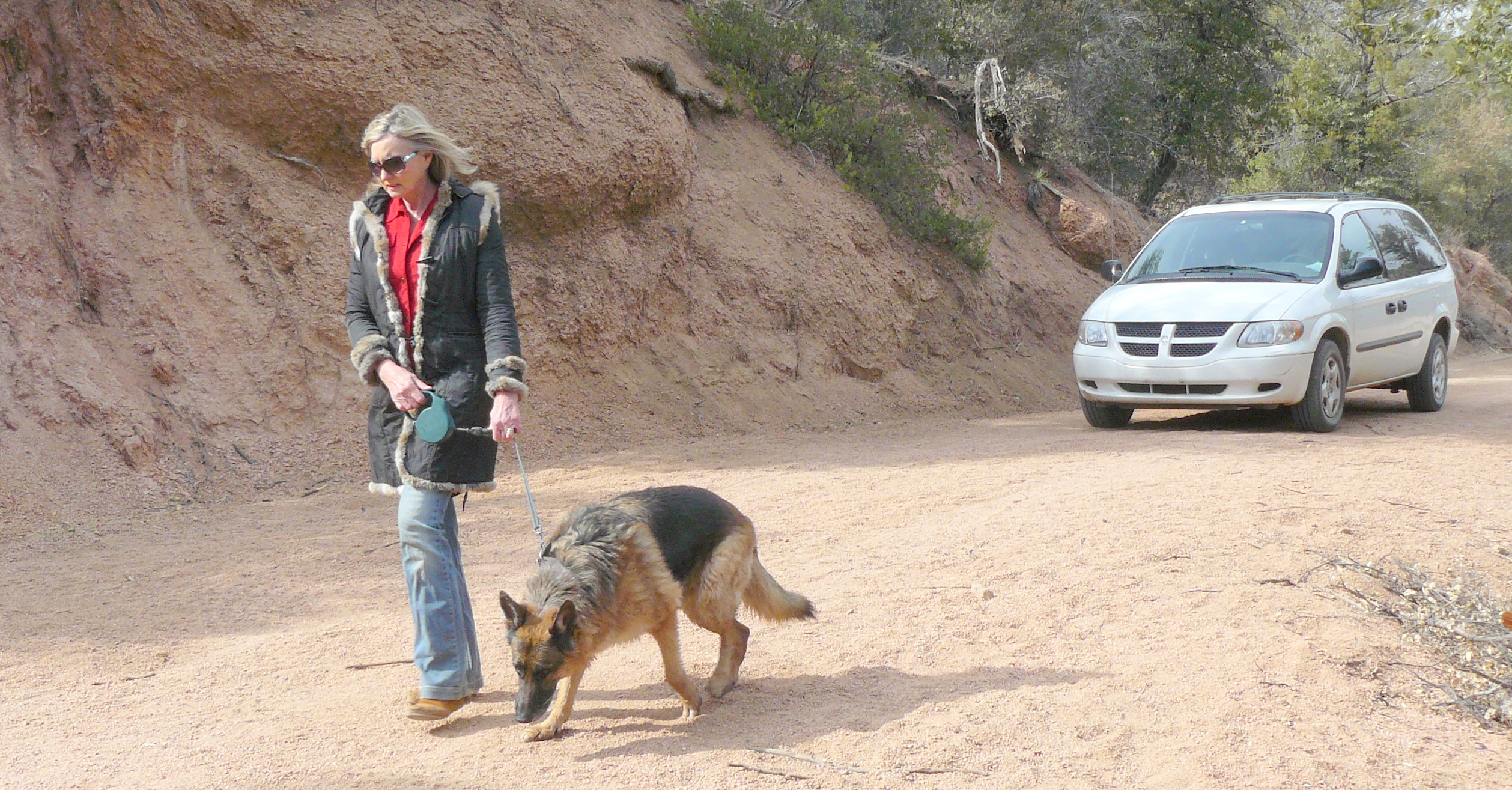
They set off and quickly crested the first ridge. Ahead, about a mile away, they saw the forest road busy with arriving search and rescue trucks. Paul noticed Jean’s Dodge parked ahead of the trucks and instinctively knew she and Pharaoh had already disappeared into the forest, Pharaoh leading the way to them.
Pharaoh and Jean heading up the search.
They set off down the slope, Dhalia’s tail wagging with unbounded excitement, Paul ready to start shouting for attention from the next ridge. They were about to wade through a small stream when, across from them, Pharaoh raced out of the trees. He tore through the water, barking at the top of his voice in clear dog speak, ‘I’ve found them, they’re here, they’re safe’. Paul crouched down to receive his second huge face lick in less than six hours.
Later, safely home, it came to Paul. When they had set off in that early morning light, Dhalia had stayed pinned to him. So unusual for her not to run off. Let’s face it, that’s what got them into the mess in the first place. Dhalia had stayed with him as if she had known that during that long, dark night, it had been he who had been the lost soul.
The message from the night, as clear as the rays of this new day’s sun, the message to pass to all those he loved. If you don’t get lost, there’s a chance you may never be found.











 Learning from Dogs