The incredible story of one stray dog and a desert racer.
This has been widely reported in many other places but, nonetheless, seemed a perfect fit for a blog called Learning from Dogs!
This is the story of a stray dog that took a liking to a runner participating in the 2016 Gobi March 4 Deserts race in China. I first saw the story when it was carried on the Care2 Causes site.
How hard are you willing to work to improve your position in life? For one stray dog, the answer is: pretty darn hard.
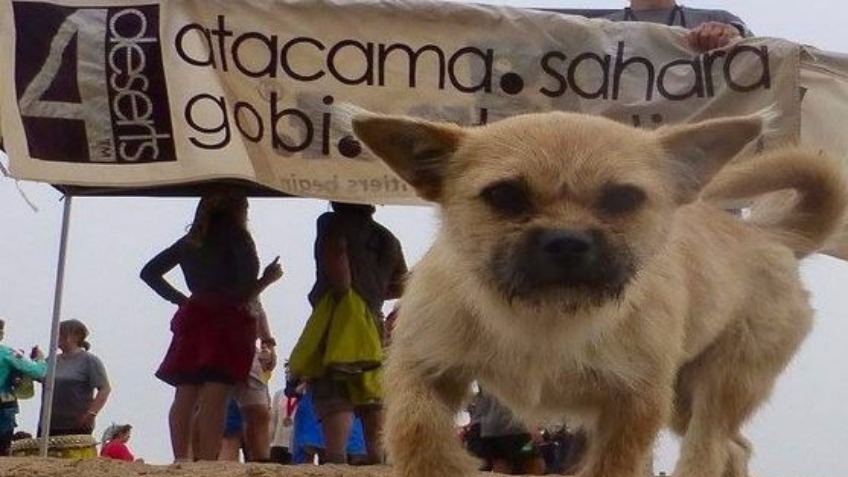
During the 2016 Gobi March 4 Deserts race in China, extreme runner Dion Leonard from Scotland was racing through the rugged terrain of the Tian Shan mountain range. That’s when a stray female pooch (eventually and aptly named) Gobi started following him.
The runner figured that she’d tire out eventually. She was a small dog, so keeping up with a life-sized human (who is an extreme jogger) probably didn’t seem likely. But amazingly, the little dog kept up.
Man who befriended stray dog during extreme desert marathon launches reunion appeal
The dog ran alongside Dion Leonard for 124 kilometres
May Bulman Tuesday 2 August 2016
Mr Leonard hopes to be reunited with the dog who ran with him during the 250 kilometre race in the Gobi desert 4Deserts.com / Omni Cai
An extreme marathon runner has launched an appeal to be reunited with a stray dog with whom he formed an “unbreakable bond” during a 250-kilometre (155 mile) race in the Gobi desert in China.
Dion Leonard, 41, hopes to raise the funds that will allow him to be reunited with the dog, named Gobi, who joined him during the annual 4 Deserts Race Series in March.
Gobi began running alongside the 101 competitors as they ran through the Tian Shan mountain range. Despite her small size the dog managed to run half of the race.
Later on in that Independent article it is reported:
Mr Leonard set up the crowdfunding page to raise funds towards organising for Gobi to be transported from China to live with him in Scotland.
The process will take up to four months and cost £5,000, with the dog having to be medically checked and quarantined before she can be cleared for entry.
A simple mouse click then takes the reader to that Crowdfunding page where the headline then shows that already over £19,000 has been raised.
That page explains:
Gobi, a friendly stray dog joined 101 other competitors running 250km over the Tian Shan Mountains down to the Black Gobi Desert during a 6 stage 7 day self sufficiency foot race. Gobi ran 4 stages including the final 10km stage to the finish line, showing unique strength and stamina for a little dog to keep up with the runners in such grueling conditions.
Everyone from the competitors, volunteers and race crew fell in love with this little dog that captured all our hearts. Gobi took a shine to me and over the week we developed an unbreakable bond as I shared my sleeping space, food/water and ultimately our companionship.
Now let’s hear from Dion.
Time and time again our wonderful dogs inspire us to reach out; to never say never!
The lesson of love from our dogs just keeps rolling along.
Neighbour Dordie had the following sent to her in an email and, subsequently, passed it on to me.
I share it with you and hope that it brightens your day.
ooOOoo
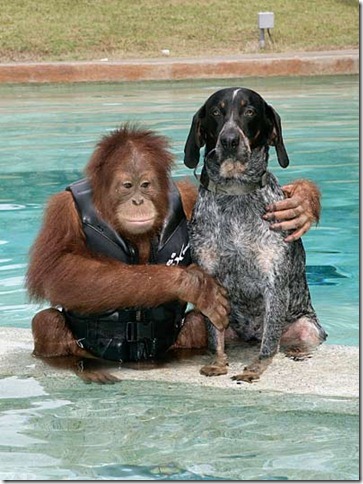
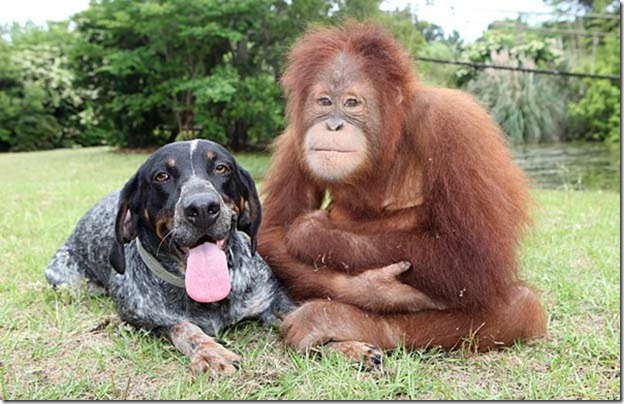
After losing his parents, this three-year-old orangutan was so depressed he wouldn’t eat and didn’t respond to any medical treatments. The veterinarians thought he would surely die from sadness.
The zoo keepers found an old sick dog on the grounds in the park at the zoo where the orangutan lived. They took the dog to the animal treatment center; the dog arriving at the same time that the orangutan was there being treated.
The two lost souls met and have been inseparable ever since. The orangutan found a new reason to live and each always tries his best to be a good companion to his new-found friend. They are together 24-hours-a-day in all their activities.
They live in Northern California where swimming is their favorite past-time, although Roscoe (the orangutan) is a little afraid of the water and needs his friend’s help to swim.
Yesterday, Val published a post over on her blog Find Your Middle Ground that really ‘spoke’ to me. That’s not to imply, by the way, that her other posts don’t very often reach out to me and, undoubtedly, to many others.
Val’s post was called The Depths of our Relationships and explored the different levels of relationships that we have with others in and around our lives.
Instinctively most people would regard us humans as far more complex than our animal companions. As the old Devon (South-West England) expression goes, “There’s now’t so queer as folk.”
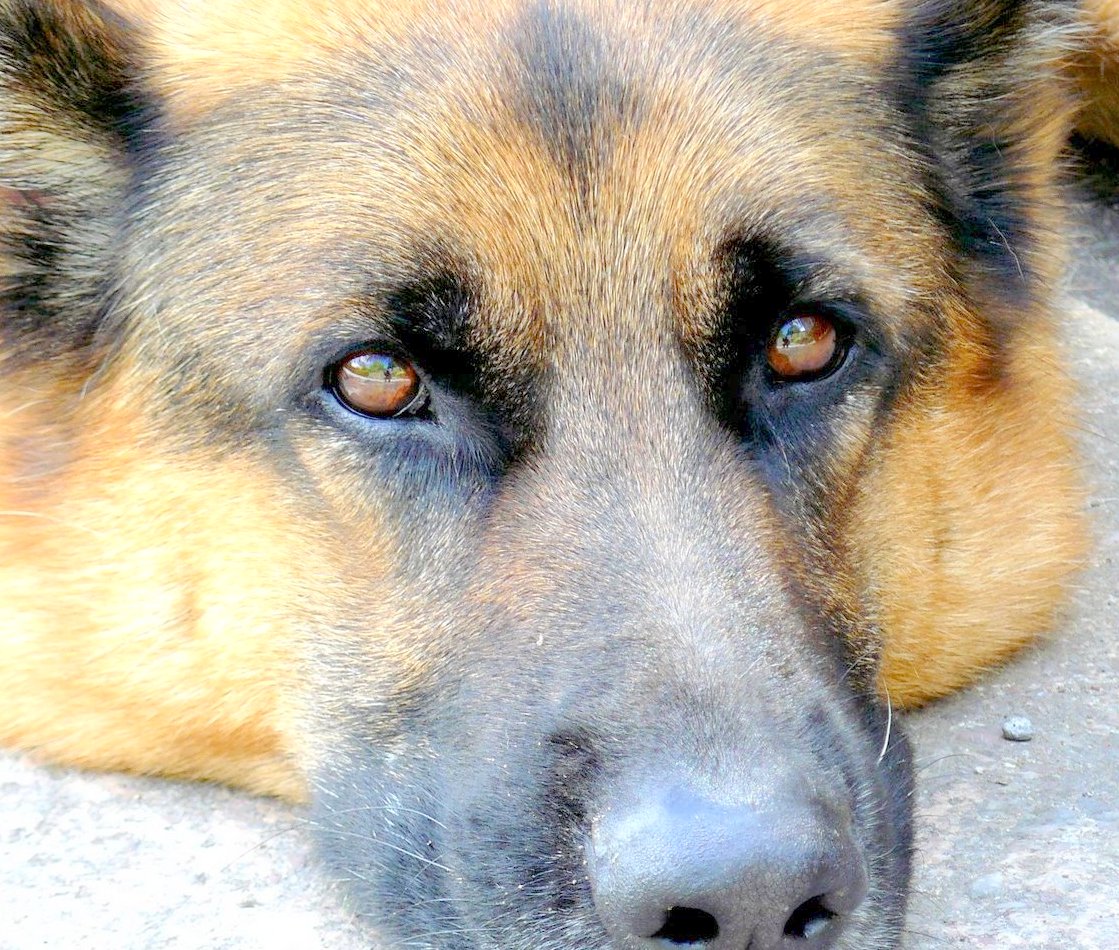
Yet, once we have really got to know a dog there will be many who will see behind those fabulous eyes a sense of a depth of character, a soul comes to mind, that suggests that the brain of the dog offers a canine psychological complexity most of us don’t allow for.
To support that proposition just look at the eyes of Pharaoh in this photograph going back to June, 2007.
However, today I am republishing Val’s recent post and I do so with great pleasure.
I read an interesting article some time ago by coach Michael Neill on how there are different levels in our relationships with others. I’m not talking about literal closeness, for example a brother is closer than a colleague at work, but more about our ability to truly connect in an authentic way with another person.
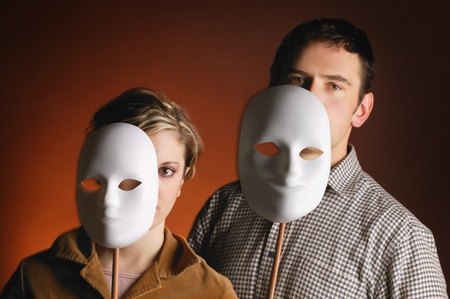
Have you noticed that you can feel a deep connection almost immediately with a stranger? Or feel like a member of your family is hiding behind a mask and being superficial? … That’s what I am talking about.
Surface Level – How we pretend to be
On the surface, people present themselves to the world in whatever ways they would like to be seen. They may be clever or cynical, light and cheerful or intellectual and deep. This is our persona or the “mask” of our personality, often revealing our fears, judgments, and insecurities in the very attempt to hide them.
Whether we enjoy or dislike someone’s personality is fairly arbitrary – an accidental coming together of our own innocently acquired preferences and prejudices from a young age.
But like it or not, at some point the mask slips and we see through to…
One Level Deep – The selfish self
Underneath the masks of personality, we’re continually navigating the world through a swirl of thought. Because we feel that thinking is coming at us from the outside world, we tend to see our actions, as one of my clients once put it, as being ‘the only sane response to an insane world’.
This is how we justify our ambition and ruthlessness; our cruelty to ourselves and others. After all, if it wasn’t a dog eat dog world out there, who would ever want to eat a dog?
When we see through someone’s “nice person” or “tough guy” mask, we often see only as far as this level. And it’s difficult for most of us to feel warmly towards someone who is seemingly only out for their own self-aggrandizement or self-preservation.
Until, that is, we see through to…
Two Levels Deep – Doing the best we can as we’re all in this together
There is a quote often attributed to Philo of Alexandria that we should “Be kind, for everyone you meet is fighting a hard battle.” This is not only true in the physical world, where our bodies begin to decay long before our thoughts are ready to let go, but also in our innate psychology.
Every human being I know wants to love and be loved; to be happy more and suffer less; and to feel like in some way their life had meaning and value. How they go about achieving these aims is a product of their level of understanding and experience of the world.
It’s easy to love people “two levels deep”, because we see ourselves reflected in them. We all have a natural compassion for the suffering of others and an abiding conscience which ensures that while we may at times act in ways that are harmful to ourselves and others, we do it in spite of and not because of who we are at core.
Loving people at this level doesn’t mean we have to live with them or let them get away with murder, literally or figuratively. It just means that we don’t get so upset by their humanness or carried away by our own delusions that we can escape the human condition.
While seeing through to people’s innate humanity makes for richer and more wholesome relationships, there is a level beyond even that which takes us past the illusion of separation which allows us to play judge and jury to our fellow humans…
Three Levels Deep – Who we are before the fact of thought
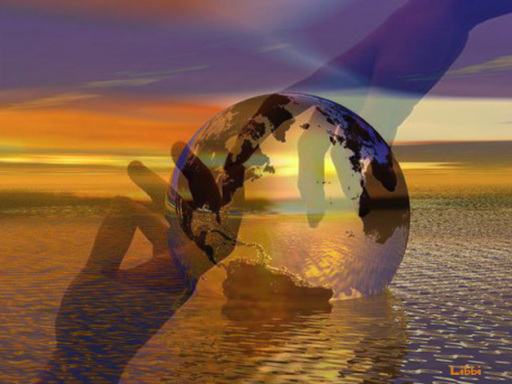
Who are you before thought comes into the equation? Mystics throughout time have described our essential nature as being made of spirit – a name for the invisible life force that makes up the visible world of form.
It’s difficult to even talk about “loving someone” at this level because rather than two or seven or even seven billion separate people, there is simply the presence of Love with a capital “L” – and as we dissolve and surrender into that Love, we fulfill the age-old proverb that “we are that which we seek”.
We are one in shared consciousness and spirit.”
p.s. This makes me think about how that pesky neighbor, or annoying colleague and Donald Trump appear one level deep for many of us.
ooOOoo
Val concluded her post with the proverb “we are that which we seek”. I used a very similar idea as the title to today’s post, “We are what we think of most!“. I am clear in my own mind that those two sayings are opposite sides of the same coin.
All of which reinforces in spades the benefits that flow from open and honest self-awareness.
If only for the wonderful quality of a deep sleep that results from that self-awareness.
A few weeks ago I had a comment left on a blogpost, “Hello Paul.. all the very best ex, 1234 lol“. The comment had been left by a Martin Lowe. That won’t mean anything to anyone until I explain that I have a pilot’s log book and the very first entry reads:
March 3rd, 1984/Cessna FA152/G-BGAF/Capt. M. Lowe/P u/t/IPSWICH – LOCAL/1325 Departure/1355 Arrival/ 0:30 mins dual/ Ex 4,5.
That was my very first flight in a powered aircraft and my instructor was Martin Lowe of the Suffolk Aero Club based at Ipswich Airport in Suffolk, England.
Yesterday, Martin and I had a great catch-up over the phone and I’m republishing an earlier post of mine as a way of saying how fabulous it was to remake contact with Martin once again.
ooOOoo
Keeping a balance on one’s state of mind.
Don’t know about you but I find that it is all too easy to get wound up by so much that is going on in this crazy world. That’s not to marginalise the threats to society that are all around us and there are some powerful writers out there who work so hard to inform the world as to the truth of those threats. (As an aside, one of my favourite authors is this context is Patrice Ayme, just see this recent Post of his as an example of his depth of analysis.)
But my dear friend of over 40 years, Dan Gomez, recently sent me a link to a video of the 10 most extreme airports in the world. That stirred some memories from my own flying days.
First settle back and enjoy 7 minutes of reasons why you don’t want to think about flying! 😉
The YouTube video has this information, which I republish below,
Pictures and videos of the top 10 most extreme airports in the world!
San Diego: Busy airspace lots of buildings on approach
Madeira: Difficult approach and did have a short runway
Eagle Vail: High altitude, short runway & mountainous approach & departure
Courchevel: Short runway, bumpy runway, high altitude
Kai Tak: Difficult approch, fly through tall buildings, short runway
Gibraltar: Short runway, building on approach, winds from the Gibraltar rock
St Maarten: Short runway, has to fly over the beach with alot of people on there, steep takeoff because of mountains
St Barts: Short runway, has to dive.
St Barts: To land, the low approach on that hill thingy
Toncontin: Difficult approach, short runway
Lukla, short runway, only was cemented a few years ago, no go around, if land too low you land into a cliff
First song: La Perla by Kobojsarna
Second song: Feel It – Explicit Album Version by Three 6 Mafia vs Tiesto with Sean Kingston and Flo Rida
Now to a personal recollection.
I was a private pilot for many years, first learning to fly at the Suffolk Aero Club at Ipswich Airport in Suffolk, England. My first lesson was on the 3rd March, 1984!
Some twenty years later, on the 13th August 2004 to be exact, I was checked out to land at Courchevel Airport in an aircraft type known as a TB20, a French-built aircraft. Here’s the page from my log book with the necessary authorisation stamp affixed.
Cleared to land at Courchevel, LFLJ!
The following year, 19th July, 2005, I added my wonderful Piper Super Cub to that authorisation. (See here for a part picture of the aircraft.)
So thanks to YouTube as someone has uploaded a film of a light aircraft operating into Courchevel. It really is rather thrilling!
Finally, back to Dan. Here’s his recollections included in the email that he sent with that first film.
Just found this. I’ve landed at two of these. Eagle Vail was a piece of cake compared to Toncontin as Marty and Bruce know. BAE146 and small Boeing jets. I flew in and out of Toncontin 5 times in the 90’s and had no idea it was as scary as it was. That is to say, I knew it was scary because my palms sweated and heartbeat was about 140 but when I look at it now I go “what was I thinking?”
Take offs were like Orange County, Full brake power straight up. The big difference was you were shuttling along the runway and then down the runway and finally, up the runway to get the wheels up.
One time, on a connecting flight from Medellin, we taxied in, were boarded by military police with drug dogs who sniffed their way through the aisle. Bags were searched while everyone waited in intense heat. It took about 2 hours, three time longer than necessary. Then the interior was fumigated with everyone aboard. All the big machine guns too. Nobody said a word!
There’s one thing about flying a light aircraft, especially into ‘interesting’ airfields, you don’t have a moment to worry about the state of the world!
ooOOoo
March 3rd, 1984 to August 2nd, 2016 – more than thirty-two years – just like that!
P.S. I had a 15-minute solo flight on April 25th, 1984.
Sometimes the most obvious solutions take the longest to find.
I feel a little embarrassed that this introduction may come across as rather self-indulgent; I don’t intend that.
My purpose is to offer an introduction to a recent blogpost from Sue Dreamwalker that explains why her post really ‘spoke’ to me and why it felt important to share Sue’s post with all you good people.
Subsequently, I left a follow-up to my first comment, replying to a comment from Diane Husic. This is what Diane wrote:
Many of us realize what a critical junction the country faces in this election cycle. As an academic, I am trying to figure out the appropriate role I should play. We need to teach students to be respectful of difference, to be tolerant, to be problem solvers, and to be civically engaged, but we aren’t supposed to use our positions to “force” our political views on them. But given the magnitude of issues confronting the planet and humanity and the importance of having leadership that “gets it” (and displays compassion and empathy), this is a tough balance to try to find.
and this was my reply to Diane:
Diane, as someone who previously has run his own business and then, after selling it in 1986, spent a number of years as a mentor with the Prince’s Youth Business Trust in the UK, I have come to the conclusion that the best role model we adults can offer our ‘students’ is this: “Be the best you can be!” That flows from being fully aware of the person that one is. For self-awareness is the key to understanding oneself and, consequently, of understanding others. Understanding why people think and behave the way they do, for good and bad, is the only effective way of engaging with others and seeking that ‘civic engagement’ so critically important.
Apologies, that paragraph sounds like a damn speech! I didn’t intend it to be so. Plus, my own journey of self-awareness has been a long and tortuous one – but that doesn’t change my view just expressed.
Her recently released book on the effectiveness of Role Montage in building leadership skills is highly relevant to today’s students. In Jan’s words (and I have no commercial or financial link with Jan):
Role Montage: A Creative New Way to Discover the Leader Within You is written from Jan’s experience with her client work and her research. It helps leaders explore self-awareness and leadership using the role montage process.
I’ll creep back into my hole!
You can see why I offered a warning about coming across as self-indulgent!
But if you have stayed with me so far (and thank you) you will now understand why Sue’s post spoke so clearly to me. Republished here with Sue’s very kind permission.
ooOOoo
Set Yourself Free..
by Sue Dreamwalker. July 28th, 2016.
This morning I switched on the radio and the first record I heard was this one.. It was the very first time I had listened to this recording, never hearing it before.. It made me smile.. Especially when it mentioned taking Calcium and taking care of our knees.. So I decided to YouTube it to listen to again and to my delight found several versions..
Life has been busy within the Dreamwalker’s Domain this last week.. Last night I was so tired I went to bed at 7pm and slept for 12 hours.
Today the Universe thought to allow me to cool down in the showers of rain, so I thought I would share about my Busy time in the Sun on my Gardening Blog. And to share what brought such a smile to my face first thing this morning..
I particularly enjoyed the lyrics in the middle of this narrative of the inclusion of Rozalla’s Song Everybody’s Free to Feel Good, which is an old favourite of mine..
So Go On FEEL GOOD and DANCE.. LAUGH and SING..
And SHARE THE FEEL GOOD FACTOR
Sending Love and Blessings
Next time I will share with you the village I grew up in as we went back to see the Well Dressings.. Along with some of my thoughts..
Sue
ooOOoo
Feeling good about ourselves is the result of knowing and liking who we are. The foundation stone of knowing and liking all the many good people we interact with throughout our lives.
I was speaking recently with John Hurlburt whom Jean and I knew well when we were living in Payson, AZ. Subsequently, John sent me a wonderful essay with his permission for me to share it with all you good folks!
A quick web search found a photograph of Wildcat Canyon and that is at the end of today’s guest post.
ooOOoo
Midnight in Wildcat Canyon
The dirt road maze in our Arizona forests covers hundreds of miles. It’s quite possible to drive all day without encountering another human being. I once ended up at a place called Wildcat Canyon at midnight after taking a wrong turn on a wet rocky mountain road.
Cell phones are problematical in the high country. It would have helped if there had been a back woods road map on board. Fortunately there was a GPS that worked.
Wildcat Canyon in the moonlight was well worth visiting. The heavens were open above without a trace of man made light. The impact was awe inspiring. As we intuitively agree, everything fits together or we’d be random atoms.
Although, it may seem random to the casual observer, we scientifically know that the cosmos is unified from the quantum level of physics up with the classical level of physics and back again through fundamental forces we have barely begun to understand.
Einstein’s theories prove that the cosmos turns inside out without breaking. Slight earthly energy shifts can modify and potentially eliminate all life on earth. There’s no need to contribute to the problem by aggravating the negative effects of climate shift through either our deliberate negative action or our thoughtless lack of action.
It’s difficult to understand why we’re fussing and fuming as though we owned the earth, the moon, the sun, and the stars. There’s consensus on the body of scientific fact that supports a holistic understanding of our relative insignificance and our corresponding responsibilities as a consciously aware biological species which is presently the dominate life form on a remote garden planet.
Signs of our cultural crisis of consciousness are clear. Science is ignored or denied unless convenient and/or profitable. World economics are systemically corrupt. Slick politicians twist reality on its ear without regard for truth, justice, liberty, or equality.
Knowledge, understanding and wisdom are disparaged.
Insanity, driven by both conscious and unconscious human fears, masquerades as truth and reason. War is profitable and encouraged. Our politicians know better if they have any awareness or compassion at all in their hearts and souls. It seems that even when most politicians are aware of reality to some degree, they simply don’t care for much beyond themselves in the long run. Political ends justify the means without regard and without regret. Hyper concentrated economic power takes no prisoners.
Insanity is cold. We light a fire to keep us warm and to heat our food.
As the flame burns, we realize that matter and energy are interchangeable. We realize that the earth is finite. We know that we’re energized by the universe. We are children of the light. We are the voice of life and the hope of the future and we’ve lost our moral compass.
Nature always wins and doesn’t care about the quarterly bottom line. Peace is a verb.
Without a unifying purpose, surrender and unilateral acceptance are dubious. What could be more unifying than our instinctive need to survive? Our common objective is to sustain our natural balance. Our immediate practical objective is to save our planetary farm.
We don’t become fully consciously aware until we are born. We begin learning about our world in our cribs. Consider that we live in a garden cradle at the edge of the Milky Way. Change is constant as our universe emerges. Adapting to change is the prime directive for all life forms.
Our problems are complex. The simple answer is found in all our human wisdom traditions. “Be of service to the Earth which sustains all planetary life.” The answer to our political quandary is similarly simple. We can vote for the Nature of Creation or we can vote for Mammon.
We can vote for Sanity (Greek: sanos; balance, wholeness and well being) or we can vote for the meaningless night shades of human insanity. We may vote for Nature or we may vote for global corporate financial interests.
It’s important to note that the unaided human mind is limited. Dumb comes with the territory with no additional charge. Our lives are a learning experience with an ongoing purpose of growth and service.
It took about an hour to get back to a main highway from Wildcat Canyon. It was a matter of back tracking through landmarks noted along the way such as the occasional miniature lake in the middle of the trail or a stretch of jagged rocky out cropping. It was a relief to return to an asphalt road about an hour later.
A wave is breaking. Take care and maintain an even strain.
an old lamplighter
ooOOoo
Wildcat Canyon
You all have a very peaceful weekend. (Oh, and you may want to drop across to Sustainable Rim Country, a fabulous project that John and others have under way.)
The recent news of finding a dog graveyard that is 2,000 years old.
Before going on to today’s post, can I just remind you kind folks that as of today, and for the rest of this week, we have family guests staying with us here in Oregon.
Grandson Morten responding to his mother, Maija, taking a picture of him and Marius, as they wait to board the aircraft for San Francisco yesterday morning.
Thus from tomorrow until the end of the coming weekend my posts will be a preponderance of republications of previous posts. Plus my attention to you dear readers will be less than you are accustomed to.
Now on to today’s post that was kindly sent to me by Chris Gomez. Thanks Chris.
ooOOoo
2,000-Year-Old Dog Graveyard Discovered in Siberia
By Tom Metcalfe, Live Science Contributor | July 15, 2016
Archaeologists have discovered a prehistoric dog graveyard at a 2,000-year-old village near the Arctic Circle in Russia’s Siberia. Credit: University of Alberta/Robert Losey
The carefully buried remains of five dogs were recently found in a 2,000-year-old doggy graveyard near the Arctic Circle in Siberia, according to archaeologists.
This discovery at the Ust-Polui archaeological site, in Salekhard, Russia, reveals close relationships between the region’s people and their animal “best friends” two millennia B.C. The dogs likely served as pets, workers and sources of food — and possibly as sacrificial offerings in religious ceremonies, the researchers said.
“The role of dogs at Ust-Polui is really complex and variable,” Robert Losey, an archaeologist at the University of Alberta in Canada, wrote in an email to Live Science from Salekhard, where he is carrying out fieldwork at Ust-Polui. [See photos of the prehistoric dog graveyard in Siberia]
“The most striking thing is that the dog remains are really abundant compared to all other sites in the Arctic — there are over 115 dogs represented at the site,” Losey said. “Typically, sites have only a few dog remains — 10 at most.”
Working dogs
The dogs were likely involved in various tasks in the ancient Arctic village, including pulling sleds, he said. The remains of two sleds, as well as a carved bone knife handle thought to depict a sled dog in a harness, have been found at the site.
“Some [dogs] were probably also used in hunting, for reindeer and birds, the remains of which were both abundant at the site,” Losey said.
Parts of a reindeer harness had also been found at Ust-Polui, he added, and dogs may have been used to herd reindeer, as is still done today by some communities in the region.
But despite evidence that the dogs worked with people and other animals, it was also clear that many of the dogs at Ust-Polui had been butchered and probably eaten, Losey said. Many of the dog bones had cut marks on them, and were found scattered around the site in the same way as the bones of other food animals, such as deer and birds, he said.
Some of the dog consumption may have been related to sacrifices or rituals, or even feasting, Losey noted. In fact, “at one place in the site, the heads of 15 dogs were piled together, all with their brain cases broken open in the same manner,” he said.
He added that the sacrificing of dogs was well documented among indigenous people in this region of Siberia, “and is done to appease spirits, or to ensure community health, and so on.”
Prehistoric pets
But though it might have been a dog’s life for most of the canine population of Ust-Polui, a few top dogs seem to have enjoyed special treatment, the archaeologists said. [10 Things You Didn’t Know About Dogs]
Of the more than 115 dogs that archaeologists identified among the animal bones at Ust-Polui, the remains of just five dogs were found carefully buried in a group near one edge of the site, Losey said.
This separation likely indicates close bonds between some people and some dogs in the ancient village, he said.
Each of the prehistoric doggy graves contained the entire dog skeleton, laid on its side in a shallow pit, similar to three human burials at the site, and they showed no signs of butchery or of being intentionally killed, the researchers found.
“The only thing that distinguishes them from the human burials is their location. No other animals at Ust-Polui were treated like this,” Losey said.
Ancient friendship
Losey started working with the dog remains from Ust-Polui three years ago, as part of his work studying the ancient relationships between people and dogs in the world’s northern regions.
In 2013 in the journal PLOS ONE, Losey published the results of his research into dog burials, dated to around 8,000 years ago, from archaeological sites in the Lake Baikal region of Siberia.
Some of the dogs from Lake Baikal were buried with decorated collars and what appeared to be grave goods, such as pottery jars and wooden spoons.
Losey said the differences between the two sites showed how people’s relationships with dogs varied among cultures over the estimated 15,000 years since dogs evolved from wolves.
“At Baikal, we have no evidence of dog consumption or sacrifice at all, and many of the dogs there are from carefully made burials,” Losey said.
Although tests on the dog remains at both sites suggested they would have been similar to Siberian huskies, the dogs at Ust-Polui were much smaller, with most weighing less than 50 lbs. (22 kilograms) and standing only 1.6 feet (0.5 meters) tall at the shoulder, Losey said.
What a long and intensely beautiful relationship. I’m bound to reinforce how that relationship is so powerful all these thousands of years later by republishing one of the photographs from yesterday’s picture parade:
Winner of the Man’s Best Friend category (Photo: Fiona Sami/Dog Photographer of the Year Competition)
There will be few who can’t have heard of the enormous changes going on in my old country, with Teresa May now Britain’s second female Prime Minister. Talk about out with the old and in with the new!
In the weeks since British citizens voted to leave the European Union in a national referendum, the government of the United Kingdom has seen its share of political turmoil. Following the results of the vote, then-Prime Minister and “Remain” supporter David Cameron announced that he would be stepping down, and has now been replaced by his successor, Theresa May. But while Cameron has officially left the Prime Minister’s residence and offices at 10 Downing Street in London, at least one of his appointees will remain in May’s service: a brown and white tabby cat named Larry.
“It’s a civil servant’s cat and does not belong to the Camerons—he will be staying,” a government official tells the BBC.
Larry first came to 10 Downing Street in 2011, when Cameron adopted him from a rescue home in hopes that the feline would help handle a mouse infestation plaguing the Prime Minister’s residence. As the first cat to hold the title of Chief Mouser to the Cabinet Office, Larry has become a familiar face in and around the building over the years.
“Larry spends his days greeting guests to the house, inspecting security defenses and testing antique furniture for napping quality,” an official government website detailing the history of 10 Downing Street writes. “His day-to-day responsibilities also include contemplating a solution to the mouse occupancy of the house. Larry says this is still ‘in tactical planning stage.’”
However, despite being touted as a “good ratter” with “a high chase-drive and hunting instinct,” some reports suggest that Larry is not as good at his job as official statements might lead one to believe. Indeed, Larry has faced harsh scrutiny for slacking on the job, as his love of long naps often gets in the way of his hunting duties, Jack Goodman reports for Atlas Obscura. In one incident, Cameron reportedly was forced to throw a silver fork at a mouse to shoo it away during a meeting with other government officials, even after Larry was brought on board to handle the problem. However, despite his lack of progress on the mouse problem, Larry has managed to continue to retain his position.
While Larry may be the first cat to hold this particular title, he isn’t the first cat to make his home at 10 Downing Street. During the 1920s, Prime Minister Ramsay MacDonald brought along his cat, Rufus of England, and, in the 1930s and ’40s, the so-called “Munich Mouser” ran rampant throughout the residence, the BBC reports. In the 1970s, a cat named Wilberforce took up guard. Upon retirement, he was replaced by a stray who wandered into the offices during Margaret Thatcher’s premiership (he was called Humphrey). The last cat before Larry to hold court at 10 Downing Street was Sybil, who belonged to former Chancellor Alastair Darling. However, she reportedly did not care for city life, and later retired with Darling to his home in the Scottish countryside.
Whatever other effects the decision to leave the European Union will have on the United Kingdom’s government in the coming weeks, Larry’s position as “top cat,” at least, remains assured.
Many people have shared this traditional Native American legend filled with wisdom:
There was once a native Elder who came to realize that he had two wolves fighting inside of him. The dark wolf was mean spirited, angry, fearful and selfish. The light wolf was noble, honest, loving and kind. A boy once asked of him “Which wolf usually wins?” He replied, “It depends on which one I feed.”
I shared this story the other day and asked the question “What can we do to stop feeding the dark wolf and nourish the white wolf?”
What came up was surprising. I had always thought of our inner emotions being the key to which wolf we are feeding. When we are angry, jealous or resentful, we feed the dark. When we are loving and grateful, we feed the light.
But it’s not as simple as this.
Like life, its more than black or white.
I believe that the biggest feeder of the dark wolf comes from the environment we live in nowadays. It feeds the dark insecurity within us. It ignites fear and anger. It triggers old wounds and deep insecurities. It fans the waves of violence and retribution. Whether we are surrounded by negative angry people, or are listening to negative politicians, or are watching live footage of violence … this is the food that feeds our dark wolf.
It is mostly unconscious, and perhaps habit … but I’m sure you know it is so.
So now, you can choose.
What can you stop doing that is feeding the dark wolf? For me it was to turn off the t.v. and make a conscious decision about what I listen to and who I choose to be around. I have become aware of which wolf I am feeding, and my life has changed for the better.
Namaste
ooOOoo
I’m going to conclude today’s post by adding a comment that was left by Karen Lanser in response to Val’s post.
Years ago I came across the most lovely little meditation called “Egg of Light Exercise”. I was reminded of it with your question … here it is! I hope it helps! Karen
Egg of Light Exercise
Excerpted from The Power of the Mind to Heal (pp.50-52)
(Joan Borysenko, Ph.D and Miroslav Borysenko, Ph.D)
Begin by taking a good stretch, and then allow your eyes to close … Focus lightly on your breathing, noticing the way that your body rises slightly as you breathe in and relaxes down as you breathe out …
As you settle gently into observing the tide of your incoming and outgoing breath, your concentration can become more and more focused …
Now, in the space about you and slightly in front of you, imagine a great star of loving light …
Allow the light to cascade over you like a waterfall and to run through you …
Imagine the light entering the top of your head and running down through and between every cell, the way that a river washes through the sand on its bottom …
Allow the river of light to carry away any fatigue, illness, or negativity and wash it out through the bottoms of your feet into the earth for transformation …
As the river of light washes through you, imagine that it is scrubbing away any darkness around your heart, allowing the light within you to shine more and more brightly … joining with the river of light … filling you and extending around you for two or three feet in every direction like an enormous, luminous egg …
Make a firm mental declaration that any thoughts of love and encouragement will penetrate the egg and reach your heart, while any negative thoughts will bounce off the egg and return to the sender with a blessing. Declare also that your own loving thoughts will penetrate the egg and reach their destination, while your negative thoughts will bounce off the interior of the egg and return to you with the awareness of loving kindness and encouragement.
*****
Anytime during the day that you feel anxious, assaulted by someone’s energy, or fatigues, try the egg-of-light exercise. After you are used to doing it, you can place yourself in the egg almost instantaneously.
P.S. LOVED your post Val!!
The wisdom, beauty and encouragement that exists in the hearts of so many people (and dogs).
Diane, as someone who previously has run his own business and then, after selling it in 1986, spent a number of years as a mentor with the Prince’s Youth Business Trust in the UK, I have come to the conclusion that the best role model we adults can offer our ‘students’ is this: “Be the best you can be!” That flows from being fully aware of the person that one is. For self-awareness is the key to understanding oneself and, consequently, of understanding others. Understanding why people think and behave the way they do, for good and bad, is the only effective way of engaging with others and seeking that ‘civic engagement’ so critically important.
Apologies, that paragraph sounds like a damn speech! I didn’t intend it to be so. Plus, my own journey of self-awareness has been a long and tortuous one – but that doesn’t change my view just expressed.
Coincidentally, I have been having some informal chats with Jan Schmuckle: http://www.janconsults.com/home
Her recently released book on the effectiveness of Role Montage in building leadership skills is highly relevant to today’s students. In Jan’s words (and I have no commercial or financial link with Jan):
Role Montage: A Creative New Way to Discover the
Leader Within You is written from Jan’s experience
with her client work and her research. It helps
leaders explore self-awareness and leadership using
the role montage process.
I’ll creep back into my hole!