So what advice would you offer to the next generation?
One of the biggest differences between Homo sapiens and Canis lupus familiaris is that the latter is such a master of living in the present that, one assumes, the issue of worrying about the next generation is largely irrelevant. Definitely not so with us humans.
A few weeks back I was chatting to a good friend of mine, Peter McCarthy, whom I first met when I undertook a sales and marketing project for one his companies. That was many years ago but Peter and I have stayed in touch. One of the many attributes about Peter that I have admired over the years is his instinctive and thoughtful approach to entrepreneurism. Peter is still an active entrepreneur.
Anyway, Peter and I were talking about the sorts of qualities that enable some young people to take a risk-based entrepreneurial approach to life. Peter gave me the links to three videos that he thought were especially relevant to the notion of achieving success in life. So over the next few days I want to share those videos with you, dear reader. To me, these videos are, indeed, the essence of the messages that any person, especially those the wrong side of 60, would wish to leave in a bottle floating down the river of life.
So to the first. The address by Steve Jobs to the University of Stanford’s 114th Commencement on June 12, 2005. Already watched at the time of writing this by 12,690,731 persons!
A beautiful story of dog loyalty – to another dog, to another blind dog.
I first received this lovely story last Sunday from Dan G., dear friend of over 30 years. As is my want, did some research to discover the source of the story. It appeared on the website of Ross Parry Agency on the 22nd October, 2011 (note the pics are copyright rossparry.co.uk) But I have taken the liberty of reproducing the story as it appeared in the UK Daily Mail online site, on the same date. Enjoy.
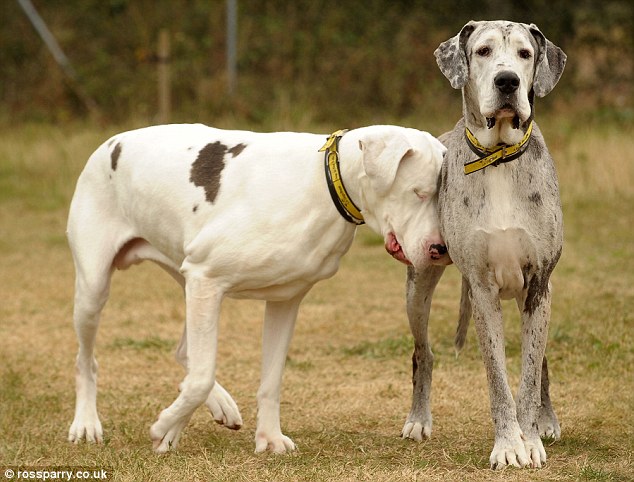
Meet the blind Great Dane in need of a home (but you’ll need to make space for HER huge guide dog)
When illness forced vets to remove Great Dane Lily’s eyes, the prospects of a fulfilling life didn’t look good.
But then no one had reckoned on her pal Maddison stepping in to turn guide dog.
The pair have been inseparable for years but now find themselves looking for a new home because their owner could no longer cope.
The catch for anyone interested is that the Great Danes come as a package. They have been waiting at the Dogs Trust re-homing centre in Shrewsbury since July.
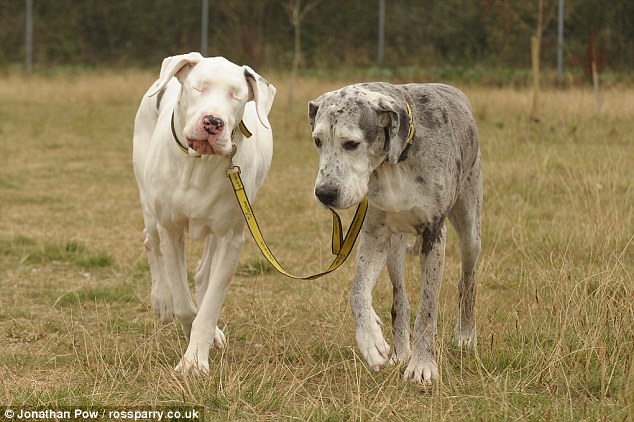
Homeless: Blind Great Dane Lily and her kind-hearted canine carer MaddisonForever friends: Lily, left, being guided while walking with Maddison right. The pair have been inseparable since Lily lost her sight
Manager Louise Campbell said: ‘Maddison is Lily’s guide dog. If they are out and about, for the majority of the time Maddison will lead and Lily will walk nearly touching her so she knows where to go. It’s lovely to watch. Maddison is always looking out for her.’
Lily, six, was barely a puppy when she was struck down by a condition that caused her eyelashes to grown into her eyeballs, damaging them beyond repair.
It was after this traumatic event that her relationship with seven-year-old Maddison developed as she took her under her wing.
The best buddies lived together until their owners decided they couldn’t look after them any more.
Miss Campbell said: ‘With her lack of sight, Lily’s other senses have heightened so although we don’t split them up often she can tell if Maddison is nearby.
‘They curl up together to go to sleep and they are very vocal with each other.
‘We haven’t analysed their different barks but if Lily wants to go forward and Maddison is in her way, the bark will have a different pitch.
‘They are very close to one another and enjoy each other’s company‘.
Playful: Lily's lack of sight has heightened her other senses so she can often tell if Maddison is nearby without the pair touching
Miss Campbell said that Lily does all the things normal dogs do and if you saw her from a distance you wouldn’t realise she had anything wrong with her eyes.
She added: ‘They are really happy with life, the glass is always half full with these two.
‘They have been with us for a considerable amount of time but they are quite happy and go about their daily routine – they are very affectionate.’
She believes the dogs’ size and advancing years, as well as the fact they have to come in a pair, may have put off potential owners and she warned that anyone contemplating taking the dogs in should look at their lifestyle and think of the responsibility involved.
‘They are not gigantic when you see them outside. These are two lovely big girls who deserve to live out the rest of their lives together in comfort‘, she said.
Dogs Trust cares for around 16,000 stray and abandoned dogs every year through a network of 17 re-homing centres.
The Great Dane is seeking an owner who would be willing to give both her and best friend Maddison a new home
Back to me. Must say that it was just fortuitous that Dan’s email came in to me a little while after I posted yesterday’s article by Robert Holden, The Gift of Happiness. Indeed, shortly after I had written, “Perhaps the art of happiness is yet another thing we can learn from dogs!”
Anyone in the UK who wants to contact the Dogs Trust click here.
Let me offer thanks to Resurgence Magazine for the written permission to reproduce this article in full, see terms at the end of the article. More background information about Robert Holden may be obtained from his own website and, finally, the Happiness Project website is here.
Robert Holden was at the forefront of ‘Happiness’ research. Here, he reflects on how that topic – initially laughed off the agenda – has gained credibility and explains why happiness is important
When I set up The Happiness Project, in 1994, the original goal was simple: talk happiness. In my training in psychology, philosophy and psychotherapy my teachers didn’t talk about happiness. We focused solely on the causes of unhappiness. This didn’t feel right to me. After all, how can you know what the causes are if you do not know what happiness is?
My goal, then, was to stimulate a conversation, so as to deepen our appreciation of what happiness is, its benefits, what enables it, and what blocks it. One conversation I focused on was the question of whether happiness is learned and whether it can be taught. To investigate this further, I created an eight-week happiness programme (which still runs today) called Be Happy.
Today happiness is a much more popular conversation than when The Happiness Project began. We are all talking more about happiness than ever before. The conversation is alive and well. Universities, hospitals, economists and governments publish new studies on happiness every week. So, what we have learned? And where does this conversation about happiness need to go next?
Let’s start with what happiness researchers refer to as ‘static happiness’. In a recent US study, it was found that when people in the 1940s were asked, “How happy are you?” the average score was 7.5 out of 10, whereas today the average score is 7.4 out of 10. In other words, in spite of all the ‘progress’ we appear to have made in the last 50 years or so, our happiness levels have remained mostly static. This tells me we need more conversations to clarify what real happiness is. For instance, we need to discern between pleasure, satisfaction and joy; and on my eight-week happiness programme we always begin by asking people, “What is your definition of a happy life?” and, “Are you living it?”
Happiness researchers have also found that most of us are only semi-happy. In 2006, I participated in a BBC documentary called The Happiness Formula. It reported, “the proportion of people saying they are ‘very happy’ has fallen from 52% in 1957 to just 36% today.” Clearly, research like this is questioning our most basic assumptions about what happiness is, and what we think will make us happy. That’s a good thing. An honest inquiry into happiness is an opportunity to rethink your life. It is one of the gifts of happiness.
Do you really know what makes you happy? This is the question both psychologists and economists are asking now. The evidence suggests we do not know. For instance, many of us believe that more money will make us happier. Some money does help, especially to cover the basics of food, rent, clothing, etc. After that, the correlation between more money and greater happiness is vague. Martin Seligman, former president of the American Psychology Association, and one of the founders of the Positive Psychology movement, concludes most forcibly: “The change in purchasing power over the last half century in the wealthy nations carries the same message: real purchasing power has more than doubled in the United States, France and Japan, but life satisfaction has changed not a whit.”
An inquiry into happiness challenges you to rethink everything. For example, almost everyone agrees with the idea that if their life circumstances improve, their levels of happiness will increase. This is the basis for almost every political and economic strategy the world over. And yet scientific research into happiness tells us this is wrong. New Zealand researcher Richard Kammann reports, “Objective life circumstances have a negligible role to play in a theory of happiness.” The same research concludes that your attitude and personal choices have a far greater influence on your happiness levels.
Another popular theory is that a better education will make our children happier. This has resulted in more tests for preschool children, more focus on regular exams, and more money spent on private education. Surely this increases happiness? “Sorry, Mom and Dad, neither education nor, for that matter, a high IQ paves the road to happiness,” states Claudia Wallis, who compiled a report called The New Science of Happiness for TIME magazine.
Happiness challenges us to rethink what is a “better education” for our children. I support the idea of happiness lessons for children at school, as pioneered at Wellington College by psychologist Nick Baylis and college Master Anthony Seldon [read his thoughts on this important topic in his article Stillness in Schools]. One opposing argument for happiness lessons at school is that children should not be “taught” happiness, but that they should be allowed to think about happiness for themselves. However, this is precisely the aim of these happiness lessons. The approach is inquiry, not dictation.
People who attend my happiness programme are always telling me, “I wish I’d learned this at school.” It’s time then for more conversations about happiness in school, and at home with our children. I encourage all my students and clients to talk more about happiness with their families. Why? Because one of the ways we evolve is through conversation. Drawing happiness with our children or talking about happiness with our partner helps us to clarify things, to heal, to come together, and ultimately to live a happier life.
And now, even governments and politicians want to talk about happiness. In Britain, David Cameron has commissioned a new survey called Measuring National Well-being. A new organisation called Action for Happiness [see what founder Richard Layard says about this new movement in his article A Better Way of Life] is working closely with the government to help create better social change in society. Again, some people are concerned that governments should not “tell us” how to be happy. I agree with this, but I don’t think governments are trying to tell us. Like us, they are simply trying to understand what happiness is, and how we can be happier.
In my latest book, Be Happy, I have written: “Your definition of happiness will influence every significant decision in your life.” It is essential, therefore, that individuals and governments alike keep happiness on the agenda because, more than ever before, humanity needs a better understanding of happiness. We have learned so much, about atoms and galaxies and other things, but we still do not understand ourselves very well; we still go to war too often, and there is still too much suffering.
I remain deeply committed to talking about happiness. Why? Because I believe that happiness is our true nature (it is the natural state of our Unconditioned Self), and for that reason happiness brings out the best in us, both individually and collectively. Happiness research has found a strong link between happiness and altruism, for instance. In a recent study by a Charities Commission, it was reported that the highest predictor of generous giving is not your income level: it’s your happiness level.
Good things come from real happiness. Happier people make better choices, which is good for society and the planet. Your happiness is a gift to the world. I believe this with all my heart.
—————————–
Robert Holden is director of The Happiness Project. His latest book, Be Happy;, is published by Hay House. For more about the eight-week happiness programme visit: http://www.happiness.co.uk
The Gift of Happiness features in Resurgence issue 269, November/December 2011.
This article is reprinted courtesy of Resurgence magazine – at the heart of earth, art and spirit. To buy Resurgence, read further articles online or find out about The Resurgence Trust, visit: http://www.resurgence.org
All rights to this article are reserved to Resurgence, if you wish to republish or make use of this work you must contact the copyright owner to obtain permission
—————————–
One final note from yours truly. Perhaps the art of happiness is yet another thing we can learn from dogs!
A delightful trawl by Neil Kelly through the call centre industry.
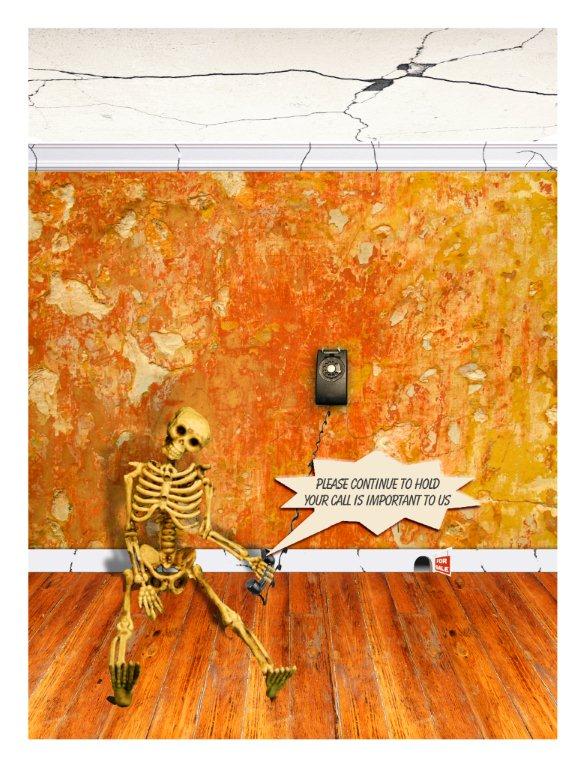
Picture by Neil Kelly
Are there any more annoying phrases in the English language than “your call is important to us“, or “we are experiencing particularly high call volumes“?
In 2007 companies worldwide spent some $280 billion on outsourced call-centre services, according to NASSCOM, a call-centre trade group in Delhi. Much of India’s call-centre industry, which employs roughly 300,000 agents, is located outside the ring road that encircles Bangalore, in a string of smart new business parks with tidy lawns and private security. Were it not for the stray dogs, a visitor could be forgiven for mistaking the area for Silicon Valley.
Meanwhile in Australia …
Meanwhile …… back in Wales in the United Kingdom … listen to this call centre handling a complaint from an ASDA customer – listen right to the end!
Thanks to David from neatorama.com I was able to put together a medley of hold music and without resorting to The Four Seasons! Hope to have The Top Twenty Hold Music Songs out in time for Christmas.
Finally, you may be interested in reading Your Call Is Important to Us: The Truth about Bullshit by Laura Penny which is available as a free eBook here.
In a sense this piece today connects with the conclusions from my review of David Kauders’ new book The Greatest Crash; that we are transitioning into a new era.
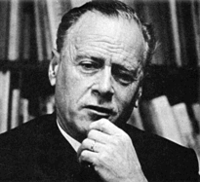
That’s why I was fascinated to come across a long essay about Herbert Marshall McLuhan written by Michael Valpy and published in the The Globe and Mail last July.
Let me quote some extracts from that article to illustrate why I made the connection with my book review.
The University of Toronto professor of English credited with foreseeing the Internet 30 years before it was invented and broadcasting scores of ideas about how electronic communications media was changing the way humans think has been redeemed from labels of McLuhanacy and psuedo-scientific charlatanism.
His work no longer is described, as it was in one erudite journal of the 1970s, as “a hoax so gigantic that it shows every sign of becoming an international intellectual scandal.”
Later on in the article,
Deciding recently to pay a visit to the McLuhan coach house, she wrote: “To be perfectly honest, I had never heard of McLuhan until I moved into residence at SMC, and accidentally stumbled into the book and media studies program. But as I quickly learned, Marshall McLuhan is kind of a big deal. You know that phrase that you hear everywhere: ‘The medium is the message?’ Yeah, that was McLuhan.”
And McLuhan’s problem – one of his problems – is that his message couldn’t escape his medium. As Douglas Coupland points out in a 2009 McLuhan biography, the wonderful, whimsical, boundlessly optimistic and imaginative sixties society that embraced him and lapped up his ideas morphed into the gloom of a change-fatigued seventies society that tired of hearing from him. Yet the brand remained strong. “You know that phrase that you hear everywhere: ‘The medium is the message?’” Ms. Kellogg asks us. “Yeah, that was McLuhan.”
Think of his intellectual history as a journey between two mountain peaks passing through a shadowed valley.
When one thinks of the power of the many new tools we lump under the title ‘social media’ then it’s easy to think that the way that humans are now communicating will have profound implications. Even this humble Blog was read by over 31,000 in the month of October. Back to the article,
McLuhan believed that each new technology created a new human environment and thus a new way of thinking. The medium-is-the-message meant that the content of electronic media is insignificant; it is the medium itself that has the greater impact on the environment. In other words, it wasn’t what we were seeing on TV that was important; it was the fact that we were watching TV (and not doing other things) that altered our brains.
And because, as Prof. Francis points out, McLuhan saw humans as essentially communicative animals, he believed it was the technologies of communication that were primary in shaping who we were, what we thought, and how we acted, with effects that often were subliminal and therefore not recognized.
Finally, the article concludes thus,
To truly understand McLuhan and his ideas, says Prof. Scheffel-Dunand, students have to read him.
Most students of McLuhan today, she says, read scholars who write about McLuhan rather than read McLuhan himself. Which is a mistake, she says, because McLuhan wrote as a poet: he wrote metaphorically, aphoristically, he wrote in what he called “mosaics.”
Biographer Philip Marchand agrees. “My suggestion for students is to begin with the articles written by McLuhan – ‘Acoustic Space’ and ‘The Effect of the Printed Book on the language of the 16th century’ and a couple others that appear in the anthology entitled Explorations in Communication. These articles are lucid, comprehensible introductions to McLuhan’s thought.”
To rejoin UpbeaT blogger Emily Kellogg on her coach house tour: “I don’t want to bore you, dear readers, but I just can’t help gushing. I dig this stuff. These kind of conversations, are the things that make an undergraduate degree worth pursuing. They’re the ones that give you an adrenalin rush because you’re thinking so quickly – and your brain kind of feels like a trapeze artist jumping from idea to idea.
There’s also something innately cool about having an intellectual conversation that ranges from iPhones to Heidegger in five seconds flat in the place that housed Marshall McLuhan as he wrote the books that revolutionized the field of media research.”
Ms. Kellogg: 2011 medium of McLuhan’s message.
Michael Valpy is a freelance writer based in Toronto.
Not too long ago, I came across the website The Big Think. It tickled my curiosity to the extent that I subscribed. On November 6th an essay was published with the wonderful title of ‘Consciousness: The Black Hole of Neuroscience‘. Couldn’t resist that! Here’s how that essay started,
What’s the Big Idea?
“By the word ‘thought’ (‘pensée’) I understand all that of which we are conscious as operating in us.” –Renee Descartes
The simplest description of a black hole is a region of space-time from which no light is reflected and nothing escapes. The simplest description of consciousness is a mind that absorbs many things and attends to a few of them. Neither of these concepts can be captured quantitatively. Together they suggest the appealing possibility that endlessness surrounds us and infinity is within.
That last sentence jumped off the page at me – hence me using it as the title of this post.
If this interests you at all, then do read the full item. That closes like this …
Hirsch sees it more practically. Though functional imaging has not explained where perception comes from, it has important applications for unconscious patients. “The boundaries have been broken a little bit, clinically,” she says. “As we study patients with disorders of consciousness, we can probe their levels of awareness in ways that other traditional ways of asking them to respond.”
It’s no different than any other aspect of the brain that we cannot presently explain, she says:
For example, we don’t understand how the brain creates colors. That’s a perception that is very private – I don’t know that your perception of blue is like my perception of blue, for example. Smells are another one. I don’t know that your perception of the smell of an orange is like mine. These are the hard problems of neuroscience and philosophy that we haven’t made a great deal of progress on.
What do you think? Is the distinction between “hard problems” and “soft problems” useful, or reductive? Does the brain create consciousness? Will we ever empirically understand where it comes from or how it works?
But that’s not the end of it. Browsing the comments revealed a link to the Blog called NeuroLogica Blog. The author is Steven Novella, MD. Here’s a flavour of Steven’s competencies.
The NeuroLogicaBlog covers news and issues in neuroscience, but also general science, scientific skepticism, philosophy of science, critical thinking, and the intersection of science with the media and society.
Dr. Novella also contributes every Sunday to The Rogues Gallery, the official blog of the SGU, every Monday to SkepticBlog, and every Wednesday to Science-Based Medicine, a blog dedicated to issues of science and medicine.
I couldn’t resist doing a search on Dr. Novella’s blog using the search term ‘consciousness’. What a rich vein! Here’s just one example of what came to light,
Neuroscience research has been increasingly fleshing out the fascinating and complex relationship between the subconscious processing of the brain and our conscious awareness. We all labor under the illusion that our decisions, feelings, and behaviors are all conscious. When we do something, it seems, it is because we wanted to do it. We are very good, in fact, at retrofitting a logical explanation for why we consciously did something.
But much of our brain’s decision making occurs at a subconscious level. When presented with a choice various parts of our brains make a calculation – processing the choice, weighing varying factors based upon some neuro-algorithm, and then present that choice to our conscious mind (the global workspace, if you accept this hypothesis). Research shows that if we change the subconscious algorithm, by suppressing, for example, one part of the brain, the decision-making process is altered. We are not aware of this, and we still are under the illusion that the decision was completely conscious.
Strongly recommend that you read the article in full; it is deeply fascinating. And then laugh out loud, as I did, when you read the first comment made to that article,
I find this fascinating even though I am not conciously aware of why!
John’s first guest contribution, Clarity of Thought, was published on the 20th September and attracted a collection of very thoughtful comments. To give you a sense of that first contribution, it started thus,
The Passion of Enlightenment
Enlightenment includes deep grief and a passion to leave life a bit better than we found it. Enlightenment has little practical value in a growing and constantly consuming cultural demographic. Consumers tend to spiritually disconnect when faced by a need for change or when morality becomes inconvenient.
To set the scene for these musings from John, Highway 87 that runs South-North through Payson, where John lives, is called the Beeline Highway and there is, indeed, a Beeline Cafe in town.
Over to John now.
Voices from the Beeline Café
Americans are the best entertained and the least informed people on earth.
Combined commercial and investment banks have become a global casino.
No one can afford to run for political office without corporate approval.
—ooOOoo—
Political campaigns are celebrity theaters devoid of content or reality.
Climate change is a planetary constant exacerbated by human activities.
A twenty-four hour media drumbeat of fear encourages human divisiveness.
—ooOOoo—
Education, history and science are marginalized.
Facts are systematically denied.
People are confused.
—ooOOoo—
Global totalitarianism is immensely profitable.
Corporations do not care about democracy or humanity.
Economically stressed voters are disenfranchised by corporate government.
—ooOOoo—
The rule of law has lost equity and become the tool of oppressors.
Firefighters, policemen, nurses and clergy have become political pawns.
Corporate supported criminals control a majority of the nations of the world.
—ooOOoo—
We have lost the rudder of human morality.
Material well-being is considered the greastest good.
War is a highly profitable form of corporate enterprise.
—ooOOoo—
The flag and cross are employed to demonize opposition to corporate authority.
Politics worth supporting begin and end with service to God and nature.
God grant us each the grace to make a transformative difference.
Perhaps ancient man is still alive and well in all of us.
Two delightful events have provided the fuel for today’s post which, I warn you, is much more the personal mental ramble than the usual daily post on Learning from Dogs. So, health warning, continue reading at your own risk, or be safe and switch off now!
Before getting in to my perambulations, just a word of thanks to you for your support. Last month, there were 31,291 viewers of Learning from Dogs and 71 of you have chosen to subscribe. I am humbled by your interest. Don’t ever hesitate to give me feedback or, if you prefer, comment to a specific post.
OK, to the theme of today.
On Wednesday I had an enjoyable lunch with a friend from here in Payson, Dennis L. Sitting in the Crosswinds restaurant at Payson airport is one of the most beautiful eating spots in terms of the view from the window. So it’s a very conducive place to relax and try put the world to rights! Conversation ranged across a variety of topics but frequently touched on the lunacy of so many things to do with man, especially when it comes to the government of peoples.
Dennis and I also acknowledged that entering politics with a set of passionate ideals, as we were sure many persons did, would quickly run up against the skein of vested interests that must permeate governments from top to bottom.
Yes Minister was a satirical comedy written by Antony Jay and Jonathan Lynn that ran for many years. It was extraordinarily funny, here’s a 3-minute clip,
That programme underlined, far better than anything else, how governments most probably work in reality.
Dennis and I were clear, as so many millions of other global citizens must be, that the complexity of commerce, politics, national interests, global finance, and more, had created ‘systems’ of decision making that were utterly disconnected with the needs of mankind having a long and stable future on the only finite home around, Planet Earth.
Then today (Thursday), Jean and I attended our regular weekly gardening course at the local college in Payson. Today’s subject was Arizona’s Climate and the tutor, Mike C., was a professional climatologist and meteorologist. It was fascinating, indeed, totally absorbing. Mike’s graphs and slides about the climate, some showing data for the last 1,000 years, underlined the incredible complexity and interconnectedness of the processes that made up the global climate system.
Once again that use of the word ‘complexity’. He confirmed that there was no scientific doubt that the world was warming as a result of changes to the Earth’s atmosphere, science certain most of it is caused by increasing concentrations of greenhouse gases produced by human activities such as deforestation and burning fossil fuels.
Mike closed the session with an interesting reflection. He reminded the audience that mankind is still essentially wired, in evolutionary terms, to know how to react to an attacking tiger or similar wild beast, as in the fight or flee response, than know how to deal with such complex, despite intellectually obvious, threats as global climate change, rising sea levels and many other totally unsustainable practices. Mike held the view that only when man had the threat in his face equivalent to that of the attacking tiger would there be a wholesale change.
On the home page of this blog, I write,
As man’s companion, protector and helper, history suggests that dogs were critically important in man achieving success as a hunter-gatherer. Dogs ‘teaching’ man to be so successful a hunter enabled evolution, some 20,000 years later, to farming, thence the long journey to modern man. But in the last, say 100 years, that farming spirit has become corrupted to the point where we see the planet’s plant and mineral resources as infinite. Mankind is close to the edge of extinction, literally and spiritually.
In the context of homo sapiens, Latin for “wise man” or “knowing man”, then we know that modern man, anatomically, originated in Africa about 200,000 years ago. Modern man only evolved from hunter/gatherer to farmer around 10,000 years ago, a tiny proportion of H. sapiens existence and, in evolutionary terms, no time at all.
The DNA of the domesticated dog separated from that of the wolf around 100,000 years ago. No one knows for sure when man and dog came together but there is archaeological evidence of dogs being buried in mens’ graves around 30,000 years ago. That’s an association over a huge time period.
Dennis and Mike, between them, triggered in my mind something fundamental. Perhaps modern society, with all it’s bizarre behaviours and so many totally illogical practises (especially, in terms of a long-term relationship with our planet), could be understood. Understood from the perspective of our social behaviours, built so much on technology, having raced far on to the point where they are now practically out of sight of our instinctive evolutionary behaviours. We really don’t know how to change those core behaviours.
In contrast, dogs have remained much more stable with regard to their evolutionary progress and their external world. Consider that the last big change for the domesticated dog was the association with man and that is at least three times as long ago as man becoming farming man. No wonder when we curl up with our dog it has echoes of a time thousands of years before we could even spell the word, ‘politician’. Echoes of a stability that seems now so way beyond reach.
Over the last week we have watched all three 0ne-hour films made by the BBC, aired in 2011, under the title of the heading of this post, All Watched Over by Machines of Loving Grace. The films are available on the website Top Documentary Films, the direct link is here. As that website explains,
A series of films about how humans have been colonized by the machines they have built. Although we don’t realize it, the way we see everything in the world today is through the eyes of the computers. It claims that computers have failed to liberate us and instead have distorted and simplified our view of the world around us.
1. Love and Power. This is the story of the dream that rose up in the 1990s that computers could create a new kind of stable world. They would bring about a new kind global capitalism free of all risk and without the boom and bust of the past. They would also abolish political power and create a new kind of democracy through the Internet where millions of individuals would be connected as nodes in cybernetic systems – without hierarchy.
2. The Use and Abuse of Vegetational Concepts. This is the story of how our modern scientific idea of nature, the self-regulating ecosystem, is actually a machine fantasy. It has little to do with the real complexity of nature. It is based on cybernetic ideas that were projected on to nature in the 1950s by ambitious scientists. A static machine theory of order that sees humans, and everything else on the planet, as components – cogs – in a system.
3. The Monkey in the Machine and the Machine in the Monkey. This episode looks at why we humans find this machine vision so beguiling. The film argues it is because all political dreams of changing the world for the better seem to have failed – so we have retreated into machine-fantasies that say we have no control over our actions because they excuse our failure.
As was eluded, the three films are deeply thought-provoking. There is a ‘taster’ to the first film on YouTube, as below,
Adam Curtis, the film maker, has a blog site under the BBC Blogs umbrella. The entry on that blog-site by Adam in connection with these films is here, and makes interesting reading. It also includes a longer trailer than the one from YouTube, above.
Finally, there are comprehensive writings on all three films on the WikiPedia website here. To give you a taste, here’s what was written about the third film,
The Monkey In The Machine and the Machine in the Monkey
In 1960 Congo had become independent from Belgium, but governance promptly collapsed, and towns became battle grounds as soldiers fought for control of the mines. America and the Belgians organised a coup and the elected leader was assassinated, creating chaos. The Western mining operations were largely unaffected however.
Bill Hamilton was a solitary man, and he saw everything through the lens of Darwin’s theory of evolution. When he wanted to know why some ants and humans gave up their life for others, he went to Waterloo station and stared at humans for hours, and looked for patterns. In 1963 he realised that most of the behaviours of humans was due to genes, and looking at the humans from the genes’ point of view. Humans were machines that were only important for carrying genes, and that it made sense for a gene to sacrifice a human if it meant that another copy of the gene elsewhere would prosper.
In the 1930s Armand Denis made films that told the world about Africa. However, his documentary gave fanciful stories about Rwanda’s Tutsis being a noble ruling elite originally from Egypt, whereas the Hutus were a peasant race. In reality they were racially the same and the Belgian rulers had ruthlessly exploited the myth. But when it came to create independence, liberal Belgians felt guilty, and decided that the Hutus should overthrow the Tutsi rule. This led to a blood bath, as the Tutsis were then seen as aliens and were slaughtered.
So, all in all, this is a great personal recommendation and, it goes without saying, those of you that do watch the films and want to comment, would love to hear from you.