I ran out of time and inspiration for today’s post; was going to republish something from earlier blogging days.
Then Suzann came to the rescue in sending me an email with a link to the following. Guess Su wanted me to keep up with some of the strange ideas of us Brits.
Published on Apr 2, 2013
Sacla’ served up a great surprise at John Lewis Foodhall from Waitrose and staged an impromptu Opera in the food aisles.
They planted five secret opera singers who were disguised as casual shoppers and store staff amongst the groceries who broke into song bringing the foodhall to a standstill with a rousing rendition of the Italian classic Funiculì, Funiculà.
I know it was an advertising stunt, but it was very well done! More please!
My posts from Monday and yesterday about the plight of our bees must to many, frequently me as well, engender a level of hopelessness as to where we, as in the peoples of this planet, are heading. Too many times the news is discouraging; to say the least.
But hold on for just a moment! Here’s a quotation from this week’s Sabbath Moment from Terry Hershey:
Tears have a purpose.
they are what we carry of the ocean, and
perhaps we must become sea,
give ourselves to it,
if we are to be transformed.
Linda Hogan
What this says to me is that feelings of sadness, of grief, even of despair are an essential part of the process of ‘letting go’; of being able to heal oneself. Just as dogs and many other animals know when to crawl away and recuperate in some peaceful and quiet place, so too must we humans counter our feelings of pain and anguish with healing.
So with that all in mind, I’m delighted, and very grateful, to Sue of Dreamwalker’s Sanctuary for permission to repost her item on Sound Healing, published last Friday.
Have you ever wondered why we so enjoy Music? Why various styles seem to either lift our mood or sooth our spirits? Or some grate on our nerve endings?
Sound Healing comes in various forms. I have received healing from various sources: Crystal Singing Bowls, Tuning Forks and the Mighty Gongs. The Gong Bath in particular shifted something within my being as I physically felt something leave my aura to be replaced with a new found peace within.
Sound Healing isn’t new and if you research back to ancient times many ceremonies were done through sound.
I know in the 90s when I was going through my own major self-healing after listening to some tapes by Deepak Chopra called Magical Mind Magical Body in which he speaks about our vowel sounds. I remember driving to work, and on occasion still do, chanting out Very Loudly the vowel sounds in a chant, each vowel holds its own frequency. Chanting brings an awareness of our own voice, as we express outwards our feelings, and there are some interesting theories as how certain frequencies are powerfully connected to our body. This includes the frequency of 528hz,referred to as ancient solfeggio frequencies which has been researched for its proposed ability to heal and resonate with human DNA. I did my own research on the net, and came across this site and post ( Forgotten in Time: The Ancient Solfeggio Frequencies )
Interestingly too the author of that post went on to explain how Deepak Chopra was a big inspiration and listened to the same tapes I did where Deepak Chopra explained saying: “Quantum physics has found that there is no empty space in the human cell, but it is a teeming, electro-magnetic field of possibility or potential.” This made me smile as synchronicity seemed to be playing a role.
Within that same article the author went on to say how music makes waves which produces shapes and patterns and quoted a passage from a book by the first to make that connection, a German scientist, Ernst Chladni who in 1787 detailed his findings in his book “Discoveries Concerning the Theory of Music.” These patterns and figures are called Chladni figures with each note having a corresponding pattern or vibration.
My drum, as I painted it.
My own tool is the Drum and if we look back through time we see how the Drum beat has been used not only in rituals but also within our military as we march to its beat! The Drum is very powerful and many join Drumming circles. You, too, can find out how to call Healing from within a Drumming Circle from an article in the magazine Sacred Hoop of 2003 called Healing Power of the Drum Circle
Side view of my drum.
Sound Healing works, because we are all vibration, we all resonate with our own frequencies. For those wishing to learn more the links are below and of course there are many many articles covering this subject on the ‘web’.
For those who have not much time I will leave you with this one note of vibration from a Singing bowl. If you go to the YouTube site you will find more about this One note and how it heals.
…
… and for those who have 5 minutes to spare this Om Meditation.
Chakra’s are energy centers in your body. There are 7 major Chakra’s. Each Chakra governs specific issues and lessons.By aligning the chakra system you can heal your mental, emotional, spiritual & physical bodies.
7th Chakra= Crown Chakra
Color: Purple
Location: top of head
Element: Superether
Musical note/ sound: B/ silence
Glands/ Organs: Pineal gland, cerebral cortex, central nervous system, right eye
Purpose: vitalizes upper brain, unification with higher self. Being open to source, accepting our own Divinity, Beauty, healing, Inspiration. Perception beyond space & time, perceives “miracles”.
When Harmonious: Idealism, selfless service, One with divine, spiritual will, unity.
When Disrupted: lack of inspiration, confusion, depression, alienation, hesitation to serve, senility, crisis of faith.
Second: Aum Meditation
Working with Aums will resonate into all objects around you, effectively re-writing all undesirable environmental energy programming. Like a springboard of positivity. Use it to launch your spiritual work to new heights. This is just a small sample of the full meditation.
“Until one has loved an animal, a part of one’s soul remains unawakened.” Anatole France
This gorgeous video has been doing the rounds and came to me thanks to Suzann.
Enjoy!
Very Talented Russian Bear and His Awesome Friend
This unbelievably talented and cute Russian bear can roll over, play the trumpet, sit on a lawn chair, play the trumpet, you name it. Leave it to a random Russian guy to train such an awesome bear.
Never underestimate the power of like-minded people.
We are nothing without others in our life. Each one of us is drawn to those that laugh with us, cry with us and comfort us in times of sorrow.
These thoughts come to mind as, to my humble amazement, the number of followers of Learning from Dogs approaches 500 and I reflect on how many of you, dear readers, now feel like friends. (Update:as at 7:40 pm last night, Raechelsheart became follower number 500! Thank you all.)
So from that parochial view to the following video. No introduction required by me, other than to thank neighbours Dordie and Bill who brought this performance to my attention.
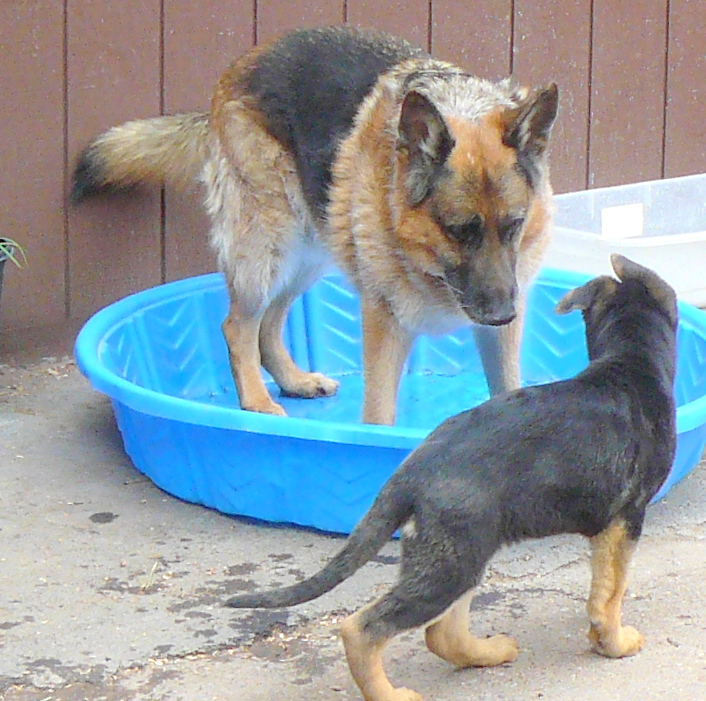
Finally, it’s not just humans who are drawn together. Here’s Pharaoh getting to know puppy Cleo back on the 7th April last year. They are now deeply connected friends who share their whole lives together; with so much fun.
Back on the 16th June, I published a post under the title of Wonder and Awe. It featured Miyoko Shida Rigolo and a balancing act of such artistry with a most beautiful finale!
Sometimes applause seems just … oh, I don’t know …. just so inadequate!
If you, like me, was entranced by the music then thanks to a comment left by one Eugene Karry on the YouTube website, all is explained.
Eugene explained that the instrument is called the Armenian Duduk and that Armenian Duduk music is recognized by UNESCO.
It was only a quick search on the UNESCO website to find this:
The duduk, the Armenian oboe, is a single or double reed wind instrument made of the wood of the apricot tree and has a warm, soft, slightly nasal timbre. The duduk or tsiranapokh, which is also called the apricot tree pipe, belongs to the organological category of areophones, which also includes the balaban played in Azerbaijan and Iran, the duduki common in Georgia and the ney in Turkey. The soft wood is the ideal material to carve the body of the instrument. The reed, called ghamish or yegheg, is a local plant growing alongside the Arax river.
The roots of Armenian duduk music go back to the times of the Armenian king Tigran the Great (95-55 BC). The instrument is depicted in numerous Armenian manuscripts of the Middle Ages. The duduk accompanies popular Armenian traditional songs and dances of the various regions and is played at social events, such as weddings and funerals. Although there are also famous duduk soloists, among them Gevorg Dabaghyan and Vache Sharafyan, the duduk is mainly played by two musicians. One player creates the musical environment for the lead melody by playing a continual drone that is held by circular breathing, while the other player develops complex melodies and improvisations.
There are four major types of duduk, varying in length from 28 to 40 cm and in sound, ranging from one to fourth or third octaves. Therefore, the sound of the duduk can express various moods depending on the content of the piece and the playing context. The 40-cm long duduk, for example, is regarded as most appropriate for love songs, whereas the smaller one usually accompanies dances. Today, duduk craftsmen continue to create and experiment with different forms of duduks. Many Armenians consider the duduk as the instrument that most eloquently expresses warmth, joy and the history of their community.
Over recent decades, the popularity of Armenian duduk music has decreased, in particular in the rural areas where it originated. At present, most duduk players are concentrated in Yerevan. The duduk instrument is played less and less in social festivities, but more often by professionals as a staged performance. Duduk music risks losing its viability and traditional character and becoming just another facet of “high culture”.
Back to Eugene, who went on to write that Jivan Gasparyan and Gevorg Dabaghyan are famous duduk players among many others. The musical pieces played on the duduk are mostly armenian folk or spiritual tunes; many of them sad songs. Nowadays the duduk is very often played during funerals among Armenians but there are some dance songs as well.
Finally, Eugene offered these further hauntingly beautiful pieces of music.
This saying was offered in a creative writing class that Jean and I attended when we were living in Payson, Arizona. It came to me spontaneously as I started today’s post. Because feeling what is going on around us is the only way to write it, to share it, to bring it to the attention of all.
These are tough times for so many that love the world around us and having the odd weep is a perfectly rational, and healthy, thing to happen.
So as you listen to the following just feel it. And if a tear comes to your eye … embrace it.
Hopefully, you listened to the full seven minutes before reading on! Because to end the post at this point would be to leave out some great connections.
Put this on in the background and let it creep up on you.
Elizabeth Shepherd performs Live-to-Air with Michael Occipinti’s Shine On: The Universe of John Lennon
Toronto, June 1, 2012 CBC Radio
UPDATE: by popular demand, the original below.
Secondly, a quick dip into WikiPedia reveals that the song was recorded by the Beatles in February 1968 at the famous Abbey Road studios and released on the 12th December, 1969. It was written by John Lennon, and credited to Lennon–McCartney.
Abbey Road Studios, 3 Abbey Road, St. John’s Wood, London
Thirdly, that Wikipedia reference includes the background to the composition of the song, some of which I will share here:
One night in 1967, the phrase “words are flowing out like endless rain into a paper cup” came to Lennon after hearing his ex-wife Cynthia, according to Lennon, “going on and on about something.” Later, after “she’d gone to sleep—and I kept hearing these words over and over, flowing like an endless stream,” Lennon went downstairs and turned it into a song. He began to write the rest of the lyrics and when he was done, he went to bed and forgot about them.
“
I was lying next to my first wife in bed, you know, and I was irritated, and I was thinking. She must have been going on and on about something and she’d gone to sleep and I kept hearing these words over and over, flowing like an endless stream. I went downstairs and it turned into a sort of cosmic song rather than an irritated song, rather than a “Why are you always mouthing off at me?”[1]… [The words] were purely inspirational and were given to me as boom!. I don’t own it you know; it came through like that.[2]
”
The flavour of the song was heavily influenced by Lennon’s and the Beatles’ interest in Transcendental Meditation in late 1967 – early 1968, when the song was composed. Based on this he added the mantra “Jai gurudevaom” (Sanskrit: जय गुरुदेव ॐ) to the piece, which became the link to the chorus. The Sanskrit phrase is a sentence fragment whose words could have many meanings. Literally it approximates as “glory to the shining remover of darkness,”[3] and can be paraphrased as “Victory to God divine”, “Hail to the divine guru”, or the phrase commonly invoked by the late Maharishi Mahesh Yogi in referring to his spiritual teacher “All Glory to Guru Dev.”[4]
Finally the lyrics.
“Across The Universe”
Words are flowing out like endless rain into a paper cup
They slither wildly as they slip away across the universe
Pools of sorrow, waves of joy are drifting through my open mind
Possessing and caressing me
Jai Guru Deva OM
Nothing’s gonna change my world
Nothing’s gonna change my world
Nothing’s gonna change my world
Nothing’s gonna change my world
Images of broken light which dance before me like a million eyes
They call me on and on across the universe
Thoughts meander like a restless wind inside a letter box
They tumble blindly as they make their way across the universe
Jai Guru Deva OM
Nothing’s gonna change my world
Nothing’s gonna change my world
Nothing’s gonna change my world
Nothing’s gonna change my world
Sounds of laughter shades of live are ringing through my open ears
Inciting and inviting me
Limitless undying love which shines around me like a million suns
It calls me on and on, across the universe
Jai Guru Deva OM
Nothing’s gonna change my world
Nothing’s gonna change my world
Nothing’s gonna change my world
Nothing’s gonna change my world
Jai Guru Deva
Jai Guru Deva
Jai Guru Deva
Jai Guru Deva
Jai Guru Deva [fade out]
Footnote
The title of the song was given a new dimension when NASA beamed the song into space.
“On 4 February 2008, at 00:00 UTC, NASA transmitted the Interstellar Message “Across the Universe” in the direction of the star Polaris, 431 light years from Earth. The transmission was made using a 70m antenna in the Deep Space Network’s Madrid Deep Space Communication Complex, located outside of Madrid, Spain. It was done with an “X band” transmitter, radiating into the antenna at 18 kW. This was done to celebrate the 40th anniversary of the song’s recording, the 45th anniversary of the Deep Space Network (DSN), and the 50th anniversary of NASA. The idea was hatched by Beatles historian Martin Lewis, who encouraged all Beatles fans to play the track as it was beamed to the distant star. The event marked the first time a song had ever been intentionally transmitted into deep space, and was approved by McCartney, Yoko Ono, and Apple Corps.”
Thus those feelings so beautifully expressed in the song will be echoing around the universe for time immemorial. Now that is a legacy!




 Learning from Dogs
Eugene explained that the instrument is called the Armenian Duduk and that Armenian Duduk music is recognized by UNESCO.
It was only a quick search on the UNESCO website to find this:
Back to Eugene, who went on to write that Jivan Gasparyan and Gevorg Dabaghyan are famous duduk players among many others. The musical pieces played on the duduk are mostly armenian folk or spiritual tunes; many of them sad songs. Nowadays the duduk is very often played during funerals among Armenians but there are some dance songs as well.
Finally, Eugene offered these further hauntingly beautiful pieces of music.
——-
——-
——–
oooOOOooo
Just beautiful.