A moving, insightful postscript to the life of the late Ernest Callenbach.
This is a continuation of the republication of a recent TomDispatch Tomgram. As I explained in Part One published yesterday I have been a follower of Tom Dispatch for some time and frequently find the essays most interesting. However, reading the words of Ernest Callenbach touched me in many ways, some of which are still evolving. Callenbach was clearly a man who many years ago not only foresaw how our world was heading but via his writings was able to articulate the solutions. Today, as the video at the end of the Post so clearly exemplifies, those solutions are spot on.
The other point that strikes me is that in leaving this ‘message’ on his computer asking for it to be released after his death, Callenbach isn’t trying to prove anything. We are reading the words of a person who feels so strongly about the fate of mankind that he wants those words to be his epitaph for ever more. Trust me. When you read the words below you will be as touched as I was, indeed still continue to be. It is a rare privilege to republish them.
Ernest ‘Chick’ Callenbach Epistle to the Ecotopians
By Ernest Callenbach[This document was found on the computer of Ecotopia author Ernest Callenbach (1929-2012) after his death.]
To all brothers and sisters who hold the dream in their hearts of a future world in which humans and all other beings live in harmony and mutual support — a world of sustainability, stability, and confidence. A world something like the one I described, so long ago, in Ecotopia and Ecotopia Emerging.
As I survey my life, which is coming near its end, I want to set down a few thoughts that might be useful to those coming after. It will soon be time for me to give back to Gaia the nutrients that I have used during a long, busy, and happy life. I am not bitter or resentful at the approaching end; I have been one of the extraordinarily lucky ones. So it behooves me here to gather together some thoughts and attitudes that may prove useful in the dark times we are facing: a century or more of exceedingly difficult times.
How will those who survive manage it? What can we teach our friends, our children, our communities? Although we may not be capable of changing history, how can we equip ourselves to survive it?I contemplate these questions in the full consciousness of my own mortality. Being offered an actual number of likely months to live, even though the estimate is uncertain, mightily focuses the mind. On personal things, of course, on loved ones and even loved things, but also on the Big Picture.
But let us begin with last things first, for a change. The analysis will come later, for those who wish it.
Hope. Children exude hope, even under the most terrible conditions, and that must inspire us as our conditions get worse. Hopeful patients recover better. Hopeful test candidates score better. Hopeful builders construct better buildings. Hopeful parents produce secure and resilient children. In groups, an atmosphere of hope is essential to shared successful effort: “Yes, we can!” is not an empty slogan, but a mantra for people who intend to do something together — whether it is rescuing victims of hurricanes, rebuilding flood-damaged buildings on higher ground, helping wounded people through first aid, or inventing new social structures (perhaps one in which only people are “persons,” not corporations). We cannot know what threats we will face. But ingenuity against adversity is one of our species’ built-in resources. We cope, and faith in our coping capacity is perhaps our biggest resource of all.
Mutual support. The people who do best at basic survival tasks (we know this experimentally, as well as intuitively) are cooperative, good at teamwork, often altruistic, mindful of the common good. In drastic emergencies like hurricanes or earthquakes, people surprise us by their sacrifices — of food, of shelter, even sometimes of life itself. Those who survive social or economic collapse, or wars, or pandemics, or starvation, will be those who manage scarce resources fairly; hoarders and dominators win only in the short run, and end up dead, exiled, or friendless. So, in every way we can we need to help each other, and our children, learn to be cooperative rather than competitive; to be helpful rather than hurtful; to look out for the communities of which we are a part, and on which we ultimately depend.
Practical skills. With the movement into cities of the U.S. population, and much of the rest of the world’s people, we have had a massive de-skilling in how to do practical tasks. When I was a boy in the country, all of us knew how to build a tree house, or construct a small hut, or raise chickens, or grow beans, or screw pipes together to deliver water. It was a sexist world, of course, so when some of my chums in eighth grade said we wanted to learn girls’ “home ec” skills like making bread or boiling eggs, the teachers were shocked, but we got to do it. There was widespread competence in fixing things — impossible with most modern contrivances, of course, but still reasonable for the basic tools of survival: pots and pans, bicycles, quilts, tents, storage boxes.
We all need to learn, or relearn, how we would keep the rudiments of life going if there were no paid specialists around, or means to pay them. Every child should learn elementary carpentry, from layout and sawing to driving nails. Everybody should know how to chop wood safely, and build a fire. Everybody should know what to do if dangers appear from fire, flood, electric wires down, and the like. Taking care of each other is one practical step at a time, most of them requiring help from at least one other person; survival is a team sport.
Organize. Much of the American ideology, our shared and usually unspoken assumptions, is hyper-individualistic. We like to imagine that heroes are solitary, have super powers, and glory in violence, and that if our work lives and business lives seem tamer, underneath they are still struggles red in blood and claw. We have sought solitude on the prairies, as cowboys on the range, in our dependence on media (rather than real people), and even in our cars, armored cabins of solitude. We have an uneasy and doubting attitude about government, as if we all reserve the right to be outlaws. But of course human society, like ecological webs, is a complex dance of mutual support and restraint, and if we are lucky it operates by laws openly arrived at and approved by the populace.
If the teetering structure of corporate domination, with its monetary control of Congress and our other institutions, should collapse of its own greed, and the government be unable to rescue it, we will have to reorganize a government that suits the people. We will have to know how to organize groups, how to compromise with other groups, how to argue in public for our positions. It turns out that “brainstorming,” a totally noncritical process in which people just throw out ideas wildly, doesn’t produce workable ideas. In particular, it doesn’t work as well as groups in which ideas are proposed, critiqued, improved, debated. But like any group process, this must be protected from domination by powerful people and also over-talkative people. When the group recognizes its group power, it can limit these distortions. Thinking together is enormously creative; it has huge survival value.
Learn to live with contradictions. These are dark times, these are bright times. We are implacably making the planet less habitable. Every time a new oil field is discovered, the press cheers: “Hooray, there is more fuel for the self-destroying machines!” We are turning more land into deserts and parking lots. We are wiping out innumerable species that are not only wondrous and beautiful, but might be useful to us. We are multiplying to the point where our needs and our wastes outweigh the capacities of the biosphere to produce and absorb them. And yet, despite the bloody headlines and the rocketing military budgets, we are also, unbelievably, killing fewer of each other proportionately than in earlier centuries. We have mobilized enormous global intelligence and mutual curiosity, through the Internet and outside it. We have even evolved, spottily, a global understanding that democracy is better than tyranny, that love and tolerance are better than hate, that hope is better than rage and despair, that we are prone, especially in catastrophes, to be astonishingly helpful and cooperative.
We may even have begun to share an understanding that while the dark times may continue for generations, in time new growth and regeneration will begin. In the biological process called “succession,” a desolate, disturbed area is gradually, by a predictable sequence of returning plants, restored to ecological continuity and durability. When old institutions and habits break down or consume themselves, new experimental shoots begin to appear, and people explore and test and share new and better ways to survive together.
It is never easy or simple. But already we see, under the crumbling surface of the conventional world, promising developments: new ways of organizing economic activity (cooperatives, worker-owned companies, nonprofits, trusts), new ways of using low-impact technology to capture solar energy, to sequester carbon dioxide, new ways of building compact, congenial cities that are low (or even self-sufficient) in energy use, low in waste production, high in recycling of almost everything. A vision of sustainability that sometimes shockingly resembles Ecotopia is tremulously coming into existence at the hands of people who never heard of the book.
___________________
Now in principle, the Big Picture seems simple enough, though devilishly complex in the details. We live in the declining years of what is still the biggest economy in the world, where a looter elite has fastened itself upon the decaying carcass of the empire. It is intent on speedily and relentlessly extracting the maximum wealth from that carcass, impoverishing our former working middle class. But this maggot class does not invest its profits here. By law and by stock-market pressures, corporations must seek their highest possible profits, no matter the social or national consequences — which means moving capital and resources abroad, wherever profit potential is larger. As Karl Marx darkly remarked, “Capital has no country,” and in the conditions of globalization his meaning has come clear.
The looter elite systematically exports jobs, skills, knowledge, technology, retaining at home chiefly financial manipulation expertise: highly profitable, but not of actual productive value. Through “productivity gains” and speedups, it extracts maximum profit from domestic employees; then, firing the surplus, it claims surprise that the great mass of people lack purchasing power to buy up what the economy can still produce (or import).
Here again Marx had a telling phrase: “Crisis of under-consumption.” When you maximize unemployment and depress wages, people have to cut back. When they cut back, businesses they formerly supported have to shrink or fail, adding their own employees to the ranks of the jobless, and depressing wages still further. End result: something like Mexico, where a small, filthy rich plutocracy rules over an impoverished mass of desperate, uneducated, and hopeless people.
Barring unprecedented revolutionary pressures, this is the actual future we face in the United States, too. As we know from history, such societies can stand a long time, supported by police and military control, manipulation of media, surveillance and dirty tricks of all kinds. It seems likely that a few parts of the world (Germany, with its worker-council variant of capitalism, New Zealand with its relative equality, Japan with its social solidarity, and some others) will remain fairly democratic.
The U.S., which has a long history of violent plutocratic rule unknown to the textbook-fed, will stand out as the best-armed Third World country, its population ill-fed, ill-housed, ill-educated, ill-cared for in health, and increasingly poverty-stricken: even Social Security may be whittled down, impoverishing tens of millions of the elderly.
As empires decline, their leaders become increasingly incompetent — petulant, ignorant, gifted only with PR skills of posturing and spinning, and prone to the appointment of loyal idiots to important government positions. Comedy thrives; indeed writers are hardly needed to invent outrageous events.
We live, then, in a dark time here on our tiny precious planet. Ecological devastation, political and economic collapse, irreconcilable ideological and religious conflict, poverty, famine: the end of the overshoot of cheap-oil-based consumer capitalist expansionism.
If you don’t know where you’ve been, you have small chance of understanding where you might be headed. So let me offer a capsule history for those who, like most of us, got little help from textbook history.
At 82, my life has included a surprisingly substantial slice of American history. In the century or so up until my boyhood in Appalachian central Pennsylvania, the vast majority of Americans subsisted as farmers on the land. Most, like people elsewhere in the world, were poor, barely literate, ill-informed, short-lived. Millions had been slaves. Meanwhile in the cities, vast immigrant armies were mobilized by ruthless and often violent “robber baron” capitalists to build vast industries that made things: steel, railroads, ships, cars, skyscrapers.
Then, when I was in grade school, came World War II. America built the greatest armaments industry the world had ever seen, and when the war ended with most other industrial countries in ruins, we had a run of unprecedented productivity and prosperity. Thanks to strong unions and a sympathetic government, this prosperity was widely shared: a huge working middle class evolved — tens of millions of people could afford (on one wage) a modest house, a car, perhaps sending a child to college. This era peaked around 1973, when wages stagnated, the Vietnam War took a terrible toll in blood and money, and the country began sliding rightward.
In the next epoch, which we are still in and which may be our last as a great nation, capitalists who grew rich and powerful by making things gave way to a new breed: financiers who grasped that you could make even more money by manipulating money. (And by persuading Congress to subsidize them — the system should have been called Subsidism, not Capitalism.) They had no concern for the productivity of the nation or the welfare of its people; with religious fervor, they believed in maximizing profit as the absolute economic goal. They recognized that, by capturing the government through the election finance system and removing government regulation, they could turn the financial system into a giant casino.
Little by little, they hollowed the country out, until it was helplessly dependent on other nations for almost all its necessities. We had to import significant steel components from China or Japan. We came to pay for our oil imports by exporting food (i.e., our soil). Our media and our educational system withered. Our wars became chronic and endless and stupefyingly expensive. Our diets became suicidal, and our medical system faltered; life expectancies began to fall.
And so we have returned, in a sort of terrible circle, to something like my boyhood years, when President Roosevelt spoke in anger of “one third of a nation ill-housed, ill-fed, ill-clothed.” A large and militant contingent of white, mostly elderly, Anglo-Saxon, Protestant right wingers, mortally threatened by their impending minority status and pretending to be liberty-lovers, desperately seek to return us still further back.
Americans like to think of ours as an exceptional country, immune through geographical isolation and some kind of special virtue to the tides of history. Through the distorted lens of our corporate media, we possess only a distorted view of what the country is really like now. In the next decades, we shall see whether we indeed possess the intelligence, the strength, and the mutual courage to break through to another positive era.
No futurist can foresee the possibilities. As empires decay, their civilian leaderships become increasingly crazed, corrupt, and incompetent, and often the military (which is after all a parasite of the whole nation, and has no independent financial base like the looter class) takes over. Another possible scenario is that if the theocratic red center of the country prevails in Washington, the relatively progressive and prosperous coastal areas will secede in self-defense.
Ecotopia is a novel, and secession was its dominant metaphor: how would a relatively rational part of the country save itself ecologically if it was on its own? AsEcotopia Emerging puts it, Ecotopia aspired to be a beacon for the rest of the world. And so it may prove, in the very, very long run, because the general outlines of Ecotopia are those of any possible future sustainable society.
The “ecology in one country” argument was an echo of an actual early Soviet argument, as to whether “socialism in one country” was possible. In both cases, it now seems to me, the answer must be no. We are now fatally interconnected, in climate change, ocean impoverishment, agricultural soil loss, etc., etc., etc. International consumer capitalism is a self-destroying machine, and as long as it remains the dominant social form, we are headed for catastrophe; indeed, like rafters first entering the “tongue” of a great rapid, we are already embarked on it.
When disasters strike and institutions falter, as at the end of empires, it does not mean that the buildings all fall down and everybody dies. Life goes on, and in particular, the remaining people fashion new institutions that they hope will better ensure their survival.
So I look to a long-term process of “succession,” as the biological concept has it, where “disturbances” kill off an ecosystem, but little by little new plants colonize the devastated area, prepare the soil for larger and more complex plants (and the other beings who depend on them), and finally the process achieves a flourishing, resilient, complex state — not necessarily what was there before, but durable and richly productive. In a similar way, experiments under way now, all over the world, are exploring how sustainability can in fact be achieved locally. Technically, socially, economically — since it is quite true, as ecologists know, that everything is connected to everything else, and you can never just do one thing by itself.
Since I wrote Ecotopia, I have become less confident of humans’ political ability to act on commonsense, shared values. Our era has become one of spectacular polarization, with folly multiplying on every hand. That is the way empires crumble: they are taken over by looter elites, who sooner or later cause collapse. But then new games become possible, and with luck Ecotopia might be among them.
Humans tend to try to manage things: land, structures, even rivers. We spend enormous amounts of time, energy, and treasure in imposing our will on nature, on preexisting or inherited structures, dreaming of permanent solutions, monuments to our ambitions and dreams. But in periods of slack, decline, or collapse, our abilities no longer suffice for all this management. We have to let things go.
All things “go” somewhere: they evolve, with or without us, into new forms. So as the decades pass, we should try not always to futilely fight these transformations. As the Japanese know, there is much unnoticed beauty in wabi-sabi — the old, the worn, the tumble-down, those things beginning their transformation into something else. We can embrace this process of devolution: embellish it when strength avails, learn to love it.
There is beauty in weathered and unpainted wood, in orchards overgrown, even in abandoned cars being incorporated into the earth. Let us learn, like the Forest Service sometimes does, to put unwise or unneeded roads “to bed,” help a little in the healing of the natural contours, the re-vegetation by native plants. Let us embrace decay, for it is the source of all new life and growth.
Ernest Callenbach, author of the classic environmental novel Ecotopiaamong other works, founded and edited the internationally known journal Film Quarterly. He died at 83 on April 16th, leaving behind this document on his computer.
Copyright Ernest Callenbach 2012
The above video is 56 minutes long. It consists of Ernest Callenbach and Harvey Wasserman chatting together in front of a camera. But please don’t let that put you off watching it. The video is deeply fascinating. In it Ernest Callenbach (ECOTOPIA, 1975) and Harvey Wasserman (SOLARTOPIA, 2007) discuss the role of the visionary novelist in opening public discourse to ‘outside the box’ possibilities. They look at the many elements of Callenbach’s Ecotopian vision that have actually come into being (and some that haven’t yet) and explore the catalytic power of realistic hope to shape the present and the future. They agree the time has come to democratically enlarge our vision of sustainable society from local, national and regional spheres to the planetary context.
Finally, I was delighted to come across a review recently written in The New York Times that is recommended to you. Here’s how NYT author Mark Bittman closed that review:
Callenbach, who grew up in central Pennsylvania and lived to be 83, led a life as “American” — whatever that means — as any of us. The messages I take from him are these: hope is necessary, organizing is imperative, and a government by and for the vast majority of the people must not be considered impossible.
Recently over at the Blog Climate Sight, Kate wrote a Post about the antics of the group known as the Heartland Institute, a Chicago-based PR group that denies the existence of human-caused climate change. Kate has given me permission to reproduce her post in full.
Here’s a classy way to slam people you disagree with: compare them to terrorists, dictators, and mass murderers.
Such was the focus of a recent billboard campaign by the Chicago-based Heartland Institute, a PR group that denies the existence of human-caused climate change. The only billboard that was actually displayed featured Ted Kaczynski (the Unabomber) and read, “I still believe in global warming. Do you?”
The message is clear: if a monster believes something, citizens of good moral standing should believe exactly the opposite. The Internet was quick to ridicule this philosophy, with parodies such as the following:
Similar billboards featuring Charles Manson and Fidel Castro were planned, but never publicly displayed. Heartland also considered putting Osama bin Laden on a future billboard. On their website, they attempted to justify this campaign:
The people who still believe in man-made global warming are mostly on the radical fringe of society. This is why the most prominent advocates of global warming aren’t scientists. They are murderers, tyrants, and madmen.
We do not apologize for running the ad, and we will continue to experiment with ways to communicate the ‘realist’ message on the climate.
Even though the campaign has been cancelled, the Heartland Institute continues to suffer financial repercussions. Dozens of corporate donors, including State Farm Insurance and drinks firm Diego (which owns Guiness and Smirnoff) have ended their support as a direct result of this campaign. Earlier in the year, Heartland lost financial backing from General Motors after internal documents exposed some of the group’s projects, particularly the development of an alternative curriculum to teach K-12 students that global warming is fake.
Will they recover from this failed campaign? Given Heartland’s reliance on donations, their prospects look poor. It seems that the Heartland Institute, previously one of the most influential mouthpieces for climate change denial, is going out with a bang.
My prayer is that the aforementioned institute goes out, not with a bang, but with the sound of whimpering! Because the right of free speech is abused and shamed by such disgraceful actions. Well done, Kate.
Some of life’s lessons are easy to learn – once we have been taught!
Readers be warned! This is one of my more subjective posts written in the hope that many will ‘connect’ with the emotions expressed.
Learning touch from Casey
I want to explore the power of touch.
Not just in a direct manner such as a hug or an arm around the shoulder but also the way that love can reach out and ‘touch’ us from afar. I’m going to do that by recounting something that Jean and I have experienced over the last couple of weeks. Here we go!
A while after we had moved to Payson in February, 2010 both Jean and I noticed that I was getting forgetful. Initially we thought it was just a characteristic of the vestibular migraine that I was diagnosed with in 2009 but eventually it seemed a good idea to have a local doctor here in Payson check me out. That examination took place last April 24th., a little over two weeks ago. The doctor dropped a huge bombshell in our laps by saying that she thought that I was exhibiting signs of early-onset Alzheimer’s Disease!
To say that I was shocked was an understatement. Jean was beside herself with worry as her late American husband, who had died in 2005, had suffered badly from Alzheimer’s Disease for his last two years. We had 48-hours of wall-to-wall worry!
A few days later, I was getting very angry at the lack of gentleness in the way that the doctor had spoken to me. Jean had the brilliant idea of contacting a retired doctor friend. His response was loud and clear; he advised me to get a second opinion and continued by recommending a neurologist that he knew well. That appointment was held this last Tuesday, May 8th, down in Phoenix.
The neurologist asked me many questions, including such verbal tests as how many animals can you name in a minute, spell the word ‘world’ backwards, deduct 7 from 95 (and then keep deducting 7 from the resultant answer!!), and then undertook a physical examination including co-ordination skills, blood flow in the neck and other relevant aspects.
All of which lead him to the conclusion that I was not showing any signs of dementia. My forgetfulness was normal for someone of my age (67 last birthday) especially taking into account all the life changes of the past few years.
Then the neurologist went on to warn me about anxiety. He said it was a ‘killer’ of healthy bodies and healthy minds, especially as we got older. So my anxiety over my sister’s dementia, my half-sister living in Devon, England, whom I am very close to, is now badly affected by vascular dementia and got me thinking I might be following in her path, and my anxiety over thinking my life now was ‘too good to be true’, was getting in the way of me being a relaxed, ‘go with the flow’ individual.
Thus a couple of extremely stressful and worrying weeks came to a most wonderful conclusion; an outcome that couldn’t have been better. The degree of emotional and psychological disruption that Jean and I have been through was not however without some major lessons being learnt.
Being scared – I’ve always taken for granted that I would have good health throughout my life, aided and abetted by the fact that I have never been admitted to hospital and have avoided serious illnesses. The first doctor’s so-called diagnosis was one giant slap-in-the-face especially realising that the future in store could be a steady decline in my cognitive skills.
For the first time in my life I was truly scared and last Monday, the day before the visit to the neurologist, I broke down in Jean’s arms saying how scared I was. Revealing such vulnerability was not easy for me but being held by Jean under those circumstances was deep and pure bliss. As the saying goes, ‘If one doesn’t run the risk of being lost, then one can never be found.’
Love and friendship – The number of people that came up to Jean and me, gave us big hugs and said that they would be thinking of us during our trip down to Phoenix last Tuesday was indescribably beautiful. So many showed such a depth of feeling for what Jean and I were going through. Many others from distant places sent encouraging emails or telephoned. It all amounted to preventing us from feeling alone and reinforced our determination that whatever the medical outcome, we would find a way of handling it.
The power of the mind – my brother-in-law, in a recent telephone call, said that once the mind latches on to an idea, it does everything it can to reinforce that idea, however illogical it may be. Thus over the last couple of weeks, every time I dropped something, or forgot where I had put my glasses, or wasn’t clear which day of the week it was, and on and on, I used that as ‘proof’ that I was rapidly losing my mind. It should serve as a strong warning that we can literally think ourselves into a crisis!
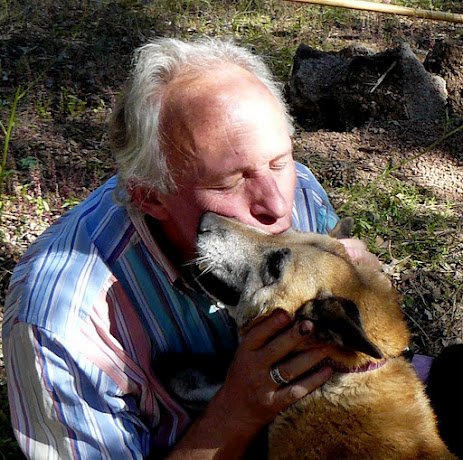
The love between a dog and a human – hugging a dog when one is feeling emotionally vulnerable is beyond measure. Dogs always sense when we humans are feeling fragile and they offer their uncomplicated hearts to us without any condition or need for return. That selfless love is an inspiring example of what we all need to learn to give one another.
Touch and social intimacy – we have so much to learn from dogs when it comes to touch and social intimacy. We are all needy for touch.
Which leads me providentially to a recent item from Terry Hershey. Terry came to Payson in March, 2011 and he was a most inspirational speaker. I have followed him ever since.
Last Monday’s Sabbath Moment included the following story, republished with Terry’s kind permission – the story is all about touch!
Caroline was very sad. Caroline was only six years old and her father had just died. In fact, her father had been assassinated.
Sitting in the back of big black limousine, Caroline Kennedy didn’t quite know what to do with her sadness. On the seat next to her sat her nanny, Maud Shaw, and next to Maud, Caroline’s younger brother John.
Through the windshield Caroline could see her mother, Jackie, and her uncles, Robert and Ted, walking in front of the limousine as it slowly made it’s way down the Boulevard to St. Matthew’s Cathedral. Looking out of her side of the car, Caroline recognized the friendly face of Secret Service agent, Robert Foster. She liked and trusted Robert Foster.
Not knowing what to do with her sadness, and on impulse, she rolled down the window and stuck out her six-year old hand. Agent Foster had a choice to make. Secret Service agents are not allowed to have their hands occupied, needing to be ready for any emergency. But Robert Foster didn’t even think twice. He held Caroline’s hand tightly the entire way to the cathedral.
Later, Agent Foster said it was all he could do to “fight back his own tears of sadness, for little Caroline Kennedy.” When asked about his kindness, he seemed surprised, “All I did was hold a hand,” he answered.
Terry then goes on to say,
We all know sadness. Life breaks for each one of us in different ways and in different places. And sometimes the sadness seems too much to carry.
It requires courage to roll down the window, to connect or ask or invite. For whatever reason, there is a knee-jerk need to deny any sadness, or dismiss it, or apologize for it. “I’m sorry,” people will say, wiping away their tears, as if their sadness is a violation of some tenet of propriety. Heaven forbid if any humanity is exposed.
So sometimes I am afraid to ask. Not sometimes; most times. I don’t want to appear weak. Asking for help is a hard pill to swallow.
I spent Saturday in Clearwater, Florida, with a group talking about intimacy and communication. (Yes, it is easier to talk about than to practice.) Here’s what I told the group.
If we don’t bring it with us, we’re not going to find it there. Which means intimacy–trust, vulnerability, authenticity, honesty–begins here.
With me. With this me.
I was raised in a religious environment that taught me to eradicate my messiness (to quash my sadness or grief or untidiness).
I now believe differently. I now know that we find and express acceptance, love and grace (the place where we can be fully human), in our messy, imperfect, and fully thorny selves. In other words: We can embrace this life–without any need to photoshop it.
To be human is to be vulnerable. I am capable of being wounded and cut and sad… which also means that I am capable of being kind and generous and present.
In such moments of heartache, I can have the courage to ask for a hand to hold.
In such moments of heartache, I can have the courage to hold a hand the needs to be held.
Robert Foster didn’t think twice about holding a hand that needed to be held. And he wasn’t posturing or amassing heavenly brownie points. He was doing what needed to be done.
Here’s the deal: we don’t need more remedies or advice. We need more touch. We become more human when we touch. Why? Because when we touch, we are seen. And when we are seen, we recognize that our value is not tied solely to our sorrow.
And we, you and I, will find no better lesson to learn from our beautiful canine friends, than this lesson of touch.
Well nothing complicated about the definition, is there! If only society was equally motivated by getting to the truth of climate change. Yes, I know I’m being naive!
Why my mini-rant?
I’m well in to James Hansen’s book Storms of my Grandchildren and it’s confirming my fears about the issues that are facing mankind now! But more of that later.
More than two decades after the Intergovernmental Panel on Climate Change (IPCC) began publishing the latest scientific consensus on the globe’s changing climate, widespread doubts persist in the U.S. over whether there really is widespread agreement among scientists. It’s the primary argument of those who deny basic scientific foundations of warming.
But new and innovative survey results suggest the consensus among scientists might actually be stronger than the scientists themselves had thought.
The battles to define and debunk scientific consensus over climate change science have been fought for years. In 2004, University of California San Diego science historian Naomi Oreskes wrote about a broad consensus she found after studying 928 scientific papers published between 1993 and 2003.
But what I found deeply fascinating was that later on Bruce Lieberman, the report’s author, lists in detail the actual levels of agreement compared to the perceived levels. To make it easier to take in, I have amended the telling differences to italic.
In sum, the newly released poll results identified surprisingly common points of agreement among climate scientists; and yet for each point, those scientists underestimated the amount of agreement among their colleagues. The results:
Human activity has been the primary cause of increases in global average air and ocean temperatures in the last 250 years. (About 90 percent of respondents agreed with this characterization, but those respondents estimated that less than 80 percent of their scientist colleagues held that view.)
If governmental policies do not change, the CO2 concentration in the atmosphere will exceed 550 parts per million between 2050 and 2059. (More than 30 percent agreed, but those respondents estimated that just over 20 percent of their peers held that view.)
If and when atmospheric CO2 concentrations reach 550 ppm, the increase in global average surface temperature relative to the year 2000 will be 2-3 degrees Celsius, or 3.2-4.8 F. (More than 40 percent agreed, but those respondents estimated that less than 30 percent held that view.)
If governmental policies do not change, in the year 2050, the increase in global average surface temperature relative to the year 2000 will be 1.5-2 degrees Celsius, or 2.4-3.2 F). (More than 35 percent agreed, but those respondents estimated that just over 30 percent held that view.)
The likelihood that global average sea level will rise more during this century than the highest level given in the 2007 assessment of the IPCC (0.59 meters, 23.2 inches) is more than 90 percent. (More than 30 percent agreed, but those respondents estimated that less than 20 percent held that view.)
Since 1851, the U.S. has experienced an average of six major hurricane landfalls (> 111 mph) per decade. The total number of major hurricane landfalls in the U.S. from 2011-2020 will be seven to eight. (Nearly 60 percent agreed, but those respondents estimated that just over 30 percent held that view.)
The total number of major hurricane landfalls in the U.S. from 2041 to 2050 will be seven to eight. (About 35 percent agreed, but those respondents estimated that less than 30 percent held that view.)
Given increasing levels of human activity, the concentration of CO2 in the atmosphere can be kept below 550 ppm with current technology — but only with changes in government policy. (Nearly 70 percent agreed, but those respondents estimated that just over 50 percent held that view.)
Now back to Hansen’s book. Here’s what Hansen writes starting on p.144,
Getting to the truth!
Sea level rise is one of the two climate impacts that I believe should be at the top of the list that defines what is “dangerous,” on any time scale that humanity can imagine. Ice sheets take thousands of years to build up from snowfall. Reasonable “adaptation” to a large sea level rise is nearly impossible, because once ice sheets begin to rapidly disintegrate, sea level would be continually changing for centuries. Coastal cities would become impractical to maintain.
The other climate change impact at the top of my “dangerous” list is extermination of species. Human activities already have increased the rate of species extinctions far above the natural level. Extinctions are occurring as humans take over more and more of the habitat of animal and plant species. We deforest large regions, replace biologically diverse grasslands and forests with monoculture crops, and introduce foreign, invasive animal and plant species that sometimes wipe out the native ones.
Hansen points out that about a billion people live at elevations less than 25 metres (81 feet).
I included a short video of James Hansen in a Learning from Dogs Post just a few days ago. You’ll find it here – go and watch it – and think about the truth!
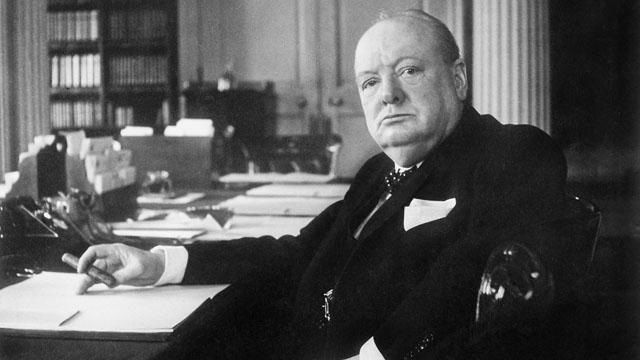
Photo: Winston Churchill, photographed by Cecil Beaton, at 10 Downing Street, London, in 1940.
Men stumble over the truth from time to time, but most pick themselves up and hurry off as if nothing happened.– Winston Churchill
How lady luck brought joy for a ‘down-and-out’ Londoner and a cat called Bob!
I was chatting with my son yesterday and he happened to mention that perhaps I should write about a cat for a change! Alex mentioned a book recently published in the UK called A Street Cat Named Bob: How One Man and His Cat Found Hope on the Streets.
This is how the book is described on Amazon (UK site),
When James Bowen found an injured, ginger street cat curled up in the hallway of his sheltered accommodation, he had no idea just how much his life was about to change. James was living hand to mouth on the streets of London and the last thing he needed was a pet. Yet James couldn’t resist helping the strikingly intelligent tom cat, whom he quickly christened Bob. He slowly nursed Bob back to health and then sent the cat on his way, imagining he would never see him again. But Bob had other ideas. Soon the two were inseparable and their diverse, comic and occasionally dangerous adventures would transform both their lives, slowly healing the scars of each other’s troubled pasts. A Street Cat Named Bob is a moving and uplifting story that will touch the heart of anyone who reads it.
A quick web search found volumes of material, so let’s start with this video,
The local London newspaper the Islington Tribune wrote this back in 2010,
Two cool cats… the Big Issue seller and a stray called Bob
Inseparable: musician James Bowen with Bob
Down-on-his-luck musician teams up with ‘wonderful loyal friend’ he rescued from streets
Published: 24 September, 2010
by PETER GRUNER
NOT since the legendary Dick Whittington has a man and his cat become such unlikely celebrities on the streets of Islington.
Big Issue seller James Bowen and his docile ginger cat Bob, who go everywhere together, have been attracting comments since they first appeared outside Angel Tube station.
The story of how they met – widely reported in blogs on the internet – is one of such extraordinary pathos that it seems only a matter of time before we get a Hollywood film.
James, 31, who lives off Seven Sisters Road, Holloway, is a musician who has fallen on hard times.
He ekes out a basic living selling the homeless people’s magazine Big Issue at Angel and Covent Garden.
Bob was a stray discovered by James outside his accommodation one day.
The cat was limping after apparently being attacked by another animal, possibly a fox.
After failing to discover the cat’s owner, James took him to the RSPCA hospital at Finsbury Park, which prescribed a course of antibiotics.
“I kept him for two weeks until he was well enough to go on his way,” said James. “But when I opened the front door to let him out Bob wouldn’t move. He seemed to me to be saying: ‘I want to stay with you.’
“Now we go everywhere together. I even have a cat harness when we go out and Bob gets really excited when I show it to him.”
Read the rest of the article here and if you want more information, a web search on Bob the Cat will finds loads more.
It’s a fabulous story with a great message of hope for not just for James and Bob but for all of us that find ourselves ‘up a creek without a paddle’ at points in our lives.
Here’s how the newspaper The Daily Mail wrote about it on their website,
[last half of the story]
But then Bob started following him and it became increasingly difficult to shoo him away, especially as there were dangerous roads to be crossed. One day there was nothing for it but to put Bob on a makeshift lead and take him along. Bob travelled sitting on James’s shoulders.
The trouble was, so many cat-mad passers-by stopped him to stroke the animal that James arrived late at his pitch, secretly cursing Bob for thereby costing him some of his usual £25-a-day takings. He couldn’t have been more wrong.
Within minutes, people who would normally have walked by without giving James a second glance were lingering to make a fuss of the cat sitting sedately in his guitar case, and most made a donation. By the end of the day, he’d racked up more than £60.
It was the beginning of a phenomenon as tourists and commuters befriended Bob and James, many bringing titbits for the cat. People were amazed at how placidly Bob would sit all day, quite happily watching the world go by while James earned a living. Not that it was always without a hitch; on a couple of occasions Bob bolted when startled, leading to a frantic chase through the crowded streets.
Bob’s popularity continued when James switched from busking to selling the Big Issue, the magazine produced and sold by homeless people. This change in direction was part of James’s growing sense of a need to get his life in order, which he puts down to the responsibility of looking after Bob, and the example the cat offered of the possibility of a second chance.
It enabled James to make the final push to end his drug dependency, going through the necessary cold turkey to get off heroin substitutes, and to mend broken contacts with his family. The final result of Bob’s influence came when a literary agent who passed the duo every day and had seen them on YouTube suggested James tell their story in a book. The result is this heart-warming tale with a message of hope that will appeal especially to the many cat obsessives out there.
A discovery of some writing from the past triggers memories.
Way back on the 15th November, 2009, I wrote a post about single-handed sailing and how it caused me much disquiet. Rather than just leave you with a link to that reflection, I’m going to include the post again, below. The reason is that a few days ago, in looking through some of my earlier writings in conjunction with a writing group that Jean and I belong to, I came across a piece that I wrote following a solo voyage from Larnaca in Cyprus, west along the Mediterranean Sea and then out over the Atlantic from Gibraltar to Horta on the island of Faial in the Azores. That last leg was a little over 1,100 nautical miles (1,300 land miles) and took me eight days.
So first here’s that earlier post from 2009.
A personal reflection on this rather strange way of travelling!
The recent Post about young Jessica Watson sailing alone around the world raised a few comments but also reminded me of my own experiences of solo sailing.
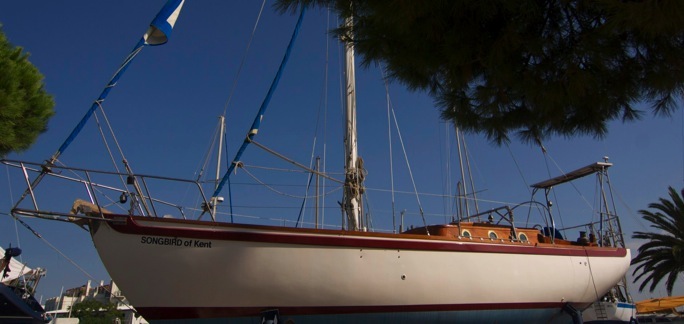
Some years ago, having successfully sold my own IT company, I warmed to the idea of being a full-time yachtie! A second-hand Tradewind 33 was discovered on the Island of Corfu. (Now here’s a surprise! I was just browsing the web looking for a picture of a Tradewind and came across my old yacht currently up for sale. Her name is Songbird of Kent! Picture below.)
Tradewind 33 - Songbird of Kent
Anyway, the deal was done and having sold my house in England I flew out to Corfu to collect Songbird of Kent. Inevitably it was a number of months before the boat was ready to head out into the Mediterranean but in early Spring 1988 it was time to explore the long coastlines of Greece and Turkey.
After a fantastic summer cruising from one idyllic anchorage to another mostly with friends or family on board, it was time to find a winter haven. Many recommended Larnaca Marina in Cyprus. Thus it was late in the summer of 1988 that I said goodbye to friends and set out on my own to cross from Antalya in Turkey to Cyprus and along the South coast of Cyprus to Larnaca, on the SE side of the island.
That sea crossing, a little over 200 nautical miles, was to become a regular solo experience at the start and end of each summer season. Impossible to do in a single day thus it always included a night at sea and rarely, if things didn’t go well with the weather, a couple of nights. I hated it! Maybe it was the sudden transition from coastal sailing to a deep water crossing, often going from having friends on board to being alone, but whatever it was I never enjoyed my time on my own and knew that long-distance solo sailing was never going to be my scene.
Anyway, I ended up spending several very happy winters in Larnaca.
One time, there was news of a Frenchman who had come into Larnaca on his way home to France having nearly completed a circumnavigation of the world. He was on his own!
I was astounded to hear how someone could do this and made a point of calling round to his berth. The boat was a beautiful, solid steel yacht, the very epitome of a craft that could challenge the oceans. The owner’s name was Pierre (it would be!). Pierre invited me aboard and we went down to his saloon to drink a hot coffee – real French coffee!
Inevitably the conversation turned to the challenges of sailing alone. Pierre said that the big cargo ships at sea moved quickly relative to the speed of a yacht so at night he set an alarm for every 15 minutes. That was the time that a ship could go from being hull down over the horizon to being close enough to be a hazard. Thus while at sea Pierre got up briefly every 15 minutes during the night to avoid being run down! It sounded totally exhausting.
Then Pierre asked me about the sailing I had done and whether I had sailed on my own. I declared my trivial journeys back and forth from Cyprus to Turkey and revealed that being on my own made me very, very unhappy. Pierre was surprised to hear that as he admitted that being at sea alone was one of the most tranquil and peaceful experiences ever. Pierre asked how long these solo journeys took. I replied, two or three days.
“Ah!”, he said, “That is the problem.” “I, too, hate the three days. It is always a period where you adjust and it is terrible.“
“My friend, you must find a way to be alone for more than three days. You will see that it is very different.“
It was some years before that opportunity came about but, in the end, I did undertake a solo journey of 8 days. Pierre was right. The first three days were hell, the rest were heaven!
Thank you, Songbird of Kent, you gave me some fabulous memories!
By Paul Handover
Now on to my writings about being out at sea alone on a small yacht.
Being at Sea
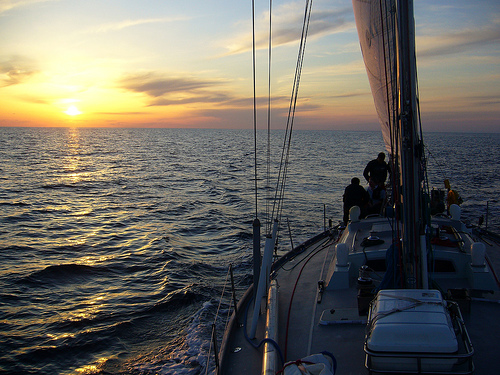
Going to sea in a small vessel is a profound experience.
In harbour we build up a reliance on things external. We have no need to worry if there is insufficient food on board, we can plug into the dockside power supply, sleep through the night undisturbed and we can wander off and enjoy the company of others if the boat feels a little claustrophobic.
Then slowly, imperceptibly, but with huge force, arrives the need to move on. The realisation that our cosy life connected to the busy, bustling and self-obsessed world of shoreside is not fulfilling our search for adventure and for the truths that lay over the horizon. It is time to leave.
The act of casting off is always exciting as it heralds a new adventure. But it also carries feelings of loss and apprehension as one lets go of the bonds of a previous certainty. The first few hours are filled with the workload of getting one’s craft shipshape and battened down for the unknown seas. Then gradually comes the realisation that the land is now less the dominating visual feature than the vastness of the seascape that is ahead. But with the land in sight, albeit a distant horizon behind one, you can still sense the life you are leaving.
Now all that surrounds you is the sea. You are now truly disconnected from the land. It is often at this point that despondency and uncertainty play with your mind; after all this new life is still very unfamiliar compared to the warmth of that island home that still resonates in your heart. Time to remind yourself of why you wanted to take this voyage.
A small boat is very fragile. Just a centimetre of hull separating you from the unimaginable depths of the ocean beneath your keel. Not until the end of your voyage, when you draw your boat up, metaphorically on to that beach, will you ever stop feeling how close fate is, how it rides on your shoulder night and day. That, of course, is why we go to sea. It is the place where we taste life, where we savour each moment of the present because the future seems too bound up in the mystery, the uncertainty of the ocean. You are in charge of your tiny craft. Your survival depends on how you manage your small ship, how you navigate these seas, how you read the weather ahead and avoid the storms.
Soon your life on the ocean becomes everything to you. You have time to reflect on so much that is left behind. The distance seems to dissolve all the nuisances, bring into focus all the things that are important to you. There is no certainty with the ocean apart from the knowledge that you are very small and very, very vulnerable and yet, in a sense, also so strong.
In the end, we have to break away from our insecurities and our emotional dependencies on external people and situations because, without that, we are never able to command our own life and the destiny that flows from that captaincy. There is a real strength in knowing ourselves as we would know our own boat. If we really know every spar, sail, rope and fitting, if we have real understanding of the strengths and weaknesses of our small vessel then we are able to know when to breast the waves or when to turn and run before the storm. We are secure that our small craft will protect us day and night.
Thus self-knowledge gives us the same freedom to manage our lives, to know when to fight and when to turn away. And just as after every long voyage the boat will need hours of careful maintenance so our own souls need regular love and caring from our spiritual keeper.
It was called “the most influential environmental photograph ever taken.” Rightly so!
Those words were spoken by the late Galen Rowell, the famous Californian wilderness photographer, commenting about the Earthrise photograph taken from Apollo 8 on December 24th, 1968 during the first manned mission to the Moon.
No one who saw that picture of the planet we all live on could fail to be moved. Indeed, none more so than onboard NASA astronaut Frank Borman who uttered the words as the Earth rose above the horizon of the moon, “Oh my God! Look at that picture over there! Here’s the Earth coming up. Wow, is that pretty.” It was fellow Apollo 8 crew-member, Bill Anders, who then took the ‘unscheduled’ photograph.
Who hasn’t gazed into a night sky and been lost in the beauty above our heads. Or felt the wind, flowing across our ancient lands, kiss our face. We stand so mite-like, so insignificant in all this immensity of creation. Our planet is ‘pretty’. Indeed, Planet Earth is good, beautiful, and so precious to life. Life that arose in just a fraction of time after our Solar System formed 3.7 billion years ago; the oldest traces of life have been found in fossils dating back 3.4 billion years. Our miracle of life.
But the one thing we cannot do is to take that miracle of life for granted. Here’s a perspective on that. Just a couple of months after that famous Earthrise photograph, in February 1969, America’s National Oceanic and Atmospheric Administration (NOAA) recorded the level of CO2 in the Earth’s atmosphere as 324.42 parts per million (PPM).
From 43 years ago we fast forward to February of 2012. NOAA now recorded that CO2 level as 393.65 PPM, some 21% higher than the 1969 level, but even more importantly over 12% higher than the figure of 350 PPM which is regarded by climate scientists as the maximum safe level for our Planet. And the trend upwards is steepening. Not just for CO2 but also for Methane and Nitrous Oxide which have the potential to be incredibly more damaging to our beautiful planet than CO2.
Across the face of the world people are waking up to the fact that something has to be done. While some Governments and many industries are providing great leadership, the complexities of these modern institutions means that progress is slow; far too slow. People are now taking action for themselves and for their communities.
The most notable group is the worldwide Transition Movement. It started in the UK in September 2006, indeed started in the town of Totnes, Devon, just three miles from where I used to live.
Less than 6 years later across the world there are 975 initiatives! Including nearly 500 Transition Communities in Europe and 392 in the UK.
In the USA, there are a staggering 285 initiatives with 26 in California and three here in Arizona: Tucson, Pima and and East Valley in Phoenix ‘mulling’ it over. The ideas behind the Transition concept are powerfully simple and can be easily summarised thus:
That it is inevitable that our lives will soon have to adapt to a dramatically lower energy consumption, especially carbon-based energy, and that it’s better to plan for it than to be taken by surprise.
That the over-whelming majority of communities, currently lacks resilience.
That we have to act now to rebuild our community resilience and prepare for life without fossil fuels.
That by tapping into the collective potential of the community, it is possible to develop new ways of living that are nourishing, fulfilling and ecologically sustainable.
Reduce our energy use, increase our resilience, switch away from carbon-based fuels and go back to the strength of communities. No mystery about what to do!
We do not have another 43 years. Indeed, some say we are very close to the tipping point of runaway climate consequences.
My message for this Earth Day and, indeed, for every day of the rest of our lives.
The Western Arctic Reserve, also known as the National Petroleum Reserve-Alaska, is the largest tract of unprotected, relatively pristine public land in the United States. But Big Oil has the reserve in its sights and will not hesitate to turn this vast wilderness into a sprawling industrial complex to drum up massive profits.
The 23.5 million-acre reserve is home to imperiled polar bears, seabirds and one of the densest populations of nesting raptors in the world. Its shores and lagoons harbor beluga whales, seals, walruses and other marine mammals.
In the rapidly warming Arctic, short-sighted oil and gas development will further stress the remarkable wildlife that lives and breeds there.The Bureau of Land Management (BLM) is now collecting comments on a planning document that will set the stage for oil and gas leasing in the western Arctic for decades to come.
You can help save this national treasure: Take action to tell the BLM to protect the Western Arctic Reserve from dirty fossil fuel development.
The action that is requested is to email or mail the following to the BLM (the link is here.) The email address for Bob Abbey, taken from the relevant BLM webpage is Director: Bob Abbey E-mail: Director@blm.gov
Director Bob Abbey
Bureau of Land Management
NPR-A IAP/EIS Comments, AECOM Project Office
1835 South Bragaw Street, Suite 490
Anchorage, AK 99508
US
Subject: Comments Regarding the BLM’s National Petroleum Reserve-Alaska Integrated Activity, DEIS
The National Petroleum Reserve-Alaska, or Western Arctic Reserve, comprises the largest unprotected tract of public land in the United States. It provides habitat for a wide variety of Arctic species, and its wilderness values are second to none. While the most environmentally protective alternative analyzed by the Bureau of Land Management (Alternative B) is an improvement over previous plans, it still allows over 11 million acres of ecologically intact wilderness-quality lands to be leased for oil development. As the BLM develops the “integrated activity plan” and “final environmental impact statement” for the reserve, I urge you to provide maximum protection for areas with high-value habitats by designating all of the Special Area contained in Alternative B, and to create additional protections for all other areas in the reserve that contain ecologically intact and/or wilderness-quality lands.
The BLM must also consider the long-term impacts of greenhouse gas emissions from oil and gas development, and any future impacts of climate change on the low-lying western Arctic. Arctic animals are already stressed by a melting and warming Arctic, and none of the alternatives considered go far enough to protect these species from the wide array of impacts from oil and gas development.
Among other things, the BLM must account for sea-level rise due to ice melt, permafrost collapse, coastal erosion and increased high-energy storm events that will degrade, or wipe out, critical coastal habitat, including the Teshekpuk Lake area. The BLM must also consider the impacts of ocean acidification, changes in circulation, increased freshening due to sea ice melt, and shifts in productivity to the marine environment and to marine species, including polar bears, ice seals, walruses, bowhead whales, and beluga whales.
Congress has required that “maximum protection” be given to Special Areas in the reserve. I encourage the BLM to adopt an alternative that provides protections for these areas, which include Teshekpuk Lake, the Colville River, Kasegaluk Lagoon, and the Utukok River Uplands. The BLM must also protect the Dease Inlet-Meade River area, Peard Bay and adjacent wetlands, and the Ikpikpuk River and adjacent wetlands.
I implore the BLM to adopt a management alternative that includes the strongest possible protections for the Western Arctic Reserve. This means designating Alternative B as the preferred alternative, and adding additional protective measures for important wildlife habitat and wilderness areas so they are not destroyed by ecologically devastating oil and gas development, or from the long-term impacts of greenhouse gas emissions and climate change.
Thank you.
But if that doesn’t work then there is a full webpage offering detailed information and which also has links relevant to letting the BLM know your views. That webpage starts,
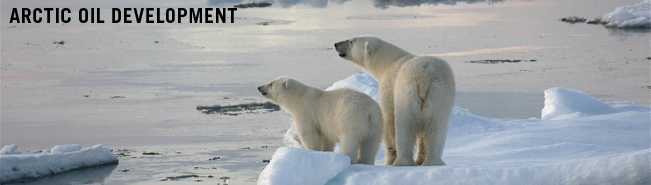
ARCTIC OIL DEVELOPMENT
Alaska’s north coast and ocean waters are teeming with species found in few other places, and many of them are now under threat. The Western Arctic Reserve and the Arctic National Wildlife Refuge provide critical denning areas for polar bears, support vast caribou herds and are essential nesting grounds for thousands of bird species, including threatened eiders and yellow-billed loons. The sea ice of the Arctic Ocean is hunting and denning habitat for polar bears and a foraging platform for Pacific walrus and numerous Arctic ice seal species. Under the sea ice, endangeredbowhead whales and other whale species live off the biological richness of the Arctic Ocean.
Nearly all Arctic species are at risk from global warming. But that’s not the only problem: In a drastically changing environment, Arctic species must now contend with dirty, industrial fossil fuel development.
Please go here, read the the full information and do your little bit. It all makes a difference.
If you eat food, and hope to do so in the future, read this!
I subscribe to Food Freedom News and often read their articles when they appear in my ‘in-box’. Especially so yesterday morning when the headline jumped off the ‘page’ at me: Autism and Disappearing Bees: A Common Denominator?
So, in a sense, hand-in-hand with the article in yesterday’s Learning from DogsFood, glorious food! Because if trying to feed 9 billion people living on a planet where ‘farmers holding seeds that won’t sprout‘ means the even greater use of chemicals then ….. then, I don’t know what!
The Food Freedom website showed that the article came from Brian Moench of the Common Dreams website. Not a website I had come across before but one that quickly impressed me!
A few days ago the Salt Lake Tribune’s front page headline declared, “Highest rate in the nation, 1 in 32 Utah boys has autism.” This is a national public health emergency, whose epicenter is Utah, Gov. Herbert. A more obscure story on the same day read: “New pesticides linked to bee population collapse.” If you eat food, and hope to do so in the future, this is another national emergency, Pres. Obama. A common denominator may underlie both headlines.
A honeybee pollinates a flower in a citrus grove just coming into blossom. (Photograph: David Silverman/Getty Images)
A Stanford University study with 192 pairs of twins, with one twin autistic and one not, found that genetics accounts for 38% of the risk of autism, and environmental factors account for 62%.
Supporting an environmental/genetic tag team are other studies showing autistic children and their mothers have a high rate of a genetic deficiency in the production of glutathione, an anti-oxidant and the body’s primary means of detoxifying heavy metals. High levels of toxic metals in children are strongly correlated with the severity of autism. Low levels of glutathione, coupled with high production of another chemical, homocysteine, increase the chance of a mother having an autistic child to one in three. That autism is four times more common among boys than girls is likely related to a defect in the single male X chromosome contributing to anti-oxidant deficiency. There is no such thing as a genetic disease epidemic because genes don’t change that quickly. So the alarming rise in autism must be the result of increased environmental exposures that exploit these genetic defects.
During the critical first three months of gestation a human embryo adds 250,000 brain cells per minute reaching 200 billion by the fifth month. There is no chemical elixir that improves this biologic miracle, but thousands of toxic substances can cross the placenta and impair that process, leaving brain cells stressed, inflamed, less well developed, fewer in number and with fewer connections with each other all of which diminish brain function. The opportunity to repair the resulting deficits later on is limited.
The list of autism’s environmental suspects is long and comes from many studies that show higher rates of autism with greater exposure to flame retardants, plasticizers like BPA, pesticides, endocrine disruptors in personal care products, heavy metals in air pollution, mercury, and pharmaceuticals like anti-depressants. [my emphasis] (Utah’s highest in the nation autism rates are matched by the highest rates of anti-depressant use and the highest mercury levels in the country in the Great Salt Lake).
Doctors have long advised women during pregnancy to avoid any unnecessary consumption of drugs or chemicals. But as participants in modern society we are all now exposed to over 83,000 chemicals from the food we eat, the water we drink, the air we breathe and the consumer products we use. Pregnant women and their children have 100 times more chemical exposures today than 50 years ago. The average newborn has over 200 different chemicals and heavy metals contaminating its blood when it takes its first breath. 158 of them are toxic to the brain. Little wonder that rates of autism, attention deficit and behavioral disorders are all on the rise.
How does this relate to vanishing bees and our food supply? Two new studies, published simultaneously in the journal Science, show that the rapid rise in use of insecticides is likely responsible for the mass disappearance of bee populations. The world’s food chain hangs in the balance because 90% of native plants require pollinators to survive.
The brain of insects is the intended target of these insecticides. They disrupt the bees homing behavior and their ability to return to the hive, kind of like “bee autism.” But insects are different than humans, right? Human and insect nerve cells share the same basic biologic infrastructure. Chemicals that interrupt electrical impulses in insect nerves will do the same to humans. But humans are much bigger than insects and the doses to humans are miniscule, right?
During critical first trimester development a human is no bigger than an insect so there is every reason to believe that pesticides could wreak havoc with the developing brain of a human embryo. But human embryos aren’t out in corn fields being sprayed with insecticides, are they? A recent study showed that every human tested had the world’s best selling pesticide, Roundup, detectable in their urine at concentrations between five and twenty times the level considered safe for drinking water.
The autism epidemic and disappearing bees are real public health emergencies created by allowing our world to be overwhelmed by environmental toxins. Environmental protection is human protection, especially for the smallest and most vulnerable among us.
Please bring this to the notice of any couples who you know are planning for a family!
If all this sort of information makes you want to curl up and kiss your backside goodnight, then hold on. Next week I hope to publish a summary of a fascinating presentation given to a local women’s group here in Payson that shows the many obvious and easy steps we can all take to revert back to a resilient life on this planet.
An interesting reflection on the rearing of cattle and an ‘Anti-Meat pill! No kidding!
I was vaguely aware of the contribution of cattle towards the overall rise in greenhouse gases. A very quick web search found this news item from the United Nations which included,
29 November 2006 – Cattle-rearing generates more global warming greenhouse gases, as measured in CO2 equivalent, than transportation, and smarter production methods, including improved animal diets to reduce enteric fermentation and consequent methane emissions, are urgently needed, according to a new United Nations report released today.
“Livestock are one of the most significant contributors to today’s most serious environmental problems,” senior UN Food and Agriculture Organization (FAO) official Henning Steinfeld said. “Urgent action is required to remedy the situation.”
But what prompted me to look a little closer at this was a recent article on the Big Think website that was entitled, The Anti-Meat Pill: Human Engineering to Combat Climate Change.
Let me quote a little from the article, presented on the Big Think website by Daniel Honan.
NYU Bio-ethicist Matthew Liao has caused a stir recently with a forthcoming paper that explores the biomedical modification of humans in order to stop us from consuming red meat.
and a paragraph later continued with,
In a forthcoming paper to be published in Ethics, Policy and the Environment, Liao suggests that humans might take pills to bring about mild nausea to rid ourselves of our appetite for red meat. This would have a mitigating effect on climate change, he argues.
Liao refers to studies such as a widely-sited UN report that estimates 18 percent of greenhouse emissions come from livestock, which is a higher share than transportation. Another report, from 2009, estimates livestock emissions are significantly higher, at 50 percent. Fact of life: cows fart. Other negative impacts of increased livestock farming includes deforestation and a drain on water supplies.
The Internet rapidly found Matthew Liao’s website and from there the paper referred to above, which is introduced thus,
Professor Matthew Liao of New York University
Anthropogenic climate change is arguably one of the biggest problems that confront us today. There is ample evidence that climate change is likely to affect adversely many aspects of life for all people around the world, and that existing solutions such as geoengineering might be too risky and ordinary behavioural and market solutions might not be sufficient to mitigate climate change. In this paper, we consider a new kind of solution to climate change, what we call human engineering, which involves biomedical modifications of humans so that they can mitigate and/or adapt to climate change. We argue that human engineering is potentially less risky than geoengineering and that it could help behavioural and market solutions succeed in mitigating climate change. We also consider some possible ethical concerns regarding human engineering such as its safety, the implications of human engineering for our children and for the society, and we argue that these concerns can be addressed. Our upshot is that human engineering deserves further consideration in the debate about climate change.
Now if we go back to that UN article, we can see that emissions from cattle and livestock in general is not a minor issue.
When emissions from land use and land use change are included, the livestock sector accounts for 9 per cent of CO2 deriving from human-related activities, but produces a much larger share of even more harmful greenhouse gases. It generates 65 per cent of human-related nitrous oxide, which has 296 times the Global Warming Potential (GWP) of CO2. Most of this comes from manure.
And it accounts for respectively 37 per cent of all human-induced methane (23 times as warming as CO2), which is largely produced by the digestive system of ruminants, and 64 per cent of ammonia, which contributes significantly to acid rain.
With increased prosperity, people are consuming more meat and dairy products every year, the report notes. Global meat production is projected to more than double from 229 million tonnes in 1999/2001 to 465 million tonnes in 2050, while milk output is set to climb from 580 to 1043 million tonnes.
But modifying humans, frankly, misses the point.
That is unless we wholeheartedly embrace the need to change, to sustain the only planet we can call home, and do it because we care, Planet Earth will do the bioengineering for us – engineering us into extinction. For example, just cut back on eating meat! And if you don’t want to do it for the planet, do it for the health of your children as this Health Petition underlines in spades.
So I’m sorry Professor Liao but this seems like a step too far – by a long way.









 Learning from Dogs