Next Monday, the 21st September, is going to be the most important day this year. No! The most important day ever!
Because next Monday is the date of the People’s Climate March in New York. It is predicted to be the largest climate march in history. Well over 100,000 are expected to attend. I shall write more about this event during the coming week.
But also the 21st September will be International Day of Peace. That coincidence strikes me as highly significant. For a world at peace would cause the most massive reduction in our use of carbon-based fuels.
Thus without any embarrassment, I intend to republish in full [Ed: but see my comment] a recent item on the Permaculture News website: Seven Reasons Why World Peace is Possible.
Do I mention dogs? Read through to the end to find out! (Probably not difficult to guess the answer!)
ooOOoo
Seven Reasons Why World Peace is Possible
Introduction
The 21st of September will be International Day of Peace. It may seem a little premature to declare that world peace is due to break out by the end this month. I do not deny that the amount of killing and death and war and torture and death and coercion and abuse and death all over everywhere can be overwhelming. Nor do I deny that considering this, it is a natural assumption to believe people are sinners, destined for extinction. However, I do argue that compassion is as much a part of human nature as cruelty.
There is evidence that humankind did not always live violent lives. In fact, I assume most people reading this article are not habitually violent, and do not desire to watch someone suffer. All animals have the capacity to enrich the lives of others. We have the capacity to be both selfish and kind. What matters is which quality we chose to focus on; bringing that quality into focus within ourselves, the world, and our children.
Here I have collected an array of research demonstrating that there is a positive potential within each social group and person. I argue that humans can learn to build societies which are not founded on the expectation of organised violence. Here are seven reasons why world peace is possible. You won’t believe your own strength of belief: There is at least some hope.
The balance of this powerful and fascinating article may be read here.
ooOOoo
How many links did you follow? Most of them are wonderful links to organisations that many readers, including me, may not have come across before.
So to close.
I was about half-way through arranging today’s post when I realised that dogs have evolved without the need to have their own police forces or armies. It’s not as silly as it first sounds. Of course, dogs fight and some fights can be brutal and, occasionally, fatal to one or more of the participants. But they have a keen sense of their locality, of their tribal space; so to speak. Even as domestic animals, they are fiercely protective of what is their own place. Before dogs were domesticated, like the wolves from whence dogs evolved, the pack size was around fifty animals with just three animals having any form of status; something that has been mentioned many times before in this place.
The point is that dogs are creatures that have evolved to live in a local community and to live peacefully; by and large. My sense is that ancient man also evolved to be most complete within a community environment.
This is the end of the era of huge federal and national social constructions.
We must return to locally run and managed communities, which is the pathway to peace across this planet.
To awaken one’s true self, one must awaken the entire world.
As you may gather from the sub-heading above, this is not a typical post today! (If there is a typical post in this place!) In fact, I think this is the first time in over five years of publishing Learning from Dogs that I have devoted a post solely to a full-length film.
But the film so perfectly picks up the theme of yesterday’s post, Quietening one’s self down, that it was too good an opportunity to miss.
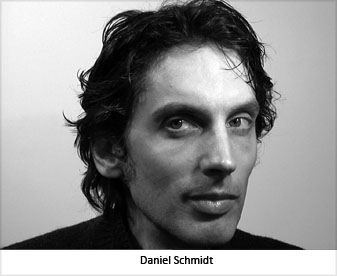
Inner Worlds was created by Canadian film maker, musician and meditation teacher Daniel Schmidt. The film could be described as the external reflection of his own adventures in meditation. As Daniel came to meditative insights, he realized that these same insights were discovered over and over in spiritual traditions around the world and that all traditions share a common mystical underpinning.
He realized that it is this core experience that connects us not only to the mysterious source of all creation, but to each other as well. Along with his wife Eva, Daniel currently lives in a log home tucked away in a forest of tall pine trees located in Ontario, Canada. It is in this beautiful setting where they run a meditation and yoga center called Breathe True Yoga www.breathetrue.com.
Daniel has studied meditation from the traditions of Buddhism, Taoism, the Yogic traditions of India, as well as the mystical traditions of various cultures, and has come to his own teaching method helping point people towards their own inner wisdom and knowledge. “Meditation is not so much a technique to master as it is a re-orientation of the heart; a selfless act of love and surrender into the mystery and stillness at the core of our being“.
Daniel has always had a strong life connection with sound and music. He has been a composer for over 20 years with an extensive library of music venturing into many genres and styles, and he is the President and CEO of REM Publishing Ltd. Music is not something to be comprehended merely with the hearing faculty. The vibratory nature of the universe is understood when we recognize that everything is music.
Eva has studied and teaches chakra yoga, hatha yoga, meditation and healing through expressive arts. She has integrated yogic traditions from around the world and attended the Pyramid Yoga Center in Thailand for extensive yoga training. Eva is a sound healer, artist and was a strong creative force in the editing room as “Inner Worlds” was being created. Together Dan and Eva were the Shiva and Shakti forces that birthed the film into the world.
It became clear during the making of the film that Inner Worlds Outer Worlds had to be released for free for the benefit of all beings. In the ancient traditions the dharma or “the truth” was always taught freely and never for personal gain or profit in order to preserve the purity of the teachings. It is Daniel and Eva’s belief that to awaken one’s true self, one must awaken the entire world. Daniel and Eva have started the Awaken the World initiative www.awakentheworld.com to bring the ancient knowledge back to the earth in order to restore balance and harmony on the planet.
If you want to dip into the film then here’s the trailer.
But many, including Jean and me, will want to watch the full film.
The website Top Documentary Filmsoffers this summary (the links below will take you to other films on meditation):
Inner Worlds could be described as the external reflection of Daniel Schmidt’s own adventures in meditation.
Akasha is the unmanifested, the “nothing” or emptiness which fills the vacuum of space. As Einstein realized, empty space is not really empty. Saints, sages and yogis who have looked within themselves have also realized that within the emptiness is unfathomable power, a web of information or energy which connects all things.
The Spiral. The Pythagorean philosopher Plato hinted enigmatically that there was a golden key that unified all of the mysteries of the universe. The golden key is the intelligence of the logos, the source of the primordial om. One could say that it is the mind of God. The source of this divine symmetry is the greatest mystery of our existence.
The Serpent and the Lotus. The spiral has often been represented by the snake, the downward current, while the bird or blooming lotus flower has represented the upward current or transcendence.The ancient traditions taught that a human being can become a bridge extending from the outer to the inner, from gross to subtle, from the lower chakras to the higher chakras.
Beyond Thinking. Life, liberty and the pursuit of happiness. We live our lives pursuing happiness “out there” as if it is a commodity. We have become slaves to our own desires and craving. Happiness isn’t something that can be pursued or purchased like a cheap suit.
There was a wonderful reader reaction to yesterday’s post and it seemed so utterly appropriate to repost something back from November, 2012. Simply because it underscores the reasons why if anyone is looking for a dog, to please consider a rescue dog first.
oooo
More on the beautiful and inspiring ways of the dog.
(First posted on the 20th November, 2012.)
Back at the beginning of July, I wrote a post about Jasmine. Jasmine was a rescue dog that turned out to be a natural ‘Mother hen’. That post was called Letting go; a dog lesson and, as the post explains, “Jasmine was truly one of a kind. She mothered many of the sanctuary’s residents back to health including Bramble the roe deer, Humbug the badger and two of the other sanctuary dogs, just to mention a few.”
But, guess what? More evidence of the benefits of having a dog in your life (or in our case make that 10 dogs!). [Ed. Now 9 dogs.]
Babies who spend time around pet dogs have fewer ear infections and respiratory ailments than those whose homes are animal-free, reported a study.
The study, published in the US journal Pediatrics, did not say why but suggested that being around a dog that spends at least part of its day outdoors may boost a child’s immune system in the first year of life.
Cats, too, seemed to convey some protection to babies, though the effect observed was weaker than with dogs.
The article goes on to say,
The research was based on 397 children in Finland whose parents made diary entries each week recording the state of their child’s health during the infant’s first year, from nine weeks to 52 weeks of age.
Overall, babies in homes with cats or dogs were about 30 percent less likely to have respiratory infectious symptoms — which included cough, wheezing, rhinitis (stuffy or runny nose) and fever — and about half as likely to get ear infections.
And concludes,
The most protective association was seen in children who had a dog inside at home for up to six hours a day, compared to children who did not have any dogs or who had dogs that were always outside.
“We offer preliminary evidence that dog ownership may be protective against respiratory tract infections during the first year of life,” said the study.
“We speculate that animal contacts could help to mature the immunologic system, leading to more composed immunologic response and shorter duration of infections.”
The improvement was significant, even after researchers ruled out other factors that could boost infection risk, such as not having been breastfed, attending daycare, being raised by smokers or parents with asthma, or having older siblings in the household.
In addition to having less frequent ear infections and respiratory infections, babies near dogs tended to need fewer courses of antibiotics compared to those who were reared in pet-free households, it said.
Previous research has shown conflicting results, with some studies finding no benefit for young children being around furry pets and others finding that animal contact appears to offer some protection against colds and stomach ailments.
The study authors said their research differs from previous analyses because it focuses solely on the first postnatal year and does not include older children.
I’m delighted to announce a new feature for Learning from Dogs, a feature that will be close to many of your hearts; of that there is no doubt.
The background.
Those who have been long-term readers of this place will have been aware that Jean and I first met in San Carlos, Mexico in December, 2007. The result of a very generous invitation from Suzann and Don Reeve for me to spend Christmas with them. Suzann being the sister of Californian, Dan Gomez, whom I have regarded as a close friend for over 35 years. I have known Suzann and Don for nearly the same time.
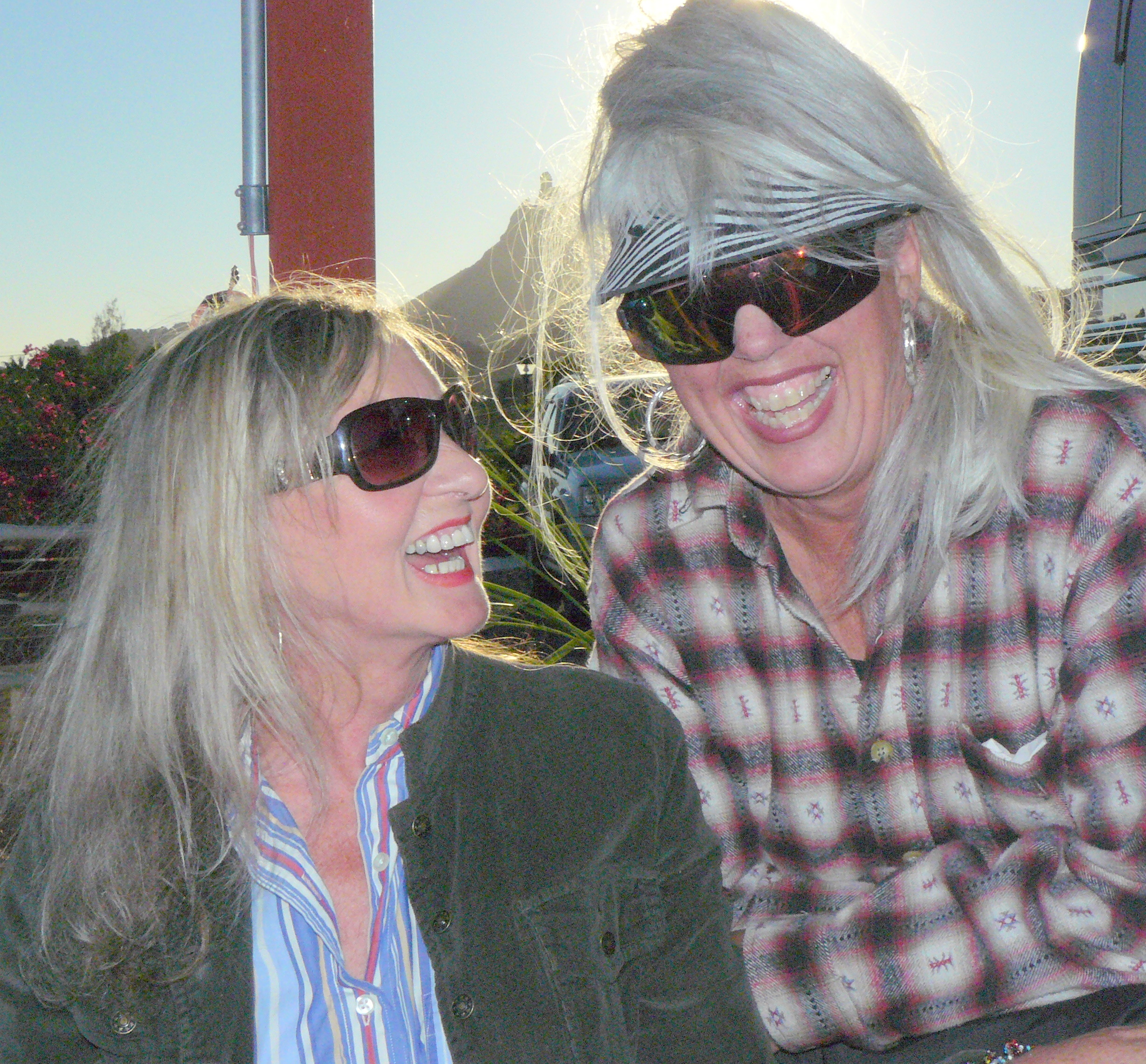
Suzann and Jean, Mexico, December, 2007.
Anyway, long before I came on the scene, Suzann and Jean had been working together caring for the countless feral street dogs that roam so many Mexican streets. In many cases that caring included finding new, loving homes for them in the USA. When Jean and I moved away from San Carlos in 2010, eventually ending up here in Southern Oregon almost 2 years ago, Suzann didn’t hesitate to continue caring for these Mexican dogs and, wherever possible, finding new homes for them.
Thus came the idea of promoting a wonderful dog ready for a new home here on Learning from Dogs. Who knows, maybe a reader somewhere may know of a family or a person looking for a dog and as a recent post highlighted, rescued dogs are life-savers.
Suzann caring for a feral Mexican street dog.
Thus starting today I will be promoting a particular dog that Su has sent me the details of and, hopefully, we can keep promoting a new dog every two weeks or so.
oooo
Diamonte
by Suzann Reeve
Diamonte
Each day I travel to La Manga, a part of San Carlos, Mexico, to feed at least a dozen dogs, frequently more; plus two old men every day! I need to stop off at the market several times a week for food for both species!
One day, about five weeks ago, I happened to see a Mommy dog and her teenaged pup in the middle of the road. I got out of my car and called them over, hoping they would get clear of the flow of traffic. Thankfully that happened and they quickly came close to take advantage of a bowl of food and some water that I put in front of them. It was wonderful to see the mother move away so her pup could eat first.
A few days later I returned and was delighted to see the mother and puppy again. Once more I put down food and water and, again, the mother dog held back to let her puppy feed before her.
Several days later, yes, you guessed it! Once more I put out food and water, although this time I never actually saw Momma dog eat.
A further two weeks went by before I saw them both. But this time, Momma dog was not well. She crept over to lay under a car while her daughter ate the food I put out. Then a few days after noticing the unwell mother dog, I returned and knew there was a problem. There was a message I was picking up from the mother dog. She seemed to be saying to me that she wanted me to take her puppy. So I did.
I picked up the young puppy and put her in my car. As I did so, Momma dog slowly lifted herself up, went over to my car, sniffed one door and then went around to the other side and sniffed that other door. She then looked at me as if to say thank you.
Momma dog then wandered off and lay down in the shade on the other side of the door, never eating a thing. She watched me drive out of the parking lot and I have never seen her there again.
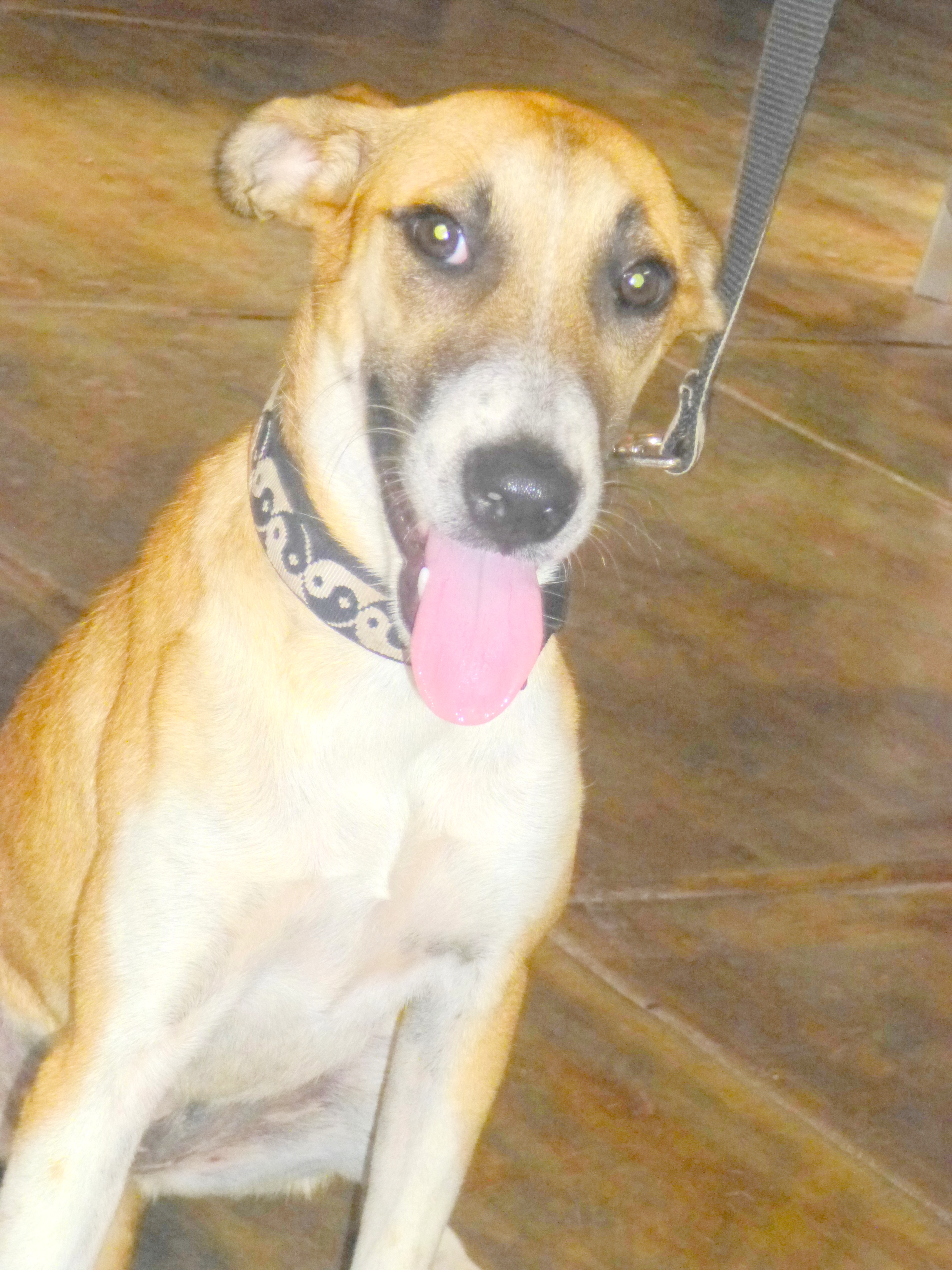
Who could resist such a lovely open, happy face! Please find a home for Diamonte.
Diamonte is a happy, bouncy little girl, presently at about 30 lbs and my guess is that she will be around 40lbs at full growth. She is a very sweet dog, always wanting to please and I regard her as a sunny and bright little girl. Diamonte is as cute as a button, with a dash of freckles over her nose. She is a quick learner and would be a lovely pet for a family or an active single person or couple.
She will receive her 2nd puppy vaccination on the 20th August and hopefully before then she will be spayed.
Note from Su:
With any dog that is ready for a new home, I always try to get the dog spayed or neutered here in San Carlos together with any necessary vaccinations.
Regarding getting the dog to you, the new owner, there are a few regular people who drive to AZ that could hook up with you or with someone who could take it on another leg in it’s journey.
There are some pilots who also fly dogs from point A to point B as well as people who would transport a dog by car in a similar manner. It all depends on networking, trying to find the right person at the right time, activities that must be done by the rescuer as well as the adopter. In other words, a joint effort to try to find a way to get the dog to you. It can be done with people who are tenacious.
oooo
If Diamonte pulls at your heartstrings or you know of someone who may feel likewise, leave a short response to this post and I will put you in direct contact with Suzann. Thank you.
Oh, just to help those heartstrings along, here’s a repeat of a picture from last Sunday.
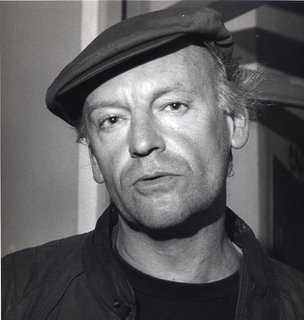
Yesterday, I read the latest from TomDispatch, an essay entitled Eduardo Galeano, A Lost and Found History of Lives and Dreams (Some Broken).
I wasn’t sure if I had vaguely heard of Eduardo Galeano before but whatever, I had no idea of the power and beauty of his writings and was simply blown away when reading them. As Tom introduced the writings:
Who isn’t a fan of something — or someone? So consider this my fan’s note. To my mind, Uruguayan writer Eduardo Galeano is among the greats of our time. His writing has “it” — that indefinable quality you can’t describe but know as soon as you read it. He’s created a style that combines the best of journalism, history, and fiction and a form for his books that, as far as I know, has no name but involves short bursts of almost lyrical reportage, often about events long past. As it turns out, he also carries “it” with him. I was his English-language book editor years ago and can testify to that, even though on meeting him you might not initially think so. He has nothing of the showboat about him. In person, he’s almost self-effacing and yet somehow he brings out in others the urge to tell stories as they’ve never told them before.
Despite Tom’s blanket permission to republish his essays, I’m not going to do so in this case, there’s a small niggle in the back of my mind that the copyright issues are rightfully protecting Mr. Galeano’s publishing rights.
So just going to offer this single extract and trust that you will go here and read Tom’s full essay: please do!
Century of Disaster
Riddles, Lies, and Lives — from Fidel Castro and Muhammad Ali to Albert Einstein and Barbie
By Eduardo Galeano
[The following passages are excerpted from Eduardo Galeano’s history of humanity, Mirrors (Nation Books).]
Walls
The Berlin Wall made the news every day. From morning till night we read, saw, heard: the Wall of Shame, the Wall of Infamy, the Iron Curtain…
In the end, a wall which deserved to fall fell. But other walls sprouted and continue sprouting across the world. Though they are much larger than the one in Berlin, we rarely hear of them.
Little is said about the wall the United States is building along the Mexican border, and less is said about the barbed-wire barriers surrounding the Spanish enclaves of Ceuta and Melilla on the African coast.
Practically nothing is said about the West Bank Wall, which perpetuates the Israeli occupation of Palestinian lands and will be 15 times longer than the Berlin Wall. And nothing, nothing at all, is said about the Morocco Wall, which perpetuates the seizure of the Saharan homeland by the kingdom of Morocco, and is 60 times the length of the Berlin Wall.
Why are some walls so loud and others mute?
See what I mean!
There is much more about Eduardo Galeano on the web as these two following links prove.
Eduardo Galeano
Wikipedia have an entry here that is informative. Then there is an in-depth article about the man over on The Atlantic website, that starts thus:
Eduardo Galeano is regarded as one of Latin America’s fiercest voices of social conscience. Yet he insists that language — its secrets, mysteries, and masks — always comes first.
November 30, 2000
“The division of labor among nations,” Eduardo Galeano proclaimed in the opening sentence of Open Veins of Latin America, “is that some specialize in winning and others in losing.” A native of Uruguay who was forced into exile under the country’s military regime during the 1970s, Galeano has always identified with the losing side. Open Veins, originally published in Mexico in 1971, employed captivating, elegiac prose to chronicle five centuries of plunder and imperialism in Latin America. Radically different in style, though not in content, from Marxist-oriented “dependency theory” of the 1960s — which held that Latin America had been systematically marginalized by the world economy since the colonial era — Open Veins quickly became a canonical text in radical circles, selling hundreds of thousands of copies in the Southern Hemisphere. In a period of social upheaval, guerrilla warfare, and dictatorship, the book, composed in three months of intense labor, was routinely treated as samizdat: when Open Veins was banned by the Pinochet regime, a young woman fled Chile with the book stashed in her infant’s diapers.
Going to close by musing on the fact that in today’s visual, technological age, the sharing of words, in all ways, shapes and sizes, across so many parts of our global society, is a pure miracle. Such creativity out there!
Jean would be the first to tell you that I’m always remarking to her how this funny old world of blogging creates links and friendships right across the world. Many of the kind people who follow Learning from Dogs are themselves the authors of blogs and in the vast majority of cases when I read their posts I sense a kindred spirit.
T.O.R.A Rescue shelter to close – Dogs need homes Foster or Adopt
TORA will close. This is indeed sad news for me but devastating for the dogs still left at the rescue shelter. My beautiful Annie came from there. Rescued off the street as a frightened puppy: Just look at her now.
Beautiful Annie.
TORA, like many other rescue shelters in Romania have been fighting against all odds to get dogs off the streets, and now out of the public shelters since the killing law has been passed. Dogs are in public shelters for only a short time before they are put to sleep. There are horrific stories and pictures around. Some may see it as practical, culling the population. That’s a valid opinion but not one I and thousands upon thousands of dog/animal lovers can share.
All TORA asks now though is for people to view the site on Facebook or contact them [Ed. via that Facebook link] and foster or adopt one of the remaining dogs. If there are dogs left in October when they must close, then they will be returned to the public shelter to receive their fate.
EVEN IF YOU CANNOT HAVE A DOG YOURSELF, please share, someone somewhere will, and for each one that does, another beautiful dog is safe. They didn’t ask to be thrown on the streets. They didn’t ask to be cast out like vermin. All they want is a chance to have a human family and a life of kindness.
ABOUT ASOCIATIA
T.O.R.A. is a small non-profit dog rescue organization that is based in Bistrita, North of Romania (Transylvania). TORA is dedicated to the rescue and placement of stray dogs.
We are an animal charity of 2-4 volunteers, with funds available only from public support, with a shelter of 20 spacious kennels, 11 indoor & outdoor and 9 only outdoors ones. We have a vet attending the dogs daily and a caretaker.
All of our dogs get neutered, (with the exception of puppies under the age of 6 months old and very old dogs), vaccinated, microchipped , defleed and dewormed prior to adoption.
T.O.R.A. shelter cares for the rescued dogs entirely from donations received from private people, that’s why there is a constant need of support whether its financial, material (food or medicine donations, beds, dog clothes, etc) or by sharing and promoting the dogs to find good homes so that space becomes available to help others .
T.O.R.A. helps an average of 40-60 animals at any given time.
Many who follow my scribblings know that of the nine dogs we have here at home, seven are rescues. When I first met Jean down in Mexico she was rescuing feral dogs off the streets and finding homes for them. Over the many years, Jean estimates that well over two-hundred stray dogs had been found loving homes. Indeed, when Jean and I moved from Mexico to Payson, AZ., we came with fourteen dogs of which thirteen were ex-rescues! Pharaoh being the notable exception!
Anyway, back to Mrs Skeats.
I was so moved by what I read on her blogsite that I implored her to write a guest post for you, dear reader. Suzan was gracious enough to agree and here is her post.
ooOOoo
Rescued dogs are life-savers.
by Suzan.
Paul asked if I would post as a “guest” after reading my post(s) about dogs that have been or need to be rescued from some quite awful conditions. “OH here we go again” some of you will say. Well, then it is your choice to read on or close the page.
I hope you read on as this is not about begging for funds or equipment or even a home for these lovely creatures. It’s about what THEY can offer you.
I love animals – not just dogs. I’ve cared for many in my time, but dogs have to be top of my list. Dogs love to love. They don’t know how to be any other way until they are mistreated in some way.
Dog’s are like having a permanent 3 years old around you, with the exception they don’t answer back (often) and are usually not quite so stubborn. I’ve had 7 children under my roof in the years (hence the menagerie at times) – I know.
Dogs look to their human companion as leader, feeder, soul mate, room mate, walker, talker, and all they want to do is to please …. literally their life is lived for you. But rescued dogs do this to a deeper level than dogs raised from a pup. Not just me but thousands of others find this.
Raised dogs are no less loyal, please don’t think I say different. There’s just something about a dog that has had a bad start, lonely, captured, mistreated … whatever. These dogs reach deeper into your heart and aim to please as if they are desperate to say thank you. Perhaps they have a fear that the person who has been so lovely will leave if they misbehave. I can’t say, I’m not a dog.
I do know as I have had both kinds; from a pup and rescued from kennels. My last ‘pup raised’ dog, Dizzi, was with me 18 years and a star in her own right, but my rescues … it’s hard to say, but they love me in a different way, unique to rescues.
Take Joe. Joe had been sold on Facebook and bought by dog-baiters, bitten so severely vets thought he would die. You’d think that’s turned him off to humans? But no! He was a beautiful 6yr-old Collie. He was awesome. He obeyed, loved and cherished us, giving cuddles, playing gently … I’ve never had such a beauty under my roof. [Ed: Joe’s early and tragic death will be the subject of tomorrow’s post.]
Annie is a Romanian street dog, rescued age 9 months from under a pile of pallets in the cold Romanian winter, never having had a home. Now two, and she too has a special love for us. I swear if we’re annoyed with her she cries (not the doggy whine – I mean from the heart) and she’ll do ANYTHING to get a hug from us. Not once has she ever messed in the house from day 1, she goes to bed when told, sits politely for treats or her lead and wags herself to death when we come in the front door. Very rarely has she “got it wrong” and is so sorrowful if she does, her worst misdemeanour being chewing her bedding when she was about 14 months old, and obviously bored.
I could go on, I’ve had 5 rescues and two from pups…..
All I’ll now say is if you’re looking for a dog to share your life with – consider very carefully as they love you warts and all for a long time – then get a rescued dog. Once you look into those soulful eyes, and hold that paw, you’ll connect and feel the love and be very humbled ……. but you won’t regret it.
ooOOoo
Please share the message as much as possible! These dogs need to find loving homes. Thank you.
I’m preparing this post on Sunday; i.e. three days ago. Reason is that my sister, Elizabeth, and friend, Merle, are arriving on Monday afternoon (as in two days ago) bringing us up to three guests in the house. My mother leaves on tomorrow morning and then Elizabeth and Merle depart on Friday morning. So for all the right reasons, Learning from Dogs is taking a backstage. Hence me doing as much as I can ahead of time.
In Monday’s post, The tracks we leave, towards the end I wrote, “The utter madness of mankind’s group blindness is beyond comprehension.” Many know that there is something very badly wrong with the way politics is operating today. Yet, at the same time, many intuitively know the political changes that mankind has to see if there is to be any chance of a sustainable future for mankind on this planet.
Thus George Monbiot’s essay published on the 29th July makes encouraging reading in the context of the growing confidence of the UK Green Party. It is republished here with the kind permission of George Monbiot.
ooOOoo
Unmasked
July 29, 2014
The justifications for extreme inequality have collapsed. But only the Green Party is prepared to take the obvious step
By George Monbiot, published in the Guardian 30th July 2014
When inequality reaches extreme and destructive levels, most governments seek not to confront it but to accommodate it. Wherever wealth is absurdly concentrated, new laws arise to protect it.
In Britain, for example, successive governments have privatised any public asset which excites corporate greed. They have cut taxes on capital and high incomes. They have legalised new forms of tax avoidance (1). They have delivered exotic gifts like subsidised shotgun licences and the doubling of state support for grouse moors (2). And they have dug a legal moat around the charmed circle, criminalising, for example, the squatting of empty buildings (3) and most forms of peaceful protest (4). However grotesque inequality becomes, however closely the accumulation of inordinate wealth resembles legalised theft, political norms shift to defend it.
None of this should surprise you. The richer the elite becomes, and the more it has to lose, the greater the effort it makes to capture public discourse and the political system. It scarcely bothers to disguise its wholesale purchase of political parties, by means of an utterly corrupt and corrupting funding system (5,6). You can feel its grip not only on policy but also on the choice of parliamentary candidates and appointments to the cabinet. The very rich want people like themselves in power, which is why we have a government of millionaires (7).
But that describes only one corner of their influence. They fund lobby groups, thinktanks and economists to devise ever more elaborate justifications for their seizure of the nation’s wealth (8). These justifications are then amplified by the newspapers and broadcasters owned by the same elite.
Among the many good points Thomas Piketty makes in Capital in the 21st Century – his world-changing but surprisingly mild book – is that extreme inequality can be sustained politically only through an “apparatus of justification.” (9) If voters can be persuaded that insane levels of inequality are sane, reasonable and even necessary, then the concentration of income can keep growing. If they can’t, then either states are forced to act, or revolutions happen.
For the notion that inequalities must be justified sits at the heart of democracy. It is possible to accept that some can have much more than others if one of two conditions are met: either that they reached this position through the exercise of their unique and remarkable talent; or that this inequality is good for everyone. So the network of think tanks, economists and tame journalists must make these justifications plausible.
It’s a tough job. If wages reflect merit, why do they seem so arbitrary? Are the richest executives 50 or 100 times better at their jobs than their predecessors were in 1980? Are they 20 times more skilled and educated than the people immediately below them, even though they went to the same business schools? Are US executives several times as creative and dynamic as those in Germany? If so, why are their results so unremarkable?
It is, of course, all rubbish. What we see is not meritocracy at work at all, but a wealth grab by a nepotistic executive class which sets its own salaries, tests credulity with its ridiculous demands and discovers that credulity is an amenable customer. They must marvel at how they get away with it.
Moreover, as education and even (in the age of the intern) work becomes more expensive, the opportunities to enter the grabbers’ class diminish. The nations which pay the highest top salaries, such as the US and Britain, are also among the least socially mobile (10). Here, you inherit not only wealth but opportunity.
Aha, they say, but extreme wealth is good for all of us. All will be uplifted by their god’s invisible hand. Their creed is based on the Kuznet’s curve, the graph which appears to show that inequality automatically declines as capitalism advances, spreading wealth from the elite to the rest.
When Piketty took the trouble to update the curve, which was first proposed in 1955, he discovered that the redistribution it documented was an artefact of the peculiar circumstances of its time. Since then the concentration of wealth has reasserted itself with a vengeance (11). The reduction in inequality by 1955 was not an automatic and inherent feature of capitalism, but the result of two world wars, a great depression and the fierce response of governments to these disruptions.
For example, the top federal income tax rate in the US rose from 25% in 1932 to 94% in 1944. The average top rate throughout the years 1932 to 1980 was 81%. In the 1940s, the British government imposed a top income tax of 98% (12). The invisible hand? Hahaha. As these taxes were slashed by Reagan and Thatcher and the rest, inequality boomed once more, and is exploding today. This is why the neoliberals hate Piketty with such passion and poison: he has destroyed with data the two great arguments with which the apparatus of justification seeks to excuse the inexcusable.
So here we have a perfect opportunity for progressive parties: the moral and ideological collapse of the system of thought to which they were previously in thrall. What do they do? Avoid the opportunity like diphtheria. Cowed by the infrastructure of purchased argument, Labour fiddles and dithers (13).
But there is another party, which seems to have discovered the fire and passion that moved Labour so long ago: the Greens. Last week they revealed that their manifesto for the general election will propose a living wage, the renationalisation of the railways, a maximum pay ratio (no executive should receive more than 10 times the salary of the lowest paid worker), and, at the heart of their reforms, a wealth tax of the kind Piketty recommends (14).
Yes, it raises plenty of questions, but none of them are unanswerable, especially if this is seen as one step towards the ideal position: a global wealth tax, that treats capital equally, wherever it might lodge. Rough as this proposal is, it will start to challenge the political consensus and draw people who thought they had nowhere to turn. Expect the billionaires’ boot boys to start screaming, once they absorb the implications. And take their boos and jeers as confirmation that it’s onto something. You wanted a progressive alternative? You’ve got it.
A short film by Alan Watts and Terence McKenna. A film that makes a perfect postscript to yesterday’s post: The tracks we leave.
Published on Mar 3, 2013
Alan Watts and Terence McKenna talk about our need for a sense of unity as our global problems are getting worse and we have become enemies of our planet and each other.
I’m really showing my age and cultural upbringing through the choice of this title to today’s post.
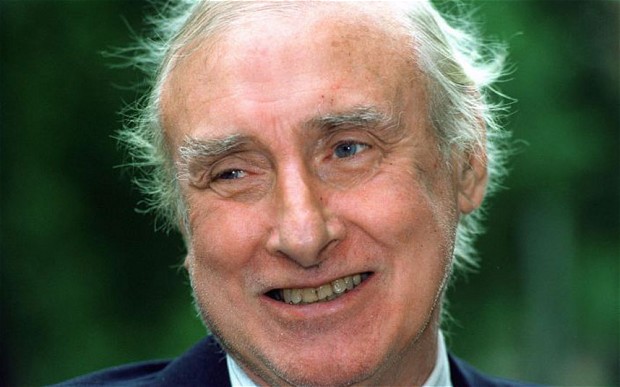
For The Goon Show was an integral part of my ‘education’ during my formative years. Spike Milligan was an outstanding actor in The Goon Show, a comedy legend, along with Peter Sellers and Harry Secombe; not forgetting the narratives from Wallace Greenslade.
The Goon Show ran from 1951 to 1960 (I was born in 1944) broadcast by the BBC Home Service.
Spike Milligan after receiving his Order of the British Empire (OBE) in 1992.
What’s this all leading up to?
Simply that a recent speech by George Monbiot reveals such utter madness in the upper echelons of the United Kingdom that only reflecting on The Goon Show offers any meaning to this old Brit. Not that the USA escapes Mr. Monbiot’s analysis.
Here’s how the speech opens:
The Pricing of Everything
Ladies and gentlemen, we are witnessing the death of both the theory and the practice of neoliberal capitalism. This is the doctrine which holds that the market can resolve almost all social, economic and political problems. It holds that people are best served, and their prosperity is best advanced, by the minimum of intervention and spending by the state. It contends that we can maximise the general social interest through the pursuit of self-interest.
To illustrate the spectacular crashing and burning of that doctrine, let me tell you the sad tale of a man called Matt Ridley. He was a columnist on the Daily Telegraph until he became – and I think this tells us something about the meritocratic pretensions of neoliberalism – the hereditary Chair of Northern Rock: a building society that became a bank. His father had been Chair of Northern Rock before him, which appears to have been his sole qualification.
While he was a columnist on the Telegraph he wrote the following:
The government “is a self-seeking flea on the backs of the more productive people of this world. … governments do not run countries, they parasitize them.”(1) He argued that taxes, bail-outs, regulations, subsidies, interventions of any kind are an unwarranted restraint on market freedom. When he became Chairman of Northern Rock, Mr Ridley was able to put some of these ideas into practice. You can see the results today on your bank statements.
In 2007 Matt Ridley had to go cap in hand to the self-seeking flea and beg it for what became £27 billion. This was rapidly followed by the first run on a British bank since 1878. The government had to guarantee all the deposits of the investors in the bank. Eventually it had to nationalise the bank, being the kind of parasitic self-seeking flea that it is, in order to prevent more or less the complete collapse of the banking system. (2)
You can read the full transcript and look up the references over on the George Monbiot website.
However, a real bonus is that his speech (delivered without notes!), his SPERI Annual Lecture, hosted by the Sheffield Political Economy Research Institute at the University of Sheffield, was recorded on video.
Please set aside a quiet hour (and a tad) to listen to George Monbiot and wonder at the goon show that we are all acting out! In fact, watching his speech and his answers to a number of questions from the audience will give you something that the transcript just can’t convey. Watch it! You will be inspired!
(SPERI Annual Lecture by George Monbiot: “The Pricing of Everything” at the Octagon in Sheffield, UK, on 29th April 2014.)
Back to dear old Spike Milligan and to close with what seems like a very apt quote of his.
“All I ask is the chance to prove that money can’t make me happy.“
The more that man tries to interfere the more that man screws up.
Jeannie and I subscribe to Time Magazine. This week’s edition had a pretty eye-catching cover that required a second look.
Illustration by Justin Metz for Time. Photo reference for emerald ash borer courtesy of PDCNR—Forestry Archive, Bugwood.org
That cover referred to the lead article concerning invasive species, “From giant snails to Asian carp, alien wildlife is on the move.“, written by Bryan Walsh. The essence of the article is that man’s global activities are responsible, albeit often unwittingly, for the movement of a wide range of species across national borders. My own reaction to the article was that it was typical of the many ‘scare’ stories the media present but that at the end of the day, nothing will change. However the last two paragraphs of the article did resonate with me.
Human beings have become the dominant force on the planet, so much so that many scientists believe we’ve entered an entirely new geological epoch: the Anthropocene. We have already been shaping the planet unintentionally, through greenhouse-gas emissions and global trade and every other facet of modern existence. The challenge now is to take responsibility for that power over the planet and use it for the right ends – all the while knowing that there is no single correct answer, no lost state of grace we can beat back toward.
How we respond to the thickening invasions that we ourselves loosed will be part of that answer – which is only just. There is one species that can claim to be the most dominant invasive of all time. From its origins in Africa, this species has spread to every corner of the world and every kind of climate. Everywhere it goes, it displaces natives, leaving extinction in its wake, altering habitat to suit its needs, with little regard for the ecological impact. Its numbers have grown nearly a millionfold, and its spread shows no sign of stopping. If that invasive species sounds familiar, it should. It’s us.
Thus with that article from Time in mind, it was very pertinent to see the latest essay from George Monbiot. It reinforces, in spades, the sentiment expressed by Bryan Walsh in those paragraphs above and is republished here on Learning from Dogs with the generous permission of George Monbiot.
ooOOoo
A One Way Street to Oblivion
As soon as an animal becomes extinct, a new bill proposes, it will be classified as “non-native”.
By George Monbiot, published on the Guardian’s website, 21st July 2014
Can any more destructive and regressive measures be crammed into one bill?
Already, the Infrastructure Bill, which, as time goes by, has ever less to do with infrastructure, looks like one of those US monstrosities into which a random collection of demands by corporate lobbyists are shoved, in the hope that no one notices.
So far it contains (or is due to contain) the following assaults on civilisation and the natural world:
– It exempts fracking companies from the trespass laws
– Brings in a legal requirement for the government to maximise the economic recovery of petroleum from the UK’s continental shelf. This is directly at odds with another legal requirement: to minimise the UK’s greenhouse gas emissions
– Introduces the possibility (through Clauses 21 and 22) of a backdoor route to selling off the public forest estate. When this was attempted before, it was thwarted by massive public protest.
– further deregulates the town and country planning system, making life even harder for those who wish to protect natural beauty and public amenities
Enough vandalism? Not at all. There’s yet another clause aimed at suppressing the natural world, which has, so far, scarcely been discussed outside parliament. If the Infrastructure Bill is passed in its current state, any animal species that “is not ordinarily resident in, or a regular visitor to, Great Britain in a wild state” will be classified as non-native and subject to potential “eradication or control”. What this is doing in an infrastructure bill is anyone’s guess.
At first wildlife groups believed it was just poor drafting, accidentally creating the impression that attempts to re-establish species which have become extinct here – such as short-haired bumblebees or red kites – would in future be stamped out. But the most recent Lords debate scotched that hope: it became clear that this a deliberate attempt to pre-empt democratic choice, in the face of rising public enthusiasm for the return of our lost and enchanting wildlife.
As Baroness Parminter, who argued unsuccessfully for changes to the bill, pointed out, it currently creates
“a one-way system for biodiversity loss, as once an animal ceases to appear in the wild, it ceases to be native.”
She also made the point that it’s not just extinct species which from now on will be treated as non-native, but, as the bill now stands, any species listed in Schedule 9 of the Wildlife and Countryside Act 1981.
Among those in Schedule 9 are six native species that have already been re-established in Britain (the capercaillie, the common crane, the red kite, the goshawk, the white-tailed eagle and the wild boar); two that are tentatively beginning to return (the night heron and the eagle owl); and four that have been here all along (the barn owl, the corncrake, the chough and the barnacle goose). All these, it seems, are now to be classified as non-native, and potentially subject to eradication or control.
After the usual orotund time-wasting by aristocratic layabouts (“my ancestor Sir Ewen Cameron of Lochiel, who was known as the great Sir Ewen … killed the last wolf in Scotland” etc), the minister promoting the bill, Baroness Kramer, made it clear that the drafting was no accident. All extinct species, it appears, are to be treated as non-native and potentially invasive. At no point did she mention any of the benefits their re-establishment might bring, such as restoring ecological function and bringing wonder and delight and enchantment back to this depleted land.
Here is a list, taken from Feral, of a few of the animals which have become extinct recently (in ecological terms) and which probably meet the bill’s new definition of non-native: “not ordinarily resident in, or a regular visitor to, Great Britain in a wild state”. Some would be widely welcomed; others not at all, but it’s clear that a debate about which species we might welcome back is one that many people in this country want to have, but that the government wants to terminate. There’s a longer list, with fuller explanations and a consideration of their suitability for re-establishment, in the book.
European Beaver: became extinct in Britain in the mid-18th Century, at the latest. Officially re-established in the Knapdale Forest, Argyll. Unofficially in the catchment of the River Tay and on the River Otter, in Devon.
Wolf: The last clear record is 1621 (not 1743 as commonly supposed). It was killed in Sutherland. As far as I can determine, neither Sir Ewen Cameron nor any of the other blood-soaked lairds and congenital twits from whom Lord Cameron of Dillington is descended were involved.
Lynx: The last known fossil remains date from the 6th Century AD, but possible cultural records extend into the 9th Century.
Wild Boar: The last truly wild boar on record were killed on the orders of Henry III in the Forest of Dean, in 1260. Four small populations in southern England, established after escapes and releases from farms and collections.
Elk or Moose (Alces alces): The youngest bones found in Britain are 3,900 years old. Temporarily released in 2008 into a 450-acre enclosure on the Alladale Estate, Sutherland.
Reindeer: The most recent fossil evidence is 8,300 years old. A free-ranging herd grazes on and around Cairn Gorm in the Scottish Highlands.
Wild horse: The most recent clearly-established fossil is 9,300 years old. Animals belonging to the last surviving subspecies of wild horse, Przewalski’s (Equus ferus przewalskii), graze Eelmoor Marsh in Hampshire.
Forest bison, or wisent: Likely to have become extinct here soon before the peak of glaciation, between 15,000 and 25,000 years ago. A herd was temporarily established at Alladale in 2011.
Brown bear: probably exterminated around 2000 years ago.
Wolverine: survived here until roughly 8,000 years ago.
Lion: the last record of a lion in the region is a bone from an animal that lived in the Netherlands – then still connected to Britain – 10,700 years ago.
Spotted hyaena: around 11,000 years ago.
Hippopotamus: it was driven out of Britain by the last glaciation, around 115,000 years ago, and hunted to extinction elsewhere in Europe about 30,000 years ago.
Grey whale: the most recent palaentological remains, from Devon, belonged to a whale that died around 1610 AD.
Walrus: late Bronze Age, in the Shetland Islands.
European Sturgeon: possibly as recently as the 19th Century.
Blue stag beetle: probably 19th Century.
Eagle owl: the last certain record is from the Mesolithic, 9,000-10,000 years old . But a possible Iron Age bone has been found at Meare in Somerset. Now breeding in some places, after escaping from collections.
Goshawk: wiped out in the 19th Century. Unofficially re-established in the 20th Century, through a combination of deliberate releases and escapes from falconers.
Common crane: last evidence of breeding in Britain was in 1542. Cranes re-established themselves through migration in the Norfolk Broads in 1979, and have bred there since then. Now breeding in two other places in eastern England. Re-introduced in 2010 to the Somerset Levels.
White Stork: last recorded nesting in Edinburgh in 1416. In 2004 a pair tried to breed on an electricity pole in Yorkshire. In 2012 a lone bird built a nest on top of a restaurant in Nottinghamshire.
Spoonbill: the last breeding records are 1602 in Pembrokeshire and 1650 in East Anglia. In 2010 a breeding colony established itself at Holkham in Norfolk.
Night Heron: last bred here in either the 16th or 17th Century, at Greenwich. Today it is a scarce visitor.
Dalmatian Pelican: remains have been found from the Bronze Age in the Cambridgeshire Fens and from the Iron Age in the Somerset levels, close to Glastonbury. A single mediaeval bone has been found in the same place.
These and many others are now to be classified as officially non-native, unless this nonsense can be stopped.
Incidentally, determining what is and isn’t a native species, let alone what “should” or “should not” be living here, is a much more complicated business than you might imagine, as Ken Thompson’s interesting book, Where Do Camels Belong?, makes clear. He also points out that some species which are initially greeted with horror and considered an ecological menace soon settle down as local wildlife learns to prey on them or to avoid them. Sometimes they perform a useful ecological role by filling the gaps created by extinction. He overstates his case, and glosses over some real horror stories, but his book is an important counterweight to attempts to create a rigid distinction between native and non-native wildlife.
Many species introduced to this country by human beings are now cherished as honorary members of our native wildlife. Here are just a few I’ve come across. How many of you knew that they were all brought here by people?:
Brown hare
Little owl
Field poppy
Corncockle
Crack willow
Greater burdock
Pheasant’s eye
Cornflower
Wormwood
Mayweed
White campion
Isn’t this an interesting subject? Unfortunately government ministers seem to know to know nothing about it and to care even less. They are crashing through the middle of delicate interactions between people and the natural world like bulldozers in a rainforest.
I will close today’s post with another, very recent, story in The Guardian, that opens, thus:
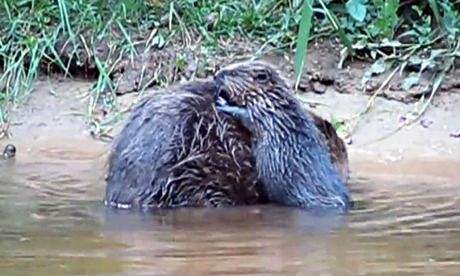
Wild beaver kits born in Devon
Thursday 17 July 2014
One of the first wild beavers to be seen in England in centuries and due to be taken into captivity has given birth to three young.
Local retired environmentalist Tom Buckley captured the three young beavers climbing all over their mother. Photograph: Tom Buckley/Apex
A wild beaver due to be taken into captivity has given birth to at least three young.
The young, known as kits, were born to the family of two adult and one juvenile European beavers (Castor fiber) that were spotted living on the river Otter in Devon earlier this year, in what was believed to be the first sighting of the species in the wild in England in 500 years.
All that is left for me to do is to quote a little from a recent letter from John Hurlburt.
Our future depends on the air we breathe. Our lives depend upon rivers of living water. Our health requires the blessings of organic agriculture. Our energy streams through us from the cosmos.
We are warrior animals. Peace must come from within. Non-violence is our best choice. We have the magnificent opportunity to wake up as an animal that is grateful and sings in harmony with the Earth.
The present is surrounded by the past and the future. We float on the wings of compassion and wisdom with a sacred responsibility for the Nature of all Creation.









 Learning from Dogs