Category: monetary policy

Econned, by Yves Smith

Learning from Dogs muses the new book from Yves Smith

ECONned, by Yves Smith

In Econned, Yves Smith, founder of Naked Capitalism, argues that the economy was doing just fine in the regulated environment up to the 1970s.  Then began the work of the Chicago economists who challenged Keynesian economics and touted the benefits of deregulation which eventually led to the financial crisis we have today.

Yves argument is internally consistent and well researched, but ignores some factors that I think would change the conclusions drawn from her work.

Yves Smith, author and founder of Naked Capitalism

First, Yves notes that the primary reason that economists are not useful to the real world is that economic research presumes equilibrium.  Smith misses the point here, but it is understandable. It took me years of study and contemplation to fully appreciate that an equilibrium simply gives economists a point of reference, a common base, from which to study shocks and movements. In and of itself, equilibrium is not interesting or important.   But movements to and from equilibrium are of real interest because they enable us to study and try to predict how individuals will react to incentives and changes in market conditions.

Second, we have to put the contributions of the Chicago economists of the 1970s into context.  Up until that time, the only real school of thought in macroeconomics was based on Keynes, who presumed that markets fail and that the government must play an active and large role – primarily through government spending and taxes — for the economy to perform well.  Keynes’ work was a reaction to the Great Depression.

Friedman’s monetarism also sought to explain the Great Depression, but focused on the role of monetary policy on the economy. This work showed that the missteps of the Federal Reserve was the primary cause of the depth and length of the Great Depression, and that long-term accommodative monetary policy causes inflation.  This body of work did not stress deregulation, although it did lean more heavily on enabling private market solutions than on replacing them with government solutions.  Neither theory is complete; Keynes focused on the short run (“In the long run, we are all dead” is a rather famous Keynes quip) and Monetarism focused on the long run.

There was a second large body of work that came out of the University of Chicago during the late 1960s and 1970s.  This research documented the tremendous costs of regulation. I know this literature personally and believe that its conclusions are very sound:  it shows that any effective regulation limits either the quantity or price of a good or service away from what it would have been without the regulation.  In fact, in my view, it was the passage of regulations requiring certain lending behavior that set off the series of events that led to the crisis, which is the exact opposite argument from what Ms. Smith makes.

By Sherry Jarrell
Fed Funds Rate and Consumer/Business Costs

Looking more closely at the implications of changes in the Fed rate

Fed funds rate chart_img
Fed Funds rate influences consumer and business interest costs

Does the Fed Funds Rate, the rate charged by the Federal Reserve to make short-term loans to banks, directly influence the interest rate consumers and businesses pay on credit cards, mortgages, and consumer and business loans?  If you took the word of the average business news commentator, you would think not.  But the answer, of course, is yes.

One way to view the market rate of interest, although certainly not the only correct or useful way, is to think of it as a base rate that represents the risk-free rate, a rate that compensates the population for its impatience to consume the goods it would have consumed had it not lent the funds out in the first place. This risk-free rate is also influenced by the efficiency and functioning of the capital markets that bring borrowers and lenders together.

A risk premium is then added to this base rate of risk-free interest, one that varies depending on the degree of uncertainty of the lender getting repaid.  The risk of default, the risk of prepayment, the risk of political uprising, exchange rate risk, and many other sources of uncertainty — including the risk of inflation — raise the level of the risk premium commanded by lenders in the market.  As an example, over the last 100 years or so, the average annual risk-free rate in the U.S. has been about 4%, and the average annual risk premium for equity securities has been about 8%, bringing the average annual observed interest rate or rate of return to about 12% on these securities.

So what happens to the interest rate charged to consumers and businesses when the Fed raises the fed funds rate?  Basically, the level of the risk-free rate in the economy rises and, as debt contracts expire or new lending takes place, this higher base rate gets factored into the market rate of interest charged.

Overall, the demand for loanable funds falls, the aggregate demand curve for the economy falls, and equilibrium output and employment fall, RELATIVE to where they would have been without the rate increase. The bright side is that a reduction in the money supply that accompanies an increase in the fed funds rate is absolutely essential to curtailing inflation, which drives the risk premium, and represents a much greater cost to the economy.

By Sherry Jarrell

Why the Fed Raised the Interest Rate

Contractionary Fed policy in a recession?

What does it mean when the Fed raises the interest rate? It helps to first understand how the Fed raises the rate, which may surprise some people.  The Fed does not “set” the interest rate as it might, for example, by declaration or edict or by fixing prices.  No, it targets a higher interest rate by contracting the money supply until that money supply intersects the market demand for money at a higher market-clearing rate of interest.

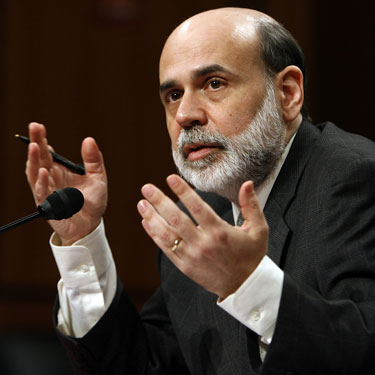
Ben Bernanke, recently reconfirmed Fed Chairman

How does the Fed reduce the money supply? Typically by conducting open market operations, which is the purchase or sale of government securities by the Fed.  To raise the money supply, it purchases new government securities, paying for them by creating — out of thin air — reserves for the commercial banking system. To reduce the money supply, it sells securities which shrinks the amount of deposits in circulation in the economy. In other words, it reduces the liquidity or amount of credit in the system.  This is equivalent to reducing aggregate demand for the goods and services in the economy. (Yes, you heard right — a reduction in the money supply decreases the aggregate demand for goods and services by businesses and consumers.)

Raising interest rates is a contractionary policy decision.  It is designed to “slow down” the economy, reducing output and employment, and raising the equilibrium prices of goods and services in the economy.  Why would the Fed choose to contract an already anemic economy?  To head off inflation, which has it own set of insidious costs and distortions that significantly hurt the economy.

The Fed has always had to tread a very fine line between increasing the money supply enough in the short run to pump up demand and minimize the depth and length of a recession, but not increasing the money supply so much that the increase in demand outstrips the ability of the economy to produce, which creates inflation in the longer run.   Excessive money growth is what causes inflation.  And over the last two years, the U.S. has witnessed a record-shattering increase in the money supply as policymakers struggled to deal with an unprecedented financial crisis.

I have been saying for months that this behemoth money supply would inevitably lead to significant inflation unless steps were taken to shrink it.  I believe the Fed has now begun to take those steps.

By Sherry Jarrell