The glass is filled half-way. Is it half-full or half-empty?
This is a rhetorical question, of course. It is what comes to mind as I write this simply because of a small half-full/half-empty experience in the last 10 minutes. Let me explain.
I had started watching a video on TED.com. This one was entitled Jared Diamond on why societies collapse. Within a few minutes I started drifting to the comments, and read:
Jared Diamond talks of how societies choose (unwittingly) to collapse. William McDonough with his Cradle to Cradle concept also talks about choices and provides ‘Love of all children of all species for all time’ as a positive conscious choice.
With goals or missions in place (for example profit for businesses) humans have achieved amazing things.
So what would happen if all groups, families and individuals followed a mission of ‘Love of all children of all species for all time’?
I rather liked that. We always have choices. A positive conscious choice is always better.
So I stopped the Jared Diamond lecture and found the William McDonough one, also on TED.com, and conveniently shared on YouTube. It’s just 20 minutes long, so settle down somewhere, perhaps with a glass filled half-way with something!
Digital content opens up a whole new ways of thinking about price, value and success.
Book cover
Some time ago, I read the new book from Chris AndersonFree: The Future of a Radical Price It was a very busy period of my life and I had ‘parked’ the conclusions contained in the book for a later time – and then forgot about it!
Anyway, something that came into my in-box earlier today reminded me of the power of giving content away. But before going there, let me briefly come back to Anderson’s book. An extract from this link talking about what in the UK we know as jelly and in the US the name of Jell-O, (nice history on Wikipedia):
But it didn’t sell. Jell-O was too foreign a food and too unknown a brand for turn-of-the-century consumers. Kitchen traditions were still based on Victorian recipes, where every food type had its place. Was this new jelly a salad ingredient or a dessert?
For two years, Wait kept trying to stir up interest in Jell-O, with little success. Eventually, in 1899, he gave up and sold the trademark — name, hyphen, and all — to Orator Frank Woodward, a local businessman. The price was $450.
Woodward was a natural salesman, and he had settled in the right place. LeRoy had become something of a nineteenth- century huckster hotbed, best known for its patent medicine makers. Woodward sold plenty of miracle cures and was creative with plaster of paris, too. He marketed plaster target balls for marksmen and invented a plaster laying nest for chickens that was infused with an anti-lice powder.
But even Woodward’s firm, the Genesee Pure Food Company, struggled to find a market for powdered gelatin. It was a new product category with an unknown brand name in an era where general stores sold almost all products from behind the counter and customers had to ask for them by name. The Jell-O was manufactured in a nearby factory run by Andrew Samuel Nico. Sales were so slow and disheartening for the new product that on one gloomy day, while contemplating a huge stack of unsold Jell-O boxes, Woodward offered Nico the whole business for $35. Nico refused.
Anderson then explores what Woodward does next:
So in 1902 Woodward and his marketing chief, William E. Humelbaugh, tried something new. First, they crafted a three-inch ad to run in Ladies’ Home Journal, at a cost of $336. Rather optimistically proclaiming Jell-O “America’s Most Famous Dessert,” the ad explained the appeal of the product: This new dessert “could be served with the simple addition of whipped cream or thin custard. If, however, you desire something very fancy, there are hundreds of delightful combinations that can be quickly prepared.”
Then, to illustrate all those richly varied combinations, Genesee printed up tens of thousands of pamphlets with Jell-O recipes and gave them to its salesmen to distribute to homemakers for free.
(My emphasis – do read the extract in full from here.) The book is highly recommended.
So what was it that came into my email in-box? It was an email from Leo Babauta of Zen Habits, a Blog that I subscribe to. This is what it said:
I’m happy to announce that focus is now in the Kindle Store. You can get the full book — the free chapters plus bonus chapters from me and five other authors — for $8.99. It doesn’t include the videos, audio interviews and bonus PDFs in the full version.
The free version is simple: it’s 27 chapters that you can download for free, without having to give an email address or do anything else. It’s uncopyrighted, and you can share it with as many people as you like.
Again, you can share this ebook freely, so feel free to post it on your blog, Twitter, Facebook, or email.
I have no way of knowing how many downloads have been made but I suspect many more than one might imagine.
What I would be curious is to know from amongst the many Learning from Dogs readers how many of you have read this Post to the point of downloading the book for yourself, or others?
Some remarkable recent achievements in aeronautics
Just happened that a few items crossed my inbox more or less in the same time-frame that made me reflect on the ingenuity and persistence of inventors and explorers.
Here’s the first item that I came across in The Register.
Canadian enthusiasts have finally achieved a feat that has eluded humanity’s finest engineers since the time of Leonardo da Vinci – to build a machine, powered by a human pilot’s muscles, which flies by flapping its wings: an ornithopter.
Then Klaus Ohlmann is recorded on the FAI website as submitting a world record claim for flying a solar powered glider a total of 375.7 km (233.4 miles) around three turning points. Oh, and not forgetting a claim by Jan BÈM and Olga ZALUSKÁ from the Czech Republic for a world record altitude by a weight-shift microlight – 8,188 metres no less (26,864 feet!) – or the claim by Richard Young of the USA for a world record of flying an aircraft between 300 to 500 kg around a closed circuit of 100 km at a speed of 390 km/h (242 mph). What is it with these guys – have they not got proper jobs to go to? 😉
Anyway, here’s Klaus on a nice video.
Finally, my dear friend of many years, Dan Gomez, reminded me in a recent email of this very brave pushing back of the boundaries.
On July 15th, 2009 a post called Parenting lessons from Dogs started what has now become a bit of a ‘habit’. But more reflections tomorrow.
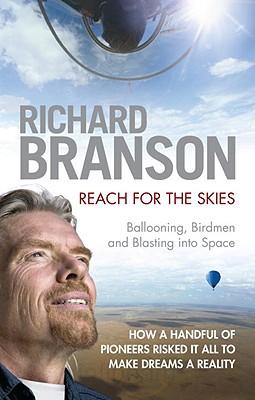
Reach for the Skies
Today I want to voice something that has been running around my mind for some time. It is whether we give in to the mounting doom and gloom at so many levels in our societies (and it can be a very compelling draw) or whether we see this as a painful but necessary period where slowly but surely the desires of ordinary people; for a fairer, more truthful, more integrous world are gaining power.
And I’m going to use Richard Branson to voice it for me!
(Now this is an unusually long Post so I’ve inserted the Read More divider to prevent the Post visually swamping your browser.)
I subscribe to a Blog that comes with the rather intriguing name of The Gospel According to Rhys. It’s a bit ‘geeky’ for my tastes but it offers sufficiently good advice on Blogging and other Social Media systems that it is a worthwhile entry in to my email in-box.
Learning from Dogs is, of course, a WordPress driven Blog and thus is an example of the power of this wonderful software. I trust that Rhys will forgive me if I quote at length from his article – I can’t better it.
Recently it was WordPress’ 7th Birthday. On the 27th of May in 2003, Matt Mullenweg released a fork of b2/cafelog, called WordPress. From the 0.72 release, it’s become the defacto blogging solution for thousands of publishers.I love it, I think it’s great, and although I’m probably preaching to the converted, here’s 7 reasons why I think your blog should be on WordPress.
It’s Free
For what it does, and for amount it costs, it is amazing that it costs nothing. Sure there’s hosting costs & domain names, but there’s nothing stopping you playing with the software for nothing.
It’s Open Source
Fancy yourself as a bit of a coder? Well WordPress is entirely free to see the code. In fact, I recommend playing with WordPress to learn the basics of PHP. There is great documentation (again, open source wiki) to help you with the WordPress framework, itself a great introduction into advanced PHP programming & working with API’s & frameworks.
Furthermore, with it being open source, if a bug is discovered, it’s fixed relatively quickly.
It Is Quick & Easy To Use
WordPress is famous for it’s five minute installation, and when you get good, it should take you half of that time. Logging in you can write a post within a minute, and it’s ridiculously easy to use. Changing design & adding plugins is easy as well.
As CMS’s Goes, It’s Pretty Good for SEO
Out of the box, f0r search engine optimisation, it’s okay. However, with a few tweaks, WordPress becomes a solid SEO platform. It’s certainly one of the better CMS’ out there.
It’s Well Supported
I’m not sure if there’s been a “state of the wordpress community” post ever done, but WordPress itself hosts nearly 10,000 plugins, and there must be tens of thousands of themes available online (WordPress itself only holds about 1 and a half thousand). Each one has a programmer or designer behind it, and although support varies (the official wordpress forum is average at best), enough people know what they are doing, both paid or free, to help you out.
It Can Make You A Rich Man (or Woman)
Whilst I’m not a rich man, running this blog & a few websites on WordPress have allowed me to make some money, and anybody can do this. As well as ebooks, adsense, affiliate marketing & god knows what else, you can make a fortune carrying out WordPress related services for other people.
It’s Never Going To Disappear Overnight
WordPress has some huge sites supporting it, a company fully dedicated to it’s production, and a thriving community. It’s not here today, and gone tomorrow.
So happy birthday WordPress, here’s to the next 7 years!
I can’t recall how but I came across a web site that focuses on ‘translating’ data into pictures. As they say, a picture is worth a thousand words. The web site is called Information is Beautiful.
Anyhow, they have attempted to graphically portray the scale of the BP oil spill. (A thumbnail is below but please click on the link, or here, to see this as it was meant to be shown.)
Ouch!
But this image is an update of an earlier one here that is really powerful. Because it attempts to put the scale of the oil spill into context with global oil consumption.
If the Purdue University estimate of the oil spill is correct at 48,500 barrels a day (a barrel is approximately the equivalent of two car tankfuls of gas/petrol) and the spill is contained in 90 days then the total oil spilled will be:
90 x 48,500 = 4,365,000 barrels
That is an enormous quantity.
But have a guess as to how much that would represent in terms of hourly global oil consumption?
Any idea?
Well global oil consumption is 3,500,000 barrels an hour.
So 90 days at 48,500 barrels a day represents just 1 hour 15 minutes worth of global consumption!
If there was ever an argument for the world to wean itself off oil then this would appear to be it.
What has happened so far is tragic – tragic beyond measure. But if it turns out to be a ‘tipping point’ for nations to reconsider how we find and use energy then, perhaps, it will have been a horrible lesson that we all had to take.
And if the USA puts all it’s collective back into leading the world out of our addiction to oil then the damage and hardship will not have been in vain.
The Hubble Space Telescope (HST) has been in space for 20 years!
This week, twenty years ago, the HST was launched into orbit. There’s much online if you want to read about it both on WikiPedia and on the Hubble web site so this post is going to offer just two items.
A beautiful picture
Nucleus of Galaxy Centaurus A
And an interesting audio slideshow tribute from the BBC – click here, introduced thus:
Take a look at some of the sights it has seen in that time with Professor Alec Boksenberg from the Institute of Astronomy in Cambridge – who was on the European team that helped build Hubble.
By Paul Handover (in awe of what is beyond our skies)
Wow, the big picture of the IT world seems to be crumbling with increasing rapidity! Many people are at risk of getting hurt if they continue to hold traditional attitudes.
Plenty of seismic shifts have rocked and reshaped IT in the past. Some big rumblings’ epicenters had origins in an unstoppable technology shift; other fissures had nothing to do with PCs and servers. Consider the recent shocks: the Internet revolution and dotcom bust; Y2K and 9/11; the consumerization of IT; and the unstoppable broadband and mobile explosion.
However, the latest shock–the global financial meltdown–is like the recent 8.8 earthquake that shook Chile and knocked the earth off its axis. And for IT leaders today, it’s important to realize that the aftershocks are still coming.
Thomas Wailgum provides an insightful description of the challenges facing the important operational aspects of IT in many organizations. Many of the symptoms and some of the causes that he describes are undoubtedly true and have been adversely affecting the performance of many people for a long time!
But, who really cares?
I suggest that the people who really care are the people who are trying to serve the customers of the business. Consequently they will decide what they do and how they do it, including what services and products they use, including those that involve IT (almost all of them these days).
It seems to me interesting to describe this, as he has done, from the perspective of IT and IT people (of whom I am also, broadly, one!) .. but it is only interesting to IT people.
The people who require services are getting them from wherever they can and wherever they like and will continue, increasingly, to do so.
Many of the points that he makes are valid and accurate, including his list of “recent shocks”. Two of those struck me as particularly poignant and relevant.
One is “the unstoppable broadband and mobile explosion”, which seems to be a strange way to describe it. My reading of this is that IT people would like to “stop” it; but why? The availability of communication services with increasing bandwidth and location-independence is enabling greater sharing of information and understanding; many people, especially those in the “third world”, are benefitting enormously from this. I hope that I have understood his meaning incorrectly because, surely, the task of people who understand IT is to help others to take full advantage of the opportunities, not to try to stop them!
The other is “the consumerization of IT”, which is one way of looking at it but, again, seems to carry a subtextual bias. I detect a sense that this is seen to be the use, in business applications, of lower quality facilities intended for individuals who do not know the implications. There is some truth in this, but this has been a trend for decades and, so far, the roof has not fallen in! I suggest that this is misunderstanding of the bigger picture and, in a sense, does not go far enough
This is not simply consumerization, this is the commoditization of IT. This happens in every industry as bespoke products become more generally available, the nature of the competition changes. What was custom becomes standard and the action moves up a layer!
Much of Thomas Wailgum’s account of the situation is accurate and, potentially, very useful; but, by viewing it from the perspective of the providers of IT services rather than that of the consumers of IT services, the nature of the solutions seems to be pointing in the wrong direction!
Better navigational accuracy in the air may be approaching its limits.
For passengers travelling with scheduled airlines, times have changed, sadly, and no longer can you visit the flight deck, and see from there the views that pilots get.
New meaning to the term 'on track'.
It was not so long ago, that aircraft navigation was carried out using beacons on the ground, either on VHF, or Medium wavebands.
For longer trips with no ground aids a Navigator would plot your route using Astro (sun or the stars) navigation, until companies like Decca produced other radio systems to give you a position, but these from my memory had their problems.
Today in the modern aircraft we have Inertial Navigation Systems using laser gyros together with radio VHF back up, taking cross cuts from beacons, coupled with Distance measuring equipment to pinpoint your position, and now the magic Global Positioning System (GPS) with it`s startling accuracy.
Often with only 1000 feet between, you can see aircraft either above, or below you, often on the same track. This picture of an Emirates airline Airbus A380 was taken northbound over Turkey. The trails left behind are ice crystals which are left by the water vapour that passes through the engine, and freezes immediately at temperatures of some minus 60 degrees C.
The vortex from the wings causes the rotating trail from each engine to be disturbed, and if you pass through such disturbed air following the wake of another aircraft you often get a bump as your aircraft will be travelling at 500 MPH, some 7 miles per minute, a closing speed of 1000MPH if heading towards each other.
As the accuracy is so good these days, airlines have taken to introducing an offset of one or two miles to the left or right of track, just in case there is an error of timing, or in severe turbulence an aircraft could lose or gain the amount of separation which is between machines.
I think we get the best seats in the house!
By Bob Derham
[Bob is a Captain on a privately operated Airbus A319. Ed.]







 Learning from Dogs