With thanks to Dan Gomez for sending me the YouTube link.
It’s a crazy old world but sometimes that craziness provides a relief from the ‘serious’ side to life.
This week the Dutch company PAL-V announced the first flights of its prototype “flying car”.
This unique vehicle is called the PAL-V One, or the ‘Personal Air and Land Vehicle’, and It marks the start of a new era.
On the ground the vehicle drives like a sports car. Within minutes its rotor is unfolded and its tail is extended: then it is ready to take off thanks to the advanced gyrocopter technology.
With these successful test results it is proven that it is not only possible to build a flying car but also that it can be done within existing international rules for both flying and driving.
Having passed this important milestone the company is now inviting investors to join them in creating the future.
The next step will be the design of the first commercial production model of the PAL-V, and first deliveries are expected in 2014.
For 100 years people have dreamed of a flying car, and many attempts have been made to realize this dream, but now it has truly become a reality.
An interesting reflection on the rearing of cattle and an ‘Anti-Meat pill! No kidding!
I was vaguely aware of the contribution of cattle towards the overall rise in greenhouse gases. A very quick web search found this news item from the United Nations which included,
29 November 2006 – Cattle-rearing generates more global warming greenhouse gases, as measured in CO2 equivalent, than transportation, and smarter production methods, including improved animal diets to reduce enteric fermentation and consequent methane emissions, are urgently needed, according to a new United Nations report released today.
“Livestock are one of the most significant contributors to today’s most serious environmental problems,” senior UN Food and Agriculture Organization (FAO) official Henning Steinfeld said. “Urgent action is required to remedy the situation.”
But what prompted me to look a little closer at this was a recent article on the Big Think website that was entitled, The Anti-Meat Pill: Human Engineering to Combat Climate Change.
Let me quote a little from the article, presented on the Big Think website by Daniel Honan.
NYU Bio-ethicist Matthew Liao has caused a stir recently with a forthcoming paper that explores the biomedical modification of humans in order to stop us from consuming red meat.
and a paragraph later continued with,
In a forthcoming paper to be published in Ethics, Policy and the Environment, Liao suggests that humans might take pills to bring about mild nausea to rid ourselves of our appetite for red meat. This would have a mitigating effect on climate change, he argues.
Liao refers to studies such as a widely-sited UN report that estimates 18 percent of greenhouse emissions come from livestock, which is a higher share than transportation. Another report, from 2009, estimates livestock emissions are significantly higher, at 50 percent. Fact of life: cows fart. Other negative impacts of increased livestock farming includes deforestation and a drain on water supplies.
The Internet rapidly found Matthew Liao’s website and from there the paper referred to above, which is introduced thus,
Professor Matthew Liao of New York University
Anthropogenic climate change is arguably one of the biggest problems that confront us today. There is ample evidence that climate change is likely to affect adversely many aspects of life for all people around the world, and that existing solutions such as geoengineering might be too risky and ordinary behavioural and market solutions might not be sufficient to mitigate climate change. In this paper, we consider a new kind of solution to climate change, what we call human engineering, which involves biomedical modifications of humans so that they can mitigate and/or adapt to climate change. We argue that human engineering is potentially less risky than geoengineering and that it could help behavioural and market solutions succeed in mitigating climate change. We also consider some possible ethical concerns regarding human engineering such as its safety, the implications of human engineering for our children and for the society, and we argue that these concerns can be addressed. Our upshot is that human engineering deserves further consideration in the debate about climate change.
Now if we go back to that UN article, we can see that emissions from cattle and livestock in general is not a minor issue.
When emissions from land use and land use change are included, the livestock sector accounts for 9 per cent of CO2 deriving from human-related activities, but produces a much larger share of even more harmful greenhouse gases. It generates 65 per cent of human-related nitrous oxide, which has 296 times the Global Warming Potential (GWP) of CO2. Most of this comes from manure.
And it accounts for respectively 37 per cent of all human-induced methane (23 times as warming as CO2), which is largely produced by the digestive system of ruminants, and 64 per cent of ammonia, which contributes significantly to acid rain.
With increased prosperity, people are consuming more meat and dairy products every year, the report notes. Global meat production is projected to more than double from 229 million tonnes in 1999/2001 to 465 million tonnes in 2050, while milk output is set to climb from 580 to 1043 million tonnes.
But modifying humans, frankly, misses the point.
That is unless we wholeheartedly embrace the need to change, to sustain the only planet we can call home, and do it because we care, Planet Earth will do the bioengineering for us – engineering us into extinction. For example, just cut back on eating meat! And if you don’t want to do it for the planet, do it for the health of your children as this Health Petition underlines in spades.
So I’m sorry Professor Liao but this seems like a step too far – by a long way.
An opportunity to watch a new video of Rupert Sheldrake talking about his new book The Science Delusion
I have written or referred to Rupert Sheldrake many times previously on Learning from Dogs. I have also read the book by Mr. Sheldrake, Dogs That Know When Their Owners Are Coming Home. (The linked title takes you to something I published about the book and the author on the 9th May, 2011 and also links to other articles about Rupert Sheldrake.)
Rupert Sheldrake
Previously, I had written about what Rupert Sheldrake calls morphic resonance and morphic fields, see my article here.
Yesterday, I received an email promoting Sheldrake’s new book. This is what it said,
From Rupert Sheldrake
London January 30th, 2012
In my last newsletter I said that the UK launch of my new book The Science Delusion would be streamed live from Kings College, London University, on January 17, but unfortunately the internet connection at King College broke down, so this did not happen.
Clearly they were able to film that launch and that video link is available, but only until February 7th, 2012! So if you want to watch the video then please go here. I am not able to embed that into this Post. You will be going to the video of this:
THE SCIENCE DELUSION: FREEING THE SPIRIT OF INQUIRY
January 17, 2012, 7pm – 8:30pm (GMT), 2pm – 3:30pm (EST)
Venue: Great Hall King’s College London, Strand, London WC2R 2LS
In addition, that email newsletter carried the link to a review of the new book in the British Guardian newspaper, by Mary Midgley. It starts thus,
The unlucky fact that our current form of mechanistic materialism rests on muddled, outdated notions of matter isn’t often mentioned today. It’s a mess that can be ignored for everyday scientific purposes, but for our wider thinking it is getting very destructive. We can’t approach important mind-body topics such as consciousness or the origins of life while we still treat matter in 17th-century style as if it were dead, inert stuff, incapable of producing life. And we certainly can’t go on pretending to believe that our own experience – the source of all our thought – is just an illusion, which it would have to be if that dead, alien stuff were indeed the only reality.
If you want to read the review in full then it is here. (If you are a follower of Rupert Sheldrake, best not to take the comments to Mary’s article too seriously!)
Also, the Guardian blog carried a piece by Mark Vernon, that opened thus,
Werner Heisenberg, one of the founding fathers of quantum physics, once observed that history could be divided into periods according to what people of the time made of matter. In his book Physics and Philosophy, published in the early 60s, he argued that at the beginning of the 20th century we entered a new period. It was then that quantum physics threw off the materialism that dominated the natural sciences of the 19th century.
“[This] frame was so narrow and rigid that it was difficult to find a place in it for many concepts of our language that had always belonged to its very substance, for instance, the concept of mind, of the human soul or of life. Mind could be introduced into the general picture only as a kind of mirror of the material world.”
Today we live in the 21st century, and it seems that we are still stuck with this narrow and rigid view of the things. As Rupert Sheldrake puts it in his new book, published this week, The Science Delusion: “The belief system that governs conventional scientific thinking is an act of faith, grounded in a 19th-century ideology.”
Mark Vernon closes the fascinating piece with these tantalising words.
The analogy has the benefit of naturalising extrasensory perception, Watts notes. But it also raises problems. For example, how would it be possible mentally “to touch” objects that don’t exist, as would happen when contemplating a centaur? Watts concludes: “An adequate account of the mind must encompass both first- and third-person description whereas the idea of a ‘field’, along with the other spatial descriptions that Sheldrake uses, seem to be exclusively third-person type descriptions.” Oddly, this is a strikingly 19th century attitude to have.
Nonetheless, Sheldrake must welcome such serious engagement with his work. He may not be right in the details. But he is surely right, with Heisenberg, in insisting that the materialist world view must go.
Don’t rely on my short excerpts, read the article in full here.
For my money, this will be a book that I won’t miss reading!
Unless you are one of the several million that have watched a couple of versions on YouTube.
Anyway, the YouTube link was sent to me by Katie S.
Watch and be overwhelmed.
Duo MainTenanT
Composed by Nicolas Besnard (former guest hand to hand of Cirque du Soleil “Zumanity” 2005-2009) and Shenea Booth (formerly of Duo Realis and two time Sport Acrobatic World Champion).
————
Nicolas Besnard developed his art at National Circus School and at the University of Dance of Montreal. In 2005, Nicolas was invited to be a guest act in the sexiest production of Cirque du Soleil in Las Vegas – Zumanity where he performed over 2000 times in four years.
He has performed all around the globe and has appeared in many different TV shows: Le Plus Grand Cabaret du Monde, Benissimo, …
He also won the Silver Medal in Paris at the most recognized Circus Festival in the world – 31st Festival Mondial du Cirque de Demain and made it to the finals of French Got Talent.
Shenea Booth is a former two time World Champion in Acrobatic Gymnastics, and is a recent USA Gymnastics Hall of Fame Inductee. In 2004 she retired from the competitive arena and evolved into a world renowned artist, creating a groundbreaking genre of entertainment as an acrobatic duo.
As an entertainer, Shenea has made special appearances on Dancing With The Stars, So You Think You Can Dance, Cirque Du Soliel premier special events, NBC’s Ice Skating and Gymnastics Spectacular, and was a finalist on Americas Got Talent.
Today, Shenea and Nicolas have come together to combine their unique and original artistic knowledge of acrobatic dance and create a breathtaking master piece.
A peek at a very interesting article in the February issue of National Geographic magazine.
Big thanks to Bob T. here in Payson for sending me a recent email that contained the one line, “There is a lengthy article entitled “Mix, Match, Morph” in the February issue of National Geographic. I strongly suspect you will find it of interest.” Understatement big time! The article is wonderful. It is also available online! 🙂
The premise behind the article is, as the opening words reveal,
Three breeds, Copyright National Geographic, photo by Robert Clark
How to Build a Dog
Scientists have found the secret recipe behind the spectacular
variety of dog shapes and sizes, and it could help unravel the
complexity of human genetic disease.
As is made clear early on in Evan Ratcliff’s text, the huge variety in the breeds of dogs is a very recent occurence,
For reasons both practical and whimsical, man’s best friend has been artificially evolved into the most diverse animal on the planet—a staggering achievement, given that most of the 350 to 400 dog breeds in existence have been around for only a couple hundred years.
And later Ratcliff writes,
The breeders gave no thought, of course, to the fact that while coaxing such weird new dogs into existence, they were also tinkering with the genes that determine canine anatomy in the first place. Scientists since have assumed that underneath the morphological diversity of dogs lay an equivalent amount of genetic diversity. A recent explosion in canine genomic research, however, has led to a surprising, and opposite, conclusion: The vast mosaic of dog shapes, colors, and sizes is decided largely by changes in a mere handful of gene regions.
What is critically being discovered is,
Already, more than a hundred dog diseases have been mapped to mutations in particular genes, many of them with human counterparts. Those diseases may have a whole array of mutations leading to a risk of disease in dogs, as they do in us.
It would be wrong, without permission to reproduce the article, to include more but you can quickly go here and read it yourself. Except I can’t resist closing with the last sentence from the article,
After all, he points out, there are millions of dog lovers out there willing and eager to help with the fieldwork.
Ain’t that the truth!
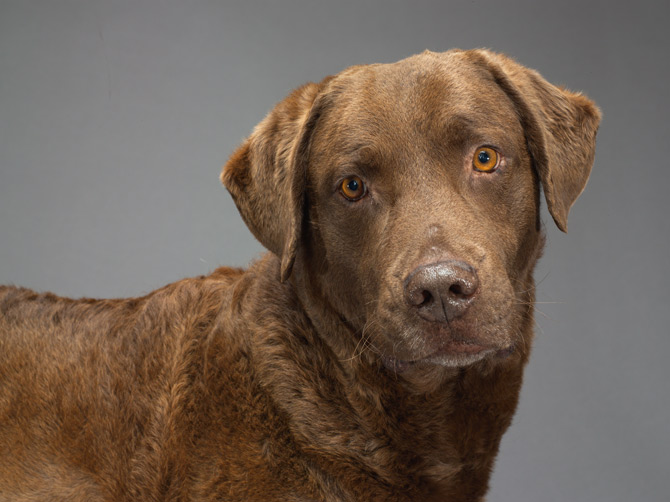
And don’t miss the fabulous photographs of dogs taken by Robert Clark which you can see here, another example of which is below. Robert Clark’s website is here.
Chesapeake Bay retriever, 48, Photograph by Robert Clark
A powerful lecture by the eminent Lord Martin Rees
Martin Rees at Jodrell Bank, 2007
I came across this interview a few days ago in connection with some book research that I was undertaking. Please don’t be put off by the 56 minute length because Martin Rees is one of the most pre-eminent cosmologists around today, as well as being the UK’s Astronomer Royal since 1995.
Make a promise to yourself to settle down sometime soon and watch the lecture, given at the University of Melbourne’s Medical School in 2010. And a warning! I going to pick up on some of the important points made by Martin Rees in a couple of posts next week.
Here’s how the lecture was reported by the Australian science website, SixOne Science,
Lord Rees in Melbourne
In a packed Sunderland Lecture Theatre in the University of Melbourne’s Medical School, Lord Martin Rees gave the inaugural Derek Denton Lecture in Science and the Arts. Lord Rees, an eminent and accomplished astrophysicist and cosmologist, is coming to the end of his five year tenure as the president of The Royal Society. The event even managed to attract or Prime Minister, Kevin Rudd, who entered without a noticeable entourage and with no fanfare, and the Governor of Victoria, Professor David de Kretser, a scientist himself.
The lecture was entitled “Life and the Cosmos”, a grand and sweeping title if ever there was one. It seemed like an impossible amount of material to cover in the allotted hour. However, Rees delivered an entertaining, humorous account of life from the big bang, through the formation of stars and galaxies, to the origins of life and perhaps the biggest crowd pleaser, the search for extra-terrestrial life. Most in the lecture theatre would not have learnt anything new, but this lecture was aimed at a general audience and the material was interesting enough to keep everyone interested for the hour despite being squashed into an ageing undergraduate lecture theatre complete with squeaky desks and a slightly musty smell. Perhaps Mr. Rudd was sufficiently uncomfortable to increase university funding, we can hope.
Whist this was predominately an overview of the subject material, Rees expressed some opinions about space exploration. He seemed torn between his human curiosity and the cost of human exploration. Given the advances in robotic exploration vehicles, Rees has difficulty in justifying the cost of sending humans on planetary exploration missions. Perhaps the best case for robotic exploration was made by the amazing photos he showed from the surfaces of Mars (photos) and Titan (photos), a moon of Saturn. Interestingly, Rees believes that if human exploration does proceed in the future it will be led by the Chinese or groups of private individuals. He also raised the issue of exploitation of other planets, something not often mentioned in the debate over human space travel. We need to decide if other bodies in our solar system are open for exploitation or if they should be preserved as wilderness, in a similar way to Antarctica. Given the pressures faced by places like Antarctica and the Amazon this will be an important debate should human exploration resume.
Rees concluded his lecture with the almost obligatory call for us to take better care or our own planet. He, like many others, recognises the unique place in history that we occupy. For the first time a single species is capable of exerting profound changes on the Earth’s natural and physical environments (although it might be argued that the first photosynthesizing cyanobacteria had a similarly singular influence by increasing the proportion of oxygen in the atmosphere). It is interesting to note that he does not see colonisation of other planets as a solution as the Earth is still the only known planet capable of sustaining us. Although he did discuss the likelihood of discovering Earth-like planets (pretty good given advances in technology). However, Rees did not paint an overly pessimistic picture and he generally came across as optimistic and enthusiastic about the future.
The organisers of the Derek Denton Lecture series should be commended for attracting such a high profile speaker for the first of the series. Hopefully the series will be successful, and if so may need to be moved to a bigger venue. If you want to see the lecture it will soon be available here. The next lecture of this series hasn’t been announced yet, it will be on the Arts, but you can check here for future public events at The University of Melbourne.
My rather slow response to my Versatile Blogger award!
Last Friday morning, the 16th, I turned on my PC to discover that lovely Kathryn Johnston of 4amWriter had nominated Learning from Dogs for the Versatile Blogger Award. I was blown away especially as since then the connections I have made with other writers have been wonderful.
However, a more prompt acknowledgement on LfD seems to have escaped me until today. I quickly learnt that there is a proper protocol associated with the response to the award.
Thank the award-giver and link back to them in your post.
Share 7 things about yourself.
Pass this award along to 15 blogs you enjoy reading.
Contact your chosen bloggers to let them know about the award.
So here goes!
Award logo
So first, a very big thank you to Kathryn of 4amWriter for including me in her list. As she said on her post, “This title says it all! If you love dogs, this is a must-visit!” That’s generous of Kathryn. Dogs are a very powerful reminder of an uncomplicated way to live, as described on the Home Page. The Vision behind the Blog is:
Our children require a world that understands the importance of faith, integrity and honesty
Learning from Dogs will serve as a reminder of the values of life and the power of unconditional love – as so many, many dogs prove each and every day
Constantly trying to get to the truth …
The power of greater self-awareness and faith …
Seven things about me!
H’mm, what to say.
Born in London 6 months before the end of WWII,
Been a business-to-business salesman most of my life,
Started my own business in 1978 and remained in ‘self-employment’ until quite recently,
Lived on my own boat, based in Larnaca, Cyprus, for 5 years,
A keen glider pilot for many years at Rattlesden Gliding Club in Suffolk, later a private pilot,
Always wanted to write,
And, finally, happier than I have ever been being married to Jean, having met in Mexico in 2007, moving out there with Pharaoh, my GSD, in 2008 and subsequently arriving in Payson, Arizona in 2010 with 11 dogs and 6 cats!
So here are the 16 Blogs (I use that description loosely) that I wish to pass this award to:
Yves Smith of Naked Capitalism. How Yves finds the time to produce the huge volume of articles and website links every day is beyond me.
James Kwak and Simon Johnson of Baseline Scenario. James and Simon were, for me, an early source of openness about the key issues affecting the global economy that slammed into our collective faces in 2008.
Patrice Ayme of the Blog of his own name. Patrice’s sub-heading on his Blog reads, “Intelligence at the core of humanism.” Again, a prolific writer with a huge intellect that he puts to wonderful use. Just pick anything that he has written to see that proved in spades.
Bill McKibben of 350.org. The headline on the website says, “We’re building a global movement to solve the climate crisis.” Say no more!
Michelle of Dog Kisses’s blog. Wonderful blog – just go there and enjoy it.
Sue of Sue Dreamwalker. Again, just a wonderful Blog – do please visit.
Vlatko, the owner of Top Documentary Films. We do not subscribe to any television channels at home so Vlatko’s resource is so valuable for us. Huge selection of free documentary films to watch.
Deanna Raeke and Andrea Rosebrock of the Blog For The Love of a Dog. Very active in fighting all corners on behalf of man’s oldest companion.
Rob Hopkins and his team at Transition Network. Rob is one of the leading voices for changing to a sustainable relationship with this planet. He is based in Totnes, Devon, my local town for many years when I lived in the village of Harberton. His books on Transition are masterpieces.
Victoria Brown, Daniel Honan and team at Big Think. As their headline says, “A forum where top experts explore the big ideas and core skills defining the 21st century.” Fabulous resource.
All the Directors and team at Sustainable Arizona. As is described on their site, Sustainable Arizona is about, “Our nonprofit organization is made up of volunteers and professionals committed to making sustainable development possible. We accomplish this by encouraging businesses that add true value to our communities while preserving the environment.“
Anthony Watts of Watt’s Up With That. With over 9,000 followers and over 98 million viewers this very reasonably can be regarded as the world’s most viewed climate website. Anthony’s 3 million monthly visitors puts my 40,000 into perspective!
The whole team at the US-based National Wildlife Federation. Their Mission: As America’s largest conservation organization, National Wildlife Federation works with more than 4 million members, partners and supporters in communities across the country to inspire Americans to protect wildlife for our children’s future!
Peter Russell of Spirit of Now. Peter writes on his Blogsite, “There are many observations I make in daily life—some profound, some mundane—mostly concerning the natural world around, or the nature of the inner world of mind. Some incline us to wonder and awe. Others make us think, and question our assumptions.” Never before have we needed so much to think about the way we think!
Nakibul Hoq, blogging from Bangladesh in the city of Dhaka under the Blog name of Freedom to Survive.
I shall be passing on the ‘award’ to all bloggers today.
Let me close again by saying such a big thank you to Kathryn of 4amWriter and, from that, how quickly I came across Limebird Writers who, I know, will be a great source of support as I face 2012 and ‘the novel’!
A fascinating talk by Luis von Ahn about new and powerful ways of collaborating.
Before moving on to this Post, just a quick word about the next seven days. I’m going to take a small break over Christmas, not by ceasing to publish Posts but by offering you a number of light-hearted items that have come my way. Hope you enjoy them and a very big thanks for the support of Learning from Dogs that you have shown over the year; it means a great deal. Have a wonderful Christmas vacation.
This particular Post focusses on a talk given (as below) by Luis von Ahn that is on TED Talks. The TED website is a fabulous resource. The interview was brought to my attention by Lee Crampton of Softdev. Lee and I go back a number of years, to the time when he and I were part of a small group that started up a company that offered online flight briefing services to the airline industry; still running today as it happens. So very happy to recommend Lee, more details of the services he can offer are here.
After re-purposing CAPTCHA so each human-typed response helps digitize books, Luis von Ahn wondered how else to use small contributions by many on the Internet for greater good. At TEDxCMU, he shares how his ambitious new project, Duolingo, will help millions learn a new language while translating the Web quickly and accurately — all for free.
Watching this video made me muse about the potential for this level of transformation in other areas. Fascinating!
The concluding part of what we might care to leave for the next generation
Mankind over the next few years is facing the start of an interval of economic chaos and social stress between the end of the fossil fuel age and whatever follows. That interval could well last a lifetime or more. Some might argue that the economic challenges that have been the mark of 2011 are, indeed, the first signs of this economic chaos.
How well we cope, adapt and survive is not going to be down to those of my age (born 1944) but to the bright youngsters who have been born in the 21st century.
That was the motivation behind publishing, on December 1st, the speech given by Steve Jobs, the 2005 Stanford Commencement Speech, and on December 6th, the famous and fabulous speech given by Sir Ken Robinson at the 2005 TED Talks conference.
The third and concluding message is a subsequent speech given by Sir Ken, this time in May 2010. It isn’t as stirring as his speech in 2005 but still a wonderful focus on what is our, as in homo sapiens, only chance of surviving – the innovation and creativity of the next generations.
In this poignant, funny follow-up to his fabled 2006 talk, Sir Ken Robinson makes the case for a radical shift from standardized schools to personalized learning — creating conditions where kids’ natural talents can flourish.