Possibly the start of the end of traditional means of generating electricity
A recent item by David Roberts on the Grist website/Blog caught my eye,
Solar is getting cheap fast—pay attention, Very Serious People
That was the headline to the opening, thus,
I hope everyone has read Kees Van Der Leun’s post about the rapidly falling cost of solar PV. I want to draw out one quick point that Kees leaves implicit.
He argues that PV will be the cheapest source of electricity for most of the world some time around 2018, and for the rest of the world soon after. That could be off by a few years in either direction. It depends on whether the cost curve for silicon solar cells continues as it has the past and, as Alan says in his comment, whether the cost curve for “balance of system” costs (steel, glass, installation, etc.) declines as well. Let’s say it could be off by five years either way. Let’s just assume it’s 2023 before solar PV crosses grid parity and becomes cheaper than coal.
The Kees Van Der Leun post, referred to, points out that,
For a long time, the holy grail of solar photovoltaics (PV) has been “grid parity,” the point at which it would be as cheap to generate one’s own solar electricity as it is to buy electricity from the grid. And that is indeed an important market milestone, being achieved now in many places around the world. But recently it has become clear that PV is set to go beyond grid parity and become the cheapest way to generate electricity.
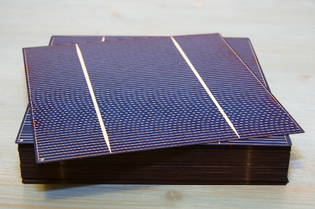
A hundred solar cells, good for 380 watts of solar PV power. Photo: Ariane van Dijk
Whenever I say this I encounter incredulity, even vehement opposition, from friends and foes of renewable energy alike. Apparently, knowledge of the rapid developments of the last few years has not been widely disseminated. But it’s happening, right under our noses! It is essential to understand this so that we can leverage it to rapidly switch to a global energy system fully based on renewable energy.
Working on solar PV energy at Ecofys since 1986, I have seen steady progression: efficiency goes up, cost goes down. But it was only on a 2004 visit to Q-Cells‘ solar cell factory in Thalheim, Germany, that it dawned on me that PV could become very cheap indeed. They gave me a stack of 100 silicon solar cells, each capable of producing 3.8 watts of power in full sunshine. I still have it in the office; it’s only an inch high!
That’s when I realized how little silicon was needed to supply the annual electricity consumption of an average European family (4,000 kWh). Under European solar radiation, it would take 1,400 cells, totaling less than 30 pounds of silicon.
Of course, you need to cover the cells with some glass and add a frame, a support structure, some cables, and an inverter. But the fact that 30 pounds of silicon, an amount that costs $700 to produce, is enough to generate a lifetime of household electricity baffled me. Over 25 years, the family would pay at least $25,000 for the same 100,000 kilowatt-hours (kWh) of electricity from fossil fuels — and its generation cost alone would total over $6,000!
He argues that PV will be the cheapest source of electricity for most of the world some time around 2018, and for the rest of the world soon after. That could be off by a few years in either direction. It depends on whether the cost curve for silicon solar cells continues as it has the past and, as Alan says in his comment, whether the cost curve for “balance of system” costs (steel, glass, installation, etc.) declines as well. Let’s say it could be off by five years either way. Let’s just assume it’s 2023 before solar PV crosses grid parity and becomes cheaper than coal.
Here’s the thing: 2023 isn’t that far off. It feels distant to us in a lot of ways. My kids will be out of college. Fifty versions of the iPhone will have come and gone. We might finally have the jetpacks we were promised.
But in terms of energy infrastructure, 12 years is nothing. It can take half that long or longer to permit and build big coal and nuclear plants, and they are meant to last a long-ass time. The Perry K Steam Plant, which serves downtown Indianapolis, was built in 1938. They didn’t have color TV then. Thirty-six coal plants in the U.S. were built before 1950. If a coal plant built today lasts that long, it will still be belching all over the atmosphere in 2072. My kids will be in their 60s.
This is also true of nuclear plants (the oldest is 42 years) and to a lesser extent natural-gas plants. It’s even true of transmission lines. These are large, long-term investments.
So if solar PV is going to be cheaper than coal in the next decade or so, that seems like the kind of thing utilities, regulators, investors, and political leaders would want to, I don’t know, talk over. Grapple with. Mull. It certainly seems relevant to the investment thesis for large, centralized power infrastructure. Yet it’s all but invisible in the elite U.S. energy conversation, outside of a few voices like FERC Chair Jon Wellinghoff. Very Serious People still see solar PV as an affectation, a kind of charity project.
Hope you are still with me, because this is really an incredibly positive message. By the time children born today are becoming teenagers, the means of harnessing the sun to deliver clean energy cheaper than carbon-based and nuclear generation will be a reality. In a little over a decade from now!
It is so easy to see doom and gloom wherever we look. For good reasons; these are very difficult times as societies pull back from the greed and materialism of recent times to a better, sustainable relationship with our planet, the only one we have. But technology and innovation are quietly creating the opportunities for a new future for humanity.
Let me finish with an email received recently from good friend, John H., up here in Payson, Arizona.
Greetings from a Mountain Top,
It has been another bright and peaceful day of Indian summer in the Ponderosa pine forests of the Arizona Rocky Mountains. Our annual state-wide church convention last weekend was a metaphorical breath of fresh air. It was an opportunity to realize where we’ve been and consider how far we have to go.
From the early evening vantage point of an upper porch with a vista of forest, mountains and sky, it appears that we’re facing spiritual, environmental, human and economic bankruptcy caused by top down idolatry, arrogance and ignorance.
It’s deeply disturbing to watch our human heritage destroyed by a corporate-government-military-industrial-intelligence complex with a clear plan to control the world through oppression. This systemic machine continues to increase the drain on the earth’s severely depleted resources.
Our present energy sources can no longer sustain exponential human population growth. The industrial use of fossil fuels is destroying the earth which sustains us. It’s time for us to wake up and read the book of life. It’s time to lighten the human footprint upon the earth while we still have a choice. Nature doesn’t care about human ambition.
Chance to spotlight the very creative work of Neil Kelly
I have had the pleasure of knowing Neil for a good number of years. I can’t recollect how and when we met but, these days, that applies to so much that slips away from the memory cells! Neil has been a great friend of my sister, Corinne, and brother-in-law, John, who like Neil, have lived in South Devon for many years. Pretty sure that it was through John and Corinne that I first met Neil.
Anyway, Neil’s wonderful, slightly askew sense of humour comes out in his art. Rest is obvious. Enjoy!
Finally, if you are within reach of Totnes and want to see Neil’s work, details of Rumour’s Wine Bar are here.
With great thanks to Dan G. for sending me the link.
Science educator James Drake built this amazing timelapse video from the perspective of the International Space Station as it flew over North and South America. He created this video by downloading a series of 600 photographs that were available online at theGateway to Astronomy Photograph of Earth, and then stitching them together into a complete video. You can see more of James work at his blog: infinity imagined.
Yesterday, I referred to a piece on the Chris Martenson blog about Joel Salatin, proprietor of Polyface Farms. I want to stay with the theme of food, and the growing thereof, as this is yet another critically important aspect of how we all have to change our attitudes and behaviours in the face of a growing ecological disaster.
I’m using a recent item presented by Rob Hopkins of Transition UK fame. The link to the full piece is here but I am presenting some extracts and further links in this article.
A while ago I was sent a book called ‘SPIN farming basics: how to grow commercially on under an acre’ by Wally Satzewich and Roxanne Christensen. The book describes itself as a “step-by-step learning guide to the sub-acre production system that makes it possible to gross $50,000+ from a half-acre”. SPIN, which stands for‘SmallPlot Intensive’ (their website is here), has the feel of an important, big, and timely idea, and it is one that fits into Transition beautifully. So what is it?
At the moment, when contemplating urban food production, the models that are used tend to be allotments, community gardens, planting productive trees or forest gardens, private gardens or even, perhaps, rooftop gardens. Commercial urban market gardens tend to be thought of as needing to be on a larger scale and requiring significant infrastructure. SPIN is based on the idea of ‘patchwork farming’, of seeing unused areas of urban land as having the potential to be worked commercially, viewed through the eyes of a commercial grower rather than someone growing for a hobby. This is a profound shift of emphasis and one that I find very exciting. Here is a short talk by SPIN farmer Paula Sobie of City Harvest which gives her take on what SPIN farming is:
Let me quote how that article from Rob concludes,
‘SPIN farming basics’ is just one of the books that SPIN produce. It isn’t a step-by-step growing guide, rather it is an overview book on how to run such an operation. I have no way of gauging whether their figures are accurate and how they might translate into the UK context. I’m also not sure what they do about slugs. There is also, I guess, a distant danger that should this really take off it might edge out more egalitarian forms of urban land use, such as allotments and community gardens. But even if they are only half right about their potential yields, it is still an impressive approach, and it calls for a powerful shift in focus for urban growers. In the wake of the recent riots in a number of English cities, I am struck by the potential of this approach to shift thinking about how to create viable social enterprises and a sense of purpose for young people. It has certainly got my brain ticking over pretty rapidly.
As the authors put it, “once you put on SPIN glasses, you start seeing dollar signs all over vacant and underutilised patches of land”. As economic contraction worsens, and peak oil starts to bite, this form of land use will become the norm, as it has done every time in history that societies have faced similar sets of circumstances. The obstacle to getting started has always been how to make this stuff viable. That obstacle, thanks to the work of the SPIN folks, would appear to no longer exist, or at least to be greatly diminished. If you don’t do it someone else will, and they likely won’t do it in a way rooted in social justice, community benefit, food security and Transition. This is an important window in time to get moving on this.
This is a revolutionary text, an incendiary call to rethink urban land use in a way that ticks everyone’s boxes. I can’t recommend it too highly.
It is rather hard to tell from the SPIN website which of the books they offer is this one… so for the last time ever, here is a link to the book on Amazon…. it is quite pricey, but one to get and share with as many people as you can…
The SPIN Farming website is chock full of fantastic ideas, advice and guidance. Website is here. From which you will understand,
THINKING OF FARMING? THINK AGAIN.
There’s a new way to farm. It’s called SPIN, and it is causing people to re-think not only how to farm, but what it means to be a farmer today.
Some practice SPIN in their backyards in the city. Others do it on front lawns in the suburbs.
Some do it part-time, others full-time.
Some are young and just starting out, while others are older and on their third or fourth careers.
Some have more money than they know what to do with, and others have less than they need.
Some are convinced the world is doomed, while others are trying to save it.
What unites them all is a calling to farm.
If you want to follow your calling, follow the system that shows you how to make money farming.
It’s one of the many beams from that wonderful rainbow just over the horizon!
Want a brilliant idea for tomorrow? Stay in the present!
Dogs do this wonderfully. I am told that followers of Zen Buddhism discover peace and grace from embracing the present. But is there more to this? Is there some deeper psychology involved? Does our species have an intrinsic challenge in terms of staying in the present?
My musings on this arise from a couple of recent conversations.
The first was with Peter McCarthy from the Bristol area of West England. Peter and I go back a few years (at my age, everything goes back a few years!) and at one stage I did some work for Peter’s company, Telecom Potential. Just a quick aside, Peter’s company was based in the magnificent Clevedon Hall, a mansion built in 1853 as a family home for Conrad William Finzel, a German-born businessman. Here’s a picture of one of the rooms,
A room at Clevedon Hall
Peter, like me, is sure that the period in which the world now appears to be, is not some cyclical downturn, not some temporary departure from the national growth and employment ambitions promoted by so many countries. No! This one is different.
Peter is sure that a major transition is under way, as big as any of the great societal upheavals of the past. And, for me, a fascinating comment from Peter was his belief that the key attitude required for the next years would be innovation. Peter reminded me that we tend to think of innovation as applying to things physical, scientific and technical. But Peter sensed that it would be in the area of social innovation where key changes would arise and, from which, these large societal changes would flow.
Then a day later I was chatting with one of the founders of a brilliant new authentication process, Pin Plus. It is a very smart solution to a major global problem, the weaknesses of traditional password user-authentication systems.
On the face of it, Pin Plus is obviously a better and more secure way of authenticating users, and a number of key test customers have borne this out. Jonathan C was speaking of the challenges of convincing companies to have faith in this new process. This is what he said,
More than once, indeed many times, I am told by prospects something along the lines that the IT world has been looking so hard and so long for a password solution that a solution can’t possibly exist.
Let’s ponder that for a moment. Are we saying that a far-sighted approach to the potential for change is not an easy place for some, probably many, human brains?
Indeed, Jonathan and I mused that here we were, both speaking via Skype, an internet telephony service, both of us looking at different web sites in support of many of the points that we were discussing and totally dependent, in terms of our mentoring relationship, on the technology of the internet, a multi-node packet-switched communications system that was a direct result of the American shock of seeing the Russians launch the world’s first artificial satellite, Sputnik 1, into low earth orbit on the 4th October, 1957.
Launch of Sputnik 1
At that time, it would have seemed impossible for anyone on the planet to see that the American response to Sputnik 1 would eventually lead to the vast packet-switched network that is now the modern Internet.
But why do we regard the ability to look into the future so utterly out of reach of the common man? Look at this, the Internet Timeline here. Look how quickly the response to Sputnik1 gathered pace. See how Leonard Kleinrock of MIT way back in May, 1961, presented a paper on the theory of packet-switching in large communications networks.
So maybe there’s a blindness with humans. A blindess that creates the following bizarre characteristics,
Whatever is going on in our lives at present we assume will go on forever. I.e. the boom times will never end, or the period of doom and gloom is endless.
Our obsession with how things are now prevents us from reflecting on those signs that indicate changes are under way, even when the likely conclusions are unmistakeable. The ecological and climatic changes being the most obvious example of this strange blindness that mankind possesses.
Yet, unlike animals and some spiritual groups of humans, truly living in the present appears incredibly difficult for man.
However, the history of mankind shows that our species is capable of huge change, practically living in constant change for the last few millennia, and that a very small proportion of a society, see yesterday’s article, is all that is required to create a ‘tipping point’.
I want to continue with this theme but conscious that there is still much to be written. So, dear reader, I shall pause and pick this up tomorrow.
Today, delighted to offer a guest post from author Garth Stein
Garth Stein and dog!
But first to how this came about. Way back in June, I was contacted by Wiley Saichek who signed off his email, Marketing Director, Authors On The Web. To be frank, I hadn’t heard of the organisation before. Wiley invited me to participate in something he called a Blog Tour on behalf of Garth Stein. It was connected with Garth’s latest book, The Art of Racing in the Rain.
Jeannie had read it some time ago and thoroughly enjoyed it. The book had been next to my side of the bed for weeks but, ironically, the demands of my own writing had just got in the way of me reading it.
Anyway, back to the Blog Tour!
Apparently, the ideal was to have the guest post published on Learning from Dogs during the period July 18th to August 1st but I dragged my heels waiting and hoping that the story from Garth could include a picture of Comet. The picture has not been forthcoming so here it is anyway. I shall be reviewing Garth’s book The Art of Racing in the Rain as soon as I can get around to reading it.
A Game Called Fetch, by Garth Stein
People often ask me about my dog, Comet. They want to know if she was the inspiration for Enzo, the dog narrator in my book, The Art of Racing in the Rain (and the young reader version, Racing in the Rain: My Life as a Dog). And the answer is, flatly, no. Enzo is a singular character, I tell them, and has no predecessor. Comet is goofy and silly, and is very much not Enzo. But she’s still very smart–in her own Comet way–and has taught me much about the world.
When Comet was just a pup, she hated being left at home; she didn’t like the responsibility of having the house to herself. She would always get into some mischief: eat an entire bunch of bananas, for instance (having peeled them first!). Or claw her way into the pantry looking for cookies. But one day, she communicated her anxiety in a way that was so clear, so unmistakable, there was no doubt at all as to her feelings. We went out for a couple of hours, confining her to the kitchen/dining area of our house. And when we came home, there was a perfectly round, undisturbed puddle of urine on the dining room table.
Now that is a statement. Message received. Since that day, whenever we get ready to leave her alone in the house, she willingly–one might saygratefully–finds her crate, curls up, and waits for us to secure the door.
While Comet may not be able to wax eloquently about philosophy and popular culture as Enzo does, she did teach me an important lesson this summer.
Comet loves playing fetch with a tennis ball. She always has. And she will run herself into the ground chasing balls, so that my arm gets sore throwing a ball for her with my Chuck-It, and I find myself neglecting my cooking duties, my lawn mowing, my reading, my writing, and even my children…all to throw a tennis ball for Comet.
This summer I purchased a GoDogGo. It’s a ball launcher with a bucket of tennis balls and a delayed feed, so one can teach one’s dog to play fetch with herself. A brilliant idea! The machine spits the ball, the dog fetches it, drops it in the bucket, the machine spits it again. Ad infinitum.
And so one weekend this summer, I decided to teach Comet how to use this machine so I could do other things that needed doing, like cleaning gutters and grilling chickens.
Well, she got the idea right away. Launch, fetch, drop. She was really quite good. And then I taught her launch, fetch, drop-in-the-bucket, prepare for re-launch. And she got that, too.
“I have the smartest tennis-ball-dog on the planet,” I thought. “She picked this up in ten minutes! Now I can go have an iced tea while she plays fetch with a ball throwing machine.”
But it didn’t work. As soon as I stepped away, she lost the thread. Ball launch, ball fetch, ball dropped in the bucket. Instead, she dropped it next to the bucket and stared at it while the machine ground its ball-throwing wheels in anticipation.
“Come on, Comet,” I said. “Drop it in the bucket!”
I dropped the ball in the bucket, the launcher launched, Comet fetched, and dropped the ball at my feet.
“In the bucket,” I said. She wagged, sat and barked and waited for me to drop the ball in the bucket.
I spent two days teaching her how to drop the ball in the bucket by herself. Sometimes she’d do it for me–so I knew it was possible!–but the moment I stepped away to attend to some other business, she lost her ability to drop the ball in the bucket. She’d stand over the ball and bark until I came to help her. It was a miserable time.
As Sunday evening arrived, my wife came outside to see how our training was going. I expressed to her my frustration. “She knows what to do,” I said. “She just won’t do it.”
My wife watched as I put the ball in the bucket and the launcher clicked, ratcheting up its gears. Comet had gotten to recognize the clicks that meant the ball would soon be launched, and she sunk to her haunches, tail wagging, staring at the launch tube. And then with a thwack! the ball sailed across the yard and she took off after it, recovered it, dropped it at my feet and barked happily.
“She won’t drop it in the bucket,” I said, bewildered. “She wants me to drop it in the bucket.”
My wife smiled at me my sympathetically. “Comet doesn’t want to play fetch with a machine,” she said. “She wants to play fetch withyou.”
And I realized, in my effort to make my life more efficient, in order to multi-task one more thing during a busy day, that playing fetch is not about economy and efficiency. It’s about playing fetch.
The ball launcher sits in the shed gathering dust these days, but the Chuck-It is always in use. And while Comet might like to spend every waking hour of every day playing fetch, she realizes that I have to put the ball down at some point to cook dinner or play with my family or write a book. But she’s okay with that. Because when we do play fetch together, that’s the only thing we’re doing–we are focused on each other, and that’s what the game is all about.
In Paul Gilding’s book, The Great Disruption, there is a chapter called When the Dam of Denial Breaks. On page 121 Paul Gilding writes this,
To argue we are naturally greedy and competitive and can’t change is like arguing that we engage naturally in murder and infanticide as our forebears the chimps do and therefore as we did. We have certain tendencies in our genes, but unlike other creatures we have the proven capacity to make conscious decisions to overcome them and also the proven ability to build a society with laws and values to enshrine and, critically, to enforce such changes when these tendencies come to the surface.
So don’t underestimate how profoundly we can change. We are still capable of evolution, including conscious evolution. This coming crisis is perhaps the greatest opportunity in millennia for a step change in human society.
The United States of America gets a lot of stick, rightly so, for it’s greedy consumption of energy, especially the use of coal. According to the World Coal Association, the USA in 2010 produced 932 million tons of hard coal, second in the world to China that produced 3,162 million tons.
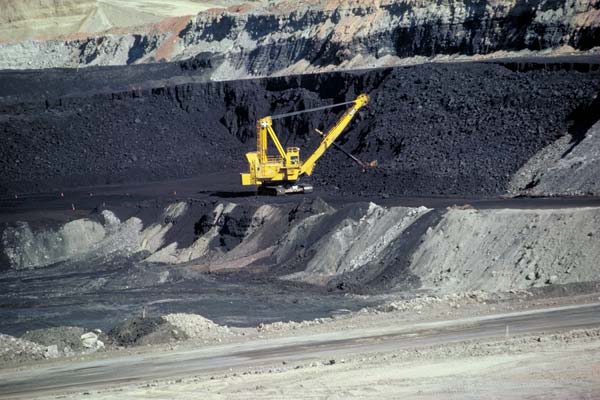
Coal mine in Wyoming
But the one thing that the USA has shown time and time again is that it has the capacity to change very quickly, especially when the country, from its leaders to its entrepreneurs, senses a global leadership opportunity. With that in mind, read the latest release from the Earth Policy Institute, reproduced below,
AUGUST 10, 2011 A Fifty Million Dollar Tipping Point?
Lester R. Brown
At a press conference on July 21, New York City Mayor Michael Bloomberg announced that he was contributing $50 million to the Sierra Club’s Beyond Coal Campaign. Michael Brune, head of the Sierra Club, called it a “game changer”. It is that, but it also could push the United States, and indeed the world, to a tipping point on the climate issue.
It is one thing for Michael Brune to say coal has to go, but quite another when Michael Bloomberg says so. Few outside the environmental community know who Michael Brune is, but every business person knows Michael Bloomberg as one of the most successful business entrepreneurs of his generation.
The Sierra Club’s Beyond Coal Campaign has two main goals. The first is to prevent the permitting and construction of new coal-fired power plants. So far 153 proposed power plants have been taken off the board. The second goal is to close the 492 existing plants. The Sierra Club lists 71 plants already scheduled for total or partial closure, most of them by 2016.
The efforts to stabilize climate will be won or lost with coal, the world’s largest source of carbon emissions. The effort to phase out coal is now well under way in the United States, the world’s second ranking coal user after China.
There are likely to be many ripple effects from the Bloomberg grant. To begin with, it may encourage other philanthropists to invest in climate stabilization.
The prospect for investment in coal, already deteriorating, will weaken even faster. In August 2010, the Rainforest Action Network (RAN) announced that several leading U.S. investment banks, including Bank of America and J.P. Morgan, had ceased lending to companies involved in mountaintop removal coal mining. Now with Bloomberg’s opposition, investors will be even more wary of coal.
The Bloomberg-Sierra initiative again focuses attention on the 13,200 lives lost each year in the United States due to air pollution from burning coal. If deaths from black lung disease among coal miners are included the number climbs even higher. The number of coal-related deaths in one year dwarfs total U.S. fatalities in the Iraq and Afghanistan wars. We invest heavily in protecting the lives of our troops in the Middle East, and rightly so. Bloomberg is saying let’s do the same for our people at home.
In addition, this initiative brings attention to the health care costs to society of burning coal. These are currently estimated at more than $100 billion per year, roughly $300 for every person in the United States or $1,200 for a family of four. These costs are real, but it is the American people, not the coal companies, who shoulder the burden.
Further reinforcing the urgency of phasing out coal are the more extreme weather events that climate scientists have been warning about for decades. During the first half of 2011 we watched TV news channels become weather channels. First it was a record number of tornadoes in one month, including the one that demolished Tuscaloosa, Alabama. Then, a few weeks later, an even more powerful tornado demolished Joplin, Missouri. As drought and heat sparked record or near-record wildfires in Arizona, New Mexico, and Texas, the lower Mississippi Basin was flooding. Searing heat waves scorched the southern Great Plains, the Midwest, and the East Coast. Intense heat has continued to break records across the country as Texas suffers its most severe one-year drought on record.
For coal, the handwriting is on the wall. Between 2007 and 2010, coal use in the United States dropped 8 percent. (See data.) Meanwhile, more than 300 new wind farms came online, totaling over 23,000 megawatts of generating capacity—the electricity output equivalent of 23 coal-fired power plants.
When people were asked in a national poll where they would like to get their electricity from, only 3 percent opted for coal. Despite the coal industry’s heavy expenditures to promote “clean coal,” it is still a loser in the public mind.
In addition to the Sierra Club, RAN, and a talented team of Earthjustice lawyers, the anti-coal movement also has allies in Friends of the Earth and Greenpeace, the latter with its highly developed capacity to focus public attention on environmental issues. This was evident in May when a Greenpeace team of eight daring activists scaled the 450-foot Fisk coal plant smokestack located in Chicago and painted “Quit Coal” on it. They were drawing public attention to the deadly air pollution in the city coming from the plant.
As the United States closes its coal-fired power plants, it sends a message to the world. With Michael Bloomberg’s grant bolstering the Sierra Club’s well-organized program to phase out coal, we can now imagine a coal-free United States on the horizon. The United States could again become a world leader, this time in stabilizing climate.
“The United States could again become a world leader, this time in stabilizing climate.” That would be a dream come true, a dream of unimaginable consequences.
The president of Earth Policy Institute presents his thesis on how best to save mankind.
Before turning to the theme of this Post, just a personal message. I arrived back home in Payson, Arizona yesterday and, as much as I love the huge number of readers that now regularly visit Learning from Dogs, I love my dear wife rather more 😉 So for the next few days, please understand why this Blog will be tending to ‘republish’ the fine works of others, to lessen the creative load on yours truly.
One key component of the Plan B climate stabilization strategy is solar energy. Solar is even more ubiquitous than wind energy and can be harnessed with both solar photovoltaics (PV) and solar thermal collectors.
Solar PV—both silicon-based and thin film—converts sunlight directly into electricity. The growth in solar cell production climbed from an annual expansion of 38 percent in 2006 to an off-the-chart 89 percent in 2008, before settling back to 51 percent in 2009. At the end of 2009, there were 23,000 megawatts of PV installations worldwide, which when operating at peak power could match the output of 23 nuclear power plants. Germany, with an installed PV power generating capacity of almost 10,000 megawatts, is far and away the world leader in installations.
On the manufacturing front, the early leaders—the United States, Japan, and Germany—have been overtaken by China, which produces more than twice as many solar cells annually as Japan. World PV production has roughly doubled every two years since 2001 and exceeded 20,000 megawatts in 2010.
Historically, photovoltaic installations were small-scale—mostly residential rooftop installations. Now that is changing as utility-scale PV projects are being launched in several countries. The United States, for example, has under construction and development some 77 utility-scale projects, adding up to 13,200 megawatts of generating capacity. Morocco is now planning five large solar-generating projects, either photovoltaic or solar thermal or both, each ranging from 100 to 500 megawatts.
More and more countries, states, and provinces are setting solar installation goals. Italy’s solar industry group is projecting 15,000 megawatts of installed capacity by 2020. Japan is planning 28,000 megawatts by 2020. The state of California has set a goal of 3,000 megawatts by 2017. Solar-rich Saudi Arabia recently announced that it plans to shift from oil to solar energy to power new desalination plants that supply the country’s residential water. It currently uses 1.5 million barrels of oil per day to operate some 30 desalting plants.
With installations of solar PV climbing, with costs continuing to fall, and with concerns about climate change escalating, cumulative PV installations could reach 1.5 million megawatts (1,500 gigawatts) in 2020. Although this estimate may seem overly ambitious, it could in fact be conservative, because if most of the 1.5 billion people who lack electricity today get it by 2020, it will likely be because they have installed home solar systems. In many cases, it is cheaper to install solar cells for individual homes than it is to build a grid and a central power plant.
The second, very promising way to harness solar energy on a massive scale is a large-scale solar thermal technology, often referred to as concentrating solar power (CSP), that uses reflectors to concentrate sunlight on a liquid, producing steam to drive a turbine and generate electricity. One of the attractions of utility-scale CSP plants is that heat during the day can be stored in molten salt at temperatures above 1,000 degrees Fahrenheit. The heat can then be used to keep the turbines running for eight or more hours after sunset.
CSP first came on the scene with the construction of a 350-megawatt solar thermal power plant complex in California. Completed in 1991, it was the world’s only utility-scale solar thermal generating facility until the completion of a 64-megawatt power plant in Nevada in 2007.
Although solar thermal power has been slow to get under way, utility-scale plants are being built rapidly now, led by the United States and Spain. The United States has more than 40 solar thermal power plants operating, under construction, and under development that range from 10 to 1,200 megawatts each. Spain has 60 power plants in these same stages of development, most of which are 50 megawatts each. The American Solar Energy Societynotes that solar thermal resources in the U.S. Southwest can satisfy current U.S. electricity needs nearly four times over.
In July 2009, a group of 11 leading European firms and one Algerian firm, led by Munich Re and including Deutsche Bank, Siemens, and ABB, announced that they were going to craft a strategy and funding proposal to develop solar thermal generating capacity in North Africa and the Middle East. Their proposal would meet the needs of the producer countries and supply part of Europe’s electricity via undersea cable.
This initiative, known as the Desertec Industrial Initiative, could develop 300,000 megawatts of solar thermal generating capacity—huge by any standard. Caio Koch-Weser, vice chair of Deutsche Bank, noted that “the Initiative shows in what dimensions and on what scale we must think if we are to master the challenges from climate change.”
Even before this proposal, Algeria—for decades an oil exporter—was planning to build 6,000 megawatts of solar thermal generating capacity for export to Europe via undersea cable. The Algerians note that they have enough harnessable solar energy in their vast desert to power the entire world economy. This is not a mathematical error. The German government was quick to respond to the Algerian initiative. The plan is to build a 1,900-mile high-voltage transmission line from Adrar deep in the Algerian desert to Aachen, a town on Germany’s border with the Netherlands.
At the global level, Greenpeace, the European Solar Thermal Electricity Association, and the International Energy Agency’s SolarPACES program have outlined a plan to develop 1.5 million megawatts of solar thermal power plant capacity by 2050. For Earth Policy Institute’sPlan B to save civilization, we suggest a more immediate world goal of 200,000 megawatts by 2020, a goal that may well be exceeded as the economic potential becomes clearer.
The pace of solar energy development is accelerating as the installation of rooftop solar water heaters—solar thermal collectors on a smaller scale—takes off. This technology is sweeping China like wildfire, with an estimated 1.9 billion square feet of rooftop solar thermal collectors installed, enough to supply 120 million Chinese households with hot water. Other developing countries such as India and Brazil may also soon see millions of households turning to this inexpensive water heating technology. Once the initial installment cost of rooftop solar water heaters is paid back, the hot water is essentially free.
In Europe, where energy costs are relatively high, rooftop solar water heaters are also spreading fast. Systems typically pay for themselves in electricity savings within 10 years. In Austria, 15 percent of all households now rely on them for hot water. As in China, in some Austrian villages nearly all homes have rooftop collectors. And some 2 million Germans are now living in homes where water and space are both heated by rooftop solar systems.
The U.S. rooftop solar water heating industry has historically concentrated on a niche market—selling and marketing 100 million square feet of solar water heaters for swimming pools between 1995 and 2005. The industry was poised to mass-market residential solar water and space heating systems when federal tax credits were introduced in 2006. Led by Hawaii, California, and Florida, annual U.S. installation of these systems has more than tripled since 2005. The state of Hawaii requires that all new single-family homes have rooftop solar water heaters. California aims to install 200,000 solar water heaters by 2017, and New York State aims to have 170,000 residential solar water systems in operation by 2020.
With the cost of rooftop heating systems declining, many other countries will likely join Israel, Spain, and Portugal in mandating that all new buildings incorporate rooftop solar water heaters. Worldwide, Plan B calls for a total of 1,100 thermal gigawatts of rooftop solar water and space heating capacity by 2020.
Moving fast to harness the world’s enormous solar potential would bring a clear win for local economies and for the climate.
“In a world dependent on fossil energies, Solar Impulse is a paradox, almost a provocation.”
Press release gobbledygook? Absolutely. But you’ve got to give it up for any company with the guts to try designing and building a true solar airplane.
We’ve written about Solar Impulse — it’s a consortium of European financial and technology parters led by the Federal Institute of Technology in Lausanne, Switzerland. The group is working on a solar-powered plane that can take off under its own power without generating any emissions at all. The general idea is that sunlight would not only power the plane during the day but would also charge its lithium batteries, allowing it to fly around the clock pollution free.
That was written May 12th, 2008. This is now! Landing at Brussels International Airport, May 2011.
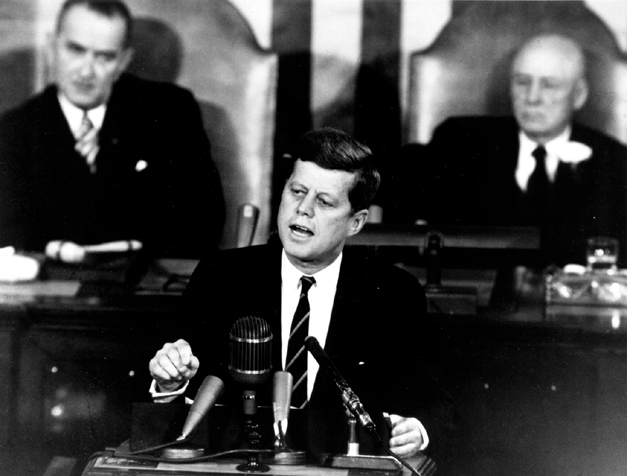
President John F. Kennedy's May 25, 1961 Speech before a Joint Session of Congress
On the 25th May, 1961, President John Kennedy summoned a joint session of Congress and asked America to commit itself to a goal – that of landing a man on the moon and returning him safely to Earth before the decade was out.
There’s a good link on the NASA site to the speech.
MY print column this week notes that it is half a century next week since John Kennedy called for sending a man to the moon and returning him safely to Earth. The bottom line, I think:
If we can send a man to the moon, people ask, why can’t we [fill in the blank]? Lyndon Johnson tried to build a “great society”, but America is better at aeronautical engineering than social engineering. Mr Obama, pointing to competition from China, invokes a new “Sputnik moment” to justify bigger public investment in technology and infrastructure. It should not be a surprise that his appeals have gone unheeded. Putting a man on the moon was a brilliant achievement. But in some ways it was peculiarly un-American—almost, you might say, an aberration born out of the unique circumstances of the cold war. It is a reason to look back with pride, but not a pointer to the future.







 Learning from Dogs