Category: Innovation

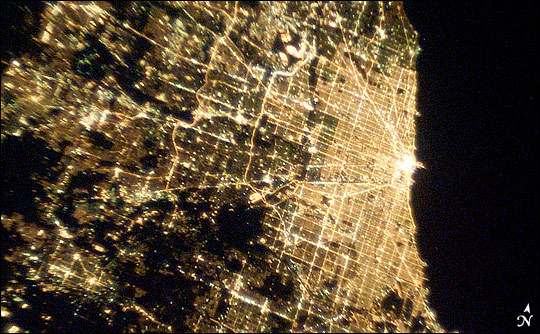
Down here, from up there!

The power of mankind’s footprint on Planet Earth.

Last Friday, I published a post under the title of People, people, everywhere! Coincidentally, that same day over on Transition Town Payson‘s blog a post was published Urban Sprawl, a Vision from Space! It seemed like a fitting follow-on to that post on Learning from Dogs and is reproduced with the kind permission of the TTP team (thanks Rob).

oooOOOooo

Urban Sprawl, a Vision From Space!

Posted on by

Urban Sprawl has a major impact on all our Resources!

Urban Sprawl can be tracked

In the Sun Belt Areas of our country, phenomenal growth has occurred over the past 30 years.  Satellite images from 1984 through 2012 show the impacts on the Landscape in a time lapse image that is a scary picture of what the next 30 years may bring.

A blog article from the Atlantic Cities website forwarded to me by my friend Dave H. It is a geographic time lapse of satellite images provided by Google.  Their article titled  “The Devastating Impact of 30 Years of Sprawl, as Seen From Space.” gives startling images of how our cities have grown.

“These GIFs were recorded from Google’s “Landsat Annual Time Lapse” tool by Samuel Aston Williams, a young Texas architect. Williams wanted to contribute something new to a startling series of showing three decades of human-landscape intervention recently produced by a collaboration of Google, NASA, TIME and others.”

Read the full article.

The Atlantic Cities also published a blog titled “A Terrifying, Fascinating Time lapse of 30 Years Impact on Earth.”  The images in this blog shows development in other places on the earth in a scary 30 year blink of an eye.

“Since the 1970s, NASA and the U.S. Geological Survey have been amassing satellite images of every inch of our planet as part of the Landsat program. Over time, the images reveal a record of change: of cities expanding, lakes and forests disappearing, new islands emerging from the sea off the coast of rising Middle East metropolises like Dubai.

If you could thumb through these historic pictures as if in a flip book, they would show stunning change across the earth’s surface, in both our natural environments and our man-made ones. Now, the digital equivalent of that experience is possible – three decades of global change as GIF – in a project unveiled today between NASA, the USGS, TIME, Google, and the CREATE Lab at Carnegie Mellon University.

Landsat images taken between 1984 and 2012 have been converted into a seamless, navigable animation built from millions of satellite photos. As Google wrote this morning on its blog: “We believe this is the most comprehensive picture of our changing planet ever made available to the public.”

See the time lapse images here.

Here’s the Problem!

World Population Growth.

Our Population is only going to Grow Larger!

World population details here.

NASA has also been Following Urban Sprawl

This is how Baltimore has grown in 200 Years!

October 11, 2002:  While space technology was undergoing its spectacular birth during the 1950s and ’60s, and visionaries were predicting the spread of human colonies into space, another kind of human colony was spreading rapidly–right here on Earth!

It was the dawn of the modern suburb, a time of post-war prosperity when housing developments popped up across the landscape like mushrooms after a rain.

A half-century later, we now understand that many environmental problems accompany the outward spread of cities: fragmenting and destroying wildlife habitat, for example, and discharging polluted runoff water into streams and lakes.”

More information here.

Urban Sprawl in the United States is covered in Photos by Christoph Gielen

The photo below was taken by Christoph Gielen.  There is a symmetrical beauty to his aerial photos of Urban Areas.  Please go to his Twisted Sifter website for phenomenal aerial photos of our Urban Centers.

A Great Aerial photo by Christoph Gielen of an Arizona Neighborhood

Urban Sprawl is defined in detail at the Wiki website;

An interesting phenomena is that Sprawl is a term only used in America for Urban Growth,  “The term “sprawl” is most often associated with US land use; outside the US (and especially outside the Anglosphere), the term “peri-urbanisation” is often used to denote similar dynamics and phenomena.”

More on Urban Sprawl.

Urban Sprawl and Public Health?

Smart Growth is the alternative to Urban Sprawl,  unfortunately many people argue against high density living and it is still a contentious point.  Do we continue to grow outward or upward.  Will we feel more like rats trapped in a cage or free range rats. Read the following National Institute of Health article for their take on the impacts of Urban Sprawl vs. Smart Growth.

Urban Sprawl

“Urban sprawl in the United States has its origins in the flight to the suburbs that began in the 1950s. People wanted to live outside of city centers to avoid traffic, noise, crime, and other problems, and to have homes with more square footage and yard space. As suburban areas developed, cities expanded in geographic size faster than they grew in population. This trend has produced large metropolitan areas with low population densities, interconnected by roads. Residents of sprawling cities tend to live in single-family homes and commute to work, school, or other activities by automobile.”

“Although there is considerable evidence that urban sprawl has adverse environmental impacts and contributes to a variety of health problems—including obesity, diabetes, cardiovascular disease, and respiratory disease implementation of policies designed to combat sprawl, such as smart growth, has proven to be difficult.”

Smart Growth

“Smart growth can be defined as a policy framework that promotes an urban development pattern characterized by high population density, walkable and bikeable neighborhoods, preserved green spaces, mixed-use development (i.e., development projects that include both residential and commercial uses), available mass transit, and limited road construction.”

Urban Sprawl, Smart Growth, and Deliberative Democracy

From Wiki these are the Advantages and Disadvantages of Urban Sprawl

Advantages

– More single family residences on larger lots.
– Lower land prices.
– Less experience of noise and pollution.
– Suburban areas generally associated with “sprawl” tend to have lower crime and higher-quality schools.
– Perceived overwhelming consumer preference for sprawl-type developments.

Disadvantages

– High car dependence.
– Inadequate facilities e.g.: cultural, emergency, health, etc.
– Higher per-person infrastructure costs.
– Inefficient street layouts.
– Low diversity of housing and business types.
– Higher per-capita use of energy, land, and water.
– Perceived low aesthetic value

Source: Wikipedia

Our Human Colonies seem to be spreading about as fast as our ice caps are melting.  I wonder if there is any correlation?

Is it time for mankind to adapt to a new future?  No, it’s past time.  We have a lot of catching up to do in implementing new technologies to provide sustainable growth options in all areas; industry, transportation, energy production, carbon footprints, food supply, to taking care of our precious fresh water supplies.

How do we make our cities more sustainable and resilient?  Start with telling your national, state and local politicians that you want a sustainable future.  Let’s work together and make this happen.

Urban Sprawl or Smart Growth, your choice!

Make your world Sustainable!

oooOOOooo

Entropia, a review.

A review of the new book by Dr. Samuel Alexander.

Back last November, not long after Jean and I had moved up to Oregon, I saw this on the PRI website: The Sufficiency Economy – Envisioning a Prosperous Way Down. Very quickly I realised the importance of the essay and contacted the author requesting permission to republish on Learning from Dogs.  That author was Dr. Samuel Alexander and permission was quickly given, leading to two essays: The simpler life and Where less is so much more.

Now fast forward to nearly a month ago and in came this email:

Samuel Alexander here, from the Simplicity Institute. I’ve recently published a new book, Entropia: Life Beyond Industrial Civilisation. Was wondering whether you were interested in posting either a review or an excerpt on your website?

I was flattered to have been asked and delighted to review the book.

First, some background. samuelalexanderDr. Alexander is a part-time lecturer with the Office for Environmental Programs, University of Melbourne, Australia. He teaches a course called ‘Consumerism and the Growth Paradigm: Interdisciplinary Perspectives’ in the Masters of Environment.

He is also co-director of the Simplicity Institute and co-founder of Transition Coburg. He writes regularly at the Simplicity Collective and posts most of his academic essays at www.TheSufficiencyEconomy.com.

oooOOOooo

Introduction

After the review was completed, I forwarded it to Sam just to check that I hadn’t made any technical errors.  Within Sam’s reply to that email was his acknowledgement that his book fell into a genre that was not easily classified.  Ergo, the book being fiction yet not a novel.  Sam went on to muse that perhaps he should have been clearer about what the reader was going to get.  He wondered if my review should mention that aspect.  I said that I wouldn’t amend my review but would include an introduction to that effect, as now witnessed!

So to the review.  (Note: For some reason, I was unable to prevent the paragraph spacing from being deleted in the published version.  Hence the insertion of a single ‘-‘ after each paragraph.)

oooOOOooo

Entropia-Cover

Entropia – Life Beyond Industrial Civilisation by Samuel Alexander

A review by Paul Handover

The title of the book didn’t offer this reader any clue about what might be coming. Nevertheless, very soon an experience of an ‘ah-ha’ moment arrived. Right on page one of the Acknowledgements when this sentence jumped off the page: “Henry Thoreau has been by far the greatest influence on my worldview, for it was he who awakened me to the insight that ‘superfluous wealth can buy superfluities only’.” [my emphasis] Wow, what an intriguing turn of phrase about wealth.

I plunged into the Prologue:

After the poets were banished from Plato’s Republic it is said that they set sail into unknown horizons in search of a new place to call home.

Shortly later reading:

But life proceeds in twists and turns, not straight lines. After losing consciousness in the midst of this perfect storm, the lost poets found themselves washed ashore on a small,fertile island, which was uninhabited and isolated entirely from the rest of civilisation. The boundless opportunities presented by this merciful twist of fate were immediately clear to all.

Some people believe this simple living community flourishes peacefully to this day, lost to the world in its own harmonious, aesthetic existence. But like Atlantis, the Isle of Furor Poeticus, as it has come to be known, has never been found.

* * *

The Isle of Furor Poeticus is a utopian romance of course – a myth. But we should remember that human existence has always been shaped and guided by myths and stories, so let us not dismiss the story of the lost poets too quickly or proudly. After all, we may not be so free from superstitions of our own. Modernity’s ‘myth of progress’ might itself just be a story we have been telling ourselves in recent centuries, one in fact that could soon be dismissed as a story no longer worth telling. Indeed, perhaps that book is closing before our very eyes – has already closed – leaving us to reflect on its themes from beyond as we step forth into unknown pages. And yet, it seems we have not found a new story by which to live. We are the generation in-between stories, desperately clinging to yesterday’s story but uncertain of tomorrow’s. Adrift in the cosmos, without a narrative in which to lay down new roots, humanity marches on – lost and directionless. But then again, perhaps the new words we need are already with us. Perhaps we just need to live them into existence.

Beautiful, magical writing right up to the closing sentences of the Prologue:

By choosing to do so we could again become the poets of our own lives and of a new generation, instead of merely reading out a pre-written script to an audience that is no longer listening. So open your mind, gentle reader, for the future is but clay in the hands of our imaginations.

We are being called to make things new. [again, my emphasis]

The novel, for it is a work of fiction, opens in substance with the account of Mortimer Flynn, a wealthy Texas oil magnate and son and only child of a Welsh coal industrialist, who having achieved “everything of which he had ever dreamed” comes to the realisation that he has no idea at all as to the purpose of his life. From this life-changing reassessment of his journey, his profound crisis of conscious, comes the purpose of the book. A story of a group of people who settle down in a remote South Pacific island, the island of Entropia. A “story about a community that became isolated on its small island in the wake of industrial civilisation’s collapse, during the third decade of the twenty-first century.”

Now, it’s fair to say that at this point I was truly hooked on the book. This was going to be the read of my life. Because it reflected my own belief that humanity was at the point, perhaps beyond the point, where the growing threats to our natural world threatened our moral obligations to the generations that follow.

However, somewhere during the second chapter, the style of writing started to intrude into my absorption of the story. At first the intrusion was more like a fly buzzing around; a minor irritation. Then it got to the stage where I had to stop reading and ponder on why I felt so uncomfortable with this reading experience. I was by now well into the third chapter.

Still couldn’t put my finger on what the problem was. Returned to the book but noticed that I was skim reading and had forcibly to focus on fully reading each page. After all, I was reading the book for review purposes!

Then it struck me. There were no characters coming to life off the page. Consequently, there was no dialogue. It didn’t read like a novel, much more like a report. That was the key to me re-establishing my relationship with the story; the book. Because despite the unusual style for a work of fiction, the value inherent in the pages was beyond measure. Here was a book that described in great detail the way a community discovered the reality of a sustainable way of life. How this group of a couple of thousand souls reinvented a society, a sustainable society, out of the ashes of a failed industrial civilisation.

I read on.

Later on the book described how the community looked at the way they governed themselves, how they set up representative systems and then, on page 119, came something that really punched me in the face, figuratively speaking. It was introduced, thus:

Eventually a short constitutional document was drafted by the Advisory Council and put to a referendum by the People’s Council, and this document received 94 per cent support. It is reproduced in its entirety below, as it serves as the best summary of our social, economic and political vision.

And proceeded:

Charter of the Deep Future

ENOUGH, FOR EVERYONE, FOREVER

.

We affirm that providing ‘enough, for everyone, forever’ is

the defining objective of our economy, which we seek to

achieve by working together in free association.

.

We affirm that everyone is free to create as an aesthetic

project the meaning of their own lives, while acknowledging

that this freedom legitimately extends only so far as others

can have the same freedom. Freedom thus implies restraint.

.

We affirm that our inclusive democracy does not

discriminate on such grounds as race, ethnicity, gender,

age, sexuality, politics, or faith.

.

We affirm that generations into the deep future are entitled

to the same freedoms as present generations.

.

We affirm that respecting the deep future requires maintaining

a healthy environment.

.

We affirm that technology can help to protect our

environment only if it is governed by an ethics of sufficiency,

not an ethics of growth. Efficiency without sufficiency is lost.

.

We affirm that maintaining a healthy environment requires

creating a stationary state economy that operates within

environmental and energy limits.

.

We affirm that a stationary state means stabilising

consumption and population, transitioning to renewable

sources of energy, and adapting to reduced energy supply.

.

We affirm that strict limits on material accumulation are

required if a stationary state is to maintain a just distribution

of resources and avoid corrosive inequalities.

.

We affirm that property rights are justifiable only to the

extent they serve the common good, including the overriding

interests of humanitarian and ecological justice.

.

We affirm that a stationary state economy depends on a

culture that embraces lifestyles of material sufficiency and

rejects lifestyles of material affluence.

.

We affirm that material sufficiency in a free society provides

the conditions for an infinite variety of meaningful, happy,

and fulfilling lives.

___________________________

Well that had such an impact on this reader. For this reason. The contrast between the reality of our present 21st Century life and the lives of those souls on Entropia was like night versus day. Enough, For everyone, Forever. If ever we needed a new cry from the heart, a new cry of hope and purpose, it was now and those are the words of that cry.

Entropia is a book you should read. It is a book that offers much hope, much guidance and much direction. As Samuel Alexander wrote on page 148, “Tranquillity and angst are both contagious, so it matters which of them we feed.

Time to feed that tranquillity.

oooOOOooo

Being tied to that mast!

What an expanse of learning is out there in this modern interconnected world!

I try to limit my following to those organisations and writers who offer me the opportunity of learning.  Whether something I was previously unaware of or a sight of the world from an unfamiliar perspective, it’s a rare day when something doesn’t ‘pass my screen’ that offers an ‘Ah, ha’ moment.

Such as the following essay by Dave Nussbaum that recently appeared on the Big Think website.  Cheekily, I asked permission to republish and promptly and generously both Dave and Daniel Honan, managing editor of Big Think, said yes.  Thank you, gentlemen.

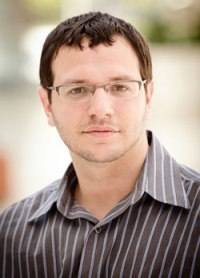
A quick web search finds that Dave Nussbaum is Adjunct Assistant Professor of Behavioral Science, University of Chicago Booth School of Business.  (I couldn’t avoid wondering if the learned Professor requires extra-large business cards! Sorry for that!)  To fill in a little more about the Professor, one can easily read that:

nausbaum

I am currently an Adjunct Assistant Professor of Behavioral Science at the University of Chicago Booth School of Business. I received my PhD in Social Psychology from Stanford in 2008, working primarily with Claude Steele and Carol Dweck. I recently completed a SSHRC Post-Doctoral Fellowship at the University of Waterloo with Steve Spencer. My research is primarily focused on how people manage and defend their self-image in the face of threats, and how this affects their beliefs and behavior. I also explore how social contexts and psychological processes can either exacerbate threats to self-image or attenuate them. I have found that defensively managing self-image threats can often lead to negative consequences, including academic disidentification, missed learning opportunities, the avoidance of important medical tests, and persistence in failing investments. I believe that by identifying contexts and processes that attenuate threat, individuals and organizations can employ strategies to prevent these maladaptive outcomes.

So moving on past my quip about the length of Professor Nussbaum’s title, the summary above shows that this is one smart cookie!  Just go back and reread “My research is primarily focused on how people manage and defend their self-image in the face of threats, and how this affects their beliefs and behavior.” Then reflect on the range and scale of ‘threats’ facing millions of us across the world.  So research into “how social contexts and psychological processes can either exacerbate threats to self-image or attenuate them“, seems particularly appropriate for these times.

OK, without further ramblings from yours truly, here is that essay.

oooOOOooo

Odysseus Nudged: How Limiting Our Choices Can Give Us More Freedom

by Dave Nussbaum – May 27, 2013

Odysseus

According to legend, the Sirens were beautiful women whose voices were so alluring that when sailors heard their song they could not resist approaching and were drowned on the rocky shores of the island where the Sirens sang. No sailor had heard their song and lived until Odysseus, who, on the counsel of the goddess Circe, had his crew tie him to the mast of his ship. When he heard the Sirens’ song he begged to be released, but his crew, their ears plugged with beeswax, would not unbind him and saved him from his own desires. Odysseus was lucky – he knew that he would be unable to resist the Sirens and had himself bound – but people often have difficulty foreseeing their weakness from a distance. Sometimes they need help.

I love watching my not-quite-two-year-old son learn about the world from his mistakes. I look on with sympathy at his falls and bumps and spills and I try to restrain myself from interceding. But when he’s about to tumble down a flight of stairs I step in. It is difficult to balance preserving his freedom to explore and make his own mistakes with the desire to keep him safe. There’s a lot to be said for giving kids autonomy and letting them learn from experience, but sometimes you have to behave paternalistically and tie them to the mast (or at least install safety gates).

When you start treating grown men and women like you’re their father, though, the charge of paternalism becomes a more serious one. There may be cases in which a heavy-handed approach is necessary (particularly when people’s actions harm others), but we should be careful about using it. A more circumspect approach is libertarian paternalism, described by Richard Thaler and Cass Sunstein in Nudge (and re-articulated more recently by Sunstein in his Simpler) as a way of influencing people to make decisions that they themselves would consider beneficial, without restricting their freedom.

Here, we are not tying Odysseus to the mast – the more appropriate analogy would be to the beeswax that Odysseus had his sailors put in their ears. The wax prevented the sailors from hearing the Sirens’ song and saved them from being lured to their deaths, but it also left them free to remove the wax if that is what they wanted to do. This sort of intervention is an acknowledgment that the sailors’ freedom is important, but also that people are not always perfectly rational. As Carnegie Mellon economist (and psychologist) George Loewenstein recently explained to me, “When people have problems exercising self-control, restricting their choices can, in some cases, leave them more freedom to choose.”

On its face, Loewenstein’s claim may seem paradoxical – isn’t a person most free when presented with all her options and allowed to choose among them? But as the mythical Sirens make clear, there are some options that we are not truly free to resist. Without beeswax in their ears Odysseus’ crew would have been doomed; the wax gave them the freedom to choose.

Take the recent attempt by New York City Mayor, Michael Bloomberg, to forbid stores from displaying cigarettes to their customers. Just like the beeswax did not prevent the sailors’ from choosing to hear the Sirens’ song, hiding cigarettes from view doesn’t prevent people from buying them. But, as Loewenstein explains, it makes it easier for those who may be trying to quit to avoid being lured back in.

When we pass laws that forbid the sale of cigarettes to minors we are being paternalistic. We are tying Odysseus to the mast, whether he likes it or not. But when we ban cigarette advertising that targets children – as the FTC did when it banned Joe Camel ads – we’re not tying anyone down. We are merely acknowledging that children are vulnerable to influences that may lead them to act contrary to their own interests and that they may not be in a position to resist these influences. Banning the display of cigarettes in stores is merely acknowledging that children aren’t the only ones who are vulnerable. The cigarettes, like the sirens, draw us in against our will. Putting them out of sight is like putting wax in our ears – we can easily still give in to temptation if we choose to, but we’re less at its mercy.

You can visit Dave Nussbaum’s blog at www.davenussbaum.com and follow Dave on Twitter at @davenuss79

Images courtesy of Wikimedia Commons and Shutterstock.

oooOOOooo

Breathtakingly creative.

Hungarian shadow-theatre company ‘Attraction’ leaves the Britain’s Got Talent crowd and judges in tears.

Meet Molly.

A most heart-warming story! Beats the heck out of murders, politics and terrorists!

This was sent in by John Hurlburt for Jean who has been a bit of a ‘horse lady’ in her times and is devoted to the two miniature horses we have here in Oregon.

oooOOOooo

Meet Molly

molly1

Molly is a gray speckled pony who was abandoned by her owners when Hurricane Katrina hit southern Louisiana . She spent weeks on her own before finally being rescued and taken to a farm where abandoned animals were stockpiled. While there, she was attacked by a dog and almost died.  Her gnawed right front leg became infected and her vet went to Louisiana State University (LSU) for help.

However, LSU were overwhelmed and Molly became a ‘welfare’ case. You know where that goes, don’t you!

Then surgeon Rustin Moore met Molly and changed his mind. He saw how Molly was careful to lie down on different sides so she didn’t seem to get sores.  He saw how Molly allowed people to handle her. She protected her injured leg. She constantly shifted her weight and didn’t overload her good leg. She was a smart pony with a serious survival ethic.

Surgeon Moore agreed to remove her leg below the knee and a temporary artificial limb was built. Molly walked out of the clinic and, in a very real sense, that’s where her story really begins.

This was the right horse and the right owner!” Moore insisted.

Molly happened to be a one-in-a-million patient. She’s tough as nails, but sweet, and she was willing to cope with pain. She made it obvious she understood that she was in trouble. The other important factor, according to Moore , is having a truly committed and compliant owner who is dedicated to providing the daily care required over the lifetime of the horse.

Molly’s story turns into a parable for life in Post-Katrina Louisiana.  The little pony gained weight and her mane finally felt a comb.  Then, amazingly, a prosthesis designer built her a leg.

The prosthetic has given Molly a whole new life, Allison Barca DVM, Molly’s regular vet, reports:

And she asks for it. She will put her little limb out and come to you and let you know that she wants you to put it on. Sometimes she wants you to take it off too. And sometimes, Molly gets away from Barca. “It can be pretty bad when you can’t catch a three-legged horse,” she laughs.

Most important of all, Molly has a job now. Kay, the rescue farm owner, started taking Molly to shelters, hospitals, nursing homes, and rehabilitation centers. Anywhere she thought that people needed hope. Wherever Molly went, she showed people her pluck. She inspired people, and she had a good time doing it.

It’s obvious to me that Molly had a bigger role to play in life,” Kay said. “She survived the hurricane, she survived a horrible injury, and now she is giving hope to others.

Allison Barca concluded, “She’s not back to normal, but she’s going to be better. To me, she could be a symbol for New Orleans itself.”

This is Molly's most recent prosthesis.
This is Molly’s most recent prosthesis.

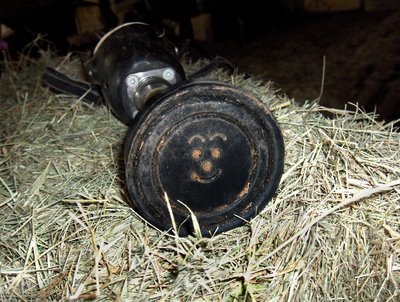
Wherever Molly goes, she leaves a smiley hoof print behind.  Literally as well as metaphorically.

The photo shows the ground surface that she stands on has a smiley face embossed in it!
The photo shows that the bottom flat surface of the prosthesis has a smiley face embossed in it!

Leave you with that wonderful feeling of love for Molly?  Feel free to share it with all the animal lovers that you know.

Fancy lending a hand?

A new animated short film from Lucas Martell, the creator of Pigeon: Impossible.

Back on the 4th December, 2011 I published a post under the title of Pigeon: Impossible.  Here’s some of what I wrote:

A truly remarkable example of the level of film animation being produced.

The second item that came to me from Bob D. (yesterday’s is here) has clearly done the rounds; the YouTube video has been watched nearly 7 million times!  But if you haven’t seen this short film, just over 6 minutes long, then do watch it.  It shows just how close to reality film animation has become!  The story behind the film is from here, reproduced below.

Pigeon: Impossible is the tale of Walter, a rookie secret agent faced with a problem seldom covered in basic training: what to do when a curious pigeon gets trapped inside your multi-million dollar, government-issued nuclear briefcase.

The film took nearly 5 years to complete and is the first attempt at animation by writer/director Lucas Martell: “When the project started, it was mostly an excuse to learn 3D animation, but by the end of the project I had spent so much time reworking and polishing the story that I just wanted people to laugh.

The end-result is a hilarious 6-minute romp through the streets of Washington D.C. as our hero fights to save himself, and the world from the chaos reigned down by a hungry pigeon. Breathtaking visuals and a sweeping soundtrack showcase the work of nearly one-hundred talented artists and musicians, and the film stands as a testament to what can be accomplished by a team of dedicated volunteers working for the love of their craft.

Personally, I think that last sentence is still an understatement.  Just watch this – and be amazed.

If you haven’t seen the film then you can watch it here.

Anyway, yesterday Lucas Martell left a comment to that post, as follows:

Lucas Martell
Lucas Martell

Hi, I’m the creator of Pigeon: Impossible and am so glad you enjoyed the film! We’re trying to finish our next animated short, and would love it if you could check it out and help us spread the word.

Thanks!

It seemed a worthwhile thing to do just that.  That next animated short is called The OceanMaker. Enjoy 4 minutes of it:

This is the website associated with the venture that explains more and also gives details of the way you can financially support the project, starting from as little as $10.  The website is great fun! (I couldn’t resist republishing the following)

oooOOOooo

About the Film

The OceanMaker is a 9-minute animated short film that takes place after Earth’s oceans have disappeared. It tells the tale of one courageous pilot who fights against vicious sky pirates for control of the last remaining source of water: the clouds.

OceanMaker1

From a visual standpoint, we’re steering away from the air pirates often found in steampunk and going straight-up “Mad Max” in the sky. The film is packed with old, beat-up planes that have been cobbled together from spare parts found in airplane graveyards.

OceanMaker2

Tonally, The OceanMaker is filled with exciting action, but the ending is emotional and powerful in a way that even feature-length films rarely achieve. The film also contains no dialogue, which means that the visuals and soundtrack need to be top notch in order to tell this story properly.

Finally, this film is unique in that it’s a complete story which stands on its own as a self-contained short film, but it’s also part of a even larger, more epic tale. Contributing to this project means a double dose of good karma, as you’re not only helping us complete the short, you’re getting us one step closer to making the feature! Our sights are set high and it’s going to be an amazing ride. We hope you’ll come along and share the adventure with us!

Goals

  • $10,000 – We can finish the models! – At the moment we have our hero models finished, but the story requires several other assets in order to set up the world and show how the loss of the oceans has affected life on earth. At $10,000, we’ll be able to bring on two model/texture artists to finish these assets.
  • $20,000 – We can finish the animation! – Animation is about 70% completed, but the remaining shots are the most challenging ones in the film. We’ll need two animators to bring these awesome shots to life!
  • $30,000 – We can finish the lighting! – Lighting and rendering are what make things pretty. It’s also a very technically challenging process, with each frame taking about an hour to render. At 24 frames per second, that’s just under 13,000 frames!
  • $40,000 – We can finish the film! – The last major step is the effects. In a word: clouds. They’re very tough to do right, and they’re pretty important for this whole story to work. Plus, these aren’t just static clouds in the background. We’re flying through them, scooping them up and making them grow!
  • $50,000 – Post Production! – This first stretch goal would allow us to hire a professional sound designer, as well as doing the final mix, color correction and output in a proper studio. This is crucial in order to submit the film to festivals and put it up on the big screen. If we reach this stretch goal, then all donors will also recieve a PDF copy of the script!
  • $60,000 – Live orchestra! – With this stretch goal, we could record Chris Reyman’s amazing score with a real live orchestra. This would be HUGE, as the film is extremely reliant on music, and the production value will increase dramatically. All donors at every level would receive a DRM-free copy of the score.
  • $70,000 – Expanded cast! – One thing that will make the film even better, is a second character. We already have a temporary version of that character in our animatic, but she’s very difficult to create and quite expensive for the few shots she’s in. However, that small addition would take the emotion and complexity of the story to a whole new level.
  • $80,000 – $100,000 The OceanMaker extended universe – As you can imagine, the OceanMaker is a really BIG story… too big to fit entirely within a short, but we’ve done an excellent job capturing the essence of it in a way that feels complete and stands on its own. However, if we hit $80,000, we can start to explore this broader story. This would be in the form of a graphic novel that delves deeper into the world both before and after the short film. The higher into this range we get, the longer this graphic novel could be and the more of the expanded story we could tell. Donors at every level would get a free digital copy of the graphic novel.
  • $100,000 and up – Feature!!! – OK, I realize we’re really reaching for the stars here, but you don’t do something like this without being a dreamer. If we somehow manage to reach the 100k mark, we’ll be able to start working on the feature film! It would be based in part on the content from the extended universe. The first step would be a treatment, then a script, then visual development and finally an animatic. Should we be able to complete any of these stages with money raised from this campaign, all donors will receive a digital copy of the completed work. You can take a sneak peek or remain unspoiled, but its the least we can do if your hard-earned dollars end up funding development of the feature.

oooOOOooo

So I hope you can contribute whatever you can afford.

Oh, and I should make it clear that neither Jean nor I have any financial or commercial connection with the project.

Bears and duct tape!

With grateful thanks to Cynthia G. who sent this to me.

(Going to take a break from the serious writing for this long week-end)

So, what's the story here?
So, what’s the story here?

The place: The Alaskan Wilderness

Just a bear wanting some food!

The event: A private “fly-in” fishing excursion to that Alaskan wilderness.

Well, a bear would, wouldn't it!
Well, a bear would, wouldn’t it!

The mistake: The pilot and fishermen left a cooler and bait in the plane.

Now what?
Now what?

The consequence: The bear went exploring for food!

Nothing if not ingenious!

The smart thinking: The pilot used his radio and had another pilot bring him 2 new tires, 3 cases of duct tape, and a supply of sheet plastic.

And they all happily went home!

The result: The pilot patched the plane together, and they all flew home!

duct tape

The moral of this story: Duct Tape? Never Leave Home Without It

Trust me, I’m an engineer!

Wonderful set of pictures, courtesy of Bob Derham.

oooOOOooo

eng1

eng2

eng3'

eng4

eng5

eng6

eng7

eng8

eng9

eng10

eng11

oooOOOooo

What on Earth to do?

Prediction is very difficult, especially if it involves the future. Niels Bohr

I have seen a number of versions of this quotation from Niels Bohr but no matter the inference is clear.  My way of putting it is that the future has a habit of observing the law of unintended consequences!

This gentle immersion into today’s muse is on the back of two events.  The first was the reading of Guy McPherson’s book, Walking Away from Empire, that I reviewed last week.  The second was watching a fascinating presentation about reversing climate change.

Just stay with Guy McPherson for a moment longer.  He is of the very firm opinion that we face imminent environmental collapse and the collapse of the industrial economy.  His bet is that the environment is already in the grip of ten feedback loops that guarantee making the environment unsustainable for the majority of species on this planet within a couple of decades.  If you want more then take a mouse click across the Guy’s blog Nature Bats Last.

So, given that one embraces this prediction, free of the clouds of delusion that it couldn’t possibly come to that, then what?  (I’m assuming that you have the basic motivation to get out of bed in the morning!)

The natural response is what on earth to do?

That’s where Allan Savory comes in!

WikiPedia introduces him as follows:

OLYMPUS DIGITAL CAMERA

(Clifford) Allan Redin Savory (born September 15, 1935) is a Zimbabwean biologist, farmer, soldier, exile, environmentalist, and winner of the 2003 Banksia International Award and the 2010 Buckminster Fuller Challenge. He is the originator of holistic management.

Savory had begun working on the ancient problem of land degradation (desertification) in 1955 in Northern Rhodesia, where he served in the Colonial Service as Provincial Game Officer, Northern and Luapula Provinces. He subsequently continued this work in Southern Rhodesia first as a research officer in the Game Department, then as an independent scientist and international consultant. When in exile, Savory worked from the Cayman Islands into the Americas introducing his new discoveries about both the cause of desertification and how to reverse it using increased numbers of livestock.

He subsequently wrote up this work in the book Holistic Management: A New Decision Making Framework, written with his wife Jody Butterfield and published by Island Press (1989; 1999 2nd edition).

In 1992, he co-founded the Africa Center for Holistic Management with his wife Jody Butterfield and, in 2009, the Savory Institute, headquartered in Boulder, Colorado, which he currently heads. The Savory Institute works globally with individuals, government agencies, NGOs, and corporations to restore the vast grasslands of the world through the teaching and practice of holistic management and decision making.

The institute’s consulting and training activities are turning deserts into thriving grasslands, restoring biodiversity, bringing streams, rivers, and water sources back to life, combating poverty and hunger, and increasing sustainable food production, all mitigating global climate change through carbon sequestration. In 2010, Savory and the Africa Center for Holistic Management won The Buckminster Fuller Challenge.

In a 2012 address to the International Union for Conservation of Nature World Conservation Congress, on the urgent need to bring agriculture and conservation back together, Prince Charles lauded Savory’s nature based approach.

OK, enough from me. Watch Allan Savory’s fascinating and potentially life-saving idea, as presented to the TED2013 conference.

Why?

“Why do you get out of bed in the morning, and why should anyone care?”

These words are spoken by Simon Sinek just before the three-minute mark in the video that follows.  As Wikipedia explains,

simono-sinek

Simon O. Sinek (born October 9, 1973) is an author best known for popularizing a concept of The Golden Circle.

He joined the RAND Corporation in 2010 as an adjunct staff member, where he advises on matters of military innovation and planning. His first TEDx Talk on “How Great Leaders Inspire Action” is the 7th most viewed video on TED.com.

His 2009 book on the same subject, Start With Why: How Great Leaders Inspire Everyone to Take Action (2009) delves into what he says is a naturally occurring pattern, grounded in the biology of human decision-making, that explains why we are inspired by some people, leaders, messages and organizations over others.

He has commented for The New York Times, Wall Street Journal, The Washington Post, Houston Chronicle, FastCompany, CMO Magazine, NPR and BusinessWeek, and is a regular contributor to The Huffington Post, BrandWeek, IncBizNet.

This new year that we are now in is going to require millions of us to think and do differently.  As Einstein so famously quoted, “Insanity: doing the same thing over and over again and expecting different results“.  More than ever before we need different results and that means thinking and doing differently.

Enjoy the video.