Category: Innovation

This is counter-intuitive.

The universe and normal matter.

Frequently I look up at the night sky and ponder about so many things that I cannot understand. I wish I did but it is far too late now. But that doesn’t stop me from reading about the science and more. Here is a perfect example of that and I am delighted to be able to share it with you.

ooOOoo

Most normal matter in the universe isn’t found in planets, stars or galaxies – an astronomer explains where it’s distributed

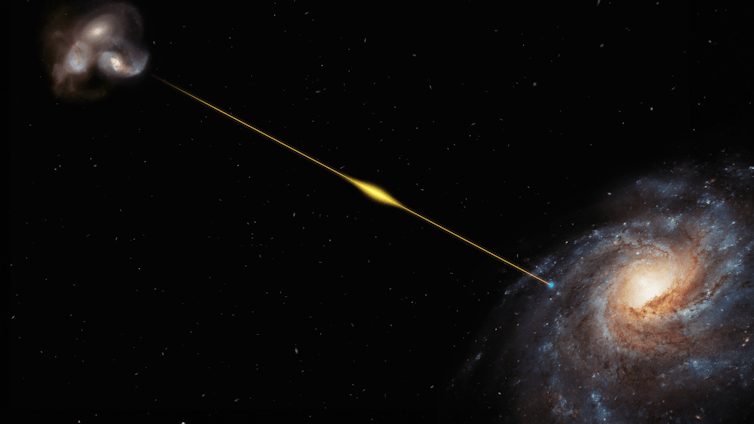
Mysterious blasts of radio waves from across the universe called fast radio bursts help astronomers catalog matter. ESO/M. Kornmesser, CC BY-SA

Chris Impey, University of Arizona

If you look across space with a telescope, you’ll see countless galaxies, most of which host large central black holes, billions of stars and their attendant planets. The universe teems with huge, spectacular objects, and it might seem like these massive objects should hold most of the universe’s matter.

But the Big Bang theory predicts that about 5% of the universe’s contents should be atoms made of protons, neutrons and electrons. Most of those atoms cannot be found in stars and galaxies – a discrepancy that has puzzled astronomers.

If not in visible stars and galaxies, the most likely hiding place for the matter is in the dark space between galaxies. While space is often referred to as a vacuum, it isn’t completely empty. Individual particles and atoms are dispersed throughout the space between stars and galaxies, forming a dark, filamentary network called the “cosmic web.”

Throughout my career as an astronomer, I’ve studied this cosmic web, and I know how difficult it is to account for the matter spread throughout space.

In a study published in June 2025, a team of scientists used a unique radio technique to complete the census of normal matter in the universe.

The census of normal matter

The most obvious place to look for normal matter is in the form of stars. Gravity gathers stars together into galaxies, and astronomers can count galaxies throughout the observable universe.

The census comes to several hundred billion galaxies, each made of several hundred billion stars. The numbers are uncertain because many stars lurk outside of galaxies. That’s an estimated 1023 stars in the universe, or hundreds of times more than the number of sand grains on all of Earth’s beaches. There are an estimated 1082 atoms in the universe.

However, this prodigious number falls far short of accounting for all the matter predicted by the Big Bang. Careful accounting indicates that stars contain only 0.5% of the matter in the universe. Ten times more atoms are presumably floating freely in space. Just 0.03% of the matter is elements other than hydrogen and helium, including carbon and all the building blocks of life.

Looking between galaxies

The intergalactic medium – the space between galaxies – is near-total vacuum, with a density of one atom per cubic meter, or one atom every 35 cubic feet. That’s less than a billionth of a billionth of the density of air on Earth. Even at this very low density, this diffuse medium adds up to a lot of matter, given the enormous, 92-billion-light-year diameter of the universe.

The intergalactic medium is very hot, with a temperature of millions of degrees. That makes it difficult to observe except with X-ray telescopes, since very hot gas radiates out through the universe at very short X-ray wavelengths. X-ray telescopes have limited sensitivity because they are smaller than most optical telescopes.

Deploying a new tool

Astronomers recently used a new tool to solve this missing matter problem. Fast radio bursts are intense blasts of radio waves that can put out as much energy in a millisecond as the Sun puts out in three days. First discovered in 2007, scientists found that the bursts are caused by compact stellar remnants in distant galaxies. Their energy peters out as the bursts travel through space, and by the time that energy reaches the Earth, it is a thousand times weaker than a mobile phone signal would be if emitted on the Moon, then detected on Earth.

Research from early 2025 suggests the source of the bursts is the highly magnetic region around an ultra-compact neutron star. Neutron stars are incredibly dense remnants of massive stars that have collapsed under their own gravity after a supernova explosion. The particular type of neutron star that emits radio bursts is called a magnetar, with a magnetic field a thousand trillion times stronger than the Earth’s.

An illustration of a bright star with circular rings around it representing magnetic field lines
A magnetar is a rare type of neutron star with an extremely strong magnetic field. ESO/L. Calçada, CC BY-ND

Even though astronomers don’t fully understand fast radio bursts, they can use them to probe the spaces between galaxies. As the bursts travel through space, interactions with electrons in the hot intergalactic gas preferentially slow down longer wavelengths. The radio signal is spread out, analogous to the way a prism turns sunlight into a rainbow. Astronomers use the amount of spreading to calculate how much gas the burst has passed through on its way to Earth.

Puzzle solved

In the new study, published in June 2025, a team of astronomers from Caltech and the Harvard Center for Astrophysics studied 69 fast radio bursts using an array of 110 radio telescopes in California. The team found that 76% of the universe’s normal matter lies in the space between galaxies, with another 15% in galaxy halos – the area surrounding the visible stars in a galaxy – and the remaining 9% in stars and cold gas within galaxies.

The complete accounting of normal matter in the universe provides a strong affirmation of the Big Bang theory. The theory predicts the abundance of normal matter formed in the first few minutes of the universe, so by recovering the predicted 5%, the theory passes a critical test.

Several thousand fast radio bursts have already been observed, and an upcoming array of radio telescopes will likely increase the discovery rate to 10,000 per year. Such a large sample will let fast radio bursts become powerful tools for cosmology. Cosmology is the study of the size, shape and evolution of the universe. Radio bursts could go beyond counting atoms to mapping the three-dimensional structure of the cosmic web.

Pie chart of the universe

Scientists may now have the complete picture of where normal matter is distributed, but most of the universe is still made up of stuff they don’t fully understand.

The most abundant ingredients in the universe are dark matter and dark energy, both of which are poorly understood. Dark energy is causing the accelerating expansion of the universe, and dark matter is the invisible glue that holds galaxies and the universe together.

A pie chart showing the composition of the universe. The largest proportion is dark energy, at 68%, while dark matter makes up 27% and normal matter 5%. The rest is neutrinos, free hydrogen and helium and heavy elements.
Despite physicists not knowing much about it, dark matter makes up around 27% of the universe. Visual Capitalist/Science Photo Library via Getty Images

Dark matter is probably a previously unstudied type of fundamental particle that is not part of the standard model of particle physics. Physicists haven’t been able to detect this novel particle yet, but we know it exists because, according to general relativity, mass bends light, and far more gravitational lensing is seen than can be explained by visible matter. With gravitational lensing, a cluster of galaxies bends and magnifies light in a way that’s analogous to an optical lens. Dark matter outweighs conventional matter by more than a factor of five.

One mystery may be solved, but a larger mystery remains. While dark matter is still enigmatic, we now know a lot about the normal atoms making up us as humans, and the world around us.

Chris Impey, University Distinguished Professor of Astronomy, University of Arizona

This article is republished from The Conversation under a Creative Commons license. Read the original article.

ooOOoo

The details are incredible. Take for example that three-quarters of the matter out there is found outside the galaxies. Or that there are more stars in the universe than all of the sand grains on Planet Earth.

Just amazing!

Rebecca Stott

Speaks on BBC Radio 4 this week.

Let me offer you Rebecca Stott’s website.

Now I am going to republish that site because it is the only way I can think of to spread the word more widely.

ooOOoo

Rebecca also writes for radio. She has been a frequent broadcaster on BBC Radio Four over the years.

Her radio essay ‘Reflections on My Mother’s Kenwood Mixer’, a homage to her mother’s gritty resilience in times of trouble, promoted scores of people on Twitter and Facebook to share stories about Kenwoods and their own steely mothers. Her essay ‘On Waiting’, tells the story of being marooned with her daughters at dusk in a bus-stop in remote Norfolk during a Covid lockdown. Her essay ‘House Clearing’ tells the story of the strangeness of dismantling her mother’s house after she had moved into a carehome. And her final essay for the programme, ‘On Migration’, describes an astonishing ten days in which hundreds of wild geese flew across the skies of her home town, as well the story of the great philosopher Aristotle study of migrating birds whilst himself a migrant in flight for his life on the island of Lesbos.

You’ll find a link to Rebecca’s Private Passions episode here too. A kind of Desert Island Discs without the Desert Island…. and with the extraordinary composer Michael Berkeley in the interview seat.

Also here is her five-part series commissioned by Radio Four in 2025 called Beautiful Strangeness. You can find the link below.

https://www.bbc.co.uk/programmes/m002fv7z/episodes/player

ooOOoo

Being the age I am, Rebecca’s Beautiful Strangeness programmes spoke to me in a way that I find difficult to put into words but nonetheless the series did.

Perfect!

That magical night sky

Or more to the point of this article: Dark Matter.

Along with huge numbers of other people, I have long been interested in the Universe. Thus this article from The Conversation seemed a good one to share with you.

ooOOoo

When darkness shines: How dark stars could illuminate the early universe

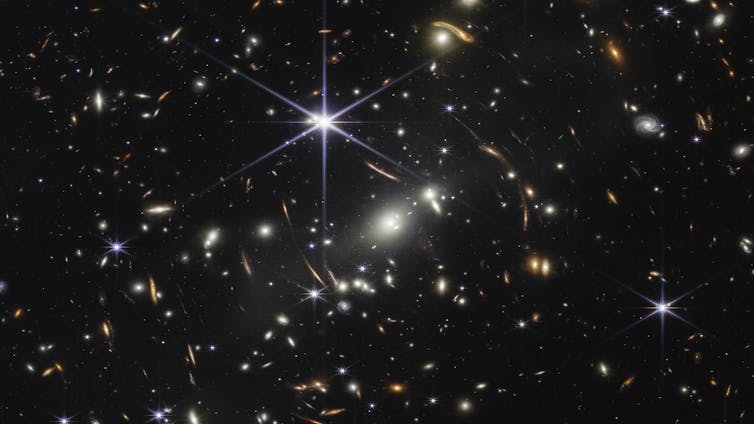
NASA’s James Webb Space Telescope has spotted some potential dark star candidates. NASA, ESA, CSA, and STScI

Alexey A. Petrov, University of South Carolina

Scientists working with the James Webb Space Telescope discovered three unusual astronomical objects in early 2025, which may be examples of dark stars. The concept of dark stars has existed for some time and could alter scientists’ understanding of how ordinary stars form. However, their name is somewhat misleading.

“Dark stars” is one of those unfortunate names that, on the surface, does not accurately describe the objects it represents. Dark stars are not exactly stars, and they are certainly not dark.

Still, the name captures the essence of this phenomenon. The “dark” in the name refers not to how bright these objects are, but to the process that makes them shine — driven by a mysterious substance called dark matter. The sheer size of these objects makes it difficult to classify them as stars.

As a physicist, I’ve been fascinated by dark matter, and I’ve been trying to find a way to see its traces using particle accelerators. I’m curious whether dark stars could provide an alternative method to find dark matter.

What makes dark matter dark?

Dark matter, which makes up approximately 27% of the universe but cannot be directly observed, is a key idea behind the phenomenon of dark stars. Astrophysicists have studied this mysterious substance for nearly a century, yet we haven’t seen any direct evidence of it besides its gravitational effects. So, what makes dark matter dark?

A pie chart showing the composition of the universe. The largest proportion is 'dark energy,' at 68%, while dark matter makes up 27% and normal matter 5%. The rest is neutrinos, free hydrogen and helium and heavy elements.
Despite physicists not knowing much about it, dark matter makes up around 27% of the universe. Visual Capitalist/Science Photo Library via Getty Images

Humans primarily observe the universe by detecting electromagnetic waves emitted by or reflected off various objects. For instance, the Moon is visible to the naked eye because it reflects sunlight. Atoms on the Moon’s surface absorb photons – the particles of light – sent from the Sun, causing electrons within atoms to move and send some of that light toward us.

More advanced telescopes detect electromagnetic waves beyond the visible spectrum, such as ultraviolet, infrared or radio waves. They use the same principle: Electrically charged components of atoms react to these electromagnetic waves. But how can they detect a substance – dark matter – that not only has no electric charge but also has no electrically charged components?

Although scientists don’t know the exact nature of dark matter, many models suggest that it is made up of electrically neutral particles – those without an electric charge. This trait makes it impossible to observe dark matter in the same way that we observe ordinary matter.

Dark matter is thought to be made of particles that are their own antiparticles. Antiparticles are the “mirror” versions of particles. They have the same mass but opposite electric charge and other properties. When a particle encounters its antiparticle, the two annihilate each other in a burst of energy.

If dark matter particles are their own antiparticles, they would annihilate upon colliding with each other, potentially releasing large amounts of energy. Scientists predict that this process plays a key role in the formation of dark stars, as long as the density of dark matter particles inside these stars is sufficiently high. The dark matter density determines how often dark matter particles encounter, and annihilate, each other. If the dark matter density inside dark stars is high, they would annihilate frequently.

What makes a dark star shine?

The concept of dark stars stems from a fundamental yet unresolved question in astrophysics: How do stars form? In the widely accepted view, clouds of primordial hydrogen and helium — the chemical elements formed in the first minutes after the Big Bang, approximately 13.8 billion years ago — collapsed under gravity. They heated up and initiated nuclear fusion, which formed heavier elements from the hydrogen and helium. This process led to the formation of the first generation of stars.

Two bright clouds of gas condensing around a small central region
Stars form when clouds of dust collapse inward and condense around a small, bright, dense core. NASA, ESA, CSA, and STScI, J. DePasquale (STScI), CC BY-ND

In the standard view of star formation, dark matter is seen as a passive element that merely exerts a gravitational pull on everything around it, including primordial hydrogen and helium. But what if dark matter had a more active role in the process? That’s exactly the question a group of astrophysicists raised in 2008.

In the dense environment of the early universe, dark matter particles would collide with, and annihilate, each other, releasing energy in the process. This energy could heat the hydrogen and helium gas, preventing it from further collapse and delaying, or even preventing, the typical ignition of nuclear fusion.

The outcome would be a starlike object — but one powered by dark matter heating instead of fusion. Unlike regular stars, these dark stars might live much longer because they would continue to shine as long as they attracted dark matter. This trait would make them distinct from ordinary stars, as their cooler temperature would result in lower emissions of various particles.

Can we observe dark stars?

Several unique characteristics help astronomers identify potential dark stars. First, these objects must be very old. As the universe expands, the frequency of light coming from objects far away from Earth decreases, shifting toward the infrared end of the electromagnetic spectrum, meaning it gets “redshifted.” The oldest objects appear the most redshifted to observers.

Since dark stars form from primordial hydrogen and helium, they are expected to contain little to no heavier elements, such as oxygen. They would be very large and cooler on the surface, yet highly luminous because their size — and the surface area emitting light — compensates for their lower surface brightness.

They are also expected to be enormous, with radii of about tens of astronomical units — a cosmic distance measurement equal to the average distance between Earth and the Sun. Some supermassive dark stars are theorized to reach masses of roughly 10,000 to 10 million times that of the Sun, depending on how much dark matter and hydrogen or helium gas they can accumulate during their growth.

So, have astronomers observed dark stars? Possibly. Data from the James Webb Space Telescope has revealed some very high-redshift objects that seem brighter — and possibly more massive — than what scientists expect of typical early galaxies or stars. These results have led some researchers to propose that dark stars might explain these objects.

Artist's impression of the James Webb telescope, which has a hexagonal mirror made up of smaller hexagons, and sits on a rhombus-shaped spacecraft.
The James Webb Space Telescope, shown in this illustration, detects light coming from objects in the universe. Northrup Grumman/NASA

In particular, a recent study analyzing James Webb Space Telescope data identified three candidates consistent with supermassive dark star models. Researchers looked at how much helium these objects contained to identify them. Since it is dark matter annihilation that heats up those dark stars, rather than nuclear fusion turning helium into heavier elements, dark stars should have more helium.

The researchers highlight that one of these objects indeed exhibited a potential “smoking gun” helium absorption signature: a far higher helium abundance than one would expect in typical early galaxies.

Dark stars may explain early black holes

What happens when a dark star runs out of dark matter? It depends on the size of the dark star. For the lightest dark stars, the depletion of dark matter would mean gravity compresses the remaining hydrogen, igniting nuclear fusion. In this case, the dark star would eventually become an ordinary star, so some stars may have begun as dark stars.

Supermassive dark stars are even more intriguing. At the end of their lifespan, a dead supermassive dark star would collapse directly into a black hole. This black hole could start the formation of a supermassive black hole, like the kind astronomers observe at the centers of galaxies, including our own Milky Way.

Dark stars might also explain how supermassive black holes formed in the early universe. They could shed light on some unique black holes observed by astronomers. For example, a black hole in the galaxy UHZ-1 has a mass approaching 10 million solar masses, and is very old – it formed just 500 million years after the Big Bang. Traditional models struggle to explain how such massive black holes could form so quickly.

The idea of dark stars is not universally accepted. These dark star candidates might still turn out just to be unusual galaxies. Some astrophysicists argue that matter accretion — a process in which massive objects pull in surrounding matter — alone can produce massive stars, and that studies using observations from the James Webb telescope cannot distinguish between massive ordinary stars and less dense, cooler dark stars.

Researchers emphasize that they will need more observational data and theoretical advancements to solve this mystery.

Alexey A. Petrov, Professor of physics and astronomy, University of South Carolina

This article is republished from The Conversation under a Creative Commons license. Read the original article.

ooOOoo

Alexey Petrov says at the end of the article that more observations are required before we humans know all the answers. I have no doubt that in time we will have the answers.

Cambridge University and our brains.

Scientists have identified five ages of the human brain.

Neuroscientists at the University of Cambridge have identified five “major epochs” of brain structure over the course of a human life, as our brains rewire to support different ways of thinking while we grow, mature, and ultimately decline.”

So wrote Fred Lewsey. Fred is the Communications Manager (Research) and is Responsible for: School of the Humanities and Social Sciences. (And I took this from this site.) He went on to report that: Four major turning points around ages nine, 32, 66 and 83 create five broad eras of neural wiring over the average human lifespan.

Being in my early 80’s I was most interested in that last turning point. This is the information about that era:

The last turning point comes around age 83, and the final brain structure epoch is entered. While data is limited for this era, the defining feature is a shift from global to local, as whole brain connectivity declines even further, with increased reliance on certain regions.     

“Looking back, many of us feel our lives have been characterised by different phases. It turns out that brains also go through these eras,” added senior author Prof Duncan Astle, Professor of Neuroinformatics at Cambridge.

“Many neurodevelopmental, mental health and neurological conditions are linked to the way the brain is wired. Indeed, differences in brain wiring predict difficulties with attention, language, memory, and a whole host of different behaviours”

“Understanding that the brain’s structural journey is not a question of steady progression, but rather one of a few major turning points, will help us identify when and how its wiring is vulnerable to disruption.”

The research was supported by the Medical Research Council, Gates Foundation and Templeton World Charitable Foundation. The full report may be read here: https://www.newscientist.com/article/2505656-your-brain-undergoes-four-dramatic-periods-of-change-from-age-0-to-90

Finally, here is an image of this amazing organ that we humans have.

Picture Parade Four Hundred and Ninety-Eight

Today, I am publishing a video.

That is a wonderful video!

Rejected by his mother, Richard found love and security with the most unlikely of friends — a guard dog who adopted him as one of his own.”

Richard’s social media:   / richardandtheguardians  

About Bark & Bond: At Bark & Bond, we believe that there is nothing more powerful — and simple — than the way a dog changes our routine. Whether it’s with a look full of expectation, an unexpected lick or just by being there, silent, sharing the same space.

What if we die before our pets?

We love our dogs and can never envisage being without one.

So what happens to them after the last one of us die?

I have just turned 81 and, although I am fit, think more seriously about this matter than I used to. Jean has no children and my son and daughter, from a previous marriage, are living in the U.K.

So an article from The Conversation caught my eye and I wanted to share it with you.

ooOOoo

Diane Keaton’s $5M pet trust would be over the top if reports prove true – here’s how to ensure your beloved pet is safe after you are gone

Allison Anna Tait, University of Richmond

Diane Keaton loved her dog, Reggie.

The award-winning actor, director and real estate entrepreneur frequently posted photos and video clips of the golden retriever on her social media accounts. After she died on Oct. 11, 2025, at 79, some news outlets reported that she left US$5 million of her estimated $100 million estate to her dog.

I’m a law professor who teaches about wills, trusts and other forms of inheritance law. Every semester, I teach my students how they can help clients provide for their pets after death. Because they, like many Americans, love their pets and want to know how to take care of them, this topic always piques their interest. https://www.youtube.com/embed/FYJGCvpJIV0?wmode=transparent&start=0 Diane Keaton was very open about her devotion to her dog, Reggie.

Writing pets into a will

An estimated 66% of all U.S. households include at least one pet. Many Americans consider their cats, dogs, tortoises or other animals to be part of their family, and their spending on those nonhuman relatives is immense. In 2024, they paid a total of about $152 billion for goods and services to feed and otherwise support their pets.

Taking good care of your pets can go beyond buying them treats and sweaters. It can include leaving clear directions to ensure their needs are met once you’re gone. There are several ways that you can do this.

The first is through your will. You can’t give your pet money directly in your will, because the law says that pets are property, like your books or your dishes.

You can, however, leave a bequest, the technical term for a gift to a person or a cause listed in a will, to someone who will be the animal’s caretaker. That bequest can include directions that the money be spent meeting the pet’s needs.

It’s worth it to also name an alternate or contingent caretaker in case the first person you name does not want to or cannot take on that responsibility, or they die before you or the animals you’ve provided for in the will.

Choupette’s life of luxury

German fashion designer, photographer and creative director Karl Lagerfeld, who died in 2019 at 85, was someone who made the mistake of leaving money directly to his fluffy Birman cat, Choupette. It worked out for Choupette, though.

The cat was, according to several reports, still alive in 2025 and eating meals out of the porcelain bowls that Lagerfeld bought for her. Choupette is cared for at great expense and in the utmost luxury by Françoise Caçote, the designer’s former housekeeper. The cat even had a 13th birthday party at Versailles.

Another pet owner who did right by her pet was the comedian, producer and red carpet interviewer Joan Rivers.

Rivers had two rescue dogs in Manhattan and two more dogs in California when she died in 2014 at age 81. Rivers had made provisions for their care in her will.

A petite woman holding a tiny dog stands next to three men on a TV set.
The late Joan Rivers, right, seen on the set of her short-lived talk show in 1987, planned ahead for her dogs’ care. Bettmann via Getty Images

Creating pet trusts

If you’d like an arrangement that’s more secure than a will, then you might want to opt for a pet trust, another celebrity favorite. These kinds of trusts were not possible until the 1990s, because pets were not considered true beneficiaries – meaning they couldn’t sue the trustee.

But in the 1990s, states began to change their rules to allow for pet trusts. Today, pet trusts are valid in the whole country, although the rules vary slightly from state to state.

To establish a pet trust, you or a lawyer must draw up a trust document that names two important people: a trustee and a caretaker. The trustee is the person who will manage the money you leave in trust. They will make distributions to the caretaker that you select.

You must also specify how the money is to be spent meeting the animal’s needs and who would get any money that could be left in the trust when the pet dies. Typically, these trusts take effect at the owner’s death, just like other provisions in a will.

Drafting a pet trust can be free, if you use an online template and get no legal guidance. The same thing might cost around $100 if you use an online service such as Legal Zoom that provides directions. More commonly, however, pet trusts are part of a broader estate plan, and costs range depending on how complicated your estate is.

When the rich go overboard

One of the most over-the-top pet trusts came from Leona Helmsley, the New York hotel and real estate mogul known widely as the “Queen of Mean.” She was famous for her pettiness and tough management style and for landing in prison for tax evasion.

When Helmsley died in 2007, she left her dog, a Maltese named Trouble who had reportedly bitten members of her staff, a $12 million trust fund. Most of Helmsley’s estate went to the Helmsley Charitable Trust, but she made individual gifts to several relatives, and the gift to Trouble was larger than any of those.

The grandchildren, upset that Trouble got more money than they did, took the case to court, where the probate judge was less than impressed by Trouble’s luxury lifestyle and knocked down the amount in trust to $2 million. The other $10 million flowed back to her family’s foundation, where the bulk of the estate went in the first place.

Lesson learned: Your dog can have a trust fund, but don’t go overboard.

Bequests for pets can be challenged – in which case it’s up to courts to determines how much they think is reasonable for the pet’s need. In Helmsley’s case, $12 million was found to be excessive. And maybe with good reason. Trouble still had a nice life with fewer millions. The dog died in December 2010 after several years in Sarasota, Florida, at a Helmsley-owned hotel.

Other pet owners who aren’t celebrities have used pet trusts as well, such as Bill Dorris, a Nashville businessman without any human heirs. He left his dog, Lulu, $5 million.

Pet-loving celebrities who loved all the pets

Finally, there’s a lesson to be learned from British fashion designer and icon Alexander McQueen, who was worth £16 million ($21 million) when he died in 2010 at the age of 40. McQueen left £50,000 ($66,000) in a trust for his two bull terriers so that they would be well cared for during the remainder of their lives.

McQueen also included a bequest of £100,000 ($132,000) to the Battersea Dogs and Cats Home in his will to help fund the care of some of the millions of other animals out there that need the basics of food and shelter.

Animal shelters, in the U.K., the United States and other countries, help rescue and protect animals, and these animals need more help than the Choupettes and Troubles of the world.

So, my advice is that you go ahead and create a pet trust for your cat. But don’t forget to give some money in your will – and ideally while you’re alive – to help the vast majority of the millions of companion animals who need new homes every year. None of them have trust funds.

What becomes of Reggie, Keaton’s golden retriever, and her estate remains to be seen. Keaton, who starred in hit movies such as “Annie Hall,” “Reds” and “The First Wives Club,” isn’t the first celebrity to leave millions of dollars to a pet. And it’s unlikely that she will be the last.

Allison Anna Tait, Professor of Law, University of Richmond

This article is republished from The Conversation under a Creative Commons license. Read the original article.

ooOOoo

Amending our Will to create a pet trust seems like a very good idea! And making sure there is money for the trust as well.

More about Jane Goodall

An article published by The Conversation is offered today.

ooOOoo

Jane Goodall, the gentle disrupter whose research on chimpanzees redefined what it meant to be human

Jane Goodall appears on stage at 92NY in New York on Oct. 1, 2023.
Charles Sykes/Invision/AP

Mireya Mayor, Florida International University

Anyone proposing to offer a master class on changing the world for the better, without becoming negative, cynical, angry or narrow-minded in the process, could model their advice on the life and work of pioneering animal behavior scholar Jane Goodall.

Goodall’s life journey stretches from marveling at the somewhat unremarkable creatures – though she would never call them that – in her English backyard as a wide-eyed little girl in the 1930s to challenging the very definition of what it means to be human through her research on chimpanzees in Tanzania. From there, she went on to become a global icon and a United Nations Messenger of Peace.

Until her death on Oct. 1, 2025 at age 91, Goodall retained a charm, open-mindedness, optimism and wide-eyed wonder that are more typical of children. I know this because I have been fortunate to spend time with her and to share insights from my own scientific career. To the public, she was a world-renowned scientist and icon. To me, she was Jane – my inspiring mentor and friend.

Despite the massive changes Goodall wrought in the world of science, upending the study of animal behavior, she was always cheerful, encouraging and inspiring. I think of her as a gentle disrupter. One of her greatest gifts was her ability to make everyone, at any age, feel that they have the power to change the world. https://www.youtube.com/embed/rcL4jnGTL1U?wmode=transparent&start=0 Jane Goodall documented that chimpanzees not only used tools but make them – an insight that altered thinking about animals and humans.

Discovering tool use in animals

In her pioneering studies in the lush rainforest of Tanzania’s Gombe Stream Game Reserve, now a national park, Goodall noted that the most successful chimp leaders were gentle, caring and familial. Males that tried to rule by asserting their dominance through violence, tyranny and threat did not last.

I also am a primatologist, and Goodall’s groundbreaking observations of chimpanzees at Gombe were part of my preliminary studies. She famously recorded chimps taking long pieces of grass and inserting them into termite nests to “fish” for the insects to eat, something no one else had previously observed.

It was the first time an animal had been seen using a tool, a discovery that altered how scientists differentiated between humanity and the rest of the animal kingdom.

Renowned anthropologist Louis Leakey chose Goodall to do this work precisely because she was not formally trained. When she turned up in Leakey’s office in Tanzania in 1957, at age 23, Leakey initially hired her as his secretary, but he soon spotted her potential and encouraged her to study chimpanzees. Leakey wanted someone with a completely open mind, something he believed most scientists lost over the course of their formal training.

Because chimps are humans’ closest living relatives, Leakey hoped that understanding the animals would provide insights into early humans. In a predominantly male field, he also thought a woman would be more patient and insightful than a male observer. He wasn’t wrong.

Six months in, when Goodall wrote up her observations of chimps using tools, Leakey wrote, “Now we must redefine tool, redefine Man, or accept chimpanzees as human.”

Goodall spoke of animals as having emotions and cultures, and in the case of chimps, communities that were almost tribal. She also named the chimps she observed, an unheard-of practice at the time, garnering ridicule from scientists who had traditionally numbered their research subjects.

One of her most remarkable observations became known as the Gombe Chimp War. It was a four-year-long conflict in which eight adult males from one community killed all six males of another community, taking over their territory, only to lose it to another, bigger community with even more males.

Confidence in her path

Goodall was persuasive, powerful and determined, and she often advised me not to succumb to people’s criticisms. Her path to groundbreaking discoveries did not involve stepping on people or elbowing competitors aside.

Rather, her journey to Africa was motivated by her wonder, her love of animals and a powerful imagination. As a little girl, she was entranced by Edgar Rice Burroughs’ 1912 story “Tarzan of the Apes,” and she loved to joke that Tarzan married the wrong Jane.

When I was a 23-year-old former NFL cheerleader, with no scientific background at that time, and looked at Goodall’s work, I imagined that I, too, could be like her. In large part because of her, I became a primatologist, co-discovered a new species of lemur in Madagascar and have had an amazing life and career, in science and on TV, as a National Geographic explorer.
When it came time to write my own story, I asked Goodall to contribute the introduction. She wrote:

“Mireya Mayor reminds me a little of myself. Like me she loved being with animals when she was a child. And like me she followed her dream until it became a reality.”

In a 2023 interview, Jane Goodall answers TV host Jimmy Kimmel’s questions about chimpanzee behavior.

Storyteller and teacher

Goodall was an incredible storyteller and saw it as the most successful way to help people understand the true nature of animals. With compelling imagery, she shared extraordinary stories about the intelligence of animals, from apes and dolphins to rats and birds, and, of course, the octopus. She inspired me to become a wildlife correspondent for National Geographic so that I could share the stories and plights of endangered animals around the world.

Goodall inspired and advised world leaders, celebrities, scientists and conservationists. She also touched the lives of millions of children.

Two women face each other, smiling and holding a book
Jane Goodall and primatologist Mireya Mayor with Mayor’s book ‘Just Wild Enough,’ a memoir aimed at young readers. Mireya Mayor, CC BY-ND

Through the Jane Goodall Institute, which works to engage people around the world in conservation, she launched Roots & Shoots, a global youth program that operates in more than 60 countries. The program teaches children about connections between people, animals and the environment, and ways to engage locally to help all three.

Along with Goodall’s warmth, friendship and wonderful stories, I treasure this comment from her: “The greatest danger to our future is our apathy. Each one of us must take responsibility for our own lives, and above all, show respect and love for living things around us, especially each other.”

It’s a radical notion from a one-of-a-kind scientist.

This article has been updated to add the date of Goodall’s death.

Mireya Mayor, Director of Exploration and Science Communication, Florida International University

This article is republished from The Conversation under a Creative Commons license. Read the original article.

ooOOoo

That comment by Jane that was treasured by Mireya is so important. “The greatest danger to our future is our apathy. Each one of us must take responsibility for our own lives, and above all, show respect and love for living things around us, especially each other.

More Bark & Bond.

🐶❤️ Because the love of a dog changes your day.

Thank you, John.

Bark & Bond

A terrific set of videos!

John Zande sent me an email yesterday. It contained a link that when clicked on took me to a series of videos.

Here is the first one I looked at:

That link sent by John is here: https://www.youtube.com/@BarkBondOfc

Emmy the dog

She has her own doorbell.

A lovely video.

Emmy’s way of seeing her ‘Mum’, namely Linda Rose.

ooOOoo

Jean and I are atheists. I subscribe to the American Humanist Association whose motto is “GOOD WITHOUT A GOD”.

Bill Watterson of the AHA posted the following yesterday:

I wish people were more like animals. Animals don’t try to change you. Animals like you just the way you are. They listen to your problems, they comfort you when you’re sad, and all they ask in return is a little kindness.

So, so true!