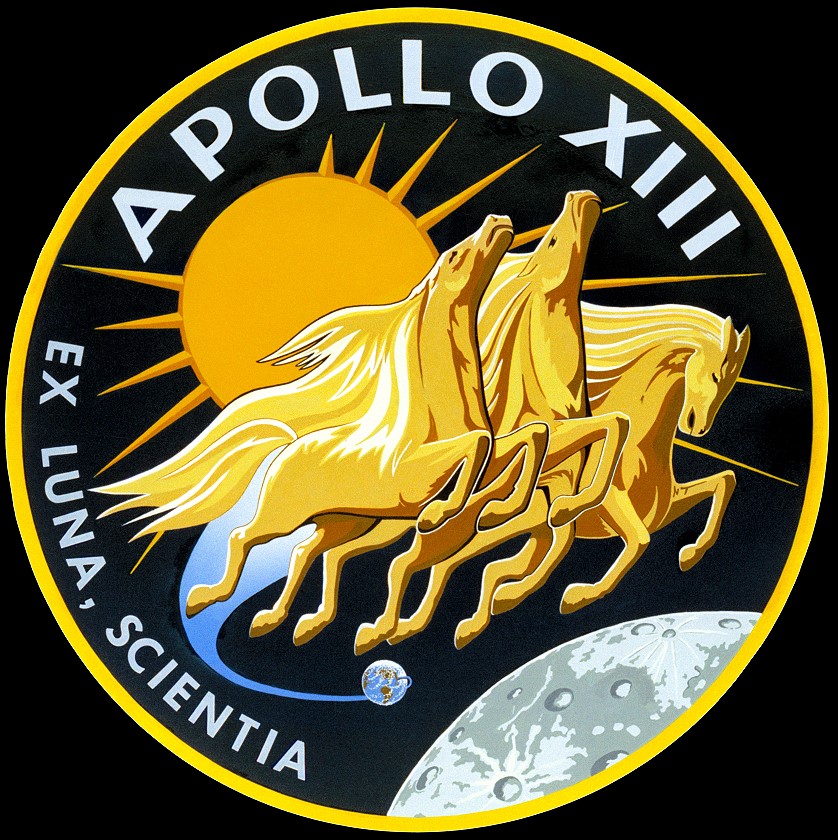
Category: History

Apollo 13 – who remembers?

55:55:20 – Swigert: “Okay, Houston, we’ve had a problem here.”

Apollo 13

Probably one of the most famous phrases from the whole Apollo program, these immortal words were uttered shortly before 10.10 PM EST on April 13th, 1970.

There is so much material around that it would be pointless covering too much ground in this Post.  So why the Post today?

Because today, too, is the 13th April.  So on this day, 41 years ago, the world came together held its collective breath and prayed for a successful outcome to this scary disaster.

There are some wonderful archives around from NASA.  Here’s one that covers the chronology of events of that famous accident.

The following includes events from 2.5 minutes before the accident to about 5 minutes after. Times given are in Ground Elapsed Time (G.E.T.), that is, the time elapsed since liftoff of Apollo 13 on April 11, 1970, at 2:13 PM Eastern Standard Time (EST). 55:52:00 G.E.T. is equal to 10:05 PM EST on April 13, 1970.

Also, those who want more information, may wish to go here, here and here

And 41 years ago, this coming Sunday, i.e. April 17th 1970, with the whole world praying for their safe return, Apollo 13 splashed down near Samoa.

Four hours before landing, the crew shed the service module; Mission Control had insisted on retaining it until then because everyone feared what the cold of space might do to the unsheltered CM heat shield. Photos of the Service Module showed one whole panel missing, and wreckage hanging out, it was a sorry mess as it drifted away. Three hours later the crew left the Lunar Module Aquarius and then splashed down gently in the Pacific Ocean near Samoa. From here.

In a very real sense, Apollo 13, like a number of the other historic Apollo flights, is a wonderful reminder of something that this Planet needs right now.  A coming together of all the peoples of this beautiful planet, a unity of mankind, to remind us in these fragile and difficult times of the saying, ‘United we stand, divided we fall.’

Finally, this Post is published, not only on the 41st anniversary of that memorable Apollo Flight but the day after the 50th anniversary of Yuri Gagarin’s first flight of a human into space, the 12th April, 1961.

Mogollon culture in Payson, AZ

In fact, within a few steps of our front door.

The son of one of our neighbours called us round last Thursday to show us the skeletal remains he recently found in their front garden together with a most beautiful pot.  Here are a few pictures.

Discovery site
Mogollon culture pot?
Ancient and modern!

On the website Desert USA there is a section dealing with the culture of the Prehistoric Desert Peoples including the peoples of The Mogollon.  Here’s an extract.

In addition to wild edible and utilitarian plants, the mountain flanks and desert basins harbored a thriving community of game, including bighorn sheep, elk, mule deer, white-tail deer, antelope, beaver, badger, blacktail jackrabbits, desert cottontails, turkeys and various other species. Rock exposures served as quarries for the raw materials for making projectile points and tools. Clay exposures provided the raw material for making ceramic vessels and figurines.

Even as the Mogollon people gradually adopted village life and farming, they would continue to count on the ranges and basins to supplement their larder and provide essential material resources. They would never be able to rely on corn, beans, squash and other crops to the exclusion of wild plant foods because the Mogollon region held relatively few areas suitable for agriculture. Most of them occurred along lower mountain river valleys, along the few desert river basins and near a few desert playas. Even those areas which were suitable experienced erratic rainfall year in and year out.

The article includes the following photograph which shows how close the resemblance of the pot found next door to the one in the article.

All very fascinating. Indeed, when one reflects that European descendants have only been in the area for about 500 years and Payson considers it’s founding year as recent as 1882 it really isn’t that long ago, in historical terms, that the land around here will have borne the footprints of peoples very different to us today.

Maybe on still, dark nights, their memories are very close to us.

More with Joseph Campbell

When I posted my introductory piece on Joseph Campbell on the 14th February, I was tight on time.  So it was pretty brief, as a piece.

But I was amazed at the number of people who read that Post; clearly this man Campbell has reached out to many across the world.  Plus there was this comment from Michelle, better known as Dogkisses.

What a wonderful man! My hero. I cried when he passed on. He is the first person who reached me in my mid-twenties.

A friend of mine introduced me to “The Power of Myth,” and gave me a video series, which is so old now the VHS won’t play. Bill Moyers (I think I have that name right) interviewed him in the series.

The last book I had about him was, “Radio Interviews with Joseph Campbell.” I gave it to my teenage son. He loved it so much, but his girlfriend said reading that book made him act differently. I laughed and said thank goodness. He said the book disappeared. I wondered how. She said it made him not want to work full time. He was only barely seventeen, and I was trying to get him to take a different path in life.

The world would be a better place if everyone could appreciate what Joseph Campbell said and for the great work he did in his life.

Thank you. A very nice way to start a hectic Monday.

And in reply to me thanking DK for her comment and offering her the chance to guest post on Learning from Dogs, this further comment,

I certainly look forward to the future posts.

I’m having a hard time with my memory and mental fatigue lately. I would have to re-read myself to be able to write about what I learned from Joseph Campbell, which actually might help me and I know I would enjoy it.

I’ve been turning back for the past few months, looking back to when I stood on more solid ground spiritually. Hearing Joseph Campbell again would certainly help me remember that time in my life, because I was reading his work. I have daily quotes from him that come to my Google reader.

Thank you for the invitation and I am truly honored that you ask. I can do some reading and see if my brain gives me anything to share.

Peace,
Michelle.

So this Post today is for Michelle.

Where are we off to?

More musings on how this present civilisation is going to change, as change it must.

I have a sense that this article is going to spread across a number of posts.  Regular readers of Learning from Dogs will be aware that I am summarising Lester Brown’s excellent book, World on the Edge.  If you have missed those summaries, the last one, Part 4, was here. (Part 3 here, Part 2 here, Part 1 here.)

Details of this excellent book are on the Earth Policy Institute website including the opportunity to download the book for free.

OK, back to the theme of this article, very much connected with the mission of the EPI.

Jean and I watched a video last night from the website Top Documentary Films; great site by the way.  It was called 2210: The Collapse.  This was how the film was described on that website.

Imagine if hundreds of years from now, scientists excavated the abandoned ruins of some of our largest cities, what conclusions would they come to?

It happened to the Romans, the Anasazi, and the Mayans and, inevitably, one day our own modern civilization will also fall. In this two hour special discover how a future civilization might be baffled as to why the population of these once-great cities would suddenly abandon their technology and architecture, and turn their homes into ghost towns.

Some experts believe that there is a very real risk this could happen, and the collapse of the world as we know it is closer than we think.

Examining the parallels between cultures separated by hundreds of years, explore whether the key to preventing such a global collapse today could lie in finding renewable alternatives to our dwindling energy supplies and sustainable resources. Can we learn from the mistakes of the past before it’s too late?

Jared Diamond

In some ways the film didn’t cover any new ground despite it being an interesting way of approaching the subject of the future of our present civilisation.  But what was really worthwhile were the clips from three experts in their various fields.  They were the author Jared Diamond, Daniel Gilbert who is Professor of Psychology at Havard, and Joseph Tainter also an author.  There is much material around from these three gentlemen.

So I am going to start with Jared Diamond.  WikiPedia has Jared’s details.  The following is a video going back to 2003 which is no less relevant in terms of where we are in 2011.  (If you want more of Jared’s ideas, just let me know and they will be included in a future Post.)

“I’ve set myself the modest task of trying to explain the broad pattern of human history, on all the continents, for the last 13,000 years. Why did history take such different evolutionary courses for peoples of different continents? This problem has fascinated me for a long time, but it’s now ripe for a new synthesis because of recent advances in many fields seemingly remote from history, including molecular biology, plant and animal genetics and biogeography, archaeology, and linguistics.”

JARED DIAMOND is Professor of Geography at the University of California, Los Angeles. Until recently he was Professor of Physiology at the UCLA School of Medicine. He is the author of the recently published Collapse: How Societies Choose to Fail or Succeed, and the Pulitzer Prize-winning author of the widely acclaimed Guns, Germs, and Steel: the Fates of Human Societies, which also is the winner of Britain’s 1998 Rhone-Poulenc Science Book Prize.  (From here)

Truth, myth and meaning

A musing on Chief Seattle’s famous speech.

I came across this recently following a bit of a prowl through YouTube.   The YouTube video, although deeply moving, is more myth than factual record; as one finds out if even a small amount of probing is undertaken.

But does it matter?  Maybe those ideas that reach out to us in a spiritual sense are as powerful as myths, perhaps even more so, than as ‘facts’.

Here’s that YouTube video.

Did you watch it all?  I hope so. Did it disturb you to know that this wasn’t a factual rendition?  Probably not.

WikiPedia has a comprehensive account of Chief Seattle and in terms of the speech here’s an extract:

There is a controversy about a speech by Si’ahl concerning the concession of native lands to the settlers.

Even the date and location of the speech has been disputed,[8] but the most common version is that on March 11, 1854, Si’ahl gave a speech at a large outdoor gathering in Seattle. The meeting had been called by Governor Isaac Ingalls Stevens to discuss the surrender or sale of native land to white settlers.Doc Maynard introduced Stevens, who then briefly explained his mission, which was already well understood by all present.[3]

Si’ahl then rose to speak. He rested his hand upon the head of the much smaller Stevens, and declaimed with great dignity for an extended period. No one alive today knows what he said; he spoke in the Lushootseed language, and someone translated his words into Chinook jargon, and a third person translated that into English.

So in terms of looking for the truth, forget it.

But in terms of being inspired to regard the land, and all that depends on it, as sacred then the myth of Chief Seattle’s words is beautiful and powerful, a myth that modern man has just about rejected.

If you want to read the words that are supposed to be the most authentic recording of what the noble Chief said, then these follow.  They are taken from here and the introduction and footnotes are valuable background information.  You may also want to read this account of the speech from the Washington State Library.

The only known photograph of Chief Seattle, taken 1864.


Scraps from a Diary:
Chief SeattleA gentleman by Instinct
His Native Eloquence, etc., etc.

by Henry A. Smith
10th article in the series “Early Reminiscences”
Seattle Sunday Star, October 29, 1887

Yonder sky that has wept tears of compassion upon my people for centuries untold, and which to us appears changeless and eternal, may change. Today is fair. Tomorrow it may be overcast with clouds. My words are like the stars that never change. Whatever Seattle says, the great chief at Washington can rely upon with as much certainty as he can upon the return of the sun or the seasons. The white chief says that Big Chief at Washington sends us greetings of friendship and goodwill. This is kind of him for we know he has little need of our friendship in return. His people are many. They are like the grass that covers vast prairies. My people are few. They resemble the scattering trees of a storm-swept plain. The great, and I presume — good, White Chief sends us word that he wishes to buy our land but is willing to allow us enough to live comfortably. This indeed appears just, even generous, for the Red Man no longer has rights that he need respect, and the offer may be wise, also, as we are no longer in need of an extensive country.  

There was a time when our people covered the land as the waves of a wind-ruffled sea cover its shell-paved floor, but that time long since passed away with the greatness of tribes that are now but a mournful memory. I will not dwell on, nor mourn over, our untimely decay, nor reproach my paleface brothers with hastening it, as we too may have been somewhat to blame.

Youth is impulsive. When our young men grow angry at some real or imaginary wrong, and disfigure their faces with black paint, it denotes that their hearts are black, and that they are often cruel and relentless, and our old men and old women are unable to restrain them. Thus it has ever been. Thus it was when the white man began to push our forefathers ever westward. But let us hope that the hostilities between us may never return. We would have everything to lose and nothing to gain. Revenge by young men is considered gain, even at the cost of their own lives, but old men who stay at home in times of war, and mothers who have sons to lose, know better.

Our good father in Washington—for I presume he is now our father as well as yours, since King George has moved his boundaries further north—our great and good father, I say, sends us word that if we do as he desires he will protect us. His brave warriors will be to us a bristling wall of strength, and his wonderful ships of war will fill our harbors, so that our ancient enemies far to the northward — the Haidas and Tsimshians — will cease to frighten our women, children, and old men. The in reality he will be our father and we his children. But can that ever be? Your God is not our God! Your God loves your people and hates mine! He folds his strong protecting arms lovingly about the paleface and leads him by the hand as a father leads an infant son. But, He has forsaken His Red children, if they really are His. Our God, the Great Spirit, seems also to have forsaken us. Your God makes your people wax stronger every day. Soon they will fill all the land. Our people are ebbing away like a rapidly receding tide that will never return. The white man’s God cannot love our people or He would protect them. They seem to be orphans who can look nowhere for help. How then can we be brothers? How can your God become our God and renew our prosperity and awaken in us dreams of returning greatness? If we have a common Heavenly Father He must be partial, for He came to His paleface children. We never saw Him. He gave you laws but had no word for His red children whose teeming multitudes once filled this vast continent as stars fill the firmament. No; we are two distinct races with separate origins and separate destinies. There is little in common between us.

To us the ashes of our ancestors are sacred and their resting place is hallowed ground. You wander far from the graves of your ancestors and seemingly without regret. Your religion was written upon tablets of stone by the iron finger of your God so that you could not forget. The Red Man could never comprehend or remember it. Our religion is the traditions of our ancestors — the dreams of our old men, given them in solemn hours of the night by the Great Spirit; and the visions of our sachems, and is written in the hearts of our people.

Your dead cease to love you and the land of their nativity as soon as they pass the portals of the tomb and wander away beyond the stars. They are soon forgotten and never return. Our dead never forget this beautiful world that gave them being. They still love its verdant valleys, its murmuring rivers, its magnificent mountains, sequestered vales and verdant lined lakes and bays, and ever yearn in tender fond affection over the lonely hearted living, and often return from the happy hunting ground to visit, guide, console, and comfort them.

Day and night cannot dwell together. The Red Man has ever fled the approach of the White Man, as the morning mist flees before the morning sun. However, your proposition seems fair and I think that my people will accept it and will retire to the reservation you offer them. Then we will dwell apart in peace, for the words of the Great White Chief seem to be the words of nature speaking to my people out of dense darkness.

It matters little where we pass the remnant of our days. They will not be many. The Indian’s night promises to be dark. Not a single star of hope hovers above his horizon. Sad-voiced winds moan in the distance. Grim fate seems to be on the Red Man’s trail, and wherever he will hear the approaching footsteps of his fell destroyer and prepare stolidly to meet his doom, as does the wounded doe that hears the approaching footsteps of the hunter.

A few more moon, a few more winters, and not one of the descendants of the mighty hosts that once moved over this broad land or lived in happy homes, protected by the Great Spirit, will remain to mourn over the graves of a people once more powerful and hopeful than yours. But why should I mourn at the untimely fate of my people? Tribe follows tribe, and nation follows nation, like the waves of the sea. It is the order of nature, and regret is useless. Your time of decay may be distant, but it will surely come, for even the White Man whose God walked and talked with him as friend to friend, cannot be exempt from the common destiny. We may be brothers after all. We will see.

We will ponder your proposition and when we decide we will let you know. But should we accept it, I here and now make this condition that we will not be denied the privilege without molestation of visiting at any time the tombs of our ancestors, friends, and children. Ever part of this soil is sacred in the estimation of my people. Every hillside, every valley, every plain and grove, has been hallowed by some sad or happy event in days long vanished. Even the rocks, which seem to be dumb and dead as the swelter in the sun along the silent shore, thrill with memories of stirring events connected with the lives of my people, and the very dust upon which you now stand responds more lovingly to their footsteps than yours, because it is rich with the blood of our ancestors, and our bare feet are conscious of the sympathetic touch. Our departed braves, fond mothers, glad, happy hearted maidens, and even the little children who lived here and rejoiced here for a brief season, will love these somber solitudes and at eventide they greet shadowy returning spirits. And when the last Red Man shall have perished, and the memory of my tribe shall have become a myth among the White Men, these shores will swarm with the invisible dead of my tribe, and when your children’s children think themselves alone in the field, the store, the shop, upon the highway, or in the silence of the pathless woods, they will not be alone. In all the earth there is no place dedicated to solitude. At night when the streets of your cities and villages are silent and you think them deserted, they will throng with the returning hosts that once filled them and still love this beautiful land. The White Man will never be alone.

Let him be just and deal kindly with my people, for the dead are not altogether powerless.


Amen to that.

This most beautiful of relationships

That of man and dog.

A number of items have crossed my screen that, together, present the most wonderful story of the intensity and length of the time that mankind has shared his life with the dog.

First is this piece from Anthropology.net from 2008 when this was big news.

A Possible Domestication Of Dogs During The Aurignacian: 31,700 Years Ago

Both Dienkes and John Hawks have shared news about the latest research on the domestication of dogs. The researchers analyze 117 skulls of prehistoric canids from sites in Belgium, Ukraine and Russia. They conclude that a 31,700 year old canid from Belgium is ‘clearly different from the recent wolves, resembling most closely the prehistoric dogs.’

The draft can be found in the Journal of Archaeological Science under the title, “Fossil dogs and wolves from Palaeolithic sites in Belgium, the Ukraine and Russia: osteometry, ancient DNA and stable isotopes.” If the dating, and phylogenetic analysis is correct, these remains makes them the oldest known remains of domesticated dog, pushing back domestication time by 17,700 years, since the second oldest known dog, found in Russia, dates to 14,000 years ago as explained by Carl Feagans.

Doral View of the Goyet Cave Dog (a) and wolf skulls (b & c)Doral View of the Goyet Cave Dog (a) and wolf skulls (b & c)

Prehistoric dogs are distinguished from both prehistoric and extant wolves in having a shorter and broader snout, relatively wider brain cases, and a general reduction in skull size. Palaeolithic dogs in the study conform to this pattern. The researchers extended their anatomical analysis to mtDNA and stable isotopes on the Belgian samples. All fossil samples yielded unique DNA sequences.

This is a fascinating article, read the rest of it here.

Next a further explanation of the history of the dog from About.com Archaeology:

Dog history is really the history of the partnership between dogs (Canis lupus familiaris) and humans. That partnership is based on human needs for help with herding and hunting, an early alarm system, and a source of food in addition to the companionship many of us today know and love. Dogs get companionship, protection and shelter, and a reliable food source out of the deal. But when this partnership first occurred is at the moment under some controversy.

Dog history has been studied recently using mitochondrial DNA, which suggests that wolves and dogs split into different species around 100,000 years ago; but whether humans had anything to do with that, no one really knows.

Just think about that – 100,000 years ago!  But even if one assumes that early man wasn’t linked to this species divergence, the hard evidence of dogs being special to man still goes back a very long way.  Continuing the piece above:

The oldest dog skull discovered to date is from Goyet Cave, Belgium. The Goyet cave collections (the site was excavated in the mid-19th century) were examined recently (Germonpré and colleagues, cited below) and a fossil canid skull was discovered among them. Although there is some confusion as to which level the skull came from, it has been direct-dated by AMS at 31,700 BP. The skull most closely represents prehistoric dogs, rather than wolves. The study examining the Goyet cave also identified what appears to be prehistoric dogs at Chauvet Cave (~26,000 bp) and Mezhirich in the Ukraine (ca 15,000 years BP), among others.

However, I am told that what the Goyet Cave skull represents is not a “domesticated dog” but rather a wolf in transition to a dog, and that the physical changes seen in the skulls (consisting primarily of the shortening of the snout) may have been driven by changes in diet, rather than specific selection of traits by humans. That transition in diet could well have been partly due to the beginnings of a relationship between humans and dogs, although the relationship might have been as tenuous as animals following human hunters to scavenge, rather like the behavior that is believed to have existed between humans and cats. You could argue that cats never have been domesticated, they just take advantage of the mice we attract

As they say, dogs have masters, cats have slaves! Millions of dog owners have a relationship with their dog that is close to spiritual, and that also isn’t new. Let’s read on:

A burial site in Germany called Bonn-Oberkassel has joint human and dog interments dated to 14,000 years ago. The earliest domesticated dog found in China is at the early Neolithic (7000-5800 BC) Jiahu site in Henan Province. European Mesolithic sites like Skateholm(5250-3700 BC) in Sweden have dog burials, proving the value of the furry beasts to hunter-gatherer settlements. Danger Cave in Utah is the earliest case of dog burial in the Americas, at about 11,000 years ago.

Haplotypes and Grey Wolves

A recent study led by Robert Wayne (vonHoldt et al., below) at UCLA and appearing in Nature in March 2010 reported that dogs appear to have a higher proportion of wolf haplotypes from grey wolves native to the Middle East. That suggests, contrary to earlier studies, that the middle east was the original location of domestication. What also showed up in this report was evidence for either a second Asian domestication or a later admixture with Chinese wolves.

Dog History: When Were Dogs Domesticated?

It seems clear that dog domestication was a long process, which started far longer ago than was believed even as recently as 2008. Based on evidence from Goyet and Chauvetcaves in Europe, the dog domestication process probably began as long ago as 30,000 years, although the oldest evidence for a broader relationship, a working relationship, is at the Bonn-Oberkassel site, 14,000 years ago. The story of dog domestication is still in transition itself.

14,000 years ago people buried a dog with a human!  That is so beautiful.

Finally, National Geographic have been showing a series on this wonderful relationship between man and dog.  Enjoy this introduction video.

This is the dog!

More close to man for more years than one could ever imagine.

A week ago, there was an article on Learning from Dogs entitled What is the dog? It was primarily based on the work of Dr. George Johnson; his details are here.

Anyway, last Thursday Pete N who is incredibly helpful in passing me items of interest, passed me a link to a series of videos that come under the collective name of Dogs Decoded.  They were on the website Top Documentary Films itself an interesting site.

It looks as though the videos are due to be released as a single film later on this year, as this link suggests.  Here’s how the three videos are introduced.

Dogs Decoded reveals the science behind the remarkable bond between humans and their dogs and investigates new discoveries in genetics that are illuminating the origin of dogs – with surprising implications for the evolution of human culture.

Other research is proving what dog lovers have suspected all along; dogs have an uncanny ability to read and respond to human emotions.

Humans, in turn, respond to dogs with the same hormone responsible for bonding mothers to their babies. How did this incredible relationship between humans and dogs come to be? And how can dogs, so closely related to fearsome wild wolves, behave so differently?

No more from me.  Just find a quiet corner and watch the three videos by clicking on each link in turn.  They will blow your mind.

Dogs Decoded (1/3)

Dogs Decoded (2/3)

Dogs Decoded (3/3)


It’s all we have!

A bit tight on time for today’s Post so just feast your eyes on this image.


Earthrise, from the cabin of Apollo 8


This view of the rising Earth greeted the Apollo 8 astronauts as they came from behind the Moon after the lunar orbit insertion burn. The photo is displayed here in its original orientation, though it is more commonly viewed with the lunar surface at the bottom of the photo. Earth is about five degrees left of the horizon in the photo. The unnamed surface features on the left are near the eastern limb of the Moon as viewed from Earth. The lunar horizon is approximately 780 kilometers from the spacecraft. Height of the photographed area at the lunar horizon is about 175 kilometers.

The Apollo 8 mission was the first time man had left the orbit of the Earth.

The photograph was taken on the 24th December 1968 by NASA astronaut William Anders.  Within 18 months of this image being published, the environmental movement had started. Wilderness photographer Galen Rowell called it “the most influential environmental photograph ever taken.”


Afghanistan and truth!

“But better to be hurt by the truth than comforted with a lie.”

The quote is from the film, The Kite Runner, which was based on the book  of the same name written by Khaled Hosseini.

This Post is not about taking a position, at any level, about the West’s involvement in the war in Afghanistan – far too dangerous territory!  But it is a reflection on what truth means.

At first that proposition might appear bizarre, of course we know what truth means. My Thesaurus offers three meanings: Correspondence with fact or truth; Freedom from deceit or falseness; The quality of being actual or factual.  Clear?  H’mmm not really in this instance.

OK, to the motivation behind this article.

Last Sunday two outwardly disconnected actions came together, as often seems to happen, to cause me to ponder on how my opinions are formed.  The actions concerned Afghanistan.

The first was that a friend from the congregation gave me his copy of TIME Magazine for January 17th.  In it was an article about a Black Hawk Medevac unit in Afghanistan.  From the TIME website:

The Birds Of Hope: With A Black Hawk Medevac Unit In Afghanistan

By James Nachtwey Monday, Jan. 17, 2011

General William Tecumseh Sherman got it right. War is hell. But even within the cruelty of war, there exists mercy.

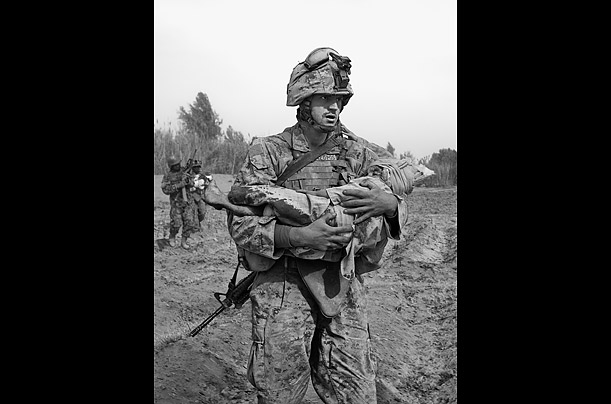
Across a dusty field, two U.S. Marines walk toward a helicopter, each carrying a bloodied and bandaged child. They hold the children as if they were their own. Although at this moment they appear as saviors, a few minutes earlier, they had called in air support in response to enemy fire. The shooter was among children, however (a fact that I have to believe was not known to the Marines), and two were seriously wounded by fragments from machine-gun rounds.

Innocent people are caught in the cross fire in all wars. That’s reality. The two Marines never signed up to hurt kids, and in the shock and confusion, their default reaction was to be protective of the children they indirectly had a hand in wounding. The kids were not left to die, as they might have been in another time and another place by other armies. Instead, a U.S. Army air-ambulance medevac crew was dispatched to fly them to the same medical facility that treats American casualties. If the shooter had survived, he too would have been helped.

Read more: http://www.time.com/time/magazine/article/0,9171,2041191,00.html#ixzz1Byu1S0xj

The article in TIME Magazine contained some emotionally powerful pictures, such as the one below.


A Marine carries an Afghan child.

The full description of the photograph, taken by James Nachtwey for TIME , is Helping Hand
A Marine carries an Afghan child, one of two wounded by coalition aircraft during an air support mission.

My reaction on reading the gruelling story was confused and difficult to articulate clearly but certainly not complimentary! Something along the lines of big and powerful nations, such as the USA, Russia and the United Kingdom, playing out their global strategies with no real insight into the pain and suffering caused by their big ‘war games’.

The second action was that Jean had returned a rental film to the local Blockbuster store and returned with another one that had caught her eye for us to watch on Sunday evening.  That film was The Kite Runner based on the book of the same name by Khaled Hosseini.

There’s a good summary of the plot of the film at WikiPedia.  Here’s a flavour.

In Kabul, prior to the Soviet invasion of Afghanistan, well-to-do young boy Amir and his loyal young Hazara servant Hassan are best of friends. Amir enjoys writing and literature, reading stories to the eager but illiterate Hassan. Amir’s Baba (father), is contemptuous of Amir’s writing and privately regards him as a weakling for letting Hassan protect him from bullies. Baba’s friend Rahim Khan demonstrates interest and encouragement to Amir. Assef, a bully with rancor towards Hazaras, and two accomplices confront Hassan and Amir, but Hassan prevents the attack with a slingshot, a birthday gift from Amir. Assef swears revenge, ridiculing their relationship as mere master and servant. .

Soon the Soviets invade Afghanistan; forcing Baba, a known anti-communist, to flee the country leaving Rahim Khan as property caretaker. En route to Pakistan, Baba bravely risks his life defending a female refugee from a Soviet soldier who demands to rape her in return for safe passage for all. Baba and Amir eventually reach the United States as humble refugees in Fremont, California. Baba tends a gas station while Amir attends community college and vends at a weekly flea market. There, Amir meets Soraya Taheri; Soraya is interested in Amir’s writing although her father, the ex-General Taheri, a proud traditional Pashtun, is contemptuous. Baba is stricken mortally ill but manages to obtain General Taheri’s permission for Amir to marry Soraya. Although Soraya feels bound to confess her previous relationships, they are happily married despite an inability to conceive children. As foreshadowed in the movie’s first scene, Amir’s debut novel is published, dedicated to Rahim Khan who encouraged his writing.

It was a fabulous film, one of the more thought-provoking films seen in many years.  If you haven’t seen it, do so.

So to the point of this article.

The film demonstrated to me that my rather black-and-white opinion of the West’s involvement in Afghanistan was based much more on my instincts that ‘war is bad’ and that the USA tends to throw its military weight around, than having a clue as to the enormous complexities, both at the level of a family and of the nation, that these conflicts entail.

The film showed a much more compassionate aspect to the activities of the USA, specifically in getting involved in Afghanistan and, more generally, in a policy of offering a new home and new hope to those from afar.

And for me, the realisation that while it may be said, ‘There is only one truth’, knowing what that truth is is something very much more challenging!

The first casualty when war comes is truth“. (Hiram W Johnson, senator for California, 1917)
What is the dog?

Time to attempt an answer to this fundamental, well for this Blog, question!


Like wolves, the Dingo is smarter than pet dogs.

(The above photograph comes from an article on ImpactLab – see foot of Post for more details.)

When putting together the Blog ahead of the publication of the very first Post on July 15th, 2009, some 820 Posts ago, I prepared some additional material that set out to justify the Raison d’être for the venture.  Included was a piece regarding Dogs and integrity.  There I wrote:

Dogs are part of the Canidae, a family including wolves, coyotes and foxes, thought to have evolved 60 million years ago.  There is no hard evidence about when dogs and man came together but dogs were certainly around when man developed speech and set out from Africa, about 50,000 years ago.  See an interesting article by Dr. George Johnson.

Anyway, I revisited the article written by Dr Johnson and thought it worthy of being published in full, as a separate article in Learning from Dogs.  I requested permission to reproduce the article in full and Dr. George Johnson was very gracious in quickly coming back to me giving his agreement.  Thank you.  The original article can be read here, the ONSCIENCE home page is here and Dr. Johnson’s details are here.

Evolution of the family dog

I first suspected that Boswell would have a short life when he bit my wife on our nuptial bed.

Boswell was my dog, a feisty Toto-like terrier who shared my bachelor bed and resented the intrusion of a woman where he felt a dog — Boswell — ought to be. As it turns out, my suspicion was correct, and he did not live out the year, which was 1982. Staying with others while I and my bride were overseas, Boswell resented being denied chicken bones, ate them anyway, and died of the consequences. To this day I miss him.

This week I found myself wondering about Boswell’s origins. From what creature did the domestic dog arise? Darwin suggested that wolves, coyotes, and jackals — all of which can interbreed and produce fertile offspring– may all have played a role, producing a complex dog ancestry that would be impossible to unravel. In the 1950s, Nobel Prize-winning behaviorist Konrad Lorenz suggested some dog breeds derive from jackals, others from wolves.

Based on anatomy, most biologists have put their money on the wolf, but until recently there was little hard evidence, and, as you might expect if you know scientists, lots of opinions.

The issue was finally settled in 1997 by an international team of scientists led by Robert Wayne of the University of California, Los Angeles. To sort out the evolutionary origin of the family dog, Wayne and his colleagues used the techniques of molecular biology to compare the genes of dogs with those of wolves, coyotes and jackals.

Wayne’s team collected blood, tissue, or hair from 140 dogs of sixty-seven breeds, and 162 wolves from North America, Europe, Asia, and Arabia. From each sample they extracted DNA from the tiny organelles within cells called mitochondria.

While the chromosome DNA of an animal cell derives from both parents, the mitochondrial DNA comes entirely from the mother. Biologists love to study mitochondrial DNA because of this simple line of descent, female-to-female-to-female. As changes called mutations occur due to copying mistakes or DNA damage, the mitochondrial DNA of two diverging lines becomes more and more different. Ancestors can be clearly identified when you are studying mitochondrial DNA, because clusters of mutations are not shuffled into new combinations like the genes on chromosomes are. They remain together as a particular sequence, a signature of that line of descent.

When Wayne looked at his canine mitochondrial DNA samples, he found that wolves and coyotes differ by about 6% in their mitochondrial DNA, while wolves and dogs differ by only 1%. Already it smelled like the wolf was the ancestor.

Wayne’s team then focused their attention on one small portion of the mitochondrial DNA called the control region, because it was known to vary a lot among mammals. Among the sixty seven breeds of dogs, Wayne’s team found a total of 26 different sequences in the control region, each differing from the others at one or a few sites. No one breed had a characteristic sequence — rather, the breeds of dogs share a common pool of genetic diversity.Wolves had 27 different sequences in the control region, none of them exactly the same as any dog sequence, but all very similar to the dog sequences, differing from them at most at 12 sites along the DNA, and usually fewer.

Coyote and jackal were a lot more different from dogs than wolves were. Every coyote and jackal sequence differed from any dog sequence by at least 20 sites, and many by far more.

That settled it. Dogs are domesticated wolves.

Using statistical methods to compare the relative similarity of the sequences, Wayne found that all the dog sequences fell into four distinct groups. The largest, containing 19 of the 26 sequences and representing 3/4 of modern dogs, resulted from a single female wolf lineage. The three smaller groups seem to represent later events when other wolves mated with the now-domesticated dogs. Domestication, it seems, didn’t happen very often, and perhaps only once.

The large number of different dog sequences, and the fact that no wolf sequences are found among them, suggests that dogs must have been separated from wolves for a long time. The oldest clear fossil evidence for dogs is 12,000 – 14,000 years ago, about when farming arose. But that’s not enough time to accumulate such a large amount of mitochondrial DNA difference. Perhaps dogs before then just didn’t look much different from wolves, and so didn’t leave dog-like fossils. Our species first developed speech and left Africa about 50,000 years ago. I bet that’s when dogs came aboard, when our hunter-gatherer ancestors first encountered them. They would have been great hunting companions.

I think Boswell would be happy to know his ancestor was a wolf. I doubt, however, I will ever be able to get my wife to overlook the biting as “wolf genetic baggage” inherited from nobel ancestors. In my house, science only stretches so far. © Txtwriter Inc

As so often happens, for reasons quite beyond me, when I am pursuing an article idea something else crops up that is highly relevant to my musings.  This was no exception.

A recent article in the Christian Science Monitor describes finding a fragment of dog bone in North America dating back some 9,400 years.  Here’s a flavour of that article.

By Associated Press / January 19, 2011

PORTLAND, MaineNearly 10,000 years ago, man’s best friend provided protection and companionship — and an occasional meal.

That’s what researchers are saying after finding a bone fragment from what they are calling the earliest confirmed domesticated dog in the Americas.

University of Maine graduate student Samuel Belknap III came across the fragment while analyzing a dried-out sample of human waste unearthed in southwest Texas in the 1970s. A carbon-dating test put the age of the bone at 9,400 years, and a DNA analysis confirmed it came from a dog — not a wolf, coyote or fox, Belknap said.

Because it was found deep inside a pile of human excrement and was the characteristic orange-brown color that bone turns when it has passed through the digestive tract, the fragment provides the earliest direct evidence that dogs — besides being used for company, security and hunting — were eaten by humans and may even have been bred as a food source, he said.

Belknap wasn’t researching dogs when he found the bone. Rather, he was looking into the diet and nutrition of the people who lived in the Lower Pecos region of Texas between 1,000 and 10,000 years ago.

The article then, a little later, goes on to say:

Dogs have played an important role in human culture for thousands of years.

There are archaeological records of dogs going back 31,000 years from a site in Belgium, 26,000 years in the Czech Republic and 15,000 years in Siberia, said Robert Wayne, a professor of evolutionary biology at UCLA and a dog evolution expert. But canine records in the New World aren’t as detailed or go back nearly as far.

Darcy Morey, a faculty member at Radford University who has studied dog evolution for decades, said a study from the 1980s dated a dog found at Danger Cave, Utah, at between 9,000 and 10,000 years old. Those dates were based not on carbon-dating or DNA tests, but on an analysis of the surrounding rock layers.

“So 9,400 years old may be the oldest, but maybe not,” Morey said in an e-mail.

Morey, whose 2010 book, “Dogs: Domestication and the Development of a Social Bond,” traces the evolution of dogs, said he is skeptical about DNA testing on a single bone fragment because dogs and wolves are so similar genetically.

My last extract is as follows:

Darcy Morey, a faculty member at Radford University who has studied dog evolution for decades, said a study from the 1980s dated a dog found at Danger Cave, Utah, at between 9,000 and 10,000 years old. Those dates were based not on carbon-dating or DNA tests, but on an analysis of the surrounding rock layers.

“So 9,400 years old may be the oldest, but maybe not,” Morey said in an e-mail.

Morey, whose 2010 book, “Dogs: Domestication and the Development of a Social Bond,” traces the evolution of dogs, said he is skeptical about DNA testing on a single bone fragment because dogs and wolves are so similar genetically.

Fascinating.

Finally, going back to the photograph at the top of the page, this came from an article here in ImpactLab.  It’s well worth a read.