This came in from Suzann, Su to her friends, a few days ago. Suzann is Dan Gomez’s sister and if Dan’s name is familiar it’s because he, too, sends in items for Learning from Dogs, the recent Tad too much cabin pressure being an example. It was Su that invited me out to San Carlos, Mexico for Christmas 2007 which resulted in me meeting Jean, a long-time friend of Su, and, as they say, the rest is history! OK, to the article from Su.
oooOOOooo
Here’s a question?
Think about railroad (railways in ‘English’!) tracks. The US standard railroad gauge (distance between the rails) is 4 feet, 8.5 inches. That’s an exceedingly odd number.
Why was that gauge used? Because that’s the way they built them in Scotland, and Scots expatriates designed the US railroads.
Why did the Scots build them like that? Because the first rail lines were built by the same people who built the pre-railroad tramways, and that’s the gauge they used.
Why that gauge then? Because the people who built the tramways used the same jigs and tools that they had used for building wagons, which used that wheel spacing.
Why did the wagons have that particular odd wheel spacing? Well, if they tried to use any other spacing, the wagon wheels would break on some of the old, long-distance roads in Scotland, because that’s the spacing of the wheel ruts.
So who built those old rutted roads? Imperial Rome built the first long distance roads in Europe (including Scotland) for their legions. Those roads have been used ever since. [And rarely repaired! 😉 Ed. ]
And the ruts in the roads? Roman war chariots formed the initial ruts. Which forever more everyone else had to match for fear of destroying their wagon wheels.
Since the chariots were made for Imperial Rome, they were all alike in the matter of wheel spacing. Therefore the United States standard railroad gauge of 4 feet, 8.5 inches is derived from the original specifications for an Imperial Roman war chariot.
Bureaucracies live forever….
So the next time you are handed a specification or a procedure or process and wonder ‘What horse’s ass came up with this?‘, you may be exactly right. Imperial Roman army chariots were made just wide enough to accommodate the rear ends of two war horses.
Now, the twist to the story. When you see a Space Shuttle sitting on its launch pad, there are two big booster rockets attached to the sides of the main fuel tank. These are solid rocket boosters, or SRBs. The SRBs are made by Thiokol at their factory in Utah.
The engineers who designed the SRBs would have preferred to make them a bit fatter, but the SRBs had to be shipped by train from the factory to the launch site. The railroad line from the factory happens to run through a tunnel in the mountains, and the SRBs had to fit through that tunnel.
The tunnel is slightly wider than the railroad track, and the railroad track, as you now know, is about as wide as two horses’ behinds.
oooOOOooo
Just a fabulously interesting account of something we all take for granted, or had done until now! Thank you so much, Su, for sharing that with everyone.
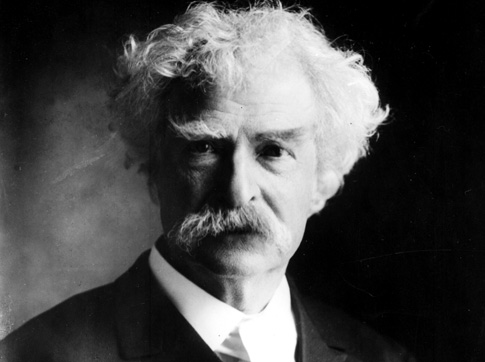
Mark Twain quotation after hearing that his obituary had been published in the New York Journal.
Mistaken publications of obituaries aren’t as rare as you might expect. A recent example is of Dave Swarbrick, the British folk/rock violinist, who was killed off mistakenly by the Daily Telegraph in April 1999 when they reported that his visit to hospital in Coventry had resulted in his death. He did at least get the opportunity to read a rather favourable account of his life, not something we all get to do, and to deliver the gag “It’s not the first time I have died in Coventry”.
So why have I opened with this quote from Mark Twain? Read on and I hope all will be clear.
Integrity is always about getting to the truth!
A little under a week ago I published a couple of posts that proposed that the United States of America is an empire in decline. The first was What goes up? and the second Might just come down! As a Brit I well know that aspect of British history!
However a recent conversation with a friend of many years back in England, who has also been a shrewd and wise entrepreneur for longer than I care to remember, argued that the evidence for the ‘end of the USA’ could be challenged.
He cited five reasons why he thought the USA would remain, more or less, in its dominant position. They were:
Spirit of innovation
Relaxed labour laws
The importance of Mexico
The uncertainty of China in terms of the next ’empire’
The likely energy self-sufficiency for the USA in the near-term.
So let me expand on each of those points.
Spirit of innovation
Let me quote from an article in TIME Magazine of the 5th June, 2011,
Innovation is as American as apple pie. It seems to accord with so many elements of our national character — ingenuity, freedom, flexibility, the willingness to question conventional wisdom and defy authority. But politicians are pinning their hopes on innovation for more urgent reasons. America’s future growth will have to come from new industries that create new products and processes. Older industries are under tremendous pressure. Technological change is making factories and offices far more efficient. The rise of low-wage manufacturing in China and low-wage services in India is moving jobs overseas. The only durable strength we have — the only one that can withstand these gale winds — is innovation.
Now there are plenty to argue both ways in terms of the future innovation potential for the USA, as a recent article in The Atlantic does, see American Innovation: It’s the Best of Times and the Worst of Times. But the spirit of innovation will be a powerful economic potential for the USA for many years to come.
Relaxed labour laws.
Definitely an area that I have little knowledge of except for the subjective notion that compared to many other nations, the laws in the USA are much less of a restraint on economic productivity than elsewhere.
The importance of Mexico.
Importance in the context of providing the USA with a source of cheaper manufacturing facilities. My English friend thought that this was a significant competitive advantage for the USA. Now, as it happens, we had a couple staying with us over the week-end of the 6th/7th October. The husband is a senior manager of Horst Engineering, an American firm based in Guaymas, Sonora County, Mexico. Here’s a picture from their website,
We are a contract manufacturer of precision machined components and assemblies for aerospace, medical, and other high technology industries. Our core processes include Swiss screw machining, turning, milling, thread rolling, centerless grinding, and assembly. Our extensive supply chain offers our customers a full service logistics solution for managing their precision product requirements. We are ISO9001:2008 and AS9100 registered and proud of our 66 year, three-generation legacy of quality and performance.
I was told that many American and British firms were using Mexico rather than China for a number of reasons. Not least because Chinese suppliers require full payment before shipment. Plus that taking into account that financial aspect together with shipping costs and other logistical issues, China wasn’t as ‘cheap’ over all. Here’s a recent announcement from Rolls Royce,
Rolls-Royce plans new Sonora hub
The burgeoning aerospace industry in Guaymas had its efforts validated recently when the venerable Rolls-Royce chose it as the site for its newest global purchasing office.
Surrounded by several of its aerospace manufacturing suppliers, London-based Rolls-Royce will move into a Guaymas industrial park owned by Tucson-based The Offshore Group to develop a supply hub for commercial jets and military aircraft around the globe.
“Rolls-Royce has very robust booking orders for the next 10 years,” said Joel Reuter, director of communications for Rolls-Royce in North America. “We need to double our production.”
Because a number of Rolls-Royce suppliers already operate in Guaymas, the city was a logical choice, Reuter said.
The uncertainty of China in terms of the next ’empire’
The point made in terms of China taking over ’empire’ status from the USA, as Simon Johnson argues over at Baseline Scenario, is countered by the fact that politically China is an unknown quantity. Until China endorses some form of democratic process, that unknowingness is not going to disappear.
The likely energy self-sufficiency for the USA in the near-term.
I can’t do better than to ask you to watch this video! Just 27-minutes long, it is a very interesting review of the energy future of the USA.
As the TED website suggests in terms of why you should listen to Amory Lovins,
Amory Lovins was worried (and writing) about energy long before global warming was making the front — or even back — page of newspapers. Since studying at Harvard and Oxford in the 1960s, he’s written dozens of books, and initiated ambitious projects — cofounding the influential, environment-focused Rocky Mountain Institute; prototyping the ultra-efficient Hypercar — to focus the world’s attention on alternative approaches to energy and transportation.
His critical thinking has driven people around the globe — from world leaders to the average Joe — to think differently about energy and its role in some of our biggest problems: climate change, oil dependency, national security, economic health, and depletion of natural resources.
So, don’t know about you, but I found those five points deeply convincing. How about you? Are the reports of the death of the USA greatly exaggerated? Do leave a comment.
Civilizations die from suicide, not by murder. Arnold J Toynbee
I’m not sure where to start but as a result of finishing a particular book, plus a recent essay on Tom Dispatch, then another recent essay from Simon Johnson of Baseline Scenario fame, there were so many thoughts bumping around this aged brain that I had no alternative than to offer them to you, dear reader. You should also be warned that this is going to be two posts, covering today and tomorrow.
So let’s start with the book: The United States of Fear by Tom Engelhardt. To be brutally honest, I purchased the book more as a gesture of support to Tom who has been very supportive of Learning from Dogs, in particular allowing me permission to reproduce any essays that were published on TomDispatch, as a number have so been. What an error of judgment! Tom’s book provided another one of those rare but inspirational occasions where you know the world will never look quite the same again!
The back cover page of the book sets out the theme, thus,
Published 2011
In 2008, when the US National Intelligence Council issued its latest report meant for the administration of newly elected President Barack Obama, it predicted that the planet’s “sole superpower” would suffer a modest decline and a soft landing fifteen years hence. In his new book The United States of Fear, Tom Engelhardt makes clear that Americans should don their crash helmets and buckle their seat belts, because the United States is on the path to a major decline at a startling speed. Engelhardt offers a savage anatomy of how successive administrations in Washington took the “Soviet path”—pouring American treasure into the military, war, and national security—and so helped drive their country off the nearest cliff.This is the startling tale of how fear was profitably shot into the national bloodstream, how the country—gripped by terror fantasies—was locked down, and how a brain-dead Washington elite fiddled (and profited) while America quietly burned.
Think of it as the story of how the Cold War really ended, with the triumphalist “sole superpower” of 1991 heading slowly for the same exit through which the Soviet Union left the stage twenty years earlier.
One of the fascinating aspects of the book is that it was put together from 32 essays previously published online by Tom; the complete list with titles and dates is on pps. 205 & 206. So giving you a real feel for the book is easy! I’m going to do that by linking to one of those essays available in the archives of TomDispatch here. That essay was called Washington’s Echo Chamber and appears in the book starting on page 170 under the sub-heading of Five Ways to Be Tone Deaf in Washington. Let me quote you a little,
So much of what Washington did imagine in these last years proved laughable, even before this moment swept it away. Just take any old phrase from the Bush years. How about “You’re either with us or against us”? What’s striking is how little it means today. Looking back on Washington’s desperately mistaken assumptions about how our globe works, this might seem like the perfect moment to show some humility in the face of what nobody could have predicted.
It would seem like a good moment for Washington — which, since September 12, 2001, has been remarkably clueless about real developments on this planet and repeatedly miscalculated the nature of global power — to step back and recalibrate.
As it happens, there’s no evidence it’s doing so. In fact, that may be beyond Washington’s present capabilities, no matter how many billions of dollars it pours into “intelligence.” And by “Washington,” I mean not just the Obama administration, or the Pentagon, or our military commanders, or the vast intelligence bureaucracy, but all those pundits and think-tankers who swarm the capital, and the media that reports on them all. It’s as if the cast of characters that makes up “Washington” now lives in some kind of echo chamber in which it can only hear itself talking.
As a result, Washington still seems remarkably determined to play out the string on an era that is all too swiftly passing into the history books. While many have noticed the Obama administration’s hapless struggle to catch up to events in the Middle East, even as it clings to a familiar coterie of grim autocrats and oil sheiks, let me illustrate this point in another area entirely — the largely forgotten war in Afghanistan. After all, hardly noticed, buried beneath 24/7 news from Egypt, Bahrain, Libya, and elsewhere in the Middle East, that war continues on its destructive, costly course with nary a blink.
That was published by Tom a little over 18 months ago! Seems as relevant today as then! Let me stay with perspectives from 2011.
Chomsky, visiting Vancouver, Canada in March 2004
On the 24th August 2011 Noam Chomsky wrote an essay entitled American Decline: Causes and Consequences. Chomsky, as Wikipedia relates, is Professor (Emeritus) in the Department of Linguistics & Philosophy at MIT, where he has worked for over 50 years. Here is how that essay opens,
In the 2011 summer issue of the journal of the American Academy of Political Science, we read that it is “a common theme” that the United States, which “only a few years ago was hailed to stride the world as a colossus with unparalleled power and unmatched appeal — is in decline, ominously facing the prospect of its final decay.” It is indeed a common theme, widely believed, and with some reason. But an appraisal of US foreign policy and influence abroad and the strength of its domestic economy and political institutions at home suggests that a number of qualifications are in order. To begin with, the decline has in fact been proceeding since the high point of US power shortly after World War II, and the remarkable rhetoric of the several years of triumphalism in the 1990s was mostly self-delusion. Furthermore, the commonly drawn corollary — that power will shift to China and India — is highly dubious. They are poor countries with severe internal problems. The world is surely becoming more diverse, but despite America’s decline, in the foreseeable future there is no competitor for global hegemonic power.
So, according to Chomsky, it’s not as ‘black and white’ as Engelhardt sets out. But do read the full essay.
Nevertheless, the idea that the USA is ‘fiddling while Rome burns’ is supported in an essay published by Mattea Kramer on TomDispatch on the last day of September. I’m going to end Part One by republishing the essay in full. (Note that this is being published here after the first ‘debate’ had taken place.)
oooOOOooo
Tough Talk for America
A Guide to the Presidential Debates You Won’t Hear
By Mattea Kramer
Five big things will decide what this country looks like next year and in the 20 years to follow, but here’s a guarantee for you: you’re not going to hear about them in the upcoming presidential debates. Yes, there will be questions and answers focused on deficits, taxes, Medicare, the Pentagon, and education, to which you already more or less know the responses each candidate will offer. What you won’t get from either Mitt Romney or Barack Obama is a little genuine tough talk about the actual state of reality in these United States of ours. And yet, on those five subjects, a little reality would go a long way, while too little reality (as in the debates to come) is a surefire recipe for American decline.
So here’s a brief guide to what you won’t hear this Wednesday or in the other presidential and vice-presidential debates later in the month. Think of these as five hard truths that will determine the future of this country.
1. Immediate deficit reduction will wipe out any hope of economic recovery: These days, it’s fashionable for any candidate to talk about how quickly he’ll reduce the federal budget deficit, which will total around $1.2 trillion in fiscal 2012. And you’re going to hear talk about the Simpson-Bowles deficit reduction plan and more like it on Wednesday. But the hard truth of the matter is that deep deficit reduction anytime soon will be a genuine disaster. Think of it this way: If you woke up tomorrow and learned that Washington had solved the deficit crisis and you’d lost your job, would you celebrate? Of course not. And yet, any move to immediately reduce the deficit does increase the likelihood that you will lose your job.
When the government cuts spending, it lays off workers and cancels orders for all sorts of goods and services that would generate income for companies in the private sector. Those companies, in turn, lay off workers, and the negative effects ripple through the economy. This isn’t atomic science. It’s pretty basic stuff, even if it’s evidently not suitable material for a presidential debate. The nonpartisan Congressional Research Service predicted in a September report, for example, that any significant spending cuts in the near-term would contribute to an economic contraction. In other words, slashing deficits right now will send us ever deeper into the Great Recession from which, at best, we’ve scarcely emerged.
Champions of immediate deficit reduction are likely to point out that unsustainable deficits aren’t good for the economy. And that’s true — in the long run. Washington must indeed plan for smaller deficits in the future. That will, however, be a lot easier to accomplish when the economy is healthier, since government spending declines when fewer people qualify for assistance, and tax revenues expand when the jobless go back to work. So it makes sense to fix the economy first. The necessity for near-term recovery spending paired with long-term deficit reduction gets drowned out when candidates pack punchy slogans into flashes of primetime TV.
2. Taxes are at their lowest point in more than half a century, preventing investment in and the maintenance of America’s most basic resources: Hard to believe? It’s nonetheless a fact. By now, it’s a tradition for candidates to compete on just how much further they’d lower taxes and whether they’ll lower them for everyone or just everyone but the richest of the rich. That’s a super debate to listen to, if you’re into fairy tales. It’s not as thrilling if you consider that Americans now enjoy the lightest tax burden in more than five decades, and it happens to come with a hefty price tag on an item labeled “the future.” There is no way the U.S. can maintain a world-class infrastructure — we’re talking levees, highways, bridges, you name it — and a public education system that used to be the envy of the world, plus many other key domestic priorities, on the taxes we’re now paying.
Anti-tax advocates insist that we should cut taxes even more to boost a flagging economy — an argument that hits the news cycle nearly every hour and that will shape the coming TV “debate.” As the New York Times recently noted, however, tax cuts might have been effective in giving the economy a lift decades ago when tax rates were above 70%. (And no, that’s not a typo, that’s what your parents and grandparents paid without much grumbling.) With effective tax rates around 14% for Mitt Romney and many others, further cuts won’t hasten job creation, just the hollowing out of public investment in everything from infrastructure to education. Right now, the negative effects of tax increases on the most well-off would be small — read: not a disaster for “job creators” — and those higher rates would bring in desperately-needed revenue. Tax increases for middle-class Americans should arrive when the economy is stronger.
Right now, the situation is clear: we’re simply not paying enough to fund the basic ingredients of prosperity from highways and higher education to medical research and food safety. Without those funds, this country’s future won’t be pretty.
3. Neither the status quo nor a voucher system will protect Medicare (or any other kind of health care) in the long run: When it comes to Medicare, Mitt Romney has proposed a premium-support program that would allow seniors the option of buying private insurance. President Obama wants to keep Medicare more or less as it is for retirees. Meanwhile, the ceaseless rise in health-care costs is eating up the wages of regular Americans and the federal budget. Health care now accounts for a staggering 24% of all federal spending, up from 7% less than 40 years ago. Governor Romney’s plan would shift more of those costs onto retirees, according to David Cutler, a health economist at Harvard, while President Obama says the federal government will continue to pick up the tab. Neither of them addresses the underlying problem.
Here’s reality: Medicare could be significantly protected by cutting out waste. Our health system is riddled with unnecessary tests and procedures, as well as poorly coordinated care for complex health problems. This country spent $2.6 trillion on health care in 2010, and some estimates suggest that a staggering 30% of that is wasted. Right now, our health system rewards quantity, not quality, but it doesn’t have to be that way. Instead of paying for each test and procedure, Medicare could pay for performance and give medical professionals a strong incentive to provide more efficient and coordinated care. President Obama’s health law actually pilot tests such an initiative. But that’s another taboo topic this election season, so he scarcely mentions it. Introducing such change into Medicare and the rest of our health system would save the federal government tens of billions of dollars annually. It would truly preserve Medicare for future generations, and it would improve the affordability of health coverage for everyone under 65 as well. Too bad it’s not even up for discussion.
4. The U.S. military is outrageously expensive and yet poorly tailored to the actual threats to U.S. national security: Candidates from both parties pledge to protect the Pentagon from cuts, or even, in the case of the Romney team, to increase the already staggering military budget. But in a country desperate for infrastructure, education, and other funding, funneling endless resources to the Pentagon actually weakens “national security.” Defense spending is already mind-numbingly large: if all U.S. military and security spending were its own country, it would have the 19th largest economy in the world, ahead of Saudi Arabia, Taiwan, and Switzerland. Whether you’re counting aircraft carriers, weapons systems, or total destructive power, it’s absurdly overmatched against the armed forces of the rest of the world, individually or in combination. A couple of years ago, then-Secretary of Defense Robert M. Gates gave a speech in which he detailed that overmatch. A highlight: “The U.S. operates 11 large carriers, all nuclear powered. In terms of size and striking power, no other country has even one comparable ship.” China recently acquired one carrier that won’t be fully functional for some time, if ever — while many elected officials in this country would gladly build a twelfth.
But you’ll hear none of this in the presidential debates. Perhaps the candidates will mention that obsolete, ineffective, and wildly expensive weapons systems could be cut, but that’s a no-brainer. The problem is: it wouldn’t put a real dent in national defense spending. Currently almost one-fifth of every dollar spent by the federal government goes to the military. On average, Americans, when polled, say that they would like to see military funding cut by 18%.
Instead, most elected officials vow to pour limitless resources into more weapons systems of questionable efficacy, and of which the U.S. already owns more than the rest of the world combined. Count on one thing: military spending will not go down as long as the U.S. is building up a massive force in the Persian Gulf, sending Marines to Darwin, Australia, and special ops units to Africa and the Middle East, running drones out of the Seychelles Islands, and “pivoting” to Asia. If the U.S. global mission doesn’t downsize, neither will the Pentagon budget — and that’s a hit on America’s future that no debate will take up this month.
5. The U.S. education system is what made this country prosperous in the twentieth century — but no longer: Perhaps no issue is more urgent than this, yet for all the talk of teacher’s unions and testing, real education programs, ideas that will matter, are nonexistent this election season. During the last century, the best education system in the world allowed this country to grow briskly and lift standards of living. Now, from kindergarten to college, public education is chronically underfunded. Scarcely 2% of the federal budget goes to education, and dwindling public investment means students pay higher tuitions and fall ever deeper into debt. Total student debt surpassed $1 trillion this year and it’s growing by the month, with the average debt burden for a college graduate over $24,000. That will leave many of those graduates on a treadmill of loan repayment for most or all of their adult lives.
Renewed public investment in education — from pre-kindergarten to university — would pay handsome dividends for generations. But you aren’t going to hear either candidate or their vice-presidential running mates proposing the equivalent of a GI Bill for the rest of us or even significant new investment in education. And yet that’s a recipe for and a guarantee of American decline.
Ironically, those in Washington arguing for urgent deficit reduction claim that we’ve got to do it “for the kids,” that we must stop saddling our grandchildren with mountains of federal debt. But if your child turns 18 and finds her government running a balanced budget in an America that’s hollowed out, an America where she has no chance of paying for a college education, will she celebrate? You don’t need an economist to answer that one.
Scientists have given animals consciousness. Not through complex manipulation of the brain or through genetic manipulation, but by publicly acknowledging the consensus, for the first time in such a straightforward way, that non-human animals, including some of our evolutionarily distant cousins, have awareness and experience like we do.
The declaration, called The Cambridge Declaration On Consciousness, was signed at the Francis Crick Memorial Conference of Consciousness in Human and Non-Human Animals in the presence of Stephen Hawking in July in Cambridge, U.K. by an international group of scientists including cognitive neuroscientists, neuropharmacologists, neurophysiologists, neuroanatomists and computational neuroscientists.
What do they mean by consciousness? The Declaration treats it as the same as the phrase, “subjective experience.” Philosophers who share this view of consciousness with the scientists often say that something is conscious if there is “something that it is like” to be that thing. So, according to this, a rock is not conscious, because there is nothing “that it is like to be a rock.”
The signing marked the first formalization of the scientific consensus about the consciousness of several non-mammals, including birds, octopuses and even bees.
We declare the following: “The absence of a neocortex does not appear to preclude an organism from experiencing affective states. Convergent evidence indicates that non-human animals have the neuroanatomical, neurochemical, and neurophysiological substrates of conscious states along with the capacity to exhibit intentional behaviors. Consequently, the weight of evidence indicates that humans are not unique in possessing the neurological substrates that generate consciousness. Nonhuman animals, including all mammals and birds, and many other creatures, including octopuses, also possess these neurological substrates.”
The full document is really worth reading, by the way.
There is much more about the conference including some remarkable videos here, from which I will select two. The first one, in particular, is very moving, and upsetting! Be warned!
OK, forgive me but I’m going to state the obvious! Just read the entry on Wikipedia about Orangutans.
Orangutans are among the most intelligent primates and use a variety of sophisticated tools, also constructing elaborate sleeping nests each night from branches and foliage. The apes have been extensively studied for their learning abilities. There may even be distinctive cultures within populations. Field studies of the apes were pioneered by primatologist Birutė Galdikas. Both orangutan species are considered to be Endangered with the Sumatran orangutan being Critically Endangered. Human activities have decimated the populations and ranges of both species. Threats to wild orangutan populations include poaching, habitat destruction and the illegal pet trade. There are several conservation and rehabilitation organisations dedicated to the survival of orangutans in the wild.
‘Among the most intelligent primates‘! Yet again, an example of mankind treating the planet as a disposable item! A quick web search came across the Orangutan Foundation so as well as being saddened and angry, there is something we can do; support them.
The second video from that Conference website is about the intelligence of dolphins – enjoy!
The signatories have indicated that we cannot, at least certainly not for the reasons we have been giving, ignore the fact that animals have the same type of experiences that gives us a reason to treat other humans humanely.
Beyond the ethical ramifications, this declaration is another step in a long line of conclusions that the animal brain displays remarkable plasticity and is able to accomplish highly complex tasks in multiple ways.
While anyone who has gone to a zoo or owned a pet has at least temporarily thought of animals as conscious, there is still a large contingent that strongly believes that humans are exceptional in some morally and scientifically significant way. But, as Christof Koch, who co-presented the declaration notes, “The belief in human exceptionalism, so strongly rooted in the Judeo-Christian view of the world, flies in the face of all evidence for the structural and behavioral continuity between animals and people.”
A wonderful story that mustn’t be allowed to fade away.
Togo
A week ago, I wrote a post called Sticks and Stones. Towards the end of that post, I mentioned Togo,
In 1925, a ravaging case of diphtheria broke out in the isolated Alaskan village of Nome. No plane or ship could get the serum there, so the decision was made for multiple sled dog teams to relay the medicine across the treacherous frozen land. The dog that often gets credit for eventually saving the town is Balto, but he just happened to run the last, 55-mile leg in the race. The sled dog who did the lion’s share of the work was Togo. His journey, fraught with white-out storms, was the longest by 200 miles and included a traverse across perilous Norton Sound — where he saved his team and driver in a courageous swim through ice floes.
and added that I would write more about Togo. Here it is.
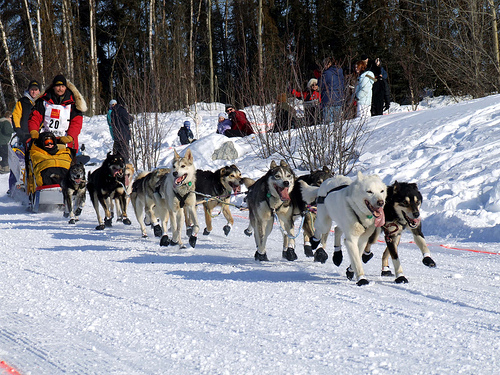
Togo (October 1913 – December 5, 1929) was the sled dog who led Leonhard Seppala and his dog sled team as they covered the longest distance in the 1925 relay of diphtheria antitoxin from Anchorage to Nome, Alaska, to combat an outbreak of the disease. The run is commemorated by the annual Iditarod dog sled race.
Annual Iditarod Trail Sled Dog Race
Togo was a Siberian Husky, his coat was black, brown, and gray, and he weighed about 48 pounds (22 kg). Seppala’s lead dog during the 1914 All-Alaska Sweepstakes, and was a precocious leader. At the time of the serum run Togo was twelve years old.
Within that entry, under the sub-heading of the Great Race of Mercy is this,
The first batch of 300,240 units of serum was delivered by train from Anchorage to Nenana, Alaska, where it was picked up by the first of twenty mushers and more than 100 dogs who relayed the serum a total of 674 miles (1,085 km) to Nome.
Togo and Seppala traveled 170 miles (274 km) from Nome in three days, and picked up the serum in Shaktoolik on January 31. The temperature was estimated at −30 °F (−34 °C), and the gale force winds causing a wind chill of −85 °F (−65 °C).
The return trip crossed the exposed open ice of the Norton Sound. The night and a ground blizzard prevented Seppala from being able to see the path but Togo navigated to the roadhouse at Isaac’s Point on the shore by 8 AM preventing certain death to his team. After traveling 84 miles (134 km) in one day, the team slept for six hours before continuing at 2 AM.
Before the night the temperature dropped to −40 °F (−40 °C), and the wind increased to 65 mi/h (105 km/h). The team ran across the ice, which was breaking up, while following the shoreline. They returned to shore to cross Little McKinley Mountain, climbing 5,000 feet (1,500 m). After descending to the next roadhouse in Golovin, Seppala passed the serum to Charlie Olsen, who in turn would pass it to Gunnar Kaasen and Balto.
A web search for ‘Togo’ including a mention on a website called Find A Grave that has this,
Birth: Oct., 1913
Death: Dec. 5, 1929, Poland Spring, Androscoggin County, Maine, USA
A sled dog for Leonhard Seppala. In 1925, When a diphtheria out brake happened in Nome Alaska. Seppala, Togo and a team of dogs ran to Nenana. He ran 10 times the distance of a average sled run. However another dog named Balto got nearly all of the fame. After the run, Seppala sold Togo to a friend in Poland Spring Maine were Togo was euthanized on December 5th 1929. He was stuffed and was put on display at Yale University. He was eventually moved to the Iditarod Trail Sled Dog Race Museum in Wasilla Alaska, where he is today.
Burial: Iditarod Trail Sled Dog Race Museum, Wasilla, Matanuska-Susitna Borough, Alaska, USA
A reflection on why living in harmony with Planet Earth seems so challenging.
John Hurlburt is the ‘mover and shaker’ behind a series of talks and discussions under the overall title of Everything Fits Together, part of the adult education umbrella of St Paul’s Episcopal Church here in Payson, AZ. John generously asked if I would lead the discussion tonight (19th) along the theme of Nature and Faith. I plan to close the session with these words and the compelling video that was on Learning from Dogs last Friday A planet worth protecting.
oooOOOooo
Man – a study in behaviours.
The relationship between Planet Earth and man goes back a very long way. But what of today?
There is little doubt that many people, even with the minimum of awareness about the world in which we live, are deeply worried. On so many fronts there are forbidding and scary views. It feels as though all the certainty of past times has gone; as if all the trusted models of society are now broken. Whether we are talking politics, economics, employment or the environment, nothing seems to be working.
Why might this be?
It would be easy to condemn man’s drive for progress and an insatiable self-centredness as the obvious causes of our society failing in widespread ways. But in my view that’s too simple an explanation. It’s much more complex.
I propose that the challenges we all face today have their roots in the dawning of our evolution. Let’s remind ourselves how far back that goes.
The earliest documented members of the genus Homo are Homo habilis which evolved around 2.3 million years ago. Homo habilis was the first species for which we have positive evidence of the use of stone tools.
A theory known as Recent African Ancestry theory, postulates that modern humans evolved in Africa possibly from Homo heidelbergensis and migrated out of the continent some 50,000 to 100,000 years ago, replacing local populations of Homo erectus and Homo neanderthalensis.
Thus for tens of thousands of years, the behaviours of humans have served our species well, by definition. Ergo, mankind has evolved as the result of mankind’s behaviours. Behaviours that may have changed little over those countless years.
So one might speculate that these behaviours have been potentially damaging to the ultimate survival of our species, perhaps hugely damaging, for a very long time. But because man’s population footprint has been so small for 99% of eternity the consequences have not impinged on the planet until now. Let’s reflect on those population figures.
Until the development of agriculture, around the 11th millennium BC, the world population was stable at around one million persons, as man lived out a subsistence hunter-gatherer existence. By about 2000 years ago the global population of man had climbed to around 300 million. It took another 1,200 years for that global population to reach the first billion, as it did in 1804.
However, just 123 years later, in 1927, the two-billionth baby was born. The three-billionth baby was born in 1960, just 33 years later! Only a further 14 years slip by for the four-billionth baby to be born in 1974. Another blink of the geological eyelid and 13 years later, in 1987, along comes the five-billionth bundle of joy. Around October 1999, the sixth-billionth baby is born! It is likely that we are in a world where there are now seven billion people! Indeed, the world population clock estimates that on September 12th, a week ago, the world population was 7,039,725,283 persons.
About a billion every decade. The equivalent of a growth of 100 million each and every year, or around 270,000 every single day! Or if you prefer 11,250 an hour (Remember that’s the net growth, births minus deaths, of the population of humans on this planet!)
Combine man’s behaviours with this growth of population and we have the present situation. A totally unsustainable situation on a planet that is our only home.
The only viable solution is to amend our behaviours. To tap into the powers of integrity, self-awareness and mindfulness and change our game.
All of us, no exceptions, have to work with the fundamental, primary relationships we have with each other and with the planet upon which we all depend. We need the birth of a new level of consciousness; of our self, of each other and of the living, breathing planet. A new consciousness that will empower change. We need spiritual enlightenment. We need a spiritual bond with this beautiful planet.
Over eons of time, Planet Earth has favoured our evolution. Now, today, not tomorrow, it is time to favour our beautiful planet with our love and with our faith. It is the ultimate decision for our species.
oooOOOooo
If you need a reminder of how beautiful our planet is (and I’m sure the majority of LfD readers don’t require that reminder) then go back and watch David Attenborough’s video and voice-over to the song What a Wonderful World.
I will close by inserting into this post, the video that Martin Lack included in a recent comment to my post The wind doth blow!
I admit to being too free with my silly clichés including, “I can predict anything unless it involves the future!” So now that millions of informed people have the benefit of “20:20 hindsight“, why is it years since the banking crisis first erupted and we are still without a root and branch overhaul of the governance of the industry?
Did you see Per Kurowski’s interview with a leading regulator on Learning from Dogs yesterday? Aren’t we so slow to learn!
Anyway, I waffle on! Let me get to the point of today’s post.
Back on the 1st September, there was a post called Understanding Europe. One of the resulting commentators was Pendantry who is author of a blog called Wibble. He included a link to a poem that he wrote on the 28th February, 2009! The fact that the poem is still so relevant (and when we see what’s happening in Europe perhaps even more relevant now!) is truly shocking. I wanted to republish it which I do with the kind permission of Pendantry. Here it is.
oooOOOooo
House of cards
When the inevitable strikes,
when the house falls down,
do you patch up the walls,
fix the holes in the roof,
shore it all up,
splash it with paint?
No.
You learn from the mistakes.
You start from scratch.
You call in the architects.
You rebuild the foundations.
You use new materials;
replace wattle and daub
with a sounder design.
Unless:
Because you’re lost outside the box,
and your mates demand
to regain their riches (and, now!):
You set up the same as before,
perhaps with a few bells and whistles
(spun to persuade that they’ll work).
And… in the end, we’ll believe
that your clothing is not invisible.
“Who is more foolish?
The fool, or the fool who follows him?”
oooOOOooo
Written over three years and five months ago. Shame on us all!
Like millions of others on this planet, I was held spellbound by the historic and epic moment of man placing his mark on another heavenly body, the Moon. I had been so wrapped up in NASA’s space missions that I took a holiday from work (I was working at the time for ICIANZ in Sydney, Australia) for the week of July 16th, 1969.
It was, of course, July 16th when the Apollo 11 Mission launched from the Kennedy Space Center culminating at precisely 20:17:39 UTC on July 20, 1969, the moment when the Lunar Module made lunar contact.
But in terms of me writing my own obituary for Neil, what could I offer?
Then a couple of items changed my mind.
Neil Armstrong (August 5, 1930 – August 25, 2012)
The first was reading the obituary printed in The Economist. I have long admired the many, many beautiful obituaries that have been published by this newspaper and this one was no exception. Take this extract from the Neil Armstrong obituary,
He had an engineer’s reserve, mixed with a natural shyness. Even among the other astronauts, not renowned for their excitability, he was known as the “Ice Commander”. Mike Collins, one of his crew-mates on the moon mission, mused that “Neil never transmits anything but the surface layer, and that only sparingly.” He once lost control of an unwieldy contraption nicknamed the Flying Bedstead that was designed to help astronauts train for the lunar landing. Ejecting only seconds before his craft hit the ground and exploded, he dusted himself off and coolly went back to his office for the rest of the day. There was work to be done.
Then the beautiful words that bring the obituary to a close,
Earth’s beauty
Over half a century, the man who never admitted surprise was surprised to observe the fading of America’s space programme. The Apollo project was one of the mightiest achievements of the potent combination of big government and big science, but such enterprises came to seem alien as well as unaffordable. Mr Armstrong, who after his flight imagined bases all over the moon, sadly supposed that the public had lost interest when there was no more cold-war competition.
Yet the flights had one huge unintended consequence: they transformed attitudes towards Earth itself. He too had been astonished to see his own planet, “quite beautiful”, remote and very blue, covered with a white lace of clouds. His reserve, after all, was not limitless. One photograph showed him in the module after he and Buzz Aldrin had completed their moon-walk, kicking and jumping their way across the vast, sandy, silver surface towards the strangely close horizon. He is dressed in his spacesuit, sports a three-day beard, and is clearly exhausted. On his face is a grin of purest exhilaration.
” … they transformed attitudes towards Earth itself. He too had been astonished to see his own planet, “quite beautiful”, remote and very blue, covered with a white lace of clouds.” For that reason alone, we need to celebrate the achievement of the Apollo 11 mission for putting our own planet into perspective within the enormity of the universe.
The second item that persuaded me to write this was a wonderful historic insight into how a potential catastrophy on the surface of the Moon would have been handled by President Nixon. This historic item was published on Carl Milner’s blog the other day, the specific item being What if the Moon Landing Failed? Republished with the very kind permission of Carl.
When Richard Nixon was the President of the United States, they had a speech ready for him to deliver to the world just in case the 1969 moon landing had ended in disaster. In fact many experts believed there was a big chance that Neil Armstrong and Edwin ‘Buzz’ Aldrin could have really gotten stuck on the moon. It’s something we don’t really think about now because we all know it was such a success. American Archives have unearthed the speech that would have been delivered if the late great Armstrong and Aldrin had never made it back to earth. This is such a great piece of history that I thought I might never see.
Give it a read, It’s such a moving and well prepared speech, and such a good thing that President Nixon never had to delivered it.
So, as with millions of others, I am delighted that this speech remained unspoken and instead we experienced: “At 5:35 p.m. (US EDT), Armstrong and Aldrin successfully docked and rejoined Collins, and at 12:56 a.m. on July 22 Apollo 11 began its journey home, safely splashing down in the Pacific Ocean at 12:50 p.m. on July 24.”
Neil Armstrong’s legacy is not only being part of the wonderful team that allowed man to make the first footprint on the Moon but also bringing into our human consciousness that this blue, wonderful planet we all live on is the only home we have.
First Full-View Photo of Earth Photograph courtesy NASA Johnson Space Center This famous “Blue Marble” shot represents the first photograph in which Earth is in full view. The picture was taken on December 7, 1972, as the Apollo 17 crew left Earth’s orbit for the moon. With the sun at their backs, the crew had a perfectly lit view of the blue planet.
Strikes me that celebrating July 20th each year as Blue Planet Day might not be a bad idea! Any takers? Now that would be a legacy for Neil!
A stirring set of pictures from the Queen’s Jubilee
At the end of June, pilot friend Bob Derham sent me an email which contained all of what follows. I ‘filed’ it away and then forgot I had received it! My apologies. But as Europe was the subject of yesterday’s post, then maybe this can be seen as remaining on theme. Enjoy.
oooOOOooo
One last look back at those amazing Jubilee celebrations . . . as seen by the ‘Tail-end Charlie’ in Britain’s last airworthy Lancaster
Incredible footage has been released showing the bird’s eye view enjoyed by the crew aboard a Lancaster bomber flying over London for the Queen’s Diamond Jubilee celebrations.
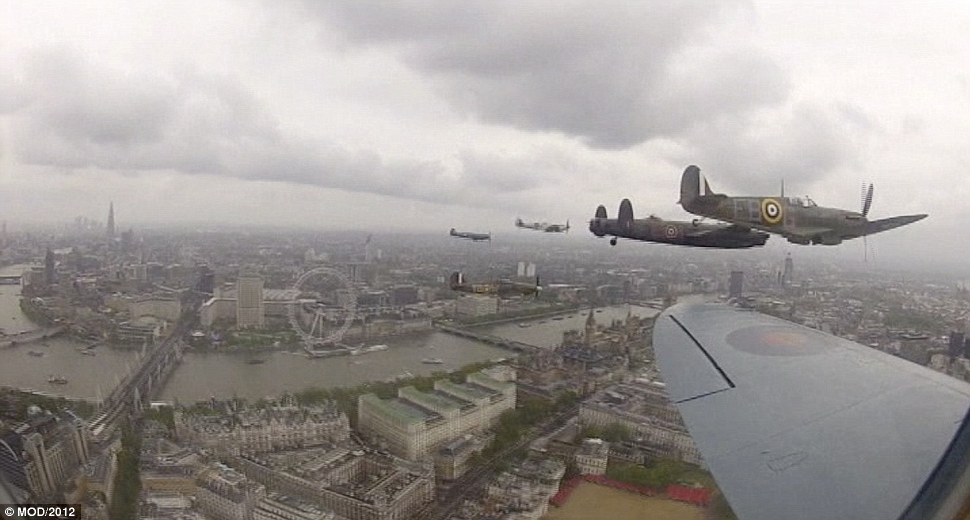
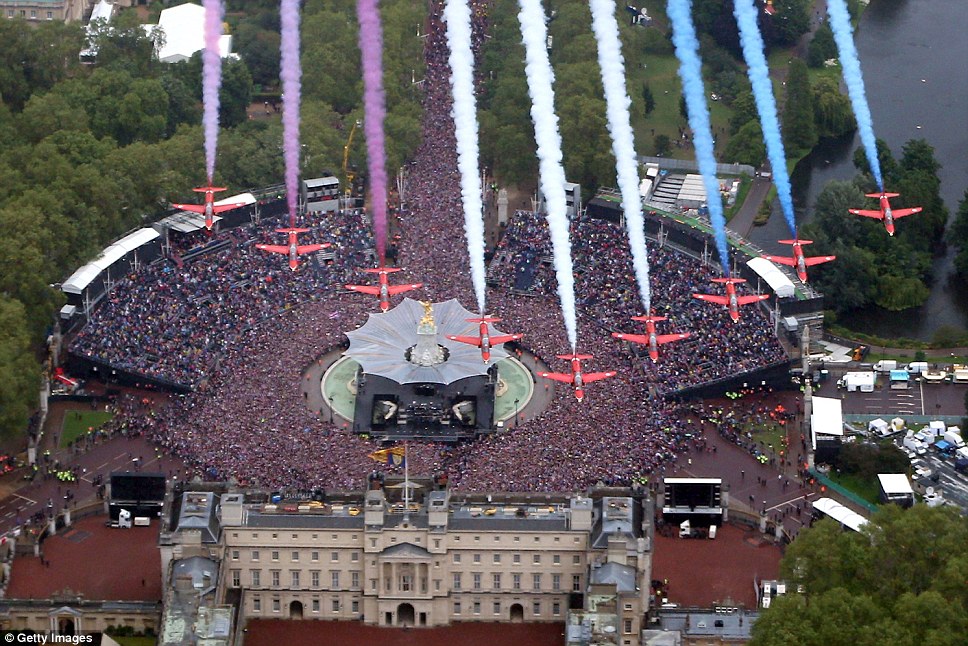
The aeroplane, which is part of the RAF’s Battle of Britain Memorial Flight (BBMF), flew in formation with aircraft including a Spitfire, Hurricane and Dakota transport aircraft down The Mall, followed by the Red Arrows aerobatic team – to the delight of crowds and the Royal Family at Buckingham Palace below.
As well as preserving a fleet of priceless aircraft and keeping them in tip-top flying condition, the BBMF reminds the nation of the sacrifices made during World War Two.
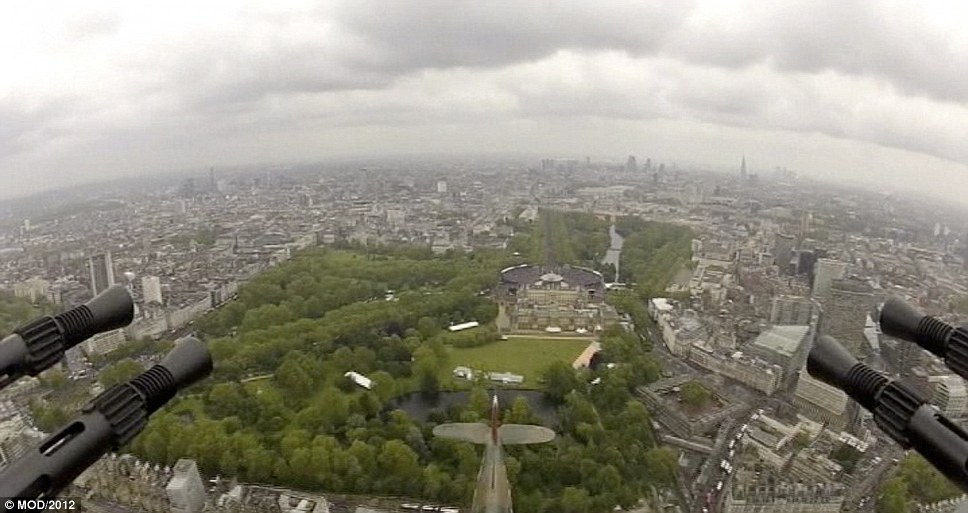
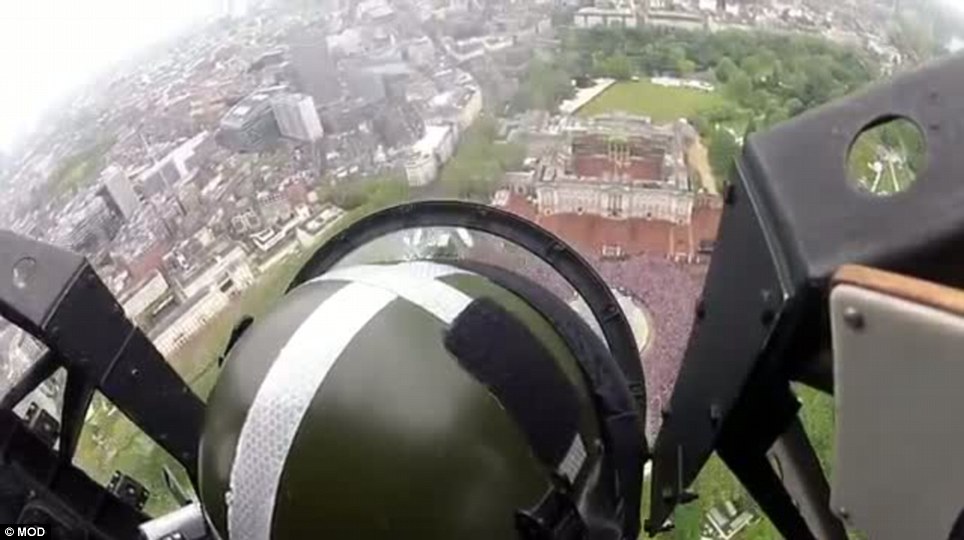
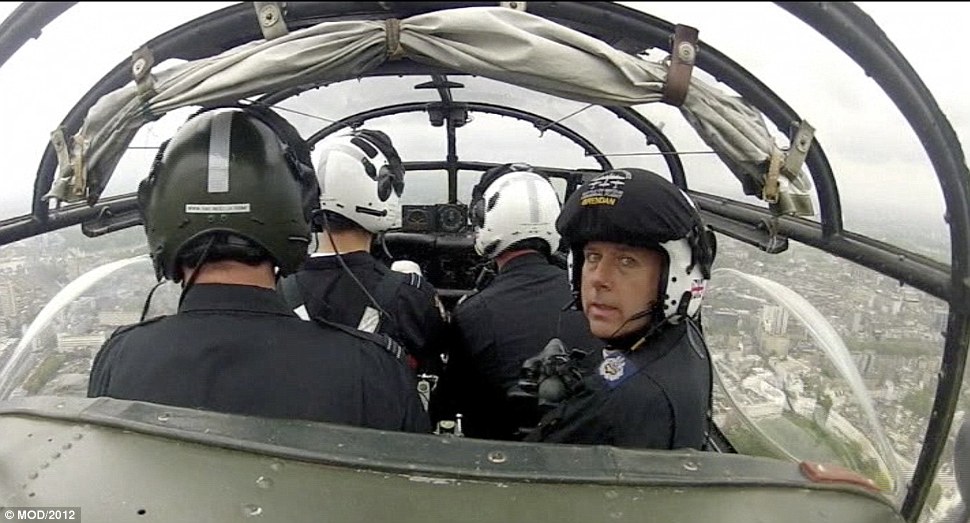
Spectacular: The tail gunner’s view from the Lancaster bomber, as it completed the Diamond Jubilee flypast. Buckingham Palace Gardens can be seen behind the tail of a Hurricane fighter, also of the Battle of Britain Memorial Flight, which flew in formation with the LancasterFinal approach: Having lined up on The Mall, the RAF Battle of Britain Memorial Flight Lancaster flies towards Buckingham Palace with St James’ Park on the left and Birdcage Walk beyond.The nose of the Lancaster passes over the Memorial to Queen Victoria in front of Buckingham Palace.
The BBMF is based at RAF Coningsby in Lincolnshire with many of its personnel, including pilots, acting as volunteers; the flight costs about £3m a year to run.
Squadron Leader Ian Smith, who is in charge of the BBMF, is the only permanent member, with all of the remaining pilots, navigators, air engineers and other crew coming from different airbases and ordinarily flying several different types of aircraft; from Typhoon fighters to the huge Hercules transport plane.
Cramped: The footage shows just how tight a fit it can be aboard a vintage aircraft and what a tight squeeze it is for the crew aboard the Lancaster bomber.
The aircrew give up three out of every four weekends from May to the end of September in order to fly and display the historic aircraft.
The footage, released by the Ministry of Defence, shows just how tight a fit it can be aboard a vintage aircraft, with the crew – clearly eager to catch a glimpse of the Queen – taking up most of the available space.
The historic flight includes the Lancaster, which first saw service in 1942. The ‘Lanc’ was the most famous of the Second World War bombers and gained renown for its starring role in the momentous ‘Dambuster’ raid on Germany’s Ruhr Valley in 1943.
Carrying a payload of 22,000lb and with a 1,500-mile range, the RAF bomber wreaked havoc on Germany. Some 3,500 were lost in action during the war.
The view of Buckingham Palace and The Mall beyond from the Lancaster bomber.In formation: Incredible footage has been released showing the view enjoyed by crew aboard a Lancaster bomber flying over London for the Queen’s Diamond Jubilee celebrations.
Hurricane single-seater fighters played a crucial role in the Battle of Britain. Heavier and slower than the Spitfire, it was considered the RAF’s ‘workhorse’ against the Luftwaffe.
A remarkable total of 14,533 Hurricanes were built and served operationally on every day and in every theatre during the war. Only 12 are still airworthy worldwide.
The Spitfire is the iconic fighter that won legendary status against the Luftwaffe in the Battle of Britain. It possessed a top speed of 378mph, an altitude of 35,000ft and armed with two 20mm cannons, four Browning machine guns and two 250lb bombs.
One of the four that flew yesterday was P7350 – the oldest airworthy Spitfire in the world and the only one which actually fought in the Battle of Britain. It was shot up by a Messerschmitt 109 during combat in October 1940 but its wounded Polish pilot Ludwik Martel managed to crash-land it, wheels up, near Hastings.
The pride of Britain: The vintage planes – all powered by classic World War Two Merlin engines – roar across the London sky.Flypast: The Duchess of Cornwall, the Prince of Wales, the Queen, the Duke and Duchess of Cambridge and Prince Harry watch the aerial action.Aerobatic aces: The Red Arrows display team fly in formation over Buckingham Palace.Stirring image: The Lancaster, centre, was accompanied by two Spitfires on both flanks and tailed by a Hurricane.
oooOOOooo
A wonderful and incredibly nostalgic set of photographs. Finally, let me close with a short piece of video of that Lancaster Bomber in flight.
Strange theory reveals secrets of the universe, the logic of sycamore leaves and why even smart people struggle with new ideas.
A guest post from Pete Aleshire, Editor, Payson Roundup.
Introduction
The Payson Roundup is our local newspaper here in Payson, AZ. I first saw this article by Pete a couple of weeks ago and was just utterly engrossed by it. Not just the tantalising peek into a physics I know so little about but the beautiful prose. The latter is not surprising because as well as being editor of the paper, Pete also teaches the creative writing course at our local college. Jean and I had the benefit of attending the course, I guess about a year ago, and therefore can speak from experience.
So settle down and enjoy.
oooOOOooo
I finally got Drake Larson together with both sycamore leaves and Payson Mayor Kenny Evans. Moreover, I have been entrusted with a formula that may win me an invitation to Oslo if Drake gets a Nobel Prize.
But even if that don’t work out, I did get to eavesdrop on Drake and Evans. Quite the event, from my bemused point of view, since it shed light on dangerous delights of outside-the-box thinking and the Nature of the Universe.
But wait. You look confused.
Let me back up — and start somewhere closer to the beginning. Be patient with me — by the time we’re done, you’ll realize why God’s a math nerd, one surprising secret of Dark Energy, why farmers become original thinkers and what sycamore leaves tell us about the universe.
But first, I have to explain about Drake.
We grew up together, getting into (and mostly out of) various varieties of trouble. Very early on, I realized that he was much (much) smarter than me. This initially really irritated me, as I was previously inclined to vanity about my intelligence. Turns out, I love learning stuff other people have discovered, but Drake only gets truly excited when he has hold of a completely new idea that no one else can quite grasp. This prepared me, as it turns out, for meeting Kenny Evans — but that’s getting ahead of the story.
Drake and I grew up doing math homework together, before I wandered off into a career in newspapers. He got his degree in mathematics, turned down a job with the RAND Corporation and took up growing table grapes.
But he never quit picking at the lock of the universe.
Years ago when I was the science writer for the Oakland Tribune, he came to me all excited about a set of formulas he had. I did my best to follow the two pages of calculations, but all I can tell you is that they described instabilities of any sphere with uniform density. He predicted that when the Voyager spacecraft reached Jupiter, it would report inexplicable turbulence at a certain depth in the atmosphere. I ran his numbers past various top-level physicists and mathematicians who couldn’t find a flaw in his formulas — but concluded that it had to be wrong since it led to a violation of the keystone laws of conservation of mass and energy.
But I took note some months later when the Voyager spacecraft reported mysterious levels of turbulence deep within the atmosphere of Jupiter.
The years passed. Drake kept growing grapes, flowers, dates and vegetables — and working on his calculations. He wrote a book, “The Cults of Relativity,” in which he described a few of his theories, delighted in the conundrums of mathematics and pondered the curious resistance of even smart people to unconventional ideas.
We got together again recently. I took him down to Fossil Creek, all overhung with sycamores with the rustle of floppy, five-pointed leaves. Drake was his old self on our Fossil Creek tour as he tried to show me math’s beauty around us, although I was but a blind man clutching the tail of his mathematical elephant.
He had now connected his formulas to dark energy, a still hypothetical form of energy invoked by desperate cosmologists to explain the startling observation that the expansion of the universe is actually accelerating. To explain this seeming impossibility, they invented “dark energy” — which they figure pervades the universe and at certain densities creates a repulsive force stronger than the attractive force of gravity.
Anyhow, here’s the point: Drake was in awe that his mathematical wanderings offered a way to calculate dark energy’s cap within earth — it happened to be an “inside is now outside” inversion of Isaac Newton’s simplest integral. No. Please. Don’t ask me to explain that. But earth’s dark energy cannot exceed 17 pounds per square inch at a depth of about 1,500 miles. He’s been working with University of Southern California computer crunching guru professor Barry Boehm, and the University of California at Riverside geophysics professor Shawn Biehler on its implications. Among other things, it could explain the perplexing observation that major earthquakes increase the earth’s rotation rate.
No one knows how to measure such a quantity at present. Someday they will. If it turns out that 17 pounds per square inch is a relevant benchmark for earth’s dark energy, then this column will maybe win Drake the Nobel — and I’ll get to dress up and attend the ceremony.
So Drake and I spent the day wandering along the banks of Fossil Creek as he kept trying to come up with metaphors so I could grasp math’s secret within the beauty of Fossil Creek’s sycamore leaves. The well-designed sycamore leaves adhere to the Fibonacci sequence, a mysterious progression of numbers that crops up throughout nature — from the spiral of a nautilus shell to the layout of the ruins of Chaco Canyon.
So I figured I’d just write this — and get earth’s 17 PSI cap for dark energy out there in the time/date/ stamped world.
Oh, yeah: And about Kenny Evans.
So that night, I took Drake to the Payson council meeting. Turns out, Drake’s family was growing grapes in the Coachella Valley at the same time Evans was farming 10,000 acres in Yuma. They both managed to survive that tempestuous time when the United Farm Workers union organized agriculture workers.
I introduced them and listened as they recalled events and figured out whom they knew in common.
It was then that I decided to blame Drake for my faith in Evans’ ridiculous conviction that a university will build a campus here in this itty bitty tourist town — complete with a research center and convention hotel. No sensible small-town mayor would risk public ridicule while spending thousands of hours on such an outside-the-box notion … unless he’d learned to gamble on dreams and hard work during all those years as a farmer.
Evans’ notion is almost as silly as a farmer who calculates the amount of dark energy emanating from earth, while credentialed experts scratch their collective heads.
Still, I’m thinking maybe I’ll get a nice suit jacket — something I can wear to both the university’s groundbreaking and the ceremonies in Oslo.
Hey, never hurts to be prepared.
oooOOOooo
A big thank-you for the permission to republish this on Learning from Dogs. I have no doubt that many LfD readers enjoyed it as much as I did! Stay with me for tomorrow when the theme of thinking, innovation and craziness is explored a touch more.
















 Learning from Dogs