Love as seen through the Celtic spiritual belief of bonding souls.
Who hasn’t lifted their eyes to the skies above and become lost in themselves? Whether the drama of a turbulent daytime sky or the deep mystery of an endless, clear night, sky? Doesn’t matter who we are or where we have or haven’t been in our lives, experiencing that shift from ‘reality’ to a place of souls is familiar to all.
Right at the front of Richard Bach’s lovestory book The Bridge Across Forever, there’s this quotation from E.E. Cummings:
– how fortunate are you and I, whose home
is timelessness: we who have wandered down
from fragrant mountains of eternal now
to frolic in such mysteries as birth
and death a day (or maybe even less)
Then on page 9, Richard Bach writes as part of his introduction:
We think, sometimes, there’s not a dragon left. Not one brave knight, not a single princess gliding through secret forests, enchanting deer and butterflies with her smile.
We think sometimes that ours is an age past frontiers, past adventures. Destiny, it’s way over the horizon; glowing shadows galloped past long ago, and gone.
What a pleasure to be wrong. Princesses, knights, enchantments and dragons, mystery and adventure …. not only are they here-and-now, they’re all that ever lived on earth!
Our century, they’ve changed clothes, of course. Dragons wear government-costumes, today, and failure-suits and disaster-outfits. Society’s demons screech, whirl down on us should we lift our eyes from the ground, dare we turn right at corners we’ve been told to turn left. So crafty have appearances become that princesses and knights can be hidden from each other, can be hidden from themselves.
Yet masters of reality still meet us in dreams to tell us that we’ve never lost the shield we need against dragons, that blue fire voltage arcs through us now to change our world as we wish. Intuition whispers true: We’re not dust, we’re magic!
Copyright (1984) Richard Bach.
Richard Bach’s hugely popular lovestory is widely summarised, thus:
‘Did you ever feel that you were missing someone you had never met?’.
Haunted by the ghost of the wise, mystical, lovely lady who lives just around the corner in time, Richard Bach begins his quest to find her, to learn of love and immortality not in the here-after, but in the here and now. Yet caught in storms of wealth and success, disaster and betrayal, he abandons the search, and the walls he builds for protection become his prison. Then he meets the one brilliant and beautiful woman who can set him free, and with her begins a transforming journey, a magical discovery of love and joy.
Just pause and listen. Hear your intuition whispering to you: You are not dust, you are magic!
oooOOOooo
Now let’s turn to another author: John O’Donohue. WikiPedia has an entry that starts:
John O’Donohue (1 January 1956 – 4 January 2008) was an Irish poet, author, priest, and Hegelian philosopher. He was a native Irish speaker, and as an author is best known for popularizing Celtic spirituality.
His death in January 2008 just a few days past his 52nd birthday was a huge and tragic loss. Not just to his family and all who knew him, but to all those in the world who dream the spiritual bonding with another person.
John O’Donohue’s book is no better appreciated than by hugging the meaning of that Celtic phrase anam cara, assuming you aren’t a Celtic speaker! A quick web search finds an explanation typically like this:
In the Celtic Spiritual tradition, it is believed that the soul radiates all about the physical body. What some refer to as an aura. When you connect and become completely open and trusting with another person, your two souls begin to flow together. The forming of that deep bond is described as having found your anam cara or soul friend.
Your anam cara always accepts you as you truly are, holding you in beauty and light. Inevitably, to appreciate this relationship, you must first recognize your own inner light and beauty. This is not always easy to do! The Celts believed that forming an anam cara friendship would help you awaken to your own inner light and beauty, as a pathway to experiencing the joys of others.
According to John O’Donahue, an accomplished Irish poet, philosopher and Catholic priest, “…You are joined in an ancient and eternal union with humanity that cuts across all barriers of time, convention, philosophy and definition. When you are blessed with an anam cara, the Irish believe, you have arrived at that most sacred place: home.“
Do you sense how the writings of Richard Bach and John O’Donohue are two hues from the same rainbow?
Take a few minutes and explore the John O’Donohue website that has much to remember about this wonderful man. Embrace such profound insights on the universal themes of friendship, solitude, love, and death as:
Light is generous
The human heart is never completely born
Love as ancient recognition
The body is the angel of the soul
Solitude is luminous
Beauty likes neglected places
The passionate heart never ages
To be natural is to be holy
Silence is the sister of the divine
Death as an invitation to freedom
I’m going to offer two videos. They are both of John O’Donohue. One is 51 minutes and one is 5 minutes. Do watch them both but if for whatever reason you cannot do that, then please watch the shorter one.
Your beloved and your friends were once strangers. Somehow at a particular time, they came from the distance toward your life. Their arrival seemed so accidental and contingent. Now your life is unimaginable without them. Similarly, your identity and vision are composed of a certain constellation of ideas and feelings that surfaced from the depths of the distance within you. To lose these now would be to lose yourself.
and recognising this post is day three of writing about love, here’s another quotation:
If you send out goodness from yourself, or if you share that which is happy or good within you, it will all come back to you multiplied ten thousand times. In the kingdom of love there is no competition; there is no possessiveness or control. The more love you give away, the more love you will have.
oooOOOooo
Are Jean and I touched by the spirit of anam cara? Leave you, dear reader, to judge that. In fact, leave you with the sign that is on our front gate!
This saying was offered in a creative writing class that Jean and I attended when we were living in Payson, Arizona. It came to me spontaneously as I started today’s post. Because feeling what is going on around us is the only way to write it, to share it, to bring it to the attention of all.
These are tough times for so many that love the world around us and having the odd weep is a perfectly rational, and healthy, thing to happen.
So as you listen to the following just feel it. And if a tear comes to your eye … embrace it.
Hopefully, you listened to the full seven minutes before reading on! Because to end the post at this point would be to leave out some great connections.
Put this on in the background and let it creep up on you.
Elizabeth Shepherd performs Live-to-Air with Michael Occipinti’s Shine On: The Universe of John Lennon
Toronto, June 1, 2012 CBC Radio
UPDATE: by popular demand, the original below.
Secondly, a quick dip into WikiPedia reveals that the song was recorded by the Beatles in February 1968 at the famous Abbey Road studios and released on the 12th December, 1969. It was written by John Lennon, and credited to Lennon–McCartney.
Abbey Road Studios, 3 Abbey Road, St. John’s Wood, London
Thirdly, that Wikipedia reference includes the background to the composition of the song, some of which I will share here:
One night in 1967, the phrase “words are flowing out like endless rain into a paper cup” came to Lennon after hearing his ex-wife Cynthia, according to Lennon, “going on and on about something.” Later, after “she’d gone to sleep—and I kept hearing these words over and over, flowing like an endless stream,” Lennon went downstairs and turned it into a song. He began to write the rest of the lyrics and when he was done, he went to bed and forgot about them.
“
I was lying next to my first wife in bed, you know, and I was irritated, and I was thinking. She must have been going on and on about something and she’d gone to sleep and I kept hearing these words over and over, flowing like an endless stream. I went downstairs and it turned into a sort of cosmic song rather than an irritated song, rather than a “Why are you always mouthing off at me?”[1]… [The words] were purely inspirational and were given to me as boom!. I don’t own it you know; it came through like that.[2]
”
The flavour of the song was heavily influenced by Lennon’s and the Beatles’ interest in Transcendental Meditation in late 1967 – early 1968, when the song was composed. Based on this he added the mantra “Jai gurudevaom” (Sanskrit: जय गुरुदेव ॐ) to the piece, which became the link to the chorus. The Sanskrit phrase is a sentence fragment whose words could have many meanings. Literally it approximates as “glory to the shining remover of darkness,”[3] and can be paraphrased as “Victory to God divine”, “Hail to the divine guru”, or the phrase commonly invoked by the late Maharishi Mahesh Yogi in referring to his spiritual teacher “All Glory to Guru Dev.”[4]
Finally the lyrics.
“Across The Universe”
Words are flowing out like endless rain into a paper cup
They slither wildly as they slip away across the universe
Pools of sorrow, waves of joy are drifting through my open mind
Possessing and caressing me
Jai Guru Deva OM
Nothing’s gonna change my world
Nothing’s gonna change my world
Nothing’s gonna change my world
Nothing’s gonna change my world
Images of broken light which dance before me like a million eyes
They call me on and on across the universe
Thoughts meander like a restless wind inside a letter box
They tumble blindly as they make their way across the universe
Jai Guru Deva OM
Nothing’s gonna change my world
Nothing’s gonna change my world
Nothing’s gonna change my world
Nothing’s gonna change my world
Sounds of laughter shades of live are ringing through my open ears
Inciting and inviting me
Limitless undying love which shines around me like a million suns
It calls me on and on, across the universe
Jai Guru Deva OM
Nothing’s gonna change my world
Nothing’s gonna change my world
Nothing’s gonna change my world
Nothing’s gonna change my world
Jai Guru Deva
Jai Guru Deva
Jai Guru Deva
Jai Guru Deva
Jai Guru Deva [fade out]
Footnote
The title of the song was given a new dimension when NASA beamed the song into space.
“On 4 February 2008, at 00:00 UTC, NASA transmitted the Interstellar Message “Across the Universe” in the direction of the star Polaris, 431 light years from Earth. The transmission was made using a 70m antenna in the Deep Space Network’s Madrid Deep Space Communication Complex, located outside of Madrid, Spain. It was done with an “X band” transmitter, radiating into the antenna at 18 kW. This was done to celebrate the 40th anniversary of the song’s recording, the 45th anniversary of the Deep Space Network (DSN), and the 50th anniversary of NASA. The idea was hatched by Beatles historian Martin Lewis, who encouraged all Beatles fans to play the track as it was beamed to the distant star. The event marked the first time a song had ever been intentionally transmitted into deep space, and was approved by McCartney, Yoko Ono, and Apple Corps.”
Thus those feelings so beautifully expressed in the song will be echoing around the universe for time immemorial. Now that is a legacy!
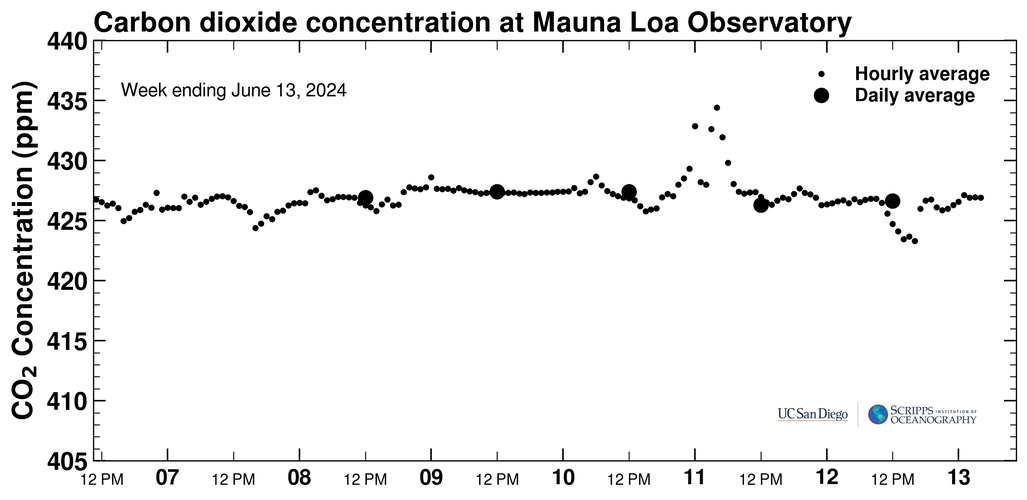
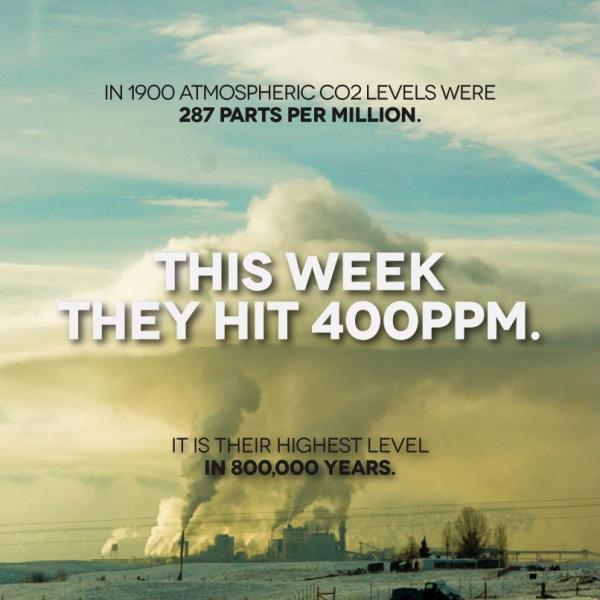
Staying with the terrible news that we are now above 400 ppm atmospheric CO2.
If there is anything of comfort to be drawn from the news that we are above 400 ppm CO2 it is that the mainstream media are running with it. I shall focus on the reportage from the BBC News website.
First, there was the news of the passing of that “symbolic mark”.
10 May 2013Last updated at 11:39 ET
Carbon dioxide passes symbolic mark
Key measurements are made on top of the Mauna Loa volcano
Carbon dioxide levels in the atmosphere have broken through a symbolic mark.
Daily measurements of CO2 at a US government agency lab on Hawaii have topped 400 parts per million for the first time.
The station, which sits on the Mauna Loa volcano, feeds its numbers into a continuous record of the concentration of the gas stretching back to 1958.
The last time CO2 was regularly above 400ppm was three to five million years ago – before modern humans existed.
Scientists say the climate back then was also considerably warmer than it is today.
Carbon dioxide is regarded as the most important of the manmade greenhouse gases blamed for raising the temperature on the planet over recent decades.
Then David Shukman, Science editor BBC News added this further background, that I am going to republish in full:
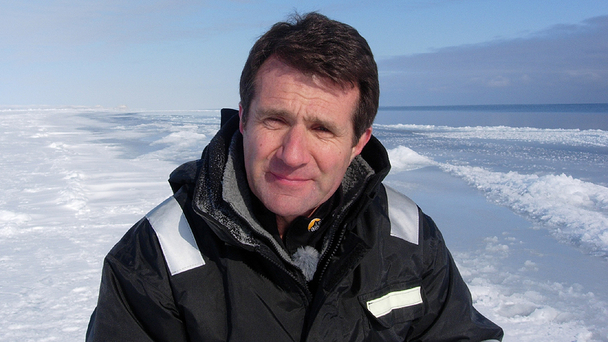
David Shukman
Near the summit of the Mauna Loa volcano, the carbon dioxide monitors stand amid one of the world’s remotest huddles of scientific instruments. To reach them you have to leave the steamy Hawaii coast and climb through barren lava-fields.
At the top, above 11,000ft, the air is thin and the sun piercing. During my visit, I watched rain clouds boiling in the valleys below me. Charles David Keeling chose this otherworldly spot because the air up here is neither industrial nor pristine; it is “well-mixed” which means it can serve as a useful guide to changes in the atmosphere.
Despite their global significance, the devices he installed back in 1958 do not look impressive. But he battled bureaucratic objections to fund them and his legacy is the longest continuous record of a gas, linked to much of global warming, that just keeps rising.
Scientists are calling on world leaders to take action on climate change after carbon dioxide levels in the atmosphere broke through a symbolic threshold.
Daily CO2 readings at a US government agency lab on Hawaii have topped 400 parts per million for the first time.
Sir Brian Hoskins, the head of climate change at the UK-based Royal Society, said the figure should “jolt governments into action”.
China and the US have made a commitment to co-operate on clean technology.
But BBC environment analyst Roger Harrabin said the EU was backing off the issue, and cheap fossil fuels looked attractive to industries.
The laboratory, which sits on the Mauna Loa volcano, feeds its numbers into a continuous record of the concentration of the gas stretching back to 1958.
‘Sense of urgency’
Carbon dioxide is regarded as the most important of the manmade greenhouse gases blamed for raising the temperature on the planet over recent decades.
Human sources come principally from the burning of fossil fuels such as coal, oil and gas.
Ministers in the UK have claimed global leadership in reducing CO2 emissions and urged other nations to follow suit.
But the official Climate Change Committee (CCC) last month said that Britain’s total contribution towards heating the climate had increased, because the UK is importing goods that produce CO2 in other countries.
Rest of that news article is here. But I can’t resist the picture and quote from Professor Sir Brian Hoskins, director of the Grantham Institute for Climate Change at Imperial College London.
Sir Brian Hoskins said a greater sense of urgency was needed
“A greater sense of urgency was needed.” I’m going to be emotional! Frankly, those wishy-washy words are pathetic.
We need the sort of words that George Monbiot penned a few days ago. Those I will share with you tomorrow.
I started writing this early morning last Friday, 10th May. It was prompted by a post then just in from Christine’s blog 350 or bust. I didn’t have the heart to republish it for a few days.
Then as the news of the atmospheric CO2 concentration passing 400 parts per million (ppm) moved more and more into mainstream news, I found myself morphing from sadness and puzzlement into anger and then into some form of determination to ‘do something‘, however insignificant that might be.
Because if humanity does not turn back from our carbon-based lifestyle pretty damn soon then those who are, say, 20 years or more younger than me (I’m 68), are in for some very tough, very rough times indeed.
So over the next two or three days, I shall focus on this topic simply from the motivation of wanting to join the numerous others around the world who are also recognising this moment in the history of man.
Ergo, for today that post from Christine. But I make no apologies for staying with the theme for much of this week.
oooOOOooo
Rolling The Dice: CO2 Concentration Hits Record High Amid Global Inaction On Climate Change
Readings at the US government’s Earth Systems Research laboratory in Hawaii, are not expected to reach their 2013 peak until mid May, but were recorded at a daily average of 399.72ppm on 25 April. The weekly average stood at 398.5 on Monday.
“I wish it weren’t true but it looks like the world is going to blow through the 400ppm level without losing a beat. At this pace we’ll hit 450ppm within a few decades,” said Ralph Keeling, a geologist with the Scripps Institution of Oceanography which operates the Hawaiian observatory.
*
*
Source: Scripps Institute of Oceanography
*
For more on the awful implications of this milestone in human history, check out the links below (hint: it isn’t good news for humans or animals or the ocean).
How libertarian ideology is holding back our liberty to change.
Martin Lack, he of the popular blog Lack of Environment is taking a small break from his writings. In his own words,
I am afraid this may be the last post on this blog for a while because – what with the all the willful blindness and ideological prejudice that seems to stop people from recognising what an Eff-ing mess humanity is in – and my as yet unresolved employment situation – I am feeling somewhat emotionally drained. However, please don’t cancel your subscription (as who knows how quickly I may recover).
So what a pleasant surprise when less than a day after those words in came an email that read, “Since I have told readers of my blog that I am taking a rest, I offer you the text appended below to post on your blog instead (or not – as you see fit).”
On reading the text I most certainly ‘saw fit‘ to publish it!
It is a very interesting approach to climate science denialism resulting from an analysis of conspiracy theories.
So over to Martin.
oooOOOooo
Professor Stephan Lewandowsky.
Libertarian ideology is the real road block
I have recently been catching up on a bit of reading – focusing on the recent work of Professor Stephan Lewandowsky (and others). Following in the wake of James Hansen, Ben Santer and Michael Mann, Lewandowsky has recently been the target of hate-mail campaigns by climate change sceptics. Unlike all the others, however, Lewandowsky (formerly at the University of Western Australia but now at Bristol University in the UK) is not a climate scientist. This is how Bristol University announced his recent appointment.
Steve is an internationally renowned cognitive scientist who has joined us from the University of Western Australia. His research has already revolutionised our understanding of human memory and cognition, and he now stands poised to build upon his impressive body of work with a project as ambitious as it is timely. In particular, Steve’s intention to improve our understanding of how people choose to acquire information, and to use this understanding to help create a more informed populace, is a unique and much needed undertaking. Thus, this research offers enormous benefits in the fields of experimental psychology, climate research and the wider public engagement with and understanding of scientific research.
However, now that I have read them, the thing that strikes me most forcefully is not the stupidity of conspiracy “ideation”, the invocation of conspiracy theories, it is the fact that, as Lewandowsky et al acknowledge, their work confirms the findings of many previous studies; that climate change scepticism is associated with prejudicial adherence to libertarian ideology. Also key is that climate change scepticism can be predicted by that prejudicial adherence to libertarian ideology.
Amongst many other things, this explains why EU sceptics are climate sceptics and why the United Kingdom Independence Party (UKIP) do not like Wind Farms. I had understood this for some time. However, I had not fully realised its importance; it was just one theme among others. Anyone who has read my blog recently will probably have noticed my post about New World Order (NWO) conspiracy theory, in which I acknowledged that I had not realised just how significant such thinking is, and how subliminal and subconscious it may be.
Although adherence to free-market economics and libertarian ideology were themes I highlighted in my MA dissertation and in my subsequent book, and mentioned on my blog numerous times, everything I have read in the last few days points to one conclusion: We will not succeed in communicating the urgency of the need for radical changes in energy policy until we can convince people that climate scientists are not trying to perpetuate their research funding or halt human progress.
Professor Lewandowsky’s research shows that little can be achieved by simply telling people they are wrong. Far better is pointing out to people that Limits to Growth and Peak Oil have already halted the progress of globalised Capitalism, as recent times prove dramatically. In other words conveying facts to people rather than ideology.
I must admit that this has been a tough pill to swallow. I am not naturally progressive and certainly not naturally “liberal”. On the contrary, I am socially and politically conservative. However, the reality of anthropogenic climate disruption is a game-changer. Therefore, unlike members of the Flat Earth Society or Young Earth Creationists (YECs), I do not refuse to accept what scientists tell me simply because I don’t like the message.
We cannot defeat such obscurantism by telling people they are irrational; we can only defeat it by focusing on the evidence that suggests strongly that they are mistaken. To this end, I think the words of St Augustine of Hippo are an important consideration; words going back over 1,400 years before anyone started to question the Age of the Earth or the Origin of Species! Words echoed by Thomas Aquinas, (often quoted to those YECs):
“… since Holy Scripture can be explained in a multiplicity of senses, one should adhere to a particular explanation only in such measure as to be ready to abandon it if it be proved with certainty to be false, lest Holy Scripture be exposed to the ridicule of unbelievers, and obstacles be placed to their believing.”
– Thomas Aquinas, Summa Theologica (1273).
In the last 150 years or so, most Christians have now come to reject conspiracy theory explanations for fossils, for example, and have realised that it is inappropriate to treat the Bible as a scientific text book. Regretably, the main source of ideological blindness today is not conventional religion; it is adherence to free-market economics.
Therefore, it is important that we acknowledge the ideological nature of the communication problem we face. That is that the research by Prof Lewandowsky and others has discovered a tendency for libertarians to prefer conspiracy theories to reality. Perhaps, therefore, not surprising that he has been attacked; no-one likes to be told they are deluded.
Roadblocks to policy change will not be cleared by social and political scientists telling libertarians that they are deluded. All that will do is confirm their suspicions and reinforce their prejudices! No, what is needed is for climate scientists to be bolder in stating the facts.
The majority of climate scientists seem content to continue to soft-soap the issue; afraid of “telling it to people straight” because it may induce despair.
No, it is not too late to prevent an ecological catastrophe but I am certain that we are now very short of time and, as everyone from the International Energy Agency, the Pentagon and the IMF agree, further delay will not be cost-effective.
At the same time, I think social and political scientists need to focus on debunking the ‘New World Order’ conspiracy myth and pointing out the logical fallacy in the idea that all Greens are Communists in disguise (the so-called ‘Watermelons’).
The environment has become a political football when it is nothing of the kind. It is our life support system and we have pushed it near to the point of collapse, as E.F. Schumacher once said, by mistaking Nature’s capital for a form of income. Therefore, if we do not change course, bankruptcy would seem inevitable.
oooOOOooo
Having read and reflected on Martin’s essay, a couple of recollections surface. The first is Guy McPherson’s book Walking Away from Empire that I reviewed earlier this year then referred to in a recent republication of a George Monbiot essay:
So very difficult to pick out the sentence that carried the most power, for the essay is powerful from start to end. But this one did hit me in the face, “The impossibility of sustaining this system of endless, pointless consumption without the continued erosion of the living planet and the future prospects of humankind, is the conversation we will not have.“
Finally, I can’t resist reminding you, dear reader, of the point made by Prof. Guy McPherson in his book Walking Away from Empire, which I reviewed on March 6th. particularly in the first paragraph of the first chapter; Reason:
At this late juncture in the era of industry, it seems safe to assume we face one of two futures. If we continue to burn fossil fuels, we face imminent environmental collapse. If we cease burning fossil fuels, the industrial economy will collapse. Industrial humans express these futures as a choice between your money or your life, and tell you that, without money, life isn’t worth living. As should be clear by now, industrial humans — or at least our “leaders” — have chosen not door number one (environmental collapse) and not door number two (economic collapse), but both of the above.
The second recollection comes most recently; from yesterday’s The story of carbon. A story that showed the power of academic, peer-reviewed, properly conducted, rational science!
I will close with a repeat of the closing words from yesterday:
“By my calculation, we have a 5–10 year window to avoid the catastrophe. It won’t be easy — we’re past the point where any transition will be smooth — but we can make the transition and survive as a civilized species, humans in a recognizable world.”
I struggled for a while to decide what to call this post, the first of three. Explain why in just a moment.
The post is predominantly from the hand of a professional writer who goes under the name of Gaius Publius. He is described as contributing editor on AMERICAblog from where one also learns that:
Gaius Publius
Gaius Publius is a professional writer living on the West Coast of the United States. Gaius has written in a variety of genres and styles. He’s published short stories and poetry, books on education & technology, and is currently working on two book-length projects, including one novel.
In addition to writing, Gaius has been a professional educator and currently manages a small publishing consultancy. He holds a Bachelors degree in Great Books with a side concentration in physics and math, and a Masters in English and Communication.
A web search soon comes across a blog where there is a collection of the gentleman’s works.
OK, back to the theme.
Five days ago I read an essay on Yves Smith’s Naked Capitalism blog that struck me as a fabulously bold and clear presentation of the climate crisis. The essay, written by Gaius, also derived a positive message from the boldness and clarity of the argument. I dropped Yves an email asking for permission to republish on Learning from Dogs and not only did I get a quick reply from Yves, that reply included approval for the reposting from Mr. Publius. Thank you both.
The essay was called: The climate crisis in three easy charts. However, I was uncomfortable that the word ‘crisis’ might be a turn-off in a blog post title, so opted for The story of carbon. So with that off my chest, let me go straight to the essay as it appeared on Naked Capitalism.
oooOOOooo
The Climate Crisis in Three Easy Charts
Yves here. This post is the first in a series by Gaius. It starts by looking at the larger climate picture over larger swathes of time and showing what level of temperature changes led to mass extinction events.
I’m preparing to pivot back to climate crisis, starting with some reformatting of the earlier Climate Series posts — the transition to WordPress wasn’t kind to them — and the organization of this material into book form. (There’s also a climate-themed novel in the works; thriller fans, stay tuned.)
As a result, I’m doing serious study to refine both the concepts (or rather, the explanation of them) and the dating of coming events (the crisis in its various stages).
The first part of that pivot includes two media appearances this week. I’ll be on Virtually Speaking With Jay Ackroyd this Thursday (May 2) at 9 pm ET to discuss climate crisis for a full hour, followed by a Sunday appearance with Avedon Carol as part of the Virtually Speaking Sundays weekly media panel.
It’s the climate discussion I want to focus on here, and I’d like to do it by focusing on three diagrams and a few references back to my earlier climate pieces.
Climate catastrophe will usher in a new geologic era
Long-scale earth history is divided into Eons, then Eras, then Periods. But in fact, prior to the Cambrian Period, when life on earth exploded in number and variety, earth history is the story of non-life or small single- or multi-celled life. And starting with the Cambrian period, there’s just one “eon” anyway. It’s eras and periods we care about.
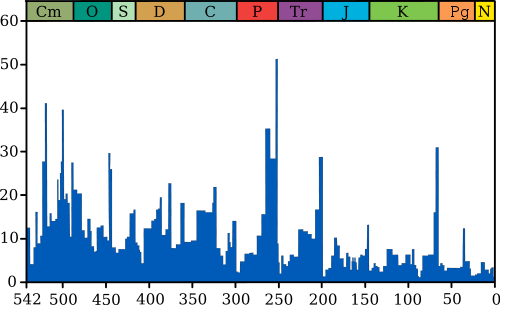
So let’s start there, with the Cambrian Period and the flourishing of life on earth. Consider the chart below:
The divisions across the top are geologic periods, starting with the Cambrian (“Cm”), the period of “visible life”‘ — meaning a proliferation of hardshelled species. It’s the big explosion of life on earth. The numbers across the bottom are millions of years ago. The spikes show extinction events, with the percentage of marine species going extinct expressed on the vertical or Y axis.
The chart doesn’t call them out, but starting with the Cambrian period, we’ve had three geologic eras (the larger divisions):
Paleozoic Era — “old life” Mesozoic Era — “middle life” or the Age of Reptiles (dino days) Cenozoic Era — “new life” or the Age of Mammals (including us)
The Paleozoic Era runs from the start of the graph to the big spike at 250 million years ago on the X axis. It encompasses six geologic periods and ended in the greatest mass extinction event on the planet — geologists call it the “Great Dying”.
The Mesozoic Era runs from the Great Dying at 250 million years ago to the big spike at 65 million years ago, the event that wiped out the dinosaurs — and every other large species. That cleared the way for mammals to grow big and thrive.
We’re now in the Cenozoic Era. Keep those transitions in mind — when mass extinctions change which groups of species can evolve and rule, it’s the end of an era and the start of another. Now look at the chart again. The whole chart shows 540 million years, and just three geologic eras. The next extinction event on the scale of the one at 250 million years ago, or the one at 65 million years ago, will change the shape of life on earth and usher in a new era. Ready for that?
Great question — where does man fit in? Answer: We come in very late.
First, notice the last three geologic “periods” at the top-right in the chart above. The period marked “K” is the Cretaceous, the period at the end of the Mesozoic Era. The next period (“Pg”) is the Paleogene, the one that marks the start of the Cenozoic (new life) Era. The period after that (“N”) is the Neogene, which ended just 2 million years ago. The period after that, not shown, is the Quarternary Period, our current one.
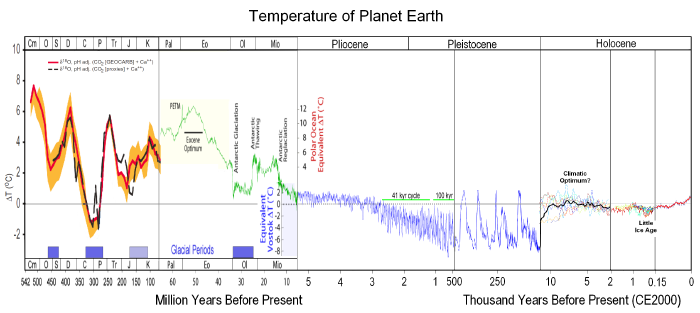
The Neogene-Quarternary boundary is the start of the time of great glaciers, and the best way to show that is with the chart below, showing earth temperatures mapped across the geologic periods (at the left end) and geologic epochs (the rest of the chart).
Click here to open the full version in another tab. It’s a big, interesting chart. (Source here.)
First, get oriented. On the Y axis is global temperature using change — in °C — from global temperature in the year 1800 as the norm or zero mark. (The global pre–Industrial Revolution temperature is generally the mark from which other global temperatures are measured, unless otherwise noted. To convert from °C to °F, just double the number; you’ll be pretty close.)
On the X axis, the first big division — from 542 million years ago to 65 million years ago — represents the first two geologic eras, the Paleozoic and Mezozoic (which unfortunately aren’t called out on this chart). “K” at the top and bottom is still the Cretaceous Period, and the end of the Cretaceous Period is also the end of the dinos and the end of the Mesozoic Era.
In this respect, both charts are the same. Man hasn’t showed up yet — our mammal ancestors were the equivalent of field mice in that world, small prey with soft shells and hiding skills.
But before we look at the rest of the X axis, notice that in the left-most part of the chart, the Y axis shows a huge change in global temperature relative to pre-Industrial norms. Looks like a monster spike, especially the first one, doesn’t it?
The Cambrian temperature spike is 6–8°C (about 11–14°F) higher than pre-Industrial levels.
It’s also the temperature we’re headed for by 2100.
But let’s not get distracted. Let’s set some markers in this chart in the horizontal (time) dimension. The whole rest of the chart — the part after the period called “K” — shows the Cenozoic Era (“new life” or Age of Mammals). From here to the right, the chart’s subdivisions show Epochs, which are sub-parts of Periods.
[Update: For a chart that shows the relationship between eras, periods and epochs, click here. it will help you stay oriented.]
Jump through the next five divisions — the epochs marked “Pal” through “Pliocene”. That takes you through the Neogene Period (“N” in the first chart) and to the start of the modern Quarternary Period, the one we’re in, and the one we’re interested in.
The epoch of the Pleistocene, which starts the Quarternary Period (again, see the chart), is the great age of glaciers. Homo habilis evolves at this time, a little over 2 million years ago. Homo erectus evolves shortly afterward. Each starts in Africa — now you can probably guess why — and each leaves Africa and spreads across the globe. (Homo erectus, by the way, lasts a long time on this earth. Longer than us by a lot.)
Homo sapiens evolved much later, in the Pleistocene — the age of glaciers, remember — just 250 thousand years ago, almost died out in Africa, but rebuilt our numbers, then spread out of Africa like our cousins. Because that was the glacier age, we’re still hunter-gatherers like the the rest of our cousins. The big beasts of the earth are creatures like woolly mammoths and sabre-tooth tigers, and we’re all alive on a fairly frozen planet with glaciers coming and going.
At the end of the Pleistocene is another extinction event. At the same time that the last glaciers recede (see chart), the big mammoths and tigers (et al) die off. Simultaneous with a noticeable change in climate, what we call “human civilization” begins. You can see that above, around 12–10 thousand years ago as the planetary temperature stabilizes. From then until almost now, planetary temperature is pretty stable. Notice it doesn’t take much of a wobble to mark the “Little Ice Age”.
Just two more points to make in this piece and I’m done.
First the bad news
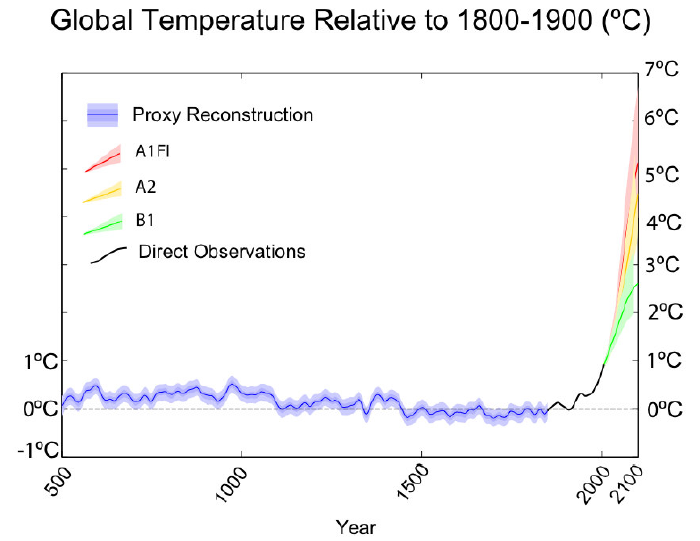
Folks, that little climb in temperature you see near the right end of the graph above is just the beginning. Remember the Cambrian spike at the left end of the graph? Take another look and note the increase — about 7°C. Now here’s Figure 21 from the Copenhagen Diagnosis, a report prepared by … oh … every single one of the world’s top climate scientists for the benefit of our world’s “leaders,” who met in 2009 to discuss how to pass the climate buck one more time:
What you see is temperatures from 500 AD to about 2000, with a number of prediction scenarios going forward. See the scenario called “A1FI”? It’s the one in red. That’s the one we’re on if we don’t stop spewing carbon. I call it the “do nothing” scenario — otherwise known as the “Keep David Koch Happy” scenario.
All you need to know? We’re on track for about +7°C — the peak temperature in the big Cambrian spike — by the year 2100.
Now the good news
Despite all this doom-and-gloom, it’s not over yet. Truly. By my calculation, we have a 5–10 year window to avoid the catastrophe. It won’t be easy — we’re past the point where any transition will be smooth — but we can make the transition and survive as a civilized species, humans in a recognizable world.
But two things are needed:
This has to be our top priority, which means you and everyone you know has to be fully aware and in full battle gear. (For reference, it’s called “hugging the monster.”)
It’s us vs. David Koch and all of his friends and enablers. Tackling any other enemy is tackling a dummy while the game is being played.
Educate your friends, and put a wrench into the Koch machine. How’s that not a plus?
If the Koch Bros keep getting rich, we move backward. If Barack “Hope & Change” Obama approves Keystone, we move backward. If the U.S. develops “domestic oil” resources, we move backward. For every new car (“carbon-delivery system”) sold, we move backward. People need to know this and think like this. We can stop the crisis, but only if we stop carbon. It’s that simple; and that stark.
But it’s also doable, and we’re the species that’s most equiped for “doable.” It’s what our big brains are for.
I’ll have more in the weeks and months ahead. I haven’t given up, not by a long shot. But you can’t pull out of a tail spin if you don’t admit you’re in one. Me, I think we can pull out.
oooOOOooo
So presumably if you are reading this, you have read the essay above. I hope so because while at first sight there appears to be much to take in, the story is clear, informed and powerful. You are unlikely to change the mind of a committed ‘denier’ but if there’s a little part of you that isn’t utterly clear about the risks ahead, then this essay is a fabulous opportunity to embrace clarity – and not to give up hope! Remember those words in the essay:
“By my calculation, we have a 5–10 year window to avoid the catastrophe. It won’t be easy — we’re past the point where any transition will be smooth — but we can make the transition and survive as a civilized species, humans in a recognizable world.”
“It sometimes feels like a strange movie, you know, it’s all so weird that sometimes I wonder if it is really happening.”
This quote by Marshall Bruce Mathers III (born October 17, 1972), better known by his stage name Eminem, is so apt for today’s item. Because in so many places in so many countries, the weather ain’t what it used to be!
For example, in Grants Pass, Oregon, our local town, yesterday’s high was 86 deg F. (30 deg C.)! Then recently NOAA reported that:
According to NOAA scientists, the globally-averaged temperature for March 2013 tied with 2006 as the 10th warmest March since record keeping began in 1880. It also marked the 37th consecutive March and 337th consecutive month with a global temperature above the 20th century average.
So with all this in mind, I’m republishing a recent item on Climate Crocks, with the permission of Peter Sinclair.
oooOOOooo
Jet Stream Blows Winds of Change
April 19, 2013
I’ve been recovering from earth-month speaking-event whiplash, having criss crossed the state over recent days to talk about climate change, and what scientists are telling us.
Meanwhile, Paul Douglas, above, gave a brief summary of what we know about the extreme spring in the US, just before the current river of moisture hit across the nation’s midsection last night.
Near record setting flooding is hitting at my location, schools closed and evacuations underway. I got a bump from Jeff Masters last night about the situation, he is grappling with the big picture, will be posting more later today. For now, more concern about extreme weather knock-on effects – possible washing of dangerous invasive species into the Great Lakes water system.
The rains have brought the Des Plaines River on the east side of Chicago to major flood stage this morning, and a record flood crest is expected on Friday. The Asian Carp, a dangerous invasive species that would cost billions of dollars were it to get loose in the Great Lakes, is present in the Des Plaines River. Today’s flood event is capable of washing significant numbers of Asian Carp from the Des Plaines River into a canal that feeds directly into Lake Michigan, where they might be able to set up a breeding population capable of devastating the Great Lakes’ fishing industry. However, in October 2010, the U.S. Army Corps of Engineers completed the Des Plaines River barricade, a 13-mile-long system of concrete barriers and a specially fabricated wire mesh that allows water to flow through the fence but prevents the passage of fish. Hopefully, this barricade will withstand the flood and prevent Asian Carp from washing into Lake Michigan.
The Met Office has just released a report entitled “why was the start to spring 2013 so cold?”
–
The immediate cause was a natural climate fluctuation called the North Atlantic Oscillation (NAO). The NAO switches between two states, and this winter (in its negative phase) saw a southward shift of the jet stream, bringing cold air over the UK from northern Europe and Russia.
The Met Office identifies three other natural climate variations that may have made the negative NAO phase more likely.
One is the recent behaviour of another natural climate fluctuation, called the Madden-Julian Oscillation ( MJO). It was particularly strong during late February and March – often a sign that a negative NAO is on the way.
This winter also saw what’s called a Sudden Stratospheric Warming ( SSW) event, where winds in the stratosphere above the north pole reverse direction. This brought cold weather conditions to the UK.
Finally, Europe’s climate is influenced by another natural climate system – the Atlantic Multi-decadal Oscillation ( AMO). While the influence on UK winters is unclear, the report suggests:
“[T]here is some evidence that the changes in Atlantic sea surface temperatures associated with the AMO, dispose the circulation to give drier than normal spring conditions over the UK and northern Europe.”
Arctic Amplification
What about the effects of human-caused climate change? One question that has been much discussed recently is whether the recent rapid decline in Arctic sea ice could contribute to a change in the UK’s weather.
“It is argued that amplification of global warming over the Arctic is reducing the equator to pole temperature gradient, thereby weakening the strength of the mid-latitude jet streams.”
This could allow cold Arctic air to push further south, over mid-latitude countries like the UK, and weather patterns could stay longer in one place.
The possibility of a link between the Arctic and UK weather appears to be gaining scientific support, but the Met Office acknowledges it’s still an “area of ongoing research”. The Met Office has told us it’s holding an “ informal workshop” in the next two to three months for leading UK scientists plus several international experts.
Multiple factors
While scientists are making progress in working out how climate change could influence the odds of abnormal weather, it would be unwise to attribute one year’s events to a single cause. The report points this out, noting that:
“…no single explanation can account for the cold conditions observed”.
The report also highlights that although this spring was unusually cold,”it is not unprecedented or outside the expected natural variability of our climate”.
Nevertheless, with what the Met Office describes as “particularly heightened interest” in recent weather, getting to grips with how climate change could be affecting things is important. Even if, as the Met Office suggests, the complexities of the UK weather make “communicating the science drivers more complicated and nuanced than some audiences may wish.”
oooOOOooo
So wherever you are, do try and watch the Chasing Ice film because the more we all see the truth of what’s happening the better we can embrace change; locally, regionally, and globably.
Considering that this blog is called Learning from Dogs, there has been precious little published about the animal species known as Canis familiaris; the classification of the domestic dog. Let me try to correct that.
The subdivision of Canidae into “foxes” and “true dogs” may not be in accordance with the actual relations; also, the taxonomic classification of several canines is disputed. Recent DNA analysis shows that Canini (dogs) and Vulpini (foxes) are valid clades (see phylogeny below). Molecular data imply a North American origin of living Canidae and an African origin of wolf-like canines (Canis, Cuon, and Lycaon).
Currently, the domestic dog is listed as a subspecies of Canis lupus, C. l. familiaris, and the dingo (also considered a domestic dog) as C. l. dingo, provisionally a separate subspecies from C. l. familiaris; the red wolf, eastern Canadian wolf, and Indian wolf are recognized as subspecies. Many sources list the domestic dog as Canis familiaris, but others, including the Smithsonian Institution and the American Society of Mammalogists, more precisely list it as a subspecies of C. l. familiaris; the red wolf, eastern Canadian wolf, and Indian wolf may or may not be separate species; in the past, the dingo has been variously classified as Canis dingo, Canis familiaris dingo and Canis lupus familiaris dingo.
However a recent paper published by Nature magazine throws some interesting light of the development on the domestic dog. As the article preview explains:
The genomic signature of dog domestication reveals adaptation to a starch-rich diet
The domestication of dogs was an important episode in the development of human civilization. The precise timing and location of this event is debated and little is known about the genetic changes that accompanied the transformation of ancient wolves into domestic dogs. Here we conduct whole-genome resequencing of dogs and wolves to identify 3.8 million genetic variants used to identify 36 genomic regions that probably represent targets for selection during dog domestication.
Nineteen of these regions contain genes important in brain function, eight of which belong to nervous system development pathways and potentially underlie behavioural changes central to dog domestication. Ten genes with key roles in starch digestion and fat metabolism also show signals of selection. We identify candidate mutations in key genes and provide functional support for an increased starch digestion in dogs relative to wolves. Our results indicate that novel adaptations allowing the early ancestors of modern dogs to thrive on a diet rich in starch, relative to the carnivorous diet of wolves, constituted a crucial step in the early domestication of dogs.
Anyone who owns a dog knows that it will rummage around in the kitchen bin looking for food, given half a chance.
But this annoying behaviour may have a more profound undercurrent than we realise, according to scientists.
A new study of dog genetics reveals numerous genes involved in starch metabolism, compared with wolves.
It backs an idea that some dogs emerged from wolves that were able to scavenge and digest the food waste of early farmers, the team tells Nature journal.
No-one knows precisely when or how our ancestors became so intimately connected with dogs, but the archaeological evidence indicates it was many thousands of years ago.
One suggestion is that the modern mutt emerged from ancient hunter-gatherers’ use of wolves as hunting companions or guards.
But another opinion holds that domestication started with wolves that stole our food leftovers and eventually came to live permanently around humans as a result.
Anyone who owns or loves dogs will find this article fascinating. Jonathan Amos goes on to say:
“This second hypothesis says that when we settled down, and in conjunction with the development of agriculture, we produced waste dumps around our settlements; and suddenly there was this new food resource, a new niche, for wolves to make use of, and the wolf that was best able to make use of it became the ancestor of the dog,” explained Erik Axelsson from Uppsala University.
“So, we think our findings fit well with this theory that the dog evolved on the waste dump,” he told BBC News.
Dr Axelsson and colleagues examined the DNA of more than 50 modern dogs from breeds as diverse as the cocker spaniel and the German shepherd. They then compared their generic genetic information with those of 12 wolves taken from across the world.
The Swedish-US team scanned the DNA sequences of the two types of canid for regions of major difference. These would be locations likely to contain genes important in the rise of the domesticated dog.
Axelsson’s group identified 36 such regions, carrying a little over a hundred genes. The analysis detected the presence of two major functional categories – genes involved in brain development and starch metabolism.
In the case of the latter, it seems dogs have many more genes that encode the enzymes needed to break down starch, something that would have been advantageous in an ancestor scavenging on the discarded wheat and other crop products of early farmers.
Do go across to that BBC item and read the rest of the article.
That article and the paper in Nature magazine resonate strongly with an article written on the Dr George Johnson on Science website. In fact I referred to the George Johnson piece when I first published the Dogs and integrity side piece in July 2009. (My how time flies!) As that George Johnson piece reveals:
This week I found myself wondering about Boswell’s origins. From what creature did the domestic dog arise? Darwin suggested that wolves, coyotes, and jackals — all of which can interbreed and produce fertile offspring– may all have played a role, producing a complex dog ancestry that would be impossible to unravel. In the 1950s, Nobel Prize-winning behaviorist Konrad Lorenz suggested some dog breeds derive from jackals, others from wolves.
Based on anatomy, most biologists have put their money on the wolf, but until recently there was little hard evidence, and, as you might expect if you know scientists, lots of opinions.
The issue was finally settled in 1997 by an international team of scientists led by Robert Wayne of the University of California, Los Angeles. To sort out the evolutionary origin of the family dog, Wayne and his colleagues used the techniques of molecular biology to compare the genes of dogs with those of wolves, coyotes and jackals.
Wayne’s team collected blood, tissue, or hair from 140 dogs of sixty-seven breeds, and 162 wolves from North America, Europe, Asia, and Arabia. From each sample they extracted DNA from the tiny organelles within cells called mitochondria.
While the chromosome DNA of an animal cell derives from both parents, the mitochondrial DNA comes entirely from the mother. Biologists love to study mitochondrial DNA because of this simple line of descent, female-to-female-to-female. As changes called mutations occur due to copying mistakes or DNA damage, the mitochondrial DNA of two diverging lines becomes more and more different. Ancestors can be clearly identified when you are studying mitochondrial DNA, because clusters of mutations are not shuffled into new combinations like the genes on chromosomes are. They remain together as a particular sequence, a signature of that line of descent.
Finally, just watch this short trailer for a BBC Horizon screened in early 2010. (Wet eyes warning!)
So the next time you look a dog in the eyes or hug their lovely furry body, think how far back the relationship goes and marvel at how much we have learnt from them.
Man and dog. Each loving and protecting the other! (Ex-feral dog Hazel snuggling up on the author’s chest who, I can assure you, was genuinely fast asleep when Jean took the picture one evening last January.)
“Prediction is very difficult, especially if it’s about the future.“ Niels Bohr
I love this saying from Mr. Bohr and often repeat it, albeit at times with my own twist to it. I was reminded of this uncertainty of the future from some comments to a recent post over at Lack of Environment. The particular post was called Can technology save us? and was a reflection of Martin Lack, the blog’s author, watching a recent BBC Horizon special called Tomorrow’s World. (There’s the YouTube of the broadcast at the end of this post.) Martin opened his post by saying:
I happened to stumble across a BBC TV Horizon special, entitled ‘Tomorrow’s World’ last Thursday. It begins with a fascinating review of humankind’s history of – and propensity for – invention. It also explains some truly fascinating – and inspiring – developments in the spheres of space exploration, nanotechnology, biotechnology, and power generation.
In the introduction, the programme presenter and narrator Liz Bronnin explains how, after 100’s of thousands of years of technological stagnation, the fast-moving world of technological innovation is very definitely a modern invention.
Then a little later Martin goes on to say:
After about 32 minutes, Bronnin introduces the power of the Internet to promote innovation – crowd-sourcing research funding and the concept of open-source technology – the complete abrogation of intellectual copyright… It is a fundamental challenge to globalised Capitalism; but it may well be the solution to many of our problems…
However, to me, the final third of the programme is by far the most fascinating… It looks at the challenges of finding a replacement for fossil fuels. It provides a very clear message that this is a technological challenge driven by the reality of physics – not by ideology.
But, overall, Martin lets us know his perspective with his final paragraphs:
Re-engineering nature for our benefit will, without doubt, be very very useful. However, I still think the optimism of the comment at the very end of the programme “…I never worry about the future of the human race, because I think we are totally capable of solving problems…” is very unwise. This is because anthropogenic climate disruption is a problem that is getting harder to solve the longer we fail to address it effectively.
Bronnin concludes by saying that, “it is an exciting time to be alive…” However, I remain very nervous. This is because, as Professor Peter Styles of Keele University – a strong supporter of the hydraulic fracturing industry – recently acknowledged, it will be impossible for carbon capture and storage to remove enough CO2 from the atmosphere to prevent very significant changes to our climate. This is because of the collective hypnosis that deludes most people into seeing perpetual economic growth as the solution to all our problems.
In short, I am certain that technology alone cannot save us. In order to avoid the ecological catastrophe that all but the most ideologically-prejudiced and wilfully-blind can see developing all around us… we need to modify our behaviour: This primarily means that we need to acknowledge the injustice of a “use it up and wear it out” mentality and, as individuals, all learn to use an awful lot less energy.
Climate change “sceptics” have picked a fight with history and science – primarily with the concept of Entropy – and they will lose. The only question that remains is this: Are we going to let them put us all in (what xraymike79 recently called) ‘the dustbin of failed evolutionary experiments’.
Now Jean and I also watched the Horizon special and, to be perfectly frank, found it both uplifting and inspiring. It seemed a great counter to the overwhelming volume of commentary these days along the lines of ‘The end of the world is nigh!‘ some of that coming from yours truly! That’s not to make light of the huge hurdles ahead.
But it was a couple of comments on Martin’s post from Patrice Ayme that got me thinking. Here’s the exchange that went between Patrice and Martin following on from a comment from Thomas Foster.
Considering that it is technology which has enabled us to “conquer” nature and thus the degradation of the environment which is a consequence of that it seems most unlikely to this writer that the cause will also bring about a cure. Thomas Foster
—–
The genus Homo has been technological for 5 million years. Give or take two million. Homo is the cure for life. Patrice Ayme
—-
If we Homo Sapiens have been technological for 5 million years, we have spent most of that time being very unsuccessful; and have spent the rest being far too successful. Is there no scope for just living in harmony with our environment (as opposed to being at war with it)? Martin Lack
—-
Hominids have been masters of the environment for at least three million years. By a million years ago, only Homo was left (but for places like Flores). Dozens of megafauna species got annihilated. Homo’s technology has extended to the entire Earth for at least a million years. The Earth itself was turned into a tool. A tool we are not at war with, but that we use. Patrice Ayme
—-
A utilitarian attitude to Nature is one that does not recognise its inherent value (i.e. which it would have even if we did not exist). Seeing ourselves as superior to Nature rather than as part of it has resulted in our not living in harmony with it. This is, by definition, equivalent to being at war with Nature. QED. Refer: Nature is not your enemy. Martin Lack
—-
Call it what you want, Martin. Man manipulates nature, and that nature one calls nature has not been “natural” for more than a million years. Except if one views man as part of nature! Patrice Ayme
Patrice is a very clear thinker even if, at times, pretty hard-hitting. But this exchange confirmed in my mind that clearly looking out to the future must always be hard. Most certainly in this period of mankind’s evolution predicting the future is especially difficult. Hence my contribution to Martin’s post:
Jean and I watched the Horizon special a couple of evenings ago. To be honest, I’m not entirely sure what my overall thoughts are in response to your post, Martin. What does come to mind is that old saying, “Never underestimate the power of unintended consequences.”
So it may be that we are at a particular point in time, or more likely an era, where seeing clearly into the future is challenging.
The one aspect of modern life that is a game-changer is what we are doing now. Sharing ideas and thoughts across a far-flung net. Not only as the Horizon programme illustrated but as ordinary people trying to make sense of the world.
These are incredibly uncertain times. Undoubtedly not the first in man’s long history as an historian will explain (cue to Alex!). But to all of us alive today, these are the most uncertain times we have ever experienced!
No wonder so many of us feel lost at times in today’s world.
Here’s that BBC Horizon, courtesy of YouTube.
I will close with this thought from one masterly ‘wordsmith’, William Wordsworth.
“Life is divided into three terms – that which was, which is, and which will be. Let us learn from the past to profit by the present, and from the present, to live better in the future.”




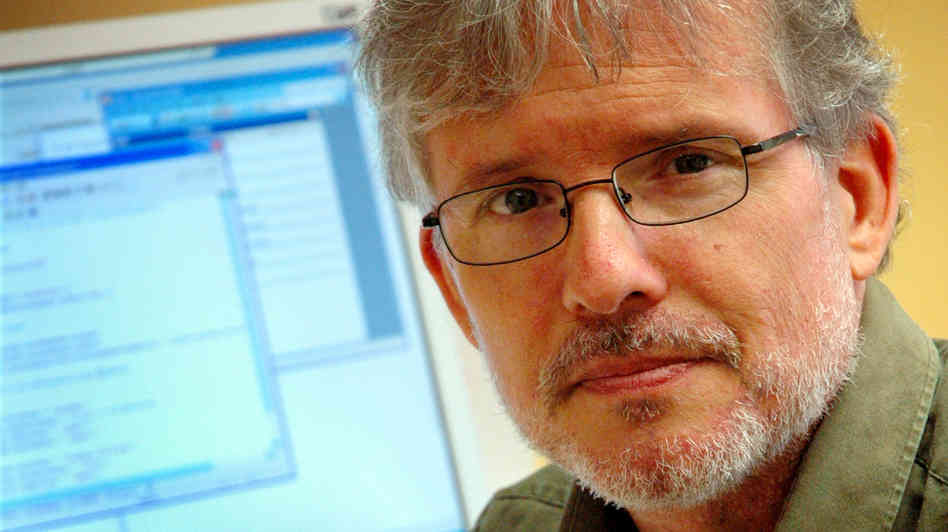



 By Jonathan Amos Science correspondent, BBC News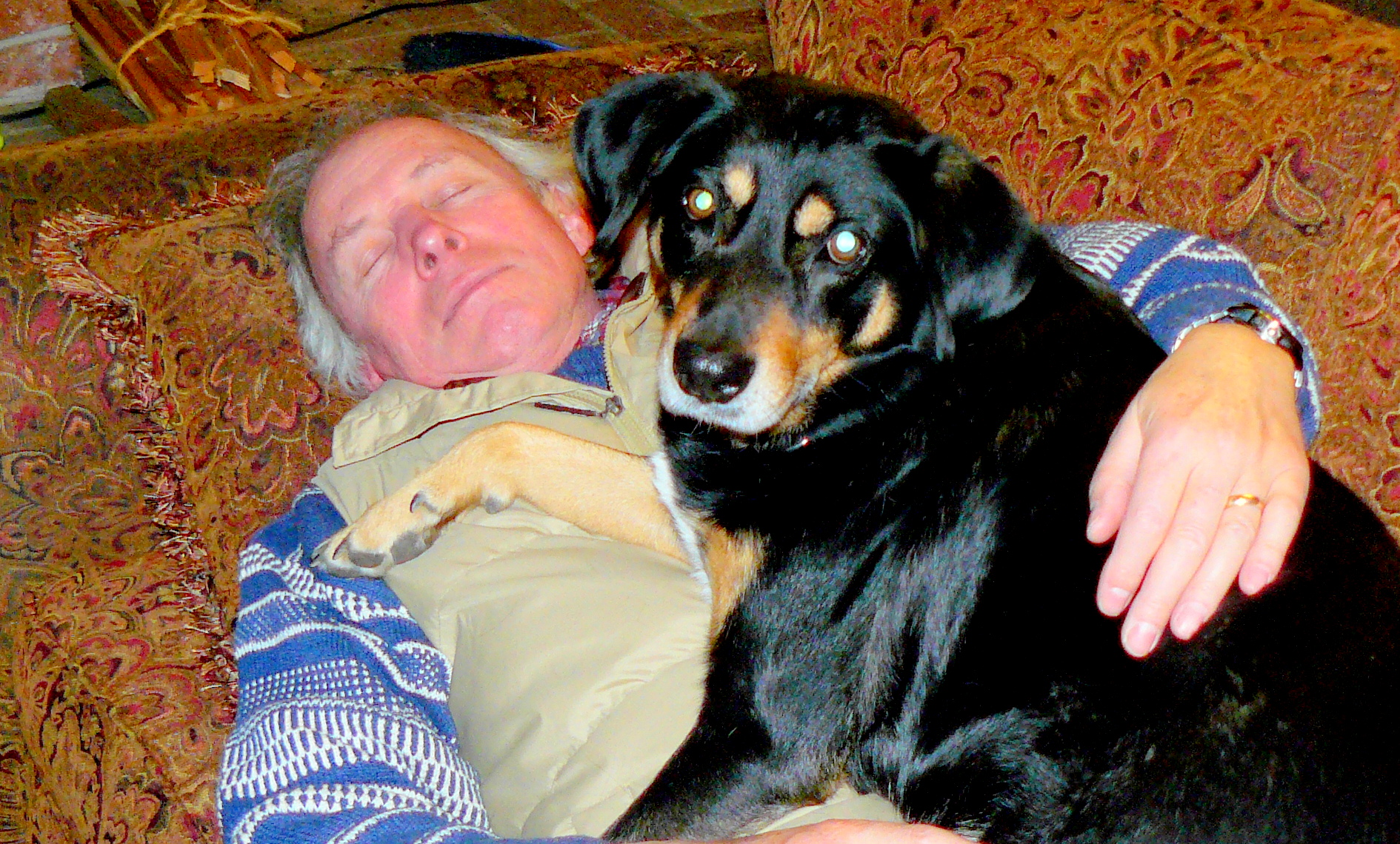
 Learning from Dogs