Two Chinese governing bodies plan to introduce new legislation that will provide special protections to canines by classifying them as companion animals. This would exclude dogs from being used for human consumption.
If you are unfamiliar with the festival, it is notorious for its bloodshed and cruelty. Because dog meat consumers believe that the meat tastes better when dogs have more adrenaline in their blood, dog meat butchers torture the animals. Dogs are beaten, burned alive with blowtorches, or tossed into pots of boiling water.
Thanks to public outcry, the festival’s popularity has decreased and restrictions have been set, however, that hasn’t been enough to end the festival for good. Now’s our chance.
Mr Panek, who lost his sight in his early 20s, told CNN that while he appreciated the support of human volunteers, he missed the feeling of independence.
“It never made sense to me to walk out the door and leave my guide dog behind when I love to run and they love to run,” he said. “It was just a matter of bucking conventional wisdom and saying why not.
In 2015, Mr Panek established the Running Guides programme which trains dogs to support runners.
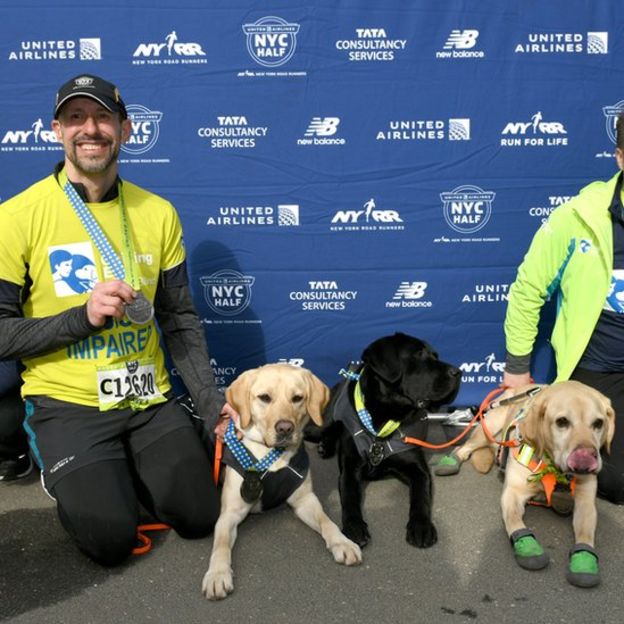
When selecting his canine companions for the New York race, Mr Panek chose siblings Waffle and Westley to join Gus, who is his full-time guide dog.
(L-R) Thomas Panek, Waffle, Westley and Gus show off their medals after the race
“The bond is really important. You can’t just pick up the harness and go for a run with these dogs,” Mr Panek told CNN. “You’re training with a team no matter what kind of athlete you are, and you want to spend time together in that training camp.”
Each dogs sets its own pace – Westley runs an eight minute mile, while his sister Waffle can cover the same distance in six minutes – and helps Mr Panek avoid obstacles such as kerbs and cones.
Each dog wears a special harness and set of running boots, to protect their paws.
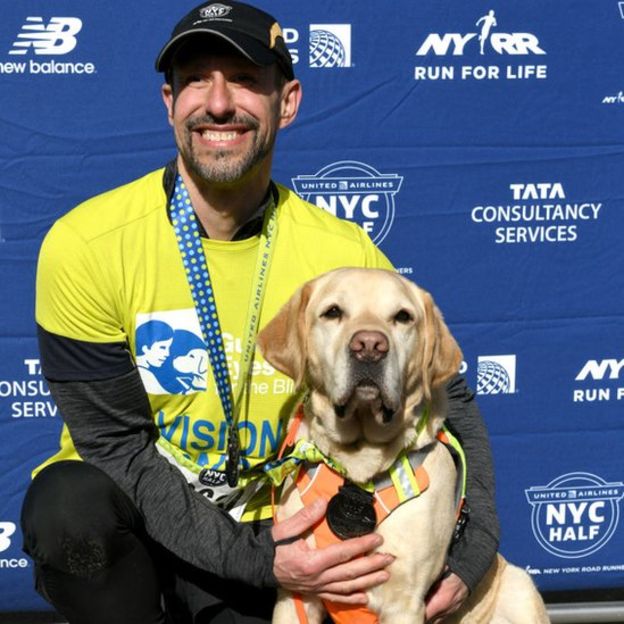
Gus was chosen to run the final leg of the race and cross the finish line with Mr Panek. He retired from his duties as a guide dog at the end of the race.
“It’s a little emotional for me because he’s been there with me the whole time,” Mr Panek said.
Gus, Mr Panek’s personal guide dog, entered retirement after the race
Before the race, Mr Panek told Time magazine that guide dogs give visually impaired people the freedom to “do whatever it is a sighted person does, and sometimes, even run a little faster than them”.
ooOOoo
“It’s a little emotional for me because he’s been there with me the whole time,”
It’s not just Mr. Panek who finds the report a little emotional!
As I have said many times before and undoubtedly will continue to say: Dogs are truly amazing animals.
Dear Fellow Dog Lover,
The U.S. Food and Drug Administration is warning pet owners not to feed 3 specific lots of Darwin’s Natural dog food because Salmonella bacteria were discovered in the product.
To learn which products are affected, please visit the following link:
Please be sure to share the news of this alert with other pet owners.
If you go to that link then you will see the following:
FDA Warning: Do Not Feed These Lots of Darwin’s Natural Dog Food
March 26, 2019 — The U.S. Food and Drug Administration is cautioning pet ownersnot to feed their pets 3 lots of Darwin’s Natural Pet Products raw dog food after samples from these lots tested positive for Salmonella.
No images were provided by the FDA in its announcement.
The following image was previously retrieved from the brand’s website and is provided in good faith by The Dog Food Advisor. It may not be an accurate representation of the affected products.
What Products Are Affected?
The codes for each product affected are listed in the second group of numbers found just below the barcode on the package.
Here are the affected products:
Darwin’s Natural Pet Products Natural Selections Chicken Recipe with Organic Vegetables for Dogs
Package: 5309(11)181019
Manufacture Date: October 19, 2018
Darwin’s Natural Pet Products Natural Selections Chicken Recipe with Organic Vegetables for Dogs
Package: 5375(11)181106
Manufacture Date: November 11, 2018
Darwin’s Natural Pet Products Natural Selections Turkey Recipe with Organic Vegetables for Dogs
Package: 5339(11)181026
Manufacture Date: October 26, 2018
These products are manufactured by Arrow Reliance Inc., doing business as Darwin’s Natural Pet Products.
They are sold online direct to consumers.
What Caused This Alert?
The FDA is issuing this alert because the affected lots of Darwin’s raw dog food represent a serious threat to human and animal health.
They are are considered adulterated under the Federal Food, Drug, and Cosmetic Act because they contain Salmonella bacteria.
The FDA collected and analyzed unopened samples of products from these 3 lots in response to a consumer complaint.
Samples from all three lots tested positive for Salmonella.
Because these products are sold and stored frozen, the FDA is concerned that people may still have them in their possession.
About Salmonella
Salmonella is a bacterium that can cause illness and death in humans and animals, especially those who are very young, very old, or have weak immune systems.
According to the Centers for Disease Control and Prevention (CDC), people infected with Salmonella can develop diarrhea, fever and abdominal cramps.
Most people recover without treatment. But in some people, the diarrhea may be so severe that they need to be hospitalized.
In these patients, the Salmonella infection may spread from the intestines to the blood stream and then to other body sites unless the person is treated promptly with antibiotics.
Consult your health care provider if you have symptoms of Salmonella infection.
Pets do not always display symptoms when infected with Salmonella, but signs can include vomiting, diarrhea (which may be bloody), fever, loss of appetite and/or decreased activity level. If your pet has these symptoms, consult a veterinarian promptly. You should also be aware that infected pets can shed the bacteria in their feces without showing signs of being sick.
Consult a veterinarian if your pet has symptoms of Salmonella infection.
What to Do?
If you have any of the affected Darwin’s Natural Pet Products in your possession, stop feeding it to your pets.
Discard the product in a secure container where other animals, including wildlife, cannot access it.
Consumers who have had the affected products in their homes should clean refrigerators and freezers where they were stored.
Clean and disinfect all bowls, utensils, food prep surfaces, pet bedding, toys, floors, and any other surfaces that the food or pet may have had contact with.
Clean up the pet’s feces in yards or parks where people or other animals may become exposed.
Consumers should thoroughly wash their hands after handling the recalled product or cleaning up potentially contaminated items and surfaces.
U.S. citizens can report complaints about FDA-regulated pet food products by calling the consumer complaint coordinator in your area.
Because you signed up on our website and asked to be notified, I’m sending you this special recall alert. If you no longer wish to receive these emails, please click the “unsubscribe” link at the bottom of this message.
Hill’s Pet Nutrition is expanding its recall of specific lots of its Prescription Diet and Science Diet dog foods due to elevated levels of vitamin D.
Very high levels of vitamin D can lead to serious health issues in dogs, including kidney dysfunction.
To learn which products are affected, please visit the following link:
Vitamin D, when consumed at very high levels, can lead to serious health issues in dogs including kidney dysfunction.
What’s Recalled?
The following products and lot numbers are affected by the recall.
Items marked in blue are new SKUs that were added to the list on March 20, 2019.
About Excessive Levels of Vitamin D
While vitamin D is an essential nutrient for dogs, ingestion of elevated levels can lead to potential health issues depending on the level of vitamin D and the length of exposure.
Dogs may exhibit symptoms such as vomiting, loss of appetite, increased thirst, increased urination, excessive drooling, and weight loss.
Pet parents with dogs who have consumed any of the products listed and are exhibiting any of these signs should contact their veterinarian.
In most cases, complete recovery is expected after discontinuation of feeding.
What to Do?
If your SKU, Date and Lot codes are found in the list above, you have an affected product.
You should stop feeding it and should return to the place of purchase for a full refund.
If you have questions, you may contact Hill’s Consumer Affairs at 800-445-5777.
U.S. citizens can report complaints about FDA-regulated pet food products by calling the consumer complaint coordinator in your area.
I can’t believe that the last time we had a post from Emily was back in July, 2016.
You may not recall but Emily’s background is a cat parent to 2 lovely cats, Gus and Louis “Gus only has one eye, but we love him all the same!”. She has lived with dogs in the past and can’t wait to add a dog to the family again. She writes about all things cats at her blog, Catological.com.
OK, that’s enough from me.
Here is Emily’s guest post.
ooOOoo
Adapting and Overcoming Stereotypes: How Dogs and Cats Can Live Harmoniously Together
By Emily Parker, Catological.com
For a dog and a cat to live harmoniously in one home is a goal that many pet owners want to achieve. Before this happens, some variables need to be considered to make a good relationship between pets work.
As the pet parent, it’s important to be in tune with the tendencies and personalities of your pre-existing pet, be it a dog or a cat, and the inclinations of your new pet if you want them to live harmoniously together.
Personality is More Important than Breed
While most people pay attention to the breeds of dogs and cats when it comes to the aspect of getting along, experts argue that taking their energy and personalities into account is more important. For example, if you already have a dog that’s known for its aggressive ways don’t adopt a skittish cat. In a similar manner, an aging dog may not enjoy living in one household with a lively and playful kitten who is always interrupting the peace.
If you already have pets whose personalities don’t match, this is where your backup plan should be used. You should set up a living arrangement wherein they are separated as much as possible, while providing them each with as much loving attention as possible.
If you’re adopting a new pet, do your research and ask the caretakers if it has lived with other pets before or if the pet has a hard time getting along with others.
Give a Cat its Own Space Before Introducing it to the Dog
While most dogs are quite extroverted animals, cats need space – something that they can call their own. It’s just their nature, and you should respect that. Make sure that you provide a space that your dog won’t be allowed to navigate, so your cat can confidently mind her own business without triggering a fight with her canine brother.
Cats are natural climbers, so it should be easy to take advantage of your home’s vertical space. Prepare a cat bed atop a shelf or a bookcase, or install a cat tree that your dog can’t reach. This will allow your cat to observe your dog from across a room or from a distance.
Make sure the cat’s litter box is away from the dog, too. Cats have long been observed to hide while doing their business, and there’s also the tendency of dogs to chew on cat poo that you should be concerned about.
You can install baby gates if you must – just make sure to do everything in your power to keep a dog away from a pooping cat!
Make Sure Your Dog Has Plenty of Physical and Mental Exercise
It’s important for dogs to have their energy released someplace else other than your home so they can slow their brains down and practice restraint whenever they’re around your cat.
These are creatures that require a lot of stimulation; otherwise, they might end up chasing the cat. To prevent this from happening, practice high-intensity trick training, lure coursing, or herding-type activities with your dog.
Don’t settle for just walking, if you can help it. You can do a sit several times on each block and do direction changes now and then. You can also practice speed changes.
Dogs should be able to let go of their herding instincts around cats, and you can help them achieve this by ensuring that your pet is always active, both in mind and in body.
Should you lack time for these activities, you can always enroll your dog in daycare or hire a dog walker instead.
Allow Your Pets to Follow Their Noses
Before introducing the dog and the cat to each other, allow them to sniff each other’s toys or beddings first.
This will satisfy their curiosity as to who the other pet is in the house, and serve as an introduction. It can also prevent turf wars in the future.
While your new pet is safely tucked away in a spare room, rub him down with a clean towel, and then present it to your existing pet to sniff, and vice versa.
Plan the First Meeting Properly
As with most humans, first impressions count, so make sure it all turns out well for the dog and the cat.
After you’ve introduced scents, you can have a visual meeting, preferably behind the safety of a baby gate or most-closed door.
After they’ve been able to smell and see each other a few times, it’s time for the main event.
Your cat should always have a clear escape route during this meeting, and you should not force the issue. If possible, take control of your dog without being aggressive about it, to ensure that he doesn’t chase the cat.
You may have to do this multiple times before everyone is comfortable with each other, always making sure you praise your dog for calm behavior, while ensuring the cat isn’t forced into a meeting from which she has no escape.
When it comes to food, the choice you make may depend on how well the two pets get along together, though I’d recommend having meal time in separate places or times if possible.
Separate Each Other’s Toys and Food
Always keep your pets’ separate. Some cats are known to be nonchalant with the company of an eating dog, even walking around the dog while he’s eating to try to eat from the bowl. Many dogs will allow this, but don’t be so sure on your pet. Don’t assume that your dog won’t get overprotective with his food bowl. (Not to mention dog food is not appropriate for cats to eat.) You can prevent mealtime wars by scheduling regular mealtimes and place the bowls in separate parts of the house.
While some pets won’t make an issue of this, you can give yourself the best chance of a peaceful home by making sure their toys don’t get mixed up. Competition over toys can start a fight. Some dogs have taken into catnip as well. So always segregate.
Consider Raising a Cat and Dog Together
Compared to introducing them to each other as adults, it’s easier if each pet meets each other at a young age
Puppies are typically easier to train than adult dogs who have become set in their ways, and they can be taught to not harm a kitten or just to leave it to its own devices. Kittens are incredibly curious and playful, and will associate the dog as a friend and will get used to its company as she grows into a mature cat.
But then again, it never hurts to be cautious!
At the end of the day, your duty as a pet parent is to keep watch over your pets and make sure they’re well fed and safe within your home. With proper guidance, training, and a whole lot of patience, it’s not impossible for a dog and cat to live together peacefully.
ooOOoo
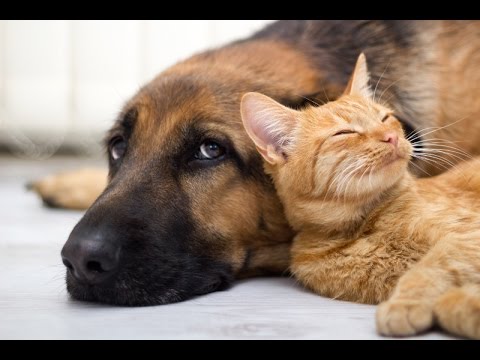
Now I took the following picture from another blog and when you visit that page you can read another account of cats and dogs living together.
But I will close with that image because it is so perfect!
Since meeting one another last year, Timofey Yuriev and his faithful dog Kira have been inseparable companions. Indeed, the happy duo do just about everything together.
And that includes saving lives.
Photo Credit: Timofey Yuriev
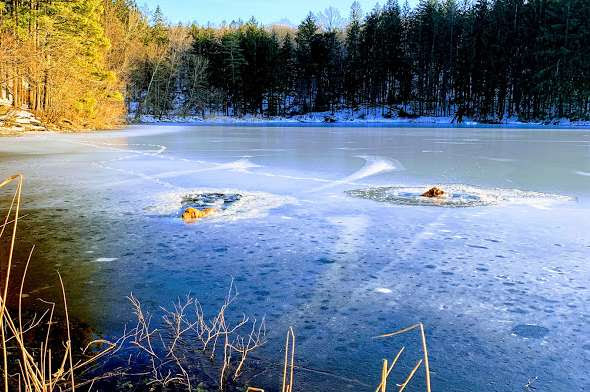
Last Saturday, Yuriev, his wife and Kira headed out for a sunset stroll around an ice-covered lake near their home in New York. It’s a tranquil spot, but on this chilly early evening, the quiet, peaceful air was shattered by the sound of a tragedy unfolding.
“We heard a woman screaming something across the lake, so we went to see what was happening,” Yuriev told The Dodo. “Her two old Labradors were crossing the lake, when they got to a spot where the ice is much thinner. One fell in, then the second. They tried to climb out but they couldn’t.”
Photo Credit: Timofey Yuriev
Yuriev watched as the dogs’ energy was quickly sapped by the freezing water — and he knew time was of the essence.
Having experience swimming in icy waters, Yuriev decided to take the plunge in order to save the two dogs himself — but he was not alone.
After Yuriev undressed and leapt into the freezing lake, he looked and saw Kira by his side entering the water as well to lend him her paw in the rescue effort.
“I knew she was going to follow me,” Yuriev said. “We were going to do it together.”
Here’s video taken by Yuriev’s wife showing him and Kira reaching the nearest dog first:
“She was great moral support; I was not alone,” Yuriev said. “There was my little helper.”
After leading the first dog safely to the shore, Yuriev and Kira headed out for the second:
“She came to each dog and touched them with her nose, then helped guide them back.”
Once back on dry land, both of the rescued dogs were frazzled but in good health.
Yuriev and Kira had saved the day.
“The owner, of course, was in tears,” Yuriev said. “She was so thankful.”
Photo Credit: Timofey Yuriev
Kira has always been a kindhearted and intelligent dog, able to assess situations and sense when she’s needed.
And on this day, it was clear for all to see.
Timofey Yuriev
“We told her that she’s a dog-saving dog. I’m sure she understood that something was happening. She could see the dogs were in distress. I’m positive about it,” Yuriev said, adding that he’s just happy they were able to help.
“It was pure luck that we were at that place at that time. It was like the universe smiled at us.”
As I said in my email to her after Jeannie and I had listened to it:
OK. Have listened to it just now.
I don’t know what to say.
Frankly, I’m overwhelmed. I need some time to let it settle down but it’s going to be featured on the blog very soon.
Thank you
Paul
I’m still ‘processing’ it but that doesn’t stop me from sharing it with you.
ooOOoo
Ralph spends the whole hour with independent journalist, Dahr Jamail, author of “The End of Ice,” his first person report on the front lines of the climate crisis.
In late 2003, award-winning journalist, Dahr Jamail, went to the Middle East to report on the Iraq War, where he spent more than a year as one of only a few independent US journalists in the country. Mr. Jamail has also written extensively on veterans’ resistance against US foreign policy. He is now focusing on climate disruption and the environment. His book on that topic is entitled, The End of Ice.
“So much of what we talk about is so dire and so extreme and so scary and also disheartening that I quote Vaclav Havel, the Czech dissident writer and statesman. And he reminds us that as he said, ‘Hope is not the conviction that something will turn out well but the certainty that something is worth doing no matter how it turns out.” And that’s where I get into this moral obligation that no matter how dire things look, that we are absolutely morally obliged to do everything we can in our power to try to make this better.” Dahr Jamail, author of “The End of Ice”
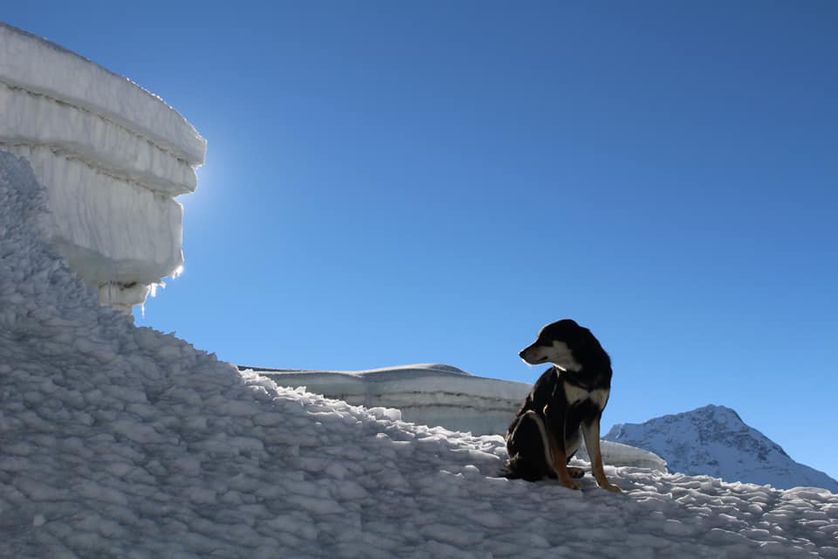
Mera seemed to have little trouble in the snow and ice. (Photo: Don Wargowsky)
When Seattle-based mountain guide Don Wargowsky was leading an expedition to Mera Peak and Baruntse in Nepal’s Himalayas last November, he picked up an extra member on his team. A stray dog noticed the climbers somewhere around 17,500 feet and decided to stick around with the group.
The climbers had just summited Mera Peak, and when they were coming down around Mera La pass, they saw the pup going up.
“What struck me was to get to that pass, there were a few hundred feet of fixed rope which means the terrain was so difficult that most climbers need rope to help themselves up,” Wargowsky tells MNN. “To see a dog up there just running by all these climbers in their $2,000 down suits and crampons was very unusual. When she came up to me, I gave her a bit of beef jerky and she didn’t leave for 3 1/2 weeks.”
The team dubbed their newest four-legged member “Mera” and she tagged along on the way back down the mountain. Wargowsky realized he had seen her in the town of Kare a few days earlier, but she had made no effort then to get close. He thinks that’s because street dogs aren’t treated very well in Nepal due to the fear of rabies.
“Dogs are shooed away pretty aggressively,” he says. “So, she was naturally pretty shy.”
A new climbing partner
Climbing is hard work. (Photo: Don Wargowsky)
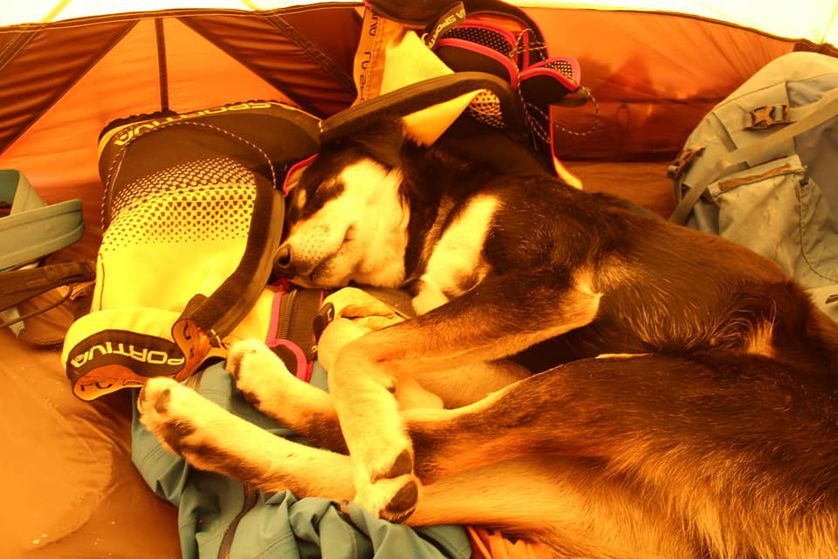
But once Mera decided to join the expedition, she gradually lowered her guard. The first night, Wargowsky tried to encourage her to sleep in his tent, but she wouldn’t come inside. The next morning, he found her curled up outside the flaps covered in a layer of snow. After that, he was able to coax her inside. He gave her one of his sleeping pads and a coat to keep her warm.
Wargowsky was in a difficult position with his uninvited guest. The elements were unforgiving, and he was worried about the dog who had no protection for her paws or her body in conditions that likely reached minus 20 or minus 30 degrees Fahrenheit at times. But he had no luck getting her to leave … and where would she go?
“Obviously my responsibility was to the group, but I was super happy to have her with us. I didn’t encourage her to come along, but I wasn’t going to have her starve, so I would feed her,” he says. “I really tried to persuade her to stay at camp as we got into steeper and more dangerous terrain. Where we were was a more remote part of Nepal. If we didn’t feed her, she was going to starve.”
Mera stuck with the expedition the entire time, never venturing far from Wargowsky’s side. Or technically, his knee.
“She would walk with her nose almost in the back of my knee when we would walk,” he says. “But she wanted to be up front. If I would drop back to hang out with a slower client, she would go up and walk with whoever was up front. She didn’t get out of sight pretty much the entire time we were there.”
‘No clue what her motivation was’
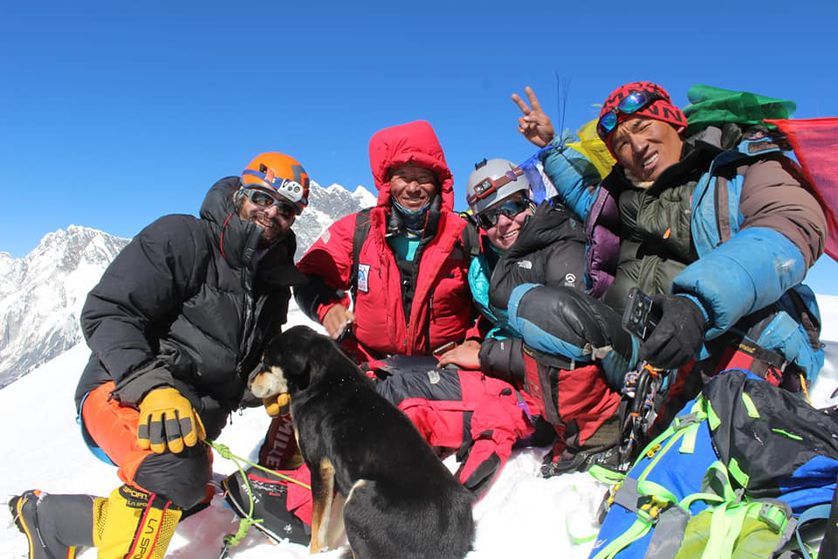
Mera celebrates with her fellow climbers. (Photo: Don Wargowsky)
There was only one time when Mera was gone for several days.
While Wargowsky was working on training with some members of the expedition, showing them how to climb the ice with rope, Mera followed the team’s sherpas instead. They were working to set up ropes to “camp one” at around 20,000 feet. She scrambled up the steep terrain but seemed afraid to go back down and wouldn’t return with them to base camp.
“She ended up spending two nights alone on a glacier at 20,000 feet. I really thought she was going to freeze to death,” Wargowsky says. The sherpas went up to continue working and she was there. But instead of going back down right away, she followed them to 22,000 feet as they continued working before going back to base camp.
The next day when the entire team went to make the climb, Wargowsky tried to keep her at base camp because he didn’t want her to make the steep climb again. He tied her up but she got out of her rope and quickly caught up with them. Wargowsky couldn’t leave his human clients to take her back, so Mera was allowed to stay with the group.
“I have no clue what her motivation was,” he says. “We were feeding her at base camp, so it wasn’t the food. It’s not like there was anything up there for her, but it was amazing to see.”
Tackling the ice and snow
Mera often trotted ahead of the climbers, waiting for them to catch up. The temperatures didn’t seem to faze her. (Photo: Don Wargowsky)
Early on, Mera started to slide and Wargowsky was able to catch her and save her from what could’ve been a dangerous fall. When the team moved to camp two at around 21,000 feet, they were sidelined there for four days because of bad weather. Mera stayed with Wargowsky, who shared his tent and his food with the pup.
“I split all my meals with her 50/50 so we both lost weight,” he says. He guesses the scruffy brown-and-tan stray weighed probably 45 pounds to start with but lost maybe five or 10 pounds during the trip. Wargowsky says Mera looked like a combination of a Tibetan mastiff and a Nepali sheepdog.
Wargowsky was impressed with how well Mera navigated the snow and ice and handled the cold.
“She did very very well like 98 percent of the time. There were certain slopes very early in the morning or late at night when the snow was very crusty and icy when it was very slippery and you could see her kind of struggle with it,” he says. “Her paws got beat up and it was hard to see her paws bleeding a little. But everything healed up that evening and it was all superficial.”
He says it was also hard to believe she didn’t go snow-blind. The humans were all wearing expensive glacier goggles while she trotted along with no protection.
The highest a dog has ever climbed
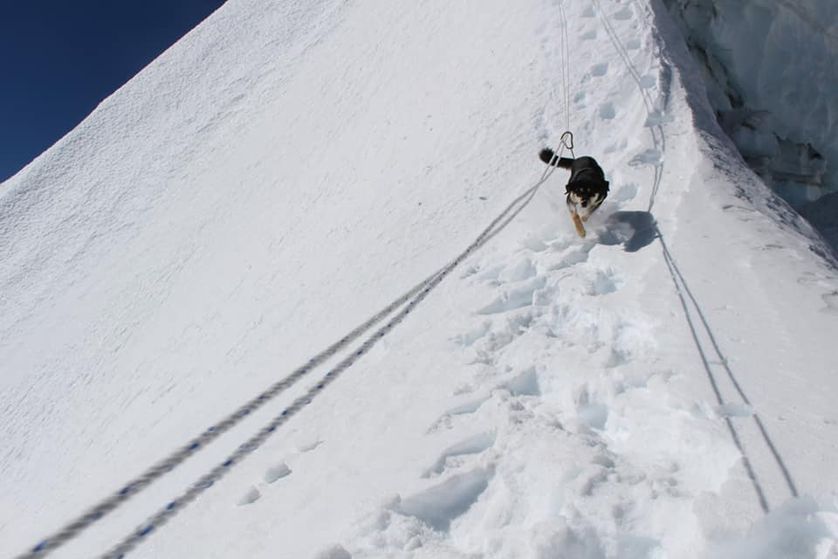
In one particularly harrowing descent, Mera was clipped to a rope to keep her safe. (Photo: Don Wargowsky)
There was only one part of the descent where she was assisted by a rope. Somehow, she had climbed the vertical 15-foot-tall section without incident but when it was time to go back down, she didn’t want to do it. The humans were rappelling, so to coax the dog down safely, they tied a rope harness to her so she could half-run, half tumble. You can see it in the photo above, but Wargowsky points out that the truly harrowing part of the mountain isn’t even visible in the shot.
In the end, when the team — along with their canine mascot — had come down from their completed 23,389-foot climb of Baruntse, Mera was hailed as a bit of a hero. Word had spread about her alleged feat and Wargowsky had to show off photos from his phone to prove she had been with them.
“She was the first dog to ever have climbed that mountain,” he says. “We can’t find anything that says a dog has ever been that high. I believe that is the highest that a dog has ever climbed ever at any point in the world.”
“I am not aware of a dog actually summiting an expedition peak in Nepal,” Billi Bierling of the Himalayan Database, an organization that documents climbing expeditions in Nepal, told Outside. “I just hope that she won’t get into trouble for having climbed Baruntse without a permit.” Bierling told Outside that there have been a few reported cases of dogs at Everest Base Camp (17,600 feet) and some who’ve trailed teams through the Khumbu Icefall up to Camp II (21,300 feet) on Mount Everest, but Mera’s adventure is perhaps the highest-recorded elevation by a dog anywhere in the world.
‘This dog wants to climb mountains’
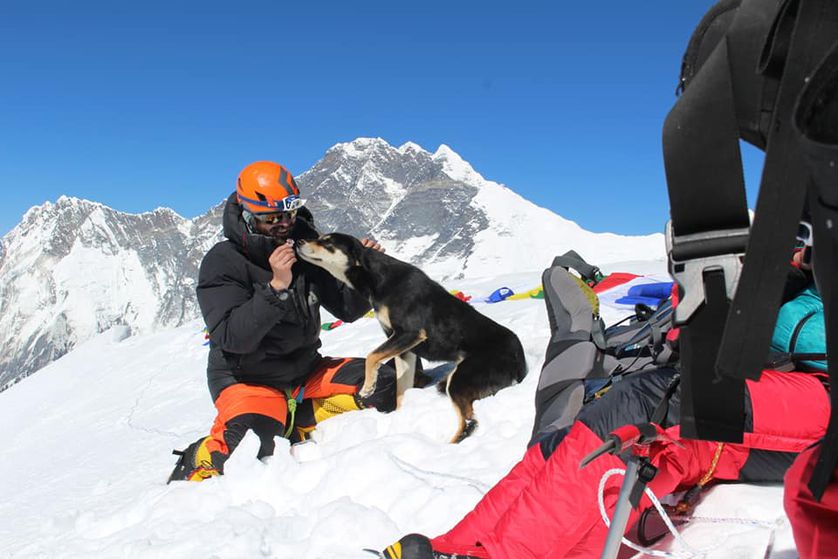
Wargowsky shares his food with his climbing buddy. (Photo: Don Wargowsky)
After all that climbing and bonding, Wargowsky was tempted to bring his new friend home with him to the U.S.
“I really would’ve loved to adopt her. But I live in a 700-square-foot unit in Seattle and this dog wants to climb mountains. I gave it a lot of consideration. I didn’t care what it cost. Despite how much I loved this dog, I thought it would’ve been a very selfish thing to do to bring her to such a small space.”
But he didn’t want to leave what he calls “this hero of a dog” out on the streets. Fortunately, the expedition’s base camp manager was also smitten with the adventurous dog. Because dogs can’t fly, NirKaji Tamang paid someone $100 to walk three days to pick her up until they could get her on a bus and get her to his home in Kathmandu.
After what she had accomplished on Baruntse, Tamang changed the athletic dog’s name to Baru. He took her to the vet to make sure she was healthy. Her injuries quickly healed, and she gained weight.
Wargowsky, who told his remarkable Mera story online, was thrilled recently to receive photos of her. He will be back in Nepal several times this year for expeditions, and he plans on visiting his canine climbing partner.
“With what we had available, I don’t know what more I could’ve done to prevent her from climbing. She was definitely there of her own free will,” he says. “I truly loved that dog.”
ooOOoo
This is such a wonderful account of a stray dog coming into contact with a group of such loving people. Plus, the photographs are wonderful especially the fourth one; just following the Tackling the Ice and Snow sub-heading. I could look at that photograph for ever!
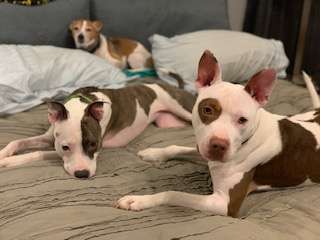
Liza was born in a shelter after her mother was abandoned on the streets while she was pregnant. Both the mama and all of her puppies were very sick at first, and it was an uphill battle to get them all to a point where they were healthy and thriving. Finally, when she was 13 weeks old, Liza was adopted by Debi Kolak and her other dog Mona, and Liza and Mona quickly became the best of friends.
For two years, Mona and Liza did absolutely everything together — until Mona passed away suddenly this past fall, leaving poor Liza completely heartbroken.
Mona and Liza |
Kolak could see that poor Liza was clearly very lonely without Mona, so when she moved in with her boyfriend and his two senior Jack Russell terriers in December, she hoped that the company of other dogs would help to cheer Liza up. Unfortunately, though, the two terriers weren’t huge fans of Liza, as she was too energetic and playful for them, and so Liza was still left without anyone to play with. Kolak discussed the possibility of adopting a playmate for Liza with her boyfriend, but he was skeptical that they could handle a fourth dog, and therefore put off the idea.
Debi Kolak
Despite her boyfriend’s hesitations, Kolak began researching different animal shelters in the area until she found one that had some dogs up for adoption who seemed like they could be good matches for Liza. She took Liza with her to the shelter and talked to the volunteers there about the kind of dog they were looking for. They showed her a few different dogs — and one of them was Murphy.
Murphy was one of the shelter’s longest residents, and had been there for five months. He was found as a stray, and during his time at the shelter had been adopted by three different families and returned every time. He seemed so defeated, and didn’t strike Kolak as the kind of dog that she and Liza were looking for. Liza needed an active, cheerful playmate, and when she first met him in his kennel, Murphy seemed to be anything but that.
Debi Kolak
“Murphy was sad … defeated-looking,” Kolak said. “He had a large scar on his head. He didn’t bark or run to the cage. He just sat there, pressed against the chain link of his tiny kennel. I sat on the floor, put my hand up to the fence and talked to him. He nibbled at my finger and barely thumped his tail. I immediately thought, ‘There is no way this guy is a match.’ But I was drawn to his pitiful face.”
Despite her doubts, Kolak had the volunteers bring Murphy and a few other dogs out into the yard so that Liza could meet them. She left it up to Liza to choose which dog they would be taking home — and almost immediately, she chose Murphy.
Debi Kolak
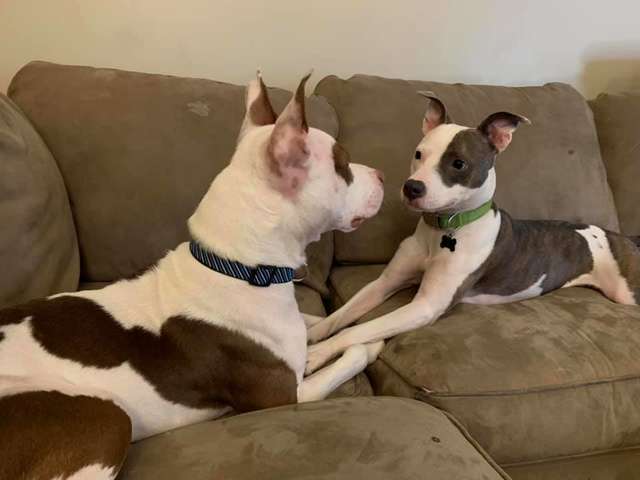
“Liza and Murphy had an instant connection,” Kolak said. “He rolled belly-up for her and then the game was on! They ran and frolicked for almost an hour, never once showing aggression and matching each other’s playfulness. I knew he was the one, and Liza knew he was the one.”
Something about Liza completely transformed Murphy, and it was as if he had been waiting for her all along.
Even though Murphy clearly belonged with them, Kolak still had to convince her boyfriend, Joel. He was still resistant when she told him about Murphy — until she sent him a video of Liza and Murphy playing together, and he realized that they were meant to be together.
Debi Kolak
“I told the volunteers at the shelter that we would need to discuss it and I would let them know,” Kolak said. “He and Liza both whined for each other as they took him away. I called Joel when I left and talked to him about it and he said, ‘Well, you can’t just leave him! Go back!’ So I did!”
The couple decided to enroll in the shelter’s “Take A Chance On Me” program, which consists of a three-day trial period to see if a dog will work out in a family’s home. Kolak and Liza went back to get Murphy, and as the trio drove home together, no one could imagine it not working out. It was very clear that Murphy had found his forever family.
Debi Kolak
“Murphy immediately jumped in the back seat of my truck and just looked out the window with his tail doing its tiny thump and he finally leaned in and licked my face,” Kolak said. “Liza nuzzled into him as if she was assuring him that he was going to be OK and he would be loved, and I swear, she totally had a smile on her face the whole ride home!”
Debi Kolak
Murphy hasn’t been with his new family for very long, but they already can’t imagine life without him. His favorite person is Joel, and he follows him everywhere he goes. At night, he sleeps under the covers with Kolak’s daughter and Liza, and the whole family loves seeing him so content.
“In just a few short days of having him home, I can’t understand how no one would give this dog a chance, he is amazing,” Kolak said.
Debi Kolak
Murphy does still seem a little confused at times, as if he’s worried that he might end up getting returned to the shelter again. Kolak is hoping that as time goes on, the fear and confusion will fade. After all, now that Liza has found her best friend and soulmate, there’s no way she’s ever letting him go.
Debi Kolak
“I called the shelter and told them that I wanted to finalize his adoption and they all cried and cheered,” Kolak said. “I got him at no charge due to him being there for so long and they are giving us free transition training classes to help him learn trust and how to be part of a family. I’m excited to see how he does and I’m excited for him to finally realize that he is home for good.”
ooOOoo
For some reason some of the photographs didn’t copy across at full size.
Hi Paul,
I thought that you and Jeannie might like to see this, if you haven’t already done so.
It brought a tear to my eye. Very inspiring – the way the world should be. The best of humanity.
Warm regards
– Margaret K








 Ralph spends the whole hour with independent journalist, Dahr Jamail, author of “The End of Ice,” his first person report on the front lines of the climate crisis.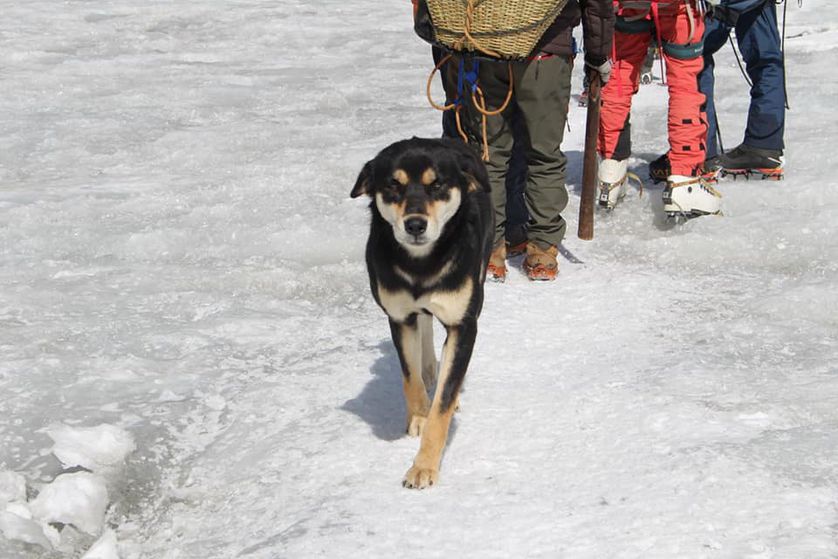




 Learning from Dogs