Category: Government

Staying positive – the test.

Where hope and inspiration meets the cold world of reality!

Yesterday’s post Don’t frighten the horses was all about reminding me that fear is a very bad motivator. I promoted the Transition message,  “If we can’t imagine a positive future we won’t be able to create it.”

Easy to say, easy to write, less easy to put into practice in the face of really chilling predictions.

My way of introducing today’s guest post, a recent post from TomDispatch.  This was an essay by Michael Klare that has been widely shared and commented upon. For good reason.  It challenges to the core the terrible consequences of not changing, of not having that image of the positive future we all so badly need.

So with the gracious permission of Tom Engelhardt, here is that essay.

oooOOOooo

Tomgram: Michael T. Klare, 2040 or Bust

Posted by Tom Engelhardt at 8:00am, September 10, 2013.
Follow TomDispatch on Twitter @TomDispatch.

If you’re an oil exec, the world is a rosy place — and I’m not talking about the pink haze of heat that’s been rising from the burning American West all summer.  I’m talking about energy consumption where the news just couldn’t be cheerier.  Despite declines in North America and Europe, according to a new study by the U.S. Energy Information Administration (EIA), world consumption of petroleum products in 2012 rose to record heights, a staggering 88.9 million barrels a day.  Increases in Asia in particular were impressive, as a snazzy little animated graphic of soaring global oil use, 1980-2012, at the EIA’s website makes clear.

And speaking of upbeat news, there was another rosy record set in 2012 (at least, if you’re an oil exec who could care less about the fate of the planet): carbon dioxide emissions leaped into the atmosphere in record quantities, 31.6 billion tons of CO2, even as U.S. greenhouse gas emissions dropped, in part because utilities were switching from coal to natural gas.  Of course, significant amounts of the coal not used in this country get shipped off to places like China where it no longer counts as U.S. emissions when it heads skyward.

Anyway, put the two together and you can practically see the heat haze of an eternal summer rising on the eastern horizon.  In fact, these days even the worst news for the rest of us can be good news for the energy industry.  For example, the possibility of an American intervention in Syria, a spreading conflict in the region, and chaos in Middle Eastern oil markets has already helped raise the price of a barrel of crude oil above $115.  An American air assault on Syrian military facilities in Damascus could send that price over $120 and cause pain at the pump in the U.S. as well.  So you and I won’t be happy, but oil execs will be toasting their good fortune.

In the coming years, there’s likely to be no end to this sort of good news, as Michael Klare,TomDispatch energy expert and author of The Race for What’s Left, makes clear today.  If you thought fossil fuel consumption and greenhouse gas emissions were at unbeatable levels, just wait until he introduces you to Earth 2040.  If, by then, you’re the CEO of a big energy company, you’ll truly be in the pink.  As for the rest of us, if you’ll excuse the expression, we’ll be in the red. Tom

Our Fossil-Fueled Future 
World Energy in 2040 
By Michael T. Klare

What sort of fabulous new energy systems will the world possess in 2040?  Which fuels will supply the bulk of our energy needs?  And how will that change the global energy equation, international politics, and the planet’s health?  If the experts at the U.S. Department of Energy are right, the startling “new” fuels of 2040 will be oil, coal, and natural gas — and we will find ourselves on a baking, painfully uncomfortable planet.

It’s true, of course, that any predictions about the fuel situation almost three decades from now aren’t likely to be reliable.  All sorts of unexpected upheavals and disasters in the years ahead make long-range predictions inherently difficult.  This has not, however, deterred the Department of Energy from producing a comprehensive portrait of the world’s future energy system.  Known as the International Energy Outlook (IEO), the assessment incorporates detailed projections of future energy production and consumption.  Although dense with statistical data and filled with technical jargon, the 2013 report provides a unique and disturbing picture of our planetary future.

Many of us would like to believe that, by 2040, the world will be far along the path toward a green industrial future with wind, solar, and renewable fuels providing the bulk of our energy supplies.  The IEO assumes otherwise.  It anticipates a world in which coal — the most carbon-intense of all major fuels — still supplies more of our energy than renewables, nuclear, and hydropower combined.

The world it foresees is also one in which oil remains a preeminent source of energy, while hydro-fracking and other drilling techniques for extracting unconventional fossil fuels are far more widely employed than today.  Wind and solar energy will also play a bigger role in 2040, but — as the IEO sees it — will still represent only a small fraction of the global energy mix.

Admittedly, International Energy Outlook is a government product of this moment with all the limitations that implies.  It envisions the future by extrapolating from current developments.  It is not visionary.  Its authors can’t imagine energy breakthroughs that have yet to happen, or changes in world attitudes that may affect how energy is dealt with, or events like wars, environmental disasters, and global economic recessions or depressions that could alter the world’s energy situation.  Nonetheless, because it assesses current endeavors that are sure to have long-lasting repercussions, like the present massive worldwide investments in shale oil and shale gas extraction, it provides an extraordinary resource for imagining the energy crisis in our future.

Among its major findings are three fundamental developments:

* Global energy use will continue to rise rapidly, with total world consumption jumping from 524 quadrillion British thermal units (BTUs) in 2010 to an estimated 820 quadrillion in 2040, a net increase of 56%.  (A BTU is the amount of energy needed to heat one pound of water by one degree Fahrenheit.)

* An increasing share of world energy demand will be generated by developing countries, especially those in Asia.  Of the nearly 300 quadrillion BTUs in added energy needed to meet global requirements between now and 2040, some 250 quadrillion, or 85%, will be used to satisfy rising demand in the developing world.

* China, which only recently overtook the United States as the world’s leading energy consumer, will account for the largest share — 40% — of the growth in global consumption over the next 30 years.

These projections may not in themselves be surprising, but if accurate, the consequences for the global economy, world politics, and the health and well-being of the planetary environment will be staggering.  To meet constantly expanding world requirements, energy producers will be compelled to ramp up production of every kind of fossil fuel at a time of growing concern about the paramount role those fuels play in fostering runaway climate change.  Meanwhile, the shift in the center of gravity of energy consumption from the older industrial powers to the developing world will lead to intense competition for access to available supplies.

To fully appreciate the significance of the IEO’s findings, it is necessary to consider four critical trends: the surprising resilience of fossil fuels, the degree to which the world’s energy will be being provided by unconventional fossil fuels, the seemingly relentless global increase in emissions of carbon dioxide, and significant shifts in the geopolitics of energy.

The Continuing Predominance of Fossil Fuels

Anyone searching for evidence that we are transitioning to a system based on renewable sources of energy will be sorely disappointed by the projections in the 2013 International Energy Outlook.  Although the share of world energy provided by fossil fuels is expected to decline from 84% in 2010 to 78% in 2040, it will still tower over all other forms of energy.  In fact, in 2040 the projected share of global energy consumption provided by each of the fossil fuels (28% for oil, 27% for coal, and 23% for gas) will exceed that of renewables, nuclear, and hydropower combined (21%).

Oil and coal continue to dominate the fossil-fuel category despite all the talk of a massive increase in natural gas supplies — the so-called shale gas revolution — made possible by hydro-fracking.  Oil’s continued supremacy can be attributed, in part, to the endless growth in demand for cars, vans, and trucks in China, India, and other rising states in Asia.  The prominence of coal, however, is on the face of it less expectable.  Given the degree to which utilities in the United States and Western Europe are shunning coal in favor of natural gas, the prominence the IEO gives it in 2040 is startling.  But for each reduction in coal use in older industrialized nations, we are seeing a huge increase in the developing world, where the demand for affordable electricity trumps concern about greenhouse gas emissions.

The continuing dominance of fossil fuels in the world’s energy mix will not only ensure the continued dominance of the great fossil-fuel companies — both private and state-owned — in the energy economy, but also bolster their political clout when it comes to decisions about new energy investment and climate policy.  Above all, however, soaring fossil-fuel consumption will result in a substantial boost in greenhouse gas emissions, and all the disastrous effects that come with it.

The Rise of the “Unconventionals”

At present, most of our oil, coal, and natural gas still comes from “conventional” sources — deposits close to the surface, close to shore, and within easy reach of transportation and processing facilities.  But these reservoirs are being depleted at a rapid pace and by 2040 — or so the Department of Energy’s report tells us — will be unable to supply more than a fraction of our needs.  Increasingly, fossil fuel supplies will be of an “unconventional” character — materials hard to refine and/or acquired from deposits deep underground, far from shore, or in relatively inaccessible locations.  These include Canadian tar sands, Venezuelan extra-heavy crude, shale gas, deep-offshore oil, and Arctic energy.

Until recently, unconventional oil and gas constituted only a tiny share of the world’s energy supply, but that is changing fast.  Shale gas, for example, provided a negligible share of the U.S. natural gas supply in 2000; by 2010, it had risen to 23%; in 2040, it is expected to exceed 50%.  Comparable increases are expected in Canadian tar sands, Venezuelan extra-heavy crude, and U.S. shale oil (also called “tight oil”).

By definition, unconventional fuels are harder to produce, refine, and transport than conventional ones.  In most cases, this means that more energy is consumed in their extraction than in the exploitation of conventional fuels, with more carbon dioxide being emitted per unit of energy produced.  As is especially the case with fracking, the extraction of unconventional fuels normally requires significant infusions of water, raising the possibility of competition and conflict among major water consumers over access to supplies that, by 2040, will be severely threatened by climate change.

Relentless Growth in Carbon Emissions

By 2040, humanity will be burning far more fossil fuels than today: 673 quadrillion BTUs, compared to 440 quadrillion in 2010.   The continued dominance of fossil fuels, rising coal demand, and a growing reliance on unconventional sources of supply can only have one outcome, as the IEO makes clear: a huge jump in carbon dioxide and other greenhouse gas emissions.

Carbon dioxide is the most prominent of the anthropogenic greenhouse gases being pumped into the atmosphere, and the combustion of fossil fuels is the primary source of that CO2; hence, the IEO’s projections on energy-related carbon emissions constitute an important measure of humankind’s ongoing role in heating the planet.

And here’s the bad news: as a result of the continued reliance on fossil fuels, global carbon emissions from energy are projected to increase by a stunning 46% between 2010 and 2040, jumping from 31.2 billion to 45.5 billion metric tons.  No more ominous sign could be found of the kind of runaway global warming likely to be experienced in the decades to come than this grim figure.

In the IEO projections, all fossil fuels and all of the major consuming regions contribute to this nightmarish future, but coal is the greatest culprit.  Of the extra 14.3 billion metric tons of CO2 to be added to global emissions over the next 30 years, 6.8 billion, or 48%, will be generated by the combustion of coal.  Because most of the increase in coal consumption is occurring in China and India, these two countries will have a major responsibility for accelerating the pace of global warming. China alone is expected to contribute half of the added CO2 in these decades; India, 11%.

New Geopolitical Tensions

Finally, the 2013 edition of International Energy Outlook is rife with hints of possible new geopolitical tensions generated by these developments.  Of particular interest to its authors are the international implications of humanity’s growing reliance on unconventional sources of energy.  While the know-how to extract conventional energy resources is by now widely available, the specialized technology needed to exploit shale gas, tar sands, and other such materials is far less so, giving a clear economic advantage in the IEO’s projected energy future to countries which possess these capabilities.

One consequence, already evident, is the dramatic turnaround in America’s energy status.  Just a few years ago, many analysts were bemoaning the growing reliance of the United States on energy imports from Africa and the Middle East, with an attendant vulnerability to overseas chaos and conflict.  Now, thanks to American leadership in the development of shale and other unconventional resources, the U.S. is becoming less dependent on imported energy and so finds itself in a stronger position to dominate the global energy marketplace.

In one of many celebratory passages on these developments, the IEO affirms that a key to “increasing natural gas production has been advances in the application of horizontal drilling and hydraulic fracturing technologies, which made it possible to develop the country’s vast shale gas resources and contributed to a near doubling of total U.S. technically recoverable natural gas resource estimates over the past decade.”

At the same time, the report asserts that energy-producing countries that fail to gain mastery over these new technologies will be at a significant disadvantage in the energy marketplace of 2040. Russia is particularly vulnerable in this regard: heavily dependent on oil and gas revenues to finance government operations, it faces a significant decline in output from its conventional reserves and so must turn to unconventional supplies; its ability to acquire the needed technologies will, however, be hindered by its historically poor treatment of foreign companies.

China is also said to face significant challenges in the new energy environment.  Simply to meet the country’s growing need for energy is likely to prove an immense challenge for its leaders, given the magnitude of its requirements and the limits to China’s domestic supplies.  As the world’s fastest growing consumer of oil and gas, an increasing share of its energy supplies must be imported, posing the same sort of dependency problems that until recently plagued American leaders.  The country does possess substantial reserves of shale gas, but lacking the skills needed to exploit them, is unlikely to become a significant producer for years to come.

The IEO does not discuss the political implications of all this.  However, top U.S. leaders, from the president on down, have been asserting that America’s mastery of new energy technologies is contributing to the nation’s economic vitality, and so enhancing its overseas influence.  “America’s new energy posture allows us to engage from a position of greater strength,” said National Security Advisor Tom Donilon in an April speech at Columbia University.  “Increasing U.S. energy supplies act as a cushion that helps reduce our vulnerability to global supply disruptions and price shocks. It also affords us a stronger hand in pursuing and implementing our international security goals.”

The Department of Energy’s report avoids such explicit language, but no one reading it could doubt that its authors are thinking along similar lines.  Indeed, the whole report can be viewed as providing ammunition for the pundits and politicians who argue that the emerging global energy equation is unusually propitious for the United States (so long, of course, as everyone ignores the effects of climate change) — an assessment that can only energize advocates of a more assertive U.S. stance abroad.

The World of 2040

The 2013 International Energy Outlook offers us a revealing peek into the thinking of U.S. government experts — and their assessment of the world of 2040 should depress us all.  But make no mistake, none of this can be said to constitute a reliable picture of what the world will actually look like at that time.

Many of the projected trends are likely to be altered, possibly unrecognizably, thanks to unforeseen developments of every sort, especially in the climate realm.  Nonetheless, the massive investments now being made in conventional and unconventional oil and gas operations will ensure that these fuels play a significant role in the energy mix for a long time to come — and this, in turn, means that international efforts to slow the pace of planetary warming are likely to be frustrated.  Similarly, Washington’s determination to maintain U.S. dominance in the exploitation of unconventional fuel resources, combined with the desires of Chinese and Russian leaders to cut into the American lead in this field, is guaranteed to provoke friction and distrust in the decades to come.

If the trends identified in the Department of Energy report prove enduring, then the world of 2040 will be one of ever-rising temperatures and sea levels, ever more catastrophic storms, ever fiercer wildfires, ever more devastating droughts.  Can there, in fact, be a sadder conclusion when it comes to our future than the IEO’s insistence that, among all the resource shortages humanity may face in the decades to come, fossil fuels will be spared? Thanks to the exploitation of advanced technologies to extract “tough energy” globally, they will remain relatively abundant for decades to come.

So just how reliable is the IEO assessment?  Personally, I suspect that its scenarios will prove a good deal less than accurate for an obvious enough reason.  As the severity and destructiveness of climate change becomes increasingly evident in our lives, ever more people will be pressing governments around the world to undertake radical changes in global energy behavior and rein in the power of the giant energy companies.  This, in turn, will lead to a substantially greater emphasis on investment in the development of alternative energy systems plus significantly less reliance on fossil fuels than the IEO anticipates.

Make no mistake about it, though: the major fossil fuel producers — the world’s giant oil, gas, and coal corporations — are hardly going to acquiesce to this shift without a fight.  Given their staggering profits and their determination to perpetuate the fossil-fuel era for as a long as possible, they will employ every means at their command to postpone the age of renewables.  Eventually, however, the destructive effects of climate change will prove so severe and inescapable that the pressure to embrace changes in energy behavior will undoubtedly overpower the energy industry’s resistance.

Unfortunately, none of us can actually see into the future and so no one can know when such a shift will take place.  But here’s a simple reality: it had better happen before 2040 or, as the saying goes, our goose is cooked.

Michael Klare is a professor of peace and world security studies at Hampshire College, a TomDispatch regular, and the author, most recently, of The Race for What’s Left, just published in paperback by Picador. A documentary movie based on his book Blood and Oil can be previewed and ordered at http://www.bloodandoilmovie.com. You can follow Klare on Facebook by clicking here. 

[Note to readers: As most of this text is based on a single document, International Energy Outlook 2013, there are fewer hyperlinks to source material than is usual in my pieces.  The report itself can be viewed by clicking here.]

Follow TomDispatch on Twitter and join us on Facebook or Tumblr. Check out the newest Dispatch book, Nick Turse’s The Changing Face of Empire: Special Ops, Drones, Proxy Fighters, Secret Bases, and Cyberwarfare.

Copyright 2013 Michael T. Klare

So how to return to a hopeful place?

Like this.  Saw this a couple of days ago on Cat Skoor’s blog I Vary Widely.  Seemed most appropriate.

Credit to Cat Skoor
Credit to Cat Skoor

In the name of progress!

Or might that be in the name of insanity?

John Hurlburt is a frequent contributor to Learning from Dogs, as a quick search through the blog will reveal.

A few days ago, John sent Jean and me a film to watch.  It was the documentary Surviving Progress.  We watched it on Monday evening.  Here’s more on the film and related information.

survivingprogresssplash3

Here’s the trailer.

Published on Apr 6, 2012

Surviving Progress Trailer (Documentary 2012).

Directed by Mathieu Roy, Surviving Progress documentary film is based on the best selling book A Short History of Progress. From Executive Producer Martin Scorsese, this provocative documentary explores the concept of progress in our modern world, guiding us through a sweeping but detailed survey of the major “progress traps” facing our civilization in the arenas of technology, economics, consumption, and the environment….

Like all films these days, there is an associated website, from which one can read the synopsis, as follows:

“Every time history repeats itself the price goes up.”

Surviving Progress presents the story of human advancement as awe-inspiring and double-edged. It reveals the grave risk of running the 21st century’s software — our know-how — on the ancient hardware of our primate brain which hasn’t been upgraded in 50,000 years. With rich imagery and immersive soundtrack, filmmakers Mathieu Roy and Harold Crooks launch us on a journey to contemplate our evolution from cave-dwellers to space explorers.

Ronald Wright, whose best-seller, “A Short History Of Progress” inspired this film, reveals how civilizations are repeatedly destroyed by “progress traps” — alluring technologies serve immediate needs, but ransom the future. With intersecting stories from a Chinese car-driving club, a Wall Street insider who exposes an out-of-control, environmentally rapacious financial elite, and eco-cops defending a scorched Amazon, the film lays stark evidence before us. In the past, we could use up a region’s resources and move on. But if today’s global civilization collapses from over-consumption, that’s it. We have no back-up planet.

Surviving Progress brings us thinkers who have probed our primate past, our brains, and our societies. Some amplify Wright’s urgent warning, while others have faith that the very progress which has put us in jeopardy is also the key to our salvation. Cosmologist Stephen Hawking looks to homes on other planets. Biologist Craig Venter, whose team decoded the human genome, designs synthetic organisms he hopes will create artificial food and fuel for all.

Distinguished Professor of Environment Vaclav Smil counters that five billion “have-nots” aspire to our affluent lifestyle and, without limits on the energy and resource-consumption of the “haves”, we face certain catastrophe. Others — including primatologist Jane Goodall, author Margaret Atwood, and activists from the Congo, Canada, and USA — place their hope in our ingenuity and moral evolution.

Surviving Progress leaves us with a challenge: To prove that making apes smarter was not an evolutionary dead-end.

WikiPedia adds:

Surviving Progress is a 2011 Canadian documentary film loosely based on A Short History of Progress, a book and a 2004 Massey Lecture series by Ronald Wright about societal collapse. The film was produced by Daniel LouisDenise Robert, and Gerry Flahive and written/directed by Mathieu Roy and Harold Crooks.

So now to reactions to the film.

To say that it was compelling watching is both correct and, yet, emotionally disconnected.

The blunt truth is that the film is scary beyond belief.  Like watching a giant wave about to engulf you, or a snake about to strike; nothing to do but be transfixed; to be mesmerized by these last few moments of your life.

Because a reasonable conclusion to the weight of evidence put forward by the film is that the time left to pull back from the certainty of the end of life on Planet Earth is minuscule. By that I mean we are speaking of a decade, perhaps two at most.  Ninety-nine percent of the people reading this, living in your neighborhood, or your region, or your country will suffer the terrible consequences of the impending end of this planet as a home for life.

Unless?

Unless there is most incredible awakening of global consciousness in the next two or three years.  Unless the free world, from the highest in those lands to the vast masses of decent, working people, say, “Enough is enough.”

Unless every level of society, from local and national Governments, from Universities, from Churches, from employers both large and small, recognize that this time it’s different.  This is about to become a global crisis.

I taken the following from the Amazon page for Ronald Wright’s book A Short History of Progress, that inspired the film:

From Neanderthal man to the Sumerians to the Roman Empire, A Short History of Progress dissects the cyclical nature of humanity’s development and demise, the 10,000-year old experiment that we’ve unleashed but have yet to control. It is Wright’s contention that only by understanding and ultimately breaking from the patterns of progress and disaster that humanity has repeated around the world since the Stone Age can we avoid the onset of a new Dark Age.

the 10,000-year old experiment that we’ve unleashed but have yet to control.

So let’s seek some solace.  Back to John Hurlburt who in a post in July, Maybe home is found in our quietness, offered this:

Evening Meditation

Our world is increasingly spiritually, morally, mentally, physically and economically bankrupt. Many people would like to change the world one way or another. Most don’t really know why. Some folks simply don’t care. The idea is to leave life a bit better than we found it when we were born.

The fact is we’re all intrinsically sacred in a universe we didn’t create. We tend to prioritize illusion and delusion above reality. Playing God is a precursor of evil.  A supreme faith in Money is self contradictory and ultimately fatal. Arrogance compounds the problem.

We connect in unified awareness through serene meditation. We experience harmony within an emerging celestial symphony. Answers flow from the inside out as we surrender to the eternal energy flow.

Be still and know…

an old lamplighter

I was going to close with a quotation from that most famous of Brits, Winston Churchill.  The one that goes:  “To improve is to change; to be perfect is to change often.”

But after I had put the post ‘to bed’, so to speak, I started to read the Transition Primer from Transition US.  It was such a positive message that I decided to write about Transition tomorrow. Then there was a quote in the Primer that just had to be the one to close today’s post.

“Never doubt that a small group of thoughtful, committed citizens can change the world.  Indeed, it is the only thing that ever has.”

Margaret Mead.

Ever noticed how quickly a dog returns to wagging its tail!

Dichlorodiphenyltrichloroethane (DDT) all over again?

The terribly worrying bee crisis.

Yesterday, I wrote about the growing awareness of a major crisis affecting bees in a number of countries.  Coincidentally, when researching the various articles for that post, into my email ‘inbox’ came the latest essay from George Monbiot published both in the UK Guardian newspaper and on his own blog.  The title was DDT 2.0.  I emailed Mr. Monbiot requesting permission to republish his essay in full on Learning from Dogs and promptly received his approval to so do.

But for those who for whatever reason, don’t recall clearly the history of DDT, here’s some background.

Wikipedia’s entry opens, thus:

DDT (dichlorodiphenyltrichloroethane) is an organochlorineinsecticide which is a colorless, crystalline solid, tasteless and almost odorless chemical compound. Technical DDT has been formulated in almost every conceivable form including solutions in xylene or petroleum distillates, emulsifiable concentrates, water-wettable powders, granules, aerosols, smoke candles, and charges for vaporisers and lotions.[2]

First synthesized in 1874, DDT’s insecticidal properties were not discovered until 1939, and it was used with great success in the second half of World War II to control malaria and typhus among civilians and troops. The Swiss chemist Paul Hermann Müller was awarded the Nobel Prize in Physiology or Medicine in 1948 “for his discovery of the high efficiency of DDT as a contact poison against several arthropods.”[3] After the war, DDT was made available for use as an agricultural insecticide, and soon its production and use skyrocketed.[4]

Then goes on to mention Rachel Carson (1907 – 1964) and her mind-boggling expose of DDT in the famous book Silent Spring.

The legacy of Rachel Carson.

The Natural Resources Defense Council (NRDC) website explains:

The Story of Silent Spring

How a courageous woman took on the chemical industry and raised important questions about humankind’s impact on nature.

Although their role will probably always be less celebrated than wars, marches, riots or stormy political campaigns, it is books that have at times most powerfully influenced social change in American life. Thomas Paine’s Common Sense galvanized radical sentiment in the early days of the American revolution; Uncle Tom’s Cabin by Harriet Beecher Stowe roused Northern antipathy to slavery in the decade leading up to the Civil War; and Rachel Carson’s Silent Spring, which in 1962 exposed the hazards of the pesticide DDT, eloquently questioned humanity’s faith in technological progress and helped set the stage for the environmental movement.

Carson, a renowned nature author and a former marine biologist with the U.S. Fish and Wildlife Service, was uniquely equipped to create so startling and inflammatory a book. A native of rural Pennsylvania, she had grown up with an enthusiasm for nature matched only by her love of writing and poetry. The educational brochures she wrote for the Fish and Wildlife Service, as well as her published books and magazine articles, were characterized by meticulous research and a poetic evocation of her subject.

You can read the rest of that NRDC article here.

So with all that in mind, here’s the essay from George Monbiot.

oooOOOooo

DDT 2.0

August 13, 2013

We’re just beginning to understand the wider impacts of neonicotinoids.

By George Monbiot, published on the Guardian’s website, 5th August 2013

It’s the new DDT: a class of poisons licensed for widespread use before they had been properly tested, which are now ripping the natural world apart. And it’s another demonstration of the old truth that those who do not learn from history are destined to repeat it.

It is only now, when neonicotinoids are already the world’s most widely deployed insecticides, that we are beginning to understand how extensive their impacts are. Just as the manufacturers did for DDT, the corporations which make these toxins claimed that they were harmless to species other than the pests they targeted. Just as they did for DDT, they have threatened people who have raised concerns, published misleading claims and done all they can to bamboozle the public. And, as if to ensure that the story sticks to the old script, some governments have collaborated in this effort. Among the most culpable is the government of the United Kingdom.

As Professor Dave Goulson shows in his review of the impacts of these pesticides, we still know almost nothing about how most lifeforms are affected. But as the evidence has begun to accumulate, scientists have started discovering impacts across a vast range of wildlife.

Most people who read this newspaper will be aware by now of the evidence fingering neonicotinoids as a major cause of the decline of bees and other pollinators. These pesticides can be applied to the seeds of crops, and they remain in the plant as it grows, killing the insects which eat it. The quantities required to destroy insect life are astonishingly small: by volume these poisons are 10,000 times as powerful as DDT. When honeybees are exposed to just 5 nanogrammes of neonicotinoids, half of them will die. As bees, hoverflies, butterflies, moths, beetles and other pollinators feed from the flowers of treated crops, they are, it seems, able to absorb enough of the pesticide to compromise their survival.

But only a tiny proportion of the neonicotinoids that farmers use enter the pollen or nectar of the flower. Studies conducted so far suggest that only between 1.6 and 20% of the pesticide used for dressing seeds is actually absorbed by the crop: a far lower rate even than when toxins are sprayed onto leaves. Some of the residue blows off as dust, which is likely to wreak havoc among the populations of many species of insects in hedgerows and surrounding habitats. But the great majority – Goulson says “typically more than 90%” – of the pesticide applied to the seeds enters the soil.

In other words, the reality is a world apart from the impression created by the manufacturers, which keep describing the dressing of seeds with pesticides as “precise” and “targeted”.

Neonicotinoids are highly persistent chemicals, lasting (according to the few studies published so far) for up to 19 years in the soil. Because they are persistent, they are likely to accumulate: with every year of application the soil will become more toxic.

What these pesticides do once they are in the soil, no one knows, as sufficient research has not been conducted. But – deadly to all insects and possibly other species at tiny concentrations – they are likely to wipe out a high proportion of the soil fauna. Does this include earthworms? Or the birds and mammals that eat earthworms? Or for that matter, the birds and mammals that eat insects or treated seeds? We don’t yet know enough to say.

This is the story you’ll keep hearing about these pesticides: we have gone into it blind. Our governments have approved their use without the faintest idea of what the consequences are likely to be.

You might have had the impression that neonicotinoids have been banned by the European Union. They have not. The use of a few of these pesticides has been suspended for two years, but only for certain purposes. Listening to the legislators, you could be forgiven for believing that the only animals which might be affected are honeybees, and the only way in which they can be killed is through the flowers of plants whose seeds were dressed.

But neonicotinoids are also sprayed onto the leaves of a wide variety of crop plants. They are also spread over pastures and parks in granules, in order to kill insects that live in the soil and eat the roots of the grass. These applications, and many others, remain legal in the European Union, even though we don’t know how severe the wider impacts are. We do, however, know enough to conclude that they are likely to be  bad.

Of course, not all the neonicotinoids entering the soil stay there indefinitely. You’ll be relieved to hear that some of them are washed out, whereupon … ah yes, they end up in groundwater or in the rivers. What happens there? Who knows? Neonicotinoids are not even listed among the substances that must be monitored under the EU’s water framework directive, so we have no clear picture of what their concentrations are in the water that we and many other species use.

But a study conducted in the Netherlands shows that some of the water leaving horticultural areas is so heavily contaminated with these pesticides that it could be used to treat lice. The same study shows that even at much lower concentrations – no greater than the limits set by the European Union – the neonicotinoids entering river systems wipe out half the invertebrate species you would expect to find in the water. That’s another way of saying erasing much of the foodweb.

I was prompted to write this article by the horrible news from the River Kennet in southern England: a highly protected ecosystem that is listed among the few dozen true chalk streams on earth. Last month someone – farmer or householder, no one yet knows – flushed another kind of pesticide, chlorpyrifos, down their sink. The amount was equivalent – in pure form – to two teaspoonsful. It passed through Marlborough sewage works and wiped out most of the invertebrates in fifteen miles of the river.

The news hit me like a bereavement. The best job I ever had was working, during a summer vacation from university, as temporary waterkeeper on the section of the Kennet owned by the Sutton estate. The incumbent had died suddenly. It was a difficult job and, for the most part, I made a mess of it. But I came to know and love that stretch of river, and to marvel at the astonishing profusion of life the clear water contained. Up to my chest in it for much of the day, I immersed myself in the ecology, and spent far more time than I should have done watching watervoles and kingfishers; giant chub fanning their fins in the shade of the trees; great spotted trout so loyal to their posts that they had brushed white the gravel of the river bed beneath their tails; native crayfish; dragonflies; mayflies; caddis larvae; freshwater shrimps and all the other teeming creatures of the benthos.

In the evenings, wanting company and fascinated in equal measure by the protest and the remarkable people it attracted, I would stop at the peace camp outside the gates of the Greenham Common nuclear base. I’ve told the strange story that unfolded during my visits in another post.

Campaigners seeking to protect the river have described how, after the contamination,the river stank from the carcases of the decaying insects and shrimps. Without insects and shrimps to feed on, the fish, birds and amphibians that use the river are likely to fade away and die.

After absorbing this news, I remembered the Dutch study, and it struck me that neonicotinoid pesticides are likely, in many places, to be reducing the life of the rivers they enter to a similar extent: not once, but for as long as they are deployed on the surrounding land.

Richard Benyon, the minister supposed to be in charge of protecting wildlife and biodiversity, who happens to own the fishing rights on part of the River Kennet, and to represent a constituency through which it passes, expressed his “anger” about the chlorpyrifos poisoning. Should he not also be expressing his anger at the routine poisoning of rivers by neonicotinoids?

Were he to do so, he would find himself in serious trouble with his boss. Just as they are systematically poisoning our ecosystems, neonicotinoids have also poisoned the policies (admittedly pretty toxic already) of the department supposed to be regulating them. In April, Damian Carrington, writing in the Observer, exposed a letter sent by the ministerin charge of the Department for Environment, Food and Rural Affairs (Defra), Owen Paterson, to Syngenta, which manufactures some of these pesticides. Paterson promised the company that his efforts to prevent its products from being banned “will continue and intensify in the coming days”.

And sure enough, the UK refused to support the temporary bans proposed by the commission both in April and last month, despite the massive petitions and the 80,000 emails on the subject that Paterson received. When Paterson and Deathra were faced with a choice between the survival of natural world and the profits of the pesticides companies, there was not much doubt about how they would jump. Fortunately they failed.

Their attempt to justify their votes led to one of the most disgraceful episodes in the sorry record of this government. The government’s new chief scientist, Sir Mark Walport, championed a “study” Deathra had commissioned, which purported to show that neonicotinoids do not kill bees. It was not published in a peer-reviewed journal, nor could it be, as as any self-respecting scientist, let alone the government’s chief scientist, should have been able to see in a moment that it was complete junk. Among many other problems, the controls were hopelessly contaminated with the pesticide whose impacts the trial was supposed to be testing. The “study” was later ripped apart by the European Food Safety Authority.

But Walport did still worse, making wildly misleading statements about the science, and using scare tactics and emotional blackmail to try to prevent the pesticides from being banned, on behalf of his new masters.

It is hard to emphasise sufficiently the importance of this moment or the dangers it contains: the total failure of the government’s primary source of scientific advice, right at the beginning of his tenure. The chief scientist is not meant to be a toadying boot-licker, but someone who stands up for the facts and the principles of science against political pressure. Walport disgraced his post, betrayed the scientific community and sold the natural world down the river, apparently to please his employers.

Last week, as if to remind us of the extent of the capture of this government by the corporations it is supposed to be regulating, the scientist who led the worthless trials that Walport and Paterson cited as their excuse left the government to take up a new post at … Syngenta. It seems to me that she was, in effect, working for them already.

So here we have a department staggering around like a drunkard with a loaded machine gun, assuring us that it’sh perfectly shafe. The people who should be defending the natural world have conspired with the manufacturers of broad-spectrum biocides to permit levels of destruction at which we can only guess. In doing so they appear to be engineering another silent spring.

oooOOOooo

Frankly, there are more and more occasions when I think that if homo sapiens becomes virtually extinct there will be no queries as to why it happened.  Then again, a much more positive muse would be to see the ever-increasing madness going on in today’s world as the crumbling death throws of a materialistic and consumptionist era that is past its time.

Just about water.

Having no drinking water puts every other aspect of living in the shade!

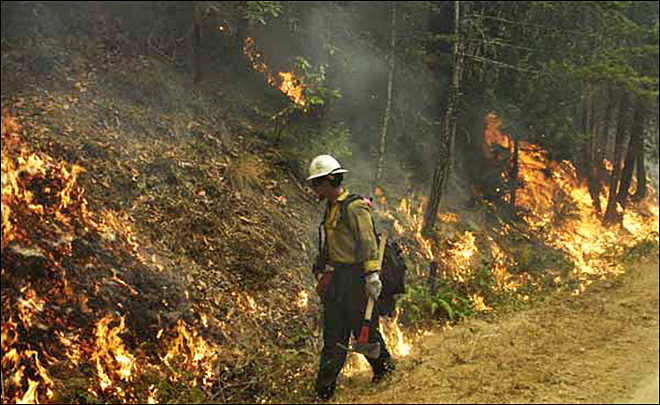
Yesterday afternoon, around 4pm, local thunderstorm activity produced some rain.  Not much but sufficient to wet the ground.  It brought to an end several weeks of intense drought complicated by what is now more than 55,000 acres of fires burning in southwest Oregon: more details here.

Oregon Wildfires
A Redmond Hotshots crew on the Douglas Complex conducts a burnout operation to create a barrier to the wildfire’s advance by removing fuel in its path.

Anyway, this is not about fire, irrespective of how potentially dangerous it can be in this part of the world, it is about water. So with that in mind, here’s a recent ‘Tomgram‘ from William deBuys, with introduction by Tom Engelhardt; republished with Tom’s generous permission.

oooOOOooo

Tomgram: William deBuys, Goodbye to All That (Water)

Martha and the Vandellas would have loved it.  Metaphorically speaking, the New York Times practically swooned over it.  (“An unforgiving heat wave held much of the West in a sweltering embrace over the weekend, tying or breaking temperature records in several cities, grounding flights, sparking forest fires, and contributing to deaths.”) It was a “deadly” heat wave, a “record” one that, in headlines everywhere, left the West and later the rest of the country “sweltering,” and that was, again in multiple headlines, “scary.”  The fire season that accompanied the “blasting,” “blazing” heat had its own set of “record” headlines — and all of this was increasingly seen, in another set of headlines, as the “new normal” in the West. Given that 2012 had already set a heat record for the continental U.S., that the 10 hottest years on record in this country have all occurred since 1997, and that the East had its own sweltering version of heat that wouldn’t leave town, this should have been beyond arresting.

In response, the nightly primetime news came up with its own convenient set of new terms to describe all this: “extreme” or “severe” heat.  Like “extreme” or “severe” weather, these captured the eyeball-gluing sensationalism of our weather moment without having to mention climate change or global warming.  Weather, after all, shouldn’t be “politicized.”  But if you’re out in the middle of the parching West like TomDispatch regular William deBuys, who recently headed down the Colorado River, certain grim realities about the planet we’re planning to hand over to our children and grandchildren can’t help but come to mind — along with a feeling, increasingly shared by those in the sweltering cities, that our particular way of life is in the long run unsustainable. Tom

Never Again Enough

Field Notes from a Drying West 

By William deBuys

Several miles from Phantom Ranch, Grand Canyon, Arizona, April 2013 — Down here, at the bottom of the continent’s most spectacular canyon, the Colorado River growls past our sandy beach in a wet monotone. Our group of 24 is one week into a 225-mile, 18-day voyage on inflatable rafts from Lees Ferry to Diamond Creek. We settle in for the night. Above us, the canyon walls part like a pair of maloccluded jaws, and moonlight streams between them, bright enough to read by.

One remarkable feature of the modern Colorado, the great whitewater rollercoaster that carved the Grand Canyon, is that it is a tidal river. Before heading for our sleeping bags, we need to retie our six boats to allow for the ebb.

These days, the tides of the Colorado are not lunar but Phoenician. Yes, I’m talking about Phoenix, Arizona.  On this April night, when the air conditioners in America’s least sustainable city merely hum, Glen Canyon Dam, immediately upstream from the canyon, will run about 6,500 cubic feet of water through its turbines every second.

Tomorrow, as the sun begins its daily broiling of Phoenix, Scottsdale, Mesa, Tempe, and the rest of central Arizona, the engineers at Glen Canyon will crank the dam’s maw wider until it sucks down 11,000 cubic feet per second (cfs). That boost in flow will enable its hydroelectric generators to deliver “peaking power” to several million air conditioners and cooling plants in Phoenix’s Valley of the Sun. And the flow of the river will therefore nearly double.

It takes time for these dam-controlled tidal pulses to travel downstream. Where we are now, just above Zoroaster Rapid, the river is roughly in phase with the dam: low at night, high in the daytime. Head a few days down the river and it will be the reverse.

By mid-summer, temperatures in Phoenix will routinely soar above 110°F, and power demands will rise to monstrous heights, day and night. The dam will respond: 10,000 cfs will gush through the generators by the light of the moon, 18,000 while an implacable sun rules the sky.

Such are the cycles — driven by heat, comfort, and human necessity — of the river at the bottom of the continent’s grandest canyon.

The crucial question for Phoenix, for the Colorado, and for the greater part of the American West is this: How long will the water hold out?

Major Powell’s Main Point

Every trip down the river — and there are more than 1,000 like ours yearly — partly reenacts the legendary descent of the Colorado by the one-armed explorer and Civil War veteran John Wesley Powell. The Major, as he preferred to be known, plunged into the Great Unknown with 10 companions in 1869. They started out in four boats from Green River, Wyoming, but one of the men walked out early after nearly drowning in the stretch of whitewater that Powell named Disaster Falls, and three died in the desert after the expedition fractured in its final miles. That left Powell and six others to reach the Mormon settlements on the Virgin River in the vicinity of present-day Las Vegas, Nevada.

Powell’s exploits on the Colorado brought him fame and celebrity, which he parlayed into a career that turned out to be controversial and illustrious in equal measure. As geologist, geographer, and ethnologist, Powell became one of the nation’s most influential scientists. He also excelled as an institution-builder, bureaucrat, political in-fighter, and national scold.

Most famously, and in bold opposition to the boomers and boosters then cheerleading America’s westward migration, he warned that the defining characteristic of western lands was their aridity. Settlement of the West, he wrote, would have to respect the limits aridity imposed.

He was half right.

The subsequent story of the West can indeed be read as an unending duel between society’s thirst and the dryness of the land, but in downtown Phoenix, Las Vegas, or Los Angeles you’d hardly know it.

By the middle years of the twentieth century, western Americans had created a kind of miracle in the desert, successfully conjuring abundance from Powell’s aridity. Thanks to reservoirs large and small, and scores of dams including colossi like Hoover and Glen Canyon, as well as more than 1,000 miles of aqueducts and countless pumps, siphons, tunnels, and diversions, the West has by now been thoroughly re-rivered and re-engineered. It has been given the plumbing system of a giant water-delivery machine, and in the process, its liquid resources have been stretched far beyond anything the Major might have imagined.

Today the Colorado River, the most fully harnessed of the West’s great waterways, provides water to some 40 million people and irrigates nearly 5.5 million acres of farmland. It also touches 22 Indian reservations, seven National Wildlife Reservations, and at least 15 units of the National Park System, including the Grand Canyon.

These achievements come at a cost. The Colorado River no longer flows to the sea, and down here in the bowels of the canyon, its diminishment is everywhere in evidence. In many places, the riverbanks wear a tutu of tamarisk trees along their edge. They have been able to dress up, now that the river, constrained from major flooding, no longer rips their clothes off.

The daily hydroelectric tides gradually wash away the sandbars and beaches that natural floods used to build with the river’s silt and bed load (the sands and gravels that roll along its bottom). Nowadays, nearly all that cargo is trapped in Lake Powell, the enormous reservoir behind Glen Canyon Dam. The water the dam releases is clear and cold (drawn from the depths of the lake), which is just the thing for nonnative trout, but bad news for homegrown chubs and suckers, which evolved, quite literally, in the murk of ages past. Some of the canyon’s native fish species have been extirpated from the canyon; others cling to life by a thread, helped by the protection of the Endangered Species Act. In the last few days, we’ve seen more fisheries biologists along the river and its side-streams than we have tourists.

The Shrinking Cornucopia

In the arid lands of the American West, abundance has a troublesome way of leading back again to scarcity. If you have a lot of something, you find a way to use it up — at least, that’s the history of the “development” of the Colorado Basin.

Until now, the ever-more-complex water delivery systems of that basin have managed to meet the escalating needs of their users. This is true in part because the states of the Upper Basin (Colorado, Wyoming, Utah, and New Mexico) were slower to develop than their downstream cousins. Under theColorado River Compact of 1922, the Upper and Lower Basins divided the river with the Upper Basin assuring the Lower of an average of 7.5 million acre-feet (maf) of water per year delivered to Lees Ferry Arizona, the dividing point between the two. The Upper Basin would use the rest. Until recently, however, it left a large share of its water in the river, which California, and secondarily Arizona and Nevada, happily put to use.

Those days are gone.  The Lower Basin states now get only their annual entitlement and no more. Unfortunately for them, it’s not enough, and never will be.

Currently, the Lower Basin lives beyond its means — to the tune of about 1.3 maf per year, essentially consuming 117% of its allocation.

That 1.3 maf overage consists of evaporation, system losses, and the Lower Basin’s share of the annual U.S. obligation to Mexico of 1.5 maf. As it happens, the region budgets for none of these “costs” of doing business, and if pressed, some of its leaders will argue that the Mexican treaty is actually a federal responsibility, toward which the Lower Basin need not contribute water.

The Lower Basin funds its deficit by drawing on the accumulated water surplus held in the nation’s largest reservoir, Lake Mead, which backs up behind Hoover Dam. Unfortunately, with the Lower Basin using more water than it receives, the surplus there can’t last forever, and maybe not for long. In November 2010, the water level of the lake fell to its lowest elevation ever — 1,082 feet above sea level, a foot lower than its previous nadir during the fierce drought of the 1950s.

Had the dry weather held — and increasing doses of such weather are predicted for the region in the future — the reservoir would have soon fallen another seven feet and triggered the threshold for mandatory (but inadequate) cutbacks in water delivery to the Lower Basin states. Instead, heavy snowfall in the northern Rockies bailed out the system by producing a mighty runoff, lifting the reservoir a whopping 52 feet.

Since then, however, weather throughout the Colorado Basin has been relentlessly dry, and the lake has resumed its precipitous fall. It now stands at 1,106 feet, which translates to roughly 47% of capacity.  Lake Powell, Mead’s alter ego, is in about the same condition.

Another dry year or two, and the Colorado system will be back where it was in 2010, staring down a crisis.  There is, however, a consolation — of sorts.  The Colorado is nowhere near as badly off as New Mexico and the Rio Grande.

How Dry I Am This Side of the Pecos

In May, New Mexico marked the close of the driest two-year period in the 120 years since records began to be kept. Its largest reservoir, Elephant Butte, which stores water from the Rio Grande, is effectively dry.

Meanwhile, parched Texas has filed suit against New Mexico in multiple jurisdictions, including the Supreme Court, to force the state to send more water downstream — water it doesn’t have. Texas has already appropriated $5 million to litigate the matter.  If it wins, the hit taken by agriculture in south-central New Mexico could be disastrous.

In eastern New Mexico, the woes of the Pecos River mirror those of the Rio Grande and pit the Pecos basin’s two largest cities, Carlsbad and Roswell, directly against each other. These days, the only thing moving in the irrigation canals of the Carlsbad Irrigation District is dust. The canals are bone dry because upstream groundwater pumping in the Roswell area has deprived the Pecos River of its flow. By pumping heavily from wells that tap the aquifer under the Pecos River, Roswell’s farmers have drawn off water that might otherwise find its way to the surface and flow downstream.

Carlsbad’s water rights are senior to (that is, older than) Roswell’s, so in theory — under the doctrine of Prior Appropriation — Carlsbad is entitled to the water Roswell is using. The dispute pits Carlsbad’s substantial agricultural economy against Roswell’s, which is twice as big. The bottom line, as with Texas’s lawsuit over the Rio Grande, is that there simply isn’t enough water to go around.

If you want to put your money on one surefire bet in the Southwest, it’s this: one way or another, however these or any other onrushing disputes turn out, large numbers of farmers are going to go out of business.

Put on Your Rain-Dancing Shoes

New Mexico’s present struggles, difficult as they may be, will look small-scale indeed when compared to what will eventually befall the Colorado. The U.S. Bureau of Reclamation expects the river’s 40 million water-users to grow to between 49.3 and 76.5 million by 2060. This translates into a thirst for Colorado River water of 18.1 to 20.4 maf — oceans more than its historical yield of 16.4 maf.

And that’s not even the bad news, which is that, compared to the long-term paleo-record, the historical average, compiled since the late nineteenth century, is aberrantly high. Moreover, climate change will undoubtedly take its toll, and perhaps has already begun to do so. One recent study forecasts that the yield of the Colorado will decline 10% by about 2030, and it will keep falling after that.

None of the available remedies inspires much confidence. “Augmentation” — diverting water from another basin into the Colorado system — is politically, if not economically, infeasible. Desalination, which can be effective in specific, local situations, is too expensive and energy-consuming to slake much of the Southwest’s thirst. Weather modification, aka rain-making, isn’t much more effective today than it was in 1956 when Burt Lancaster starred as a water-witching con man in The Rainmaker, and vegetation management (so that trees and brush will consume less water) is a non-starter when climate change and epidemic fires are already reworking the landscape.

Undoubtedly, there will be small successes squeezing water from unlikely sources here and there, but the surest prospect for the West?  That a bumper harvest of lawsuits is approaching. Water lawyers in the region can look forward to full employment for decades to come. Their clients will include irrigation farmers, thirsty cities, and power companies that need water to cool their thermal generators and to drive their hydroelectric generators.

Count on it: the recreation industry, which demands water for boating and other sports, will be filing its briefs, too, as will environmental groups struggling to prevent endangered species and whole ecosystems from blinking out. The people of the West will not only watch them; they — or rather, we — will all in one way or another be among them as they gather before various courts in the legal equivalent of circular firing squads.

Hey, Mister, What’s that Sound?

Here at the bottom of Grand Canyon, with the river rushing by, we listen for the boom of the downstream rapids toward which we are headed. Sometimes they sound like a far-off naval bombardment, sometimes more like the roar of an oncoming freight train, which is entirely appropriate. After all, the river, like a railroad, is a delivery system with a valuable cargo. Think of it as a stream of liquid property, every pint within it already spoken for, every drop owned by someone and obligated somewhere, according to a labyrinth of potentially conflicting contracts.

The owners of those contracts know now that the river can’t supply enough gallons, pints, and drops to satisfy everybody, and so they are bound to live the truth of the old western saying: “Whiskey’s for drinkin’, and water’s for fightin’.”

In the end, Powell was right about at least one thing: aridity bats last.

William deBuys, a TomDispatch regular, irrigates a small farm in northern New Mexico and is the author of seven books including, most recently, A Great Aridness: Climate Change and the Future of the American Southwest.

Copyright 2013 William deBuys

oooOOOooo

The stuff of life: literally.

If readers will forgive me, I will continue the theme tomorrow with a rather more personal perspective.

The meaning of wildness?

“Reality is merely an illusion, albeit a very persistent one.”

So said Albert Einstein.

The reason I went searching for a quotation on reality was that our, as in humans, ability to see the world in grossly distorted ways jumped ‘off the page’ at me when I was reading a recent essay from George Monbiot.  Followers of Learning from Dogs will know that Mr. Monbiot has featured before; most recently just under a month ago in a post Returning to Nature.  Before then in April when George gave permission for the full republishing of his essay The Great Unmentionable.

“Comfort the afflicted, afflict the comfortable.”

Why the notion of humans seeing reality in grossly distorted ways?  Simply because in George Monbiot‘s following essay he challenges what we mean by the word ‘wildness’ and I immediately realised that my own idea of wildness was badly corrupted.

See if you react the same way as you read The Naturalists Who Are Terrified of Nature by George Monbiot, republished in full with the kind permission of George.

oooOOOooo

The Naturalists Who Are Terrified of Nature

July 16, 2013

A radical challenge to British conservation and its bizarre priorities.

By George Monbiot, published on the RSPB’s website, 15th July 2013

I’m writing this on the train home, after visiting two places in the north of England celebrated for their “wildness”. One of them is Ennerdale in the Lake District, now officially known as Wild Ennerdale, a valley in which the river has been allowed to move freely once more, and in which native trees are succeeding naturally up the hillsides(1).

The other is the Sheffield Moors (in the Peak District), from which most of the sheep have been removed and where the structure of the vegetation has been allowed to change a little. I found both visits fascinating, not least because of the eruditon and enthusiasm of the people who walked me through these places.

But sitting on the train, watching the chemical deserts of the English lowlands flash past, I’m struck by how pathetically grateful I feel. For what? For the fact that, in two small conservation areas, located in national parks, a few natural processes have been allowed to resume.

Were I to explain to a foreigner that these places are now celebrated by conservationists in Britain for their radical approach, he or she would think I had gone mad. “What?,” they would say, “you are telling me that this is the cutting edge of nature conservation in your country? Where have you been for the past 50 years?”

I don’t know if there is any other country in which people – including conservationists – are as afraid of nature as they are in Britain. I don’t know if there is anywhere else in which conservationists are so convinced that if they relax their intensive management of the natural world, something dreadful will happen.

Nowhere else do conservationists subscribe more enthusiastically to the biblical doctrine of dominion: that we have a holy duty to control and corral nature, in case it gets out of hand. Nowhere else does conservation look more like a slightly modified version of the farming which trashed the land in the first place.

In my view most of our conservation areas aren’t nature reserves at all. They are museums of former farming practices, weeded and tended to prevent the wilds from encroaching. The ecosystem’s dynamic interactions are banned. Animals and plants are preserved as if they were a jar of pickles, kept in a state of arrested development, in which little is allowed to change.

But nature is not just a fixed assemblage of species, maintained as if it were a collection in a museum. It is also the ever-changing relationships between them, the successional processes, the shifting communities: all of which, in many of our reserves, are prohibited.

The problem begins with designation. The “interest features” of a site of special scientific interest – its species and habitats – must be kept in “favourable condition”. Often this means the condition in which they happened to be when the reserve was created. In most cases that’s a condition of dire impoverishment and depletion: ecosystems missing almost their entire trophic structure, most of their large herbivores, all their large predators, in many cases even the trees. They have to be kept like this by extreme and intrusive management, in order to sustain the impacts which reduced them to this woeful state.

In Wild-ish Ennerdale and on the Sheffield Moors, there has been a partial relaxation of this draconian regime. But even in these places, there is much that I question.

On the Sheffield Moors, for example, cattle are kept: at much higher densities and for far longer periods than large herbivores would exist in a self-willed ecosystem. In many parts of the moors, trees, if they have the temerity to return, are cleared. The effort, even here, is to ensure that the landscape remains farmed, open and bare.

This is done partly to favour breeding populations of wading birds(2). It’s likely that these species are being maintained at artificially high populations(3). A tendency I’ve noticed among some groups is to try to make all their target species common, even if they were naturally rare. Perhaps some species ought to be rare. Those which lived in open habitats – which would have been small and occasional before people started cutting and burning the forests – are likely to have been rarest of all.

Think of the varying fortunes of grouse populations in Britain. The palaeontological evidence is extremely sparse, so this is guesswork, but during the Boreal and Atlantic phases, 9,000-5,000 years ago, when closed-canopy forest covered most of Britain, the commonent grouse species in this country might have been hazel hen. Perhaps the second commonest would have been capercaillie, followed by black grouse, followed by red grouse, which are likely to have been very scarce.

That likely sequence has now been reversed. Hazel hen is extinct, capercaillie extremely rare, black grouse are sparse and in severe decline and red grouse are bloody everywhere. The red grouse is the magpie of the uplands: it benefits from human intervention, which in this case means the clearing of land.

Arbitrarily, conservation groups in the uplands of England and Wales have decided that their priorities are, for example, dunlin and curlew, rather than capercaillie and pine martens. I’m not insisting that this is always the wrong decision. But it’s a decision that should be rigorously questioned, especially if this intensive management means the destruction of habitats which would have sheltered a much wider range of species.

Spend a couple of hours in an open upland nature reserve, and count the diversity and abundance of the birds you see. Then spend a couple of hours in a bushy suburban garden and do the same thing. In my experience you’re likely to see more birds of more species in the garden. That’s hardly surprising: most birds – indeed most wildlife – require cover to survive. Am I the only one who thinks that something has gone badly wrong here?

It’s not just common species I’m talking about. Many of those excluded by our brutal upland management are not just rare in Britain; they are extinct.

Whenever I meet a conservation manager, I find myself acting like a 3-year old: I keep asking “why?”. Why are you preserving this and not that? Why is this site designated for moorland flea beetle and pearl-bordered fritillary, rather than blue stag beetle and lynx? Why are you protecting the wretched scrapings of life that remain here, rather than reintroducing the species which would once have lived here, but have been excluded by the kind of interventions that you – the conservationists – have sustained?

When I worked in the Amazon, the conservationists I met were fighting to defend the rainforest against cattle ranching. In Britain the conservationists are – literally – defending cattle ranching against the rainforest. Britain was once covered by rainforest: woodland wet enough for epiphytes to grow. (Epiphytes are plants which root in the bark of trees). Our closed-canopy rainforest was likely to have been richer in species than any of our remaining habitats. Given half a chance, it would return. But it isn’t given half a chance, even in conservation sites, because conservationists keep clearing the land and running cattle on it, in case the wayward and irresponsible ecosystem does something that isn’t listed in the rules. In doing so, they preserve a burnt, blasted and largely empty land with the delightful ambience of a nuclear winter.

Conservation groups in this country are obsessed by heather. Heather is typical of the vegetation that colonises land which has been repeatedly deforested. You can see similar vegetation – low, scrubby, tough, thriving on burnt ground and depleted soils – covering deforested land all over the tropics. There, the dominance of these plants is lamented by ecologists, for it is rightly seen as a symptom of ecological destruction. Here it is fetishised and preserved.

Even in the Eastern Sheffield Moors management plan, published by the RSPB and the National Trust, “cutting and burning” are listed as the requisite tasks for managing heather(4). Imagine what a tropical ecologist would say if she saw that. “You people have been telling us for decades that we should stop cutting and burning. You’ve been sending us money and lobbying our governments to discourage us from doing it. And all the while you’ve been telling yourselves that cutting and burning are necessary for the protection of wildlife.” If she concluded that we are hypocrites, that we are unambitious, irrational, anally retentive and ecologically illiterate, she would not be far wrong.

The same plan reveals that these two august conservation bodies will maintain cattle on the moors at their current level, but keep them there for longer. “Their grazing and trampling will manage the vegetation in a way which should improve the condition of the habitats and benefit wildlife.”(5) What does this mean? Yes, it might benefit some wildlife, but only at the expense of other species. Yes, it might “improve the condition” of a habitat, if by improvement you mean a better representation of the state of arrested development you’ve chosen. It sounds uncomfortably close to the 19th Century agricultural meaning of “improvement”: which means draining and clearing land to make it more suitable for farming.

It astonishes me to see statements like this left unpacked. Asserted without qualification, they create the impression that all wildlife benefits from management of this kind. Of course, all interventions (including a complete cessation of management), are better for some species than for others. But in my view, the losses inflicted by cattle ranching – here, as in the Amazon – outweigh any gains.

An even starker example is provided by a report commissioned by the RSPB on changing livestock numbers. It contends that “undergrazing and loss of vegetation structure is now occurring in some areas, with adverse impacts for some species such as golden plover and other waders.”(6)

“Undergrazing” is an interesting concept. The report seems to be referring to “undergrazing” by sheep. How can a native ecosystem be undergrazed by an invasive ruminant from Mesopotamia? Is our wildlife underhunted by American mink? Are our verges underinfested by Japanese knotweed?

I would question what undergrazing by any domestic animal means. “Not farmed enough” is what the term appears to signify, “or not sufficiently damaged”. Sure, the golden plover is among a small group of species that benefit from scorched-earth policies, but a far greater number are harmed by them. So why is the golden plover the priority? And how can a report for a conservation organisation blithely use the term undergrazing without qualification or explanation?

Another RSPB report advocates “the eradication of invasive tree species” from the bare uplands of Wales and claims, without citing any evidence or explaining what this means, that “extensive grazing, ideally mixed grazing, is important in maintaining upland pastures in a state that benefits upland birds and other wildlife.”(7)

A document published by the Welsh government revealed something I have never seen in the RSPB’s literature: that the society advises farmers “to cut down trees to discourage buzzards which kill other birds.”(8)

I checked with the RSPB in Wales and it confirmed that it does “at times provide advice to landowners on the management of trees to reduce available vantage points and nest sites for some avian predators.”(9)

Isn’t that more or less what the British government wanted to do to protect pheasant shoots? And didn’t the society contest those efforts?(10)

I wonder whether, in their arbitrary choice of target species and target habitats, British conservationists are influenced by the legacy of hunting. Many of the birds on behalf of which this extreme and brutal simplification of the ecosystem takes place are those which, in the 19th Century, were pursued by gentlemen with guns. Perhaps we should see conservation efforts in Britain as a form of gamekeeping, which regards some of our native species as good and worthy of preservation, and others (such as trees and buzzards) as bad and in need of control.

Sometimes I receive coherent answers from the conservation managers I speak to, which are debatable but at least consistent. Sometimes the only answer I receive is “that’s what the rules say.” But isn’t it time we began to challenge the rules? Isn’t it time we began to question the way sites are designated, and to challenge the ecological blitzkreig required to maintain them in what is laughably called “favourable condition”? Isn’t it time we began asking why we have decided to privilege certain species over others? Isn’t it time we started wondering whether the collateral damage required to support them is worth it?

After all, how did nature cope before we came along? To judge by the actions of British conservation groups, it must have been in a pretty dismal state for the three billion years before humans arrived to look after it.

George Monbiot’s book Feral: searching for enchantment on the frontiers of rewilding is published by Allen Lane.

References:

1. http://www.wildennerdale.co.uk/

2. National Trust and RSPB, 2012. The Eastern Moors Management Plan summary, page 15. Eastern Moors Partnership, Curbar.

3. This, of course, is speculative, as palaeontology gives us few indications of numbers. But the circumstantial evidence seems powerful: the habitat required for breeding populations of these birds, many of which need to nest several hundred metres from the nearest woodland edge to avoid predation, was in short supply. See for example:

NJ Whitehouse and D Smith, 2010. How fragmented was the British Holocene wildwood? Perspectives on the ‘‘Vera’’ grazing debate from the fossil beetle record. Quaternary Science Reviews Vol. 29, nos. 3-4, pp539–553. doi.org/10.1016/j.quascirev.2009.10.010

FJG Mitchell, 2005. How open were European primeval forests? Hypothesis testing using palaeoecological data. Journal of Ecology Vol. 93, 168–177

JHB Birks, 2005. Mind the gap: how open were European primeval forests? Trends in Ecology & Evolution Vol. 20, pp154-156.

R Fyfe, 2007. The importance of local-scale openness within regions dominated by closed woodland. Journal of Quaternary Science, Vol.22, no. 6, pp571–578. doi: 10.1002/jqs.1078

JC Svenning, 2002. A review of natural vegetation openness in northwestern Europe. Biological Conservation Vol 104: 133-148.

RHW Bradshaw, GE Hannon, AM Lister, 2003. A long-term perspective on ungulate-vegetation interactions. Forest Ecology and Management, Vol. 181: 267–280.

4. National Trust and RSPB, 2012, as above, p16.

5. National Trust and RSPB, 2012, as above, p11.

6. http://www.rspb.org.uk/Images/Final_Report_tcm9-340975.pdf

7. http://www.assemblywales.org/6_rspb_formatted.pdf

8. Welsh Government, 2010. Glastir: frequently asked questions, Section 13. This document is no longer available on the government site, but you can read it here:  http://www.fuw.org.uk/glastir-faq-miscellaneous.html

9. Emma Roberts, RSPB Wales, 10th August 2011. By email.

10. http://www.rspb.org.uk/media/releases/316283-back-off-our-birds-of-prey

oooOOOooo

Will leave you with the following picture.

Ennerdale Lake, Cumbria

In Defence of Politics.

A guest post from Chris Snuggs.

Regular readers of Learning from Dogs will know that Chris often pops up on these pages. Most recently with Now this is a dog! and before that with Reflections on pain and peace.

I first met Chris many years ago when he was working for a French educational college with the name of ISUGA, based in Quimper, France. As a result of being introduced to Chris, I had the very good fortune of becoming a guest teacher at ISUGA.

Classroom picture taken at ISUGA.

Anyway, Chris has his own blog Nemo Insular Est. If the title doesn’t immediately say very much to you, try Chris’ sub-title: Truth, Justice, Sanity & Brotherhood.

Thus it is with great pleasure I offer this guest post from Chris.

oooOOOooo

In Defence of “Politics”

by Chris Snuggs.

The most depressing thing I ever heard at school was: “I’m not interested in politics.” Even at the age of 10, this seemed to me bizarre, for politics is at the heart of everything. It decides what we can eat, how much money we have, what sort of shelter we have, health, education, defence, what it takes to get locked up, EVERYTHING – including in the USA of course gun control …….

“Politics” completely arranges the environment of our existence, within which we can be individuals and lead some kind of “private life”, but nothing can function in a civilised manner without politics.

There is only one circumstance I can imagine when the statement: “I’m not interested in politics.” might possibly be justified, and that is if you lived in a society where everything was perfect: no injustice, hunger, or discomfort; excellent health, education, shelter and sustenance in a peaceful environment with nothing to worry about ….

There remains a niggling doubt about whether such a society would be just a teensy bit boring. However, the point is, has there ever been one? Does anyone KNOW one? Are they accepting immigrants?

If we accept that politics decides everything, then there are certain conclusions to be drawn. If it is so fundamentally important, is it not then legitimate to oblige everyone to vote, as they do in Australia for example? Then again, is it acceptable that we so easily tolerate as “democracy” elections where only 30% of eligible voters actually vote? And is it acceptable that the teaching of “politics” and all it involves holds such little place in our schools?

I would say “NO!!” And in fact, the study of politics involves so many branches of knowledge. You can’t (or shouldn’t) be taught “politics” without teaching psychology. Why is X saying that? What are his motivations? What is the psychology of voting groups. Or without studying logic, so as to recognize false arguments, of which there is no lack. You need to study what evidence is, since a political policy should be based on evidence, not fantasy or demagoguery.

In fact, just as politics decides everything then a study of politics involves just about every branch of knowledge, too. You cannot vote sensibly for party X which wants to build zillions of windfarms or go full-steam ahead on shale-fracking if you don’t have a reasonable understanding of the science, and of course environmental consequences. You can’t sensibly vote for or against grammar schools without a sound knowledge of the social and psychological rationale behind them or indeed of their history. The same applies to religion of course, and almost any other area you care to mention.

No, politics as a subject of study, discussion and involvement is vastly undervalued in our society. And the fact that politicians are often venal and incompetent liars is not a reason to be LESS interested in politics but a compelling reason to be MORE involved!! If you don’t get informed and involved, the politicians will do it THEIR way, and you have to ask yourself one final question: Do you REALLY trust them to do it in YOUR interests?

oooOOOooo

(Sorry about the late delivery!)

True Independence.

Can’t believe a year has gone so quickly!

Last year, on this day, I published the transcript of the Declaration of Independence before Congress on July 4, 1776.  Part of one of the comments, left by Patrice Ayme, was this:

That the trust is gone is actually a good thing. We cannot trust a system where a few lead hundreds of millions, if not billions. Even if they come from the People, and especially if they come from the People. Because the less power where they come from, the greedier they are, and thus, the more eager to be bought.

Two thousand years ago, any grouping of a few thousands Germans got enraged when someone would proclaim himself a king. Now people venerate those who think they can do all the thinking in place of billions.

Hence we are facing the reality of a vastly incomplete revolution: Athens, at her apex, had direct democracy (OK, no women, no slaves…). We don’t.

Perhaps, what has changed most in the last year is the realisation, the growing realisation, as to where real power lies.

This highly subjective conclusion comes to me as a result of reading, very recently, two essays.

The first was an essay by ‘Gaius Publius’ seen on Naked Capitalism.  It was called: A Primer – What’s in a “Tar Sands” Pipeline?

In the wake of renewed interest in the Keystone Pipeline project and the likelihood that Obama will eagerly approve it unless we stop him, there’s a lot of interest in what actually flows through those pipes.

Van Jones has called it “planet-cooking goo.” I’ve called it “sludge.” But what is it really?

To answer that question, we need to look at:

▪ What is “tar sand“?
▪ What is extracted from it (answer, bitumen or “tar”)?
▪ What is done to the bitumen to make it “flow”?

All of which produces a great bottom line. Click any of those links to jump to that section.

The primary source, though not the only source, of this information is a great article and slideshow at the Scientific American website. Feel free to click and read as we walk through this material.

It is a thorough and very disturbing explanation of what Keystone XL is truly about; please don’t hesitate to read it in full.

It includes this video:

However, I will republish the closing paragraphs:

SO WHAT FLOWS THROUGH THE PIPES?

If you thought that diluted bitumen, as produced by the upgrading plants, is now capable of flowing through a pipeline to the cash registers in Texas (or wherever), you’d be wrong. Even in diluted form, bitumen doesn’t flow. To make it flow, it has to be heated — often to 150°–160°F — and then forced through the pipelines under high pressure.

So what flows through the pipeline? Keeping those cash registers in mind, you now have all the pieces. Tar sand pipelines contain:

A carbon-rich colloidal suspension …

Made up of lighter-than-water, easily-evaporated toxic liquids (like diesel) …

And heavier-than-water solids (the tar or bitumen itself) that sink to the bottom of rivers and below the mud in fields …

Which has been heated hot enough to burn your hand — or accelerate the external corrosion of the pipeline itself, including pinhole breaks …

Which has been forced to move under high pressure …

And which contains poisons and toxins like sulphur, arsenic, nickel, lead and mercury …

All so megalomaniacal carbon billionaires can make even more money.

That’s what flows through the pipelines. Or to put it more simply:

What flows through the pipes is the unmonetized assets of the try-and-stop-me CEO class, which if it spills, will poison everything it touches for decades or centuries, and if it gets into the air, will turn most of our grandchildren — the ones that survive — into hunter-gatherers.

Bill McKibben counts those unmonetized assets (proven reserves) at $27 trillion dollars. Add in reserves that are likely but not proven, plus the ones in the melting Arctic that are yet to be found, and you’re talking real money. The billionaire class won’t walk away from that in a hurry.

And that, kids, is Science Talk for today. We learned a little about a lot, didn’t we — everything from colloidal suspensions and bitumen “froth,” to billionaire psychopathology and cash registers in Texas. To those of you who got to this end of the post, my thanks!

So hold in mind the reference to the billionaire class as I cross the ‘pond’ to the old country for the second essay.

Recently, George Monbiot published an essay under the title of Robber Barons.

It opened, thus:

Why do we ignore the most blatant transfer of money from the poor to the rich?

It’s the silence that puzzles me. Last week, the Chancellor stood up in parliament to announce that benefits for the very poor would be cut yet again. On the same day, in Luxembourg, our government battled to maintain benefits for the very rich. It won. As a result, some of the richest people in Britain will each continue to receive millions of pounds in income support from taxpayers.

There has been not a whimper of protest. The Guardian hasn’t mentioned it. UK Uncut is silent. So – at the other end of the spectrum – is the UK Independence Party.

I’m talking about the most blatant transfer of money from the poor to the rich that has occurred in the era of universal suffrage. Farm subsidies. The main subsidy – the single farm payment – is doled out by the hectare. The more you own or rent, the more money you receive.

Later on mentioning:

The minister responsible for cutting income support for the poor, Iain Duncan Smith, lives on an estate owned by his wife’s family. Over the past ten years, it has received €1.5m in income support from taxpayers.

How much more obvious do these double standards have to be before we begin to notice?

Then Mr. Monbiot examines some of the cultural aspects such as how “A high proportion of the books aimed at very young children are about farm animals.” then closes with this thought.

Whatever the reason may be, it’s time we overcame these inhibitions and confronted this unembarrassed robbery of the poor by the rich. The current structure of farm subsidies epitomises the British government’s defining project: capitalism for the poor, socialism for the rich.

So examples from both sides of The Atlantic that reveal deeply disturbing issues.  However …….

I celebrate America this day.  I celebrate the power of the common man to achieve justice and fairness for the peoples of all nations. I celebrate the Constitution of the United States of America.

oooOOOooo

Preamble

We the people of the United States, in order to form a more perfect union, establish justice, insure domestic tranquility, provide for the common defense, promote the general welfare, and secure the blessings of liberty to ourselves and our posterity, do ordain and establish this Constitution for the United States of America.

oooOOOooo

Down here, from up there!

The power of mankind’s footprint on Planet Earth.

Last Friday, I published a post under the title of People, people, everywhere! Coincidentally, that same day over on Transition Town Payson‘s blog a post was published Urban Sprawl, a Vision from Space! It seemed like a fitting follow-on to that post on Learning from Dogs and is reproduced with the kind permission of the TTP team (thanks Rob).

oooOOOooo

Urban Sprawl, a Vision From Space!

Posted on by

Urban Sprawl has a major impact on all our Resources!

Urban Sprawl can be tracked

In the Sun Belt Areas of our country, phenomenal growth has occurred over the past 30 years.  Satellite images from 1984 through 2012 show the impacts on the Landscape in a time lapse image that is a scary picture of what the next 30 years may bring.

A blog article from the Atlantic Cities website forwarded to me by my friend Dave H. It is a geographic time lapse of satellite images provided by Google.  Their article titled  “The Devastating Impact of 30 Years of Sprawl, as Seen From Space.” gives startling images of how our cities have grown.

“These GIFs were recorded from Google’s “Landsat Annual Time Lapse” tool by Samuel Aston Williams, a young Texas architect. Williams wanted to contribute something new to a startling series of showing three decades of human-landscape intervention recently produced by a collaboration of Google, NASA, TIME and others.”

Read the full article.

The Atlantic Cities also published a blog titled “A Terrifying, Fascinating Time lapse of 30 Years Impact on Earth.”  The images in this blog shows development in other places on the earth in a scary 30 year blink of an eye.

“Since the 1970s, NASA and the U.S. Geological Survey have been amassing satellite images of every inch of our planet as part of the Landsat program. Over time, the images reveal a record of change: of cities expanding, lakes and forests disappearing, new islands emerging from the sea off the coast of rising Middle East metropolises like Dubai.

If you could thumb through these historic pictures as if in a flip book, they would show stunning change across the earth’s surface, in both our natural environments and our man-made ones. Now, the digital equivalent of that experience is possible – three decades of global change as GIF – in a project unveiled today between NASA, the USGS, TIME, Google, and the CREATE Lab at Carnegie Mellon University.

Landsat images taken between 1984 and 2012 have been converted into a seamless, navigable animation built from millions of satellite photos. As Google wrote this morning on its blog: “We believe this is the most comprehensive picture of our changing planet ever made available to the public.”

See the time lapse images here.

Here’s the Problem!

World Population Growth.

Our Population is only going to Grow Larger!

World population details here.

NASA has also been Following Urban Sprawl

This is how Baltimore has grown in 200 Years!

October 11, 2002:  While space technology was undergoing its spectacular birth during the 1950s and ’60s, and visionaries were predicting the spread of human colonies into space, another kind of human colony was spreading rapidly–right here on Earth!

It was the dawn of the modern suburb, a time of post-war prosperity when housing developments popped up across the landscape like mushrooms after a rain.

A half-century later, we now understand that many environmental problems accompany the outward spread of cities: fragmenting and destroying wildlife habitat, for example, and discharging polluted runoff water into streams and lakes.”

More information here.

Urban Sprawl in the United States is covered in Photos by Christoph Gielen

The photo below was taken by Christoph Gielen.  There is a symmetrical beauty to his aerial photos of Urban Areas.  Please go to his Twisted Sifter website for phenomenal aerial photos of our Urban Centers.

A Great Aerial photo by Christoph Gielen of an Arizona Neighborhood

Urban Sprawl is defined in detail at the Wiki website;

An interesting phenomena is that Sprawl is a term only used in America for Urban Growth,  “The term “sprawl” is most often associated with US land use; outside the US (and especially outside the Anglosphere), the term “peri-urbanisation” is often used to denote similar dynamics and phenomena.”

More on Urban Sprawl.

Urban Sprawl and Public Health?

Smart Growth is the alternative to Urban Sprawl,  unfortunately many people argue against high density living and it is still a contentious point.  Do we continue to grow outward or upward.  Will we feel more like rats trapped in a cage or free range rats. Read the following National Institute of Health article for their take on the impacts of Urban Sprawl vs. Smart Growth.

Urban Sprawl

“Urban sprawl in the United States has its origins in the flight to the suburbs that began in the 1950s. People wanted to live outside of city centers to avoid traffic, noise, crime, and other problems, and to have homes with more square footage and yard space. As suburban areas developed, cities expanded in geographic size faster than they grew in population. This trend has produced large metropolitan areas with low population densities, interconnected by roads. Residents of sprawling cities tend to live in single-family homes and commute to work, school, or other activities by automobile.”

“Although there is considerable evidence that urban sprawl has adverse environmental impacts and contributes to a variety of health problems—including obesity, diabetes, cardiovascular disease, and respiratory disease implementation of policies designed to combat sprawl, such as smart growth, has proven to be difficult.”

Smart Growth

“Smart growth can be defined as a policy framework that promotes an urban development pattern characterized by high population density, walkable and bikeable neighborhoods, preserved green spaces, mixed-use development (i.e., development projects that include both residential and commercial uses), available mass transit, and limited road construction.”

Urban Sprawl, Smart Growth, and Deliberative Democracy

From Wiki these are the Advantages and Disadvantages of Urban Sprawl

Advantages

– More single family residences on larger lots.
– Lower land prices.
– Less experience of noise and pollution.
– Suburban areas generally associated with “sprawl” tend to have lower crime and higher-quality schools.
– Perceived overwhelming consumer preference for sprawl-type developments.

Disadvantages

– High car dependence.
– Inadequate facilities e.g.: cultural, emergency, health, etc.
– Higher per-person infrastructure costs.
– Inefficient street layouts.
– Low diversity of housing and business types.
– Higher per-capita use of energy, land, and water.
– Perceived low aesthetic value

Source: Wikipedia

Our Human Colonies seem to be spreading about as fast as our ice caps are melting.  I wonder if there is any correlation?

Is it time for mankind to adapt to a new future?  No, it’s past time.  We have a lot of catching up to do in implementing new technologies to provide sustainable growth options in all areas; industry, transportation, energy production, carbon footprints, food supply, to taking care of our precious fresh water supplies.

How do we make our cities more sustainable and resilient?  Start with telling your national, state and local politicians that you want a sustainable future.  Let’s work together and make this happen.

Urban Sprawl or Smart Growth, your choice!

Make your world Sustainable!

oooOOOooo

The perils of self-reinforcing arguments.

Professor Mark Cochrane’s perspective on ‘certainty’!

I’m an avid follower of Mike Stasse’s blog Damn the Matrix.  So it was rather fortuitous that two days ago there was a guest post on Mike’s blog from Mark Cochrane. Dr. Mark Cochrane is a Senior Scientist and Professor at South Dakota State University where one can read:

Dr. Mark Cochrane conducts interdisciplinary work combining ecology , remote sensing, and other fields of study to provide a landscape perspective of the dynamic processes involved in land-cover change. He is an expert on wildfire, documenting the characteristics, behavior and severe effects of fire in tropical and temperate forests that are inherent to current systems of human land-use and management. His research focuses on understanding spatial patterns, interactions and synergisms between the multiple physical and biological factors that affect ecosystems. Recently published work has emphasized the climate change, human dimensions of land-cover change and the potential for sustainable development.

The guest post was called Doom and Denial two sides of the same coin; I’m extremely grateful to Mike Stasse for granting me permission to republish the essay.

oooOOOooo

Doom and Denial two sides of the same coin.

19th June 2013

Another guest post by Mark Cochrane……  and I hope Guy reads this, I’d like his feedback, no pun intended!

Mark CochraneMark Cochrane

I’ve been asked by several people to address the take of climate ‘doomists’ like McPherson and indicate how my views on what the science indicates differ. First, let me just say that my differences with the doomist views are similar to my differences with the ‘denialist’ views, namely one of actually examining the scientific findings and concluding what they signify versus beginning with a conclusion and looking for evidence to support a pre-concluded viewpoint.

Appropriate use of science (or any information), requires weighing anything being newly reported against the rest of the accumulated evidence on a subject (e.g. climate change) that we have amassed, to date, and using this knowledge to infer the most probable meaning and significance. How credible is the source, how relevant are the results to the larger question, do the new results substantially change our previous understanding? If someone is presenting new ideas that claim to massively shift what we think we know about the world, have they been vetted (e.g. peer-reviewed), do they adequately explain how their new claims better explain observed phenomena than previous studies did and also detail why previous explanations were somehow erroneous? If the results are truly stunning, can they be replicated by others? Although some may find it hard to believe, there is a lot of space between climate denial and climate doom.

I’ve only seen the one talk now by McPherson but where the ‘we are doomed and soon’ meme falls apart is on general logic. You cannot say, there are positive feedbacks A, B and C, therefore life on Earth is suddenly going to end without considering:

  1. what are the current rates of those feedbacks,
  2. what is the rate of change for the feedback,
  3. what is the area affected by the feedback,
  4. what natural limits exist for the feedback,
  5. what negative feedbacks might occur in response?

If you listen to McPherson’s talk, what you get is a litany of disturbing findings, especially feedbacks, and then an expectation that you must reach the same conclusion that we are doomed, and soon. If someone would like to outline the chain of logic used, I’d be happy to discuss it. Even if you accept the chain of logic though, where, in any of it, is there evidence for the timeline being suggested?

Guy McPherson

There is considerable amount of concern about the feedbacks in the Arctic, with good reason, but people do things like linking the large amount of carbon stocks in the Arctic with rapid warming, with increased rates of release, with increased rates of warming……with the obvious end of all life on Earth – near-term extinction!

As anyone who has followed this thread knows, I am usually the one pointing out feedbacks and how most are not even included in current climate projections, in contradiction to those who claim such dire projections are all because of such feedbacks (which ‘skeptics’ claim don’t exist). This does not mean though that the existence of feedbacks means that we can then make the leap to a runaway greenhouse that will soon lead us to having the climate of Venus (atmospheric acid bath at temperatures that would melt lead). Perhaps providing some perspective on the recent material posted about the NASA CARVE project and what it means for all of that carbon in the (not so) permafrost will help.

As NASA recently reported (site),

“Over hundreds of millennia, Arctic permafrost soils have accumulated vast stores of organic carbon – an estimated 1,400 to 1,850 petagrams of it (a petagram is 2.2 trillion pounds, or 1 billion metric tons). That’s about half of all the estimated organic carbon stored in Earth’s soils. In comparison, about 350 petagrams of carbon have been emitted from all fossil-fuel combustion and human activities since 1850. Most of this carbon is located in thaw-vulnerable topsoils within 10 feet (3 meters) of the surface.”

“Permafrost soils are warming even faster than Arctic air temperatures – as much as 2.7 to 4.5 degrees Fahrenheit (1.5 to 2.5 degrees Celsius) in just the past 30 years,” Miller said. “As heat from Earth’s surface penetrates into permafrost, it threatens to mobilize these organic carbon reservoirs and release them into the atmosphere as carbon dioxide and methane, upsetting the Arctic’s carbon balance and greatly exacerbating global warming.”

In other words, there is 4-5 times as much carbon sitting around in those frozen soils as we have already emitted that are becoming increasingly vulnerable to being thawed out for a portion of each year.

Once those soils thaw they become accessible to microorganisms that feed on the incompletely decomposed plant materials that they contain. If there is sufficient oxygen (warm relatively dry Arctic) the process is faster and the product is CO2, if the process is anaerobic (warm relatively wet Arctic), then the product is methane.

So warming leads to thawing, thawing leads to microbial decomposition, and microbial activity leads to carbon emissions. These emissions are a positive feedback that makes the current process of greenhouse gas warming worse since each degree of warming yields more greenhouse gases that speed up the warming process further. This is where the message of doom goes off the tracks and extrapolates erroneously that this somehow means that all of that carbon is going to suddenly find itself in the atmosphere.

Three meters (10ft) of soil carbon doesn’t just suddenly evaporate into the atmosphere in the next few years. Thawing permafrost is not synonymous with melting carbon.  Even once permafrost melts, it is still very cold. However, bacteria can start digesting it – until it freezes again. Melted permafrost does not mean permanently melted. The surface layer of the Arctic lands are already in the active layer that temporarily thaws each year and then refreezes. Now, we are making more of the Arctic soil active to greater depths and at higher latitudes. This means that there will be more emissions from those soils.

Taken out of context snippets like this (below) from that NASA press piece can be made to sound catastrophic.

“Some of the methane and carbon dioxide concentrations we’ve measured have been large, and we’re seeing very different patterns from what models suggest,” Miller said. “We saw large, regional-scale episodic bursts of higher-than-normal carbon dioxide and methane in interior Alaska and across the North Slope during the spring thaw, and they lasted until after the fall refreeze. To cite another example, in July 2012 we saw methane levels over swamps in the Innoko Wilderness that were 650 parts per billion higher than normal background levels. That’s similar to what you might find in a large city.”

Parsing the quote, please note that “episodic bursts of higher-than-normal carbon dioxide and methane” in two locations (regions) does not mean the end is nigh. Higher-than-normal is just that, but how much higher and how long did it last? The scientists are saying that the observations do not match existing ‘models’ (models are wrong, a favorite meme), it doesn’t mean that such events haven’t been happening up until now (only that we didn’t know about them). As for the 650ppb increase over a swamp, that equates to being 1/3 higher than the background level. Methane and swamps go together so some higher level is to be expected. The question is if and by how much 650ppb is higher than it would have been back around 1980 or so? If it used to be 10ppb higher than background then you have a big change (640ppb), however, if it used to be 640ppb, then not so much (10ppb difference). Even if that is all new carbon being emitted, the local change becomes very small when diluted globally. The point here is not to poo-poo the findings or the scientist’s work, they are doing very important stuff (!), it is to provide context.

Just how bad could things be? I do not work in the high Arctic but I do work in similar organic soils in the tropics (peat swamps) where, because of intentional draining, the several meter thick peat layer that is ‘active’ is increased in an analogous manner to the effects of melting permafrost. Microbial degradation is occurring, with the difference that the temperature is very warm instead of being very cold. Think of how fast fruit spoils in your refrigerator versus on a hot window sill. In these tropical peat soils we see large amounts of CO2 coming off into the atmosphere each year now, but even with such large rates of loss, this equates to taking about 20-25 years to lose 1 meter of organic soil. In the Arctic the microbial degradation will be much slower due to the relatively low temperatures. This doesn’t mean that it is not important. Slow rates of emissions over a large area is still a lot of extra carbon going into atmosphere but this is a problem that is going to take centuries to play out, not less than a decade. It makes things worse but it doesn’t suddenly end life on Earth.

Incidentally, all of that soil carbon in the Arctic isn’t a uniform petri dish either. Some of that carbon is easier to access by bacteria than other portions. Emissions will rise quickly as the bacteria chew through the cellulose, for example, but things like lignin get left behind. The point being that even for a given mass of carbon in the ‘active’ layer, there will be a dampening of the emissions growth rate as the quality of the bacteria buffet goes down when it gets picked over.

I do not pretend to know what the motivations of ‘doomists’ are, whether it be honest despair or simple misunderstanding but they are conveying the same message of do nothing as those who deny the existence or importance of climate change. Denial = don’t worry be happy, while Doom = don’t worry, you can’t do anything about it anyway. Both viewpoints are wrong in trying to turn climate change into a false dichotomy of either fantasy or inevitability. Both the science and our choices are much more complicated. It’s uncomfortable but your choices do matter now and for generations to come. There is no ‘fixing’ things at this point but you still have the ability to choose how you react to the predicament we have created. Doom and denial are respectively trying to tell you that you either have no choice or no need to choose. But, as Philip K. Dick wrote:

“Reality is that which, when you stop believing in it, doesn’t go away.”

oooOOOooo

AGW – summing up.

“If there’s any doubt, there’s no doubt!”

I opened the first post on Monday with the sub-heading: “Certainty is perfect knowledge secure from error or doubt.” going on to write that, “Whatever your views on the effect of man’s behaviours on our planet’s climate, it’s a long way from the logical idea of ‘2 + 2‘!”

Within that very strict definition, I remain unmoved.  The argument that mankind is the cause of the present change in the climate of Planet Earth is not certain!

However, if only life was that simple! The change in our planet’s atmosphere is possibly the most emotionally-laden topic of all time.  For some reason that quotation attributed to Hiram Johnson comes to mind, “The first casualty when war comes is truth.” because the supporters and deniers of AGW are engaged in what amounts to a verbal war.

Each side can draw on much information.

For example, a very recent article in The New York Times by their Justin Gillis offered this:

The rise in the surface temperature of earth has been markedly slower over the last 15 years than in the 20 years before that. And that lull in warming has occurred even as greenhouse gases have accumulated in the atmosphere at a record pace.

The slowdown is a bit of a mystery to climate scientists. True, the basic theory that predicts a warming of the planet in response to human emissions does not suggest that warming should be smooth and continuous. To the contrary, in a climate system still dominated by natural variability, there is every reason to think the warming will proceed in fits and starts.

But given how much is riding on the scientific forecast, the practitioners of climate science would like to understand exactly what is going on. They admit that they do not, even though some potential mechanisms of the slowdown have been suggested. The situation highlights important gaps in our knowledge of the climate system, some of which cannot be closed until we get better measurements from high in space and from deep in the ocean.

As you might imagine, those dismissive of climate-change concerns have made much of this warming plateau. They typically argue that “global warming stopped 15 years ago” or some similar statement, and then assert that this disproves the whole notion that greenhouse gases are causing warming.

Rarely do they mention that most of the warmest years in the historical record have occurred recently. Moreover, their claim depends on careful selection of the starting and ending points. The starting point is almost always 1998, a particularly warm year because of a strong El Niño weather pattern.

Dan Gomez, a long-time friend of over 40 years and a regular contributor to items on Learning from Dogs, wrote in a recent email,

I’m not sure what is meant by “believer”, Paul.  The Universe unfolds as it should.  Because many have been led to “believe” that AGW is inevitable and that all the facts are the ‘Truth”, we’ve created a religious substitute, almost a new “industry” with significant “tithing” obligations, etc. (e.g. Cap and Trade). Presumptions and facts are being manipulated to fulfill the prophecy.

Interesting to note in our daily lives, that weather prediction is very good 24-36 hrs out.  This drops precipitously just a few days out.  More than 7-10 days is nearly impossible. Even though both Europe and the USA have decreased CO2 levels by multiple percentage points over the last 20 years, the rest of the world does not care and the impact is very problematic.  Recently, CO2 gas has increased overall but heat has not. In the past, warming has occurred followed by CO2 levels increasing. Global politics and redistribution of wealth schemes continue to interfere with common sense.

Let’s just deal with the facts as Science reveals its secrets. New information is discovered every day about the interaction of the  Earth/Sun/Atmosphere/Lithosphere/Hydrosphere. New information is learned every day about the Universe.  These are not closed subjects. Climatology, meteorology, geology and solar system dynamics will continue to shape the Earth’s future for millennia to come whether Man is involved or not.

There is much in what Dan writes that has me nodding my head; stimulates my recollection of what Luther Haave and Derek Alker wrote in 2009:

With the explosion of knowledge, particularly in the past 100 years, each of us has found it a requirement for being successful, and to being able to earn a living, to concentrate our knowledge in an ever increasingly narrow field. Just as we have come to expect others to defer to our expertise in our narrow area, we have come to assume that we need to defer to others who have a deeper comprehension of seemingly complex topics such as the science related to climate change. [Apologies, can’t find the web link for this.]

However, if we broaden the perspective from that tight definition of certainty to an analysis of probabilities, then it all changes for me and I can embrace the views so strongly put forward by Martin Lack.

For example, Martin left a comment on Monday, “ACD is not a matter of opinion or belief; it is a matter of probability. As such, all that matters now is the extremely high probability that the scientific consensus is real, reasonable and reliable.”  That comment included a link to a discussion on the website Skeptical Science, Is the science settled? Let me quote from that:

Some aspects of the science of AGW are known with near 100% certainty. The greenhouse effect itself is as established a phenomenon as any: it was discovered in the 1820s and the basic physics was essentially understood by the 1950s. There is no reasonable doubt that the global climate is warming. And there is also a clear trail of evidence leading to the conclusion that it’s caused by our greenhouse gas emissions. Some aspects are less certain; for example, the net effect of aerosol pollution is known to be negative, but the exact value needs to be better constrained.

What about the remaining uncertainties? Shouldn’t we wait for 100% certainty before taking action? Outside of logic and mathematics, we do not live in a world of certainties. Science comes to tentative conclusions based on the balance of evidence. The more independent lines of evidence are found to support a scientific theory, the closer it is likely to be to the truth. Just because some details are still not well understood should not cast into doubt our understanding of the big picture: humans are causing global warming.

In most aspects of our lives, we think it rational to make decisions based on incomplete information. We will take out insurance when there is even a slight probability that we will need it. Why should our planet’s climate be any different?

That, ultimately, delivers for me what truly counts.

I am not a scientist; just a Brit living in Southern Oregon trying to make sense of the world while I still have a functioning head and body – time is not on my side! 😉  The powerful common-sense in the sentence, “Outside of logic and mathematics, we do not live in a world of certainties.” is beyond argument.

In the year 2012, the total number of passengers carried by US Airlines and other carriers in and out of the USA was a staggering 815 million people. 815,000,000 people!

Remember the sub-heading from the start of this post!  “If there’s any doubt, there’s no doubt!” Years ago I heard that from Bob Derham, a long-time friend and a commercial airline Captain since the time God was a boy!  It’s that cautious, safety-focused attitude that has made airline transport such an amazing mode of transport for all those millions of passengers.

Should we not travel with the same cautious, safety-focused attitude on the ‘vehicle’ that carries every man, woman and child; every animal, plant and living thing: Planet Earth!

The answer is obvious – more than obvious!