Category: Food

Here’s another dog food alert.

It has been quiet since the last one.

That last one was on December 3rd and concerned a recall for Dave’s Pet Food.

Well two days ago Purina announced a recall but it was only alerted by Dog Food Recall yesterday. Here are the details that you can also read here.

ooOOoo

March 10, 2016 — Nestle Purina has announced it is voluntarily recalling select lots of its Beneful and Purina Pro Plan wet dog foods because they may not contain the recommended level of vitamins and minerals.

Purina discovered through its own testing that the affected dog foods did not contain the recommended level of vitamins and minerals and voluntarily recalled the product.

What’s Being Recalled?

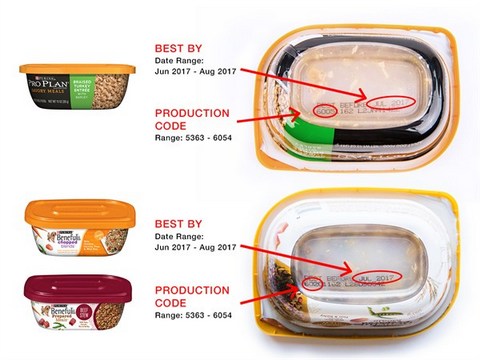
The recall includes select lots of wet dog food 10-oz. tubs under the Beneful Prepared Meals, Beneful Chopped Blends and Pro Plan Savory Meals brands.

No other Purina products or sizes are affected.

purina-wet-dog-food-recall-480Lot Information

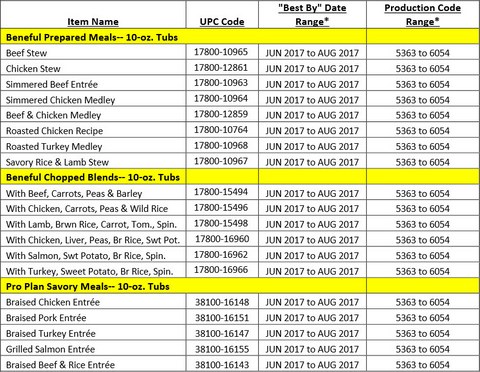
A complete list of included products by “Best Before” date and production code ranges are listed below:

purina-wet-dog-food-recall-march-2016-480What to Do?

Purina is conducting this voluntary recall as a precaution for those dogs who may have eaten the affected product as their only meal for more than several weeks.

If you have questions about your pet’s health, the company suggests that you contact your veterinarian.

Although most of the recalled product contains all of the vitamins and minerals your dog needs, Purina recommends that you discard any of the affected product you may have.

For more information or to request a refund, please call the company at 800-877-7919.

U.S. citizens can report complaints about FDA-regulated pet food products by calling the consumer complaint coordinator in your area.

Or go to http://www.fda.gov/petfoodcomplaints.

Canadians can report any health or safety incidents related to the use of this product by filling out the Consumer Product Incident Report Form.

Get Dog Food Recall Alerts by Email

Get free dog food recall alerts sent to you by email. Subscribe to The Dog Food Advisor’s recall notification list.

ooOOoo

Feel free to share this widely with other dog lovers. We must look after our fabulous friends.

Xylitol damages dogs’ livers.

One Common Thing That is More Toxic Than Chocolate for Dogs!

Note: This is a repeat of the Xylitol warning that appeared in a LfD post on the 4th. January. It is being repeated to ensure the maximum awareness of all my readers and followers.
Deborah Taylor-French is an author and also has the blog Dog Leader Mysteries. It was on her blog that I saw a reference to the acute dangers on Xylitol for dogs, and for cats. So please read and share the following.

ooOOoo

One Common Thing That is More Toxic Than Chocolate for Dogs!

The power of caring!

Sandra and Francisco send their blessings.

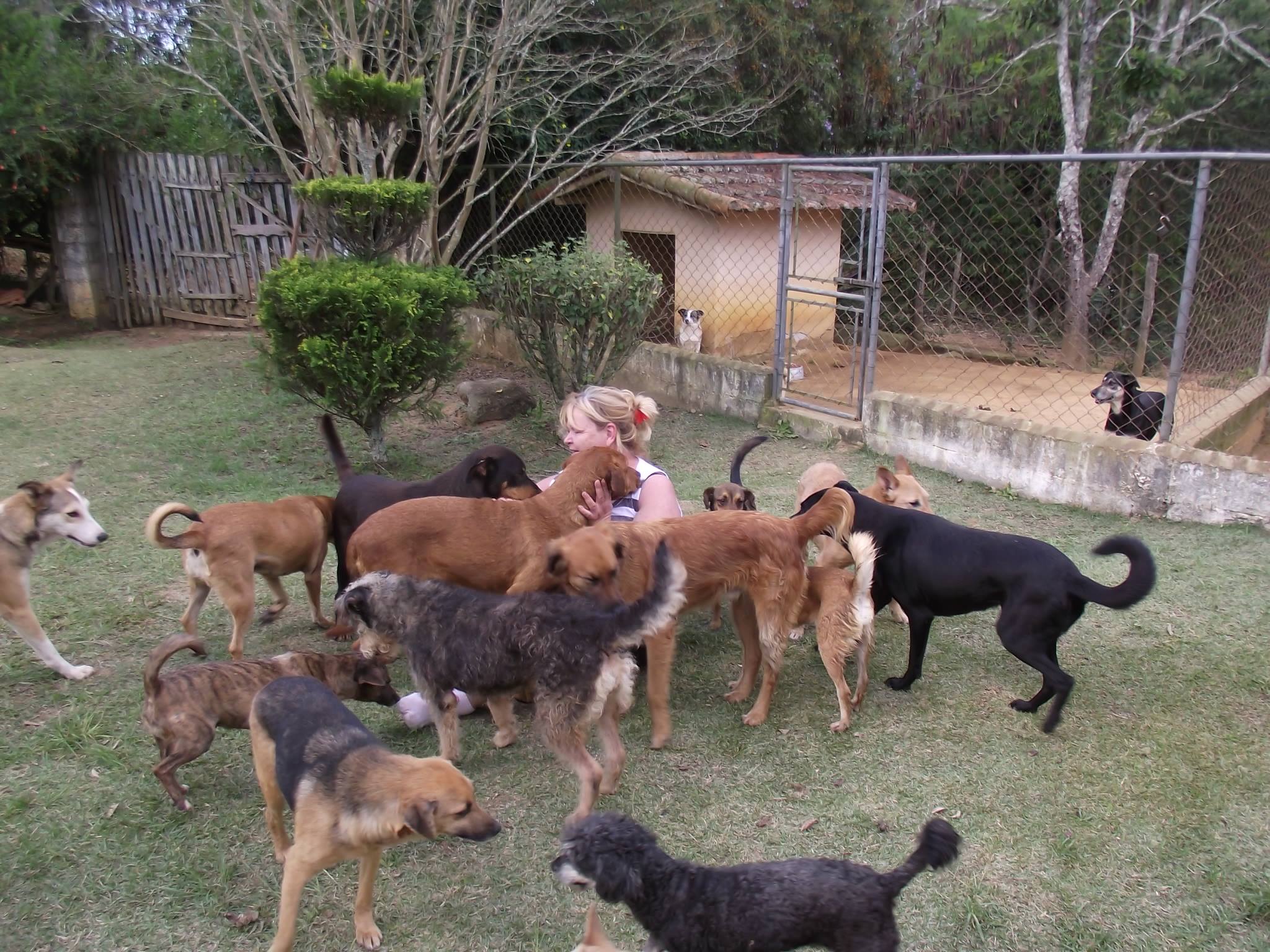
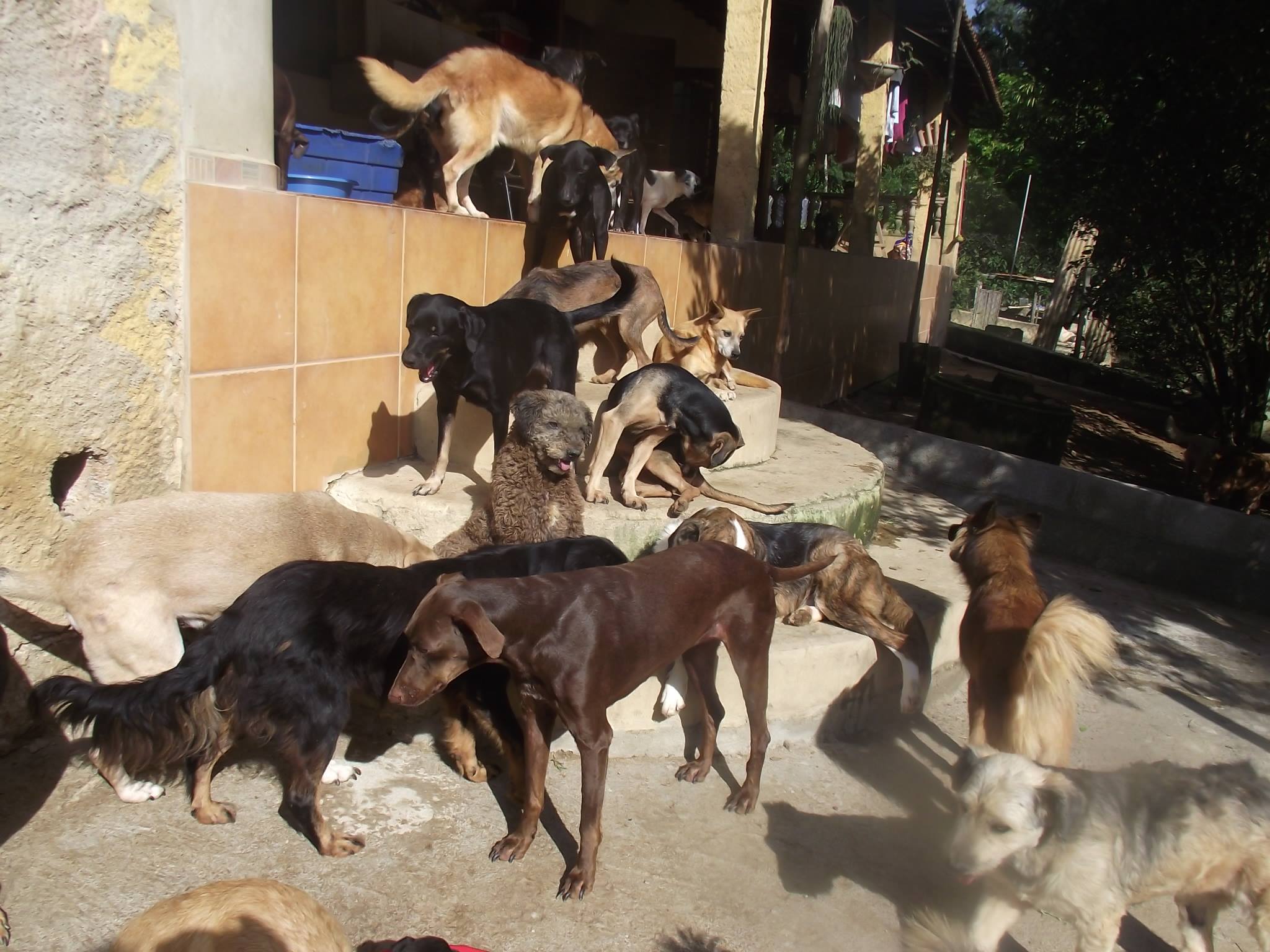
For the last two days there has been a post running explaining the desparate need for donations to be sent to MaxMello, the Brazilian charity run by Sandra Guilarducci and her husband, Francisco, in Ibiuna, Brazil.

Earlier yesterday, John Zande in Brazil sent me an email:

Morning Paul. Sandra wrote to G this morning. Portuguese and English translation below.

ah querida Dionete…ando tão cansada, tão cansada… na segunda de carnaval lá estava eu num laboratório em Cotia com a minha cachorra Nicole, fazendo eletrocardiograma e hemograma. Não paramos nunca aqui. Tem tantos cães soltos no sítio em Piedade por falta de canis e isso gera um estresse que vc nem imagina, além de brigas. Dentro da minha casa, aqui em Ibiúna, vivem 62 cães, que não podem ficar lá fora porque senão os outros matam, aqui em IBiúna o espaço é super pequeno. Enfim…, sempre correndo com eles, sempre tem um ou outro com problemas de saúde, ainda tenho vários pra castrar e…não tem fim. Mas a sua ajuda tem sido importantíssima pra gente. Que Deus te abençõe sempre e sempre. Ficamos emocionados demais com essas publicações no exterior (graças a vc, claro !) e esperamos cheios de esperanças mesmo, que isso gere frutos em pról de toda essa galerinha que abrigamos. Que vc e seus amigos envolvidos nessa nossa luta sejam cobertos de prosperidade, saúde e bênçãos. Quando puder, vamos marcar de vir aqui, será um prazer imenso poder te abraçar e agradecer pessoalmente. Forte abraço, cheio de gratidão.


Ah dear Dionete …I am soooo tired… on Monday I had to take my dog ​​Nicole to a clinic in Cotia for an ECG and blood test. We never stop around here. There are too many dogs in the property in Piedade – we don’t have kennels for all of them – and the amount of stress it generates is almost too much to bear. And the fights! Here in Ibiúna I have to keep 62 dogs inside my house; they can’t go outside otherwise they will be killed by the others. And they don’t have much room. Anyway… always running up and down for them, there’s always one or another who gets sick or needs treatment, many to still be neutered… it’s an endless task. But your help has been very important for us. May God bless you always and forever. We are thrilled to see these publications abroad (thanks to you, of course!) and do hope it generates the help these little creatures desperately need. May you and your friends involved in our struggle be covered with prosperity, health and blessings. Let’s try to set up a visit. It will be an immense pleasure to hug you and thank you personally. Big hugs full of gratitude

So all of you who have cared for Sandra and Francisco know that it counts.

Do drop across to their Facebook page here, from where the following photographs have been taken.

12661938_745930475542510_5091027821470656796_noooo

12651257_744030742399150_8059991037127794727_noooo

12657804_743519195783638_4907819882854948071_ooooo

12698495_743517825783775_8117881471369857165_ooooo

12657309_743517135783844_4620837696465933042_ooooo

12647160_743514762450748_8548235142741434775_noooo

So, once again, if you can see your way to help, by sharing this information or by making even the tiniest donation, then please do. The MaxMello PayPal account is: associacaomaxmello@gmail.com

Big hugs to every one of you out there!

Update: This is a translation of a recent comment left by Sandra on MaxMello’s Facebook page.

Friends, thanks to the generosity of you guys have raised almost 9 thousand Real. Our survival challenge continues, but we know that we are not alone in this fight. Our total debt is 36,450 Real and we need help to stamp her out. Any amount makes a big difference. As we have received many requests for the bank details, follow the possibilities:
Bradesco
Agência:1937-2
Current account: 16505-0
Social Security Number: 766.545.758-49
Sandra Maria Guilarducci
Caixa econômica federal
Agency: 0800
Arr. Operational: 003
Current account: 692-4
A Social Security Number: 16.729.925/0001-08
To those who are outside of Brazil, the transfer can be made via Paypal to the email associacaomaxmello@gmail.com
Very, very thank you all for the affection and solidarity.

Dogs are dirty – Thank Goodness!

A fascinating new study offering insight into the health of our gut!

P1150755It doesn’t take too much imagination to appreciate that living in a house and sharing it with nine dogs and four cats doesn’t lend itself to perfect hygiene! Indeed, just yesterday morning we found evidence of mice in one of our bedroom cabinets. Plus both the bedroom and the main living room are never completely free of fleas, as my skin attests to. Then let’s not even speak of the hair and dust around the house!

Plus we live in a very rural location and the dog traffic in and out of the house is a consequence of our lifestyle choices that we do accept (99% of the time! 😉 ).

But possibly living a healthier life as a consequence of our ‘dirty’ animals was not something that would have ever crossed my mind until now, thanks to a recent essay published over on The Conversation site.

Read it and come to your own conclusion. It is republished within the generous terms of The Conversation; viz:

We believe in the free flow of information. We use a Creative Commons Attribution NoDerivatives licence, so you can republish our articles for free, online or in print.

ooOOoo

If being too clean makes us sick, why isn’t getting dirty the solution?

January 13, 2016 5.59am EST

Author: Associate Professor of Surgery, Duke University
image-20151216-30102-sybi4b
Wash up. Riccardo Meneghini/Flickr, CC BY-NC-ND.

Today rates of allergic, autoimmune and other inflammatory diseases are rising dramatically in Western societies. If that weren’t bad enough, we are beginning to understand that many psychiatric disorders, including depression, migraine headaches and anxiety disorders, are associated with inflammation. Perhaps the most startling observation is that our children are afflicted with the same inflammatory problems, contributing to the fact that over 40 percent of US children are on medications for some chronic condition.

And the cause, according to the “hygiene hypothesis,” is that being too clean causes a malformation of the immune system, leading to a wide range of inflammatory diseases. The original idea was that decreased infections in childhood due to hygiene led to a weak immune system, prone to become allergic and inflamed.

If the problem is that we are too clean, then, hypothetically, the issue can be easily resolved. We just need to get dirty, right? Wrong.

Getting dirty doesn’t help our immune system and generally makes inflammation worse. Much worse. That means there is something very wrong with the hygiene hypothesis.

Biodiversity is the real issue

What we actually have is a biodiversity problem. Our clean, indoor-centered lives and a Western diet rich in processed foods have depleted our biomes – the bacteria and worms that naturally live in our bodies, our guts in particular. These organisms play a role in the development and regulation of our immune systems, and scientists have identified the loss of biodiversity as being central to the high rates of inflammatory disease in the developed world.

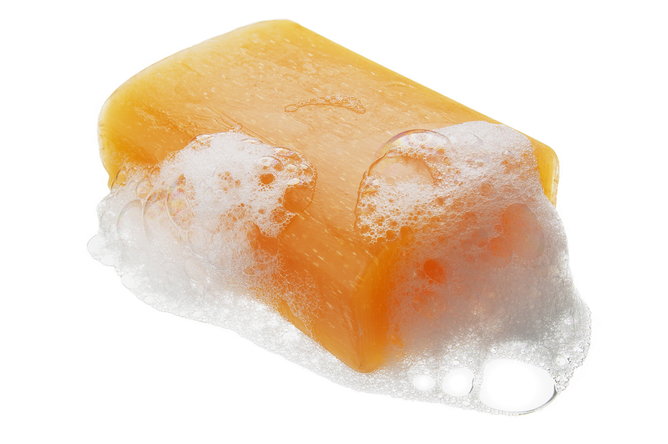
 Giving up soap won’t help your biome. Bar of soap via www.shutterstock.com.
Giving up soap won’t help your biome. Bar of soap via http://www.shutterstock.com.

The hygiene hypothesis was right…in its day

An increase in inflammatory disorders, like allergies, was first observed about 150 years ago among the aristocracy in Europe, then reached the entire population of the industrialized world by the 1960s, and seems only to have climbed steadily since then.

When trying to understand why inflammatory diseases increased in the late 1800s and throughout the 20th century, scientists put their finger on things such as toilets and water treatment facilities. In those days, having a toilet was “hygiene.”

But times change. After generations of living with toilets and water treatment facilities, some of the wildlife in our bodies has been driven to the point of extinction. Our loss of contact with the soil due to indoor working environments has further depleted the wildlife of our bodies. And the typical Western diet doesn’t help either.

Even if you were to never use soap again for the rest of your life, you would not recover the wildlife your body is missing. Many of the lost organisms of our body don’t exist in North America in the wild, and others you simply won’t come across in your daily life.

On top of tremendous social difficulties imposed by a lack of soap, you’d likely increase your exposure to a lot of aggravating and even dangerous germs. The bacteria and viruses deposited on your shopping cart handle or the light switch at a hotel are generally not good. Those are often the germs of modern society that cause infection and inflammation. Your immune system would remain inflamed, and perhaps be even more agitated than before.

So what exactly are we missing? For practical purposes, it’s important to divide the wildlife of our bodies into two groups: microbes and more complex organisms such as worms. Microbes and worms affect our immune systems in different ways and both are important to be healthy. Biodiversity is the key.

A healthy crop of microbes and a few good worms

What would the gut biomes in our hunter-gatherer ancestors have looked like? A study by Jeffrey Gordon at Washington University in St. Louis showed that people living in modern preindustrial societies had more diverse micriobiome compositions than people living in the United States today. Seventy bacterial species Gordon found in preindustrial people’s biomes were present in very different amounts from those found in the modern U.S. participants.

While each group may have been exposed to different kinds of bacteria in their day-to-day life, the primary reason for the difference in diversity was attributed to diet. The preindustrial folks ate a diet rich in corn and cassava, compared to a U.S. diet rich in animal fat and protein.

And you might think that antibiotics are an issue, but they are usually less of a long-term problem for biodiversity. They can deplete bacteria in the gut microbiome, but the dangerous and disease-inducing tailspin is generally temporary. The microbiome usually recovers quite nicely, for the most part, although some lingering effects can remain.

The second group of organisms that we need are intestinal worms called helminths. These worms are called mutualists, because they benefit from us and we benefit from having them hanging around in our intestines. They used to naturally live in our gut. In fact, only 150 years ago most people in the West had intestinal worms that helped regulate immune function and prevent inflammatory disease. The culprit here isn’t diet, but cleanliness and sanitation.

Eat some fiber. Ali Karimian/Flickr, CC BY-SA.

If getting dirty won’t help your biome, what can you do?

When it comes to bacteria, a healthy diet is the critical ingredient. We can actually achieve a good mixture of gut bacteria very similar to that of our hunter-gatherer ancestors by adopting a good diet high in fiber and low in processed foods. The right diet helps the good bacteria in your gut flourish, and might make it easier for new varieties of good bacteria to take root.

In addition, there are some products that might, in theory, support a more hunter-gatherer-like bacterial flora, by exposing us to the kind of bacteria we don’t encounter anymore, but they haven’t been tested in clinical trials.

Probiotics, generally formulations of bacteria such as bifidobacteria and lactobacilli that grow readily in milk, are safe to use unless patients are severely ill. They could help support biodiversity in our guts if we need to take antibiotics.

Worms are a bit more challenging. There are two schools of thought on how to help helminth-less guts: one is to figure out what makes good worms good for us, and develop a drug that can do the same thing. The other is just to have these good worms living in your intestines.

Personally, I don’t think we can replicate complex biological relationships using a drug. My view is that modern medicine will eventually embrace the actual worm or maybe complex single-celled organisms called protozoans that work the same way, but research in this field is still in the early stages of development.

In the meantime, some intrepid people are going straight for the worm. As in actually acquiring worms in their gut. The challenge for these adventurers is to find a worm that has more benefits than disadvantages.

For instance, the same species of worm can have different effects in different people. The human hookworm, for instance, is commercially available and easily cultured at home. It has been found to treat multiple sclerosis and severe airway hypersensitivity but can also cause severe gastrointestinal distress in many patients.

For now, most individuals interested in immune health will focus on those factors that are risk-free, like avoiding chronic psychological stress, eating well and exercising, and watching out for vitamin D deficiency. These factors, all within our control, are important for avoiding a wide range of inflammation-related diseases, including allergy, autoimmunity, depression and cancer.

ooOOoo

It seems to me that another solution is having more and more dogs and fully embracing them into our lives.

P1150854My case rests!

Another week; another food recall.

Carnivore Meat Company of Green Bay, Wisconsin, has announced it is voluntarily recalling a single lot of its Vital Essentials Frozen Chicken Entrees for Dogs due to contamination with Salmonella bacteria.

To learn which products are affected, please visit the following link:

Vital Essentials Dog Food Recall of January 2016

Please be sure to share the news of this alert with other pet owners.

Mike Sagman, Editor
The Dog Food Advisor

That link above explains:

January 15, 2016 — Carnivore Meat Company of Green Bay, Wisconsin, has announced it is voluntarily recalling a single lot of Vital Essentials Frozen Chicken Patties Entrée for Dogs due to possible contamination with Salmonella bacteria.

vital-essentials-dog-food-recall-january-2016-480px

What’s Being Recalled?

The single lot involved in this voluntary recall is:

  • Vital Essentials Frozen Chicken Patties Entrée for Dogs
    Net weight 6 pounds
    UPC 33211 00807
    Lot # 11475
    Best by date 20161108 (11/08/16)

The “Best By” date code and lot # is located on the back of the package.

Where Was It Distributed?

The affected product was distributed in the following states:

  • California
  • Florida
  • Georgia
  • Rhode Island
  • Texas
  • Washington

Why Was It Recalled?

The Federal Food and Drug Administration (FDA) selected and tested product as part of a national collection initiative, which was issued by the Center of Veterinary Medicine (CVM) on June 3, 2015.

The Agency notified Carnivore Meat Company that one of the samples collected, tested positive for Salmonella, bacteria commonly associated with fresh and frozen poultry, in human and in pet products.

There have been no customer complaints reported.

No other product manufactured by Carnivore is involved in this recall.

About Salmonella

Salmonella can cause serious illness or fatal infection in young children, frail or elderly people, and others with weakened immune systems.

Although healthy individuals may suffer only short term symptoms such as high fever, severe headache, stiffness, nausea, abdominal cramping and diarrhea.

Consumers exhibiting these signs after having contact with this product should contact their healthcare providers.

What to Do?

If you are a consumer and have purchased a bag of the affected product, please call the the company at 920-370-6542 Monday-Friday, 9 AM to 4 PM CST.

The company will assist you in obtaining replacement or a full refund from your local retailer for your original purchase.

If your package has been opened, the company suggests that you dispose of the raw food in a safe manner. This can be accomplished by securing it in a covered trash receptacle.

U.S. citizens can report complaints about FDA-regulated pet food products by calling the consumer complaint coordinator in your area.

Or go to http://www.fda.gov/petfoodcomplaints.

Canadians can report any health or safety incidents related to the use of this product by filling out the Consumer Product Incident Report Form.

Get Dog Food Recall Alerts by Email

Get free dog food recall alerts sent to you by email. Subscribe to The Dog Food Advisor’s recall notification list.

Let’s all take care of our wonderful dogs!

Big Dog Natural food recall

The first one of the New Year.

Dear Fellow Dog Lover,
Big Dog Natural of Brick, NJ, has announced it is voluntarily recalling select lots of its raw dehydrated dog food products because they have the potential to be contaminated with either Salmonella or Listeria monocytogenes bacteria.

To learn which products are affected, please visit the following link:

Big Dog Natural Dog Food Recall of January 2016

Please be sure to share the news of this alert with other pet owners.

Mike Sagman, Editor
The Dog Food Advisor

If you go to that link, you will read the following:

ooOOoo

January 4, 2015 — Big Dog Natural of Brick, NJ, has announced it is voluntarily recalling a select lot of its Big Dog Natural Chicken Supreme raw dehydrated dog food because it may be contaminated with Salmonella.

The company is also recalling its Fish Supreme product because it may be contaminated with Listeria monocytogenes.

The affected products were shipped to online customers during the period from October 31, 2015 through November 13, 2015.

big-dog-natural-chickenbig-dog-natural-fish

About Salmonella and Listeria

Salmonella and Listeria monocytogenes can affect animals eating the products.

And there is also risk to humans from handling contaminated pet products — especially if they have not thoroughly washed their hands after having contact with the products or any surfaces exposed to these products.

Healthy people infected with Salmonella and Listeria monocytogenes should monitor themselves for some or all of the following symptoms: nausea, vomiting, diarrhea or bloody diarrhea, abdominal cramping and fever.

Rarely, Salmonella and Listeria monocytogenes can result in more serious ailments, including arterial infections, endocarditis, arthritis, muscle pain, eye irritation, and urinary tract symptoms.

Consumers exhibiting these signs after having contact with this product should contact their healthcare providers.

Pets with Salmonella and Listeria monocytogenes infections may be lethargic and have diarrhea or bloody diarrhea, fever, and vomiting.

Some pets will have only decreased appetite, fever and abdominal pain.

Infected but otherwise healthy pets can be carriers and infect other animals or humans.

If your pet has consumed the recalled product and has these symptoms, please contact your veterinarian.

These products were sold directly to consumers through the company’s online website and in the US.

The recalled products include all weight volumes of the Big Dog Natural Chicken and Fish Supreme.

No additional products are affected by this recall.

What Caused the Recall?

Big Dog Natural became aware of a potential issue after receiving notification from the FDA that an investigative sample of Chicken Supreme tested positive for Salmonella.

And that an investigative sample of Fish Supreme tested positive for Listeria monocytogenes.

What to Do?

Consumers should discontinue feeding the affected product, monitor their pet’s health and contact their veterinarian if they have concerns.

Consumers who purchased the product can obtain a full refund or exchange by returning the product in its original packaging.

Consumers with questions should contact Big Dog Natural by calling 732-785-2600 from 9 AM to 4 PM ET.

U.S. citizens can report complaints about FDA-regulated pet food products by calling the consumer complaint coordinator in your area.

Or go to http://www.fda.gov/petfoodcomplaints.

Canadians can report any health or safety incidents related to the use of this product by filling out the Consumer Product Incident Report Form.

Get Dog Food Recall Alerts by Email

Get free dog food recall alerts sent to you by email. Subscribe to The Dog Food Advisor’s recall notification list.

ooOOoo

Please share this with all other dog owners – thank you!

A tiny bite of this could kill your dog!

Please read, digest and share as widely as you can!

Fellow author, Deborah Taylor-French, recently posted a stark warning for all dog owners. Deborah wrote on her blog, Dog Leader Mysteries, the following:

1 thing more toxic than chocolate for dogs

More toxic than chocolate?

Yes, and it’s everywhere.

Please visit my guest blog post on 4Knines blog “One common thing that is more toxic than chocolate for dogs”  Then please comment! Of course, after you comment, I’d love it if you would share far and wide for the love and lives of dogs. After working on this post for about a month I shared it as a guest post so that it may reach a larger audience of dog lovers, beyond my WordPress blog.

(I also can’t resist including the following photograph of Deborah and Syd that was in that post!)

Syd the kid!
Syd the kid!

So the balance of my post today is a full republication of Deborah’s guest post as it appeared over on 4knines blog.

ooOOoo

One Common Thing That is More Toxic Than Chocolate for Dogs!

And another dog food recall.

This one came in on the 12th December.

Stella and Chewy’s of Oak Creek, Wisconsisn, has announced it is voluntarily recalling select lots of its raw dog and cat food due to the possible presence of Listeria monoyctogenes bacteria.

To learn which products are affected, please visit the following link:
Stella and Chewy’s Dog and Cat Food Recall of December 2015

Please be sure to share the news of this alert with other pet owners.

Mike Sagman, Editor
The Dog Food Advisor

That link offers, in part:

December 11, 2015 — Stella and Chewy’s of Oak Creek, Wisconsin, has announced it is voluntarily recalling four of its products sold in the U.S. and Canada due to possible contamination with Listeria monocytogenes bacteria.
The recall affects a total of 990 cases — 964 cases in the U.S. and 26 cases in Canada.
What’s Recalled?
As a precautionary measure, Stella and Chewy’s is voluntarily recalling selected products from Lot # 165-15, which includes:

Please go here to read all the details if this is a concern for you.

The following is just one of the product images – view all of them here.

stella-chewys-1

Nutro Dog Treats Recall

This was released on December 13th.

Dear Fellow Dog Lover,

MARS Petcare has issued a voluntary recall for select lots of Nutro Chewy dog treats due to possible mold.

To learn which products are affected, please visit the following link:
Nutro Dog Treats Recall of December 2015

Please be sure to share the news of this alert with other pet owners.

Mike Sagman, Editor
The Dog Food Advisor

That link further discloses:

December 12, 2015 — MARS Petcare has issued a voluntary recall of select lots of its Nutro dog treats due to potential mold.

nutro-chewy-apple-treats

What’s Recalled?
The following product is affected by this recall event:
Nutro CHEWY Treats with Real Apples
Size: 4OZ
UPC: 7910511344
Lot Codes beginning with the following numbers and regardless of the Best By date:
4 50
5 02
5 03
5 05

Nutro-Chewy-Treats-Recall-December-2015

What to Do?
Consumers are asked to stop feeding this product to your pet and to bring any remaining Nutro 4 ounce Nutro Apple Chewy Treats affected by this recall to your nearest PetSmart for a full refund.
If you have questions about this voluntary recall, customers are invited to call Nutro Customer Service at 800-833-5330.

Another food alert.

Bravo Pet Foods

Bravo Pet Foods of Manchester, Connecticut, has announced it is voluntarily recalling select lots of its raw food for dogs and cats due to the possible presence of Salmonella.

To learn which products are affected, please visit the following link:
Bravo Dog Food Recall of December 2015

Please be sure to share the news of this alert with other pet owners.

Mike Sagman, Editor
The Dog Food Advisor

That link offers the following:

bravo-dog-food-logo-470

The following product is being voluntarily recalled because of the possible presence of Salmonella.

Bravo Blend Chicken diet for dogs and cats
Item number: 21-102
Size: 2 pound (32 ounce) chub
Best Used By Date: 11-13-16
UPC: 829546211028