(A republication of a post first shown on the 8th August, 2009, still seems pretty relevant)
We live in a world where finance and money play a hugely more important role in our everyday lives than, say, 25 years ago. Well that’s how it seems. Our energy costs don’t seem to be connected to supply and demand but more in the hands of the speculators. Our house values have been greatly influenced, perhaps misaligned is a better word, by the availability of too easy money, resulting from exotic financial leveraging. Commodities are, like energy, traded for their own sake rather than to provide an efficient process of linking the grower with the consumer. And more.
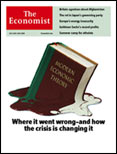
So it comes as a bit of a shock to read in a recent copy of The Economist that most of the theories and economic models are being ‘re-examined’ in the light of the current global crisis. These theories and models are not esoteric ideas kept
The Economist July 18th 2009
within the scholarly walls of universities but used by Governments, investment institutions and banks so they affect you and I in the real world, big time!
They ought to work a great deal better than they do because they have the capability to harm, as millions have found out in the last 2 years.
Anyway, The Economist, July 18th-July 24th has a lengthy briefing: The state of economics, comprised of two articles. To me it makes very sobering reading. Unless you have a subscription there is no web access to the articles so here are a few extracts to give you a flavour. The first article is about turmoil among macro-economists.
In the last of his Lionel Robbins lectures at the LSE on June 10th, Mr Krugman [Paul Krugman of Princeton and the New York Times] feared that most macroeconomics of the past 30 years was “spectacularly useless at best, and positively harmful at worst”.
These internal critics argue that economists missed the origins of the crisis; failed to appreciate its worst symptoms; and cannot now agree about the cure. In other words, economists misread the economy on the way up, misread it on the way down and now mistake the right way out.
Nor can economists now agree on the best way to resolve the crisis. They mostly overestimated the power of routine monetary policy (ie, central-bank purchases of government bills) to restore prosperity. Some now dismiss the power of fiscal policy (ie, government sales of its securities) to do the same.
Towards the end of this first article in the Briefing, there is this:
In the first months of the crisis, macroeconomists reposed great faith in the powers of the Fed and other central banks. In the summer of 2007, a few weeks after the August liquidity crisis began, Frederic Mishkin, a distinguished academic economist and then a governor of the Fed, gave a reassuring talk at the
Frederick Mishkin
Federal Reserve Bank of Kansas City’s annual symposium in Jackson Hole, Wyoming. He presented the results of simulations from the Fed’s FRB/US model. Even if house prices fell by a fifth in the next two years, the slump would knock only 0.25% off GDP, according to his benchmark model, and add only a tenth of a percentage point to the unemployment rate. The reason was that the Fed would respond “aggressively”, by which he meant a cut in the federal funds rate of just one percentage point. He concluded that the central bank had the tools to contain the damage at a “manageable level”.
Since his presentation, the Fed has cut its key rate by five percentage points to a mere 0-0.25%. Its conventional weapons have proved insufficient to the task. This has shaken economists’ faith in monetary policy. Unfortunately, they are also horribly divided about what comes next.
The second article explores the way that the efficient-markets hypothesis has underpinned many of the financial industry models.
IN 1978 Michael Jensen, an American economist, boldly declared that “there is no other proposition in economics which has more solid empirical evidence supporting it than the efficient-markets hypothesis”
Michael Jensen
(EMH).
Eugene Fama, of the University of Chicago, defined its essence: that the price of a financial asset reflects all available information that is relevant to its value.
Eugene Fama
Even as financial engineers were designing all sorts of clever products on the assumption that markets were efficient, academic economists were focusing more on how markets fall short. Even before the 1987 stockmarket crash gave them their first real-world reminder of markets’ capriciousness, some of them were examining the flaws in the theory.
However, a second branch of financial economics is far more sceptical about markets’ inherent rationality. Behavioural economics, which applies the insights of psychology to finance, has boomed in the past decade.
Behavioural economists were among the first to sound the alarm about trouble in the markets. Notably, Robert Shiller of Yale gave an early warning that America’s housing market was dangerously overvalued. This was his second prescient call. In the 1990s his concerns about the bubbliness of the stockmarket had prompted Alan Greenspan, then chairman of the Federal Reserve, to wonder if the heady share prices of the day were the result of investors’ “irrational exuberance”.
One task, also of interest to macroeconomists, is to work out what central bankers should do about bubbles—now that it is plain that they do occur and can cause great damage when they burst.
Another priority is to get a better understanding of systemic risk, which Messrs Scholes [Myron Scholes]
Myron ScholesRichard Thaler
and Thaler [Richard Thaler of the University of Chicago] agree has been seriously underestimated.
Several countries now expect to introduce a systemic-risk regulator. Financial economists may have useful advice to offer.
Financial economists also need better theories of why liquid markets suddenly become illiquid and of how to manage the risk of “moral hazard”—the danger that the existence of government regulation and safety nets encourages market participants to take bigger risks than they might otherwise have done. The sorry consequences of letting Lehman Brothers fail, which was intended to discourage moral hazard, showed that the middle of a crisis is not the time to get tough. But when is?
Mr Lo [Andrew Lo of the Massachusetts Institute of Technology] has a novel idea for future crises: creating a financial equivalent of the National Transport Safety Board, which investigates every civil-aviation crash in America. He would like similar independent, after-the-fact scrutiny of every financial
Andew Lo
failure, to see what caused it and what lessons could be learned. Not the least of the difficulties in the continuing crisis is working out exactly what went wrong and why—and who, including financial economists, should take the blame.
Mr Lo’s idea of treating financial failures in the same way as civil aviation accidents might be a brilliant idea. After all economics is a behavioural science just like the ‘science’ of air traffic controllers and air crew. Seems to me that keeping my money as safe as my body in a civil airliner isn’t a bad goal.
If you can, do get hold of a copy of the briefing, if only to arrive at the same conclusion as me. In terms of future personal financial planning, a pair of dice may be just as accurate as economists.
An original idea that shouldn’t be regarded as innovative.
We live in interesting times! Whenever I use that phrase, and it seems to slip from my lips too often these days, I am reminded of the ancient Chinese curse, “May you live in interesting times!”
There are a goodly number of countries that have legislation that ‘impose’ a minimum wage for employees. Here in the USA, the Federal level for 2012 is $7.25 per hour but it isn’t necessarily the same across all States. Based on a 40-hour working week, 50 weeks a year, that comes to a gross of $14,500 for the full year.
Let’s contrast that with a person who has been in the news recently, Mr. Bob Diamond, Chief Executive of Barclays.
Mr Diamond has said he will not take a bonus for this year as a result of the scandal.
It is not the first time the 60-year-old Boston-born former academic – he began his career as a university lecturer – has made the headlines.
Mr Diamond was previously best-known for his huge wealth: last year he topped the list of the highest-paid chief executives in the FTSE 100.
‘Unacceptable face’
In 2011 Mr Diamond earned £20.9m, comprising salary, bonuses and share options, and he is reported to have a personal wealth of £105m.
There has long been controversy about the amount he earns.
In 2010, Lord Mandelson described him as the “unacceptable face of banking”, saying he had taken a £63m salary for “deal-making and shuffling paper around”.
Barclays dismissed the figure as “total fiction” saying that his salary as head of Barclays Capital was actually £250,000.
BBC business editor Robert Peston said he believed Mr Diamond had earned £6m in 2009 from a long-term incentive scheme and £27m from selling his stake in a Barclays-owned business that had been sold.
So whether he earns £20.9m, £6m or even £250,000 frankly makes no difference to the fact that the gap between what the poorest may earn and the sorts of monies that are given to Mr. Diamond and his like is just plain wrong. [And since writing this on Monday, the news broke on Tuesday morning that Mr. Diamond is now unemployed.] Don’t often quote the bible in Learning from Dogs but 2 Corinthians 8:13-15 is irresistible (King James Version),
Our desire is not that others might be relieved while you are hard pressed, but that there might be equality. At the present time your plenty will supply what they need, so that in turn their plenty will supply what you need. The goal is equality, as it is written: “The one who gathered much did not have too much, and the one who gathered little did not have too little.” [my emphasis]
I subscribe to Naked Capitalism and the other day there was a deeply interesting article about France pushing for a maximum wage. Let me take the liberty of quoting all of it,
SUNDAY, JULY 1, 2012
France Pushing for a Maximum Wage; Will Others Follow?
A reader pointed out a news item we missed, namely, that the new government in France is trying to implement a maximum wage for the employees of state-owned companies. From the Financial Times:
France’s new socialist government has launched a crackdown on excessive corporate pay by promising to slash the wages of chief executives at companies in which it owns a controlling stake, including EDF, the nuclear power group.
In a departure from the more boardroom-friendly approach of the previous right-of-centre administration, newly elected president François Hollande wants to cap the salary of company leaders at 20 times that of their lowest-paid worker.
According to Jean-Marc Ayrault, prime minister, the measure would be imposed on chief executives at groups such as EDF’s Henri Proglio and Luc Oursel at Areva, the nuclear engineering group. Their pay would fall about 70 per cent and 50 per cent respectively should the plan be cleared by lawyers and implemented in full…
France is unusual in that it still owns large stakes in many of its biggest global companies, ranging from GDF Suez, the gas utility; to Renault, the carmaker; and EADS, parent group of passenger jet maker Airbus.
Of course, in the US, we have companies feeding so heavily at the government trough that they hardly deserve the label of being private, but the idea that the public might legitimately have reason to want to rein in ever-rising executive pay is treated as a rabid radical idea.
For those, however, receiving bailouts, deposit insurance, government guarantees, tax breaks, tax credits, other forms of public financing, government contracts of any sort – and so on – the top paid person cannot receive more than twenty-five times the bottom paid person. This ratio, by the way, is what business visionary Peter Drucker recommended as most effective for organization performance as well as society. It also echoes Jim Collins who, in his book Good To Great, found that the most effective top leaders are paid more modestly than unsuccessful ones. And, critically, it is a ratio that is in line with various European and other nations that have dramatically lower income inequality than the United States.
In other words, the French proposal isn’t that big a change from existing norms, at least in most other advanced economics (ex the UK, which has also moved strongly in the direction of US top level pay). But despite the overwhelming evidence that corporate performance is if anything negatively correlated with CEO pay, the myth of the superstar CEO and the practical obstacles to shareholder intervention (too fragmented; too many built in protections for incumbent management, like staggered director terms; major free rider problems if any investor tries to discipline extractive CEO and C level pay, which means it’s easier to sell than protest) means ideas like this are unlikely to get even a hearing in the US. Let the looting continue!
As Patrice Ayme commented on that Naked Capitalism article, “France will pass the 20 to 1 law, as the socialists control the entire state, senate, National Assembly, Regions, big cities, etc. Only the French Constitutional Court could stop it. That’s unlikely, why? Because one cannot have a minimum wage, without a maximum wage. It’s not a question of philosophy, but of mathematics.”
Let me go back and requote this,
…. the top paid person cannot receive more than twenty-five times the bottom paid person. This ratio, by the way, is what business visionary Peter Drucker recommended as most effective for organization performance as well as society. It also echoes Jim Collins who, in his book Good To Great, found that the most effective top leaders are paid more modestly than unsuccessful ones. And, critically, it is a ratio that is in line with various European and other nations that have dramatically lower income inequality than the United States.
Thus if society was to embrace this approach to fairness, in America the top paid person in 2012 in the USA would be on 25 times the minimum wage level of $14,500 a year or, in other words, $362,500 a year.
I’m not a raving liberal but I am bound to say that this sits pretty well with me. How about you?
As I opened, an original idea that shouldn’t be regarded as innovative.
It’s rare for me to post a second item on the same day but this warrants it!
The full copy of this recently issued Press Release now available on the End Fossil Fuels Subsidies website is republished in full below.
PASS IT ON!
oooOOOooo
PRESS RELEASES
MIDDAY TWITTERSTORM REPORT
June 18, 2012
Call to #EndFossilFuelSubsidies at Rio+20 Tops Twitter
EU Commissioner for Climate Action Connie Hedegaard, celebrities Mark Ruffalo,
Stephen Fry, and Robert Redford, journalist Nicholas Kristof, and more join global push
RIO DE JANEIRO — The push to end fossil fuel subsidies at Rio+20 became the #2 most talked about topic worldwide on Twitter this morning.
The social networking site, which has 100 million active users, tracks discussions by hashtag and #endfossilfuelsubsidies ranked #2 globally and #2 in United States and Australia. 350.org, the global climate campaign coordinating the effort, estimated that the hashtag was being tweeted at least once a second, reaching millions of people around the world.
A number of politicians, journalists, celebrities, and high-profile activists joined in the campaign, helping catapult it into the spotlight:
British actor Stephen Fry tweeted, “Let’s green $1 trillion with a plan to save the planet. Sign the petition & RT: http://j.mp/endFFS #endfossilfuelsubsidies #G20 #RioPlus20.”
American actor Mark Ruffalo, who recently played the Hulk in the box-office sensation The Avengers, tweeted, “Good Morn! Can you help us end fossil fuel subsidies? Pls tweet #endfossilfuelsubsidies TODAY to help us send a msg & spread the word.!!!”
The EU Commissioner for Climate Action Connie Hedegaard, who is expected to play a key role at the Rio+20 negotiations,tweeted, “Fossil fuels subsidies have no place in today’s world . They must be phased out as the G20 pledged. #EndFossilFuelSubsidies #Rioplus20.”
Journalist and New York Times columnist Nicholas Kristof tweeted, “A twitterstorm underway calling on leaders to #EndFossilFuelSubsidies at Rio summit: http://yfrog.com/1qamv1j.”
350.org founder Bill McKibben tweeted, “$1 trilllion is a lot of money–tired of the fossil fuel industry laughing at us, so joining the twitterstorm #endfossilfuelsubsidies.”
Activists with 350.org are projecting tweets in cities around the world, including Sydney, London, New Delhi, and New York, as well as inside the Rio+20 negotations.
Yesterday, 350.org and Avaaz unfurled a giant $1 trillion bill on the Copacabana beach in Rio, producing some spectacular photos. The global campaign Avaaz.org is delivering a petition with 750,000 signatures calling for an end to fossil fuel subsidies to G20 leaders in Los Cabos, Mexico this afternoon. Over a million people have signed different petitions calling for action on subsidies in the last two weeks.
The current draft of the Rio+20 agreement released on Saturday includes a paragraph on ending fossil fuel subsidies, but negotiations now hang in the balance as oil exporting countries led by Saudi Arabia and Venezuela attempt to delete any references to the proposal. The final decision is likely to come down to Brazil, who hold sway as the host country.
The Twitterstorm can be tracked at endfossilfuelsubsidies.org. Supporting organizations for endfossilfuelsubsidies.org include: 350.org, Avaaz, Climate Reality Project, Earth Day Network, Friends of the Earth International, Global Exchange, Green For All, Greenpeace International, Greenpeace New Zealand, Natural Resource Defense Council, Oil Change International, Quercus, SumOfUs, Wild Aid, WWF
###
CONTACT: In the US, Daniel Kessler, dk@350.org, +1 510-501-1779; In Rio, Jamie Henn, jamie@350.org, +55(0)2181061948
‘Twitterstorm’ gathers speed before Monday’s Global Cyberaction to #EndFossilFuelSubsidies at Rio+20
RIO, 15 June 2012 — Momentum is building for this Monday’s 24-hour “Twitterstorm,” a massive international online action to increase pressure on world leaders to cut nearly $1 trillion in fossil fuel subsidies at the upcoming Rio+20 Earth Summit.
For 24 hours between June 18th and 19th, as world leaders gather at the G20 summit and prepare for Rio+20, hundreds of thousands of people around the world will tweet with the same hashtag — #EndFossilFuelSubsidies — at celebrities and politicians, flooding the popular social network with their demand. Over 1 million people have already signed a petition calling on leaders to act.
Recent developments on the Twitterstorm include:
• Confirmation of tweet projections in Sydney, London, New Dehli, and Rio (see Notes section for times and locations) (1)
• A new website with fact sheets, a tool to tweet at celebrities and Heads of State, and more resources for activists: http://www.endfossilfuelsubsidies.org
• A new Facebook event that has registered over two thousand “Tweet Team” members to recruit participants for the day of action. (2)
• Support from over a dozen civil society groups, including 350.org, Greenpeace International, Oil Change International and WWF. (3)
WHAT: A 24-hour Twitterstorm to #EndFossilFuelSubsidies at Rio+20
WHEN: The 24-hour clock will begin at 8:00 UTC (6 PM local time in Sydney) when activists will flock to Twitter with messages that will be projected in iconic locations in Sydney, New Delhi, London, and Rio. In recent weeks campaigning groups have collected over 1 million signatures demanding that leaders act now.
WHY: According to figures compiled by Oil Change International, countries are spending as much as $1 trillion USD combined annually on fossil fuel subsidies. (4) The International Energy Agency estimates that by cutting these subsidies, the world can cut global warming causing emissions in half and significantly contribute to preventing a 2 degree temperature rise, the limit most scientists say we need to stay under to prevent runaway climate change. (5)
In May, leaders of the G20 again pledged to eliminate fossil fuel subsidies. They first made the commitment in 2009 but have yet to implement the policy change at the country level.
While global warming emissions rise and gas prices spike, fossil fuel companies continue to make massive profits, which brings into doubt the need for subsidies. ExxonMobil, for example, made $41.1 billion USD in profit in 2011.
###
CONTACT: In the US, Daniel Kessler, 350.org, dk@350.org, +1 510-501-1779; In Rio, Jamie Henn, jamie@350.org, +55(0)2181061948
NOTE TO EDITORS:
1. June 18 projection events
• Sydney
◦ Summary: Sydney will launch the Twitter Storm from the Sydney Opera House. Local supporters are invited to send a photo or video message to world leaders with the Sydney Opera House and Sydney Harbour Bridge as a backdrop. Projection of the Twitter feed will continue late at night around Sydney’s CBD.
◦ 6 PM (UTC+10) Sydney Opera House Boardwalks
◦ 9 PM (UTC+10) Sydney CBD
◦ CONTACT: Abi Jamines abigail@350.org, +61 403278621
• New Delhi
◦ Summary: There will be two projections in New Delhi.
◦ Projection 1: 6 PM – 9 PM, Moonlighting, An indoor projection while the Twitter feed is projected to an invited audience along with a speaker to discuss the issue of fossil fuel subsidies in the Indian context. (Will share speaker details soon, yet to be confirmed).
◦ Projection 2: 6PM – 11 PM An outdoor projection at a local mall called DLF Saket.
◦ CONTACT: Chaitanya Kumar, chaitanya@350.org, +91-9849016371
• London
◦ Summary: There will be 3 events in London–a petition delivery at 10 Downing Street in the morning, followed by two projections.
◦ Petition delivery: 10:30am GMT+1, Number 10 Downing Street, London.
◦ Projection 1: 1:30pm GMT+1, Houses of Parliament, London
◦ Projection 2: Approximately midnight GMT+1 (Tuesday 19th June), Nelson’s Column, Trafalgar Square, London
◦ CONTACT: Emma Biermann, emma@350.org, +44 (0) 78 3500 4720,
• Rio
◦ Summary: Tweets will be displayed in the Rio Centro conference center all day.
◦ CONTACT: Jamie Henn, jamie@350.org, +55(0)2181061948
3. Supporting organizations include: 350.org, Avaaz, Climate Reality Project, Earth Day Network, Friends of the Earth International, Global Exchange, Green For All, Greenpeace International, Greenpeace Australia, and Greenpeace New Zealand, League of Conservation Voters, Natural Resource Defense Council, Oil Change International, Oxfam, Quercus, SumOfUs, Wild Aid, World Wildlife Fund
‘Twitter Storm’ Planned to Pressure Leaders to End Fossil Fuel Subsidies at Rio+20
Environmental conference ideal place to end wasteful giveaways to corporate polluters, says civil society groups
Oakland, 7 June 2012 — Campaigning organizations from around the world will join forces on June 18 for a 24-hour ‘Twitter storm’ in which tens of thousands of messages will be posted on the social networking site demanding that world leaders use Rio+20 to agree to end fossil fuel subsidies.
The 24 hour clock will start at 6PM local time in Sydney (8AM UTC), when activists will begin to flock to Twitter with messages that will also be projected in iconic spots in Sydney, New Delhi, London, Rio, and other locations. In recent weeks campaigning groups have collected over 1 million signatures demanding that leaders act now to end subsidies and start to invest in clean energy solutions. (1)
According to figures compiled by Oil Change International, countries together are spending as much as $1 trillion dollars annually on fossil fuel subsidies. (2) The International Energy Agency estimates that by cutting these subsidies, the world can cut global warming causing emissions in half and significantly contribute to preventing a 2 degree temperature rise, the number most scientists say we need to stay under to prevent runaway climate change. (3)
“We are giving twelve times as much in subsidies to fossil fuels as we are providing to clean energy, like wind and solar. World leaders shouldn’t be subsidizing the destruction of our planet, especially since these subsidies are cooking our planet,” said Jake Schmidt, International Climate Policy Director at the Natural Resources Defense Council.
In May, leaders of the G20 again pledged to eliminate fossil fuel subsidies. They first made the commitment in 2009 but have yet to implement the policy change at the country level.
While global warming emissions rise and gas prices spike, fossil fuel companies continue to make massive profits, which brings into doubt the need for subsidies. ExxonMobil, for example, paid an effective US federal tax rate in 2010 of 17.2 percent, while the average American paid 28 percent.
Participating organizations include 350.org, Avaaz, Greenpeace. Oil Change International, Natural Resources Defense Council, and others.
###
CONTACT: In the US, Daniel Kessler, 350.org, +1 510 501 1779, daniel@350.org
A remarkably simple explanation, courtesy of a Greek Hotel, about financial bailouts!
Last week-end I was indebted to Neil Kelly for supplying a more humorous look at life for Learning from Dogs. This week-end I turn to friend, Bob D., a corporate airliner Captain out in the Middle East. Here is Bob’s contribution for today. (Editor’s note: at the time of posting this, 1 euro = 1.3405 US dollars, ergo €100 = $134 – read on, this will make sense.)
No connection with the hotel in the story!
For those interested in world events….
How the Greek bailout package works.
It is a slow day in a damp little Greek town. The rain is beating down and the streets are deserted. Times are tough, everybody is in debt, and everybody lives on credit.
On this particular day a rich German tourist is driving through the town, stops at the local hotel and lays a €100 note on the desk, telling the hotel owner he wants to inspect the rooms upstairs in order to pick one to spend the night.
The owner gives him some keys and, as soon as the visitor has walked upstairs, the hotelier grabs the €100 note and runs next door to pay his debt to the butcher. The butcher takes the €100 note and runs down the street to repay his debt to the pig farmer.
The pig farmer takes the €100 note and heads off to pay his bill at the supplier of feed and fuel. The guy at the Farmers’ Co-op takes the €100 note and runs to pay his drinks bill at the pub. The publican slips the money along to the local prostitute drinking at the bar, who has also been facing hard times and has had to offer him “services” on credit. The hooker then rushes to the hotel and pays off her room bill to the hotel owner with the €100 note.
The hotel proprietor then places the €100 note back on the counter so the rich traveler will not suspect anything. At that moment the traveler comes down the stairs, picks up the €100 note, states that the rooms are not satisfactory, pockets the money, and leaves town.
No one produced anything. No one earned anything. However, the whole town is now out of debt and looking to the future with a lot more optimism.
And that, Ladies and Gentlemen, is how the bailout package works.
The story that could run for an awfully long time!
I rather revealed my newness as a US resident by posting my review of David Kauders’ book The Greatest Crash over 2 days last week, one of them being Thanksgiving Day. Despite that 1,895 people viewed my review which was entitled The end of an era.
A week has now passed since that review. I was curious to see what sorts of headlines had been making the news in the last 7 days. It’s just a random trawl through those items that have captured my attention.
The eurozone really has only days to avoid collapse
By Wolfgang Münchau
In virtually all the debates about the eurozone I have been engaged in, someone usually makes the point that it is only when things get bad enough, the politicians finally act – eurobond, debt monetisation, quantitative easing, whatever. I am not so sure. The argument ignores the problem of acute collective action.
Last week, the crisis reached a new qualitative stage. With the spectacular flop of the German bond auction and the alarming rise in short-term rates in Spain and Italy, the government bond market across the eurozone has ceased to function.
Wolfgang concludes his article thus,
Italy’s disastrous bond auction on Friday tells us time is running out. The eurozone has 10 days at most.
Then my print copy of The Economist that arrived on the 26th had this lurid cover page,
Unless Germany and the ECB move quickly, the single currency’s collapse is looming
Past financial crises show that this downward spiral can be arrested only by bold policies to regain market confidence. But Europe’s policymakers seem unable or unwilling to be bold enough. The much-ballyhooed leveraging of the euro-zone rescue fund agreed on in October is going nowhere. Euro-zone leaders have become adept at talking up grand long-term plans to safeguard their currency—more intrusive fiscal supervision, new treaties to advance political integration. But they offer almost no ideas for containing today’s conflagration.
and a few paragraphs later, this,
This cannot go on for much longer. Without a dramatic change of heart by the ECB and by European leaders, the single currency could break up within weeks. Any number of events, from the failure of a big bank to the collapse of a government to more dud bond auctions, could cause its demise. In the last week of January, Italy must refinance more than €30 billion ($40 billion) of bonds. If the markets balk, and the ECB refuses to blink, the world’s third-biggest sovereign borrower could be pushed into default.
ICAP Plc is preparing its electronic trading platforms for Greece’s potential exit from the euro and a return to the drachma, senior executives at the inter-dealer broker said Sunday.
ICAP is the latest firm to disclose such preparations, joining the growing ranks of banks, governments and other key players in the global financial system whose officials are worried enough about the stability of the common currency to be making contingency plans for a possible break-up.
Investors sent Europe’s politicians a painful message last week whenGermany had a seriously disappointing government bond auction. It was unable to sell more than a third of the benchmark 10-year bonds it had sought to auction off on Nov. 23, and interest rates on 30-year German debt rose from 2.61 percent to 2.83 percent. The message? Germany is no longer a safe haven.
and concluded,
Ultimately, an integrated currency area may remain in Europe, albeit with fewer countries and more fiscal centralization. The Germans will force the weaker countries out of the euro area or, more likely, Germany and some others will leave the euro to form their own currency. The euro zone could be expanded again later, but only after much deeper political, economic and fiscal integration.
Tragedy awaits. European politicians are likely to stall until markets force a chaotic end upon them. Let’s hope they are planning quietly to keep disorder from turning into chaos.
Finally, on the 29th the BBC News website carried details of the Autumn Statement made by British Chancellor, George Osborne, to Parliament.
Osborne confirms pay and jobs pain as growth slows
Chancellor George Osborne has said public sector pay rises will be capped at 1% for two years, as he lowered growth forecasts for the UK economy.
The number of public sector jobs set to be lost by 2017 has also been revised up from 400,000 to 710,000.
Borrowing and unemployment are set to be higher than forecast and spending cuts to carry on to 2017, he admitted.
Just look at that figure of public sector job losses – 710,000!
Well that’s more than enough from me but it does surely endorse the opening views that David Kauders expounded in his book, as carried in my review, and reproduced here,
Starting with the first sentence, David sets out the core problem;
This book argues that it is impossible to expand the financial system much further.
expanding this a few paragraphs later,
This is the financial system limit: lack of new borrowing plus excessive weight of debt obligations from past borrowing combine to slow economies down. This is the barrier whichever way policy makers turn. It is like the lid on a boiling kettle. Enough steam can lift it for a while but it always snaps back into place. The financial system limit is a roadblock preventing growth.
A few pages later in this opening chapter ‘The roadblock preventing growth‘ this limit is explained thus,
Policy contradictions also show us that the financial system has reached a roadblock. The glaring conflict between bailout and austerity is at the core. Each bailout or stimulus requires creation of more credit, leading to false financial speculation, and for a short while markets recover their poise. The threat of inflation returns. Later, bad debts rise, the markets tumble again and a new crisis emerges. Austerity, the alternative policy, cuts spending thereby cutting the immediate level of economic activity and bringing economic decline more quickly than the stimulus alternative. Whichever way they turn, the authorities are damned.
You can understand why I called this Post a ‘footnote’ not an endnote.
A review of David Kauder’s recently published book, The Greatest Crash.
Details of the availability of the book are included at the end of the review.
Extracts from the book included are with grateful thanks to Sparkling Books.
Part One of this review was published yesterday which needs to be read before Part Two.
——————-
Chapter 5 continues by examining the over-bearing consequences of excessive public spending, excessive Government regulations, substitute taxation, weakness of Treasury forecasts, and so on. While these are UK issues, there is no doubt that similar restraints of free enterprise exist in many other western nations.
In Chapter 6, ‘Group Think‘, David looks at the strange ways in which we form opinions. It’s a topic that has been discussed and written about widely but the point behind this chapter is that people have in great part lost the ability to discern truth from fiction, with terrible implications when it comes to understanding how individuals are affected by government and bureaucratic institutions.
The chapter closes;
One of the remarkable points that I have found in writing this book is that many of the detailed errors, incorrect policies et al, have already been amply documented by others. But we never learn. The delegated society, the strength of lobby groups and vulnerability of our political system to pressure, the sheer volume of noise in the media and on the Internet, the immediacy of the demands of daily life, all combine to make our collective memory rather short.
Amen to that!
Chapter 7, ‘Academic differences of opinion‘, was surprisingly short at just 6 1/2 pages. One would have thought the subject worthy of a much longer review especially as David was exploring the fundamental differences between Keynesian and Ricardian economic theories and opportunities for alternative theories. Must say that that I laughed out loud (David’s book is a little short on humour!) at the sentence on p.127 that ran, “One correspondent writing to the Financial Times proposed that economics should be declared a failing discipline, economists as not fit for purpose, and a physicist put in charge of sorting their theories out.”
Chapter 8, ‘The dark side of capital markets‘, is the penultimate chapter and quite a technical one at that. But David manages to trip through esoteric aspects, well esoteric to the lay reader, in a manner that keeps one involved. Here’s an example from early on in the chapter.
Capital markets follow a long cycle beyond the experience of most practitioners, detectable only by understanding history and then applying this understanding to contemporary conditions.
It didn’t mean much to me. Then the next sentence;
The principles are identical for any market where prices depend on the supply of credit: equities, bonds, property and commodities are all markets where the prices must relate to the availability of credit.
That, at least, was understood but still the penny hadn’t dropped. Then came;
Bond prices prosper when credit is lacking while the other three prosper when credit is abundant.
That then made sense to me but still only at some academic level. David then followed those sentences with these two paragraphs;
The whole market cycle consists of bull market followed by bear market, as surely as night follows day. The bull market in assets is driven by an increasing supply of credit and economic expansion, since more credit leads to higher prices. The bear market in assets is driven by less credit and economic contraction; there is no purchasing power to keep asset prices high. Only fixed interest bonds are contra-cyclical, declining in price as credit expands and rising in price as credit sinks.
There are two useful theories for analysing the whole market cycle: conversion flow and Dow theory.
So in half-a-page of text, the book effectively educated me and then showed the relevance of that learning to the world I was living in. Cleverly done!
Chapter 9, ‘The attitude change‘, is, without doubt, a clincher of a close to this fascinating book. The sentiments conveyed in this chapter are so unexpected that, forgive me, it would be wrong to explicitly refer to them. Buy the book!
Let me just say that the last chapter fully endorsed me calling this review The End of an Era.
Overall conclusions
This is an important book from a writer who has both the academic and professional experience to enable him to form the views that he expresses. Only time will tell if the whole scenario that is envisaged by Mr. Kauders will play out as he expects. My personal view is that it will.
For individuals and business alike, reading The Greatest Crash will inform you in a manner that I would argue is critical when one notes the precarious and potentially unstable period we are living through. The decisions readers make after reading the book are beyond the remit of this review and, of course, David Kauders, but, at least, read the book!
Prof. Myddelton in the book’s introduction wrote, “But one of the things we need now is new thinking on the fundamentals.” Perhaps not new thinking on fundamentals, as the Prof. puts it, but a reinstatement of core fundamental values.
I am not alone from sensing that the world, especially the western world, is transitioning from an era of greed and materialism, seeing a world of unlimited resources, to a different societal relationship with planet Earth, the only planet we have. A transition across all layers of society towards the values of truth, integrity and compassion; values whose day has come.
The Greatest Crash reinforces immensely my notion that this truly is the end of an era.
——————
Want to buy The Greatest Crash? The ebook was published in October worldwide, the paperback published in the UK on the 1st November UK, the hardcover being released any day now in the UK. For North America both the paperback and hardcover versions are being published on 1st February, 2012.
Full details from the Sparkling Books webpage here.
A review of David Kauder’s recently published book, The Greatest Crash.
Details of the availability of the book are included at the end of both parts of my review, part two is published tomorrow.
Extracts from the book included are with grateful thanks to Sparkling Books.
Personal introduction.
Back in the late 90s, when I was living in England, I attempted to bolster my self-employed income by investing and trading in equities. It was a frustrating game, game being the right word! One day I was lamenting this to a close friend and he gave me the name of David Kauders at Kauders Portfolio Management and suggested I might like to contact him.
I followed my friend’s recommendation and met with David. What he outlined at that meeting all those years ago was mind-blowing, no other way of putting it. Essentially, David predicted a financial and economic crisis of huge proportions. He convinced me of the likelihood of that crisis and in November 2001 I became a fee-paying client. As the world now knows that prediction came to fruition. My anticipated residency in the USA meant continuing to be a client was not possible, and I ceased being a client of Kauders Portfolio Management in June 2010.
Thus not only am I deeply indebted to my friend for referring me to David but also unable to write this review from an unprejudiced point of view.
The Greatest Crash
The book, released in paperback in England in October 2011, published by Sparkling Books, is subtitled ‘How contradictory policies are sinking the global economy‘. Frankly, that subtitle doesn’t do much for me. A clearer message that comes from the book is this: the economic world has reached a ‘systems limit’. Indeed, the term systems limit is used widely throughout the book.
In his introduction to the book, Professor D. R. Myddelton, Chairman of the Institute of Economic Affairs, writes,
Adam Smith said ‘There’s a deal of ruin in a nation’, and it would be a mistake to despair. But one of the things we need now is new thinking on the fundamentals. That is what David Kauders provides in his book ‘The Greatest Crash’.
Without doubt, David achieves that.
Starting with the first sentence, David sets out the core problem;
This book argues that it is impossible to expand the financial system much further.
expanding this a few paragraphs later,
This is the financial system limit: lack of new borrowing plus excessive weight of debt obligations from past borrowing combine to slow economies down. This is the barrier whichever way policy makers turn. It is like the lid on a boiling kettle. Enough steam can lift it for a while but it always snaps back into place. The financial system limit is a roadblock preventing growth.
A few pages later in this opening chapter ‘The roadblock preventing growth‘ this limit is explained thus,
Policy contradictions also show us that the financial system has reached a roadblock. The glaring conflict between bailout and austerity is at the core. Each bailout or stimulus requires creation of more credit, leading to false financial speculation, and for a short while markets recover their poise. The threat of inflation returns. Later, bad debts rise, the markets tumble again and a new crisis emerges. Austerity, the alternative policy, cuts spending thereby cutting the immediate level of economic activity and bringing economic decline more quickly than the stimulus alternative. Whichever way they turn, the authorities are damned.
In the next chapter, ‘Evolution by trial and error‘, David writes about economic cycles and reminds his readers that the long economic cycle is often “beyond the practical experiences of our working lifetimes“. Then later suggesting that because we have seen the greatest period of inflation ever since the end of World War Two, ergo “the unwelcome lesson from history is that the greatest deflation should follow.”
In Chapter 4, ‘An Era of Wishful Thinking‘, the spotlight is put on the horrific policy errors that have been made for decades, try these three examples (there is a longer list in the book),
Policy makers believed that debt could expand indefinitely, at no cost.
Nobody realised that interest rate rises would make existing borrowing unaffordable and cause a wave of defaults.
The world was swamped with so many detailed requirements and standards that nobody could understand how they all fitted together. It was assumed that ‘transparency’, i.e. extensive detail, would solve the inability to comprehend how the parts made the whole.
Part Two of the review, continuing with Chapter 5 is tomorrow.
Want to buy The Greatest Crash? The ebook was published in October worldwide, the paperback published in the UK on the 1st November UK, the hardcover being released any day now in the UK. For North America both the paperback and hardcover versions are being published on 1st February, 2012.
Full details from the Sparkling Books webpage here.
Acceptance of what has happened is the first step to overcoming the consequences of any misfortune.
William James, January 11th, 1842 - August 26th, 1910
The above is a quotation attributed to the late American philosopher, William James, comprehensively written about on the Stanford Encyclopaedia of Philosophy.
When drafting this post last Wednesday, I used the quotation and reference to William James to soften, as it were, me reproducing an item on Yves Smith’s fabulous blog, Naked Capitalism.
I did have second thoughts about including the video below and the summary of what was written by Yves. The second thoughts were around me not wanting Learning from Dogs to stray into sensationalism or hot pop topics.
The reason I did publish this post was that maybe, just maybe, young Mr. Alessio Rastani is saying it how it really is. How we all have been lulled over the years into believing so much rubbish from so many movers and shakers in the world of power and politics. Whereas, in truth, most people who stop and reflect on the world we are presently living in, intuitively sense, that something has broken.
The good news that may be interpreted from Mr. Rastani’s predictions is that we are now living through a period of change, the end of an era, and that the opportunity for a better, more caring world is wide open.
Introduced on the Naked Capitalism site, as follows,
This segment on BBC may not go viral, but it seems to be getting traction, based on the e-mails (hat tip readers Paul S and Marcus) and alerts in the comments section.
This is not an entertaining Rick Santelli-style rant, it’s a cool assessment of how the Euromarket crisis is likely to end, which he thinks is very badly. The flummoxed reaction of the BBC host suggests that the trader, Alessio Rastani, was a booking mistake.
But consider his second message: that Goldman and people rule the world and like him don’t care about what happens to the real economy. A depression is just a great investment opportunity if you see it coming and position yourself accordingly. Rastani is the bland, reasonable face of predatory capitalism.
But in the best interests of scepticism and balance, I also reproduce what was published in the UK’s Telegraph newspaper on the 27th September,
The soundbites won Mr Rastani instant fame. He became a viral hit and was trending on Twitter. BBC business editor Robert Peston was among the fans. “A must watch if you want to understand the euro crisis and how markets work,” he told his army of 82,000 followers on Twitter on Tuesday.
The interview contained such gems as “Governments don’t rule the world, Goldman Sachs rules the world [and] Goldman Sachs does not care about the rescue package.”
But on Tuesday night the BBC was left facing questions about just how qualified Mr Rastani is to speak about the markets.
In the interview Mr Rastani described himself as an independent trader. Elsewhere he claims he’s an “investment speaker”. Instead of operating from a plush office in Canary Wharf Mr Rastani works and lives with his partner Anita Eader in a £200,000 semi in Bexleyheath, south London. The house, complete with a mortgage from Royal Bank of Scotland, belongs to her not him.
He is a business owner, a 99pc shareholder in public speaking venture Santoro Projects. Its most recent accounts show cash in the bank of £985. After four years trading net assets are £10,048 – in the red.
How a man who has never been authorised by the Financial Services Authority and has no discernible history working for a City institution ended up being interviewed by the BBC remains a mystery.
The incongruity led to some commentators speculating Mr Rastani was a professional hoaxer. The BBC denied the allegation: “We’ve carried out detailed investigations and can’t find any evidence to suggest that the interview with Alessio Rastani was a hoax.”
However, the BBC declined to comment on what checks, if any, it had done prior to the interview.
Mr Rastani was a little more forthcoming.
“They approached me,” he told The Telegraph. “I’m an attention seeker. That is the main reason I speak. That is the reason I agreed to go on the BBC. Trading is a like a hobby. It is not a business. I am a talker. I talk a lot. I love the whole idea of public speaking.”
So he’s more of a talker than a trader. A man who doesn’t own the house he lives in, but can sum up the financial crisis in just three minutes – a knack that escapes many financial commentators.
“I agreed to go on because I’m attention seeker,” he said on Tuesday. “But I meant every word I said.”
I am about a third into Paul Gilding’s book The Great Disruption. It’s proving to be a very-thought provoking read that I will review in more detail over the coming weeks.
However, I just wanted to quote from the start of Chapter 5, Addicted to Growth,
Indeed, as argued by economist Kenneth Boulding: “Anyone who believes exponential growth can go on forever in a finite world is either a madman or an economist.”
Very little that can be argued about that statement. It rather puts into context a couple of items read recently. Both from the blogsite New Economic Perspectives. The first on June 10th by Stephanie Kelton,
Earlier this week, President Obama talked about the weakening state of the economy, telling us that he’s not worried about a double-dip recession and that the nation should “not panic.” It’s hard to imagine a more alarming assessment at this juncture.
The recovery is faltering. Our economy is growing at annual rate of just 1.8 percent. Manufacturing just grew at its slowest pace in 20 months. More than 44 million Americans – one in seven – rely on food stamps. Employers hired only 54,000 new workers in May, the lowest number in eight months. Jobless claims increased to 427,000 in the week ended June 4. The unemployment rate rose to 9.1 percent. Nearly half of all unemployed Americans have been without work for more than 6 months. About 25% of all teenagers who are looking for work are unemployed. Eight-and-a-half million Americans are underemployed – i.e. working part-time because their hours have been cut or because they can’t find full-time work. There are, on average, 4.6 unemployed people for every 1 job opening. And even if all the open positions were filled, there would still be 10.7 million people looking for work.
Today’s unemployment data suggests that we are experiencing something far worse than a mere “bump in the road”, as our President described it last month. In fact, if last month was the time to panic, as Stephanie Kelton argued here, then today’s data should create real palpitations in the White House. This isn’t just a “bump,” but a fully-fledged New York City style pot hole.
First the headline number everyone looks at: non-farm payrolls. Up 18,000 in June, the increase was 100,000 less than expectations. In addition the prior two month payroll increases were revised down by -44,000 overall. That’s weak – but not terrible.
Dig a bit deeper into the data and it looks absolutely awful: The household measure of employment fell by -445,000. Okay, it’s a noisy number. But, as Frank Veneroso has pointed out to me in an email correspondence, this measure of employment which is never revised now shows no employment growth over the last five months and very negative employment growth over the last three.
But it gets worse: The work week was down one tenth. Overtime was down one tenth. The labor participation rate at 64.1% was the lowest since 1984. The broad U6 unemployment rate rose from 15.8% to 16.2%. In other words, as Frank suggested to me this morning, “many other employment indicators in this report confirm the deep disappointment in the payroll series and the much more negative message of the household series.”
Now here’s the latest item published by Paul Gilding in his Blog, The Cockatoo Chronicles. (I have republished it in full, hopefully without upsetting Mr. Gilding – couldn’t see advice on reproduction – but copyright remains, of course, fully with Paul Gilding.)
Like a Grenade in a Glasshouse
June 29, 2011
It’s going to hit hard and it’s going to hurt – made worse because most aren’t expecting it. They think the world is slowly returning to our modern “normal” – steadily increasing growth, with occasional annoying but manageable interruptions. After all, the global recession wasn’t so bad was it? Sure there was pain and things got shaky but Governments responded, bailed out companies, stimulated economies, got things back on track. While it’s still a bit bumpy, Greek wobbles, US debt, extreme weather, high oil and food prices etc, it’ll work out. It always does….
If only it were so. In fact we are blindly walking towards the next in a series of inevitable system shaking and confidence sapping crises, deluded in the belief that the worst is behind us.
Each crisis will be a little worse than the last. Each one will shake our denial a little more. This is what happens when systems hit their limits. They don’t do so smoothly, but bump up against the wall, hitting hard, then bouncing off equally hard. It is the behaviour of a system trying to break through. But if the limits are solid, as is the case with our economic system hitting the limits of the planet – defined by unchangeable physical capacity and the laws of physics, chemistry and biology – then it can’t find its way through. So eventually, when the pain of hitting the wall gets too much, it stops.
Then it will hit. Like a grenade in a glasshouse, shattering denial and delusion and leaving it like a pile of broken glass on the floor of the old economic model. Then we’ll be ready for change.
I’ve been arguing the inevitability of this moment since 2005, mostly inside the business community. Before the 2008 financial crisis hit, the idea was almost universally rejected, with a belief in the indomitable power of globalised markets to overcome all challenges and keep growth on track. Most audiences believed that while markets always wobbled, they also always recovered. My suggestion, that this level of arrogance was the hallmark of empires before they fell, landed on deaf ears. They were the masters of the universe and markets and growth would always reign supreme.
Now the response is different. The financial crisis saw many break off from the pack and start to ask the difficult questions. I now find as I tour the world speaking about The Great Disruption to community gatherings, corporate executives and policy makers that minds are increasingly open. While not the dominant view, the previous confidence in the inevitably of growth has become shaky and the group asking the challenging questions is rapidly expanding.
As I argue in the book, the fundamental cause of what’s coming is resource constraint and environmental breakdown, which when combined with an overstretched financial system and high levels of debt puts unbearable tension into the global economy. While no one can know what event will pull the pin out of the grenade, the underlying pressures make that moment inevitable. Yes, the dominant commentary still blames each individual problem on unique circumstances, but the underlying systemic causes are clear for those who wish to look.
The continued level of denial still surprises me, especially given the pressures driving this are not esoteric and can be measured in clear economic indicators. A good example was recently published by one of the more interesting voices to join the growing chorus that we have a system-wide problem. The legendary contrarian and fund manager Jeremy Grantham is co-founder of the Boston based firm GMO, with over $100 billion of assets under management. So this guy is a solid capitalist and market advocate, pursuing wealth for the wealthy. But he sees the data and is raising the alarm, calling this moment “one of the giant inflection points in economic history” – referring to the end of a 100-year steady decline in commodity prices. His views were echoed by Stephen King, group chief economist at HSBC, who wrote in the FT: “After the biggest meltdown since the Great Depression, economic theory tells us that world commodity prices should not be this high. But they are and the West quickly needs to wake up to this new economic reality. Commodity prices are now permanently higher.”
Grantham provides the detail, pointing out that the 100 year trend of falling prices in the 33 most important commodities, except for oil, were wiped out with a price surge from 2002 to 2010 – a surge even greater than experienced in WW2. We have now reached what Grantham calls the Great Paradigm shift; not a price spike but a new reality. Within this new reality, Grantham says: “if we maintain our desperate focus on growth, we will run out of everything and crash.”
This is why hitting the wall is inevitable – because limits are not philosophies, they are limits. We can understand what to expect – and why the grenade will shatter the glasshouse of economic growth – by going back to how systems behave when they hit their limits. Our economic system first hit the wall in 2008 – that was when The Great Disruption began with food and oil prices hitting record highs and a credit crisis driven by reckless monetary policy pursuing growth at all costs. The resulting recession meant we backed away from those limits (bouncing off the wall), and then borrowed massive amounts of money from our children (think Greece) to try to get the economy moving again.
Now that the global economy is slowly entering a so-called “recovery”, the prices of commodities (representing our use of earth’s resources for food and materials) are on the way up, accelerated, in the case of food, by climate change. Of course if significant growth kicks in, the prices of oil, food and other commodities will surge, this timestarting from near record highs. Then we will bounce back into recession and prices will back off again. Hit the wall, bounce off. Hit the wall, bounce off. Ouch.
By itself this would pose enough of a challenge to growth. But now we also have the debt we used to get the economy moving again. This debt can only be paid off with significant economic growth – but such significant growth is impossible as outlined above. So the debt itself becomes an enormous additional tension in the system, as argued by Richard Heinberg in his important forthcoming book The End of Growth. With the global economy and ecosystem now both burdened by unmanageable debt, effective global default is only a matter of time.
So we’re living in a glass house with the grenade sitting there for all to see. Who knows what will pull the pin. It could be Greece, a Chinese food crisis, peak oil or any number of other triggers. But it’s coming.
The question to ask yourself is simple. Are you ready?
Back to Kenneth Boulding: “Anyone who believes exponential growth can go on forever in a finite world is either a madman or an economist.”
Forgive me for making this a much shorter contribution but the efforts of the previous two posts took rather a long time!
This is about the debt situation in the United States of America and, as always, Learning from Dogs trying to get to the underlying truth.
It’s from the BBC and it’s a radio programme that is included in this Post.
But why the headline referring to Churchill? Well in the programme Justin Webb, of the BBC, reminds the world of a characteristic of the American Nation noted by Sir Winston Churchill, “Americans can always be counted on to do the right thing…after they have exhausted all other possibilities.” (But caution about the precise wording of that quote – see here!)
Here’s the article that accompanied the BBC broadcast, the radio programme is after this article,
Is the US in denial over its $14tn debt?
Is America in denial about the extent of its financial problems, and therefore incapable of dealing with the gravest crisis the country has ever faced?
This is a story of debt, delusion and – potentially – disaster. For America and, if you happen to think that American influence is broadly a good thing, for the world.
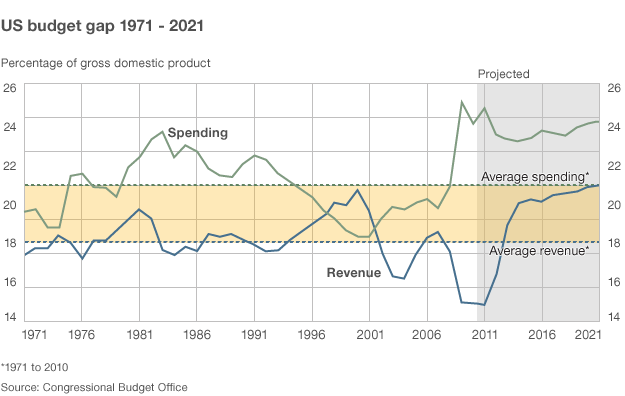
The debt and the delusion are both all-American: $14 trillion (£8.75tn) of debt has been amassed and there is no cogent plan to reduce it.
The figure is impossible to comprehend: easier to focus on the fact that it grows at $40,000 (£25,000) a second. Getting out of Afghanistan will help but actually only at the margins. The problem is much bigger than any one area of expenditure.
The economist Jeffrey Sachs, director of Columbia University’s Earth Institute, is no rabid fiscal conservative but on the debt he is a hawk: “I’m worried. The debt is large. It should be brought under control. The longer we wait, the longer we suffer this kind of paralysis; the more America boxes itself into a corner and the more America’s constructive leadership in the world diminishes.”
The author and economist Diane Coyle agrees. And she makes the rather alarming point that the acknowledged deficit is not the whole story.
The current $14tn debt is bad enough, she argues, but the future commitments to the baby boomers, commitments for health care and for pensions, suggest that the debt burden is part of the fabric of society:
“You have promises implicit in the structure of welfare states and aging populations that mean there is an unacknowledged debt that will have to be paid for by future taxpayers, and that could double the published figures.”
Richard Haass of the Council on Foreign Relations acknowledges that this structural commitment to future debt is not unique to the United States. All advanced democracies have more or less the same problem, he says, “but in the case of the States the figures are absolutely enormous”.
Mr Haass, a former senior US diplomat, is leading an academic push for America’s debt to be taken seriously by Americans and noticed as well by the rest of the world.
He uses the analogy of Suez and the pressure that was put on the UK by the US to withdraw from that adventure. The pressure was not, of course, military. It was economic.
Britain needed US economic help. In the future, if China chooses to flex its muscles abroad, it may not be Chinese admirals who pose the real threat, Mr Haass tells us. “Chinese bankers could do the job.”
Because of course Chinese bankers, if they withdrew their support for the US economy and their willingness to finance America’s spending, could have an almost overnight impact on every American life, forcing interest rates to sky high levels and torpedoing the world’s largest economy.
Not everyone accepts the debt-as-disaster thesis.
David Frum is a Republican intellectual and a former speech writer to President George W Bush.
He told me the problem, and the solution, were actually rather simple: “If I tell you you have a disease that will absolutely prostrate you and it could be prevented by taking a couple of aspirin and going for a walk, well I guess the situation isn’t apocalyptic is it?
“The things that America has to do to put its fiscal house in order are not anywhere near as extreme as what Europe has to do. The debt is not a financial problem, it is a political problem.”
Mr Frum believes that a future agreement to cut spending – he thinks America spends much too big a proportion of its GDP on health – and raise taxes, could very quickly bring the debt problem down to the level of quotidian normality.
‘Organised hypocrisy’
I am not so sure. What is the root cause of America’s failure to get to grips with its debt? It can be argued that the problem is not really economic or even political; it is a cultural inability to face up to hard choices, even to acknowledge that the choices are there.
I should make it clear that my reporting of the United States, in the years I was based there for the BBC, was governed by a sense that too much foreign media coverage of America is negative and jaundiced.
The nation is staggeringly successful and gloriously attractive. But it is also deeply dysfunctional in some respects.
Take Alaska. The author and serious student of America, Anne Applebaum makes the point that, as she puts it, “Alaska is a myth!”
People who live in Alaska – and people who aspire to live in Alaska – imagine it is the last frontier, she says, “the place where rugged individuals go out and dig for oil and shoot caribou, and make money the way people did 100 years ago”.
But in reality, Alaska is the most heavily subsidised state in the union. There is more social spending in Alaska than anywhere else.
To make it a place where decent lives can be lived, there is a huge transfer of money to Alaska from the US federal government which means of course from taxpayers in New York and Los Angeles and other places where less rugged folk live. Alaska is an organised hypocrisy.
Too many Americans behave like the Alaskans: they think of themselves as rugged individualists in no need of state help, but they take the money anyway in health care and pensions and all the other areas of American life where the federal government spends its cash.
The Tea Party movement talks of cuts in spending but when it comes to it, Americans always seem to be talking about cuts in spending that affect someone else, not them – and taxes that are levied on others too.
And nobody talks about raising taxes. Jeffrey Sachs has a theory about why this is.
America’s two main political parties are so desperate to raise money for the nation’s constant elections – remember the House of Representatives is elected every two years – that they can do nothing that upsets wealthy people and wealthy companies.
So they cannot touch taxes.
In all honesty, I am torn about the conclusions to be drawn. I find it difficult to believe that a nation historically so nimble and clever and open could succumb to disaster in this way.
But America, as well as being a place of hard work and ingenuity, is also no stranger to eating competitions in which gluttony is celebrated, and wilful ignorance, for instance regarding (as many Americans do) evolution as controversial.
The debt crisis is a fascinating crisis because it is about so much more than money. It is a test of a culture.
It is about waking up, as the Americans say, and smelling the coffee. And – I am thinking Texas here – saddling up too, and riding out with purpose.


 Learning from Dogs