Category: Environment

Chilean mine rescue – update

At last some recent news.

One of the problems of our modern media is that there is so much competition for news that old stories frequently just seem to disappear.

So it was delightful to find in last Saturday’s Daily Telegraph news that the rescue shaft had achieved a very important milestone – the pilot shaft, 12 inches in diameter, had broken through to the chamber where the miners patiently wait for their rescue.

Rescuers working to release 33 trapped Chilean miners have achieved a pivotal breakthrough by drilling an escape shaft through to the underground chamber occupied by the men.

Anyway, full story is here

And, of course, life does go on as this video clip happily illustrates.

By Paul Handover

Stonehenge, again!

As yesterday, travelling demands make it impossible to find creative time for the Blog.  Thus a repeat of one of the most popular Posts from the last year.

Incredible outcomes from the dig in 2008

Stonehenge is one of Britain’s most famous historical sites, deservedly so because Stonehenge was one of the most important places in ancient Europe.

Stonehenge
Professors Tim Darvill and Geoff Wainwright are the world-renowned archaeologists who believe they have cracked the conundrum of Stonehenge's original purpose.

But evidence from a dig that was authorised in 2008 has shown that not only is Stonehenge a much older site of human habitation but that it’s purpose is altogether different to what has been assumed.  It was, indeed, a healing place, possibly the most important in Europe.

Those living in the UK can watch the Timewatch programme on the BBC iPlayer.  But for those living outside the UK then the following web site has reams of wonderfully fascinating information.  That site is here.

By Paul Handover

Kevin Richardson, magic person

Apologies for the repeat but unable to write a fresh post for the next few days.  This post about Kevin has been one of the most popular on Learning from Dogs.

Trust is both taught and learnt!

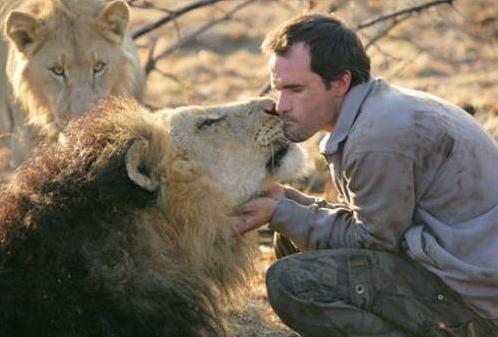
Thanks to Naked Capitalism, we posted an item on the 19th December about an unknown wild-life ranger working in the wildlife refuge area of Lanseria, South Africa.  Here was one of the pictures included in that Post:

The Post finished with an appeal to anyone that knew the name of this Ranger.  Many of you did and responded; thank you!

His name is Kevin Richardson and there is an interesting account of how he works and some of his ‘experiences’ in Revolution Magazine, luckily with online content.  That article is here.  It starts thus:

To do this he does not use the common methods of breaking the animal’s spirit with sticks and chains, instead he uses love, understanding and trust. With this unusual method of training he has developed some exceptionally personal bonds with his students. He sleeps with lions, cuddles newborn hyenas, swims with lionesses.  Kevin can confidently look into their eyes, crouch to the their level and even lie down with them – all taboos in the normal world of wild animal handling – yet he doesn’t get  mauled or attacked.

The article goes on to say that Kevin often works with the animals when they are very young.  Thus he is demonstrating very powerfully that how we behave, especially with our children when they are young, creates the environment for building trust out of consistency of deed and thought.  (By the way, do read some of the comments posted at the end of that Magazine article – some of them make for powerful reading.)

Kevin Richardson at 'work'.

Luckily, thanks to this wired world we now live in, there is also video of Kevin available on YouTube.  A quick search under Kevin Richardson on YouTube will quickly find a number of videos but here are two that I wanted to share with you.

The first will leave you speechless and possibly wet-eyed!

The second is a promotional video by Kevin encouraging us to buy his recent book – and why not!

This is a very remarkable person and it’s an honour to share this with you.  We have so much to learn from all animals.

By Paul Handover

The entombed Chilean miners

Advice and support includes NASA

The BBC reported last Wednesday (1st) the fact that NASA are now advising the Chilean authorities with regard to the trapped miners.

At first, I did a double-take.  NASA?  Why?

But, of course, it make complete sense.  Astronauts clearly have had to face the most extreme form of loneliness – that of being alone in outer space.

Here’s an extract from that BBC piece, which has been widely reported elsewhere:

A team of Nasa experts advised officials to be honest with the miners and not to give them “false hopes”.

The miners, who are 700m (2,300ft) underground, have been told it could take a long time to get them out of the San Jose mine, but have not been given dates.

The Nasa team, which includes a doctor, nutritionist, and engineer and a psychologist, arrived in Santiago after a request by the Chilean authorities. They are due to travel to the mine site on Wednesday.

All we can do is to keep these miners in our minds and hearts.

By Paul Handover

Tough day? Try this! Update.

Let’s all pray to keep the flame of hope burning brightly for these guys.

On the 24th August, Learning from Dogs published a piece about 33 Chilean miners trapped underground.  I’m sure many read that.

Well the BBC are still covering the event and their news web site has an informative update on what is happening.

The plan to rescue the 33 men trapped 700m (2,300ft) underground in the San Jose copper mine in Chile is a complex undertaking that could take engineers until the end of the year to achieve.

In a similar operation in 2002, American rescuers spent two days drilling a hole just wide enough to fit a man to rescue nine miners trapped underground.

The Americans had to drill down just 74m. By comparison, the plan to rescue the 33 men in Chile nearly three quarters of a kilometre underground is a much greater challenge. But, says John Urosek, who took part in the 2002 Quecreek mine rescue in Pennsylvania, it is not “mission impossible.”

“I would put this at the tough end of things. It’s not mission impossible but it’s a difficult mission,” says Mr Urosek who is now chief of mine emergency operations for the US Mine Safety and Health Administration.

The key to the operation is the use of a specialist drilling machine, designed to bore deep narrow holes through any rock to a depth of just over a kilometre.

Strata 950 raise bore machine

Do read the article in full on the BBC site.

RUC Cementation in Australia have an interesting website that includes pictures of the Strata 950 bore machine that will be sinking the rescue shaft.

Best of luck to all involved and to all the families and friends having to sit this out!

By Paul Handover

2001: A Space Odyssey

Even today, still an amazing film

Jean and I watched this film the other evening.  I have seen it a number of times but Jean just once before when it first was released in 1968!  Yes, over 40 years ago!

What struck me watching it today was how beautifully slow the film was.  I mean in the sense of camera and scene changes.  I had forgotten just how beautiful the film was from a technical perspective.  It held the eye and brain in a way that seemed so foreign to the way that films have been made in the last so many years.

WikiPedia has a very good summary of the film.

And there are more summaries on the INDB website, here’s an example:

“2001” is a story of evolution. Sometime in the distant past, someone or something nudged evolution by placing a monolith on Earth (presumably elsewhere throughout the universe as well). Evolution then enabled humankind to reach the moon’s surface, where yet another monolith is found, one that signals the monolith placers that humankind has evolved that far. Now a race begins between computers (HAL) and human (Bowman) to reach the monolith placers. The winner will achieve the next step in evolution, whatever that may be.

The sign!

What is just as interesting is remembering the feelings that I had when I first saw the film, probably in 1968 or 1969, when I was living out in Australia, aged mid-twenties!

I was incredibly fascinated by the US expeditions out to the moon with the actual landing in July 1969.  Indeed, I rented a TV and took a complete week’s holiday from work just to watch every minute of this historical event.

So the film, 2001: A Space Odyssey, seemed to capture, for me anyway, the feelings and mood of a brave new world reaching out beyond Planet Earth.  The year 2001 felt like aeons away.  It was obvious that when we eventually got to the 21st century, mankind would be unbelievably advanced in many exciting and positive ways.

Ah, the dreams of the naive young!

Now here we are heading towards the year 2011 and the world, I mean mankind, seems to be going where?  Here’s Jon Lavin’s rather sombre view:

Have been musing about the part failure of the Russian grain harvest and the resultant speculation, that has forced the grain price up astronomically, the impact on bread/food/beer etc., evidence of the same mentality that kicked the banks/investments recession off.

Also, the fact that Lloyds TSB are 43% owned by the British people and are charging interest on non-approved loans of 165% and have a bonus fund of half billion pounds that certainly they have not asked my permission about.

This continuing lack of integrity, in the face of food shortages, untold hardship for millions of people, just goes to show that until an absolute calamity strikes to stop the whole of mankind in our tracks, it’s business as usual for the financially-led people and get-rich-on-the-back-of-anything-and-anybody crowd.

Are we still at consciousness level 204 or have we crossed back below the threshold, back below integrity 200, where falsehood rules?

The answer is to retain faith in the future, faith in the power of love and compassion, and faith in the fact that being the best that we can be today, now, in the present, just as dogs are so wonderful at doing, will bring us the better tomorrows we all dreamed about in 1968.  Here’s a reminder:

By Paul Handover

P.S. Serendipity at work.  Saw this from the BBC less than 5 minutes after completing this Post!

Tough day? Try this!

It will take at least four months to rescue 33 miners trapped underground in Chile, the head of the rescue operation has said.

From the BBC.

Ouch, ouch and ouch!

So if you are having a bad day, stop and think about these 33 souls buried some 4.5 miles (7km) inside a Chilean mine some 2,300 feet (700m) down .

The announcement that they were still alive was made on Sunday by Chilean President Sebastian Pinera.

Surrounded by relatives of the miners who have gathered outside the mine, he held up a note from the miners saying: “All 33 of us are fine in the shelter.”

“It will take months to get them out,” Mr Pinera said. “They’ll come out thin and dirty, but whole and strong.”

Amen to that!

Todd Russell and Brant Webb endured 14 days in a Tasmanian mine in 2006.  This is what Todd told the BBC World Service:

Todd Russell, an Australian miner who was trapped 3,000ft underground in Tasmania after an earthquake in 2006, said he and a second miner who survived the collapse relied on each other for support.

“It’s amazing what your body can do,” he told the BBC World Service. “We survived on hope and courage, and each other, [and] we were lucky enough to have a bit of underground mine water.”

“They’re lucky that they’ve got 33 guys there with them that they can rely on each other,” Mr Russell said.

Here’s some footage of their rescue:

Let’s all pray that these 33 Chilean miners end up arm-in-arm back on the surface as Todd and Brant did.

Brant Webb and Todd Russell

By Paul Handover

Silent river runs deep!

And how so …

Wikipedia has been quick to register an account of something that I saw on the The Daily Telegraph website on the 1st August, 2010.

That is:

Researchers working in the Black Sea have found currents of water 350 times greater than the River Thames flowing along the sea bed, carving out channels much like a river on the land.

The undersea river, which is up to 115ft deep in places, even has rapids and waterfalls much like its terrestrial equivalents.

If found on land, scientists estimate it would be the world’s sixth largest river in terms of the amount of water flowing through it.

The researchers at the University of Leeds in England used a robotic submarine to carry out the investigations, as their news item explains.

These channels are the main transport pathway for sediments to the deep sea where they form sedimentary deposits. These deposits ultimately hold not only untapped reserves of gas and oil, they also house important secrets – from clues on past climate change to the ways in which mountains were formed.

Now the team, led by Dr Dan Parsons and Dr Jeff Peakall from the University of Leeds, has been able to study the detailed flow within these channels. Dr Parsons, said: “The channel complex and the density flow provide the ideal natural laboratory for investigating and detailing the structure of the flow field through the channel.

Fascinating!

Black Sea underground 'river'.

By Paul Handover

Another ‘ah’ moment!

Again, apologies for a ‘thin’ posting – here’s why.

I first saw this in Naked Capitalism but the picture came from the UK’s Daily Telegraph newspaper 6th August, 2010.

Trust!

The accompanying text:

This baby six-week old kookaburra called Kookie and a tiny duckling have struck up a friendship at the Seaview Wildlife Encounter, near Ryde in the Isle of Wight. Kookie was saved by staff after they feared his parents would kill him. And the duckling was rescued from one of the park’s aviaries because he was thought too small to defend himself against larger birds. Keepers took a chance and decided to see what would happen if they were put together. The duckling instantly cuddled up under Kookie’s protective wing, thinking he was his mum and Kookie didn’t seem to mind playing the caring parent

Picture: MIKAEL BUCK / SOLENT

By Paul Handover

A chance to pause.

The beauty of wild deer.

Apologies for a ‘thin’ posting – here’s why.

Wild English deer.

Julie has gone on ahead, but returns to tell me that the sika deer are feeding in the reed beds ahead of us. (These are one of two types of deer found at Holton Lee.) She offers to stay with Genie while I go and photograph them, so that Genie won’t frighten them off. They see me, but continue feeding whilst remaining alert.

It really is a magical sight – I am quite converted from my original anxiety about deer leaping out in front of the car!

There is something extremely primeval about deer, which is probably not surprising as their bodies have provided everything from meat and clothing to fish hooks and sinews for many indigenous people, while still remaining wild. It is hard to see why anyone would hunt them simply for sport, though, and I fear that Walt Disney has spoilt me for enjoying venison – ancient, organic, sustainable, non-farmed food source or not, it would be like eating Bambi!

Taken from Ju’s Holton Lee blog.

By Paul Handover