Category: Environment

Plan B for Planet Earth

Going for a sustainable future is not ‘pie in the sky’.

I have been attempting to write on Learning from Dogs about my experience reading the Lester Brown book, World on the Edge. In

Lester Brown's book

fact, there have been four articles written all with the title Total, Utter Madness (Pts 1 to 4.)  If you read the early chapters of Lester’s book you will have no issue with the notion of summarising the propositions that he presents as ‘total, utter madness’.

There was another article published on the 3rd March that I called, ‘Where are we off to?‘ that presented more information about the fragility of mankind on this Planet if we don’t change our ways, and soon. (There are links to all my articles from this 3rd March piece.)

But much of the second half of Lester Brown’s book is about the relative ease with which we can change the way we all live and offer the generations ahead of us a real alternative to the selfish, greedy way in which we treat Planet Earth at present.  That alternative is called Plan B.

Plan B offers the real hope of developing a sustainable relationship with our planet.  So this post is to reproduce in full a recent release by the Earth Policy Institute about wind power.

Wind: The Center of the Plan B Economy

Lester R. Brown

For many years, a small handful of countries dominated growth in wind power, but this is changing as the industry goes global, with more than 70 countries now developing wind resources. Between 2000 and 2010, world wind electric generating capacity increased at a frenetic pace from 17,000 megawatts to nearly 200,000 megawatts.

Measured by share of electricity supplied by wind, Denmark is the leading nation at 21 percent. Three north German states now get 40 percent or more of their electricity from wind. For Germany as a whole, the figure is 8 percent—and climbing. And in the state of Iowa, enough wind turbines came online in the last few years to produce up to 20 percent of that state’s electricity.

In terms of sheer volume, the United States leads the world with 35,000 megawatts of wind generating capacity, followed by China and Germany with 26,000 megawatts each. Texas, long the leading U.S. oil-producing state, is now also the nation’s leading generator of electricity from wind. It has 9,700 megawatts of wind generating capacity online, 370 megawatts more under construction, and a huge amount under development. If all of the wind farms projected for 2025 are completed, Texas will have 38,000 megawatts of wind generating capacity—the equivalent of 38 coal-fired power plants. This would satisfy roughly 90 percent of the current residential electricity needs of the state’s 25 million people.

In July 2010, ground was broken for the Alta Wind Energy Center (AWEC) in the Tehachapi Pass, some 75 miles north of Los Angeles, California. At 1,550 megawatts, it will be the largest U.S. wind farm. The AWEC is part of what will eventually be 4,500 megawatts of renewable power generation, enough to supply electricity to some 3 million homes.

Since wind turbines occupy only 1 percent of the land covered by a wind farm, farmers and ranchers can continue to grow grain and graze cattle on land devoted to wind farms. In effect, they double-crop their land, simultaneously harvesting electricity and wheat, corn, or cattle. With no investment on their part, farmers and ranchers typically receive $3,000–10,000 a year in royalties for each wind turbine on their land. For thousands of ranchers in the U.S. Great Plains, wind royalties will dwarf their net earnings from cattle sales.

In considering the energy productivity of land, wind turbines are in a class by themselves. For example, an acre of land in northern Iowa planted in corn can yield $1,000 worth of ethanol per year. That same acre used to site a wind turbine can produce $300,000 worth of electricity per year. This helps explain why investors find wind farms so attractive.

Impressive though U.S. wind energy growth is, the expansion now under way in China is even more so. China has enough onshore harnessable wind energy to raise its current electricity consumption 16-fold. Today, most of China’s 26,000 megawatts of wind generating capacity come from 50- to 100-megawatt wind farms. Beyond the many other wind farms of that size that are on the way, China’s new Wind Base program is creating seven wind mega-complexes of 10 to 38 gigawatts each in six provinces (1 gigawatt equals 1,000 megawatts). When completed, these complexes will have a generating capacity of more than 130 gigawatts. This is equivalent to building one new coal plant per week for two and a half years.

Of these 130 gigawatts, 7 gigawatts will be in the coastal waters of Jiangsu Province, one of China’s most highly industrialized provinces. China is planning a total of 23 gigawatts of offshore wind generating capacity. The country’s first major offshore project, the 102-megawatt Donghai Bridge Wind Farm near Shanghai, is already in operation.

In Europe, which now has 2,400 megawatts of offshore wind online, wind developers are planning 140 gigawatts of offshore wind generating capacity, mostly in the North Sea. There is enough harnessable wind energy in offshore Europe to satisfy the continent’s needs seven times over.

In September 2010, the Scottish government announced that it was replacing its goal of 50 percent renewable electricity by 2020 with a new goal of 80 percent. By 2025, Scotland expects renewables to meet all of its electricity needs. Much of the new capacity will be provided by offshore wind.

Denmark is looking to push the wind share of its electricity to 50 percent by 2025, with most of the additional power coming from offshore. In contemplating this prospect, Danish planners have turned conventional energy policy upside down. They plan to use wind as the mainstay of their electrical generating system and to use fossil-fuel-generated power to fill in when the wind dies down.

Spain, which has 19,000 megawatts of wind-generating capacity for its 45 million people, got 14 percent of its electricity from wind in 2009. On November 8th of that year, strong winds across Spain enabled wind turbines to supply 53 percent of the country’s electricity over a five-hour stretch. London Times reporter Graham Keeley wrote from Barcelona that “the towering white wind turbines which loom over Castilla-La Mancha—home of Cervantes’s hero, Don Quixote—and which dominate other parts of Spain, set a new record in wind energy production.”

In 2007, when Turkey issued a request for proposals to build wind farms, it received bids to build a staggering 78,000 megawatts of wind generating capacity, far beyond its 41,000 megawatts of total electrical generating capacity. Having selected 7,000 megawatts of the most promising proposals, the government is issuing construction permits.

In wind-rich Canada, Ontario, Quebec, and Alberta are the leaders in installed capacity. Ontario, Canada’s most populous province, has received applications for offshore wind development rights on its side of the Great Lakes that could result in some 21,000 megawatts of generating capacity. The provincial goal is to back out all coal-fired power by 2014.

On the U.S. side of Lake Ontario, New York State is also requesting proposals. Several of the seven other states that border the Great Lakes are planning to harness lake winds.

Earth Policy Institute’s Plan B to save civilization has four components: stabilizing climate, restoring earth’s natural support systems, stabilizing population, and eradicating poverty. At the heart of the plan is a crash program to develop 4,000 gigawatts (4 million megawatts) of wind generating capacity by 2020, enough to cover over half of world electricity consumptionin the Plan B economy. This will require a near doubling of capacity every two years, up from a doubling every three years over the last decade.

This climate-stabilizing initiative would mean the installation of 2 million wind turbines of 2 megawatts each. Manufacturing 2 million wind turbines over the next 10 years sounds intimidating—until it is compared with the 70 million automobiles the world produces each year.

At $3 million per installed turbine, the 2 million turbines would mean spending $600 billion per year worldwide between now and 2020. This compares with world oil and gas capital expenditures that are projected to double from $800 billion in 2010 to $1.6 trillion in 2015.

Adapted from Chapter 9, “Harnessing Wind, Solar, and Geothermal Energy” in Lester R. Brown, World on the Edge: How to Prevent Environmental and Economic Collapse (New York: W.W. Norton & Company, 2011), available online at www.earth-policy.org/books/wote.

The full moon – very full!

Brought forward as a result of the Japanese earthquake.

I had this item scheduled for publication on Friday 18th March, the day before this month’s full moon.  But recent events in Japan made me decide to bring it forward to today for reasons that will be clear when this Post is read further.

The world is set to experience the biggest full moon for almost two decades when the satellite reaches its closest point to Earth next weekend.

On 19 March, the full moon will appear unusually large in the night sky as it reaches a point in its cycle known as ‘lunar perigee’.

Stargazers will be treated to a spectacular view when the moon approaches Earth at a distance of 221,567 miles (356,577 km) in its elliptical orbit – the closest it will have passed to our planet since 1992.

The full moon could appear up to 14% bigger and 30% brighter in the sky, especially when it rises on the eastern horizon at sunset or is provided with the right atmospheric conditions.

Moon apogee and perigee

This phenomenon has reportedly heightened concerns about ‘supermoons’ being linked to extreme weather events – such as earthquakes, volcanoes and tsunamis. The last time the moon passed close to the Earth was on 10 January 2005, around the time of the Indonesian earthquake that measured 9.0 on the Richter scale.

Hurricane Katrina in 2005 was also associated with an unusually large full moon.

Previous supermoons occurred in 1955, 1974 and 1992 – each of these years experienced extreme weather events, killing thousands of people.

However, an expert speaking to Yahoo! News today believes that a larger moon causing weather chaos is a popular misconception.

Dr Tim O’Brien, a researcher at the Jodrell Bank Centre for Astrophysics at the University of Manchester, said: “The dangers are really overplayed. You do get a bit higher than average tides than usual along coastlines as a result of the moon’s gravitational pull, but nothing so significant that will cause a serious climatic disaster or anything for people to worry about.”

But according to Dr Victor Gostin, a Planetary and Environmental Geoscientist at Adelaide University, there may be a link between large-scale earthquakes in places around the equator and new and full moon situations.

He said: “This is because the Earth-tides (analogous to ocean tides) may be the final trigger that sets off the earthquake.”

UPDATE: This was noted in Naked Capitalism on Saturday.

Volcanoes have reportedly erupted in JapanIndonesia, and Kamchatka Russia today, presumably due to the massive Japanese earthquake. There have been no reports of damage from the eruptions.

Where are we off to?

More musings on how this present civilisation is going to change, as change it must.

I have a sense that this article is going to spread across a number of posts.  Regular readers of Learning from Dogs will be aware that I am summarising Lester Brown’s excellent book, World on the Edge.  If you have missed those summaries, the last one, Part 4, was here. (Part 3 here, Part 2 here, Part 1 here.)

Details of this excellent book are on the Earth Policy Institute website including the opportunity to download the book for free.

OK, back to the theme of this article, very much connected with the mission of the EPI.

Jean and I watched a video last night from the website Top Documentary Films; great site by the way.  It was called 2210: The Collapse.  This was how the film was described on that website.

Imagine if hundreds of years from now, scientists excavated the abandoned ruins of some of our largest cities, what conclusions would they come to?

It happened to the Romans, the Anasazi, and the Mayans and, inevitably, one day our own modern civilization will also fall. In this two hour special discover how a future civilization might be baffled as to why the population of these once-great cities would suddenly abandon their technology and architecture, and turn their homes into ghost towns.

Some experts believe that there is a very real risk this could happen, and the collapse of the world as we know it is closer than we think.

Examining the parallels between cultures separated by hundreds of years, explore whether the key to preventing such a global collapse today could lie in finding renewable alternatives to our dwindling energy supplies and sustainable resources. Can we learn from the mistakes of the past before it’s too late?

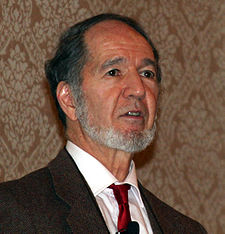
Jared Diamond

In some ways the film didn’t cover any new ground despite it being an interesting way of approaching the subject of the future of our present civilisation.  But what was really worthwhile were the clips from three experts in their various fields.  They were the author Jared Diamond, Daniel Gilbert who is Professor of Psychology at Havard, and Joseph Tainter also an author.  There is much material around from these three gentlemen.

So I am going to start with Jared Diamond.  WikiPedia has Jared’s details.  The following is a video going back to 2003 which is no less relevant in terms of where we are in 2011.  (If you want more of Jared’s ideas, just let me know and they will be included in a future Post.)

“I’ve set myself the modest task of trying to explain the broad pattern of human history, on all the continents, for the last 13,000 years. Why did history take such different evolutionary courses for peoples of different continents? This problem has fascinated me for a long time, but it’s now ripe for a new synthesis because of recent advances in many fields seemingly remote from history, including molecular biology, plant and animal genetics and biogeography, archaeology, and linguistics.”

JARED DIAMOND is Professor of Geography at the University of California, Los Angeles. Until recently he was Professor of Physiology at the UCLA School of Medicine. He is the author of the recently published Collapse: How Societies Choose to Fail or Succeed, and the Pulitzer Prize-winning author of the widely acclaimed Guns, Germs, and Steel: the Fates of Human Societies, which also is the winner of Britain’s 1998 Rhone-Poulenc Science Book Prize.  (From here)

Truth, myth and meaning

A musing on Chief Seattle’s famous speech.

I came across this recently following a bit of a prowl through YouTube.   The YouTube video, although deeply moving, is more myth than factual record; as one finds out if even a small amount of probing is undertaken.

But does it matter?  Maybe those ideas that reach out to us in a spiritual sense are as powerful as myths, perhaps even more so, than as ‘facts’.

Here’s that YouTube video.

Did you watch it all?  I hope so. Did it disturb you to know that this wasn’t a factual rendition?  Probably not.

WikiPedia has a comprehensive account of Chief Seattle and in terms of the speech here’s an extract:

There is a controversy about a speech by Si’ahl concerning the concession of native lands to the settlers.

Even the date and location of the speech has been disputed,[8] but the most common version is that on March 11, 1854, Si’ahl gave a speech at a large outdoor gathering in Seattle. The meeting had been called by Governor Isaac Ingalls Stevens to discuss the surrender or sale of native land to white settlers.Doc Maynard introduced Stevens, who then briefly explained his mission, which was already well understood by all present.[3]

Si’ahl then rose to speak. He rested his hand upon the head of the much smaller Stevens, and declaimed with great dignity for an extended period. No one alive today knows what he said; he spoke in the Lushootseed language, and someone translated his words into Chinook jargon, and a third person translated that into English.

So in terms of looking for the truth, forget it.

But in terms of being inspired to regard the land, and all that depends on it, as sacred then the myth of Chief Seattle’s words is beautiful and powerful, a myth that modern man has just about rejected.

If you want to read the words that are supposed to be the most authentic recording of what the noble Chief said, then these follow.  They are taken from here and the introduction and footnotes are valuable background information.  You may also want to read this account of the speech from the Washington State Library.

The only known photograph of Chief Seattle, taken 1864.


Scraps from a Diary:
Chief SeattleA gentleman by Instinct
His Native Eloquence, etc., etc.

by Henry A. Smith
10th article in the series “Early Reminiscences”
Seattle Sunday Star, October 29, 1887

Yonder sky that has wept tears of compassion upon my people for centuries untold, and which to us appears changeless and eternal, may change. Today is fair. Tomorrow it may be overcast with clouds. My words are like the stars that never change. Whatever Seattle says, the great chief at Washington can rely upon with as much certainty as he can upon the return of the sun or the seasons. The white chief says that Big Chief at Washington sends us greetings of friendship and goodwill. This is kind of him for we know he has little need of our friendship in return. His people are many. They are like the grass that covers vast prairies. My people are few. They resemble the scattering trees of a storm-swept plain. The great, and I presume — good, White Chief sends us word that he wishes to buy our land but is willing to allow us enough to live comfortably. This indeed appears just, even generous, for the Red Man no longer has rights that he need respect, and the offer may be wise, also, as we are no longer in need of an extensive country.  

There was a time when our people covered the land as the waves of a wind-ruffled sea cover its shell-paved floor, but that time long since passed away with the greatness of tribes that are now but a mournful memory. I will not dwell on, nor mourn over, our untimely decay, nor reproach my paleface brothers with hastening it, as we too may have been somewhat to blame.

Youth is impulsive. When our young men grow angry at some real or imaginary wrong, and disfigure their faces with black paint, it denotes that their hearts are black, and that they are often cruel and relentless, and our old men and old women are unable to restrain them. Thus it has ever been. Thus it was when the white man began to push our forefathers ever westward. But let us hope that the hostilities between us may never return. We would have everything to lose and nothing to gain. Revenge by young men is considered gain, even at the cost of their own lives, but old men who stay at home in times of war, and mothers who have sons to lose, know better.

Our good father in Washington—for I presume he is now our father as well as yours, since King George has moved his boundaries further north—our great and good father, I say, sends us word that if we do as he desires he will protect us. His brave warriors will be to us a bristling wall of strength, and his wonderful ships of war will fill our harbors, so that our ancient enemies far to the northward — the Haidas and Tsimshians — will cease to frighten our women, children, and old men. The in reality he will be our father and we his children. But can that ever be? Your God is not our God! Your God loves your people and hates mine! He folds his strong protecting arms lovingly about the paleface and leads him by the hand as a father leads an infant son. But, He has forsaken His Red children, if they really are His. Our God, the Great Spirit, seems also to have forsaken us. Your God makes your people wax stronger every day. Soon they will fill all the land. Our people are ebbing away like a rapidly receding tide that will never return. The white man’s God cannot love our people or He would protect them. They seem to be orphans who can look nowhere for help. How then can we be brothers? How can your God become our God and renew our prosperity and awaken in us dreams of returning greatness? If we have a common Heavenly Father He must be partial, for He came to His paleface children. We never saw Him. He gave you laws but had no word for His red children whose teeming multitudes once filled this vast continent as stars fill the firmament. No; we are two distinct races with separate origins and separate destinies. There is little in common between us.

To us the ashes of our ancestors are sacred and their resting place is hallowed ground. You wander far from the graves of your ancestors and seemingly without regret. Your religion was written upon tablets of stone by the iron finger of your God so that you could not forget. The Red Man could never comprehend or remember it. Our religion is the traditions of our ancestors — the dreams of our old men, given them in solemn hours of the night by the Great Spirit; and the visions of our sachems, and is written in the hearts of our people.

Your dead cease to love you and the land of their nativity as soon as they pass the portals of the tomb and wander away beyond the stars. They are soon forgotten and never return. Our dead never forget this beautiful world that gave them being. They still love its verdant valleys, its murmuring rivers, its magnificent mountains, sequestered vales and verdant lined lakes and bays, and ever yearn in tender fond affection over the lonely hearted living, and often return from the happy hunting ground to visit, guide, console, and comfort them.

Day and night cannot dwell together. The Red Man has ever fled the approach of the White Man, as the morning mist flees before the morning sun. However, your proposition seems fair and I think that my people will accept it and will retire to the reservation you offer them. Then we will dwell apart in peace, for the words of the Great White Chief seem to be the words of nature speaking to my people out of dense darkness.

It matters little where we pass the remnant of our days. They will not be many. The Indian’s night promises to be dark. Not a single star of hope hovers above his horizon. Sad-voiced winds moan in the distance. Grim fate seems to be on the Red Man’s trail, and wherever he will hear the approaching footsteps of his fell destroyer and prepare stolidly to meet his doom, as does the wounded doe that hears the approaching footsteps of the hunter.

A few more moon, a few more winters, and not one of the descendants of the mighty hosts that once moved over this broad land or lived in happy homes, protected by the Great Spirit, will remain to mourn over the graves of a people once more powerful and hopeful than yours. But why should I mourn at the untimely fate of my people? Tribe follows tribe, and nation follows nation, like the waves of the sea. It is the order of nature, and regret is useless. Your time of decay may be distant, but it will surely come, for even the White Man whose God walked and talked with him as friend to friend, cannot be exempt from the common destiny. We may be brothers after all. We will see.

We will ponder your proposition and when we decide we will let you know. But should we accept it, I here and now make this condition that we will not be denied the privilege without molestation of visiting at any time the tombs of our ancestors, friends, and children. Ever part of this soil is sacred in the estimation of my people. Every hillside, every valley, every plain and grove, has been hallowed by some sad or happy event in days long vanished. Even the rocks, which seem to be dumb and dead as the swelter in the sun along the silent shore, thrill with memories of stirring events connected with the lives of my people, and the very dust upon which you now stand responds more lovingly to their footsteps than yours, because it is rich with the blood of our ancestors, and our bare feet are conscious of the sympathetic touch. Our departed braves, fond mothers, glad, happy hearted maidens, and even the little children who lived here and rejoiced here for a brief season, will love these somber solitudes and at eventide they greet shadowy returning spirits. And when the last Red Man shall have perished, and the memory of my tribe shall have become a myth among the White Men, these shores will swarm with the invisible dead of my tribe, and when your children’s children think themselves alone in the field, the store, the shop, upon the highway, or in the silence of the pathless woods, they will not be alone. In all the earth there is no place dedicated to solitude. At night when the streets of your cities and villages are silent and you think them deserted, they will throng with the returning hosts that once filled them and still love this beautiful land. The White Man will never be alone.

Let him be just and deal kindly with my people, for the dead are not altogether powerless.


Amen to that.

Magical nature

Big thanks to Dogkisses’ Blog for highlighting this video from National Geographic.

Nothing to add to the video – just watch it, be enthralled and reflect on our need to be in spiritual harmony with our beautiful planet Earth. (N.B. for whatever reason, I was unable to embed the code in this Post so you will have to click here to watch this short video.  But do it’s magical.)

Then if you want more, watch this:

Total, utter madness, Pt 4

Continuing the review of Lester Brown’s book World on the Edge.

Regular readers will be aware that I have been summarising each chapter of this pivotal book.  Chapters 2, 3 and 4 are part of the section that Lester Brown calls A Deteriorating Foundation.  But I am aware that wall-to-wall gloom is often too much for people to take in so I wanted to let you know that the third section, The Response: Plan B, is very much a realistic and pragmatic approach to the alternative, a planet that will let countless future generations live in harmony and sustainably.

So please take in the dire situation that we are in by reading these summaries or, better still, buy the book!

Chapter Four, Rising Temperatures, Melting Ice, and Food Security.

  • The Petermann Glacier calves an iceberg that covered 97 square miles on August 5th, 2010.
  • Scientists for some years have been reporting that the Greenland ice sheet was melting at an accelerating rate.
  • Richard Bates, from the University of St Andrews, part of a team monitoring Greenland ice melt, was reported as saying:

Dr Richard Bates, who is monitoring the ice alongside researchers from America, said the expedition had expected to find evidence of melting this year after “abnormally high” temperatures in the area. Climate change experts say that globally it has been the warmest six months globally since records began.

But he was “amazed to see an area of ice three times the size of Manhattan Island had broken off.

“It is not a freak event and is certainly a manifestation of warming. This year marks yet another record breaking melt year in Greenland; temperatures and melt across the entire ice sheet have exceeded those in 2007 and of historical records.”

  • A temperate rise of between 2C and 7C would cause the entire Greenland ice mass to melt – raising sea-levels world-wide by 23 feet (7 metres)!
  • In the United States last year saw record hot temperatures on the East Coast.
  • On September 27th Los Angeles recorded an all-time high of 113 degrees F, then the official thermometer broke.
  • A nearby thermometer survived to register a temperature of 119 degrees F, a record for the region.
  • Crop ecologists use a rule of thumb that for each 1-degree-Celsius rise in temperature above the optimum during the growing season, we can expect a 10-percent decline in grain yields.
  • Temperatures are rising much faster in the Arctic than elsewhere.  Winter temperatures in the Arctic, including Alaska, western Canada and eastern Russia, have climbed by 4-7 degrees F. over the last half-century.
  • This record rise in temperatures in the Arctic region could lead to changes in climate patterns that will affect the entire planet.
  • Even a 3-foot rise in sea level would sharply reduce the rice harvest in Asia. It would inundate Bangladesh, a country of 164 million people, submerge part of the Mekong Delta ( a region that produces half of Viet Nam’s rice).

That’s enough from me, simply because although this chapter in the book continues with many more frightening facts, I can’t continue to list them in this particular Post.  If the above doesn’t cause you to think and want to change, then a couple of dozen more facts aren’t going to do it either.

Just look at the photograph below and ponder on what we are leaving our children and our grand-children.  Indeed, if you are, say 50 years or younger, ponder on what the next few decades could offer for you.

We have to break our addiction with our modern way of living – or Planet Earth will do it for us.

A mother of an iceberg!

On Aug. 5, 2010, an enormous chunk of ice, roughly 97 square miles (251 square kilometers) in size, broke off the Petermann Glacier, along the northwestern coast of Greenland. The Canadian Ice Service detected the remote event within hours in near real-time data from the Moderate Resolution Imaging Spectroradiometer (MODIS) on NASA’s Aqua satellite. The Petermann Glacier lost about one-quarter of its 70-kilometer (40-mile) long floating ice shelf, said researchers who analyzed the satellite data at the University of Delaware. Taken from here.

Food prices are up, up and up!

Interesting release from the Earth Policy Institute.

On the 3rd February I wrote a piece about the above Institute of which I had recently become aware.  That was in conjunction with the book World on the Edge that I had started reading.  Since then I have been summarising chapters on Learning from Dogs under the general heading of Total, Utter Madness.

So with food prices continuing to reach record levels around the world, with all the implications this carries for millions of families, I was interested to read the following which was emailed to me on the 15th from the EPI.

World One Poor Harvest Away From Chaos

www.earth-policy.org/plan_b_updates/2011/update91

By Lester R. Brown
Earth Policy Release
Plan B Update
February 15, 2011

Today there are three sources of growing demand for food: population growth; rising affluence and the associated jump in meat, milk, and egg consumption; and the use of grain to produce fuel for cars.

In early January, the U.N. Food and Agriculture Organization (FAO) reported that its Food Price Index had reached an all-time high in December, exceeding the previous record set during the 2007-08 price surge. Even more alarming, on February 3rd, the FAO announced that the December record had been broken in January as prices climbed an additional 3 percent.

Will this rise in food prices continue in the months ahead? In all likelihood we will see further rises that will take the world into uncharted territory in the relationship between food prices and political stability.

Everything now depends on this year’s harvest. Lowering food prices to a more comfortable level will require a bumper grain harvest, one much larger than the record harvest of 2008 that combined with the economic recession to end the 2007-08 grain price climb.

If the world has a poor harvest this year, food prices will rise to previously unimaginable levels. Food riots will multiply, political unrest will spread and governments will fall. The world is now one poor harvest away from chaos in world grain markets.

Over the longer term, expanding food production rapidly is becoming more difficult as food bubbles based on the overpumping of underground water burst, shrinking grain harvests in many countries. Meanwhile, increasing climate volatility, including more frequent, more extreme weather events, will make the expansion of production more erratic.

Some 18 countries have inflated their food production in recent decades by overpumping aquifers to irrigate their crops. Among these are China, India, and the United States, the big three grain producers.

When water-based food bubbles burst in some countries, they will dramatically reduce production. In others, they may only slow production growth. In Saudi Arabia, which was wheat self-sufficient for more than 20 years, the wheat harvest is collapsing and will likely disappear entirely within a year or so as the country’s fossil (nonreplenishable) aquifer, is depleted.

In Syria and Iraq, grain harvests are slowly shrinking as irrigation wells dry up. Yemen is a hydrological basket case, where water tables are falling throughout the country and wells are going dry. These bursting food bubbles make the Arab Middle East the first geographic region where aquifer depletion is shrinking the grain harvest.

While these Middle East declines are dramatic, the largest water-based food bubbles are in India and China. A World Bank study indicates that 175 million people in India are being fed with grain produced by overpumping. In China, overpumping is feeding 130 million people. Spreading water shortages in both of these population giants are making it more difficult to expand their food supplies.

Beyond irrigation wells going dry, farmers must contend with climate change. Crop ecologists have a rule of thumb that for each 1-degree-Celsius rise in temperature during the growing season, grain yields drop 10 percent. Thus it was no surprise that searing temperatures in western Russia last summer shrank the grain harvest by 40 percent.

On the demand side of the food equation, there are now three sources of growth. First is population growth. There will be 219,000 people at the dinner table tonight who were not there last night, many of them with empty plates. Second is rising affluence. Some three billion people are now trying to move up the food chain, consuming more grain-intensive meat, milk, and eggs. And third, massive amounts of grain are being converted into oil, i.e. ethanol, to fuel cars. Roughly 120 million tons of the 400-million-ton 2010 U.S. grain harvest are going to ethanol distilleries.

Encouragingly, President Sarkozy of France vowed to use his term as president of the G-20 in 2011 to stabilize world food prices. Thus far the talk has been about such measures as regulating export restrictions and speculation, but if the G-20 ends up treating the symptoms and not the causes of rising food prices, the effort will be of little avail.

What is needed now is a worldwide effort to raise water productivity, similar to the one launched by the international community a half century ago to raise cropland productivity. This earlier effort tripled the world grain yield per acre between 1950 and 2010.

On the climate front, the goal of cutting carbon emissions 80 percent by 2050—the widely accepted goal by governments—is not sufficient. The challenge now is to cut carbon emissions 80 percent by 2020 with a World War II-type mobilization to raise energy efficiency and to shift from fossil fuels to wind, solar, and geothermal energy.

On the demand side, we need to accelerate the shift to smaller families. There are 215 million women in the world who want to plan their families, but who lack access to family planning services. They and their families represent over a billion of the world’s poorest people. While filling the family planning gap, we need to simultaneously launch an all-out effort to eradicate poverty. Once under way, these two trends reinforce each other.

And in an increasingly hungry world, converting grain into fuel for cars is not the way to go. It is time to remove subsidies for converting grain and other crops into automotive fuel. If President Sarkozy can get the G-20 to focus on the causes of rising food prices, and not just the symptoms, then food prices can be stabilized at a more comfortable level.

Lester R. Brown is President of the Earth Policy Institute and author of 
World on the Edge: How to Prevent Environmental and Economic Collapse.

Additional data and information sources at www.earth-policy.org

Feel free to pass this information along to friends, family members, and colleagues!

*This piece was originally published through Global Viewpoint, LA Times Syndicate, on Monday, February 9, 2011.

Small update. Some few hours after writing the above piece, the BBC News Website had an item on soaring food prices.  Here’s a taste (pardon the pun!).

The World Bank says food prices are at “dangerous levels” and have pushed 44 million more people into poverty since last June.

According to the latest edition of its Food Price Watch, prices rose by 15% in the four months between October 2010 and January this year.

Food price inflation is felt disproportionately by the poor, who spend over half their income on food.

If you want to read the February Food Price Watch report published by the World Bank, then that link is here. http://www.worldbank.org/foodcrisis/food_price_watch_report_feb2011.html

Total, utter madness, Pt 3.

The third chapter of Lester Brown‘s book, World on the Edge.

This pivotal book is being explore for you, dear reader, chapter by chapter.  Chapter One set the background, Chapter Two looked at Falling Water Tables and Shrinking Harvests, this next Chapter looks at the land itself.

Chapter Three, Eroding Soils and Expanding Deserts.

  • On March 20th, 2010 a huge and suffocating dust storm first affected 250 million people in Eastern China before moving on to
    No sustenance here!

    South Korea.  It was described by the Korean Meteorological Administration (KMA) as the worst dust storm on record.

  • The thin layer of topsoil that covers the earth’s land surface is typically measured in inches and is the foundation of our civilization.
  • Journalist Stephen Leahy writes in Earth Island Journal that soil erosion is “the silent global crisis.” A gradual, unobserved process that has potentially catastrophic consequences if ignored for too long.
  • Today, roughly a third of the world’s cropland is losing topsoil at an excessive rate.
  • Studies on soil erosion in the U.S. shows that for every inch of topsoil lost, wheat and corn crop yields declined by 6 percent.
  • A U.S. Embassy report entitled, “Desert Mergers and Acquisitions” describes satellite images showing two deserts in north-central China expanding and merging to form a single, larger desert overlapping Inner Mongolia and Gansu Provinces.
  • India, with scarcely 2 percent of the world’s land area, is struggling to support 17 percent of the world’s people and 18 percent of its cattle.
  • According to scientists at the Indian Space Research Organisation, 24 percent of India’s land area is slowly turning into desert.
  • As countries lose their topsoil, they eventually lose the capacity to feed themselves.
  • Countries facing this problem include Lesotho, Haiti, Mongolia, and North Korea.

As this chapter concludes, “the health of the people cannot be separated from the health of the land itself.”


Human Activities


OK, another grim chapter covered in this series simply to underscore the grave seriousness that our beautiful planet faces if it is to continue to sustain all our peoples.  Lester Brown says that now, not tomorrow or the next day, now is the time to change direction, to stop the wholesale destruction of the very environment that we all, yes ALL OF US, depend on for our existence.  It has to be done radically and passionately.

But the book ultimately carries an extremely positive second half.  That there is a Plan B that is viable, achievable and cost-effective, and that many countries are committed to making a life-saving difference.  So while these posts carry some pretty grim messages, and will for a while, please remain hopeful and positive that you, and I, and all those around us, can make a difference once we know what to do.

Total, utter madness, Pt 2.

More on the way we are most likely treating Planet Earth.

At the start of the week the first of a shortish series of articles was published, reflecting my support of the book, World on the Edge.  Here’s what I wrote then:

I have mentioned before the Earth Policy Institute and Lester Brown’s latest book, World on the Edge.  Details of the book are here.

At the time of writing this Post (10am US Mountain Time on the 4th Feb.) I have read through to the end of Chapter 5 of the book and will have it completed soon.  It’s opening my eyes hugely!

I have decided over the next week or so to summarise each chapter, hoping that this encourages many readers of Learning from Dogs to reflect, go to the EPI website, buy the book or think about making a difference in any way that you can.

So today, I move on to the next chapter.

Chapter two, Falling Water Tables and Shrinking Harvests.

  • The term ‘fossil aquifer’ demonstrated that not all aquifers are the same.  Let me quote, “There are two sources of irrigation water: underground water and surface water.  Most underground water comes from aquifers that are regularly replenished with rainfall; these can be pumped indefinitely as long as water extraction does not exceed recharge.  But a distinct minority of aquifers are fossil aquifers – containing water put down eons ago.  Since these do not recharge, irrigation ends whenever they are pumped dry.
  • The big fossil aquifers are the Ogallala underlying the US Great Plains, the major aquifer in Saudi Arabia , and the deep aquifer under the North China Plain.
  • Saudi Arabia started drilling for water from their underground fossil aquifer when after the Arab oil-export in the 1970s, the Saudis realised that they were dependent on imported grain and set out to create self-sufficiency in grain by way of irrigation.
  • In January 2008 the Saudis announced that this huge aquifer was largely depleted!
  • From 2007 to 2010 the Saudi wheat harvest dropped from nearly 3 million tons to around 1 million tons.
  • The likelihood is that the last Saudi harvest will be around 2012.

One can’t imagine how the management of a fine and proud country such as Saudi Arabia could be so foolish!  But slightly closer to home …..

  • In most of the leading U.S. irrigation states, the amount of irrigated area has peaked and begun to decline.
  • California, historically the irrigation leader, has seen irrigated areas fall from nearly 9 million acres in 1997 to an estimated 7.5 million acres in 2010, that’s a 16% drop!  Why?
  • Aquifer depletion and diversion of water to fast-growing cities!
  • Then there’s Texas.  Their irrigated area peaked in 1978 at 7 million acres, now down to 5 million acres, a loss of 29%, as the Ogallala fossil aquifer under the Texas panhandle becomes depleted.
  • Colorado has seen its irrigated are shrink by 15%
  • Arizona’s irrigated area is shrinking.
  • Florida’s irrigated area is shrinking.

Then there’s India.  Then there’s Mexico.  And on and on.  I could quote so much more from this single chapter but – you get the message!

Here’s how the chapter ends.

Today more than half the world’s peoples live in countries with food bubbles.  The question for each of these countries is not whether the bubble will burst, but when – and how the government will cope with it. [Read that last sentence again, folks. Ed]

Will governments be able to import grain to offset production losses?  For some countries, the bursting of the bubble may well be catastrophic.  For the world as a whole, the near-simultaneous bursting of several national food bubbles, as aquifers are depleted could create unmanageable food shortages.

This situation poses an imminent threat to food security and political stability.  We have a choice to make.  We can continue with over-pumping as usual and suffer the consequences.  Or we can launch a worldwide effort to stabilise aquifers by raising water productivity – patterning the campaign on the highly successful effort to raise grainland productivity that was launched a half-century ago.

H’mmm.  Tough reading.

Amazon Drought in 2005.

The above photograph was taken from this website; here’s an extract from the accompanying article.

Food inflation is here and it’s here to stay.  We can see it getting worse every time we buy groceries. Basic food commodities like wheat, corn, soybeans, and rice have been skyrocketing since July, 2010 to record highs.  These sustained price increases are only expected to continue as food production shortfalls really begin to take their toll this year and beyond.

This summer Russia banned exports of wheat to ensure their nation’s supply, which sparked complaints of protectionism.  The U.S. agriculture community is already talking about rationing corn over ethanol mandates versus supply concerns. We’ve seen nothing yet in terms of food protectionism.

But as I wrote in the previous article, “Be worried, be concerned but don’t panic – you and I, all of us, have the collective power to sort this all out.”  Lester Brown’s book sets out some strong advice on the way forward.

To be continued, as they say.

Nothing ‘knows’ like a dog’s nose

Lovely what comes across one’s PC screen.

It started when someone we know in Payson, Peter N, posted an item on Facebook about dogs being able to smell out cancer.  The Facebook item referred to an article in Natural News.  That item here went as follows:

(NaturalNews) The mainstream media is suddenly reporting on the idea that dogs can sniff out cancer in human beings. This concept is no surprise to NaturalNews readers, of course, as we’ve talked about this before, but until now the idea that cancer patients could be detected by smelling them was considered pure quackery by conventional doctors.

Of course, conventional doctors are once again wrong:Cancer patients do have a particular smelldue to the metabolic off-gassing of cancer cell tumors. But here’s the real story the mainstream media isn’t telling you: It’s not just dogs that can smell cancer — manyhealth practitionerscan also smell cancer patients.

I’ve personally spoken to numerous natural health practitioners who say they can smell cancer in patients. It’s not really a difficult thing to do, it turns out. With a bit of training, I believe most doctors could even be trained to do it, much like this dog in Japan which correctly identified cancer from stool samples 37 out of 38 times.

It doesn’t mean doctors have to sniff patients’ poo, either: You can also smell cancer on someone’s breath, so just talking to a patient can give a doctor an opportunity to do that. (Historically, by the way, physicians use to taste patients’ urine, from which they could diagnose a number of diseases, especially diabetes.)

This particular research on dogs’ ability to sniff out cancer was conducted by researchers at the Kyushu University in Japan. Dr Hideto Sonoda, who conducted the research, told the BBC, “The specific cancer scent indeed exists, but the chemical compounds are not clear. Only the dog knows the true answer.”

An important point in all this is thatthe cancer-sniffing dogs were able to detect early-stage bowel cancer— something that is extremely difficult for modern medical technology to detect. And it only takes a dog a few seconds — at virtually zero cost — to make the assessment.

Now, of course, medical scientists are busy trying to build an electronic device to replace the dog, because conventional medicine can’t stand the fact that something built by nature (the dog’s nose) might be better than some million-dollar electronic gizmo they come up with that can be billed out at $500 a test. So rather than just using dogs who can already detect cancer right now, they’re going to wait around a few years and try to create some high-tech equipment that will probably be a poor replacement for the dog.

That’s how modern medicine works: It steals good ideas from nature and replicates them, but the results are almost always a poor imitation of what Mother Nature has provided for free. Here’s how the end results would likely stack up:

CANCER-SNIFFING DOG
Accuracy: 98%
Cost: One dog biscuit and a pat on the head

CANCER-SNIFFING HIGH-TECH MACHINE
Accuracy: 60%
Cost: $500 billed to Medicare [the US medical system for those unfamiliar with the term. Ed.]

Gee, which one do you think conventional medicine will end up using?

In fact, a quick web search finds much information on the topic including these YouTube videos.

Now how to get our dogs to tell us ……… we’re OK; assuming we are!

Then from HousePet online magazine comes this:

The British Medical Journal published a ground-breaking research reporting how dogs have been trained to detect bladder cancer by its smell in urine, bringing together dogs’ exceptional sense of smell, with the theory that cancer produces chemicals with distinctive odours. (on September 24th, 2004 )

Six dogs, none of which had any prior experience in scent discrimination, were trained over seven months to distinguish between urine samples from bladder cancer patients and those from healthy people and individuals with non-cancerous diseases. For the final tests, each dog was offered a set of seven urine samples, and their task was to determine which of them was from a patient with bladder cancer. All of the samples used in the tests were completely new and unfamiliar to the dogs.

The dogs, comprising three spaniels, one papillon, one Labrador and one mongrel, correctly selected the bladder cancer urine on 22 out of 54 occasions – an average success rate of 41% compared to the 14% which would have been expected if the dogs had randomly selected a sample each time. This was statistically significant.

The research was undertaken by a unique partnership of medical scientists, including a statistician, and dog trainers. An orthopaedic surgeon from Buckinghamshire, Mr John Church, brought together colleagues from the Department of Dermatology, Buckinghamshire Hospitals NHS Trust (funded by the Erasmus Wilson Dermatological Research Fund) to develop and supervise the scientific protocol for the research, and Hearing Dogs for Deaf People (based near Princes Risborough) for the purpose of training the dogs for the trial.

“We were flattered to be asked to assist in this study on the basis of our reputation in the field of training dogs,” Claire Guest, Operations Director at Hearing Dogs said, “although we have been very careful not to let this project affect our normal work which involves training dogs for deaf people. The four of us who trained these cancer detection dogs did so using our own pet dogs, in our own homes, in our own spare time.”

Back row: And Cook, Claire Guest, Martin Church. Front row: Carolyn Willis, John Church, Susannah Church

I rather loved the quote from John Church, “I am a passionate believer that animals have a huge amount to teach us, and I have heard many stories of people who have been alerted to the presence of cancer in their bodies by their pet dogs. I was delighted to find that the two charities were open-minded enough to participate in this study, so that we could really examine this phenomenon scientifically.”

As I keep going on about – we really can learn from dogs!

Thanks Peter.