The latest announcement continues to show dogs in very good light!
Before I plunge into this Post, just an apology. I’m trying hard to get out of what feels like a recent pattern of ‘re-publishing’ stuff rather than posting material that is primarily my own creative output. Ironically, it’s become a little harder to achieve since starting a creating writing course last Tuesday 23rd (every Tuesday evening for 12 weeks!). The course requires several thousand words of ‘homework’ each week.
Then I lost the plot and published two posts yesterday, when one of them should have been scheduled for today! Thus making it almost impossible to be fully creative today!
Anyway, to today’s theme. Which comes very close on the heels of my post on Monday about the antics of the big oil companies and ‘recovering’ oil from tar sands in Canada.
We all know that some of the most ecologically and environmentally fragile places on the planet are the polar regions. Of the two polar regions, the more sensitive one is the North Polar region. The Arctic ice cap is forecast to be clear of ice each Summer by 2030 assuming the huge annual run-off of fresh water doesn’t screw up the existing ocean currents before then. (Indeed, a fascinating film about the complexity of the weather systems as a result of very long heating and cooling cycles was seen recently on YouTube – link at the end of this post.)
So continued madness over our love affair with oil is just that: madness. Don’t get me wrong. Jean and I drive gasoline-powered vehicles but at least we are conscious of the damage we are doing and will change just as soon as it becomes viable for us to so do.
So with all that in mind, here’s a recent announcement from Exxon first seen on the BBC News website.
US oil major Exxon Mobil has clinched an Arctic oil exploration deal withRussian state-owned oil firm Rosneft.
The venture seemingly extinguishes any remaining chance of BP reviving its own deal, which lapsed in May.The agreement was signed on Tuesday in the presence of Prime Minister Vladimir Putin, a Rosneft spokesman said.
Prime Minister Putin said that it would also allow Rosneft to develop fields in the Gulf of Mexico and Texas, according to local media reports.
“New horizons are opening up. One of the world’s leading companies, Exxon Mobil, is starting to work on Russia’s strategic shelf and deepwater continental shelf,” he said.
‘Big win
‘Under the agreement, the two firms will spend $3.2bn on deep-sea exploration in the East Prinovozemelsky region of the Kara Sea, as well as in the Russian Black Sea.
Exxon described these areas as “among the most promising and least explored offshore areas globally, with high potential for liquids and gas”.
The two companies will also co-operate on the development of oil fields in Western Siberia.
Exxon spokesman Alan Jeffers told the BBC: “[The Russian Arctic] is among the most promising and least explored regions for oil, that is why we are very interested.
Cynic mode on: “The Russian Arctic is among the most promising and least explored regions for oil …” Well that’s alright then!
If one follows that link in the BBC news item, it goes to the ExxonMobil press release where one can quickly read the following key points,
US $3.2 billion exploration program planned for Kara Sea and Black Sea
Establishment of a joint Arctic Research and Design Center for Offshore Development in St. Petersburg
Rosneft participation in ExxonMobil projects in the U.S. and other countries with a focus on building offshore and tight oil expertise
Joint operations to develop Western Siberia tight oil resources
Companies form partnership to undertake projects in the Russian Federation and internationally
Thus this is not some small sideline – it’s potentially very big business for both partners.
The Kara Sea, an extension of the Arctic Ocean, is located off the coastline of Siberia in far northwestern Russia.
It’s separated from the Barents Sea (in the west) by the Kara Strait and Novaya Zemlya – and the Laptev Sea (in the east) by the Taymyr Peninsula and Severnaya Zemlya. The northern border (shown) is a mapping opinion.
It has an estimated area of 880,000 sq km (340,000 sq mi), an average depth of 128 m (420 ft) and a maximum depth of 620 m (2,034 ft).
Ice-bound for most of the year, the sea is generally navigable only during August and September.
The main ports are Dikson (Dickson) and Novyy Port, and they are heavily used during the two-month (lucrative) fishing season. They will also be distribution points when the petroleum and natural gas discovered here is brought to the surface.
Just look at that map again and see how far North of the Arctic Circle is the Kara Sea.
Dad, where's the ice gone?
Let’s go back to dogs. When dogs were primarily wild animals, really when they were still carrying all the ‘habits’ of the Grey Wolf, from which dogs are genetically descended, they were very territorial, as indeed domestic dogs are towards their domestic area. WikiPedia explains, ‘The core of their territory is on average 35 km2 (14 sq mi), in which they spend 50% of their time.‘ (That’s a great article on WikiPedia about the Grey Wolf, by the way.)
Anyway, the wolves, like practically all other animal species, live in harmony within their territory and only move or amend their territorial boundaries if the survival of the pack is threatened.
So when, oh when, is mankind going to learn that our territory is Planet Earth. We have no other territory to move to. I still remember my form teacher way back in my first English school saying to me, “There are two ways you can learn this lesson, the easy way or the hard way!” Same applies to us all! Let’s urgently learn this lesson from dogs and move on from oil.
Finally, that YouTube video. Less than an hour long, it has some interesting facts about climate change over many thousands of years and a rather interesting conclusion.
(Apologies to all you readers – bit under the cosh at the moment in terms of free thinking time – so have lent on this timely update from CASSE for today.)
From CASSE, the Centre for the Advancement of the Steady State Economy
Why Do So Many People Believe in the Fantasy of Infinite Growth on a Finite Planet?
by Rob Dietz
How do you feel about the economy these days? How about the environment? Do you think we’re sitting in a better spot than we were ten, twenty, or thirty years ago? It’s hard to find folks who are satisfied with either economic or environmental conditions. In the first place, the way we run the economy is producing appalling results. We have a mix of financial fiascos, unacceptable unemployment, and a dismal disparity between the haves and the have-nots. And if you’re not soiling yourself (or at least somewhat concerned) about what’s happening on land, sea and air, then you’re not paying much attention to the omnipresent signs of environmental breakdown.
Each day it becomes more apparent that we are on a misguided mission. Pursuit of perpetual economic growth is not a winning proposition for a lasting prosperity. Building a bigger economy can make sense in some circumstances, but always aiming to build a bigger economy means taking an ever-bigger chunk out of the earth’s ecosystems and the life-support services they provide. Why, then, do so many people believe in the fantasy of infinite growth on a finite planet? Is it because we can’t come up with a better idea? Is it because the rich and powerful have trapped the rest of us in their web of conspiracy? Is it because people are hopelessly greedy and materialistic?
At various times and places we might answer these questions affirmatively, but we can more commonly answer, “No, no, and no.” Putting aside conspiracy theories for the moment, there are three honest (but bogus) reasons why we pursue economic growth past the point of effectiveness and reason.
Bogus Reason #1: We think we have to have economic growth to create jobs.
People, and especially politicians, want jobs. We’ve used the blunt tool of economic growth to create jobs for decades, but do we really need economic growth to have good jobs? It’s true that there are typically more job openings in a growing economy, but there are other, less costly ways to make sure jobs are available. Growth, however, gives corporate elites an easy out. They can point to economic growth as the job creator while doing what they want without considering the impacts of their decisions on jobs.
If jobs are really the priority, then we wouldn’t replace people with machinery. And we wouldn’t eliminate service jobs to shift more and more burden onto people to serve themselves. My friend Chris works as a gas station attendant and provides a valuable service pumping gas for customers. He wouldn’t have a job, however, if he lived elsewhere. He happens to live in Oregon where the law says that only professional attendants can pump gas. In most states, gas station attendants have been replaced by customer labor and credit card readers. This sort of substitution has become commonplace in the name of efficiency — policy makers find it easier (or at least they’ve found it easier in the past) to avoid considering jobs explicitly. Just grow the economy and let Chris find a job elsewhere — that’s just the way it goes if his job is eliminated and the customer is forced to pick up the slack.
The truth is that we can have good jobs without producing and consuming evermore stuff. For starters, we can institute policies to make job-sharing an attainable reality. Many people would gladly trade some salary for more time. We can also stop the process of eliminating jobs through outsourcing and machinery-for-people swaps. Of course stopping this process would require a change in corporate incentives…
Shareholder corporations are severely flawed. In my household, let’s say my overriding goal is to maximize my earnings. What would I do? I would take the highest paying job I could get. I certainly wouldn’t be involved in public policy or a not-for-profit enterprise. I wouldn’t spend much time with my wife or daughter — that would be time away from my career, and it could eat into my earnings (cue the Cat’s in the Cradle). If the goal is so single-focused, the results aren’t surprising. Profit maximization, whether it occurs in my household or in a corporation, produces perverse outcomes.
We know this about shareholder corporations. We know there are better ways to set up productive enterprises that have more worthy goals, but we don’t make the change. The reason is that we are addicted to two things corporations do well. First, we’re addicted to consumer novelty. We’ve gotta have the latest and greatest. People chase after I-phones, I-pods, I-pads, and plenty of other I-wants. Second, we’re addicted to receiving unearned income from investments in stocks or mutual funds. People who can afford it are invested in corporations. Their personal wealth is tied to the ability of corporations to grow. We’ve become accustomed to the idea of passive investment — we put extra money into an account and do absolutely nothing but watch the size of the account get bigger. Are we really entitled to get something for nothing?
Bogus Reason #3: We refuse to pay attention to the downsides of economic growth.
Few people are studying ecology and understanding how economic growth is degrading environmental resources. In fact, a whopping 21% percent of college students are business majors. And as Dr. Seuss noted in his classic book, The Lorax, “Business is business, and business must grow!” While we continue to tempt fate by disrupting and dismantling natural systems that we only partially understand, our attention is locked on the results of reality TV shows, Tiger Woods’s sex life, Jennifer Anniston’s and Justin Bieber’s haircuts, fairytale weddings of figurehead monarchs, and other matters of critical importance.
While we’re failing to pay attention, those who benefit most from growth — the corporate elites — will keep on doing what they do, and they’ll keep on selling it to the rest of us. If we don’t start asking, “why?” real soon, our kids will one day be asking “How did we let this happen?”
I came across this previously unknown, well to me, volcanic eruption during my research on my Vesuvius article for last week. In that article I mentioned that I would discuss this truly giant eruption at a later date.
If your general knowledge is sufficiently good to know exactly what I am referring to, both in the title, Toba, and the sub-heading, then well done! So to those that do know about the Toba volcanic eruption, my apologies. To all you others, read on.
The Toba volcano produced the largest known volcanic eruption on earth during the past 2 million years.
Toba almost wiped out mankind 73,000 years ago. Back then Neanderthal man inhabited our Earth alongside Homo sapiens in Europe, Homo erectus and the recently discovered Homo floresiensis in Asia. It was cold in Europe, the last ice age was in full swing and reindeer, wild horses and giant stag were hunted in our breadths. Alongside the herbivorous nourishment, mammouth and woolly rhinos were occasionally on the menu for humans when Toba, with a diameter of 90 kilometres on the island known today as Sumatra, in the truest sense of the word, “blew up”.
A volcanic eruption with a diameter of 90 kilometres! Ouch! Back to the article,
Alongside gigantic Tsunami waves, there was the unimaginable amount of 2800 cubic kilometres of ejected ash, which, evenly spread throughout our planets atmosphere, should have reduced the total number of humans to just 5000 to 10,000 survivors, as the Australian vulcanologist Prof. Ray Cas explains in an interview: “The suns rays only weakly reached the ground all around the globe, plants received too little light, the average temperature dropped to 5 degrees, so that summer turned to winter and winter became deadly in Verbindung.”
Two thousand, eight hundred cubic kilometres of ejected ash! It’s practically impossible to get one’s mind around that figure. OK, it’s easy enough to look up the volume of just one cubic kilometre – it’s 1,000,000,000 m3 or a trillion litres! Or for those of you in old money, as 1 US Gallon is the equivalent of 3.785 litres, then a trillion litres is 264,200,792,602 US gallons! Approximately 264 billion US gallons! 264 billion US gallons which, in case you missed it, is just one cubic kilometre. Toba ejected 2,800 times that amount in ash!
Back to the article,
Today we know that humans and their near relatives survived this global Armageddon of nature in small groups, mainly in Africa. It is incredible how scientists found all of that out with the help of thousands of DNA studies of todays humans. Mag. Bence Viola from the Anthropological Institute of Vienna University: “We examined the DNA in human mitochondria, the powerhouse of cells, and thereby observed that the genetic composition in samples from humans from all over the world had to have been much more different if Homo sapiens were able to have developed in all parts of the Earth without problems.”
Actually todays humans originate from a few thousand survivors and we can attribute the cause to the eruption of the super volcano Toba around 73,000 years ago. So it is a sort of genetic bottleneck, through which not only Homo sapiens had to have been forced, but also all of his relatives that were still living at that time but who died out later on due to other reasons.
Therefore a volcano in the region of Indonesia was responsible for the near destruction of mankind. From the 60 to 70 volcanoes that are to be found in the area today, a remarkable number have become active again in the weeks and months after the seaquake in December. Yet Toba is dozing today deep and safe under a huge sea bearing the same name in Northern Sumatra. Many people fear that if the suddenly active volcano of Talang that lies 300 kilometres south erupts, it could awaken the deadly giant.
Vulcanologist Prof. Ray Cas
Vulcanologist Prof. Ray Cas: “That could actually happen, but only if Toba were ready to erupt and at the moment there is not the slightest indication of that.” The expert does think that it is probable that one day another huge eruption will take place: “But that can only happen in 10,000 or even 100,000 years. The Earth is despite all efforts not predictable.”
It remains furthermore open to know what would happen to us in the face of such a devastating natural disaster, if a volcanic eruption similar to Toba were imminent. The way things stand today we cannot do anything against it.
Let’s close this reflection on a truly earth-changing event by looking at a picture of Toba today,
The powerful anti-democratic forces that will threaten civilisation.
In one sense this post today carries an underlying political message – and in another sense, it does not. It does in the sense that if every American voter truly understood the risks of a continued relationship with oil then the tar-sands projects wouldn’t have a prayer of a chance of being allowed.
In the other sense, it does not. Because the influence and power of ‘behind-the-scenes’ oil and money is beyond imagination and, just possibly, outside the reach of democracy.
So what’s got me so agitated?
Well first is that I have been quietly reading The Transition Handbook by Rob Hopkins, he of Transition Totnes fame. Most readers will be aware that Totnes was the first Transition Town in the world and started what is becoming the greatest social movement of the 21st century.
In Rob’s book, on page 51, there is a diagram showing the relative energy returns from the energy invested to produce that energy – hope that makes sense! Let me explain further. For example, for every unit of energy invested in building tidal-range generators, there are eighty-seven units of energy returned. I.e. this is a great investment for mankind in terms of the net benefit.
If we look at the generation of electricity from solar photo-voltaic (PV) panels then the return is about eight units from every unit invested.
The worst return of them all is from Tar sands: just one unit returned from every unit invested. Investment and humanitarian madness!
Then next I came across this item about Tar sands on The Ecologist magazine website,
Emissions from tar sands seriously underestimated
Governments and companies making no effort to quantify the real climate impacts
Greenhouse gas emissions from tar sands operations are being significantly under-reported according to new research by Global Forest Watch Canada.
The report, ‘Bitumen and Biocarbon‘, says oil companies and governments are not accounting for emissions from deforestation. It says that when boreal forest is destroyed for tar sands development, significant amounts of greenhouse gases are emitted.
‘Governments and companies are working hard to downplay the impacts of tar sands operations, but it turns out that they don’t even know the full extent of the problem,’ said Christy Ferguson, Greenpeace climate and energy coordinator.
‘What’s worse, they’re doing nothing to find out. Denial is not a climate strategy.’
In addition, the report shows that biological carbon stored in living and decaying plants is lost when natural ecosystems are disturbed or destroyed through mining of bitumen and construction of roads, pipelines or facilities.
‘Peatlands are one of the world’s most important storehouses of soil carbon. Industrial activity in the tar sands is destroying peatlands, releasing carbon and eliminating a crucial natural mechanism.
‘Even if peatlands are reclaimed, the carbon released through industrialisation won’t be replaced for thousands of years,’ said Ferguson.
Finally, today (25th) I received in my in-box the latest TomDispatch offering. (I am indebted to Tom Engelhardt for, once again, giving me permission to reproduce in full this TomGram.)
Tom’s latest piece is written by Bill McKibben (with an introduction by Tom) and I strongly urge you to read it – the implications are global. If you read an earlier TomDispatch article by Bill re-published on Learning from Dogs on the 18th July, The Great American Carbon Bomb, today’s piece will surely make you sit up and fume; as it did me! Here it is in full.
Tomgram: Bill McKibben, Jailed Over Big Oil’s Attempt to Wreck the Planet
What might have happened if John McCain had won the presidency in 2008? One thing is certain: there would have been a lot more protest from Democrats, progressives, and the left. Take it as an irony of his election, but Barack Obama has proved remarkably effective in disarming the antiwar movement, even as the use of war in American policy in the Greater Middle East has only grown. That Obama, the supposed anti-warrior of the 2008 campaign, has paid less than no attention to his antiwar critics is no news at all. It’s now practically a cliché as well that he seems to feel no need to feed his political “base” and that, generally speaking (and explain it as you will), his base has not yet pushed back.
This has been particularly true of Obama’s wars, especially the disastrous, never-ending one in Afghanistan. Had Afghanistan been “McCain’s war,” you would surely have seen growing waves of protest, despite the way 9/11 ensured that the Afghan War, unlike the Iraq one, would long be the unassailable “good war.” Still, as American treasure surged into the ill-starred enterprise in Afghanistan, while funds for so much that mattered disappeared at home, I think the streets of Washington would have been filling. What protest there has been, as John Hanrahan of the Nieman Watchdog website reported recently, tends to be remarkably ill-covered in the mainstream media.
Obama, only two points ahead of Ron Paul in the latest Gallup Poll in the race for 2012, is a beyond-vulnerable candidate. (Somewhere there must be some Democratic pol doing the obvious math and considering a challenge, mustn’t there?) Fortunately, in another area at least as crucial as our wars, demonstrators against a Big Oil tar-sands pipeline from Canada that will help despoil the planet are now out in front of the White House — you can follow them here — and they haven’t been shy about aiming their nonviolent protests directly at Obama. Will he or won’t he act like the climate-change president that, on coming into office, he swore he would be? Time will tell. Meanwhile, let Bill McKibben, TomDispatch regular, an organizer of the protests, and just out of a jail cell, fill you in. Tom
Arrested at the White House
Acting as a Living Tribute to Martin Luther King
By Bill McKibben
I didn’t think it was possible, but my admiration for Martin Luther King, Jr., grew even stronger these past days.
As I headed to jail as part of the first wave of what is turning into the biggest civil disobedience action in the environmental movement for many years, I had the vague idea that I would write something. Not an epic like King’s “Letter from a Birmingham Jail,” but at least, you know, a blog post. Or a tweet.
Heros
But frankly, I wasn’t up to it. The police, surprised by how many people turned out on the first day of two weeks of protests at the White House, decided to teach us a lesson. As they told our legal team, they wanted to deter anyone else from coming — and so with our first crew they were… kind of harsh.
We spent three days in D.C.’s Central Cell Block, which is exactly as much fun as it sounds like it might be. You lie on a metal rack with no mattress or bedding and sweat in the high heat; the din is incessant; there’s one baloney sandwich with a cup of water every 12 hours.
I didn’t have a pencil — they wouldn’t even let me keep my wedding ring — but more important, I didn’t have the peace of mind to write something. It’s only now, out 12 hours and with a good night’s sleep under my belt, that I’m able to think straight. And so, as I said, I’ll go to this weekend’s big celebrations for the openingof the Martin Luther King Jr. National Memorial on the Washington Mall with even more respect for his calm power.
Preacher, speaker, writer under fire, but also tactician. He really understood the power of nonviolence, a power we’ve experienced in the last few days. When the police cracked down on us, the publicity it produced cemented two of the main purposes of our protest:
Eaarth
First, it made Keystone XL — the new, 1,700-mile-long pipeline we’re trying to block that will vastly increase the flow of “dirty” tar sands oil from Alberta, Canada, to the Gulf of Mexico — into a national issue. A few months ago, it was mainly people along the route of the prospective pipeline who were organizing against it. (And with good reason: tar sands mining has already wrecked huge swaths of native land in Alberta, and endangers farms, wild areas, and aquifers all along its prospective route.)
Now, however, people are coming to understand — as we hoped our demonstrations would highlight — that it poses a danger to the whole planet as well. After all, it’s the Earth’s second largest pool of carbon, and hence the second-largest potential source of global warming gases after the oil fields of Saudi Arabia. We’ve already plumbed those Saudi deserts. Now the question is: Will we do the same to the boreal forests of Canada. As NASA climatologist James Hansen has made all too clear, if we do so it’s “essentially game over for the climate.” That message is getting through. Witness the incredibly strong New York Times editorial opposing the building of the pipeline that I was handed on our release from jail.
Second, being arrested in front of the White House helped make it clearer that President Obama should be the focus of anti-pipeline activism. For once Congress isn’t in the picture. The situation couldn’t be simpler: the president, and the president alone, has the power either to sign the permit that would take the pipeline through the Midwest and down to Texas (with the usual set of disastrous oil spills to come) or block it.
Barack Obama has the power to stop it and no one in Congress or elsewhere can prevent him from doing so. That means — and again, it couldn’t be simpler — that the Keystone XL decision is the biggest environmental test for him between now and the next election. If he decides to stand up to the power of big oil, it will send a jolt through his political base, reminding the presently discouraged exactly why they were so enthused in 2008.
That’s why many of us were wearing our old campaign buttons when we went into the paddy wagon. We’d like to remember — and like the White House to remember, too — just why we knocked on all those doors.
But as Dr. King might have predicted, the message went deeper. As people gather in Washington for this weekend’s dedication of his monument, most will be talking about him as a great orator, a great moral leader. And of course he was that, but it’s easily forgotten what a great strategist he was as well, because he understood just how powerful a weapon nonviolence can be.
The police, who trust the logic of force, never quite seem to get this. When they arrested our group of 70 or so on the first day of our demonstrations, they decided to teach us a lesson by keeping us locked up extra long — strong treatment for a group of people peacefully standing on a sidewalk.
No surprise, it didn’t work. The next day an even bigger crowd showed up — and now, there are throngs of people who have signed up to be arrested every day until the protests end on September 3rd. Not only that, a judge threw out the charges against our first group, and so the police have backed off. For the moment, anyway, they’re not actually sending more protesters to jail, just booking and fining them.
And so the busload of ranchers coming from Nebraska, and the bio-fueled RV with the giant logo heading in from East Texas, and the flight of grandmothers arriving from Montana, and the tribal chiefs, and union leaders, and everyone else will keep pouring into D.C. We’ll all, I imagine, stop and pay tribute to Dr. King before or after we get arrested; it’s his lead, after all, that we’re following.
Our part in the weekend’s celebration is to act as a kind of living tribute. While people are up on the mall at the monument, we’ll be in the front of the White House, wearing handcuffs, making clear that civil disobedience is not just history in America.
We may not be facing the same dangers Dr. King did, but we’re getting some small sense of the kind of courage he and the rest of the civil rights movement had to display in their day — the courage to put your body where your beliefs are. It feels good.
So perhaps you understand why every American reading this should make sure your voice is heard. And in the last few minutes – 1.30pm MT 25th August – Reuters have just put out this news release,
Nation’s Leading Environmental NGOs Unified Against Tar Sands Pipeline
Update on Day 5 of Tar Sand Pipeline Protest at the White House
See past update and background.
275 people have been arrested so far and many have been released. Today, the largest environmental groups in the US joined to send a letter to President Obama voicing their unified opposition to the Keystone pipeline and asking him to block it.
Why is this important? “For those of us out there in front of the White House, the best thing about this ringing statement is that the administration won’t be able to play one group off against another by making small concessions here and there”; says protest organizer Bill McKibben.
“There’s only one way to demonstrate to the environmental base the rhetoric of Obama’s 2008 campaign is still meaningful – and that’s to veto this pipeline. Since he can do it without even consulting Congress, this is one case where we’ll be able to see exactly how willing he is to match the rhetoric of his 2008 campaign.”
The letter says:
Dear President Obama,
Many of the organizations we head do not engage in civil disobedience; some do. Regardless, speaking as individuals, we want to let you know that there is not an inch of daylight between our policy position on the Keystone Pipeline and those of the very civil protesters being arrested daily outside the White House.
This is a terrible project – many of the country’s leading climate scientists have explained why in their letter last month to you. It risks many of our national treasures to leaks and spills. And it reduces incentives to make the transition to job-creating clean fuels.
You have a clear shot to deny the permit, without any interference from Congress. It’s perhaps the biggest climate test you face between now and the election.
If you block it, you will trigger a surge of enthusiasm from the green base that supported you so strongly in the last election. We expect nothing less.
Sincerely,
Fred Krupp, Environmental Defense Fund
Michael Brune, Sierra Club
Frances Beinecke, Natural Resources Defense Council
Phil Radford, Greenpeace
Larry Schweiger, National Wildlife Federation Erich Pica, Friends of the Earth
Rebecca Tarbotton, Rainforest Action Network
May Boeve, 350.org
Gene Karpinski, League of Conservation Voters
Margie Alt, Environment America
New York Times Also Opposes Pipeline
In an August 21 editorial, the NY Times took a opposition against the pipeline, citing two main concerns: the risk of oil spills along the pipeline, which would traverse highly sensitive terrain, and the fact that the extraction of petroleum from tar sands creates far more greenhouse emissions than conventional production does.
Building the pipeline would clear the way for Canada to double tar sands production over the next decade to more than 1.8 million barrels a day. To do that, some 740,000 acres of boreal forest – a natural carbon reservoir – would be destroyed.
In addition to the emissions produced by tar sands extraction, would be emissions from the loss of this vast, crucial carbon sink, [editor’s note: not to mention the biodiversity it harbors.] Read the editorial:
Website: here with permission from Sustainable Business
A fascinating and beautiful insight into wild turkeys!
Yesterday, I published a couple of stories that demonstrated that close, loving bonds can form between different species, including an orang-utan and a dog, and a duck and a man.
By chance, Jean and I came across another example of cross-species bonding. This time between Joe Hutto, an American living in Florida, and a brood (is that the right description?) of newly-born wild turkeys. The first thing these tiny birds saw when they opened their eyes after breaking clear of their egg was Joe, and they immediately imprinted him as their ‘mother’.
Joe spent a complete year and more being ‘mother’ to these birds right up to the point where they naturally flew the nest, so to speak. Joe’s experiences led to a book, Illumination in the Flatwoods, and from that to a BBC Natural World special My Life as a Turkey, regrettably not available to viewers outside the UK.
But speaking to someone who did watch the BBC film, it was clear that it was a most beautiful and touching account of how young wild turkeys can bond to a human. Here’s part of the programme review in the British Guardian newspaper,
Joe Hutto’s life changed when a local farmer in the Florida flatlands where he lives left a stainless steel dog bowl full of wild turkey eggs on the porch of his cabin. Joe put them in an incubator, and waited. Some weeks later, cracks began to appear. This is the crucial time: “imprinting” only occurs in the first few moments after hatching. So Joe put his face down to the level of the opening eggs and the first poult emerged, wet and confused. Joe made a chirping, clucky noise, the poult looked him square in the eye, “and something very unambiguous happened in that moment”.
The little turkey stumbled and crawled across to Joe, and huddled up against his face. It recognised Joe as its mother. In the next few hours, Joe became mother to 15 more baby turkeys and remained so for the next 18 months. My Life as a Turkey: Natural World Special (BBC2) tells that story.
Across to the programme details from the BBC2 website (may not be available 26 days after the date of this article),
Biologist Joe Hutto was mother to the strangest family in the world, thirteen endangered wild turkeys that he raised from egg to the day they left home.
For a whole year his turkey children were his only companions as he walked them deep through the Florida Everglades. Suffering all the heartache and joy of any other parent as he tried to bring up his new family, he even learnt to speak their language and began to see the world through turkey eyes. Told as a drama documentary with an actor recreating the remarkable scenes of Joe’s life as a turkey mum.
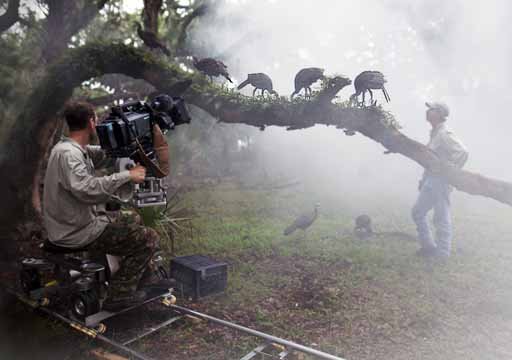
Behind the scenes image of turkeys and Jeff Palmer (actor) in misty forest in Florida. Cameraman (Mark Smith) on track & dolly shows how some of the beautiful sweeping shots were filmed.
Sam Wollaston of the Guardian continues,
It’s not hard to see how the little birds were taken in. Joe’s moustache does look a bit like feathers, he has a long scraggy neck, an understanding of the forest, and a tentative, birdlike walk. He takes them out, to catch their first grasshoppers; he teaches them how to roost. For Joe, as for any mother, parenthood is an emotional rollercoaster ride. There is the joy of seeing his babies grow, but almost constant worry. Grief too, when one is taken by a rat snake, and another by a hawk, and two more get sick (bird flu?) and die.
Adolescence arrives with all its associated problems. The males start fighting; only the toughest will get to mate. “I had no way of knowing how I was going to be part of this rite of passage,” says Joe. Steady now, Joe, let’s not take this too far, you’re not supposed to mate with any of them. For one, they’re your children. They’re also turkeys. That would be doubly wrong. Sometimes I think Joe spends too much time alone in the forest.
Quite so! However, the film was so beautifully shot that it was very, very easy to forget that this was a re-enactment of Joe’s original experience. That love is all about how you make someone, or in these cases, some other creature, feel. Another couple of pictures from the BBC website,
Lights, camera, action!Jeff Palmer (actor) sat on large felled tree on his cell phone with a dozen wild turkeys.
One final extract from the Sam Wollaston article in The Guardian newspaper,
My Life as a Turkey isn’t simply a wildlife film though. It’s not just about wild animals, it’s about one man’s relationship with wild animals, and that’s what makes it so fabulous. Serious animal behaviourists may not agree, but if you throw a human being in there, it all suddenly becomes a lot more interesting. I’m thinking Ring of Bright Water, Gorillas in the Mist, I’m definitely thinking Werner Herzog’s brilliant Grizzly Man about a man named Tim whose friendship with bears went wrong and he ended up inside one. My Life as a Turkey has something of Grizzly Man about it – a man obsessed, alone in a beautiful place, living with wild animals. But, although Joe was attacked, he didn’t end up inside one of his turkeys thankfully. There would have been a certain irony to that, especially if it had happened at Thanksgiving.
Anyway, it’s a lovely film – beautiful, charming, funny, sad, thought-provoking even. What thoughts did it provoke in me? That I need to go and see my mum.
Unfortunately, as mentioned above if you are outside the UK you are not able to watch the film via the BBC iPlayer system. But you can buy the book.
Joe Hutto's book of his life with wild turkeys.
Available from Amazon, here’s just one of the reviews,
My review is not unbiased because Joe Hutto, author of “Illumination in the Flatwoods,” and I have been friends for almost 25 years.
Joe is the most humble man I’ve ever known. I am honored that he brought me the original manuscript to read. It was so beautiful I could have cried.
With the same graceful writing skills used by conservationists Aldo Leopold (“Sand County Almanac”) and Herbert Stoddard (“Memoirs of a Naturalist”), Joe gives a masterful mix of documentary-style nature reporting and heartfelt thoughts on the meaning of life. As dramatic as that sounds, I think most readers will agree that “Illumination in the Flatwoods” is a life-changing book.
You will never regret the dollars you spend to buy this book nor the time it takes you to read it. . .
A chance email from Dan G. opens up a whole treasure trove.
Here’s what Dan sent to me,
True Friends
After losing his parents, this 3 year old orangutan was so depressed he wouldn’t eat and didn’t respond to any medical treatments. The veterinarians thought he would surely die from sadness. The zoo keepers found an old sick dog on the grounds in the park at the zoo where the orangutan lived and took the dog to the animal treatment center. The dog arrived at the same time the orangutan was there being treated. The 2 lost souls met and have been inseparable ever since.
The orangutan found a new reason to live and each always tries his best to be a good companion to his new found friend. They are together 24 hours a day in all their activities.
Roscoe and Surya
They live in Northern California where swimming is their favorite past time, although Roscoe (the orangutan) is a little afraid of the water and needs his friend’s help to swim.
Roscoe and SuryaRoscoe and Surya
Together they have discovered the joy and laughter in life and the value of friendship.
Roscoe and SuryaRoscoe and Surya
They have found more than a friendly shoulder to lean on.
Roscoe and SuryaLove across the species boundary
Long Live Friendship!!!!!!!
I don’t know……some say life is too short, others say it is too long, but I know that nothing that we do makes sense if we don’t touch the hearts of others…….while it lasts!
So after I had seen the pictures above, it was pretty easy to find this YouTube video.
Then if that wasn’t amazing and wonderful, try this,
Well that’s enough for today. But tomorrow, I will continue with Part Two which recounts the amazing year that Joe Hutto spent in the Florida wildlands with ….. (you’ll have to wait for tomorrow!)
One thousand, nine hundred and thirty-two years ago, today, there was a loud bang in Italy!
On the 24th August, in the year 79 A.D. the residents of Pompeii would undoubtedly had very little time to ponder on the consequences of a volcanic eruption just five miles away.
Try to imagine huge, billowing, gray-black clouds like those at Mount St. Helens rushing toward you at a hundred miles an hour. That is probably what the ancient Romans saw just before they were entombed by hot ash.
There is much material available for those that wish to read more about the devastating effects of that volcanic eruption, so superfluous to add much more here. The Classroom of the Future link is as good a place to start as any. What I would like to comment on is this – but first a picture,
Vesuvius and nearby cities
What is worth noting that in 2009 the CIA Factbook records that the population of Naples was 2,270,000 people. Naples is very close to Vesuvius. As WikiPedia puts it,
Mount Vesuvius (Italian: Monte Vesuvio, Latin: Mons Vesuvius) is a stratovolcano on the Bay of Naples, Italy, about 9 kilometres (5.6 mi) east ofNaples and a short distance from the shore. It is the only volcano on the European mainland to have erupted within the last hundred years, although it is not currently erupting.
There is a saying in Italy that goes ‘vedi Napoli e poi muori’. Translated, this means ‘see Naples and die’. The actual meaning of this refers to being overwhelmed by what a beautiful and an incredible city Naples is. (although some may argue that what it really means that Naples is such a dangerous and chaotic city that it will kill you!)
H’mmm. Get the timing wrong and that saying could have a literal meaning way beyond the ancient author’s intent! I quote from the website Geology.com,
Starting in 1631, Vesuvius entered a period of steady volcanic activity, including lava flows and eruptions of ash and mud. Violent eruptions in the late 1700s, 1800s and early 1900s created more fissures, lava flows, and ash-and-gas explosions. These damaged or destroyed many towns around the volcano, and sometimes killed people; the eruption of 1906 had more than 100 casualties. The most recent eruption was in 1944 during World War II. It caused major problems for the newly-arrived Allied forces in Italy when ash and rocks from the eruption destroyed planes and forced evacuations at a nearby airbase.
But for all it’s power, the Vesuvius eruption of the 24th August, 79 was a squib compared to the Toba eruption some 73,000 years ago. More on that one in a few days perhaps.
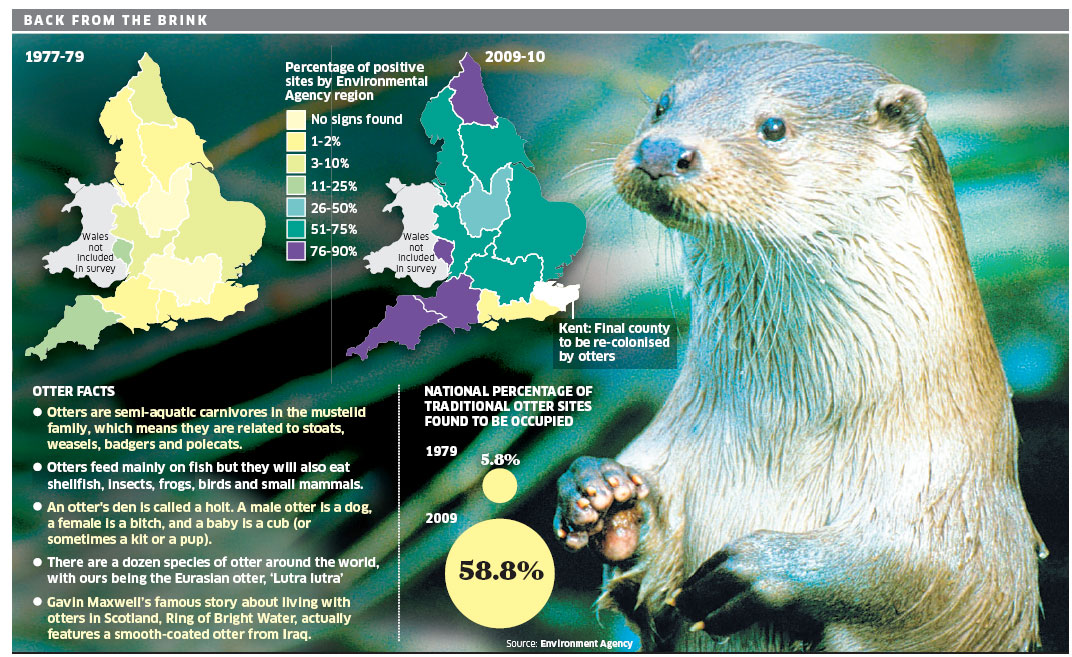
Yesterday, I wrote about the fabulous success of the British otter having gone from the crumbling edge of extinction to now being found in every English county.
For something completely different, and I do mean completely, have a read of this item that appeared in the British Guardian newspaper of the 18th August.
Aliens may destroy humanity to protect other civilisations, say scientists
Rising greenhouse emissions could tip off aliens that we are a rapidly expanding threat, warns a report
It may not rank as the most compelling reason to curb greenhouse gases, but reducing our emissions might just save humanity from a pre-emptive alien attack, scientists claim.
Watching from afar, extraterrestrial beings might view changes in Earth’s atmosphere as symptomatic of a civilisation growing out of control – and take drastic action to keep us from becoming a more serious threat, the researchers explain.
This highly speculative scenario is one of several described by a Nasa-affiliated scientist and colleagues at Pennsylvania State University that, while considered unlikely, they say could play out were humans and alien life to make contact at some point in the future.
Shawn Domagal-Goldman of Nasa’s Planetary Science Division and his colleagues compiled a list of plausible outcomes that could unfold in the aftermath of a close encounter, to help humanity “prepare for actual contact”.
Beneficial encounters ranged from the mere detection of extraterrestrial intelligence (ETI), for example through the interception of alien broadcasts, to contact with cooperative organisms that help us advance our knowledge and solve global problems such as hunger, poverty and disease.
Another beneficial outcome the authors entertain sees humanity triumph over a more powerful alien aggressor, or even being saved by a second group of ETs. “In these scenarios, humanity benefits not only from the major moral victory of having defeated a daunting rival, but also from the opportunity to reverse-engineer ETI technology,” the authors write.
Other kinds of close encounter may be less rewarding and leave much of human society feeling indifferent towards alien life. The extraterrestrials may be too different from us to communicate with usefully. They might invite humanity to join the “Galactic Club” only for the entry requirements to be too bureaucratic and tedious for humans to bother with. They could even become a nuisance, like the stranded, prawn-like creatures that are kept in a refugee camp in the 2009 South African movie, District 9, the report explains.
The most unappealing outcomes would arise if extraterrestrials caused harm to humanity, even if by accident. While aliens may arrive to eat, enslave or attack us, the report adds that people might also suffer from being physically crushed or by contracting diseases carried by the visitors. In especially unfortunate incidents, humanity could be wiped out when a more advanced civilisation accidentally unleashes an unfriendly artificial intelligence, or performs a catastrophic physics experiment that renders a portion of the galaxy uninhabitable.
To bolster humanity’s chances of survival, the researchers call for caution in sending signals into space, and in particular warn against broadcasting information about our biological make-up, which could be used to manufacture weapons that target humans. Instead, any contact with ETs should be limited to mathematical discourse “until we have a better idea of the type of ETI we are dealing with.”
The authors warn that extraterrestrials may be wary of civilisations that expand very rapidly, as these may be prone to destroy other life as they grow, just as humans have pushed species to extinction on Earth. In the most extreme scenario, aliens might choose to destroy humanity to protect other civilisations.
“A preemptive strike would be particularly likely in the early phases of our expansion because a civilisation may become increasingly difficult to destroy as it continues to expand. Humanity may just now be entering the period in which its rapid civilisational expansion could be detected by an ETI because our expansion is changing the composition of the Earth’s atmosphere, via greenhouse gas emissions,” the report states.
“Green” aliens might object to the environmental damage humans have caused on Earth and wipe us out to save the planet. “These scenarios give us reason to limit our growth and reduce our impact on global ecosystems. It would be particularly important for us to limit our emissions of greenhouse gases, since atmospheric composition can be observed from other planets,” the authors write.
Even if we never make contact with extraterrestrials, the report argues that considering the potential scenarios may help to plot the future path of human civilisation, avoid collapse and achieve long-term survival.
I am bound to say that if Mr Domagal-Goldman and his colleagues believe that spending time and money on the possible outcomes of contact with extraterrestrials is a good idea in these present times then I am minded about those other visitors from outer space who passed Planet Earth by because there were no signs of intelligent life!
Just a few days ago, the British news media carried a wonderful story about the resurgence of the otter in every county of England. For many years, the otter was losing the battle for survival owing to hunting and trapping and the far South-West of England became it’s last refuge.
Then a combination of sensible legislation and public commitment to saving the otter became the turning point.
Watch this clip from ITN News from the 18th August.
Here’s a typical media report from The Independent newspaper of Thursday, 18th August,
Otters return to every county in England
Once the rivers were cleaned up, fish returned to once-polluted waters and otters began to spread back eastwards from their strongholds in Devon and Wales
By Michael McCarthy, Environment Editor
It has taken 30 years, but the otter’s comeback is now complete. After becoming extinct across most of England in the Fifties and Sixties, one of Britain’s best-loved animals has now returned to every English county, the Environment Agency announced yesterday.
The slow but steady recolonisation of its former haunts has been rounded off with the reappearance of otters in Kent, the last county to have been without them, the agency said.
The otter’s return represents a happy ending to one of the worst episodes in modern British wildlife history: the sudden disappearance of one of our most widespread and charismatic mammals.
The process began around 1956 and was almost certainly caused by the introduction of powerful organochlorine pesticides such as aldrin and dieldrin. Residues of these chemicals were washed into the rivers where otters lived, poisoning them.
As wild otters are hard to spot – their presence is usually detected by their spraints, or droppings – it was several years before the scale of their disappearance began to dawn on people, but by then they had been wiped out over vast areas of lowland England.
Despite the banning of organochlorine pesticides in the mid-Sixties, otters continued to decline, and their population reached a low point by the end of the 1970s, when they had effectively vanished from everywhere except the West Country and parts of Northern England (although good numbers remained in Wales and Scotland).
The first national otter survey, carried out between 1977 and 1979, detected the presence of otters in just over 5 per cent of the 2,940 sites surveyed; all the sites were known to have held the animals previously.
But then a comeback gradually began. Helped by a substantial clean-up of England’s rivers, which brought back fish to many once-polluted watercourses, and by legal protection, otters began to spread back eastwards into England from their strongholds in Devon and in areas of the Welsh borders, such as the Wye Valley.
By the time of the fourth otter survey, carried out between 2000 and 2002, more than 36 per cent of the sites examined showed otter traces; and when the fifth survey was carried out, between 2009 and 2010, the figure had risen to nearly 60 per cent, with otters back in every English county except Kent. Now wildlife experts at the Environment Agency have confirmed that there are at least two otters in Kent, which have built their holts on the River Medway and the River Eden.
“The recovery of otters from near-extinction shows how far we’ve come in controlling pollution and improving water quality,” said Alastair Driver, the Environment Agency’s National Conservation Manager. “Rivers in England are the healthiest for over 20 years, and otters, salmon and other wildlife are returning to many rivers for the first time since the industrial revolution.
“The fact that otters are now returning to Kent is the final piece in the jigsaw for otter recovery in England and is a symbol of great success for everybody involved in otter conservation.”
Otters are at the top of the food chain, and are therefore an important indicator of river health. The clean-up means that they are now inhabiting once-polluted rivers running through cities – something which would have been unthinkable before the population crash – and they have been detected in places such as Stoke-on-Trent, Reading, Exeter and Leeds, as well as in more likely urban centres, such as Winchester.
But although they are now widespread once more, otters’ nocturnal habits and riverine habitat make them difficult to glimpse, let alone observe, in England. The best place to see otters in Britain is Western Scotland, where the animals have become semi-marine and live along the coast. They can regularly be seen foraging along the shoreline in the daytime, especially on some of the larger islands, such as Mull and Skye.
A lovely story with a powerful message – mankind can change things for the better, and frequently has done.
Stray dogs demonstrate remarkable skills at staying alive.
Before I start, a big word of thanks to Paul Gilding who passed this story to me. Apart from reading Paul’s powerful book, The Great Disruption, and exchanging a couple of emails, he doesn’t know me from Adam. But the fact that this undoubtedly busy man (his book has been a great success) not only responded to an earlier email from me and then dropped me a note to say that I might enjoy the following article, says a great deal about the integrity of the person.
The article, from the website The Dog Files, is about Moscow’s stray dogs. I’m taking the liberty of reproducing it in full.
Each morning, like clockwork, they board the subway, off to begin their daily routine amidst the hustle and bustle of the city.
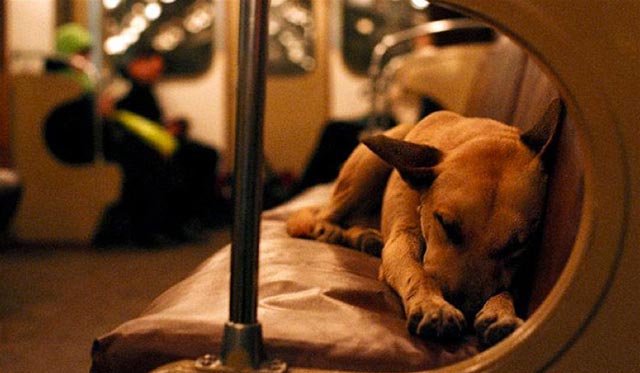
But these aren’t just any daily commuters. These are stray dogs who live in the outskirts of Moscow Russia and commute on the underground trains to and from the city centre in search of food scraps.
Then after a hard day scavenging and begging on the streets, they hop back on the train and return to the suburbs where they spend the night.
Experts studying the dogs, who usually choose the quietest carriages at the front and back of the train, say they even work together to make sure they get off at the right stop – after learning to judge the length of time they need to spend on the train.
Scientists believe this phenomenon began after the Soviet Union collapsed in the 1990s, and Russia’s new capitalists moved industrial complexes from the city centre to the suburbs.
Dr Andrei Poiarkov, of the Moscow Ecology and Evolution Institute, said: “These complexes were used by homeless dogs as shelters, so the dogs had to move together with their houses. Because the best scavenging for food is in the city centre, the dogs had to learn how to travel on the subway – to get to the centre in the morning, then back home in the evening, just like people.”
Dr Poiarkov told how the dogs like to play during their daily commute. He said: “They jump on the train seconds before the doors shut, risking their tails getting jammed. They do it for fun. And sometimes they fall asleep and get off at the wrong stop.”
The dogs have also amazingly learned to use traffic lights to cross the road safely, said Dr Poiarkov. And they use cunning tactics to obtain tasty morsels of shawarma, a kebab-like snack popular in Moscow.
With children the dogs “play cute” by putting their heads on youngsters’ knees and staring pleadingly into their eyes to win sympathy – and scraps.
Dr Poiarkov added: “Dogs are surprisingly good psychologists.”
Now had this been a normal day then I would have had the time to complete this story about the tenacity of dogs. But a failed wireless modem earlier today (Thursday) meant the loss of too many hours fighting technology. It was all sorted just a little before 5pm. It is now 6.15 pm and dinner is ready and, frankly, my brain is too tired to continue.
So stay with this fascinating story about stray dogs as I continue it tomorrow (Saturday, 20th.).















 Learning from Dogs