Category: Environment

Truths for January, 2012.

Institutionalized insanity versus intelligent thinking – a reflection.

This appeared on Patrice’s Blogsite on January 11th and is republished with his very kind permission.   You may want to bookmark Patrice’s blogsite, which is here.  The sub-heading of his blog is ‘Intelligence at the core of humanism‘ and, trust me, that is not an overstatement of the wisdom that is contained within his blog, as the following nobly illustrates.

Thinking Man (portion of), by Rodin

Aphorism January 2012

***

Species Shifting North, Intelligence Left Behind:

Nothing like raw numbers. In the last twenty years, Europe warmed up by one degree Celsius (about 2 degrees in the primitive, less meaningful Fahrenheit system). That’s equivalent to a thermal shift of 249 kilometers north.

Insects responded by an average shift north of 114 kilometers, and birds by only 33 kilometers. This is creating imbalances (fully obvious in Alaska, and high altitude North America, where the insects move faster than their predators, killing entire forests, which then burn).

This differential adaptation also illustrates an important point the stupid partisans of the “market” always neglect: being more intelligent can make you slower. Birds are more intelligent than insects, so they find harder to leave their families, friends, habits, and landscapes they are familiar with behind. (No, I will not say that insects are more like Americans, driven by the market, and birds more like Europeans, driven also by broader values. I shall resist, lest I move too fast, like an insect, and outrage part of my brainy readership…)

Thus, as the market dominates, so does the stupid.

Adaptation is not always a manifestation of intelligence, and inadaptation often a sign of intelligence. A well known experience is to put a fly, or a bee, inside an open bottle, with a light source opposed to the opening. The bee will search intelligently the bottom of the bottle, where the exit ought to be. The less intelligent fly will buzz around stupidly, and exit first.

It’s no wonder that the partisan of the markets, who are richer and thus more influential, are for something stupid, as they are faster, precisely because they are more stupid, with fewer values, besides the colossal greed which dominates their psyche. So there is a non linear vicious loop, the more the market dominates.

Thus, next year the candidate historically financed by Wall Street will confront the extremely wealthy businessman cum politician, son of his father, also a governor cum businessman. Market against market: the market should not lose. The birds will be left behind by the fast moving insects, once again. Change you can’t believe in.

***

Where is everybody?

Lord” (!) Martin Rees, “Astronomer Royal”, Nobel laureate, etc., complete with pretty pictures and beautifully spooky music, speculates it’s teeming with aliens out there.

But as Enrico Fermi quipped:”Where is everybody?

The situation is not helped by us understanding very little about what the universe is made of. In the latest numbers I saw the universe was made 4% conventional matter, and the rest was… Dark. Mostly Dark Energy, with some Dark Matter. Who said the Dark Side was not important?

There are no dominant theories of what the Darkness is made of.

CERN should be able to find stuff below its energy reach. So far, nothing.

We have detected more than 150 planets. It seems one star out of ten, at least, has planets. Some have been detected in the habitable zone, where liquid water is found. But the water has to be continuously present for billions of years. Continuously (which did not happen on Mars and Venus).

400 billion stars in our galaxy. The big question is how many planets can harbor advanced (=oxygen breathing) life. No inkling of that. There are plenty of planets out there, indeed, but most hostile to life. So far. How Much Intelligent Life Out There? On Earth, it took 1.5 billion years to go from advanced life to intelligent, civilized life. A lot of things can go wrong in 1.5 billion years.

That advanced life did not develop on Mars or Venus is not an accident: although on the outskirts of the habitable zone, either planet did not have what it took. Mars was too small, and, just like Venus was not protected by a powerful plate tectonic, with accompanying magnetic field, among other problems (so the solar wind blowing the top of the atmosphere stole the hydrogen, hence water, etc.)

My hunch is that most planets in the hospitable zone, when found, will be bereft of advanced life, although primitive life may be quite frequent. Reason? Too many miracles at work for billions of years in the solar system. Especially in light of what we find out there (We see plenty of Jupiter size planets in close orbits around their suns, presumably after sweeping their entire system clean; OK, that’s partly a result of the method used to find planets presently, but the fact is, we find such situations aplenty! The presence of Jupiter out there, as our guardian protecting Earth from comets looks quite miraculous…)

***

If You Want To Save the Biosphere, Push Tech:

Some people in the Netherlands have suggested building an artificial mountain. It’s feasible, and would be smart to do, not just there, but say in a place such as Saudi Arabia (technical variations on the theme could collect water, as in cloud, or fog forests found in California or Peru).

Another point is that artificial mountains could help protect biological diversity from the greenhouse heating. Cynics would point out that it would take an enormous amount of energy to build them. True, with present tech, and the energy would be dirty too, presently. But that would be another motivation to go green. Green and big.

***

Wind Fall-Out:

Most wind-driven energy system in Europe? Denmark. Most CO2 polluting country in Europe? Denmark. Coal power plants pick up the slack when the wind falters. Another case where nuclear offers its smiling face. Future nuclear that is. Not your great grandfather’s nuclear. Past nuclear tech should be terminated, just like coal. However, there are 100 unexploited, un-researched nuclear energies out there, and only those with insignificant waste will be acceptable. (Nobody would accept a fossil fuel system where only 2% of the fuel would be burned, and the rest allowed to pollute all over!)

Reminder: as the greenhouse heating proceeds, winds will falter because the heat differential between poles and equator will sink, thus shutting down that thermal engine known as the atmosphere (yes, hurricanes will be rarer, but fiercer).

***

Institutionalized insanity Versus Thinking Right:

In Switzerland a nuclear plant was built one kilometerdownstream from a dam, along the same river. None of those two could resist the sort of very strong quake happening occasionally in the Alps. A flood cum nuclear explosion is entirely imaginable. This sort of insanity has nothing to do with nuclear power, it has everything to do with lack of intelligence.

This is all the more strange since some Swiss cantons such as Valais get 20% of their GDP from research. By the way themedical drug sector part of GDP is twice the banking sector in Switzerland. For those who wonder why Switzerland is so rich (the same holds for Sweden and other Nordic company). It’s not (just) about the banks.

***

(More) Direct Democratic Keeps Bankers At Bay:

The weight of direct democracy has forced Swiss banks into reserve requirements twice those of the future Basel III regulations. (In other words, banks are many times tamer in Switzerland than in the USA, if one uses reserve requirements enforced as a measuring device; Basel III does not cover most of the enormous derivative trading, though.)

The scandal of the central banker heading the Swiss Central Bank buying dollars days before taking the decision of making the dollar explode up against the Swiss franc keeps unfolding. Yes, he knew about the trades, and yes, he had days to stop them afterwards.

It is dawning over Swiss society that those with privileged information should not be legally allowed to exploit them. The whole planet has to follow down that line. But, although it has been obvious for years that American and European politicians and central bankers are rich from insider trading, nothing has been done. Yet.

***

The Plutocrats Cash Out And Shame Does Not Count:

What looked to me as the immensely stupid and arrogant wife of the Swiss Bank President, explained herself from Singapore, where she owns an art gallery. If she really wanted to make real money out of her husband’s job, she knew how to do it, she asserted confidently. And there she was going through a list (a), b), c), d), etc… of things she would have done if she wanted to make more than the measly $75,000 she made. And how to make them secretly, she insisted.

Her name is “Kashya”, appropriately pronounced “Cashia”. In this case, Cashia said, in her native American English, they were in a rush, because they just had some cash from selling a chalet to store, so that is why she hid nothing.  That brings a few questions, such as whether she is used to exploit the mechanisms of further cheating she explicated so adroitly on TV. The central banker, the plutocrat Hildebrand, having resigned, will get a million dollar salary in the next year, from the People, while his fellow plutocrats will rush to propose him a much more protitable conspiracy to join. I propose to put him in jail, instead.

***

Another Claim Of Mental Decline. And The Agenda Behind It: There Is No Good Wisdom, Except Dead Wisdom, Say Plutocrats:

Supposedly some new test showed a decline in “cognitive capabilities” starting at age 45. Apparently people were asked to remember lists of words starting with some particular letters. It does not seem to have come to the mind of the experimenters that maybe older brains do not like to remember such stupid stuff.

Thinking means motivating. Without the right motivation, there is not the right thinking.

In the case of “IQ”, a decline is observed at 24, some say… Military officers would concur that it is better to send 18 year olds to die, because they are bright enough to execute orders well, but not so bright that they would know that they might die for no good reason.

A related point: no doubt a two-year old training to go potty remembers very well each time she goes. Whereas an adult tends to lose this facility of neurological retention for this sort of event. One generally observes. But it is not because adults have suffered mental decline that they do not remember every poop. Simply, they have seen lots of poop passing by.

Actually the argument can be made that consciousness and conscious memorization are needed to deploy automatisms, but once those are in place, they are not needed anymore, and so consciousness, and conscious recall should not be present.

When I was a young driver, I remembered everything I did when driving a car, but now I do it automatically, remembering very few of my gestures. When driving, my consciousness is mostly watching for the unforeseen.

Is there a political interpretation explaining such mental declines claims? Indeed, there is. As people get older, they elaborate higher wisdom. Thus, although the soldiers of revolution are typically very young people, because they have their aggression hormones less tempered by wisdom, the leaders of revolution are typically much older.

Let me explain this carefully: fascist and plutocratic leaders typically claim that they are “conservatives“. It means that they justify their mean rule by a refusal to adapt to changed circumstances.

As the French revolution stirred, the most esteemed leaders were senior citizens such as Voltaire or Benjamin Franklin, and everybody looked up to them, from Louis XVI to Turgot; on the Dark Side, many of the leaders, such as the Comte d’ Artois, were barely teenagers.

Closer to us, in WWII, the SS seduced many a 16 year old. In the last few weeks of the war, many of the most enraged Nazis fighting to the bitter end with the allies in the mountainous heart of Germany were school children with heavy weapons. In more than one case, disgusted American GIs, reluctant to blow up some more enraged children to bits, sent their school mistresses to negotiate with them!

If the (plutocratic) establishment can claim that revolutionary wisdom is actually the fruit of mental decline, presto, no revolution. It will be “conservatism” all the way.

***

Why Do We Want To Always Support Winners?

Supporting the home team is easy to understand: this is the tribal instinct. Human beings are social, they have to love the group, thus dislike what hinders the group, namely, other groups.

One has to love the leader(s) of the group, the alpha(s). In general, to abate social tensions, an instinct has got to exist, which makes the oppressed love the oppressor, or let’s say, the inferior love the superior. or even love the winning group, to be motivated to join it. Something more plausible to females. Hence Beatlemania.

***

If One Wants Happiness, One Should Prepare For The Worst:

Pe Romaneste: So happiness must be an accident.

Alexi Helligar: There seems to be greater power in the accidental than we imagine.

Patrice Ayme: Indeed, to a great extent, everything is accidental. Realizing this means that those who complain that something happened accidentally, and, thus, was not expected, have not understood the first thing about causality. Accidents is how the world happens. Wisdom consists in anticipating their occurrence, and having a plan B, should they occur.

***

Brutality Is Friendly To Plutocracy, Long Life Friendly To Wisdom:

Only wisdom can allow long life. Really very long life, lasting centuries, for individuals or civilization. Short lives are brutish, and this has the consequence in many a perpetrator, to spurn whatever life is offered. Indeed a good way to spurn something is by devaluing it. The brutality of the human condition is self reinforcing…

This why human life extension is a necessity, a preliminary, for the extension of wisdom. Because as long as lives are short and brutish, the short and brutish way of life is all too optimal, for all too many people (although those with children, or grandchildren they love will disagree, but they are not necessarily a majority).

This is something that life spurning plutocrats such as Mr. Jobs have been busy not understanding, as brutality is their friend.

***

Plutocrats Love Death Indeed:

Steve Jobs, despite leaving Reed College after six months, was asked to give the 2005 commencement speech at Stanford. Why? Did Jobs invent anything important? (Disclosure: My Mom offered me an ultra light Mac Air, and I love it.) No, he was just an artistic technology integrator, but not necessarily as mechanically oriented as a car mechanic (his partner Wozniak was the programmer, but even this one finished his college studies in computer science, 20 years later, at Berkeley, and found them hard!)

In his Stanford address, delivered after Mr. Jobs was told he had cancer, but before it was clear that it would ultimately claim his life, Mr. Jobs told his mesmerized audience of naive sheep that “death is very likely the single best invention of life. It is life’s change agent.”

In this light, the invasion of Iraq by Bush and his fanatical followers made sense: by visiting more than one million deaths upon Iraq, the USA brought the single best invention of life. Everybody, or more exactly 83%, including a majority of Stanford students, agreed, at the time.

Is this love of death why Jobs refused conventional medical treatment initially, until it was too late? Jobs insisted that the benefit of death, is you know not to waste life living someone else’s choices. I guess that extended to the medical.

Verily, death came first, and was denied by life. Life is the denial of death. Life did not have to invent death.

***

Hormuz Crisis Versus Suez Crisis: Spot The Difference!

Why did the USA not get upset when Nasser seized the Suez canal, in 1956? And actually why did the USA instead use the occasion to threaten Israel, Britain and France? Not just that, butpresident Eisenhower aligned himself with the Egyptian, and Soviet dictators. The Soviets, while invading Hungary, killing at least 40,000 Hungarians, threatened to atom bomb London and Paris. With the loud acquiescence of the USA… Which got France and Britain, not the mass murderous USSR, condemned at the United Nations’ general Assembly. What a crazy week it was.

And now, 55 years later, lo and behold, the USA is getting all upset as Iran wants to stop what’s going on below its nose in the strait of Hormuz? Just asking. Inquiring minds want to know.

Is it that in 1956, France and Britain were viewed as preys of the USA? And now that the USA has grabbed everything from France and Britain, they want to be friends again? Because the rich need servants, maybe? In any case, the Suez Crisis was an incongruous reminder that, in 1939, the USA was allied with the USSR and Nazi Germany, against France and Britain (oopss, something one should never say!)

And my advice would be to be very careful with Hormuz. If one wants long life, one does not want long wars. And one does not want fossil fuels. The sooner we get rid of fossil fuels, the better, and if Hormuz helps that way, so be it. The messy Iranian theocracy will not win a waiting game.

***

No Change, No Life!

What the USA needs to do is to do what all serious countries do, and have always done: change its constitution, since the changed circumstances require it.

***

Cool Is Not Cool:

“Cool”. Why is “cool” such a popular word? Is it supposed to correspond to an attitude? Is it a mark of, and a tool for, our subjugation?

So Obama is confronted to the greatest financial thievery in the history of civilization, and that leaves him “cool“? Having rebooted the perpetrators with public money he goes to them to ask for a billion to campaign for re-election? Cool? I mean: we are not supposed to blow our tops when we contemplate such injustice in the name of change we can’t believe?

In Europe, pretty amazingly intricate financial and semantic engineering is presently deployed to save the banks and the sovereign states entangled with them. There again the bottom line is that the resources of the countries are deployed for the exclusive enjoyment of the few, who happen to be the greatest swindlers ever. Although they are presented as too big to flay.

Actually the same technique as in the USA, Quantitative Easing, is being deployed, and on a similar scale. But, as the head of the European Central Bank, an ex Goldman Sachs partner, pointed out sardonically, a scornful smile on the corner of his mouth, Europeans use a different semantic: they don’t call it Quantitative Easing.Therein the difference. Is not that cool too?

Is the greenhouse effect already that bad that cool is the ultimate state one ought to strive for with all of one’s being? Or are we supposed to reject our mammalian inheritance? Mammals, by being warmer, could do more. So, when climate change happened 65 million years ago, they survived (so did the very warm birds, who evolved from bird-like dinosaurs). Are we supposed to do less now, and not survive? Or then survive like crocs, deep in the mud, super cool, eating carrion?

Is “cool” imposed on us so that people know no higher emotional state than iguanas? Become cool like barnacles, as we cling to the existence the plutocrats condescend to leave us to enjoy? Being so cool we would not be like the American and French hot heads who came forth with new constitutions in 1789?

So is the celebration of “cool” what forces us to not be outraged, as plutocrats steal and burn the entire planet to forget about their megalomaniac angst? To forget they are just crazy critters in need of some restraint? Is “cool” the state slaves are supposed to be in to optimize the enjoyment of their masters? Is it only cool to be cool like corpses?

***

France anti-genocide law denounced by Turkey:

Now this is hilarious. France passed a law punishing convicted holocaust deniers by up to one year in jail and 45,000 euros fine.

Fine, indeed. Who would turn into a partisan, a defender of holocausts? Is not holocaust denial a form of hate speech? Holocausts remain a problem, because when one has killed most of a human group, there is nearly nobody to complain on their behalf: other people move on, as herbivores do, once one of them has been seized and devoured.

France’s national Assembly passed the anti-genocidal law, with bipartisan support. And what do you think happened?

Erdogan, the three time elected Prime Minister of Turkey, had a fit: how does France dare make holocaust denial a crime? He forbade French fighter jets to land in Turkey (so I guess the no fly zone over Syria will be delayed), recalled the Turkish ambassador to France, and stopped all talks with France.

And the questions are: why does the present government in Turkey love holocausts so much? Are holocaust such an endangered species that Turkey has to protect them with all its might?

Why does Turkey consider that a general attack against holocausts is an attack against Turkey? Is it because holocausts are intrinsic to the Turkish character? Or is it because holocausts are mentioned positively in the Bible and the Qur’an, and the present Turkish government is obsessed with the religion of the child molester Abraham? Is this why Erdogan is angry?

***

We Are Truth Machines.

That monkeys now build cities has not changed that truth. No hallucination added in the last 6,000 years has changed that truth either. Science is what we do, and what stands in the way of that fundamental truth, faces extermination.

***

Patrice Ayme

A helping hand for dogs

Doesn’t need any further introduction from me!

Except to thank Tom M. for sending me the details, which I reproduce as Tom sent them.

Every once in a while an opportunity comes by to do “really good thing for little effort or cost. What I call “click for critters” is one of those rare opportunities you should take advantage of.

For the effort involved to perform “two mouse clicks on your computer”, you can be responsible for providing critters in shelters 6/10 of a bowl of food daily.  That is over 200 bowls of food to critters in need per year!  And get this … the sponsors will even send you an automatic reminder e-mail every day with a link to click. Couldn’t be any easier and you’ll feel so good helping those in need.

Simply go to www.theanimalrescuesite.com

Then on that web page you will see this button:

Once you click that button, you will be taken to a sponsor’s page. (That is, click the button on the Animal Rescue website, not on this Blog page!)  The sponsor’s on that next page will donate 6/10 of a bowl of food just because you clicked your mouse! Actually visit a sponsor page and more will be given!

But there’s still more you can do for our animals in need!

Simply click on “Free Ways to Help” located on the left hand side of the page!

Then click on “Sign up for a free click reminder e-mail” and that’s it!!

Have a wonderful 2012, enjoy feeling good with click for critters, spread the word and please remember the wise words of Mahatma Gandhi – “The greatness of a nation and its moral progress can be judged by the way its animals are treated.

Thanks Tom.

Affairs of the heart.

That is, a la dog!

Hazel

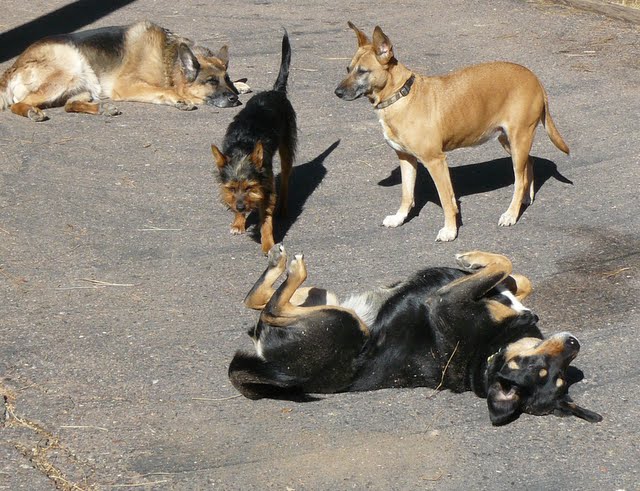
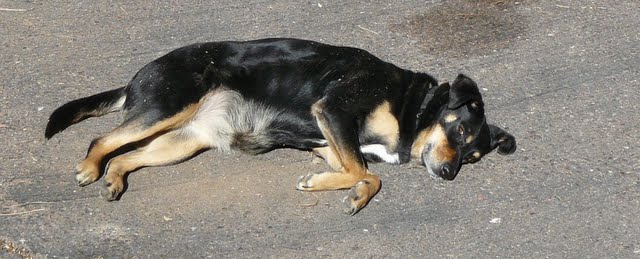
This is Hazel. She is one of three dogs that ‘belong’ to Pharaoh.

Last Tuesday, we took Pharaoh and his mini-pack of 3 dogs out for our usual afternoon walk at the very end of Granite Dells Rd, out where the forest road ends and soon becomes the relative wilderness of the Tonto National Forest.

Pharaoh, and Hazel, Dhalia and little Sweeny.

However, on this occasion Hazel decided to leave us and link up with a stranger who was hiking the forest.  That was the last we saw of Hazel for many hours.  Miracle of miracles, the stranger, Joanie, was a dog-lover so when Hazel had followed Joanie and her dog all the way to Joanie’s car, the next stop for her, Hazel that is, was our local Payson Humane Center.  Hazel’s tag very quickly linked her to Jean (a great reminder of the importance of tagging your dogs!) who is well-known as a volunteer assistant at the Humane Society Thrift store and the scare was over.

But during the hours of tramping those miles along challenging forest tracks, calling out Hazel’s name, both Jeannie and I had plenty of time to hurt.  Here’s a small insight, that millions of pet owners will resonate with, that demonstrates the way that dogs offer us so much love which, in turn, opens our human hearts to the purity of unconditional love. (And I know it’s not just dogs but many animals in our lives that offer us such love!)

Pharaoh and his ‘team’ sleep in our bedroom.  During the Winter months Hazel will often lay stretched out on the bed-cover alongside the back of my legs.  If I need a trip to the bathroom during the night, not unknown at my age, I can almost guarantee that Hazel will shift her cuddly body up to the warm sheets just below my pillow.

Thus it was this last Tuesday morning when I returned from my bathroom run about 3am; Hazel asleep with her head on my pillow!  I didn’t have the heart to push her off the bed, so just slipped in beside her and moments later back asleep, my head nestled against Hazel’s warm head.  Sleeping so close to a dog is more than just nice, it seems to stir very ancient memories deep in the subconscious, perhaps back all those thousands of years to when domesticated dogs were an integral part of early man’s security.

So you can imagine the anguish that, in our own separate minds, Jeannie and I were experiencing.  I just couldn’t go to the place where never again would I feel the warmth of Hazel’s body against mine.  Jean was desperately hoping this wasn’t a tragic repeat of losing Poppy.  Thus when I went round to the Humane Center just as they were closing up and Hazel came out to me, I dissolved in sobs of relief.

That’s the heart-felt closeness of dogs and humans.

The purity of a dog's heart!

End Puppy Mills!

Join the One In A Million Movement to End Puppy Mills!

Take another quick look at the emotions that dogs bring out in so many of us.  I’m referring to the piece I posted last Sunday under the title of The logic of dogs.  However, there’s a darker side to owning a dog, or more accurately, a puppy.

A quick search for ‘puppy mills’ on Google or YouTube will come up with more anguish than I suspect you can handle.  Here’s just one website that offers some facts about the commercial breeding of puppies.

Here’s a 2-minute video to underline the importance of this cause.

But thanks to an email sent to me from Diane M, here in Payson, there’s something that can be done.

Here’s the email that was sent.

Dear Friends and Family,

I’m sending this to you because of your concern for pets.  Dan Morrison, my friend and ex-husband, has been an advocate for years for animals. I received the information below regarding another way to protect those animals who cannot speak for themselves.

Please take a minute and read the important message below. Please know that  Dan Morrison along with Marlene Walsh are the co-founders of Pet Connections. Dan is also the President of the Board. Check out the website!

In addition, do you have friends who love animals and are understanding and empathize with the message below? If so, please take a couple minutes and forward this message to them. Dan, Marlene and I will greatly appreciate your effort.

Happy New Year, Everyone!

Diane

And now what follows is the information that Diane received and then circulated,

Sent: Friday, December 09, 2011 6:14 AM
Subject: Join the One In A Million Movement to End Puppy Mills!

There is a new movement underway to permanently put an end to the puppy mill industry by ending all demand for these puppies.  And Pet Connections, Inc. believes in the power of people to do this, one person at a time.

Just this week, the Pet Connections’ website (www.pet-connections.org) went live with its new “One In A Million” campaign, where the public is being asked to sign a pledge stating that they will not purchase or support the purchase of puppies, dogs, cats or kittens that come from “puppy mills” or indiscriminate breeders.

A puppy mill or kitten mill, sometimes known as a farm, is a commercial breeding facility that is operated with an emphasis upon profits above animal welfare and often hundreds of animals are kept in substandard conditions with little regard to the well-being of animals under their control.

Instead, the pledge asks the public to patronize animal shelters, humane societies, or “humane” pet stores who offer only shelter/rescue puppies, dogs, cats or kittens.  Pet Connections’ goal is to collect one million names to present to the governors and legislators of states who harbor puppy or kitten mills because of lax or unenforced laws and to our congressmen and senators telling them that the people have spoken! This cruel and inhumane industry must end.

Pet Connections will work with any pet store who believes that their only source of animals are mills or farms and “convert” them to using animal shelters, humane societies or rescue groups as a source for their animals.

I am hoping that you will go to our pledge page (www.pet-connections.org/pledge/pledge.php) and sign the pledge, and then share it with your family, friends, colleagues, other organizations, newsletters – everything you can think of to help us get the word out and make a big enough impact to make a difference.

Pet Connections believes people can make a difference . . . one person at a time.  I know that with your help we will make a difference.

Thank you!

Marlene

Marlene Walsh
Executive Director
Pet Connections, Inc.
marlene@pet-connections.org
Phone (920) 232-1357
Fax (920) 273-6059
Mobile (920) 216-4572
Mailing Address:  9777 Seaaca Street, Downey, CA  90241

So it’s just a moment to go here and sign the pledge – PLEASE!  Why?  Well, I can’t put it better than as conveyed in the thank-you email response you will receive,

Change will happen because you took the Pledge.  Thank you for becoming ONE IN A MILLION and supporting the efforts of Pet Connections, Inc.  We are dedicated to ending the practice of selling puppies bred in puppy mills and sold in pet shops.  This is an intolerable practice and must end.  By Pledging, you join a cause whereby numbers create the power for change.

Would you like to help Pet Connections, Inc., reach our goal of ONE IN A MILLION? Share the message by any means you can.  Tell your friends, family and neighbors about the importance of Pledging.  Convince your Facebook and Twitter friends to Pledge to become ONE IN A MILLION athttp://www.pet-connections.org/pledge/pledge.php. Watch the tote board change with each Pledge you influence.

Pet Connections, Inc., is grateful for contributions to help in our goal of ONE IN A MILLION.  It is up to each and every one of us to take responsibility to end the practice of breeding and selling puppy mill puppies.  It is the humane thing to do.


Now let me close with this video that shows the power that can flow from love as opposed to greed.

NEVER BUY A PUPPY FROM A PET STORE!!!

All three parts combined into one! Created in 2002, “I’m Alive For The Very First Time” tells the story of how two puppy mill rescue dogs forever changed the lives of their adoptive parents, Kathleen and Scottie.

Money and morality

Money must be guided by morality. – A powerful essay courtesy of Resurgence Magazine

(Because the essay, by Satish Kumar, is so well-worth reading, let me postpone my background chit-chat until later!)

Here it is.

If we take care of people and Nature, then the economy will take care of itself.

Money was a clever and convenient invention; it was designed as a means of exchange and a measure of wealth. But somehow that has changed; what was once solely a means to an end has become the end itself, and what was a measure of wealth has become wealth itself.

Take for example agriculture, the purpose of which was to produce nutritious food whilst ensuring that the land remained in good heart for all future generations and for the good health of biotic communities. Agriculture was a way of life that gave farmers their dignity, and in turn they cultivated the crops with tender loving care and considered their work intrinsically good.

Then came money, which changed everything: agriculture turned into agribusiness and the paramount purpose of it became the making of money. Food became a commodity and yet another means of making large profits. As a result British farmers – even those with 2,000 acres of land – cannot make a living, and farm labourers are paid £10 an hour whilst bankers are paid £1,000 an hour.

The example of agriculture turned to agribusiness is only one illustration of how our society has lost sight of right and wrong. We can cut down the rainforest to make money, we can pollute the rivers and over-fish the oceans for profit, we can destroy the local economy in search of cheaper goods, no matter how much CO2 is omitted in the process. The bottom line always comes first. We can hire and fire people at will for the sake of boosting the economy; people have become little more than the instruments of making money. GM crops, nuclear energy, cloning and animal experimentation – nothing is forbidden, just as long as it adds to GDP and increases the share value of corporations and companies.

Ethics, morals and human dignity are all secondary and subservient to the profit margin. Bankrupt bankers have to be bailed out even though we can all see that they and other business leaders are utterly incapable of solving the economic crisis. Politicians and policymakers have to obey their desires. No wonder then that our governments are completely incapable of creating conditions for the stability and wellbeing of people – because all social, political, educational and communal values exist solely to serve economic growth, which simply means growth in money supply, in GDP and in consumption.

As long as we are wedded to this financial paradigm and its money model, the strong will exploit the weak, and our social and environmental fabric (and morals) will continue to fall apart.

The current economic crisis gives us an opportunity to look deeper and examine the consequences of confusing the means with the ends. Money has a place, of course, but we must keep it in its place and not allow it to dominate our lives in such a manner that we lose all our bearings and become its slaves. Money was made to serve people, not the other way around. Unfortunately, we have allowed money to become the master and override all other moral, ethical and ecological values. There is more to life than an endless pursuit of money and profit.

Money is not wealth; real wealth is land, forest, rivers, animals and people. Wealth is created by the imagination, creativity and skill. Bankers and business leaders in search of ever-increasing profit are not the wealth creators; at best they are wealth counters and at worst wealth destroyers. So let’s honour the true wealth creators: skilled workers, architects and artists, craftsmen and women, teachers and doctors, builders and farmers; the economy is safe in their hands. Let us respect the generous Earth and wild Nature, the eternal source of wellbeing and prosperity. If we take care of people and Nature, then the economy will take care of itself.

Some people might say that this is too idealistic; but what have the realists done? They have made a complete mess of the world economy. Normally, we need idealism and realism in equal measure, but for the time being a little extra idealism will be helpful. We have had far too much realism.

Money must be guided by morality. And we are delighted to present this ideal in this issue of Resurgence, the first of a brand-new year.

Satish Kumar is Editor-in-Chief at Resurgence magazine.

with written permission from Resurgence magazine – at the heart of earth, art and spirit
published by The Resurgence Trust, Ford House, Hartland, Bideford, Devon EX39 6EE

oooOOOooo

OK, back to me!

I hope you enjoyed the essay, it certainly jumped off the page, as it were, for me hence my email to Emma Cocker, Picture Researcher & Assistant Editor at Resurgence Magazine which resulted in a very prompt approval for re-publishing on Learning from Dogs.

Satish Kumar

Satish Kumar is an extraordinary person as a dip into his biographical details here will underline.  Please do read about Satish; you will be amazed by his background!  It includes this fact,

During this time, he has been the guiding spirit behind a number of now internationally-respected ecological and educational ventures including Schumacher College in South Devon where he is still a Visiting Fellow.

Schumacher College was well-know to me, 2006 and before, as I lived in the small village of Harberton, just outside Totnes in South Devon, England and Schumacher College at Dartington was less than 5 miles away.  The College description includes,

People from all over the world, of all ages and backgrounds, have been informed, inspired and encouraged to act, by our 20 years of transformative courses for sustainable living.

Then later, this,

It is precisely at this time of global upheaval that we want you to come to the College to share with us the ways in which you are moved to live and act differently.

No wonder that Bill McKibben of 350.org fame and often quoted on this Blog is quoted on the Schumacher website,

Schumacher is a very special place. As we try and figure out what on earth we’re going to do with this unraveling planet, it’s become a thinktank for hope, a battery for positive vision!

Bill McKibben, founder of 350.org

Finally, there are a number of videos presented by Satish that I propose to include in subsequent Posts on Learning from Dogs.

The breathtaking Grand Canyon

Powerful prose, stunning pictures and an insight into the last 1.8 billion years of our planet.

The Payson Roundup is the local newspaper for Payson.  To be frank, most weeks it’s a fairly quick read.  That’s not a reflection of the quality of the newspaper, just an acknowledgement that Payson is a small American city some 80 miles NE of Phoenix up in the high desert.  Indeed, the Roundup has a good record of winning awards.

However on the 6th January, there was a stunning article about the Grand Canyon, less than 4 hours driving from Payson.  It was written by Pete Aleshire, a Staff Reporter with the Roundup.  I can vouch for Pete’s literary skills as he teaches the creative writing course at the local college that Jean and I attended last term (semester) and will be restarting  tomorrow.

I am very grateful to the Payson Roundup for their permission to republish this wonderful work.  So here it is.

Woe and beauty on an ancient edge

by Pete Aleshire

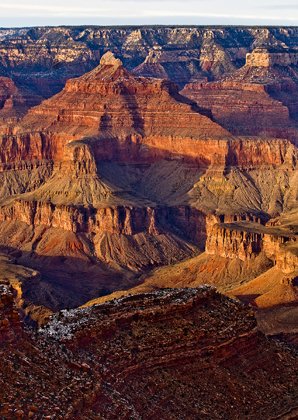
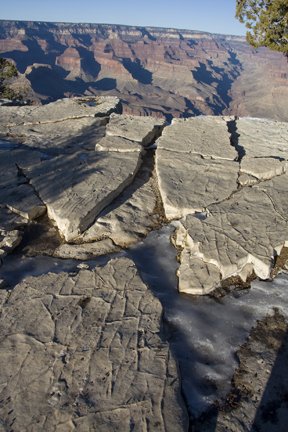
This view of the canyon reveals the layers of limestones and sandstones that testify to vanished seas and deserts. Note the strong, narrow white layer of Coconino Sandstone near the top, composed of 260-million year-old sand dunes. Also note in the center of the photo the 500-foot-tall cliff of Redwall Limestone formed on a seabottom 300-400 million years ago. Photo Tom Brossart/Roundup

I took a step — a long step — a million years step. Then I stopped, turned and faced north. Perched on the jagged edge of my life, I looked down deep into the shadowed layers of lost worlds — terrible deaths, fractured continents, vanished seas, mass extinctions.

Taking a breath, I took another step — a long step — another million years.

Curiously, I felt better — my troubles for the moment shrunk to no more than a ledge of Tapeats Sandstone in the wall of the Grand Canyon opposite. A layer of fossilized beach sand laid down 570 million years ago, the Tapeats Sandstone lies atop a mystery of missing stone — dubbed the “Great Unconformity.”

I studied that light, crumbling layer of sandstone in the canyon wall just across the way, knowing that all the great, riotous thrust of life that took us from pond scum to troubled writers has taken place since the lapping waves of a vanished sea left that layer of crumbling gray stone on a barren beach.

Perched on the wind-tormented branch of a twisted juniper nearby, a glossy black raven croaked at me.

“Nevermore,” he gurgled in my mind’s ear.

“You raise a good point,” I said to the raven and the wind that rose up out of the canyon’s 1.8-billion-year gash of time. I let loose a breath, a sigh, a puff of steam — frail and fleeting as life in the shadow of so much time. It should have depressed me, to stand so mite-like on the edge of such immensity. All I had dreamed or hoped or failed to do would not amount to a swirl of dust on this crumbling edge. I ought to have felt insignificant. Instead, I felt obscurely better.

So I took another step. A long step — a million years.

They had not built the Trail Through Time along the edge of the Grand Canyon between the El Tovar and Yaqui Point the last time I lingered on this edge. Now, it offers the most exciting crash course in geology I’ve ever encountered, although I’ve sought after rocks and unconformities all my life — and have even written geology books for confused people.

The 1.2-mile-long trail presents sliced and polished rocks representing almost all of the 24 major rock layers laid bare in the canyon wall from the 240-million-year-old limestone, siltstone, gypsum and chert layers of the Kaibab Formation to the 1.8-billion-year-old Vishnu Schist in the canyon bottom, among the oldest exposed rock’s on the planet’s surface.

Each step along the 1.2-mile path represents a million years, starting in the present and ending up at the 1.8-billion-year-old start of everything.

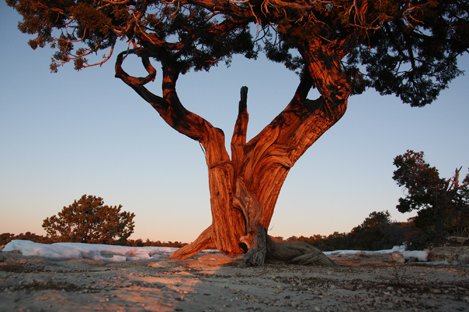
The Grand Canyon reveals a 1.8-billion year glimpse into Earth’s past from views like these along the 1.2-mile-long Trail of Time, with displays of rocks from each of the two dozen rock layers in the mile-deep canyon. A juniper catches the last light. Photo by Pete Aleshire

The Grand Canyon represents the most vividly revealed slice of Earth’s history anywhere on the planet. That makes the canyon one of the few places a person can grasp both the astonishing violence and the tormented timescale of the planet that sustains us all. This unique cross-section of time comes as a result of the relatively level uplift of the Colorado Plateau in the past 5 million to 8 million years. In most places, such a vast uplift would jumble the buried rock layers. But much of the 130,000 square miles of the Colorado Plateau rose at the rate your fingernails grow without deforming the miles-deep layers of sandstones, limestones and shales laid down on the bottoms of long-vanished seas and deserts.

As the Colorado Plateau rose, the northern edge crumpled into the Rocky Mountains. The southern edge dropped away along a 200-mile-long chain of 1,500-foot cliffs — which north of Payson forms the Mogollon Rim. Oak Creek cut back into that rising edge of the plateau to uncover the striking red rock formations of Sedona.

The Colorado River did the same thing, but on a grand scale. Many geologists believe the Colorado River originally ran north into a vast, interior sea. But as the Colorado Plateau rose, another river that ran south cut backward until it captured the north-flowing ancestral Colorado River, reversing the flow so that it now ran south into the Gulf of California.

This capture some 6 million years ago began the process of carving out the Grand Canyon. As the plateau rose, the flood-prone Colorado River cut down through it, like pressing a log up against a chain saw. Meanwhile, the steep tributaries widened the canyon by carrying those soft layers of sedimentary rock down to the main stem of the Colorado.

A layer of 230-million year old Kaibab Limestone caps the rim. The Grand Canyon reveals a 1.8-billion year glimpse into Earth’s past from views like these along the 1.2-mile-long Trail of Time, with displays of rocks from each of the two dozen rock layers in the mile-deep canyon. Photo by Pete Aleshire

That process started at about the time the genetic evidence suggests humans, chimps and gorillas last shared a common ancestor and continues to this day.

As a result of this vast uplift, the relatively young Colorado River has revealed in the walls of the Grand Canyon the long buried history of the Earth going back nearly halfway to its creation. That encompassed the entire period in which life progressed from single celled organisms in the ocean to its present, dazzling complexity.

The meander down that Trail Through Time reveals much of that history, preserved in the rock layers and the fossils they contain. Of course, erosion has already removed more than 200 million years of that history, so that the youngest rocks on the rim of the canyon are older than the dinosaurs.

A few dominant layers stand out.

Near the top, the fossilized desert sand dunes of the light Coconino Sandstone bear witness to a vast desert that covered the Southwest some 260 million years ago. At that time, what would become North America was part of a “supercontinent” that gathered almost all the dry land on the planet into a single mass.

In the middle of the canyon, lies the great, blood-red wall of Redwall Limestone, formed on the bottom of a shallow sea between 300 million and 400 million years ago. Today, the fused layers of microscopic skeletons of ancient sea creatures forms a sheer 500-foot-tall band of cliffs that pose the greatest single barrier to reaching the canyon bottom from the rim. All of the trails to the bottom must pass through fault lines in the Redwall Limestone, stained red by iron oxides leaching out of the layers above.

Farther down, the easily eroded Bright Angel Shale forms the shelf above the 1,800-foot-deep inner gorge. Shales form on shallow sea bottoms, compared to the deeper marine environments that create limestones. Most of the trails in the canyon run along its wide shelf. Formed 530 million years ago, the Bright Angel Shale represents the era when trilobites ruled the world.

Just below the Bright Angel Shale lies the Great Unconformity, where erosion in the inconceivably distant past removed 1.2 billion years worth of rock. This records another period of uplift, when erosion carried off layers of rock many times higher than Mt. Everest.

Below that unconformity, the story continues — down through a dozen more layers in the inner gorge, each one mounted alongside the trail and polished smooth. The Grand Canyon Supergroup spans the period between 570 million and 1.2 billion years ago, again recording the meanderings of the continents and the ebb and flow of oceans, as the planet breathes in, breathes out.

After another, smaller unconformity, the river finally reveals the inconceivably ancient Vishnu Schist and Zoraster Granite. The schists started as sandstone, limestone and shale, before they were buried, reheated and fused into this dense, primordial rock. The Zoraster Granite ooze up from the molten depths of the Earth, forming veins revealed finally by the relentlessly downcutting river.

I could not see the metamorphosed Vishnu Schist from my perch atop the rim, but I have seen it on raft trips in the dark heart of the canyon where it has been fluted and carved and sandblasted by eons of floods.

Finally I stood stock still, my breath coming still in moist, warm, puffs as the planet spun so that the dust of the atmosphere gave the sun’s long light a warm red glow, reflected off the ancient worlds across the way.

My raven friend — or one of his kin — flew past with an audible whoosh of his wings, then banked to consider the possibilities. He croaked, that guttural warble that only ravens dare.

Odds are, he noted my proximity to the edge and so paused to ponder my potential as carrion.

But I prefer to think that he felt our shared pulse of life and caught the updraft of my yearning.

In either case, he settled on the branch of a weirdly stunted ponderosa pine nearby and we shared the sunset.

The shadows rose up out of the canyon, swallowing continents and oceans.

I kept my gaze on the glow of the Redwall Limestone until the shadow took it, then shifted to the luminous yellow of the Coconino Sandstone.

For I came to the canyon full of woe holding my life in my fingernails, my heart in the shadows. But now my troubles seemed fleeting, the world full of marvels, my life aglow like that desert turned to sandstone in the last light of day.

My breath came in a puff, transparent but warm in the still, cold air.

“Nevermore,” quoth the raven, “nevermore.”

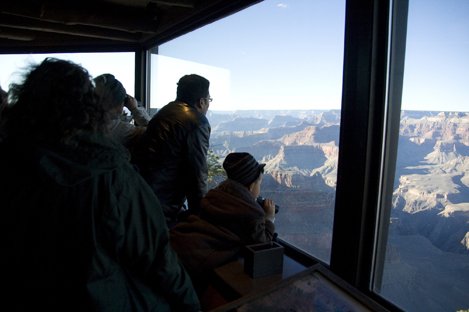
Visitors study the colorful layers of the Grand Canyon from the observation window in the geology museum at Yaqui Point. Photo by Pete Aleshire

oooOOOooo

Such beautiful words. Any additional thoughts from yours truly are utterly superfluous.

The truth about (pet) food!

We are what we eat! A sobering assessment of the food industry this Friday, the 13th!

This saying, which has been around for some time, reminds us that the foods we eat break down into elements that our bodies absorb. What we eat literally becomes part of us, and not just us humans but our dogs and cats as well.  That’s why I haven’t differentiated between us humans and our pets in this Post.

Let’s start off with our pets.

On the 28th December, just a couple of weeks ago, I wrote an article about the possible harm to dogs from Jerky treats coming in to the USA from China.  Kenneth Bryant of TriPom Chews added a comment that included a link to a news story about 353 dogs possibly being made sick.  Since then he and I have been in email correspondence including Ken passing the web address of Susan Thixton’s website Truth about Pet Food.  If you have a pet, go to this website!

I’m sure Susan wouldn’t mind me giving you a flavour (pardon the pun!) of what she has on this important website.  Try this.

Is there Chicken in Chicken Pet Foods?

One of the newest trends of pet food marketing is a tag line something like ‘Chicken is the first ingredient’.  Sounds good doesn’t it?  Chicken, first or second on the ingredient list surely means this pet food contains lots of quality meat doesn’t it?  No wonder this ‘chicken’ pet food is a little more expensive – it contains more meat.  Right?  Maybe not.

Just because petsumers think meat when the ingredient ‘chicken’ is listed on a label, doesn’t mean the pet food actually contains chicken meat.  Pet food can have a very different definition of ‘chicken’.  Thanks to very broad Association of American Feed Control Officials (AAFCO) ingredient definitions, the ingredient ‘chicken’ listed on a pet food label could be nothing more than skin, bone, cartilage, and maybe a few tiny fragments of meat.

Here is the AAFCO definition of poultry (quoting the 2011 AAFCO Official Publication): “Poultry is the clean combination of flesh and skin with or without accompanying bone, derived from the parts or whole carcasses of poultry or a combination thereof, exclusive of feathers, heads, feet and entrails.  It shall be suitable for use in animal food.  If it bears a name descriptive of its kind, it must correspond thereto.”

Problems with this pet food ingredient definition…
#1  This ingredient (which includes all types of poultry including chicken) can be “a combination thereof” of any part of poultry.  This means that a pet food, proudly claiming Chicken as the #1 ingredient, can include ONLY chicken bones and/or skin (left over from the human food industry).

#2  “It shall be suitable for use in animal food” means that animals rejected for use in human food for reasons including (but not limited to) disease and drug residues are approved for use in pet food.  This we can thank the FDA for.  Federal Food Safety Laws should make it illegal for pet food to include whole or parts of diseased or rejected animals, but FDA Compliance Policies tell pet food it is acceptable to use diseased and drugged animals in pet food [My emboldening, PH.] (“it shall be suitable for use in animal food”).

Chicken Meal/Poultry Meal is very similarly defined – except ‘meal’ implies moisture removed.  However the very same end result can apply – the meal can consist of little more than skin and bones — no meat.

Other pet food meat ingredient definitions are a bit more descriptive, however all meat pet food ingredient definitions include the “it shall be suitable for use in animal food” disclaimer.  Thus any pet food meat ingredient – thanks to FDA Compliance Policies and AAFCO ingredient definitions – can be the same quality as human meats or can be sourced from diseased, rejected animals.  But, regulations do NOT provide petsumers with a means to determine which is which.

Read the rest of this article on Susan’s website.  Even better subscribe to her newsletters.

I could go on and on but will close this section by saying ‘thanks’ to Ken of TriPom for providing this awareness of what we all may be feeding our beloved cats and dogs.

So, humans next!

Just a few days ago there was an article on The Atlantic magazine website about The Very Real Danger of Genetically Modified Foods.  It’s a detailed article that, nonetheless, needs to be read by the widest possible audience.  Here are some extracts,

Chinese researchers have found small pieces of ribonucleic acid (RNA) in the blood and organs of humans who eat rice. The Nanjing University-based team showed that this genetic material will bind to proteins in human liver cells and influence the uptake of cholesterol from the blood.

The type of RNA in question is called microRNA, due to its small size. MicroRNAs have been studied extensively since their discovery ten years ago, and have been linked to human diseases including cancer, Alzheimer’s, and diabetes. The Chinese research provides the first example of ingested plant microRNA surviving digestion and influencing human cell function.

Should the research survive scientific scrutiny, it could prove a game changer in many fields. It would mean that we’re eating not just vitamins, protein, and fuel, but information as well.

Later on the article says,

Monsanto’s claim that human toxicology tests are unwarranted is based on the doctrine of “substantial equivalence.” This term is used around the world as the basis of regulations designed to facilitate the rapid commercialization of genetically engineered foods, by sparing them from extensive safety testing.

According to substantial equivalence, comparisons between GM and non-GM crops need only investigate the end products of DNA translation: the pizza, as it were. “There is no need to test the safety of DNA introduced into GM crops. DNA (and resulting RNA) is present in almost all foods,” Monsanto’s website reads. “DNA is non-toxic and the presence of DNA, in and of itself, presents no hazard.”

The Chinese RNA study threatens to blast a major hole in that claim. It means that DNA can code for microRNA, which can, in fact, be hazardous.

And the closing two paragraphs,

The OECD’s 34 member nations could be described as largely rich, white, developed, and sympathetic to big business. The group’s current mission is to spread economic development to the rest of the world. And while that mission has yet to be accomplished, OECD has helped Monsanto spread substantial equivalence to the rest of the world, selling a lot of GM seed along the way.

The news that we’re ingesting information as well as physical material should force the biotech industry to confront the possibility that new DNA can have dangerous implications far beyond the products it codes for. Can we count on the biotech industry to accept the notion that more testing is necessary? Not if such action is perceived as a threat to the bottom line.

Please read the whole article as my extracts do not give justice to the importance of these findings.

Finally, let me turn to a recent item on the BBC website about the decline of brain function from as soon as age 45!  (I’m 67!)  The item starts,

The brain’s ability to function can start to deteriorate as early as 45, suggests a study in the British Medical Journal.

University College London researchers found a 3.6% decline in mental reasoning in women and men aged 45-49.

What caught my eye were these concluding paragraphs,

Dr Simon Ridley, head of research at Alzheimer’s Research UK, said he wanted to see similar studies carried out in a wider population sample.

He added: “Previous research suggests that our health in mid-life affects our risk of dementia as we age, and these findings give us all an extra reason to stick to our New Year’s resolutions.

“Although we don’t yet have a sure-fire way to prevent dementia, we do know that simple lifestyle changes – such as eating a healthy diet, not smoking, and keeping blood pressure and cholesterol in check – can all reduce the risk of dementia.”

Professor Lindsey Davies, president of the Faculty of Public Health, said that people should not wait until their bodies and minds broke down before taking action.

“We need only look at the problems that childhood obesity rates will cause if they are not addressed to see how important it is that we take ‘cradle to grave’ approach to public health.”

Let me repeat this sentence, “we do know that simple lifestyle changes – such as eating a healthy diet, not smoking, and keeping blood pressure and cholesterol in check – can all reduce the risk of dementia.”

Understanding what food is healthy for us and our animals ought to be straightforward.  But it’s not, when one understands the terrible lack of integrity in the industries that make our food!

The Goldilocks Planet.

Neither too close nor too far from the Sun.

Towards the end of the lecture that Lord Martin Rees gave at  University of Melbourne’s Medical School in 2010, he spoke of the way that Planet Earth has warmed up these last 100 years, warmed up uniquely.  Why the word ‘uniquely’?  Because, for the first time in the ancient life of our planet, that warming is the result of the activity of a life species living on that planet; mankind.  It’s difficult to comprehend how special, how fragile and, therefore, how vulnerable is mankind’s ability to survive on Planet Earth.  That’s why a recent item on Martin Lack’s excellent blogsite Lack of Environment is published on Learning from Dogs with Martin’s kind permission.  But first let me quote a little from WikiPedia about the ‘goldilocks principle’,

In astronomy and astrobiology, the habitable zone is the region around a star where a planet with sufficient atmospheric pressure can maintain liquid water on its surface.[1]1 Since liquid water is essential for all known forms of life, planets in this zone are considered the most promising sites to host extraterrestrial life. The terms “ecosphere” and “Liquid Water Belt” were introduced by Hubertus Strughold and Harlow Shapley respectively in 1953.[2] Contemporary alternatives include “HZ”, “life zone”, and “Goldilocks Zone.”[3]

“Habitable zone” is sometimes used more generally to denote various regions that are considered favorable to life in some way. One prominent example is the Galactic habitable zone’ (the distance from the galactic centre). Such concepts areinferred from the empirical study of conditions favorable for life on Earth. If different kinds of habitable zones are considered, their intersection is the region considered most likely to contain life.

The location of planets and natural satellites (moons) within its parent’s star’s habitable zone (and a near circular orbit) is but one of many criteria for planetary habitability and it is theoretically possible for habitable planets to exist outside the habitable zone. The term “Goldilocks planet” is used for any planet that is located within the CHZ[4][5] although when used in the context of planetary habitability the term implies terrestrial planets with conditions roughly comparable to those of the Earth(i.e. an Earth analog). The name originates from the story of Goldilocks and the Three Bears, in which a little girl chooses from sets of three items, ignoring the ones that are too extreme (large or small, hot or cold, etc.), and settling on the one in the middle, which is “just right”. Likewise, a planet following this Goldilocks Principle is one that is neither too close nor too far from a star to rule out liquid water on its surface. While only about a dozen planets have been confirmed in the habitable zone, the Kepler spacecraft has identified a further 54 candidates and current estimates indicate that there are “at least 500 million” such planets in the Milky Way.[6]

So now to Martin Lack’s post.

Goodbye Goldilocks Planet?

Is it time to say goodbye to the Goldilocks Planet?

I hope not, because the next-nearest one yet discovered is 600 light years away! However, if we are indeed now passing a tipping point (i.e. as the widespread rapid thawing of Siberian permafrost suggests) both mitigation and adaptation will be almost impossible. Therefore, if we cannot reverse the damage already done (i.e. how can we make permafrost re-freeze or reverse the retreat of mountain glaciers?), we may have to accept that temperatures will eventually rise to a level at which the Antarctic first became glaciated 35 million years ago; and that sea levels will now rise continuously for several centuries – making any permanent settlement anywhere near the coast impossible (seeJames Hansen in Storms of my Grandchildren).

If your response to all this is to accuse me of being alarmist, all I can say is that I am afraid denial is definitely not a good evolutionary survival mechanism. Furthermore, as American high school science teacher – and now climate change activist – Greg Craven has said,“Unfortunately, the experiment is already running; and we are all in the test-tube!” I believe we must therefore hope that humanity will not repeat the folly of the former inhabitants of Easter Island; who chopped down all their trees for firewood and allowed all the decent soil to be washed away so they could not grow anything.

I think it is fair to say that 2011 was a difficult year for humanity and the planet; and 2012 could be worse. We now seem to be facing both a financial and an environmental crisis: Even at the tender age of 46, I can appreciate that the prospect of 6 years of austerity measures (here in the UK) is completely without precedent; worse even than the great depression of the 1920s. In the UK, public sector workers have been demanding a better pension! What about a better economic system, or even a better planet? If necessary, please forgive my impertinence but, how can people demand justice for themselves whilst ignoring all the injustices we are inflicting on those least able to adapt; and/or bequeathing to our descendants?

This is almost as pessimistic as my recent answer on ClimateSight to the question “Why are people who want to reduce – and possibly eliminate pollution – and create a safer world, considered obstructionist naysayers?“, which is… “If everyone lived as we do in ‘the West’, the planet’s ecological carrying capacity would only be about 3 billion [Paul and Anne Ehrlich (1996)]. Therefore we cannot solve poverty without allowing a lot of people to die or by wealthy people agreeing to moderate their over-consumption of the Earth’s resources. Sorry to be so blunt but, this is the simple answer to the question.” …Despite what detractors say this is not misanthropic eco-Socialism, it is reality. There is not enough decent farmland and/or resources of every kind for 7 billion people or more to live like we currently do in ‘the West’. If we are not going to deny the legitimate aspirations of poorer peoples to attain a better standard of living, we will have to moderate our over-consumption and/or pollution of the Earth’s resources. We cannot have it both ways.

Conclusion
If we continue to burn all the Earth’s fossil fuels – just because they are there and because we can – we will most certainly have to say good bye to our Goldilocks Planet. However, now that we know that what we are doing is causing the problem, would it not be a good idea to stop doing it? You know: When in a hole, stop digging, etc… As the Good Book says, “As a dog returns to its vomit, so a fool repeats his folly” (Proverbs 26:11).

Suggested New Year’s Resolution:
If we want things to change, I believe we must acknowledge that Clive Hamilton is right: climate change is a failure of modern politics – representative democracy is not working! Therefore, we must all take a much more active role in the process of government – this is called participatory democracy – and we must start by demanding that our politicians dismantle (or at least stop being misled by) the fossil fuel lobby who do not want their business as usual programme interrupted.

Having said all that, I would still like to sincerely wish you all the best for 2012 (although I hope the Mayan Calendar is wrong).

Just a beautiful photograph

Pray for our planet this year!

This was emailed to me a couple of weeks ago.  Have no background information as to where the photograph was taken and, indeed, what type of bird it is!  But, nonetheless, just a beautiful reminder of the wonderfully, precious planet that we all, and I mean all, live on.

Nature in all her glory.

Keystone XL pipeline

Spread the word as far and wide as possible!

Yesterday I received an email from 350.org as part of their mailing to all 350.org supporters.  I have previously written a number of times, for example see here and here, about this proposed project and why it is so important to have it rejected.

Yesterday I published a lecture given in Melbourne by Britain’s eminent Astronomer Royal, Lord Martin Rees.  Lord Rees concluded his lecture with the call for us to take better care of our own planet. He, like many others, recognises the unique place in history that we occupy. For the first time a single species is capable of exerting profound changes on the Earth’s natural and physical environments.

Over and over again, scientists are reporting the rise in climate temperature of Planet Earth and the implications thereof if we do not wakeup soon to changing our ways.  The Keystone pipeline is a huge potential mistake!

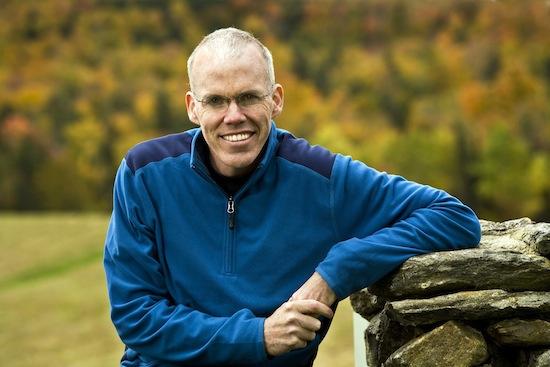
Bill McKibben of 350.org

Anyway, to the letter issued by 350.org – note the link to send a message to President Obama works – please use it!

Direct threats from Big Oil over Keystone XL

01/05/12, 11:43am

Here’s the email that Bill McKibben just sent to US 350.org supporters who have been working on Keystone XL:

Just in case you thought there was anything subtle about the Keystone battle, you need to hear what the president of the American Petroleum Institute — the oil industry’s #1 front group — said yesterday: if the President doesn’t approve the project there will “huge political consequences.”

That’s as direct a threat as you’re ever going to hear in DC, and it shows just how mad you made the oil industry last year by exposing Keystone for the climate-killing danger it is.  And the oil industry can obviously make good on their threats — they’ve got all the money on earth, and thanks to Citizens United they can use it without restriction in our elections. They’re not used to ever losing.So far the Obama administration is standing firm in the face of Big Oil’s bullying — the White House made it completely clear last month that if the oil industry and its harem in Congress forced a speeded-up review, it would lead to an outright rejection of the permit for the pipeline. We expect they’ll keep their word.

Here’s what I think we need to do.

1- Let the president know you’ve got his back when he rejects the pipeline. Tell him that addressing climate change is the key to our future, and that you’re glad he’s not bending.

2- Take the offensive against the oil industry. If they’re going to try and ram Keystone down our throats we’re going to try and take away something they hold dear, the handouts that Congress gives them each and every year. They’re the richest industry on earth, they’re doing great damage to the planet — and they expect us to pay for it with our tax dollars.

Can you send a quick note to President Obama covering those two key points? 

Click here to send a message to the President: www.350.org/stand-strong

Here’s the note I’m sending:

President Obama: Thank you for opposing the rushed Keystone XL pipeline permit. Responding to climate change is critical to preserving our collective future, and I hope this is a first step towards the dramatic changes we need to avoid catastrophe. PS: Please take handouts for the fossil fuel industry out of next year’s budget. There are people in America who need that money more.

There’s lots more to be done, of course. In the slightly longer run, we’ve got to take on the greatest subsidy of all: the special privilege that Congress gives the fossil fuel industry to use the atmosphere as an open sewer into which to dump its carbon for free.But today — right now, in the face of this kind of straight-up bullying — it’s time to punch back. We’re nonviolent, but we’re not wimps.

Bill