I’d love to engage in a discussion with you — and interested others — about the appropriate role of government in education.
The Federalist Papers made it clear, to me at least, that our founding fathers believed that the government, our federal government in particular, should have nothing to do with educating the populace.
The government providing public education? How did THAT happen?
I realize it sounds a bit radical now, but I believe that any discussion of what is right and wrong about public education today must begin with a healthy debate about whether the federal government should be involved in public education at all.
I plan to have my final post on education finished very soon. However, with my last week of finals and papers at the undergraduate level (which is finally over!) constantly hoarding my time, I have not yet quite been able to truly decide on which side I plan to end up.
My instinct tells me that the costs of the US schooling system far outweigh its benefits, but I feel I must be sure that this is truly a case that can be supported with logic and not simply my own biases coming through.
However, while I continue to ponder, I thought that readers might find this video interesting. It’s a different take on the nature of institutionalized schooling than is often seen. It’s on the longer side — approximately 20 minutes long — but I definitely think it is worth a watch for anyone pursuing a clear and well thought-out perspective on education, and it’s actually quite humorous and entertaining.
The video is of a presentation by Sir Ken Robinson, an internationally recognized leader in the development of innovation and human resources. His thesis statement is as follows:
My contention is that creativity is as important in education as literacy, and we should treat it with the same status.
I hope the Learning From Dogs community enjoys this video. Upon my return from celebrating my college graduation in Charleston, I plan to present my final finding on whether the costs or the benefits of schooling in the United States outweighs the other.
[This is another Guest Post from Patrice Ayme which appeared on his Blog on the 28th April. It has been slightly modified by me. Ed]
Celebrating Goldman Sachs, while acknowledging that it is far from being all their fault.
Point One: We are living in a state of law. Supposedly.
Point Two: That State is democracy, the rule of the demos, the people. It is not the rule of the bankers. Supposedly.
Point Three: Political leaders have recently given PRIVATE unelected individuals, the bankers, the means and the right to create money, the money everybody uses, through debt, ex nihilo, starting from PUBLIC funds (Called, somewhat misleadingly, the fractional reserve banking system.)
Point Three contradicts the union of Point One and Point Two. Power is supposed to be exerted by the people, but money is power. Big bankers create money at will, with the complicity of the political leadership. So they create power at will.
Thus, the present system incites (big) MONEY CREATING BANKERS TO BECOME GANGSTERS, and then OUTLAWS.
It is as simple as that!
Thus one needs to get rid of the private fractional reserve PUBLICLY funded money creating system. The situation has been rendered worse in the last decade by the blossoming of synthetic derivatives which are out-of-this-world bets which could not possibly be paid back.
Synthetic derivatives of derivatives transformed a 300 billion dollars loss in real mortgages into a potential exposure of 24,000 billion dollars, thanks to the leverage of the derivatives squared.
Then political leaders, accomplices with the bankers, offered to pay the 24,000 billion dollars, on behalf of taxpayers, leaving the economy in tatters.
Not all is lost: Goldman Sachs got its entire 2008 profit, 13 billion dollars, from taxpayers, through AIG, thanks to US politicians, and the USA loves a winner. Love and dove, there are still many a feather to pluck.
By Patrice Ayme
P.S. Synthetic derivatives are, mathematically and philosophically, a generalization of the license of the privately managed, publicly funded, fractional reserve system, thus proving further, if need be, how erroneous the latter can be.
P.P.S. The fractional reserve system ought to be kept, to provide the capital needed, simply it ought not to be anymore the province of a small private oligarchy gaming it.
Wake Forest University has an interesting program at our fitness center where students can be trained by certified personal trainers at an extremely discounted rate. I have been doing this program for several months with a trainer named Antonina Whaples. Aside from being a full time student at the university, “Nina,” as her friends call her, has just launched her career as a a figure competitor. The whole process has exposed to me a side of the fitness world that I was not even really aware existed, but have found to be quite interesting.
Fitness world
Antonina recently competed in the National Physique Committee North Carolina State Championships, where she placed fifth — a very impressive feat for a first time competitor. However, the real story is not just the competition itself, but also the work that went in to prepare for such an event. Antonina’s diet, workouts, and lifestyle were all completely centered around this competition; it was dedication like I have rarely seen. Antonina talked about this in an April 12 interview with the blog Promoting Real Women:
My trainers Jill Coleman (diet), and Kimberley Coronel (weight training) were essential to my process. The quality of my diet came out on stage and I trust Jill 100%. I never cheated on her plan and I was super pleased with my results. I know that this next show I will come in even leaner and fuller. I wouldn’t be where I am at all without the creative genius of Kim. She has built my body rep by rep and is my rock. I am proud to say that she is both my trainer and friend, and one of my greatest inspirations. One of the biggest things that mattered to me show day was making her proud!
Antonina (Don't try this at home! Ed.)
Before the show, Nina also did a photoshoot. The pictures are really creative, and the fact that one of her majors is studio art really comes out. My personal favorite is the photo featuring black leather boots and a chainsaw as the accessories of choice.
There’s a saying among Antonina’s friends that she is “intense.” And if anyone has ever embodied the word “intense,” it certainly is Antonina Whaples.
One of the fascinating aspects of my new American life is seeing how loud the volume of dissent is from the American
Bill Moyers
people about the shenanigans on Wall Street and the Too Big To Fail banks. There is an intensity and passion that I can’t see happening on the other side of the Pond. Maybe this is the cultural legacy of a people that just a short time ago, relatively speaking, were opening up this giant country seeking a better way of life than the ‘old countries’.
This intensity and passion is why, in the end, I believe that the solution to the huge crisis that still awaits us will start from this side of the Atlantic. But it will get a whole lot worse before it gets better, such is the complexity and depth of the fraud that is being visited on decent, ordinary folks in this and many other fine countries.
Bill Moyers of the Bill Moyers Journal on PBS is retiring. He’s approaching 76 and that’s a grand age to be dealing with the workload and stress of a weekly television presentation. His last Journal was broadcast on the 23rd April, a week ago today airing two really important topics. My only regret is that I haven’t been here sufficiently long to view many more of his Journals.
William K Black
In that last broadcast on the 23rd, Bill had two key interviews. In this Post, I want to bring to your attention his first report, which was an interview with William K Black, now an academic but, just as importantly, a former bank regulator. William Black really understands what is going on in banking.
The interview is both fascinating and captivating because, well to me anyway, it explains in terms that us laymen can understand, exactly what is going on and why it is so terribly important that legislation and regulations are brought into force to stop this fraud ever happening again.
This interview has not yet made it’s way onto YouTube so I can only post the link to the Bill Moyers website.
But, please, if you care about what is happening to us in whatever country you live in, click on this link and watch the interview.
And if you want to watch the earlier interview that Bill Moyers had with William Black then here it is.
The Hubble Space Telescope (HST) has been in space for 20 years!
This week, twenty years ago, the HST was launched into orbit. There’s much online if you want to read about it both on WikiPedia and on the Hubble web site so this post is going to offer just two items.
A beautiful picture
Nucleus of Galaxy Centaurus A
And an interesting audio slideshow tribute from the BBC – click here, introduced thus:
Take a look at some of the sights it has seen in that time with Professor Alec Boksenberg from the Institute of Astronomy in Cambridge – who was on the European team that helped build Hubble.
By Paul Handover (in awe of what is beyond our skies)
Author Update – the Learning from Dogs author team are delighted to welcome Elliot to their ranks.
On April 1st I set the scene for the essays that I wanted to write for Learning from Dogs as follows:
I often ask myself just how effective the modern US schooling system is as a tool of education, and whether or not its costs outweigh its benefits. I hope to have at least a rough answer to this question in the final post of this series.
I intend to examine three topics:
– In what ways does the modern schooling system function as a positive tool for education?
– What costs involved in modern schooling hinder its ability as an educative tool, and even make it a negative influence on students?
– Considering the analyses put forth in the first two posts, do the costs or benefits or this system outweigh the other? On the whole, are school and education complements or antagonists?
The author
On April 15th, I looked at the positive aspects of the American educational system. Now I look at the other side of the coin, so to speak.
Intellectual failure
While in my last post I attempted to put a positive spin on the United States education system, I must here admit that I personally tend to view it in a much more negative light. There are several reasons for this, three of which I will try to elaborate on here.
My first major concern about education in the United States is its lack of critical thinking skills, which produces students who do not know how to question the “system” for what is truly is, but rather constantly take the context of things presented as fact (the two-party political system is a perfect example of this.)
I am not necessarily arguing that the specific curriculum is being chosen to suit this purpose, though I think this argument could be made (it would, however, require quite a bit of research.)
Rather, consider the required courses – very rarely do you see courses on economics or logic. While some schools offer these as electives, they are almost never required. This is quite sad, as a sound ability to question the established authorities and the nature of the world as a whole requires a strong background in these two fields in particular.
The history of economics is a history of government policies that have failed because of their disregard for this very topic.
The economist Ludwig von Mises wrote that “the unpopularity of economics is the result of its analysis of the effects of privileges. It is impossible to invalidate the economists’ demonstration that all privileges hurt the interests of the rest of the nation or at least a great part of it.”
A second negative aspect of the American education system is what it does to the human mind. It essentially takes the mind and makes it into a factory that is able to take in information and then spit it back out. I think there is a direct relationship between the formerly mentioned lack of classes on logic and economics and this production of human beings who are essentially taught to be cogs in a machine.
Economically, the schooling system can, in this light, be seen as a massive subsidy to corporations, who are handed people already trained in how to listen then do and repeat.
Finally, I must admit that I am skeptical as to the true purpose of compulsory education. I have rarely in history seen it as a tool for true learning, as it seems to tend to rather be a system of control. I see no reason why our school system would be any different.
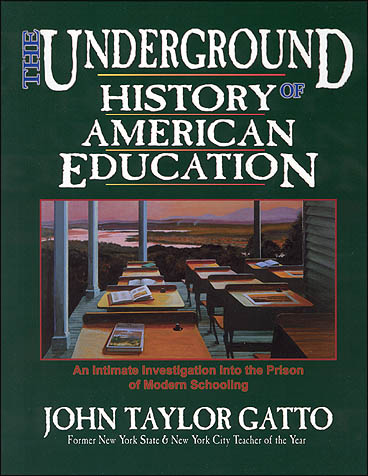
J T Gatto's book
John Taylor Gatto, a former school teacher and avid critic of mandatory schooling, has written that the purpose of modern schooling is a combination of six different functions:
The adaptive function – Establish a fixed reaction to authority.
The integrating function – People taught to conform are predictable, and are easier to use in a large labor force.
The directive function – School determines each student’s social role.The differentiating function – Children are trained as far as they need to go according to their prescribed social role
The selective function – Tag the unfit with poor grades and disciplinary actions clearly enough that their peers will see them as unsuitable for reproduction, helping along natural selection.
The propaedeutic function – A small fraction is quietly taught how to manage the rest.
I am not sure if I completely agree with Gatto, but he makes some interesting points. In my final article, I’ll attempt to weight the costs against the benefits, and see which comes out on top.
It seems that there has been nothing else on the news following the eruption of Mount Eyjafjallajokull
in Iceland, which was of particular interest to me because on the 10th April I was flying from New York across the southern area of Iceland on my way to Rome, since which time I have passed through the UAE and Singapore on my way to Japan.
My work replacement was due to arrive on the 18th April after a holiday in the Mediterranean, but the flight which he was on was diverted into Paris because UK airspace was suddenly closed. He managed to continue his journey by train, ferry, car, taxi and bus but was then stuck in England. My duty had to continue but there seemed little point in propping up a hotel bar with other crews, so I decided to turn the situation into something positive.
After an exploratory trip into Tokyo, it was Paul, our Editor in Chief who put me in contact with his sister and her husband in the city, and another friend who suggested I should jump on a train and go to Hiroshima to see his son, who I know, so my travels started.
The transport system in Japan is extremely well organised with instructions and information well displayed in English along side Japanese. Everything is clean and modern, and runs to the second! At short notice I decided to make the journey to Hiroshima in this once in a life time opportunity, and there was the famous bullet train a monster of modern technology, which runs on banked rails at steady speeds of 400 kph.
Mount Fuji - Japan
We sped along through ever changing countryside. Initially the skyline was of mainly high rise buildings which changed to two story properties once we were out of town. The new leaves of spring and the famous blossom of the plum and cherry trees, and the quick glimpse of a Japanese water garden. Industry is mixed with small allotments, and tiny houses, roads and rail lines raised from ground level to make everything fit, and above that cables and wires, because of the threat of earthquakes, and past the stunning Mount Fuji, white with snow against a blue sky.
I never met such polite people, and on the train the guards and girls who pass through the carriage with drinks and food bow when they enter and leave. They are so well dressed and smart. No graffiti here!
Familiar Japanese trading names on local buildings, and strangely a huge Union Jack flag. I wonder how there can be so many buildings and parking areas full of cars ,but seemingly no people in view, but many large span bridges arching across hill sides to join places together.
Through Kyoto where there seemed to be a lot of energy being used, for purposes that were not immediately clear. College students in smart suits with white shirts and blue ties, passed quietly through the train. I noticed each time they had left the train at a station they took their rubbish with them, and put the seat back in the upright position!
The A-Bomb Dome
At last after four hours we arrived at Hiroshima, which today it is a lovely modern city of which to be proud. There is just one damaged building standing in a stark fashion at the waters edge which is all that it takes to remind us of such devastation and the Garden of Peace, there to allow some quiet reflection.
I took a 45 minute boat ride to Mijajima, now a World Heritage site. This beautiful island is probably 15 miles from Hiroshima, and there amongst the beauty of the trees and a 500 year old shrine wander the deer, quite happy to sit as people pass by.
My thought as I came away from Hiroshima was that all leaders of any country with any connection to Nuclear weapons or power should be made to attend the A-Bomb Dome and reflect. As all the plaques say this must never be allowed to happen again.
… in developed countries is not only an insanity but also an obscenity.
It is no healthier than tapwater. If it were essential to health then how come we oldies survived before? Logically, the Human Race should have died out.
It tastes no different, unless you buy it fizzy – but you could add your own fizz at home.
It costs VASTLY more than tapwater.
It is VASTLY more profitable to producers than gasoline for oil companies.
It is VASTLY more expensive to produce – around 1500 times more than an equivalent quantity of tap water.
Its transportation produces significant amounts of harmful emissions.
It is VASTLY wasteful; water is scarce, yet it takes 7 litres of water to make a 1 litre bottle plus the contents.
It soaks up resources that could be better used, including to save lives of people dying from lack of or dirty water.
In short, it is absolute folly. What on earth is there going for it? At the same time, it is big business and very popular? Why?
Are people ignorant about all the above? That’s quite worrying …. not much future with so much ignorance about.
Are people paranoid about what comes out of their taps? Oh dear – paranoia is not good for us.
Do people place their vanity and status-image before the above-mentioned points? Hmmmm …..
Are many people just suckers for slick advertising? I guess the answer to that one is a straight “Yes”.
Have millions of people no common-sense and/or social conscience? Oh dear, this time it’s a clear “No”.
This is pretty!
Bottled water is nonsense, except of course where there is no alternative.
If rich, fat Westerners really like bottled water they could export it to developing countries where millions die through lack of or poisoned/polluted water every year while at the same time pouring funds into building water infrastructure for these very same people.
Yes, I know the industry provides jobs, but so did making nerve-gas for the Nazis.
The point is, we should direct our energy and money into things which are not totally unnecessary and destructive. I’m not a great fan of the “nanny-state”, but in some areas – and this is one – the government should be taking a more forceful lead. Help us kick our silly, selfish, faddish and destructive addiction to bottled water.
On April 1st I set the scene for the essays that I wanted to write for Learning from Dogs as follows:
I often ask myself just how effective the modern US schooling system is as a tool of education, and whether or not its costs outweigh its benefits. I hope to have at least a rough answer to this question in the
Elliot Engstrom
final post of this series.
In the following posts, I will examine three topics:
– In what ways does the modern schooling system function as a positive tool for education?
– What costs involved in modern schooling hinder its ability as an educative tool, and even make it a negative influence on students?
– Considering the analyses put forth in the first two posts, do the costs or benefits or this system outweigh the other? On the whole, are school and education complements or antagonists?
Here is the first one looking at the positive aspects of the American educational system.
Intellectual exploration
My kindergarten teacher told me to always start with something positive, so I’ll be beginning my analysis of American schooling by looking at how it is a positive tool for education.
One facet of the American education system that I once disapproved of but now find extremely useful and educative is the long period of time that students have before they must commit to a career choice.
I used to view this lag as a waste of resources. However, living in France and being a student at a French university changed my mind. The French system begins to lock children into a career path as early as the closing years of middle school. If a student in France wants to be a doctor, for example, they enter into medical school immediately upon leaving high school. The same is true for professions like pharmacology and law. There is very little opportunity for intellectual exploration in the country’s schools. Rather, one simply must make the best of wherever one ends up.
While the American system is more long-winded, it is a better tool for education in that it allows for a more dynamic range of studies. A liberal arts education forces students to delve into a wide range of subjects, giving students the chance to explore their interests and abilities.
Socrates (or Plato, depending on your interpretation of Plato’s dialogues), believed that a liberal arts education also encouraged the development of critical thinking skills. However, it should be noted that many of the greatest critical
John Stewart Mill, (1806–1873)
thinkers in history did not go through formal schooling. (Socrates himself and John Stewart Mill come to mind.)
This system also allows students to change their mind, pursuing those fields of study that truly interest them the most. It is amazing how many students in the American university system change majors during their tenure as students. This often is because they find that the career path they thought was for them is in fact not their liking – the number of students who abandon the premed track during college is a perfect example of this.
Education also entails socializing with other human beings. The American education system also facilitates this form of education quite well, as a liberal arts form of study at both the high school and university levels mixes together students of different interests.
Whereas in the French model a student studying medicine is constantly surrounded by other students of the same mindset, a premed student in the United States will have classes with students in other fields of study, expanding their social horizons and forcing them to relate to people with whom they may have little in common.
In my next post, I will examine the American schooling system as an antagonist to education, and will then close this series by attempting to weigh the system’s costs and benefits against each other.












 Learning from Dogs