Category: Economics

Future of the car?

The mistake we all make is to look behind us and think the future will be the same.

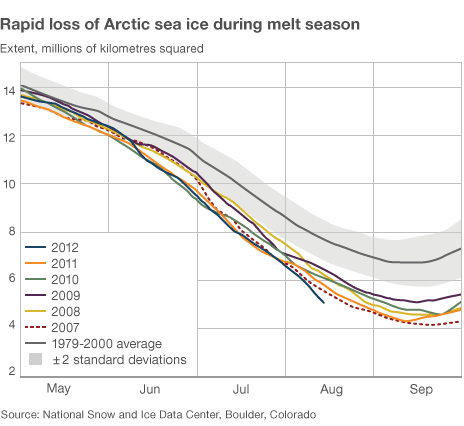
Let me start with something that is not really news.  Not news in the sense that it has been very widely reported.  I’m speaking of the probability, the high probability, that this year’s summer ice area in the Arctic will be a record low, with all the implications that this carries.  Let me refer to a recent BBC news item that included a stunningly powerful chart.

Scientists at the US National Snow and Ice Data Center said data showed that the sea ice extent was tracking below the previous record low, set in 2007.

Latest figures show that on 13 August ice extent was 483,000 sq km (186,000 sq miles) below the previous record low for the same date five years ago.

The ice is expected to continue melting until mid- to late September.

“A new daily record… would be likely by the end of August,” the centre’s lead scientist, Ted Scambos, told Reuters.

“Chances are it will cross the previous record while we are still in ice retreat.”

The US National Snow and Ice Data Center may be found here.

So to the piece that generated the title of this post, the future of the car.

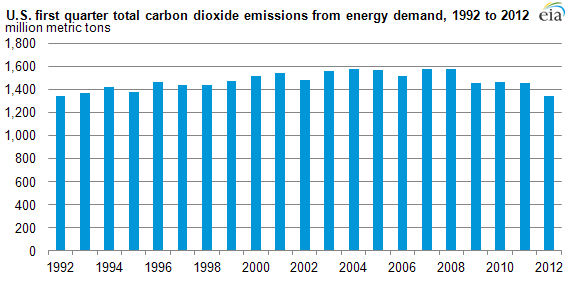
On the 17th August, I wrote an article highlighting the fact that the U.S. leads the world in cutting CO2 emissions.  That was endorsed by an item published on the U.S. Energy Information Administration’s (EIA) website, that said,

U.S. carbon dioxide (CO2) emissions resulting from energy use during the first quarter of 2012 were the lowest in two decades for any January-March period. Normally, CO2 emissions during the year are highest in the first quarter because of strong demand for heat produced by fossil fuels. However, CO2 emissions during January-March 2012 were low due to a combination of three factors:

  • A mild winter that reduced household heating demand and therefore energy use
  • A decline in coal-fired electricity generation, due largely to historically low natural gas prices
  • Reduced gasoline demand

It was the last item that caught my eye.  Because it resonated with an article on Chris Martensen’s Peak Prosperity blog just over a week ago.  That article, written by Gregor Macdonald, was called The Demise of the Car.

About a third of the way into the article, Gregor writes,

But it’s not just India that has incorrectly invested in automobile transport. The other giant of Asia, China, has also placed large resources into auto-highway infrastructure.

It appears that at least a decade ago, the developing world made the same assumption about future oil prices as was made in Western countries. The now infamous 1999 Economist cover, Drowning in Oil, reflected the pervasive, status-quo view that the global adoption of the car could continue indefinitely. A decade later, however, we find that after oil’s extraordinary price revolution, the global automobile industry is now starved for growth.

Then a little further down in this interesting article there is this,

More broadly, however, global governments are captured by sunk-cost decision making as the past 60-70 years of highway infrastructure investment is now a legacy just too painful to leave behind. Interestingly, whether citizens and governments want to face this reality or not, features of the oil economy are already going away as infrastructure is increasingly stranded. Moreover, there are cultural shifts now coming into play as young people are no longer buying cars – in the first instance because they can’t afford them, and in the second instance because it’s increasingly no longer necessary to own a car to be part of one’s group. See this piece from Atlantic Cities:

Young People Aren’t Buying Cars Because They’re Buying Smart Phones Instead

Youth culture was once car culture. Teens cruised their Thunderbirds to the local drive-in, Springsteen fantasized about racing down Thunder Road, and Ferris Bueller staged a jailbreak from the ‘burbs in a red Ferrari. Cars were Friday night. Cars were Hollywood. Yet these days, they can’t even compete with an iPhone – or so car makers, and the people who analyze them for a living, seem to fear. As Bloomberg reported this morning, many in the auto industry “are concerned that financially pressed young people who connect online instead of in person could hold down peak demand by 2 million units each year.” In other words, Generation Y may be happy to give up their wheels as long as they have the web. And in the long term, that could mean Americans will buy just 15 million cars and trucks each year, instead of around 17 million.

If future car sales in the US will be limited by the loss of 2 million purchases just from young people alone, then the US can hardly expect to return to even 15 million car and truck sales per year. US sales have only recovered to 14 million. (And that looks very much like the peak for the reflationary 2009-2012 period)

Indeed, the migration from suburbs back to the cities, the resurrection of rail, and the fact that oil will never be cheap again puts economies – and culture – on a newly defined path to other forms of transport and other ways of working.

It’s a long and interesting article that demonstrates an old truth, no better put than in this quotation reputed to have been said by John F. Kennedy,

Change is the law of life. And those who look only to the past or present are certain to miss the future.

More reflection on being human!

The voice of reason from James Howard Kunstler.

Yesterday, I published a Post that I called What it is to be human.  It was inspired and based on the compelling film I AM‘ by Tom Shadyac.  As so often seems to happen, shortly after completing yesterday’s Post, an item from Chris Martensen’s Blog caught my eye.

Chris publishes the blog Peak Prosperity and on July 14th Chris had an item featuring James Howard Kunstler.

Let me give you an idea of that item from Chris.

Author and social critic James Howard Kunstler has been one of the earliest, most direct, and most articulate voices to warn of the consequences — economic and otherwise — of modern society’s profligate wasting of the resources that underlie its growth.

In his new book, Too Much Magic, Jim attacks the wishful thinking dominant today that with a little more growth, a little more energy, a little more technology — a little more magic — we’ll somehow sail past our current tribulations without having to change our behavior.

Such self-delusion is particularly dangerous because it is preventing us from taking intelligent, constructive action at the national level when the clock is fast ticking out of our favor. In fact, Jim claims that we are past the state where solutions are possible. Instead, we need a response plan to help us best brace for the impact of the coming consequences. And we need it fast.


James Howard Kunstler

Mr. Kunstler is the author of the very successful book The Long Emergency and his latest book, as mentioned above, Too Much Magic expands on his alarming argument that our oil-addicted, technology-dependent society is on the brink of collapse, ergo that the long emergency has already begun.  His website is here.

Anyway, back to the Chris Martenson’s piece.  Chris goes on to quote Mr. Kunstler, as follows:

[We now live in] this weird, peculiar period in American history when the delusional thinking has risen to astronomical levels — predictably, really — in response to the stress levels that our society feels. And it is expressing itself as sort of “waiting for Santa Claus and the Tooth Fairy” to deliver a set of rescue remedies to us so that we can continue running Wal-Mart, Walt Disney World, Suburbia, the U.S. Army, and the Interstate Highway System by other means. That is the great wish out there. It is kind of understandable, because that is the stuff that we have, and people tend to defend the stuff that they have in any given society and the systems and platforms that they run on. But it is probably a form of collective behavior that is not really going to benefit us very much and really amounts to simply wasting our time, and wasting our dwindling resources, and even our spiritual resources when we could be doing things that are a lot more intelligent.

Here is something I have detected as I travel around the country: There is a clamor for “solutions.” Everywhere I go, people say “Don’t be a doomer; give us solutions.” And I discovered that the subtext to all that is they really want solutions for allowing them to keep on living exactly the way they are living now. To keep on running Wal-Mart, and keep on running Suburbia, and keep on running the highway system, and the whole kit of parts. And what that really means is that they are looking for ways to add on additional complexity to a society that is already suffering from too much complexity.

(Read the full article here.)

There is a podcast of the interview with James Kunstler here and also on YouTube, as below.

My own reflection on this item, as with so many other articles, essays and items available to read online, is that the power of the Web is informing and educating millions of people around the world in a way that Governments and the media have failed to so do.

That promises change and, maybe, sooner than we might expect.

We are what we eat!

So why do we insist of manipulating the genetics of food!

I read somewhere recently, and of course now can’t find the reference, that the genetic modification of our food represents as big a danger to the long-term survival  of man as does the damage to our biosphere.

So a recent item on the blog Food Freedom News jumped out at me.  This was an item that was introduced as, “The author of Seeds of Destruction (about Monsanto) has a new piece out on pesticides and mass animal deaths… very sobering.

Clicking on the ‘new piece’ link takes one to here, from which I quote the opening paragraphs,

Death of the Birds and the Bees Across America

By F. William Engdahl
Global Research

“A recent study showed that every human tested had the world’s best-selling pesticide, Roundup, detectable in their urine at concentrations between five and twenty times the level considered safe for drinking water.”

Birds and bees are something most of us take for granted as part of nature. The expression “teaching about the birds and the bees” to explain the process of human reproduction to young people is not an accidental expression. Bees and birds contribute to the essence of life on our planet. A study by the US Department of Agriculture estimated that “…perhaps one-third of our total diet is dependent, directly or indirectly, upon insect-pollinated plants.”

The honey bee, Apis mellifera, is the most important pollinator of agricultural crops. Honey bees pollinate over 70 out of 100 crops that in turn provide 90% of the world’s food. They pollinate most fruits and vegetables–including apples, oranges, strawberries, onions and carrots.  But while managed honey bee populations have increased over the last 50 years, bee colony populations have decreased significantly in many European and North American nations. Simultaneously, crops that are dependent on insects for pollination have increased. The phenomenon has received the curious designation of Colony Collapse Disorder (CCD), implying it could be caused by any number of factors. Serious recent scientific studies however point to a major cause: use of new highly toxic systemic pesticides in agriculture since about 2004.

That first paragraph alone made me sit up, “A recent study showed that every human tested had the world’s best-selling pesticide, Roundup, detectable in their urine at concentrations between five and twenty times the level considered safe for drinking water.”  What a strange race we are!

Wlliam F. Engdahl

Then it was easy to find out more information about the author of the book Seeds of Destruction, William F. Engdahl, including his website.  Mr. Engdahl is clearly no stranger to controversy as this YouTube video illustrates,

Back to that Food Freedom article.  Further on, there is evidence of the size of the problem in the UK,

Alarming UK results

A private UK research organization, Buglife and the Soil Association, undertook tests to try to determine cause of the bee death. They found that the decline was caused in part by a group of pesticides called neonicotinoids. Neonicotinoids are “systemic” chemicals that kill insects by getting into the cell of the plant. In Britain it’s widely used for crops like oilseed rape and for production of potted plants.

The neonicotinoids are found in the UK in products including Chinook, used on oilseed rape and Bayer UK 720, used in the production of potted plants which then ends up in gardens and homes around the country. The new study examined in detail the most comprehensive array of peer-reviewed research into possible long-term effects of neonicotinoid use. Their conclusion was that neonicotinoid pesticides damage the health and life cycle of bees over the long term by affecting the nervous system. The report noted, “Neonicotinoids may be a significant factor contributing to current bee declines and could also contribute to declines in other non-target invertebrate species.” The organization called for a total ban on pesticides containing any neonicotinoids.

The president of the UK Soil Association, Peter Melchett, told the press that pesticides were causing a continued decline in pollinating insects, risking a multimillion pound farming industry. “The UK is notorious for taking the most relaxed approach to pesticide safety in the EU; Buglife’s report shows that this puts at risk pollination services vital for UK agriculture,” he said.

Indeed in March 2012 Sir Robert Watson, Chief Scientist at the British Government’s Department of Environment announced that his government was reconsidering its allowance of neonicotinoid use in the UK. Watson told a British newspaper, “We will absolutely look at the University of Stirling work, the French work, and the American work that came out a couple of months ago. We must look at this in real detail to see whether or not the current British position is correct or is incorrect. I want this all reassessed, very, very carefully.”  To date no policy change has ensued however. Given the seriousness of the scientific studies and of the claims of danger, a prudent policy would have been to provisionally suspend further uise of neonicotinoids pending further research. No such luck.

And if the harm to bees wasn’t serious enough, try this extract,

Effect on Human Brain?

But most alarming of all is the evidence that exposure to neonicotinides has horrific possible effects on humans as well as on birds and bees.

Professor Henk Tennekes describes the effects:

“Today the major illnesses confronting children in the United States include a number of psychosocial and behavioral conditions. Neurodevelopmental disorders, including learning disabilities, dyslexia, mental retardation, attention deficit disorder, and autism – occurrence is more prevalent than previously thought, affecting 5 percent to 10 percent of the 4 million children born in the United States annually. Beyond childhood, incidence rates of chronic neurodegenerative diseases of adult life such as Parkinson’s disease and dementia have increased markedly. These trends raise the possibility that exposures in early life act as triggers of later illness, perhaps by reducing the numbers of cells in essential regions of the brain to below the level needed to maintain function in the face of advancing age. Prenatal and childhood exposures to pesticides have emerged as a significant risk factor explaining impacts on brain structure and health that can increase the risk of neurological disease later in life.”

There is also growing evidence suggesting persistent exposure to plants sprayed with neonicotinoids could be responsible for damage to the human brain, including the recent sharp rise in incidents of autism in children.

This really is an article that you should read in full, which also includes a full bibliography and notes section.  Plus you can leave your responses as a comment – go for it!

Apis mellifera – the honey bee (family Apidae)

Economics making sense?

Why economists seems just as confused as me.

(A republication of a post first shown on the 8th August, 2009, still seems pretty relevant)

We live in a world where finance and money play a hugely more important role in our everyday lives than, say, 25 years ago.  Well that’s how it seems.  Our energy costs don’t seem to be connected to supply and demand but more in the hands of the speculators.  Our house values have been greatly influenced, perhaps misaligned is a better word, by the availability of too easy money, resulting from exotic financial leveraging. Commodities are, like energy, traded for their own sake rather than to provide an efficient process of linking the grower with the consumer.  And more.

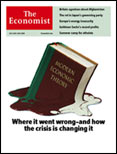
So it comes as a bit of a shock to read in a recent copy of The Economist that most of the theories and economic models are being ‘re-examined’ in the light of the current global crisis.  These theories and models are not esoteric ideas kept

The Economist July 18th 2009

within the scholarly walls of universities but used by Governments, investment institutions and banks so they affect you and I in the real world, big time!

They ought to work a great deal better than they do because they have the capability to harm, as millions have found out in the last 2 years.

Anyway, The Economist, July 18th-July 24th has a lengthy briefing: The state of economics, comprised of two articles. To me it makes very sobering reading.  Unless you have a subscription there is no web access to the articles so here are a few extracts to give you a flavour.  The first article is about turmoil among macro-economists.

In the last of his Lionel Robbins lectures at the LSE on June 10th, Mr Krugman [Paul Krugman of Princeton and the New York Times] feared that most macroeconomics of the past 30 years was “spectacularly useless at best, and positively harmful at worst”.

These internal critics argue that economists missed the origins of the crisis; failed to appreciate its worst symptoms; and cannot now agree about the cure. In other words, economists misread the economy on the way up, misread it on the way down and now mistake the right way out.

Nor can economists now agree on the best way to resolve the crisis. They mostly overestimated the power of routine monetary policy (ie, central-bank purchases of government bills) to restore prosperity. Some now dismiss the power of fiscal policy (ie, government sales of its securities) to do the same.

Towards the end of this first article in the Briefing, there is this:

In the first months of the crisis, macroeconomists reposed great faith in the powers of the Fed and other central banks. In the summer of 2007, a few weeks after the August liquidity crisis began, Frederic Mishkin, a distinguished academic economist and then a governor of the Fed, gave a reassuring talk at the

Frederick Mishkin
Frederick Mishkin

Federal Reserve Bank of Kansas City’s annual symposium in Jackson Hole, Wyoming. He presented the results of simulations from the Fed’s FRB/US model. Even if house prices fell by a fifth in the next two years, the slump would knock only 0.25% off GDP, according to his benchmark model, and add only a tenth of a percentage point to the unemployment rate. The reason was that the Fed would respond “aggressively”, by which he meant a cut in the federal funds rate of just one percentage point. He concluded that the central bank had the tools to contain the damage at a “manageable level”.

Since his presentation, the Fed has cut its key rate by five percentage points to a mere 0-0.25%. Its conventional weapons have proved insufficient to the task. This has shaken economists’ faith in monetary policy. Unfortunately, they are also horribly divided about what comes next.

The second article explores the way that the efficient-markets hypothesis has underpinned many of the financial industry models.

IN 1978 Michael Jensen, an American economist, boldly declared that “there is no other proposition in economics which has more solid empirical evidence supporting it than the efficient-markets hypothesis”

Michael Jensen
Michael Jensen

(EMH).

Eugene Fama, of the University of Chicago, defined its essence: that the price of a financial asset reflects all available information that is relevant to its value.

Eugene Fama
Eugene Fama

Even as financial engineers were designing all sorts of clever products on the assumption that markets were efficient, academic economists were focusing more on how markets fall short. Even before the 1987 stockmarket crash gave them their first real-world reminder of markets’ capriciousness, some of them were examining the flaws in the theory.

However, a second branch of financial economics is far more sceptical about markets’ inherent rationality. Behavioural economics, which applies the insights of psychology to finance, has boomed in the past decade.

Behavioural economists were among the first to sound the alarm about trouble in the markets. Notably, Robert Shiller of Yale gave an early warning that America’s housing market was dangerously overvalued. This was his second prescient call. In the 1990s his concerns about the bubbliness of the stockmarket had prompted Alan Greenspan, then chairman of the Federal Reserve, to wonder if the heady share prices of the day were the result of investors’ “irrational exuberance”.

One task, also of interest to macroeconomists, is to work out what central bankers should do about bubbles—now that it is plain that they do occur and can cause great damage when they burst.

Another priority is to get a better understanding of systemic risk, which Messrs Scholes [Myron Scholes]

M Scoles
Myron Scholes
Richard Thaler
Richard Thaler

and Thaler [Richard Thaler of the University of Chicago] agree has been seriously underestimated.

Several countries now expect to introduce a systemic-risk regulator. Financial economists may have useful advice to offer.

Financial economists also need better theories of why liquid markets suddenly become illiquid and of how to manage the risk of “moral hazard”—the danger that the existence of government regulation and safety nets encourages market participants to take bigger risks than they might otherwise have done. The sorry consequences of letting Lehman Brothers fail, which was intended to discourage moral hazard, showed that the middle of a crisis is not the time to get tough. But when is?

Mr Lo [Andrew Lo of the Massachusetts Institute of Technology] has a novel idea for future crises: creating a financial equivalent of the National Transport Safety Board, which investigates every civil-aviation crash in America. He would like similar independent, after-the-fact scrutiny of every financial

Andew Lo
Andew Lo

failure, to see what caused it and what lessons could be learned. Not the least of the difficulties in the continuing crisis is working out exactly what went wrong and why—and who, including financial economists, should take the blame.

Mr Lo’s idea of treating financial failures in the same way as civil aviation accidents might be a brilliant idea.  After all economics is a behavioural science just like the ‘science’ of air traffic controllers and air crew.  Seems to me that keeping my money as safe as my body in a civil airliner isn’t a bad goal.

If you can, do get hold of a copy of the briefing, if only to arrive at the same conclusion as me.  In terms of future personal financial planning, a pair of dice may be just as accurate as economists.dice

In praise of fairness.

An original idea that shouldn’t be regarded as innovative.

We live in interesting times!  Whenever I use that phrase, and it seems to slip from my lips too often these days, I am reminded of the ancient Chinese curse, “May you live in interesting times!

There are a goodly number of countries that have legislation that ‘impose’ a minimum wage for employees.  Here in the USA, the Federal level for 2012 is $7.25 per hour but it isn’t necessarily the same across all States.  Based on a 40-hour working week, 50 weeks a year, that comes to a gross of $14,500 for the full year.

Let’s contrast that with a person who has been in the news recently, Mr. Bob Diamond, Chief Executive of Barclays.

As the BBC reported on the 2nd July,

Mr Diamond has said he will not take a bonus for this year as a result of the scandal.

It is not the first time the 60-year-old Boston-born former academic – he began his career as a university lecturer – has made the headlines.

Mr Diamond was previously best-known for his huge wealth: last year he topped the list of the highest-paid chief executives in the FTSE 100.

‘Unacceptable face’

In 2011 Mr Diamond earned £20.9m, comprising salary, bonuses and share options, and he is reported to have a personal wealth of £105m.

There has long been controversy about the amount he earns.

In 2010, Lord Mandelson described him as the “unacceptable face of banking”, saying he had taken a £63m salary for “deal-making and shuffling paper around”.

Barclays dismissed the figure as “total fiction” saying that his salary as head of Barclays Capital was actually £250,000.

BBC business editor Robert Peston said he believed Mr Diamond had earned £6m in 2009 from a long-term incentive scheme and £27m from selling his stake in a Barclays-owned business that had been sold.

So whether he earns £20.9m, £6m or even £250,000 frankly makes no difference to the fact that the gap between what the poorest may earn and the sorts of monies that are given to Mr. Diamond and his like is just plain wrong.  [And since writing this on Monday, the news broke on Tuesday morning that Mr. Diamond is now unemployed.]  Don’t often quote the bible in Learning from Dogs but 2 Corinthians 8:13-15 is irresistible (King James Version),

Our desire is not that others might be relieved while you are hard pressed, but that there might be equality.  At the present time your plenty will supply what they need, so that in turn their plenty will supply what you need. The goal is equality, as it is written: “The one who gathered much did not have too much, and the one who gathered little did not have too little.” [my emphasis]

I subscribe to Naked Capitalism and the other day there was a deeply interesting article about France pushing for a maximum wage.  Let me take the liberty of quoting all of it,

SUNDAY, JULY 1, 2012

France Pushing for a Maximum Wage; Will Others Follow?

A reader pointed out a news item we missed, namely, that the new government in France is trying to implement a maximum wage for the employees of state-owned companies. From the Financial Times:

France’s new socialist government has launched a crackdown on excessive corporate pay by promising to slash the wages of chief executives at companies in which it owns a controlling stake, including EDF, the nuclear power group.

In a departure from the more boardroom-friendly approach of the previous right-of-centre administration, newly elected president François Hollande wants to cap the salary of company leaders at 20 times that of their lowest-paid worker.

According to Jean-Marc Ayrault, prime minister, the measure would be imposed on chief executives at groups such as EDF’s Henri Proglio and Luc Oursel at Areva, the nuclear engineering group. Their pay would fall about 70 per cent and 50 per cent respectively should the plan be cleared by lawyers and implemented in full…

France is unusual in that it still owns large stakes in many of its biggest global companies, ranging from GDF Suez, the gas utility; to Renault, the carmaker; and EADS, parent group of passenger jet maker Airbus.

Of course, in the US, we have companies feeding so heavily at the government trough that they hardly deserve the label of being private, but the idea that the public might legitimately have reason to want to rein in ever-rising executive pay is treated as a rabid radical idea.

From Doug’s post:

For those, however, receiving bailouts, deposit insurance, government guarantees, tax breaks, tax credits, other forms of public financing, government contracts of any sort – and so on – the top paid person cannot receive more than twenty-five times the bottom paid person. This ratio, by the way, is what business visionary Peter Drucker recommended as most effective for organization performance as well as society. It also echoes Jim Collins who, in his book Good To Great, found that the most effective top leaders are paid more modestly than unsuccessful ones. And, critically, it is a ratio that is in line with various European and other nations that have dramatically lower income inequality than the United States.

In other words, the French proposal isn’t that big a change from existing norms, at least in most other advanced economics (ex the UK, which has also moved strongly in the direction of US top level pay). But despite the overwhelming evidence that corporate performance is if anything negatively correlated with CEO pay, the myth of the superstar CEO and the practical obstacles to shareholder intervention (too fragmented; too many built in protections for incumbent management, like staggered director terms; major free rider problems if any investor tries to discipline extractive CEO and C level pay, which means it’s easier to sell than protest) means ideas like this are unlikely to get even a hearing in the US.  Let the looting continue!

As Patrice Ayme commented on that Naked Capitalism article, “France will pass the 20 to 1 law, as the socialists control the entire state, senate, National Assembly, Regions, big cities, etc. Only the French Constitutional Court could stop it.  That’s unlikely, why?  Because one cannot have a minimum wage, without a maximum wage. It’s not a question of philosophy, but of mathematics.

Let me go back and requote this,

 …. the top paid person cannot receive more than twenty-five times the bottom paid person. This ratio, by the way, is what business visionary Peter Drucker recommended as most effective for organization performance as well as society. It also echoes Jim Collins who, in his book Good To Great, found that the most effective top leaders are paid more modestly than unsuccessful ones. And, critically, it is a ratio that is in line with various European and other nations that have dramatically lower income inequality than the United States.

Thus if society was to embrace this approach to fairness, in America the top paid person in 2012 in the USA would be on 25 times the minimum wage level of $14,500 a year or, in other words, $362,500 a year.

I’m not a raving liberal but I am bound to say that this sits pretty well with me.  How about you?

As I opened, an original idea that shouldn’t be regarded as innovative.

End Fossil Fuel Subsidies NOW!

It’s rare for me to post a second item on the same day but this warrants it!

The full copy of this recently issued Press Release now available on the End Fossil Fuels Subsidies website is republished in full below.

PASS IT ON!

oooOOOooo

PRESS RELEASES

MIDDAY TWITTERSTORM REPORT
June 18, 2012

Call to #EndFossilFuelSubsidies at Rio+20 Tops Twitter

EU Commissioner for Climate Action Connie Hedegaard, celebrities Mark Ruffalo,
Stephen Fry, and Robert Redford, journalist Nicholas Kristof, and more join global push

RIO DE JANEIRO — The push to end fossil fuel subsidies at Rio+20 became the #2 most talked about topic worldwide on Twitter this morning.

The social networking site, which has 100 million active users, tracks discussions by hashtag and #endfossilfuelsubsidies ranked #2 globally and #2 in United States and Australia. 350.org, the global climate campaign coordinating the effort, estimated that the hashtag was being tweeted at least once a second, reaching millions of people around the world.

A number of politicians, journalists, celebrities, and high-profile activists joined in the campaign, helping catapult it into the spotlight:

British actor Stephen Fry tweeted, “Let’s green $1 trillion with a plan to save the planet. Sign the petition & RT: http://j.mp/endFFS #endfossilfuelsubsidies #G20 #RioPlus20.”

American actor Mark Ruffalo, who recently played the Hulk in the box-office sensation The Avengers, tweeted, “Good Morn! Can you help us end fossil fuel subsidies? Pls tweet #endfossilfuelsubsidies TODAY to help us send a msg & spread the word.!!!”

The EU Commissioner for Climate Action Connie Hedegaard, who is expected to play a key role at the Rio+20 negotiations,tweeted, “Fossil fuels subsidies have no place in today’s world . They must be phased out as the G20 pledged. #EndFossilFuelSubsidies #Rioplus20.”

Journalist and New York Times columnist Nicholas Kristof tweeted, “A twitterstorm underway calling on leaders to #EndFossilFuelSubsidies at Rio summit: http://yfrog.com/1qamv1j.”

350.org founder Bill McKibben tweeted, “$1 trilllion is a lot of money–tired of the fossil fuel industry laughing at us, so joining the twitterstorm #endfossilfuelsubsidies.”

Activists with 350.org are projecting tweets in cities around the world, including Sydney, London, New Delhi, and New York, as well as inside the Rio+20 negotations.

Yesterday, 350.org and Avaaz unfurled a giant $1 trillion bill on the Copacabana beach in Rio, producing some spectacular photos. The global campaign Avaaz.org is delivering a petition with 750,000 signatures calling for an end to fossil fuel subsidies to G20 leaders in Los Cabos, Mexico this afternoon. Over a million people have signed different petitions calling for action on subsidies in the last two weeks.

The current draft of the Rio+20 agreement released on Saturday includes a paragraph on ending fossil fuel subsidies, but negotiations now hang in the balance as oil exporting countries led by Saudi Arabia and Venezuela attempt to delete any references to the proposal. The final decision is likely to come down to Brazil, who hold sway as the host country.

The Twitterstorm can be tracked at endfossilfuelsubsidies.org. Supporting organizations for endfossilfuelsubsidies.org include: 350.org, Avaaz, Climate Reality Project, Earth Day Network, Friends of the Earth International, Global Exchange, Green For All, Greenpeace International, Greenpeace New Zealand, Natural Resource Defense Council, Oil Change International, Quercus, SumOfUs, Wild Aid, WWF

###

CONTACT: In the US, Daniel Kessler, dk@350.org, +1 510-501-1779; In Rio, Jamie Henn, jamie@350.org, +55(0)2181061948

NOTE TO EDITORS:

1. Information on the $1 Trillion in fossil fuel subsidies: http://priceofoil.org/wp-content/uploads/2012/05/1TFSFIN.pdf

##

PRESS ADVISORY/PHOTO CALL

‘Twitterstorm’ gathers speed before Monday’s Global Cyberaction to #EndFossilFuelSubsidies at Rio+20

RIO, 15 June 2012 — Momentum is building for this Monday’s 24-hour “Twitterstorm,” a massive international online action to increase pressure on world leaders to cut nearly $1 trillion in fossil fuel subsidies at the upcoming Rio+20 Earth Summit.

For 24 hours between June 18th and 19th, as world leaders gather at the G20 summit and prepare for Rio+20, hundreds of thousands of people around the world will tweet with the same hashtag — #EndFossilFuelSubsidies — at celebrities and politicians, flooding the popular social network with their demand. Over 1 million people have already signed a petition calling on leaders to act.

Recent developments on the Twitterstorm include:

• Confirmation of tweet projections in Sydney, London, New Dehli, and Rio (see Notes section for times and locations) (1)
• A new website with fact sheets, a tool to tweet at celebrities and Heads of State, and more resources for activists: http://www.endfossilfuelsubsidies.org
• A new Facebook event that has registered over two thousand “Tweet Team” members to recruit participants for the day of action. (2)
• Support from over a dozen civil society groups, including 350.org, Greenpeace International, Oil Change International and WWF. (3)

WHAT: A 24-hour Twitterstorm to #EndFossilFuelSubsidies at Rio+20

WHEN: The 24-hour clock will begin at 8:00 UTC (6 PM local time in Sydney) when activists will flock to Twitter with messages that will be projected in iconic locations in Sydney, New Delhi, London, and Rio. In recent weeks campaigning groups have collected over 1 million signatures demanding that leaders act now.

WHY: According to figures compiled by Oil Change International, countries are spending as much as $1 trillion USD combined annually on fossil fuel subsidies. (4) The International Energy Agency estimates that by cutting these subsidies, the world can cut global warming causing emissions in half and significantly contribute to preventing a 2 degree temperature rise, the limit most scientists say we need to stay under to prevent runaway climate change. (5)

In May, leaders of the G20 again pledged to eliminate fossil fuel subsidies. They first made the commitment in 2009 but have yet to implement the policy change at the country level.

While global warming emissions rise and gas prices spike, fossil fuel companies continue to make massive profits, which brings into doubt the need for subsidies. ExxonMobil, for example, made $41.1 billion USD in profit in 2011.

###

CONTACT: In the US, Daniel Kessler, 350.org, dk@350.org, +1 510-501-1779; In Rio, Jamie Henn, jamie@350.org, +55(0)2181061948

NOTE TO EDITORS:

1. June 18 projection events

• Sydney
◦ Summary: Sydney will launch the Twitter Storm from the Sydney Opera House.  Local supporters are invited to send a photo or video message to world leaders with the Sydney Opera House and Sydney Harbour Bridge as a backdrop.  Projection of the Twitter feed will continue late at night around Sydney’s CBD.
◦ 6 PM (UTC+10) Sydney Opera House Boardwalks
◦ 9 PM (UTC+10) Sydney CBD
◦ CONTACT: Abi Jamines abigail@350.org, +61 403278621

• New Delhi
◦ Summary: There will be two projections in New Delhi.
◦ Projection 1: 6 PM – 9 PM, Moonlighting, An indoor projection while the Twitter feed is projected to an invited audience along with a speaker to discuss the issue of fossil fuel subsidies in the Indian context. (Will share speaker details soon, yet to be confirmed).
◦ Projection 2: 6PM – 11 PM An outdoor projection at a local mall called DLF Saket.
◦ CONTACT: Chaitanya Kumar, chaitanya@350.org, +91-9849016371

• London
◦ Summary: There will be 3 events in London–a petition delivery at 10 Downing Street in the morning, followed by two projections.
◦ Petition delivery: 10:30am GMT+1, Number 10 Downing Street, London.
◦ Projection 1: 1:30pm GMT+1, Houses of Parliament, London
◦ Projection 2: Approximately midnight GMT+1 (Tuesday 19th June), Nelson’s Column, Trafalgar Square, London
◦ CONTACT: Emma Biermann, emma@350.org, +44 (0) 78 3500 4720,

• Rio
◦ Summary: Tweets will be displayed in the Rio Centro conference center all day.
◦ CONTACT: Jamie Henn, jamie@350.org, +55(0)2181061948

2.  https://www.facebook.com/events/304496622975461/

3. Supporting organizations include: 350.org, Avaaz, Climate Reality Project, Earth Day Network, Friends of the Earth International, Global Exchange, Green For All, Greenpeace International, Greenpeace Australia, and Greenpeace New Zealand, League of Conservation Voters, Natural Resource Defense Council, Oil Change International, Oxfam, Quercus, SumOfUs, Wild Aid, World Wildlife Fund

4. http://priceofoil.org/wp-content/uploads/2012/05/1TFSFIN.pdf

5. http://www.iea.org/files/energy_subsidies_slides.pdf

##

‘Twitter Storm’ Planned to Pressure Leaders to End Fossil Fuel Subsidies at Rio+20

Environmental conference ideal place to end wasteful giveaways to corporate polluters, says civil society groups

Oakland, 7 June 2012 — Campaigning organizations from around the world will join forces on June 18 for a 24-hour ‘Twitter storm’ in which tens of thousands of messages will be posted on the social networking site demanding that world leaders use Rio+20 to agree to end fossil fuel subsidies.

The 24 hour clock will start at 6PM local time in Sydney (8AM UTC), when activists will begin to flock to Twitter with messages that will also be projected in iconic spots in Sydney, New Delhi, London, Rio, and other locations. In recent weeks campaigning groups have collected over 1 million signatures demanding that leaders act now to end subsidies and start to invest in clean energy solutions. (1)

According to figures compiled by Oil Change International, countries together are spending as much as $1 trillion dollars annually on fossil fuel subsidies. (2) The International Energy Agency estimates that by cutting these subsidies, the world can cut global warming causing emissions in half and significantly contribute to preventing a 2 degree temperature rise, the number most scientists say we need to stay under to prevent runaway climate change. (3)

“We are giving twelve times as much in subsidies to fossil fuels as we are providing to clean energy, like wind and solar. World leaders shouldn’t be subsidizing the destruction of our planet, especially since these subsidies are cooking our planet,” said Jake Schmidt, International Climate Policy Director at the Natural Resources Defense Council.

In May, leaders of the G20 again pledged to eliminate fossil fuel subsidies. They first made the commitment in 2009 but have yet to implement the policy change at the country level.

While global warming emissions rise and gas prices spike, fossil fuel companies continue to make massive profits, which brings into doubt the need for subsidies. ExxonMobil, for example, paid an effective US federal tax rate in 2010 of 17.2 percent, while the average American paid 28 percent.

Participating organizations include 350.org, Avaaz, Greenpeace. Oil Change International, Natural Resources Defense Council, and others.

###

CONTACT: In the US, Daniel Kessler, 350.org, +1 510 501 1779, daniel@350.org

NOTE TO EDITORS:

1.http://endfossilfuelsubsidies.org/

2. http://priceofoil.org/wp-content/uploads/2012/05/1TFSFIN.pdf

3. http://www.iea.org/files/energy_subsidies_slides.pdf
Planet Earth is just one world!

A very simple, fundamental message to the G20+ Conference in Rio.

We live on one planet.  It is the solemn duty of everyone living on this planet to protect it from harm.  So to all those at Rio claiming to represent a Nation, or more accurately the people living in that Nation, act not only on behalf of that Nation but on behalf of the planet, the only planet, we all live on.

The only life-sustaining planet we have!

Civilisations do fail!

Any lessons for today from the Valley of the Pyramids at Tucume in Peru?

The view of Huaca Larga (Photo: Heinz Plege/PromPerú)

Let’s set the scene,

It’s amazing to think that anyone lived here, that this valley was once green. Now it is sun-blasted, scorching hot, and the only life is the circling vultures and the rainbow-colored iguanas, like something out of a desert hallucination, skittering across the rocks.

The reminders of past life rise up around me, however, eroded to look more like drip castles than the pyramids they once were. I am in Túcume, the once-grand capital of the Sican culture, Peru’s mythical Valley of the Pyramids.

I am not far from Chiclayo, and even closer to the city of Lambayeque, where the Royal Tombs of Sipán Museum serves as one of the major tourist attractions on the north coast. Here at Túcume however, there are few visitors.

It is not hard to get to the site. Combis leave regularly from Chiclayo and Lambayeque, dropping passengers in the modern village of Túcume, from which an quick mototaxi ride leads to the ruins. By car or taxi, it is about a 30 minute ride from Chiclayo.

There are two main trails marked out across the desert plain in Túcume. One leads to Cerro Purgatorio, a craggy hill overlooking the 26 pyramids that comprise the site. The trail winds across the scorched valley, between several of the pyramids, before arriving at a staircase leading to different scenic overlooks on the face of Purgatorio.

WikiPedia, too, has a short reference.

Then there’s a long and revealing article on the InkaNatura Travel Site, which I recommend you go to.

So what happened at Túcume to cause the civilisation to fail?  Maybe this 10-minute film gives the answers, but just a note to say that there are some potentially upsetting scenes for the younger or more sensitive among us.

So anyone sufficiently brave to say that history won’t repeat itself.

Wonder which would be the ‘cursed cities’?

Inequality, a rich man speaks!

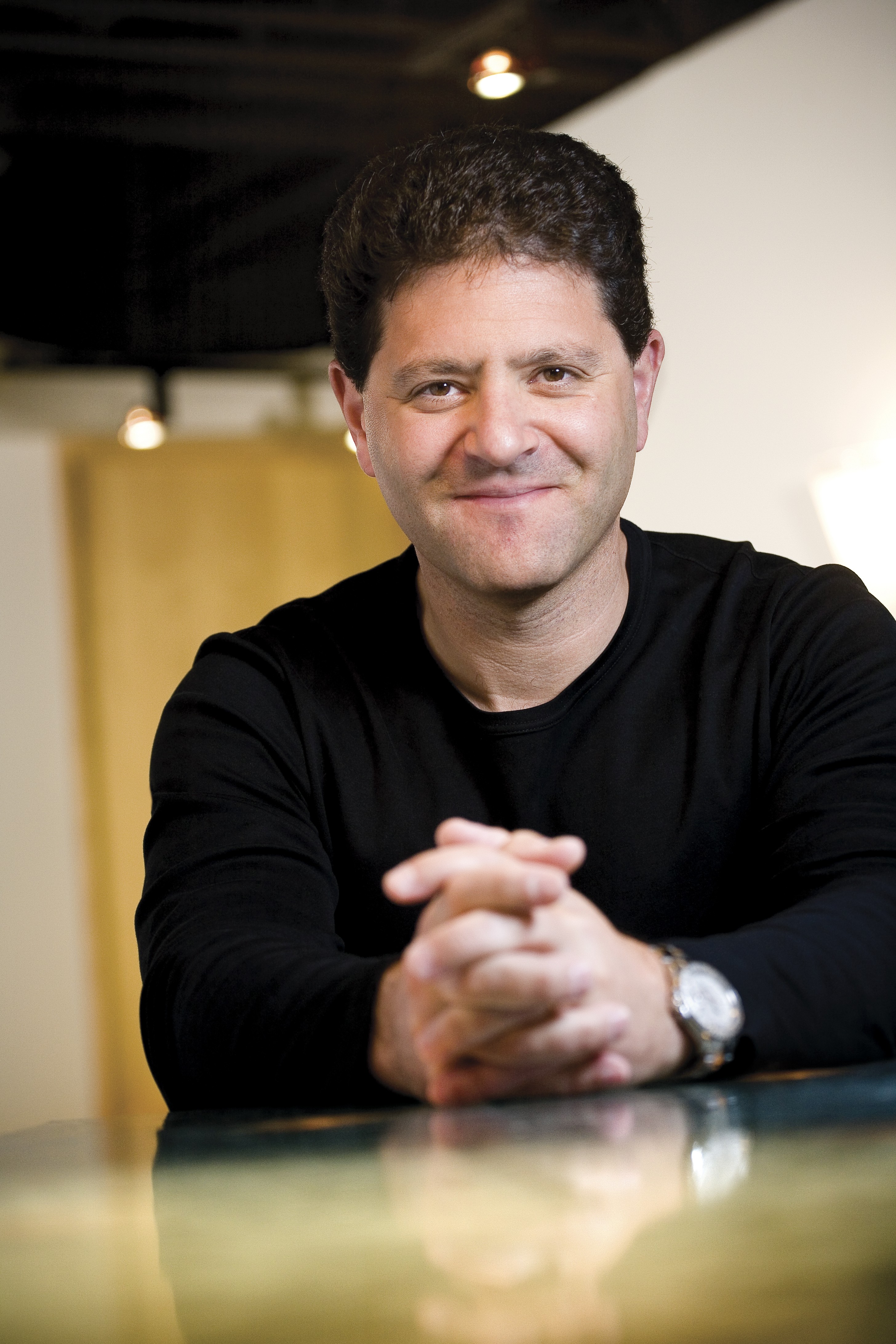
A personal reflection offered by Nick Hanauer.

Mr. Nick Hanauer

I hadn’t come across Mr. Hanauer before but thanks to some Facebook comments by Patrice Ayme found this YouTube video that is well-worth watching.  That’s an understatement!

The fundamental message that is contained in this short video seems critical, well to me it does, to society (that’s all of us, by the way) understanding why so many things seem to be going so very wrong for so many people.  But let me stop there before it becomes another of my rants!

Who is Nick Hanauer?  Here is a small extract from Nick Hanauer’s website,

Nicolas J Hanauer is a partner with Second Avenue Partners, a Seattle venture capital partnership specializing in early state startups and emerging technology. He has had a hand in such companies as Amazon.com and aQuantive among others.

Hanauer’s career began with a position as executive VP of Sales and Marketing at Pacific Coast Feather Company, a family owned manufacturer of basic bedding. In his time in that role, he helped grow Pacific Coast from several million dollars to more than $300 million in sales. Hanauer subsequently served as the company’s Co-Chairman and Chief Strategy Officer and remains Chief Executive Officer.

In 1988, Hanauer co-founded Museum Quality Framing Company, a company that has emerged the largest of its kind on the west coast with 60 locations. Hanauer was also one of the first investors in Amazon.com in 1995, where he served as a Board Advisor until January of 2000.

In 1996, he founded and served as CEO of internet media company Avenue A Media (later re-named aQuantive, Inc.) and became Chairman of the Board upon the first public offering in 2000. aQuantive was purchased by Microsoft in August of 2007 for 6.4 billion dollars; the largest acquisition in Microsoft history.

Now the video; less than 6 minutes long – do watch it!

As  a one-time entrepreneur back in the 80’s I can vouch for much of what Mr. Hanauer proclaims in his video.  The essence of successful marketing for any business, large and small, is understanding your market. Seeing the customer’s world through the customer’s eyes would be another way of putting that.

In plain language that means carefully and closely understanding what your customers, both actual and prospective, require, objectively and subjectively, and providing it to them profitably.  As the middle-classes (don’t like the term but it will have to do) are often the largest market opportunity, then it does follow that a healthy and vibrant middle-class is going to be best overall for the health and vibrancy of a country.  Indeed, in this very inter-connected world, that really equates to the health and vibrancy of our planet.

Which so easily leads on to a core truth. This one.  If all the Governments democratically elected on this planet truly acknowledged the democratic foundation, as Lincoln so ably put it, “government of the people, by the people, for the people” then those governments would be united in the one most important task facing the people – creating a sustainable way for us to live on the only planet we have!

Apologies, it did turn into a rant!

You may also want to read this TED and inequality: The real story.

An interesting year for America!

Whatever the outcome of the US elections, a real change is desperately needed.

I stay neutral in terms of American party politics.  As a ‘alien resident’, otherwise known as a Green Card holder, I am not eligible to vote anyway plus I readily admit to neither following nor understanding American politics.

But the focus on the late Ernest Callenbach’s words the last two days on Learning from Dogs has left me feeling pretty uncertain about the future for the USA.  In reading those words, despite the many elements of hope and optimism that Callenbach engenders, it is difficult not to feel the scale of the challenges facing this great nation.  Take these words toward the end of Callenbach’s essay,

Since I wrote Ecotopia, I have become less confident of humans’ political ability to act on commonsense, shared values. Our era has become one of spectacular polarization, with folly multiplying on every hand. That is the way empires crumble: they are taken over by looter elites, who sooner or later cause collapse. But then new games become possible, and with luck Ecotopia might be among them.

Humans tend to try to manage things: land, structures, even rivers. We spend enormous amounts of time, energy, and treasure in imposing our will on nature, on preexisting or inherited structures, dreaming of permanent solutions, monuments to our ambitions and dreams. But in periods of slack, decline, or collapse, our abilities no longer suffice for all this management. We have to let things go.

I have subscribed to the print version of The Economist for many years.  Indeed, it is the only broad-reaching newspaper that I read on a regular basis.  So in the last edition (May 12th), I couldn’t ignore the interesting position taken by Lexington under the title of Declinism resurgent. [NB. Not sure if you will be able to access that link without a subscription, Ed.]

The sub-heading sets the theme – The election campaign encourages America to feel worse about itself than it needs to

The third paragraph reads thus,

America is prone to bouts of “declinism”. In the 1980s the country was in a funk about the rise of Japan and its own vanishing competitiveness. Another bout was bound to follow China’s rise, two grinding wars and the deep recession of 2008. The gloom is nourished by a fountain of declinist literature. In “Time to Start Thinking” Ed Luce of the Financial Times ponders an America “in descent”. Norm Ornstein of the American Enterprise Institute and Thomas Mann of Brookings claim in a book on America’s politics (reviewed here two weeks ago) that “It’s Even Worse Than It Looks”.

Immediately followed by,

Yet anyone who prefers their glass half-full can find grounds for optimism. The first Boeing 787 Dreamliner has just landed in Washington, DC. It will be decades before China can make such a machine. The IMF is predicting average growth of over 2% for 2012 and 2013, not meteoric but not bad for a mature economy. America has a young workforce, with plenty of skilled people knocking at the door to come in. It still has more of the world’s best universities than any other country. It is the world’s largest producer of natural gas and its biggest food exporter. Amid the gloom, the economy is getting “Better, Stronger, Faster”, argues Daniel Gross, in a book of that name published this week.

Lexington then concludes,

The binary illusion

People tend to think in black and white. America is either in decline or it is ordained to be for ever the world’s greatest nation. Government is either paralysed or it is running amok, stifling liberty and enterprise and snuffing out the American dream. The election campaign accentuates the negative and sharpens this binary illusion. The Republicans say that Mr Obama is leading America into socialised serfdom; the Democrats retort that Mr Romney would restore the conditions that caused the recession. Little wonder that, according to polls, most voters do not believe that either man has a clear plan for fixing the economy.

Charles Dickens said of the United States that if its citizens were to be believed America “always is depressed, and always is stagnated, and always is at an alarming crisis, and never was otherwise.” On a variety of objective measures, it is in an awful mess right now. And yet America of all countries still has plenty of grounds to hope for a better future, despite its underperforming politics, and no matter who triumphs in November.

So  a different perspective than the one articulated by Ernest Callenbach.  But whatever the political result later in this year’s US presidential elections, if that new government doesn’t address the need for urgent attention to what mankind is doing to Planet Earth then the rest of the political agenda will become increasingly irrelevant.

I’ll close with that old saying, “Will the last person to leave Planet Earth, please turn the lights off!